
One purpose of this website is to share a series of books called The Calendar and the Grail. Five of these books were written before I encountered Sri Kaleshwar. The first two are foundational for others that would come under his influence. Volume 1 is available here and 2 will follow soon, as will the first Kaleshwar volume (6). Volumes 3-5 will appear later as warranted. Dreaming the Soul Alive, also presented here, marks a beginning of my dedicated spiritual life.
Dreaming the Soul Alive: an Experiential Journey (2006)
[Note: Depending on your motivation, I suggest you read the Preface first for context. Then try the first sections of A Book of Dreams to see how dramatically the sequence unfolds, from basic psychological clearing to substantive spiritual access in two months. If you want to understand the principles of dream work and/or apply my method for yourself, you can then start over, this time including the framing material that comes before and after Book as you go.]
8. City of Light and Revelation
Appendix: On Sacred Marriage and Human Renewal
Preface
I retired from the Irish university system in September 2005, after almost thirty years teaching philosophy and psychology. I felt a huge shift waiting to happen in me and that a complete change of circumstances was needed to facilitate it.
At the beginning of 2006 I fulfilled a long-held wish by leaving Dublin and coming to live by the Atlantic on the West coast of Ireland. From the moment I first saw this vast, rampaging, tranquil Mirror-Mother I felt a sense of deep affinity, together with deep respect for her constant, unrelenting power. This respect was coloured by elements of fear, mysterious at the time but undeniable.
I knew that coming to live by the ocean would have great importance for me but had no idea of what specifically it might entail. I was joined in this venture by a new partner who also felt strongly drawn but apprehensive. Entering into new relationship was significant for me at this time because I understood that the people we attract reflect our dispositions, challenges, liabilities and potentials back to us.
Moreover, it has always been a big part of what I call the Dreaming of my life that I should be involved in an empowering process of sacred marriage. Usually this is realised internally before manifesting successfully in outer life. Ideally, however, relationship can itself serve as a vehicle for mutual clarification and development. Like many formed in the school of relationships, I have had occasion to question this ideal.
Nevertheless, synchronicity and intuition both decreed that it was appropriate to multiply the uncertainties of my own situation by marrying them with those of someone else. I didn’t fully appreciate until recently how central this alliance would be in the unfolding of my story through 2006. I had no idea in March that I would be smitten by a great wave of dreams from late March to May or that I would be writing a book about them by July.
I had no idea that this was prerequisite for realising the major shift anticipated a year earlier. I didn’t know that themes of sacred marriage would figure prominently in the process or how crucial dreams could prove in renewing my life and, potentially, that of human culture generally. I don’t want to press any grandiose claim beyond noting that this book was written to make a case – not just for my dreams, but everyone’s.
Every human life has a Dreaming: a core destiny that it is the promise of each life to fulfil. Every soul has knowledge of its destiny and uses dreams to tell ego-us where we stand in relation to it and what we must do next the better to fulfil it. The purpose of every human life is to bring its Dreaming and its conduct into right accord, so that the life becomes an expression of its underlying dream.
I have presented my dreams so you can benefit from them as examples of how your own can work. along with directions that will help you integrate their visionary power. Read on and you will see how dreams can guide you to release destructive patterns and unimagined potentials that all humans hold within.
A Time to Dream
In the film of Brian Moore’s novel ‘Black Robe’, the Algonquin chief Neyahutin asks Jesuit missionary Laforgue how he can possibly live without dreaming. How does he know what to do? Laforgue has no idea what the savage means. Although capable of fine reflection, he has no memory of dreams. He resembles most modern people in this. Even when we do remember our dreams, we generally fail to attend further to them.
We pay a high price for this dispassion. Dreams manifest Vision, which images Destiny. Neglecting our dreams, we lose our Vision. We forget who we are and what for. Western society has become increasingly ‘rational’ over the last three centuries. As a result we have neglected dreams and lost Vision to a point where most intellectuals decry attachment to either as pious sentiment, although dissociated intellect has brought widespread devastations to Earth.
It is vital at this time for humanity to remember its dreaming, as more and more of us come to feel that ways we have been made in culture don’t adequately reflect our true nature and potentials. To overcome shortcomings of this arrangement, we must find our way back to leading authentic lives. But how can we do this, when nobody seems able to say what it might involve, specifically, for us? The answer lies within.
Every soul has knowledge of its destiny. Dreams bring this to awareness as we are ready to receive. To live authentically is to live (towards) our destiny. We realise this by following our dreams. It is even possible to restore the foundations of authentic human culture by this means, as well as appropriate trajectories for our personal lives.
Behind the play of rational intellect, the wisdom of soul is forever prompting us to realise its highest potential. Dreams are vision-bearers. They carry soul wisdom into waking consciousness. This process can be contaminated by the impact of harsh experiences in our past. By working with dreams, we can access untapped soul wisdom and at the same time bring healing to old wounds. This transforms the quality of our lives and helps us manifest our highest destiny.
It is not necessary to labour endlessly over interpretation to achieve this. All we need do is establish a general sense of what dreams are about and what messages they are attempting to convey. These invariably have to do with bringing movement into areas of our lives that have been stuck but are currently pressing for release and integration. Dreams help us move out of deadlock and into flow.
Thus, once we have established what our dream is about, we need a method that will enable us to make the leap from deadlock back to flow. This book presents such a method, along with other information required to integrate dream energies productively into our waking lives.
To prepare the ground, I open with an overview of ‘Dreaming for Beginners’. This is followed by a general account of how dreams operate (‘A Dreamer’s Apocrypha’). Later on, I provide a detailed ‘User’s Guide’ so that readers can benefit practically from their own dreams in terms of enhanced awareness, creativity and personal freedom.
My account is structured around a powerful sequence of dreams that came at a particularly charged period in my life, during which I was challenged to move beyond anything I had accomplished before and undertake something I couldn’t even imagine at the outset. This period had a potential to be one of immense creativity for me or immense frustration. Fortunately, my life had prepared me to recognise the value of dreams and discern the essence of what my soul was trying to tell me by means of them.
The dreams are presented fully in A Book of Dreams. This demonstrates the method I used with each to reveal its essential message and to make the unconscious energies behind it available for scrutiny and transformation. It also describes a procedure for enacting dreams that goes beyond interpretation-based approaches by showing how it is possible to integrate even the most deeply repressed antagonistic and creative potentials we harbour.
Every dream in my sequence builds exquisitely on those that precede it, already indicating soul direction. Together they tell the story of a huge opening in me as well as evoking potentials that inhere in every human life. Considering my dreams as examples helps open readers to an extended range of possibilities that dream-work opens up. It also shows how the method works in practice. Afterwards, when you have a sense of this practice and its rewards, I present detailed keys to help you process your own dreams.
The only limit on how far dreams can take us is the extent of our willingness to be with them. Because mine came at a particularly charged time and because I was available to process them intensively, they outline very economically a transformational pattern that could apply in anybody’s life. The circumstances of individual dreamers may vary but core underlying issues, the way they manifest and how we can best respond to them as they do – all this is essentially the same for everyone.
My Book of Dreams splits qualitatively into two halves which together reveal the archetypal structure of a human soul journey. The first half entails recovery from effects of early programming. It is followed by a progressive movement towards ever more encompassing levels of personal-spiritual fulfilment. The second stage of this process is generally masked by the first but is always implicit in it. Our dreams are constantly trying to facilitate its emergence but can succeed only in so far as we attend to them. My own journey shows this very clearly.
It also shows how rapidly dream communication escalates once we start attending consciously to it. The more we respond to the Unconscious, the more readily it ‘speaks.’ Also, practising the method of enactment as noted helps to develop a strong intuitive sense of how to move from a stage of ‘interpreting’ dreams to one of integrating their underlying energies into waking life. This allows the life to unfold more quickly, more easily and more beautifully. My chapter on Dream Weaving illustrates this.
It is followed by A User’s Guide, which presents a systematic review of all steps involved in making sense of my dreams and incorporating the energies behind them. A Woman’s Dreaming recaps the process from a female point of view. This proved crucial because the more I succeeded in integrating my dreams, the stronger my partner’s dreams became until eventually they began exhibiting tendencies that directly complemented my own. This was particularly illuminating with regard to themes of sacred marriage and sexual healing that had surfaced powerfully in my work.
Sacred marriage refers to a balancing of masculine and feminine energies in ourselves and, by extension, our relationships. The significance of this sorely needed balancing is explored in an appendix On Sacred Marriage and Human Renewal.
Dreaming for Beginners
Why should anyone be interested in dreams? Most of us don’t even remember having them and are therefore inclined to think we never dream. This assumption is categorically mistaken. Everybody dreams every night. Nevertheless, we mostly act as if dreams have no practical significance for the conduct of our lives. This too is mistaken. Dream awareness is fundamental to our happiness and fulfillment as human beings.
If this is true, you say, why are dreams so commonly disregarded that most of us don’t remember having any? This is a fair question and easy to answer in a culture where people are shaped to look outwards rather than in. We develop sensitivity to things we attend to and ignorance of those we ignore. We are taught by default to ignore our dreams and thus have only a very slight knowledge of our inner being.
This is a peculiar starting point for any human culture but it is one our modern West has firmly embraced. Dreams express the deepest wisdom and aspirations of the soul. Our culture has no time for them. This is why we create so many problems for ourselves and our world. It is never too late to recover, however, even from profound disorientation. Our dreams are constantly updated by an intelligence far greater than our conscious minds can comprehend. As a result, guidance is always available to re-turn us to the path of our soul truth. I want you to discover this and experience it for yourself.
We begin by considering the nature of sleep. For people who aren’t aware of dreaming, sleep is akin to a black hole state in which nothing happens: time out, if you will, from the process of being alive. Once again, this conception is mistaken and misleading. Sleep is an ordered activity that moves through regular cycles every night.
This has been apparent for almost fifty years, since the discovery of REM sleep - i.e. periods of sleep activity characterized by rapid eye movements. These happen under closed lids and are observed by attaching electrodes to people’s eyes. It was found that everybody goes through three or four periods of REM sleep every night. Moreover, when people are awakened out of REM sleep they almost invariably report vivid dream activity. This contrasts with an approximately one in three incidence of dream recall outside these periods.
The implications of many studies which have been made of this phenomenon are clear: everybody experiences REM sleep and everybody dreams at these times, whether or not we remember on later awakening. To appreciate the full significance of this we need to review the main stages of our human sleep cycle.
When we lie awake before sleeping our EEG, which records patterns of brainwave activity, is likely to exhibit the steady alpha rhythm characteristic of wakeful awareness. As we relax and become drowsy, this alpha rhythm is gradually replaced by the low voltage activity of Stage One sleep. This lasts only a few minutes.
The onset of Stage Two sleep is indicated by sleep spindles. These signal deepening relaxation and gradually give way to slow, high amplitude delta waves of yet deeper relaxation. When these account for 20 to 50 percent of the EEG record we are in Stage Three. When delta waves exceed 50 percent of the EEG we are in Stage Four, the deepest phase of sleep. This sequence is reversed after roughly ninety minutes.
When Stage One is reached on this ‘ascending’ phase of the cycle, REMs begin to occur prolifically. This is the period known as Stage One REM sleep. It usually lasts for about ten minutes and during it our eyes dart about under closed lids. We almost inevitably dream while this is happening.
The cycle is usually repeated three to four times through the night with variations. Generally, sleep becomes lighter and less time is spent in Stages Three and Four. REM periods get longer as the intervals between them contract from approximately ninety minutes during the first cycle to as little as forty in the last.
The occurrence of three to four REM periods nightly accounts for the fact that we sometimes wake with an impression of having had a number of separate dreams. Usually, if we remember dreams at all, it is the one we had most recently that is most clearly recalled.
Whether we remember or not, however, it is clear that everyone dreams every night. Why? What is the purpose of this universal but strangely elusive form of mental activity? It doesn’t seem plausible to dismiss it as merely random. Moreover, the question can’t be answered by any approach based on a strict practice of external observation. We have to look inside to see what we are like there.
Amazingly, when we do this, we find that our ‘inside’ is constantly trying to communicate its truth to us. Dreams are primary vehicles of this communication. They come when our ego agendas are suspended during sleep. There is thus a different order of intelligence involved than that which regulates our wakeful ordering of experience.
Dreams express a spontaneously manifesting urge towards wholeness that is prompted from the soul core of our being. I will show you how to access and facilitate this core soul impulse and, also, how it is dedicated to clarification and fulfillment of your soul destiny. This is a big claim so we must build strong foundations to support it.
Nothing can happen if you don’t have access to your dreams so I will make some preliminary suggestions now to get you started. The first is simply to intend consciously to dream and remember your dreams. You must then behave consistently with this resolution, for example by keeping some means of recording by your bed.
As I’ve said, as a culture we pay little attention to dreams. Consequently, they tend to have little energy or standing in our experience. As soon as you begin attending to them, however, this changes. The more attention you give dreams, the more they will enter your awareness. Witnessing my dreams will stimulate this process greatly for you.
Bits and pieces will begin to filter through from your sleep, even if they haven’t done before. Attending to them further by recording and thinking about them will encourage ever greater unfolding. In general, the thoughts we entertain are the thoughts we evoke. Thus, if you consciously set yourself to attend to your dreams, your dreams will start reporting to you more and more.
In fact, a dream is like a report dispatched from the journey of consciousness through sleep. It is a fragile structure and is easily lost on waking, particularly in the early stages. This is because night-time consciousness is very different from our waking orientation. When we shift abruptly from one mode to the other, dream recollections can instantly disappear.
Sometimes, just moving in the bed can trigger this, or a conversation, or reading – anything that serves to draw us out from inner-directed night consciousness into our outer-directed, logical-rational, linear-analytic daytime mode. To prevent this, you must prepare to ‘hold’ your dream carefully until you are ready to record it.
It is best to write out your dream as soon, as comprehensively and as faithfully as you can, ideally without other physical or mental activity intervening between the times of waking and recording. You need to record as fully as you can because the smallest details in a dream – a colour, number or turn of phrase – can carry important information.
You need to record as soon as you can because if you don’t, say by waiting until after breakfast, you are likely to invite elements of reconstruction into your recall. These will reflect the dispositions of your waking consciousness and will thus tend to dilute or obscure what may be most significant about your dream.
Record the dream as exactly as you can without being concerned about its length, vagueness, or seeming irrelevance. The more you welcome even fragments into your waking reality, the more readily your soul can reveal itself by means of them. We will see later that the truth of a dream is often hidden within rather than disclosed fully by its surface manifestation. Thus every detail of what manifests can be used as a ‘hook’ for drawing associated revelations into awareness.
Don’t pause to interpret or reflect much early on. Initially, you need to connect with the energies behind your dream. The best way to do this is to record it straightaway without any kind of judgment from the perspective of waking consciousness. You should also aim to preserve a sense of the dream’s inner atmosphere as best you can because, ultimately, working with this will most improve the quality of your waking life. It also helps to draw images from a dream or even paint colour portraits without form.
Some people like to use dictaphones for recording dreams. This is fine but I would also suggest that you then go on to write them as well, preferably in your own hand. This affords the dream a visible 3D presence authorised and consolidated by your own embodied energy signature. Indeed, one of the exercises I will recommend later for working with dreams presupposes a written record.
It is helpful to share your dreams by talking about them with others after you have finished your recording. This serves to establish your commitment and helps to introduce them as a concern of your waking life. It is important to note that dream-work can be far more than a casual hobby. Virtually all cultures apart from ours have acknowledged this. Dreams have a potential to transform the life of our species on this planet.
Your particular dreams tell about your Dreaming: the vision, destiny and potentials that await fulfillment in your life. Don’t doubt that you have a Dreaming. Everyone does. Realizing this brings happiness and fulfillment, irrespective of the form it takes. Celebrity or grandeur isn’t required. Your Dreaming is unique to you and beyond comparison. Only by realizing it, and not anybody else’s, will you find fulfillment.
There is no need to be anxious about this process, even if you are unfamiliar with it. Regular practice will quickly alter your experience. Don’t think about interpreting or processing your dreams until you’ve looked through mine. This will awaken your sense of what’s possible and allow you to anticipate the kinds of development you can expect. You will then be better able to work with detailed instructions I provide later on. These will tell you what you need to know about colours, chakras, numbers and so forth.
First I must show you why dreams matter: that they are significant and instructive, and that they reflect the highest wisdom of your soul, even beyond your wounds. Dreams are a language of soul. This language is fundamentally poetic and capable of expressing visionary Truth. In order to realize this, we must build a sense of how dreams work and what they do.
A Dreamer’s Apocrypha
‘Apocrypha’ refers to bits that got left out of the Bible. Freud – whose 1904 book The Interpretation of Dreams became something of a Bible in this area – says that all dreams have to do with wish fulfilment. If by this he had meant that all human beings dream of being wholly fulfilled, his statement would be comprehensively correct.
However, Freud related every aspect of human motivation to sexuality as the uncivilised, ungovernable residue of our animal past. He was correct to draw attention to this but not exhaustively so. Other aspects of human potential also press for admission into our personal and cultural awareness. In recognition of this, my aim is to reinstate much that was omitted from the Bible according to Freud.
Dreams seek to promote healing in our lives. They help us to become whole, but only if we take responsibility for them and respond appropriately to messages they carry. Dreams arise in the Unconscious and serve as pathways to greater consciousness, bridging possible rifts between both spheres. Such rifts can be of two main types.
The first arises in respect of painful situations which consciousness is unable to deal with at the time of their occurrence. When this happens, the wounding – whether caused by physical or psychological abuse – is liable to be shut out of awareness. If it is severe it may be repressed altogether, so that consciousness doesn’t even have the option of recalling it. Until such subconscious imprints are cleared we continue to be affected by them in limiting ways right through our lives.
The second major type of rift that can occur has to do with potentials that have been neglected or denied, especially in early life. It may be that, as a result, we carry gifts of which we are unaware. We try to go ahead with our ordinary business but feel frustrated by this. Whatever we do along lines we have been directed to follow doesn’t satisfy. We feel incomplete and unfulfilled without knowing why.
Dreams can help us resolve both kinds of situation as long as we know how to work with them. The purpose of this chapter is to provide some basic information and a general orientation that will help us do this.
The first principle is that dreams tend to focus two major aspects of personal psychology: our pain and our potential. They serve in the first instance to identify our pain and conditions of blockage that maintain it. In the second, they serve to bring unacknowledged potentials to awareness and also to promote their development.
So far, this seems straightforward. Why then are dreams so often apparently nonsensical and bizarre? There are several reasons.
The first is that dreams communicate information to consciousness about the state of our inner world. We have no ready-made language available for this. Consequently, the dream has to take words, symbols and images that have a particular sense in relation to our experience of the outer world and use them creatively, or metaphorically, to describe conditions of our inner world.
Animals might be used to represent abstract qualities, for example. Thus reporting nervously for a school exam with lions in tow will seem quite strange, even in a dream. If I realise that there is a testing time ahead for which I need to gather all my courage, the sense behind this apparent nonsense starts to show. It follows that it isn’t possible to read dreams literally. Any attempt to do so can only lead to a conclusion that they are nonsense. We will see that this is never the case.
Also, you will probably have noticed that dreams can seem nonsensical and yet feel very powerful and significant. How can this be? The basic reason is that many aspects of our instinctive-emotional lives are so multiply overlaid that they simply can’t gain admission into consciousness. They strive for expression but are held in check by what Freud called ego-defence mechanisms. These are psychological strategies employed to protect the often fragile stability of our ego-experience.
Their functioning creates deadlock in the psyche as our powers of expression and repression cancel each other out. This takes its toll energetically. In so far as we are affected by this condition, we are unable to feel vital, proactive or fulfilled. On the contrary, we are likely to feel frustrated and depressed.
One way in which the tension of this deadlock can be alleviated is through dreaming. This is possible because ego-consciousness is suspended during sleep and its defence mechanisms relax. Repressed content can then enter consciousness in ‘disguised’ form. This works on the same principle as the ‘lions stand for courage’ example given earlier.
Thus some point about my sexuality might be conveyed by the appearance of a bull in my dream. Further information would then be carried by the condition, treatment or behaviour of the bull. I might not understand this intellectually and yet still feel shaken by the powerful energy involved. Integrating such energy successfully is a vital aspect of working with dreams. As we will see, this takes us far beyond inherently limited practices of dream interpretation, no matter of which type.
I will return to this having considered one further reason why dreams can seem very strange – i.e., they are not bound by what we normally experience as ‘laws’ of time and space. We might turn up as adults in our infant school, for example, which may be relocated to a tropical jungle, with Cleopatra as head teacher.
These features all contribute to determining the meaning of a dream but can’t be made sense of in terms of the provisions of our ‘normal’ waking reality. The key point to bear in mind at this stage is that everything in the dream is a reflection of the dreamer. Every aspect of the dream mirrors some aspect of the person’s psyche.
Even location provides basic information concerning what a dream is about. Thus a dream set in a school will be about learning of some kind; a dream set in a hospital will be about healing, and so on. Likewise, the characters in a dream reflect attributes and potentials of the dreamer. If a friend appears in a positive role, for example, the key attributes you associate with them are waiting and need to be developed in you. You will find many examples like this in my dreams.
The action in a dream also reflects what’s happening or trying to happen in a person’s life. If nothing is happening, the dream will carry information about the nature of the blockage that is responsible for this. In such cases it is necessary to have some method of working with this information in a practical, transformative manner that goes beyond interpretation. I will present such a method systematically after we have seen examples of what it can achieve when applied to my own dreams.
Focusing on personal benefits for the moment, I would say that the overall purpose of dreams is to bring healing and guidance to our lives. If we are stuck and don’t know what direction we should be taking, our dreams will tell us. If we feel so stuck and pained that we don’t think we even have the option of moving, our dreams will pinpoint the source of the blockage that is causing us distress.
Again, dreams serve to move us out of deadlock and into flow. They do so, as far as may be warranted, by drawing our attention to aspects of our psyche that are held in confinement or limitation of some kind. Such stuck-ness invariably derives from ‘negative’ effects of difficult past experiences on our formation – i.e. the cumulative impact of pain, repression and frustrated creativity.
Dreams indicate the nature of our blockages and provide us with information needed to overcome them. They also bring to light in consciousness, from the relative obscurity of the Unconscious, formerly undisclosed information to do with life purpose, potentials and ideals. They do so with the aim of releasing hidden treasure into awareness and flow, so that we might make the best of all we have it in us to be.
More concretely, dreams serve to promote love, joy, self-acceptance, confidence, freedom and expression in our lives. Again they do so by helping to release us from painful and limiting conditions of our past. To achieve this, they must first bring these conditions to our attention, especially if we have repressed them. Thus traces of actual painful experiences are a primary source of ‘negative’ content in our dreams.
Another stems from resisting efforts to clear these in the present. It is a key feature of human psychology that we tend to prefer what is known and familiar, however painful this might be, to what is alien and unknown. The tendency is greatly amplified if we have been deeply frightened or wounded in our past.
It is important to stress that this is not usually obvious. Sometimes we are so wounded during critical phases of our growth that our comfort zones become severely restricted and we refuse to move outside them, even physically. What is more common, however, is that ‘parts’ of us are affected by patterns that applied consistently through our development - criticism, neglect, abuse etc.
Such parts exercise a persistently stifling, reactive influence over our responses in the present but we aren’t generally aware of this because ‘we’ are identified with ego aspects of consciousness that develop as we go to school, work, university, travel, have boyfriends/girlfriends etc. Our usual sense is that we choose freely to do what we do but there are often complications.
It follows from what I’ve already said, for example, that the ‘we’ who choose refers only to parts of us that actively identify with the dispositions of ego-consciousness. The parts of us that got left behind – stuck in doubt, fear and repression – are not represented by such choices. Moreover, these parts continue to exert influence by non-obvious subconscious means which ensure that familiar patterns get repeated.
A good way to clarify this for now, without going into detail, concerns the area of relationships. Consider with respect to various partners how often you’ve had occasion to reflect ‘How do I keep getting myself into these situations?’ That is to say, in other words ‘Why do I keep repeating these same patterns?’
The answer is because the limiting, confining impact of your past keeps you stuck in old ways, predisposing you to attract and respond to apparently novel situations that keep old, essential features in place. Our subconscious tendencies keep us repeating old cycles even if we choose ‘consciously’ to stage them in London or Athens rather than Brisbane or Berlin.
We may choose to go where we will. However, we have no option but to drag unresolved subconscious patterns of our past along with us. This can only change when we allow these patterns into awareness, which gives us a chance to move beyond them. Usually, they are over-ridden by the will of a guarded ego-consciousness that allows only what is familiar and consistent with its expectations and desires.
This occurs every time we ignore a pressing dream because dreams are constantly attempting to bridge unconscious tendencies into awareness. In fact, bridging gaps between ego-consciousness and what we think of as the Unconscious may be the basic function of our dreams, from which we as a culture have now largely turned away. When we do attend, however, they empower us to remember.
For this to happen we must look past established, often idealised self-concepts and readmit aspects of ourselves that we have been choosing (probably unwittingly) to leave behind. We must become responsible for our dreams, and to them. I stress this because, once we start attending to formerly repressed past wounds, unfulfilled potentials they have been blocking begin to surface also. Repression doesn’t just block ‘negative’ content. Thus lifting it creates an opportunity to follow our dreams towards completion of a destiny that encompasses the overall, gradually unfolding pattern of our lives.
Also, if everything in my dream is a reflection of me (and it is, however un/flattering this may be), then I am responsible for everything in it - all the conflicts, fears and base actions that I as ego might prefer to disown. Our dreams are projections of our whole souls, including our wounded parts. This means that if one of the characters in my dream stabs another, for example, I am doing this to myself in a metaphorical way that consciousness would do well to clarify. Dreams often carry warnings in this regard.
In being responsible for my dreams, I acknowledge my capacity to change and also my responsibility to my soul, which is the true unit of my life’s coherence and knows far more about this than my ego. Above all, my soul knows what I’m for and how I can best go about doing whatever it is, irrespective of errors I may have made up to this point. It uses dreams to relay such vital information.
It does so, moreover, in ways that are always tailored to our capacity to receive and respond to such information, protecting against overload unless we have backed ourselves into emergency situations of desperation or imminent decline. To guard against this, it is advisable to open to our soul’s transformational promptings sooner rather than later. We may elect not to, of course, in which case the function atrophies and we stumble on under the misapprehension that our life has no dreaming, or purpose, as our modern culture resolutely affirms from its baseline of psycho-spiritual ignorance.
I have no wish or need to be prescriptive here. Happiness affords a sufficient criterion, It may well be that your purpose, your dharma or spiritual duty, is simply to lead a lead a life of quiet decency. If so, you will be wholly content in the course of doing so, with no sense of frustration, emotional reactivity, unexplained anxieties, discontent or paths left unfollowed. If you are such a person I salute you. If not, it is probably advisable to read on.
I will supply the basic information you need to work with your own dreams after we work through the sequence of my dreams around which this book has grown. This will give you a chance to look at dreaming in a new way and will also extend your sense of what it’s possible to achieve as a result.
The motivation this imparts is valuable as the sequence clearly demonstrates benefits that follow from responding constrctively to dreams. If I don’t accept and pursue this principle, no benefits can be received. We see this in flight dreams, where I run away from whatever my dream is attempting to convey. The messenger may appear as a dark, ghoulish figure but even s/he represents some aspect of me in search of integration.
Subconscious fears predispose me to run but in the end I’m just running from my Self, so denying further something about me that has already been denied too long. If this weren’t so, I in the dream (my ‘dream-ego’) wouldn’t be afraid. We come to fear most what we most repress. The more we repress the greater our fear and the more it assumes terrifying guises and proportions in our dreams.
Generally, what we avoid in dreams is what we most need to admit in waking life. This usually concerns our own repressed qualities, to do with our pain and our potentials. I stress this because, despite the nightmare scenarios that resistance induces, dreams actually focus on healing. They do so by putting us into situations where we have to deal with our own ‘negative’ (by which I mean limiting) emotions. They also provide information about the nature of an issue, the source of our resistance to it and how the situation can be creatively resolved. The Apache dream in section two of my dream sequence provides a very clear example.
Some dreams also provide guidance to help us fulfil our potentials. They usually put us in situations which draw attention to our unrealised gifts. Negative elements in these dreams typically highlight our fears around developing suppressed potentials (since this too would challenge us to move outside familiar confines).
Often, healing and/or teaching figures appear in our dreams to facilitate positive transformations. We may fail to recognise them in the dream, ignore their advice or even ‘darken’ them as a result of subconscious resistance to their message. Thus I repeatedly fail to recognise Merlin as a soul teacher in my dreams until very near the end of the sequence.
We can also project negative attitudes on to benevolent figures. Last year, for example, I had a dream in which much admired Bob Dylan appeared but my negative subconscious set him snarling angrily at me because, as I realised on waking, I wasn’t paying enough attention at the time to my soul’s wish to be expressed in a new, more creative kind of writing than I had previously dared. My frustration was mirrored by Dylan’s attitude. Realising that led eventually to the writing of this book.
Sub- and Superconscious
Generically, ‘the subconscious’ refers to all parts of the psyche that are less developed than our ego-consciousness. These are mostly formed through repression and can exhibit attitudes that go all the way back to infancy. When such ‘parts’ feel threatened we find ourselves sulking, closing up, running away, getting angry or whatever the habitual response pattern is that characterises a freshly stirred part that just wants to stay asleep in some unresolved mode of adjustment that is usually established long before we could take charge of our experience or responses to it.
Dreams help us to review and resolve such issues until, eventually, we become free of them. The process gathers momentum rapidly when waking consciousness co-operates with promptings of the soul. Until then, ‘negative’ content in a dream arises from the subconscious. This too is part of our soul and thus has to be reflected in the composition of our dreams. Positive, inspirational content comes from the super-conscious, a name given by some psychologists to aspects of the soul/Unconscious that are more developed than ordinary ego-awareness.
The super-conscious has access to levels of awareness that our egos can’t fathom. This is how dream intelligence can know so much: about early experiences we weren’t able to integrate when they first occurred and are now stuck in our subconscious; about latent gifts our ego-consciousness may know nothing of; and how to regulate the subtly interwoven tasks of freeing us from our conditioned past while also pushing us towards a fulfilled and liberating future.
It may feel strange to equate the soul with the Unconscious. I do so here because most twentieth century psychologists took ego-consciousness as a norm. Anything that couldn’t be admitted into ego-consciousness was said to be Unconscious, which most took to mean subconscious, assuming ego awareness to be paramount. This overlooks vast possibilities of transforming even our ego attitudes and with them the inner structure of consciousness, so that we become aware of more and greater things than might have been considered possible before (in a context of returning spiritual consciousness).
This is exactly what happens when we follow our dreams. It has been for me an exhilarating journey and I hope that it will be the same for you. It may help to read just one of my dream chapters at a time, excepting the first four. These can be read together since the momentum that builds across them gives a clear sense of dramatic opening that happens when ego-awareness begins attending carefully to dream-borne messages from a soul that doesn’t want to stay Unconscious.
Much ‘action’ appears in my dreams once ego-I starts co-operating in this and the energies of my soul move to eliminate inhibitions held in the structure of my personality. This wave is part of a constantly recycled effort by the soul to promote psycho-spiritual integrity in the person. The difference for me on this occasion was that, for the first time in my life, I had dedicated time and space to take notice and surrender.
Try to engage my dream accounts actively, as if they were your own. Let your awareness be stimulated by their mirroring potential. This will not be hard: aspects of my experience will resonate and connect with your own. Note evidence of soul-opening within and across dreams because the essence of this opening will be the same for you as it has been for me.
Remember also that dreams serve to bring to awareness issues that were once left behind, often in secrecy and shame. Only by allowing these to return and accepting them fully can we transform old blockages into new freedoms.
We are ready now to recap my journey as a prelude to yours.
A BOOK OF DREAMS
Prologue
There is a story told about a hero who was born inside a Dragon’s Egg but knew it not. This egg had magical powers of regeneration so that every time the hero grew the egg grew with him, replenishing itself without his knowledge. The hero grew bigger and stronger within the confines of his egg. Eventually, it was said, he came of age.
Freed at last, our hero thought that he would set out on a journey to the edges of the world. There, he had been told, or somewhere on the way, he would find his Love. Eagerly, excited and compelled by irresistible urge, he sets out.
He faces many trials and challenges on his way. He encounters many mirrors but none is his Love. He approaches the edge of many horizons only to find every time that it stretches farther away than he can comprehend. His enthusiasm wanes. Despairing and exhausted, he lies down one day to sleep.
In his sleep, he dreams about a hero who is born inside a Dragon’s Egg but knows it not. This egg has magical powers of self-regeneration, so that every time the hero grows the egg grows around him, forever providing reflections of new horizons, new edges and new loves.
Of age but disappointed, confused and lonely in his heart, the hero sets out again on a quest to find her Love. This story goes on. What might it mean for us to hatch?
1. The Game of Life
The opening of my account at this moment is not arbitrary. The first dream arrived the night before a workshop which I knew was destined to have a major impact on my life, pushing me forward into changes I couldn’t even anticipate. The outer details of this process are of secondary relevance but I will provide as much information as required to establish the significance of particular dreams.
My conscious resolution was to approach the event with absolute commitment. The first dream, reflecting what was most pressing in my soul’s disposition at the time, came as something of a surprise:
I am a young teenage boy, preparing to take part in a football match against a team that plays in all-blue. My team plays in all-red. The match, a final, is important. I am at my parents’ house. They are both present and delay me. At last, I am ready to leave. I march proudly through the streets in my red soccer uniform and polished boots. By the time I arrive at the pitch, the game has started. My place has been given to another boy. I am bitterly sad and disappointed.
I can remember being such a boy very well, although no episode like this ever happened. It is symbolic. The dream sees me as a young teenager, preparing. This, in a way, is how I have felt of late. The game is a metaphor for participation in life. I am to play in red, which signifies passion and basic vital energy. Given my age in the dream, this is a powerful and mysterious force. It is also potentially dangerous, and frightening.
I am to play against a team in blue. In its positive manifestations, blue has to do with peace, communication, authority and higher purpose. If I have problems with ‘blue,’ like many young teens, I am likely to feel troubled, isolated, purpose-less and depressed – all negative ‘blue’ issues. This game between red and blue is important to me. My passion is due to play against authority. What will be the outcome of this match (note the pun) between my passion and my purpose?
The match is a final and I a young teen. It is a rite of passage, an initiatory event, like the one I have been preparing for in current adult life. This is one reason why I appear as a pubescent boy, full of energy and ideas, but incomplete. There is a part of me that is awash in red potential but needs blue direction for development. It still needs to be cultivated so it can find its true purpose and highest expression.
But there is a problem. The match never happens for me. Why? Because I am delayed, at my parents’ house. This means that the blossoming of my potential has been inhibited by attitudes I took on while under my parents’ influence. I still carry traces of this influence and these are preventing me from making the final (step or transformation). They are delaying me with regard to the crucial red-blue issue of bringing the Passion of my Life into correct alignment with its highest purpose so that both might be fulfilled.
No more information is given on this subject for now but that doesn’t matter. I have learned to trust the wisdom of my soul and know that more specific guidance will be forthcoming in due course. So, what else does the dream tell me?
I am ready inwardly to leave my parents’ house, having been delayed for a long time. This means it’s time for me to shed an inhibiting influence that has prevented me from realising my highest purpose and participating fully in the game of life. I can do so now and need to.
At this point, I recollect the demeanour of the young boy, allowing my awareness to enter his frame as he walks proudly through the streets in his red strip. There is no hint of arrogance in his pride; rather a kind of innocence that borders on naivety. He doesn’t imagine that anyone might think he looks stupid, pretentious or out of place. I admire this quality in him, even though naivety has its drawbacks.
One registers as soon as he reaches ‘the pitch.’ He never even considered that the game might start without him, or that he could miss his golden moment. But so it has proven and he feels purposeless, crestfallen, humiliated. How can he possibly make his way back home, now that everyone must know of his demotion? Where can he hide so that his shame will not be seen?
Aged 52, I take this one that I have been into my heart, so that he no longer needs to walk imaginary streets or malinger inconspicuously for fear of ridicule; so that his innocence and optimism may be restored in me, and his Passion fulfilled. Acknowledging this, I wait to see what news the coming days and nights will bring.
The next night brought the following dream:
I am in a cable car alone with C (my partner), going up a high mountain. We’re sitting at the front, enjoying spectacular views. Three males in their late teens appear suddenly and sit behind us. Their comments become intrusive. One starts pushing against me. I sense aggression building and tell C that I may need to fight these guys. I turn to face them. Two run and the third crumbles meekly at my approach. When we get to the top C disappears. Her place is taken by D, a middle-aged woman who starts berating me as a no-good male. I turn and walk away. She shouts at me to wait, what she was saying isn’t the truth, she has loved me all along. She sits by my side at the base of a monolithic Soviet-type sculpture that curves up towards a dark, lowering sky. I hold her gently without saying anything that might suggest compromise.
I am my current age and travelling with a woman who reflects my feminine side. I am ascending in consciousness (the high mountain) and have a much more encompassing outlook now (spectacular views). The young men seem to be aggressive. I interpret what I see as their intrusion in this way and respond aggressively. I relegate my feminine sensibility in so doing (C disappears). For all their brashness, the youths lack confidence and resolution. They retreat back where they came from, into my soul. They are, of course, aspects of my Self.
My adolescent legacy still shadows (sits behind) me. I am still pushing against myself and my ego-response is confrontational rather than conciliatory. I force the young men back to invisibility. Remember I spoke about energies of expression and repression getting stuck in deadlock scenarios? This is an example.
Three is the number of becoming. It stands for development and persistence. The approach of these youths is somehow necessary for my development. How can this be so? Two days later, no wiser, I try enacting the scenario from their point of view. It turns out that they are not aggressive at all, just loud because they want my attention.
The boldest of them sits on the bench, back-to-back with me, and pushes. My dream-ego treats this as aggression. The lad’s aim was to force encounter, and ultimately to promote mergence, or integration. I discover this by allowing my awareness to enter his body as he pushes – that is, by replaying the scene from his perspective.
The others wait to see my response. When I turn against them, they run away. The most forward one persists until I grab him and push him against the window. Then he vanishes and I am at the top, alone. The beautiful face of my feminine soul is no longer apparent. It seems I have frightened her as well.
Then a much harsher feminine aspect comes to the fore. She addresses me angrily. Once again, I don’t want to hear but her message is imprinted anyway: ‘I am a no-good male.’ There is a part of my soul that tells me this, and it is represented in the dream by D. Almost invariably, ‘negative’ female characters in dreams represent the limiting impact of a mother’s influence and so it is for me on this occasion.
Of course, mothers do a lot more than criticise and undermine but young souls, hungry for blessings and proof of love, register impressions of their withholding like a curse. These bite deep and stay fixed, particularly if repeated over time. The imprint ‘I am a bad/undeserving boy’ or no-good male persists more strongly than all the other things that might also have been said. As a result, I carry this message deep in my subconscious mind, which relays it when golden moments loom.
Its reappearance now is triggered by my dismissal of the youths. These represent ‘no-good male’ aspects of myself seeking to return from their confinement in my sub-conscious to the flowing, more encompassing vistas of my conscious, adult life. Their tentativeness and my response are both shaped by the impact of my mother’s criticisms. Believing them to be ‘bad’ I chase them away.
Precisely for this reason, the dream also urges that it is time for me to start healing this negative attitude in myself. I must stop walking away and listen also to other things that are (and were) being said. But I am still wary as I re-enter the shadowy atmosphere of my mother’s spell, signified by an oppressive monolith and overcast sky.
Notwithstanding misgivings I might have, the dream insists, I need to hold this imprint of my mother gently, admitting her belated declarations and allowing myself to become reconciled with all she has transmitted to me, without compromise. This is necessary to make peace in myself and has nothing to do with residual bitterness or complaining.
Parents naturally play a significant role in setting us up to learn whatever lessons and achieve whatever objectives our souls have chosen. Mothers are part of this equation. There is an Irish expression which I appreciate very much in this respect. It says ‘If it’s not one thing it’s your Mother.’ I’m not sure how old this expression is but I like to think we got it before Freud.
My next dream came two nights later:
I am walking around a Great Fire which I think of as the Fire of Truth. I carry a bowl of rice in my hand and have been selected to enter the Fire. I don’t do this but keep walking around instead. I wake with intimations of Auschwitz, Oliver Twist and survival.
This felt like a very powerful dream. The Fire is a place where ‘I’ might dissolve – be clarified, sublimated, purified. I even know this in the dream, as indicated by the ‘Fire of Truth’ reference. Fire is a symbol of Passion and Transformation. It gives us energy to move from one stage in our lives to the next, remade.
This dream also presents an opportunity for initiation and rebirth. But in order for rebirth to happen, something in us has to die – i.e. an old self, including all those aspects and dispositions that will no longer serve the life that is to come. All I have to do is enter the Fire. I know this time that I have been selected. As with my cup final, however, I shirk the appointment and for the same core reason: I still feel inhibited or ‘delayed.’
The rice is a symbol of all that I cling to, that which still delays me. In the context of Auschwitz and Oliver Twist, it is also a symbol of survival-dominated consciousness, which signifies a deformation of the (red) base chakra. This affects our ability to feel safe and at home in the world. Feeling unsafe, we are unlikely to trust and let go of the old.
We mistrust the new and refuse to open towards it, anticipating annihilation rather than transformation. We conjure crematory fires at Auschwitz rather than Ganges fires of alchemical transmutation. For these reasons, I fail to step in.
Notice that I don’t run away. I know, my soul knows, that the Fire represents a portal, a gateway to rebirth. Nevertheless, I just keep circling around. Something lingers that can’t be prevailed upon to make the leap. This is important. Destiny can’t be forced. In Celtic mythology, for example, candidates who jump into the Cauldron of Rebirth without adequate preparation end up terribly burned.
This is a symbolic warning. Myths, like dreams, are not judgmental. The message is simply that the soul won’t let you move until (all parts of) you are ready. This can be the source of many delays. The soul will, however, as in these dreams, show you exactly where the problem lies and also what must be done to overcome it.
We have already seen where the problem lies for me: in an internalised belief that I am a bad, undeserving, no-good male who, by subconscious association, will burn in Hell. Many people, male and female, are affected by such imprints, engendered early in life. I later conducted many enactment to erase mine.
I should clarify, however, regarding the dreams of this first section that I didn’t initially engage in the practice of systematic enactment which eventually became a staple of my dream work. I was able, through interpretation, to get a good sense of the meaning of my dreams and worked from there. The process evolved as I lived it.
This has the advantage of allowing you to see how the messages of my opening dreams build slowly from each other, incorporating elements of overlap and repetition. From the time I began enacting dreams systematically, the process of soul-opening got much faster and repetitive elements dropped away. You will be able to see this as my sequence unfolds through the next chapter.
In the meantime, remember that dream content is overseen by the wisdom of the soul, which knows when to release what and how much. There is no need to be concerned that the process will prove overwhelming. My case is just one example. Each person’s unfolding happens at a pace that is appropriate for them. Only essential structure and dynamics will be the same.
Before finishing this chapter, I want to emphasise some basic threads across my dreams so far: I miss vital appointments. My Passion is compromised by this. I fail to ‘die’ and enter a Fire of Rebirth.
On the face of it, this is not such an impressive record, especially in relation to an event that was to change my life radically, as Final and Fire were. As it happens, this was the last dream I had at the event, which didn’t directly produce any major transformation. How could it when, as my dreams had made abundantly clear, I wasn’t ready? The real work, I knew, would start at home.
2. Homecoming
I didn’t ‘die’ at my Big Event but was due to present a workshop myself two weeks later, at Easter. Themes of Passion, Death and Resurrection were central to this. Here is the first dream I was given to assist:
My three little daughters are asleep. The middle one is in bed. The youngest is curled up like a cat beside her and the eldest is stretched out on the floor nearby. I cover her in case she catches cold. All look happy and content.
Ostensibly, there isn’t much happening here. The atmosphere is tranquil and full of love. My daughters represent undeveloped feminine potentials in me. The dream indicates that these are literally dormant. All is quiet in my feminine soul for now. Dreams being what they are, I anticipate news concerning problems with my male side. They came the following night:
I am watching Chelsea play in a junior soccer match. I am a substitute, not good enough to make the team. They play in all blue. I look particularly at DD, who is having a very bad game. Afterwards, Mourinho (manager) storms into a white van as his team changes by the roadside. DM has been playing also but is not satisfied with his performance. He is gloomy and self-critical. I tell him that he needs only to improve his speed and self-belief, resolving to do the same myself.
Chelsea are currently England’s most successful soccer team. They are multi-national, cosmopolitan and lavishly financed. They play in London, a city which by Irish standards constitutes a very big stage. I have them playing in a junior league. Why? Perhaps a sense of under-achievement on my part, having failed recently to ‘die’? Certainly: I believe (or a part of me believes) that I am not good enough to make the team. As at my teenage final, I am forced to watch from the sideline, disqualified from participating, even at this level.
Chelsea wear all blue to match my depression. Their opponents don’t even figure in my dream awareness, so no other colours can impinge. DD, at the time their only Irish player, is having a bad game. That means in the language of dreams that I am too. Like DM, a timid and retiring friend, I am not satisfied with my performance. I am gloomy and self-critical. I need to bring myself up to speed and develop self-belief.
Mourinho, the man-ager who makes boys grow, is famously passionate and fiery. I need to develop more of these qualities in myself. He is also highly critical and a perfectionist (white undiluted by any other colour), as I am. I need to relax and release this tendency. I carry too much of it already, being a no-good male, unable to make the team. For Chelsea’s millionaire players, to change by the roadside is a humiliating come-down, the fate deserved by one who has failed to die and, in so doing, graduate to the bigger stage and a greater life in ‘London.’
Dreams never waste energy on congratulations for something that has already been achieved. They focus on what needs to be developed next. The sweeping self-indictment above doesn’t mean that I am constantly burdened by such reflections in ordinary life. Dreams don’t provide direct reflections of our ego dispositions but of sub-conscious tendencies that condition and underpin our egos.
These are alerted when significant change is in the offing, such as may threaten their state of defensive isolation. Typically, they fear for their survival. Thus they prevent me from jumping into a Fire of Truth but not, in waking life, from giving lectures and workshops on the subject or (mostly) enjoying a rich emotional-spiritual life. They have survived such exposure before and know there is no danger. We are dealing here with something a lot deeper.
My subconscious parts fear deep change because for them it implies annihilation. The only way to deal with this is by integrating such fears into consciousness, rather than denying or over-riding them. This permits them to join the flow of current awareness. It rescues them from the deadlock of a past which for them is always present. Only when they have been safely held are they free to ‘die’ alongside our more developed parts, not into oblivion but present consciousness.
This is crucial. Whenever deep change is under way, frightened parts will likely come to surface. Consciousness, forewarned, can witness and contain their emergence. If not, we become invested with their fears and our awareness contracts around theirs. We then act according to their dispositions, for example by shirking challenges or closing up. This is similar to what happens when we run away in a ‘bad dream’ scenario.
In any case, I was now feeling quite low. This is unusual for me because I am used to riding ‘waves’ from my Unconscious. I knew that something significant was waiting to break, something that my consciousness hadn’t previously been equipped to integrate. The next night brought a new dream and another clue:
I am waiting for a red double-decker bus, in London. Several pass but none stops.
I miss several buses, as a surfer might miss choice waves. These buses are red. Once again, this detail associates with passion, the base chakra and survival: I am failing to engage the big bus of my Passion at this moment because of a sub-conscious blockage which concerns a tender, vulnerable part of me that fears for its life.
What can I do to move beyond this realisation? I still need to engage my passion to fulfil my highest purpose in ‘London,’ the larger stage where the blues of Chelsea play, potentially to communicate with authority. I can do no more for now than resolve to welcome rather than resist fresh news from my Unconscious. A new dream comes that very night.
I’m in my childhood home with another cowboy. Apaches are attacking. I rush to the basement, where they’re trying to force entry from the back. My colleague defends the front. I break a hole in the rear basement window with my Winchester and kill two Apaches who are sneaking down the garden path. Three others rush in. I kill them also with repeated firing. Then there is quiet. It seems there are no more. I go back upstairs but there is no sign of my friend. Everything looks calm on the street. The house is fortified and I feel lonely.
There is action in this dream. Change is trying to happen. It’s not getting very far because something about my conscious disposition, represented by my ‘cowboy’ dream ego, prevents this by shooting down whatever the Apaches represent. Since I have experience with dream interpretation, just reviewing the text gives me lots of information. Because there is also lots of energy, I know that there is great transformative potential in this dream.
I’m one of two cowboys, which tells me I’m internally divided with regard to whatever the issue is. The Apaches represent this. That they are ‘attacking’ means I have been resisting their approach. The action takes place in my childhood home, which says that the subconscious attitude responsible for my dividedness was engendered there. The house is also a metaphor for my embodied self. Its condition is a reflection of my condition at the time.
I go to the basement, which represents the subconscious, and defend against attack from behind, which represents the past. Apaches, I know from childhood, are the cruellest of hostile Indians. They represent savages, dangerous and untamed. The part of me that is still a dutiful cowboy, childish and immature, kills them for fear of what they might unleash. I feel absolutely ruthless, desperately afraid as I do this in the dream. I can’t afford to let savages into my house for fear they will annihilate the order of my life. Thus when more appear I blast them to oblivion as well.
Having secured the frontier of my subconscious, I return upstairs to find no evidence of attack out front. My cowboy friend has disappeared. All is quiet. The house is fortified and closed. Nothing happens because my actions have prevented this. I am alone and lonely inside.
But that is not all. I now know why I have been missing the ‘bus’ (vehicle) of my passion. I even know from basement décor around what age my survival-related fears were laid down. In fact, I have a pretty full interpretation of the dream but my problem remains unsolved. I can know exactly what a dream means – in this case that I’m deeply conflicted with respect to basic instinctual energies (represented by the Apaches) that are now waiting to return – and still not have access to its gift.
Understanding, even when accurate and comprehensive, doesn’t entail transformation. To benefit fully from working with dreams, we need to do more than interpret them. We must engage the energies they bring to our attention. This is particularly true of dreams featuring overt conflict and even more so of this one, granted its place in my sequence as described so far. Something fundamental is now being brought to light. I must enact this dream fully to get under the skin of its characters, so to speak, and integrate it.
I know that the ‘conscious’ cowboy and ‘unconscious’ Apaches represent very different aspects of my Self and that these are at war with each other. Not very flattering perhaps, but true. I also know that if I can reconcile these energies a huge gift from my Unconscious will become available – nothing less, I intuit, than the wave of my true Passion. To pursue this, I go to a lonely beach the next day, intent on integrating the divided energetic streams apparent in my dream.
Having accepted that all aspects of the dream are reflections of my Self, I set myself the task of experiencing its various realities from all the points of view that it contains. That is, I resolve to enact the dream from the perspective of each of its main characters with a view to seeing how these perspectives and the energy potentials they represent can be most creatively reconciled.
I begin by focusing on the defensive cowboy, crouched low behind a rock. He clutches his rifle grimly, staring down its barrel into the coloured tunic of the first Apache. My body becomes taut with fear as I sink into this posture. My finger curls around the trigger in anticipation. I allow the Apaches to come closer, noting that they are actually moving slowly, tentatively almost. Recognising this, I suddenly feel miserable and sick. I kill them nevertheless as my dream demands. Afterwards I lie sobbing on the rock, hollow and grief-stricken.
Finally, I muster energy to go searching for the second cowboy. As he looks forward from the front of the house, I name him ‘Cowboy of the Future.’ Instinctively, I know his place is on top of a big rock facing the ocean, symbolising the upper floor of my house. I make my way there but he isn’t to be found. I realise that this is because First Cowboy, the Cowboy of my Past, carries so little energy that the world affords him no prospect, meaning that the Future is an extravagance he can’t entertain. He operates with very narrow vision, framed by a gun-sight, so nothing can flow forward through him.
I can’t discern the path of my highest future because I have yet to enter into right relationship with my past. When First Cowboy kills Apaches that symbolise returning aspects of this past, Second Cowboy has nothing to live from. The hope of his future was evoked by a promise of repressed energies which these ‘savages’ convey. Now there is nothing to sustain it or him. Their murder has been happening in me for God knows how long but my dream has only now made it apparent. Intuiting this, I turn my attention back to the Apaches.
Refocusing, I steal down the garden path as one of the lead pair. My movements are stealthy but not aggressive. I approach the back door of my house, hoping against hope to be admitted. Then I am shot once, twice, repeatedly. As I lie dying I feel dishonoured, bewildered and betrayed. I enact this scenario five times, once for each of the Apaches. Each time I am shot, I feel more and more hopeless and dismayed. Each time I revert to the role of Cowboy, I feel more leaden, mechanical and shamed.
By the time I return to front of house, I feel utterly energy-less and disconnected. My legs trail like stone impediments. I throw my rifle aside in disgust. Intuition calls me back to where the dead Apaches lie. I kneel beside the first and take him in my arms, singing a death song for him. After a while, I sense his energy rise into my body, animating it towards a slow dance of hesitant wakefulness that eventually becomes a faltering, exploratory run.
I then sing over the body of the second Apache. His spirit enters me also and likewise the third. Each time I sing my dance gets stronger and the running more sustained. By the time a fourth Apache comes to life in me I am running at breakneck speed, emitting wild whoops as I hurdle imaginary obstacles on the rock-strewn beach. The fifth Apache releases a proclamation loudly sung in a language I have never heard that I want to be a part of life again, ALL LIFE.
I clamber back up Second Cowboy’s rocky platform and face the Ocean, singing how we want to connect again with stones and Stone People, to be one with People of Stone Age, elder beings who hold the memory of Earth and know the inter-connectedness of All That Is. Ancient voices weave through me as I dance ecstatically to the music of pounding waves. We want to enter Life again. We want our wisdom and our learning to be known. These chants are neither explicit nor intelligible but my awakened reptilian brain translates instantly, drawing me ineffably into the consciousness of Earth, Cosmos and, possibly, Beyond.
When the song abates I realise, having viewed the world as Cowboy of my Past, that it would have been impossible for (the part of me that was) him to hold a greater sense of life than he had ever known in his fear and isolation. Remembering him, I remember episodes that his character dramatises in my dream, parts of me still held in trauma, defending against attacks that never end.
Filled with compassion, I return to where his imprint still lies sobbing on the rock and gather him into my Heart. He transforms into a little boy, anxious and afraid. Having thawed in my arms, been raised up and reassured of my protective intent, he thrills to scampering over rocks with Apache finesse, running flat out, fording imagined rivers and braving untold odds.
We stop a hundred metres from the rock where I had earlier taken cover as First Cowboy. I see the back wall of my childhood home interposed. Mustering all my Cowboy and Indian selves we charge the wall, smash through the gate and sprint recklessly, screaming, on to massed rifles, untroubled by their rapid fire. Numbering multitudes, we overwhelm the defensive post of the rear basement window, absorb its defenders and swarm riotously over the top floor rock manned by Cowboy of the Future. There, merging with him, we intone a deeply passionate chant to incoming waves.
As the chant fades I feel thoroughly renewed and deeply connected with Earth, Ocean, Cosmos, Stone and Sun. I recalibrate seals on the back gate and basement window of my dream and hear from within the words ‘I look forward with confidence and hope now that I can clearly see around in all directions.’
Walking home, I wonder how I could possibly have realised all this; I, John, so long unwittingly burdened with first cowboy, no-good male imprints? Then I see it, truly, viscerally, past the evanescent news of yesterday’s theory: everything in the dream is a reflection of myself, including those parts that repression has always kept at bay, out of conscious awareness. By putting consciousness into their roles, both Cowboy and Indian sensibilities become part of my present awareness. Their doubts are eased, their fears assuaged and, eventually, their gifts given and energies resorbed.
3. The Empire State
The Apache dream proclaims a major opening in my soul. This was made possible by systematic attention given to earlier dreams, even when it stopped short of wholesale enactment. The Apache dream is what I call a Big Dream. Such dreams have special significance for whatever is currently trying to happen in a person’s life that would take them closer to fulfilment of their destiny.
My next dream came the following night, before the Apache dream was fully processed. Its content is thus based on a release of the Apache material from my Unconscious but not yet its explicit integration into Awareness. There is a strong link between the two dreams. Having finished working with Apache in the morning, I turned my attention to this Theatre dream in the afternoon, back on the same beach.
I’m walking in Dublin with KM and his boys, both young teens. J, aged 13, is with me. We pass through side-streets straight into the body of an old-style theatre. We’re going to see a performance. We go out to the foyer to pay, I having left my coat to hold our seats. K and his sons stand before me in the queue. J goes off to the right to practise kung fu stretches. There are two young girls there already, one of whom performs beautifully acrobatic flips. K gets to the counter, an old-fashioned affair with a brass rail. I ask J to get my wallet from my coat, being careful not to draw attention to the fact I’ve left it inside! K questions the quality of the seats and is answered deferentially by the cashier, a young carrot-haired lad. J returns just in time for my turn at the desk. I ask for two tickets politely. When I get them they’re for the 14th, not the 4th, which is tonight. I question this, noting that my friend has just been given tickets for tonight’s show. The cashier responds haughtily that he didn’t go on with the same kind of nonsense as I do. His manner is loud and theatrical. It makes people in the other queue lines laugh. I join in their laughter.
I am in Dublin for this dream, not on London’s bigger stage. K is a former colleague whom I thought boring, passionless, conservative, diligent, pedantic, officious and assertive. This is sheer projection: my colleague serves to reflect aspects of my Self that I tend to disown. His sons are polite and dutiful in my dream but also bored, especially in the queue. J is my son. He goes off to the right, male side to ‘stretch’ (challenge) himself while K’s boys stand in line.
Now grown up, J is passionate, astute, confident and daring. At the time of writing, he is actually pursuing a risky choice to follow his dream in London! It is significant that he figures in my dream at the age I was in my red/blue soccer dream. His spontaneity engages the interest of two girls, one of whom replies in kind. This represents the first awakening of female interest since I dreamt of my sleeping daughters. Evidently, my feminine potential is beginning to stir.
J’s initiative sets an example I need to emulate, going beyond the qualities of K and his docile brood. He acts while we queue to witness a spectacle of others’ actions, rather than participating ourselves on the stage of life. The theatre is a metaphor in this respect, indicative of my old-fashioned style as distinct from J’s new one. Enactment unpacks further suspicions: I leave my coat because I fear all seats will be taken. I forget my wallet and am anxious about possible embarrassment at the counter. This echoes my humiliation at the soccer final. I don’t want to be shown up as a no-good male and so ask J not to let anyone see that I had forgotten it. There is still a part of me that affected by such concerns.
K behaves assertively at the counter, producing an effect of deference. I could be like this but more often am friendly and polite. Enacting this scenario, I realise clearly that I’m echoing my father’s wounding in this play. Even though I get my wallet on time, the trouble I anticipated manifests. I am given the wrong tickets. Why (me)? Because I am a no-good male who goes on with silly, non-functional nonsense.
The young cashier is brazen and plays to his audience. I laugh also to mask my humiliation, especially with J close by. My attempt to be assertive has backfired. Memories of my father squirming through such moments flood back, together with a deep compassion for him and my self as his hapless witness.
I carry traces of this legacy. It delays me still when I am asked to show up for Golden Moments. I feel shamed in the dream, emasculated. I want to disappear like at the soccer final but can’t now that I’ve got J to look after. That he should have witnessed this! How must my Daddy have felt!?
J represents a newly emerging masculine potential in me: a more vibrant, confident and robust 14 than I ever was. The potentials he mirrors are rising in me now, and pressing for integration. I need to look after them (me). What can I do? At this point in my enactment, I turn spontaneously and walk about fifty meters away from the old-fashioned counter and brass rail.
Untamed Apache energies gather steadily through a reconstructed dialogue with the cashier. They are poised to erupt as I turn again to face the now fragile-looking barrier that prevents consumer-spectators from finding their way through to the stage of life. Drawing on long-repressed savage energies, I and my Apache hordes charge the old-fashioned box-office and rip through it.
We don’t think to follow K and his well-mannered boys into the auditorium. We don’t want to witness someone else’s playing! We want to play ourselves! To savour the excitement of our own abundant life!
Vast energies erupt as we storm over the ‘counter.’ I absorb the young cashier in passing, knowing that he also models the shameless pedantry and superciliousness I displayed as a rookie academic at his age. My uncivil hordes pour onto the stage, skirting the edge of a mighty ocean as we go. I call upon its energies to infuse our performance on this day.
We turn once more towards the auditorium, the waiting world of those who are content to watch as we give form in movement to powerful energies that I know will carry me beyond the confines of old-fashioned dramas.
After this wave of outer expression is spent, strong energy shoots from my belly to my Heart. Passion is definitely on the move inside me now. I take my time absorbing J, K and his boys into my energy system, having established that this is now their wish. Their old reserve will now be swept up by new power.
Walking back from the beach, I recall feeling a wound in my genitals on awakening from the Theatre dream. I feel it rising again as I walk. My body crumples to the left as this happens and I hear my father’s voice say ‘I have been terribly injured by a woman’. I see a long, pointed crystal, solid and heavy, pierce my genitals. A terrible sadness fills me.
I am very tired and sleep soundly that night. Its dream brings a welcome surprise:
I’m at a workshop venue, bathing a newly born baby girl in a plastic tub. She loves this and has no difficulty slipping under water and breathing there. The workshop hasn’t begun. All the intending participants are women I know.
Next morning, I take this baby and my dream to the Ocean. The day is bright and rich with generous horizons. This child is of the Ocean, who is her mother. I am her father in consciousness. She doesn’t speak but is a channel for the deepest promptings of my soul. She will be my teacher, inner tutor and source of in-tuitions.
She represents the manifestation of a newly emerging feminine potential in me. This comes after I have brought the affairs of my male side into a new order, but also registered a need for deeper healing. It indicates a constant movement towards ever more complete sacred marriage in every human heart. A baby symbolises pure developmental potential. This one promises beautiful renewal in the adventure of my life, such as always happens when we face and resolve inner conflicts.
She can breathe in Water as well as Air: she is comfortable with the Unconscious and can move easily between it and consciousness. She is thus a source of inspiration. The women stand for different aspects of already given feminine potentials. They gather for a workshop which will soon begin. This suggests that a new synthesis is being prepared on my feminine side, in response to changes already introduced to my maleness.
The next night’s dream moves the story on dramatically:
I’m one of a wave of people evacuating a huge sky-scraper building like the Empire State. We rush out from the basement. Debris falls on us from above.
This dream conveys a lot. Its inner atmosphere is tense and urgent. Enacting brings out why. A wave of people, male and female, all parts of me, break out from the basement (subconscious) where we had previously been trapped by the sheer weight of this building and all it(s name) represents.
We emerge through a side door and are immediately dwarfed by its huge structure: a phallic tower of glass and steel that projects straight into the sky. This phallus is a symbol, a contemporary cultural metaphor built upon the image of an erect penis. Unlike a penis, the phallus is constantly erect. It has no seasons. It never rests, sleeps, dreams nor goes limp. It is inhuman: the creature of an endless fantasy, forever obsessed by its own reflections, never seeing what might lie beyond them.
It evokes and expresses a particular vision of psychological and political order. This is dominated by an idea of the ego as sovereign, rational, self-present and in charge. No instinct, spirit or emotion can upset its course. A sovereign ego is likewise always in control – always upstanding and prepared, never vulnerable or helpless.
The phallus purports to be rational and transparent. Like a dutiful cowboy, it aspires to keep unruly elements in check. It needs to control everything towards this end. It puts no trust in what is irrational, chaotic or untamed. Low trust demands high control. A dominant phallus wants everything laid-out and predetermined. Many people find it hard to live under such a regime. I turn out to be one of them. Following the release of my Apaches, something like the current mass desertion was bound to occur.
There is a space of about a hundred metres from the door to a perimeter fence. Beyond this lies freedom. My ‘phallus’ is evidently tottering: debris showers down intermittently on those who would break free. I put awareness into my body as I dash for the perimeter. Breathless, I hear the words ‘I’ve got to get out. I can’t breathe here, can’t feel here, can’t BE here!’ I reach the fence successfully and scramble clear. Many others follow. The phallic building remains intact but looks set to fall.
If everything in the dream is a reflection of me, then so is the phallus. Absolutely: my dream tells me that I am like the Empire State, a repressive phallus. I need to let more of my returning Apache energies find their true groove. Because my savages have recently been let loose and the barrier separating me from the stage of life undone, huge changes are being introduced. Old structures need to give way.
My newly unpredictable elements break for freedom, which lies outside boundaries previously laid down. The Empire State, needing the energy of its subjects, protests this by raining debris. My residual ego-structure generates a climate of fear to prevent significant movement.
Yet life always tends towards greater life. Even when impeded, it finds a way. But where will my escaping elements go? How will we eat and put roofs over our heads? Such misgivings keep us from entering our Fires of Truth but I remember that my dream is symbolic. Egos generally urge that things are best the known and familiar way they like them.
We are motivated not to break beyond our ego-vision for reasons of fear, vested interest and lack of imagination. Thus we force all parts into the limits of this mould. Such forcing induces anti-repressive eruptions. This is the process represented by my dream. The crystal wand that pierced my father was a phallus. I too have fallen under its dominion.
A controlling ego intimates that once the checks it has imposed are relinquished, chaos must ensue. Dutiful cowboys swallow this and stay in place. When Apaches try to interfere, we shoot them down. This protects controlling parts against an enemy they need to have, that which will not be controlled. To justify its controlling tendencies, a phallic ego must believe that without them chaos would be rife.
The phallic ego’s greatest fear is a possibility that this proposition might not be true. If it were untrue, if it were the case that a principle of order exists higher than that which it imposes, then the ego would have something to graduate into, a greater life than that espoused by its controls. It would have occasion to ‘die’: to surrender and let go. This is something the phallus cannot countenance.
Our whole modern Western civilisation is based on a belief that the ego is the greatest show on Earth. This is manifestly untrue. The intelligence of the dream, for example, is vastly superior to that of a rational ego, and so is the intelligence of the Universe. If things were otherwise, I would be in trouble. My escaping parts, having nowhere to go, should wreak havoc. This expectation is based on an illusion created by the propaganda of controlling egos.
I don’t need to argue this intellectually since my soul promptly supplied a second dream to disclose the upshot of such mass desertion from my Empire State:
C and I are naked in bed with a baby boy, who is also naked. He is very relaxed and well-mannered. Already he can speak very well. Jo is in the background, fading away, without resentment.
This is hardly a vision of chaos, more an evocation of sacred marriage. Nakedness is a symbol of being unconcealed as well as intimate. There is nothing hidden here. This is unlike pretences at transparency (no shadow, nightlife, mystery...) which demand repression. The reconfiguring occasioned by my Apache and Theatre dream-processing has married with that of last night’s Workshop and fruit has been born/e. My masculine and feminine aspects have come into a new level of clear, honest relationship and this has resulted in the birthing of a new generation of pure masculine potential. After all the difficult adjustments on my male side, the result is a fresh start, not destruction.
This baby boy, like his earlier dream-sister, also of last night, is symbolic of an order of intelligence that the ego, unaided, cannot begin to comprehend. He is neither chaotic nor repressed. On the contrary, he is a well-mannered and precociously articulate ‘savage.’ He carries a great gift of language that complements his sister’s gift of intuitive knowing. Both express the spontaneous creativity of my soul and, potentially, of everyone’s.
C is my current partner and Jo a former one. The child is born of my new relationship rather than the old. This means that the former condition of my feminine soul – as reflected by my former partner – has given way and ‘died’ without conflict or resentment. Such unfolding can fall within the perfect order of a soul’s destiny and the ego not be remotely in charge, or even aware.
Combining the propositions ‘I am the Empire State’ and ‘I need to get away from the Empire State’ entails that I need to transcend myself or rather, my current realisation of my Self. It also shows how liberating subconscious tendencies can cue the activation of spiritual potentials. This happens because controlling egos, acting on what they believe to be their best interests, tend to repress what is untamed and unpredictable in deference to their favoured visions of reality. Thus lifting repression releases new potentials. Each new night by now brings another dream.
4. Death and Beyond
What happens in enactments is that I put conscious awareness into unconscious tendencies that my soul brings to attention through dreams. Awareness wakes them up. Their usual condition is not to have awareness at all. When I rouse them by devoting energy to them, their inert dispositions are magnified and drawn on to centre stage. Their appearance may look like bad news in the text of a dream but issues are always brought to consciousness for healing.
Thus I welcome ‘bad’ dreams, knowing that they promise favourable change. The extent of any repression indicated is more than matched by the return of energy and blocked potentials after repression has been lifted. The whole idea is to rescue frightened, isolated parts from the deadlock of their fixity and restore them to the flow of present consciousness, strengthening this in the process.
Please assume from this point on that all elaborations of dream texts as initially presented are based on information from enactments. My next dream provides several examples, as well as developing the story further:
I’m at the university, examining a timetable in my office. I still have 4 hours teaching per week. I must tell them I’m retired now. Then I’m in a room with BK, responding to some alarm. He tells me of a place we can go for relief, a quiet room. I go there with him. Two others are already present.
Next day we go there again but there’s a mass on. A student political society is meeting in the next room. I wander through the dark, crowded corridors of my first university (where I studied myself) looking for a haven. Finally I go upstairs (towards D5: the top floor). There’s a burly man dressed in black before me on the stairs and, I fancy, an attractive woman just around the turn ahead of him.
I get lost somehow in D4, wandering into an area where a few students are loitering with little else going on. The stairs to D5 have disappeared. I find them eventually and go up.
There are a few people up there, including JT - a swarthy, tanned man in a blue shirt and white jeans. He goes out on a balcony with some companions and gives a quick demonstration which I miss. It’s based on a class he’s developed about ‘the empty essence of Lemuria.’ He’s sitting on a sunny bank of grass, with the ocean behind him.
I am still attending university, despite having left to pursue whatever tasks my soul has appointed for me. The commitment has reduced but remains substantial. Parts of me that hang on still impede my flying, although I have formally retired. BK was a colleague I respected, especially for his political commitment. He often challenged my ‘mystical’ inclinations and I always felt richly mirrored by him. He performs the same service in my dream. The part of me that he reflects is sceptical of my ‘withdrawal’ from the world.
We both respond to an alarm. ‘Quiet room’ is a rationalist euphemism for ‘place of meditation’. It’s a place where people go to de-stress and re-centre between bouts of aggravation. It offers a way of withdrawing without abandoning. BK does this a lot and wants me to as well, rather than letting go completely. His persistence is a large part of my four hours.
I try to dialogue about this but B has little energy. He is just hanging on, maintaining equilibrium by sharpening his personal story (about where he/I can be of most use) as best he can. I know this strategy so well that it is for me outmoded. For B, ‘alarm’ conjures risks of major change. For me, it evokes the dangers of not changing. The problem is that B and I are one. How can I/we manage this?
On our next visit to the quiet room, it has been taken over for a mass whose celebration is dominated by the figure of a priest. All power is vested in him and all attention. Nobody even notices when we look in. The priest is saying ‘I am the Way, the Truth and the Life.’ The congregation accepts this. He is their gateway to spiritual access and is strengthened by a power they surrender to him. I can understand the appeal of this reflection. The priest also is a part of me. I am reluctant to leave captive audiences behind and uncertain about new teachings that will draw new audiences to me. Another hook!
Next door, a political meeting is under way. I glance in at a ‘priest’ of quite another persuasion. With great passion he declaims: ‘It’s no good waiting for them to surrender power. We must take it ourselves. We must claim what is ours, cherish what is ours and defend what is ours!’ His young listeners are impressed. In my dream, I close the door on vapid rhetoric. Enacting, I see that this leaves too much of my passion behind for this man is a reflection also, related to the part that B has mirrored for me all along.
My dream shifts then to another university, one I studied in many years before. The dispositions of my present are thus referred back to my past. I wander dark corridors of transition (a corridor being neither here nor there) but this is a default resolution. I need something more empowering. I know that the energy of the orator derives from my student society days. I summon him before me and speak.
‘Your urge to fight outside yourself arises from a conflict within.’ He glares at me. ‘And your urge to convert is a reflection of your own unease.’ He doesn’t answer. ‘You think if you can persuade others to agree that you will be able to accept the truth of your own case.’ I look directly at him. His gaze falters. I extend my arms and gently draw him closer. He offers no resistance. There is no great accomplishment involved. I remember all too clearly in this place.
The priest is less forthcoming when I say that ‘I am the Way’ evokes a potential for mystical transcendence present in all human beings. These words are spoken by the Christ, not an historical person as such. They might conceivably have been spoken by equivalent transpersonal powers in other traditions. The priest scowls at me, turns and walks away.
I follow towards a stairway to D5, where I first came to philosophise years before. This journey is returning me to the origins of my entanglement within the university system and, at the same time, to a renewed sense of the passion and idealism I brought with me. My way is not uncluttered. A muse is somewhere up ahead, I know, forging a true path but the ponderous figure of a heavy-set man dressed in black is in-between.
This man may well be my priest. In the dream, however, he is first a reflection of my fear. Putting awareness into his role I feel again the drag of following the same path day after day, year after year, from office to lecture room and back. This need not be monotonous or even repetitive but for me it has become so. I want to find something new on the top floor (D5).
During enactment, the black figure becomes more and more a transform of my priest, muttering incessantly ‘I teach therefore I am. I am a teacher. Others learn from me. I impart knowledge and therefore know more than those who receive. This role is a valuable one…’ I overtake him near the Languages area and step through, consciously absorbing whatever this energetic fragment of my Self is willing to surrender.
D4 is the home of Law and the postcode for Dublin’s most fashionable suburb, home of secular-liberal values. I loiter there a while, almost getting lost. The bored students are pleased to merge with me and together we open a way to D5, where I first came as a youth in search of Truth. I know now that I am here again for the same purpose and that this time old reflections won’t suffice.
JT, the blue-shirted man, is another kind of teacher. I know this at once since he presents an image of my self that I have come back here to encounter. His blue, open-necked shirt evokes a spiritual authority unconstrained by any formal ‘ties.’ He steps outside the building (system) on to a balcony which doesn’t exist. By the time I think to follow, his demonstration is complete. I am, in other words, still delayed (unready).
I am nonetheless delighted to find myself on a grassy bank, overlooking the ocean and facing into the mirror of his eyes. I even have a sense of what ‘the empty essence of Lemuria’ might mean. This is the kind of thing I came here to learn about years before. The priests-in-residence of that era hadn’t remembered but now the adventure is starting over again.
[Lemuria is the name given to a mythic/pre-historic phase of human civilisation in which we had not yet forgotten our spiritual connectedness to Earth, Cosmos and Source. Many of us were conscious of our role as co-creators at that time – i.e. conscious beings able to consciously align our creative intent with the creativity of the Universe to make ‘magic’. In this context, the empty essence of Lemuria is the opposite of a phallic ego. The latter is obsessed with its own reflections, making it impossible for anything really new to be expressed. The secret of Lemurian magic, by contrast, is being empty, still and open to the creativity of the Universe moving through you. The cultural style of Lemuria was predominantly feminine, making it the antithesis of an Empire State. An attempt was made to balance this in a succeeding ‘Atlantean’ phase which overshot, leading to a disastrous suppression of the feminine which persists to this day.
Please note that even if we disavow references to Atlantis and Lemuria as sub-rational, they retain potent validity as mythological symbols, alluding to constant (trans-historic) potentials rather than prehistoric facts. As above, they are of interest because of what they tell us about ourselves now rather than about others then.]
It was only after I’d stepped on to the non-existent balcony at D5 that I realised I’d died and found another way to leave the Empire State. My dream tells me that I need to be another kind of teacher, to trust and step out ahead of reassurance. This involves cultivating ‘the empty essence of Lemuria’ in my self. I must attend more to my feminine soul. I was excited to learn how my next dream might develop this. Here is what came:
I’m at a wedding reception and all dressed-up. I leave the bar and go downstairs for a hot chocolate. They say it’ll take ten minutes so I pass.
I’m on a path with C that cuts through open terrain, flanked by distant mountains on both sides. We drag a heavy case behind us. There’s a circular portal on the path before us. I know it must be inter-dimensional since there is nowhere it can lead to in 3D. It’s quite close but seems to be taking an eternity for us to reach. We decide to leave the case and get to it more quickly. We then step through into another world and are immediately drawn into ritual lovemaking. C lies on her back under a blanket and my fingers explore inside her. There is an atmosphere of clarity and peace. She is very wet.
The first part is leads into the second. Enacting my role and noting my clothes, I see that I am the one getting married. Dreams don’t dally, so I am plucked out of the gathering and sent downstairs to the subconscious, where more work evidently needs to be done. I’d like a sweet reward at the threshold (‘bar’) but there is no time. Where will I be going next?
I’m on a path with C, who reflects the bride of my recent dream marriage. Path means journey. I’m on a new phase of a journey, having entered a new phase of my own, ever-unfolding fe/male sacred marriage. Everything is open. The confinements and limitations of old ways have been left behind. And yet we don’t know where we might be going. Before us on the road a portal looms like something out of ‘Stargate’. Even in the dream, it’s clearly an inter-dimensional doorway.
We spend ages approaching it and seem to be getting no closer. Then we realise that we can’t take the case. We must leave all baggage behind to pass through! Having done so, we arrive in a flash and merge spontaneously in the course of stepping through, two beings remade as one. This is a powerful experience, emotionally and energetically. We become fe/male again on the other side and begin a healing process straightaway.
We find ourselves in a muted temple environment - ancient, mysterious and remote. The atmosphere is peaceful. Our lovemaking unfolds with reverence and grace. C lies on her back, a blanket covering her lower body. My fingers probe beneath it, inside her. My explorations are careful and precise. I note details of her response to every touch.
I play both parts in this enactment. As a male, it feels like I’m searching for some kind of switch, as if there’s something dead and unresponsive that needs to be turned back on. Eventually I find this and Goddess waters flow abundantly again. As a female, I sense the same deadness and lack of response, something that refuses to yield until appropriate respect and attention are shown. When this point is reached I feel myself opening inwardly as if to an inner Sun that rises in me, filling me with life and strength.
This dream came the night before I presented a Sacred Play called Earth Initiation. Given at Easter, this has much to do with Death, Passion and Resurrection. It facilitates the re-awakening of Goddess power. Mythology teaches that when Goddess is denied, Wastelands follow: everything dries up, nothing grows, people live inauthentic lives, divorced from Truth and dreaming. My last dream stretch evokes a practice of sacred sexuality that aims to reverse such denial. My next deepens this engagement:
I’m walking down the corridor of an old school – heavy, dark wooden panelling and thick walls. I pass a door behind which I hear an interview between my eldest daughter and the female Principal of this school. My daughter (aged 7) is crying. I burst into the room, sit on her chair and take her in my arms. The Principal is shocked but tries to behave calmly, saying that the interview can continue in my presence. I say I’m going to listen to my daughter first and will then interview her as appropriate.
Things are changing in this dream (corridor). This is good given that it’s set in an old school, full of dark, heavy energies. I am changing but remain affected by the legacy of old times. I am called now to protect the young feminine potentials represented by my eldest daughter, the first to awaken from an early dream in which all were asleep.
She is distressed in the old school which I still frequent. She is being criticised by a female principal: severe, dried-up, 60-ish, hair drawn back in a tight bun. This is a disguised expression of my mother’s influence, living in me still. Nevertheless, I respect the autonomy of the character in my enactment.
As a father, I am furious in my warrior/protector role and burst through the barrier of dissociation which keeps estranged aspects of my soul apart. I ignore the principal and take my daughter’s part, holding her to me until she feels safe again. This activates old memories so that grief begins to flow spontaneously in me, born of compassion for my actual daughter and troubles I have helped to create in her life. I let it come until there is no more. I then take this image of my daughter into my heart so that the energies she represents in the dream can become integral in me again.
My sharp words to the principal have caused her to withdraw. This serves the aim of rescuing the young feminine but not my welfare overall, since the principal also is a mirror of my self. I put my awareness into her role. She is rigid and up-tight, another woman/feminine reflection damaged by the phallus.
I find a posture to express her inner attitude and exaggerate it until her frustration can no longer be contained. A long wailing scream, sustained and desperate, escapes me. It rises from deep inside my belly. I hold it a long time. Then, when it is over, I release my body to a gentle rocking motion, full of loving repetition. In this way, my old-school feminine energies are also eventually integrated and renewed.
The message concerns the need for a clarified male (warrior) energy to protect a currently emerging feminine power. This includes the healing of old ways, a theme which was fully consistent with the aims of my play. My next dream came during its second night, after we had enacted the Passion of Christ in a form adapted to modern times.
I’ve been involved in some trial, perhaps in medieval Germany, although I wear modern clothes. I have been found guilty and sentenced to death. The executioner appears, wielding a huge axe. I am to be beheaded. I feel strangely reconciled and think of T (a spiritual friend) saying ‘We’ve been through all this before’. I feel a strong wave of compassion rising in me and know I will be able to surrender gracefully.
Mythically, we ‘die’ so that greater life can come through us. This is like ridding a personality of its conditioned identity so that, returning to empty essence, we can say ‘Not I but Christ (or equivalent transpersonal power) in me’. Such statements must be read symbolically, not as reactive sentiment. Anyway, I am now on trial. The discrepancy between modern clothes and medieval setting underlines the manner in which past experiences, including those of former lives, affect our present dispositions. The scenario couldn’t be more brutally intimidating. There is nowhere I can turn for mercy or reprieve.
I would have expected to be terrified but a peculiar grace prevails. T represents spiritual consciousness, which is often pre-empted by survival concerns. It reminds me that death is an illusion, based on an excessive identification of consciousness with particular forms. On this occasion, I remember to remember who I truly am before fear takes over.
The compassion I feel is universal, of the same order (I imagine) as Jesus’ on the Cross. I remain focused, even through re-enactment. I nod briefly to my executioner, masked in black, and stretch my neck carefully on the block, unforced, seeing clearly that only full co-operation can assist swift deliverance. A whole series of related lives floods through me in the moment that it takes the axe to fall.
And so I ‘die.’ My next dream follows directly from this:
I’m in a spacious underground cavern, artificially lit and humanly engineered. I am full-bodied and a captive of ‘Soviet’ guards. I am to be sent somewhere for interrogation and confinement. I am with DF, who knows about this set-up, but we are separated when he is put into a small canoe-type vehicle and taken off down a narrow canal. I am put into the next one. My questioning by guards starts immediately. A pretty blonde woman in khaki uniform with red insignia leads. She asks about a letter I’ve received from C and some technical device they found in my luggage. Despite rational apprehension at my circumstances, I answer clearly and politely, feeling reconciled to whatever may come.
This dream presents a mythic vision of the afterlife couched in modern terms (artificial lighting). It betrays a residual subconscious fear of being lost without trace in the oblivion of some nameless gulag. The Soviets are other, modern tormentors to replace the ones I’ve just escaped. The ‘canal’ represents a scaled-down Styx, the river across which shades are ferried to the Underworld in Greek myth. It will also prove, for me, a medium of rebirth.
DF was once a senior colleague – assured, respected and informed. In my dream he knows this system and I feel safe in his presence. He is a guide who welcomes me on the other side but also an image of my own potential. His removal is a possible source of terror for me. Despite this I don’t panic. I still feel the same sense of universal reconciliation that sustained me through the beheading. I realise that great freedom can be had beyond our fear of ‘dying.’
I bear myself graciously and find the young soldiers warming to me. I tell them about my partner. They tell me about their boyfriends and girlfriends. Like the youths on the cable car, they are anxious to come home. The pretty blonde plays a leading role. She wears a uniform but can’t be reduced to it. Her demeanour betrays a failed attempt to negate specifically feminine qualities by burying them under sexless military garb. My sub-conscious makes this attempt because parts of me are still wary of opening but my super-conscious over-rides by addressing the blonde woman’s healing potential.
In the end, we laugh and joke. The import of dull uniforms no longer matters. I merge with all by mutual consent and release elements of grief imposed by requirements of uniformity in my youth. I wonder where the river will flow to next.
5. Resurrection and the Fall
Working consistently with enactment takes us ever deeper into the Land of Dreams. The deeper we go into this land, the deeper we arrive into the territory of myth. A myth is like a collective dream. It comes from deep within the psyche, so deep that it transcends distinctive circumstances and expresses something of truly representative import. It expresses the truth of my soul as well as yours and of their soul as well as ours, thus pointing to essential unity. Here is my next dream:
I’m going on a journey. Many journeys are happening at the same time: a spiritual group, school trips and various tourist concerns. My view is of a crowded public space, perhaps Middle Eastern. A beautiful golden-haired boy appears before me in an alley, apparently linked with one of the school trips.
I have reached a new point of departure. Various journeys are to unfold from this point on different levels. The place from which the journeys will begin is unfamiliar and exotic. I am cast in the role of spectator, waiting for possibilities to unravel. I feel an affinity with the spiritual travellers and one of the school groups. The beautiful golden-haired boy belongs to this latter company.
Hair turning gold in myth signifies the completion of an alchemical process (or stage thereof). This boy is a symbol of my potential, beckoning but not yet realised. He represents a maturation of the male baby we met in ‘Empire State’. Like me, he is in need of further ‘schooling’ but this will not be delivered by orthodox means. A second part of this dream follows immediately from the first:
Two males, one of whom has borrowed my clothes, sit with a beautiful woman around a fire. Her genitals rest on a poultice. She looks numb and disoriented. I surmise that the men have had intercourse with her repeatedly.
The two parts are linked by the detail of my borrowed clothes. These are modern but adorn a scene that could have been set in any time. The atmosphere is again Middle Eastern. The woman is dishevelled but her clothes are of rich design. She wears the robes of a priestess, lilac and magenta. I feel directly implicated in whatever has taken place. I am, of course, since it is my dream.
The male figures are young. Two implies an element of division. The scene is very tense. The men are conflicted but collude to deny this. Entering their characters, I know that they have raped the woman over and over. She is in shock, uncertain whether it is better to be alive in their company or dead. She is too numbed to think. Her genitals are sore and her emotions paralysed. She feels dull, wounded and betrayed; thing-like, a used animal. She tries not to draw their attention.
The men are careful in their speech. They acted as they did on a pretext of the woman’s initial consent. Their play may have stretched beyond her expectation but this is a measure of their stamina and her allure. They negotiate this understanding indirectly, through banter that extends occasionally to include her. They jest uneasily and laugh with undue provocation. It seems impossible for them to admit shame or to feel it.
These men are lost – shepherds, merchants, engineers – creatures of a great forgetting. The woman is a daughter of the Goddess, beautiful and radiant with grace. The men cannot believe that she has fallen to them and would have their fill before her presence is withdrawn. They would consume, possess and empty her in every sense so that when she turns away they will feel no loss. They have no understanding that this is the case and much less why.
It is not easy to animate their roles. I am amazed to feel how little they appreciate, how tight and constrained their awareness is. They look like brothers, even twins: early twenties, handsome with dark skin and black curly hair. One is dressed in colourful ethnic garb, the other in my pressed white shirt and slacks.
The first suggests all possibilities; the second an impossible moral perfectionism (all white), the kind that comes of being told to embrace only ‘good’ and exclude ‘evil’. This is why a sovereign phallus must be constantly erect and in control (like cowboys gunning down Apaches). Such a man thinks he is no good because his wholeness includes ‘evil.’ Believing himself unworthy, he expects not to be loved. Thus he takes when opportunities arise.
I have never behaved in this way, nor remotely considered it. Nevertheless, I register the pattern clearly. The memory is in my soul and therefore in my dream. It represents a part of me asking to come home, just like youths in the cable car. Denied long enough, they too become vengeful and aggressive when there is no contrary phallic power to restrain them. Their excess is an expression of its rule. Law and crime are one in this regard.
I look back at the men and they become teenagers, thirteen or so, still clothed as before. This reflects their surface emotional age: deeper within lies an unresolved infantile lack. They expect the woman to desert them, to turn away as the Mother (Goddess) has done. This is why they seek to ‘empty’ her, to void her power before they fall enchanted by it. They take from many rather than risk the generosity of one.
But what of the woman? She too is part of my soul. She sits traumatised and sullen, knowing she must spend her life among salivating pigs who think that they can take her as they will. They can never take what she chooses from this moment not to give, nor even know what there could be for the giving. And so the woman draws a veil over her treasure, concealing a gift that she was born to carry in the world. She too becomes a creature of forgetting, numbed in her essence, responsive only to a barter of distractions.
In her heart, she remembers that there was once another song. Remembering in this moment, she looks across the campfire and swears that she will kill them in their sleep. She knows as she thinks this that she won’t. She will choose her own way, doing as she must to stay alive and wrest whatever comforts life may yield. She will owe her Truth to no man. Men will tell her that she has no Truth and she will argue in their tongues, seeking to recall why they are wrong.
Later the woman cries, acknowledging her fury and her hurt. I sit with her, holding her, and take her into my heart. A shrill, piercing scream is emitted, expressing despair beyond all prospect of revenge. She slumps to one side when her sounding is complete. I feel in this moment like the day after the Fall, when Eve and Adam wake outside the Garden, bereft of Love, Truth, Innocence and Trust. ‘God’ has put enmity between them, a gaping wound.
Who will hold me while I am holding you, now that we no longer trust?
[No-one who has not been perfectly held can hold another perfectly. This applies to women and to men. We are all equally exiles from the experience of being truly held, of belonging. The only way to break this cycle is by learning how to hold ourselves truly, clearing the imprints of un-held parents to experience the direct embrace of archetypal Father-Mother energies that we all carry. This is what the mythic symbolism of sacred marriage is about, down to the spiritual birth of a Divine Child in our Hearts.]
I kneel by water and let the woman’s anguish fill me. Her heart is heavy and her eyes blank. She is numbed to her core. Slowly, feeling returns. It rises from her first and second chakras, building and building until it flows like a river in my Heart. I am filled with the Sorrow of the World. Two parts of one divided man are pulled into this ocean. Others follow. All have been damaged by the phallus, as my father and mother have been. It feels as if the flow will never end and that my Heart must surely burst with grief. There is much weeping.
Emerging from this, I understand better why a sacred sexuality healing was given in earlier dreaming. We will return to this after considering one other:
JT approaches and says he wants to offer me a job. We sit on a plush velvet couch that hovers in metaphysical space. I am sceptical because of his links with duplicity and illusion. He wants me to co-ordinate a new project and produces an album filled with photographs of different people, male and female Polynesians, in what seems to be Hawaii. The last photograph is of a male kahuna. It suddenly comes to life. The man starts transforming before my eyes, as if in a film. He becomes a warrior, then an elder/priest, a healer, shaman, karate master and exponent of sacred dance. He then returns to himself, static in the photo, dressed in shirt and slacks. I ask JT where the job is. He answers ‘Easterland’ in a very deliberate tone.
This JT is somebody I used to know, mercurial and charming, halfway between con-man and an angel. By non-coincidence his initials are the same as those of the ‘other kind of teacher’ we met in my university dream. This establishes a connection between it and the present one. The first reflected my need to ‘step out’. The current JT forces the issue by offering me a job.
We hover in metaphysical space, suggesting that this will be no ordinary 3D posting. I am sceptical (my subconscious escape clause) because I associate JT with shady dealings. What he prophesies doesn’t always come to pass. But this is my soul’s dreaming, and he my reflection. I am more con-man than angel in terms of negative associations I project upon this combination. There is a more creative promise here that it’s my responsibility to fulfil.
Asked to co-ordinate a new project, I have no idea what this means. He shows me an album featuring Polynesian people. These are descendants of Lemuria, which was located in the Pacific prior to its submersion. Each photograph reflects a quality, potential and memory of my Self. Half of them are women, reflecting half my karmic lives. I retain fragments of a woman’s imagining. Recollecting these helps me to remember the Goddess and live once more in awareness of Her love. I am also urged to co-ordinate this process of soul-remembering and gather whatever gifts it might entail for expression in my present life.
A kahuna is a traditional Hawaiian (Lemurian) healer. This one suggests that I can be a healer too as he undergoes a series of transformations, moving through a variety of male roles that evoke almost all the spiritual forms I’ve been drawn to in this lifetime. It’s the fluidity of his shape-shifting that impresses me most, and the promise of being accurately mirrored by such a beautiful display. When he is finished, the master returns to centre, statuesque and still, all possibilities resting inside him.
I feel deeply challenged by the implications of this dream. It tells me that I need to integrate positive potentials of these male roles I have played in the past and bring them to a clear, creative resolution in the present for some purpose that is yet to be declared. There is no place for vanity in this. The work has yet to be done. Dreams don’t offer congratulations on past deeds.
My soul prompts me to ask one question only: where the ‘job’ is to be based. JT’s tone in responding makes it clear that his answer should have special meaning for me. It does: ‘Easterland’ refers to the promise of a ‘risen Earth’, beheld in the wonder of her spiritual being, yet renowned also for physical beauty and abundance. It also entails the resurrection of healed Lemurian Goddess energies, together with a re-integration of male warrior energies that got seriously lost in what we call Atlantis. This is what the master’s kinetic display was pointing towards. Retrieving balance across earlier fe/male lives will help me achieve such balance in the present.
This dream challenges me, after ‘dying’, to resurrect as all that I am qualified to be by virtue of my soul history and soul promise. Having arrived at this awareness, I crave further inspiration. This is what came:
I’m in the hallway of New Bride Street, with C. I hold her from behind, my finger inside her. The hall is dark, dingy and run-down. Two women open the door, looking for number 9. I say I don’t know where it is and close the door but it keeps swinging open, so passers-by are able to see in.
Then we’re walking through a vastly bigger building, like a huge luxury hotel with many corridors and levels. The fittings are opulent and tasteful; the atmosphere airy and bright. Writing in sacred alphabets adorns the walls. I know that I have built this house. It is my place. We stop at an elevator and go up to room 206, there to make love again. The room is vast and elegantly furnished, with a king-size bed at centre. C sits on it and starts to undress.
I go to the end of the room and find myself carrying a beautiful baby boy. His face is radiant. Catching my eye he says ‘Don’t want you’ cheekily. I carry him to C.
The first part of this dream happens in the hallway of a house my Nana (Grand/Great Mother) lived in when I was a child. This was always a magical place for me, such was her fairy spirit and generous heart. The hall was not under her care and was often as described in my dream. A hallway is a transitional space. This one combines the possibilities of magic with an atmosphere of poverty and deprivation.
The theme of sexual healing is reintroduced but this would be less clear were it not for the impact of an earlier ‘Temple’ dream. The cramped, dark atmosphere suggests something less edifying, which is why illumination is required. It is a core message of the present dream that our explorations as given are innocent. They unfold in a context of sacred marriage with my ‘new bride’ and are no less sacred by virtue of relocation, but note what happens next.
Two women interrupt our privacy, in search of number nine. By opening the door they let in floods of light and expose our love-making to public scrutiny. Nine is the number of spiritual ascension and, more immediately, of completing a cycle (leading to the ‘10’ of a new, higher beginning). Something is coming to an end, at least with respect to its current phase of realisation.
I close the door again to avoid further exposure/illumination but it keeps opening magically, as if of its own accord. Such persistence indicates that there is something which needs to be noticed here, something new to which I must attend.
At first I have no idea what this is, even after the abrupt transformation that follows. In the dream we are concerned only with breaches of privacy. I put awareness back in this scenario through re-enactment. The C figure is content. She feels trusting and safely held. My attitude as the male changes, however. Following the women’s intrusion I become self-conscious. The dingy hall becomes ‘dirty’ in a moral sense. Our activity becomes furtive, illicit and suspect.
A retrospectively determined sense of context comes to dominate my experience of our present. The judgmental ethos of my childhood falls with all its weight upon us. Innocence is lost. I feel shame on foot of being ‘caught’. This is a far cry from our empowering temple ritual and adds a new level of complication to already dysfunctional patterns of sexual conduct noted in my ‘Campfire’ dream.
Our delivery is spectacular and prompt.
The new building has the inner character of a temple, plus all the trimmings of a luxury hotel. This transformation evokes rebirth on a grander scale: stepping out from the dark confines of my past into a spacious area that needs no illuminating from outside. This is something that is waiting to happen and in need of happening. My attention to this dream seeks to assist the transformation.
We are taken out of a cramped, dark, impoverished space into one that is expansive, opulent and bright: a total reversal. And, the dream teaches, this difference is created by consciousness. The opening scenario reflects limiting influences of my childhood formation and shows how these constrain my soul’s aspiration to greater life; the second evokes the seemingly limitless potentials of adult transformation and stresses that awareness is key to their fulfilment.
The writing is in Arabic script, recalling the atmosphere of Campfire. ‘Arabic’ evokes for me a constructed world that is mysterious, hospitable, refined and sometimes cruel. I associate it with smouldering eroticism; also the oppression of women. This may be simplistic but it is the associative base from which my dream is raised. A flowering of my ‘Arabic’ culture would eliminate oppression and promote free expression of its (my) currently latent potentials. As always, healing is prerequisite.
I pause before the writing. It ‘tells’ me I have built this house from memory to serve the promise of my soul. It is ‘a temple of my soul,’ including the currently returning parts revealed by JT’s photo album. This ‘temple’ is a house for my spirit and a projection of Spirit as pure consciousness. There is also a call to create material abundance in the dream, but this requires prior liberation from limiting imprints of my childhood conditioning.
We go up to room 206 to make love. Again there is an element of graduation regarding the first scene and an agenda for healing with regard to ‘Campfire’. Several associations with the number 206 spring to mind. The first is 2006, the year of writing, of C’s joining me in Ireland and of a mooted major transformation in my life. The second is the number 8, obtained by adding 2 and 6, or the 3 and 5 of ‘New Bride’ Street. 8 is the number of infinity. It also evokes a severing of old ties which impede consciousness growth. In the Aura-Soma colour healing system, 26 is the number of the ‘shock’ bottle, orange over orange. This helps people overcome deep trauma, frequently to do with sexual abuse (orange being the colour of the second chakra). None of this is coincidental. My soul knows that I will ‘get’ the associations.
For now it seems we have come through the hard part. The room is conducive. Easy communion has been restored. Male and female wills have entered into newly gracious accord. A new level of sacred marriage will be celebrated. So fast is its energy that I conceive and deliver an already-speaking baby boy while C undresses. Despite this, he wants to be taken to his soul-mother, my other (feminine) half.
We have met the underlying symbolism before: once a new level of sacred marriage between the God/dess potentials in man and woman has been achieved, a new level of developmental consciousness is born of their enhanced union; an expansive, masculine power that knows instinctively it must attune to Centre, to Mother and (knowledge of) the Goddess.
This is classic myth, right down to the detail where C sits on the bed (centre) and I go to the end (edge) of the room. In traditional archetypal lore, the woman (feminine) holds Centre while the male (masculine) goes to the edge, expanding horizons and discovering treasures which must then be brought Home for valuing and integration. These archetypal masculine-feminine traits are currently pressing for dynamic synthesis in the lives of many biological men and women.
It is a blessing to achieve such balance in one’s life. Inner marriage generally precedes outer in this respect, since external circumstances reflect the conditions of a reality that our inner dispositions draw upon us. It strikes me how often I now appear with C in dreams, after the isolation of my early Apache/soccer phase.
I have never before had dreams like those reported here. The first brings me to a new level of departure from which many journeys will be undertaken by different aspects of my Self. This is a direct consequence of moving into the greater life made possible by my ‘death’ in the previous chapter. Such symbolic death represents the dissolution of a particular ego-stance. It enables a reconfiguring of soul-life, such that affected parts can enter new patterns of relationship. This is the substance of transformation, a continuing process whereby we come ever closer to embodying the truth of our existence.
For it to happen, wounds buried deep in our soul histories must rise into consciousness and find acceptance there. This leads to healing and release. ‘Campfire’ presents a graver challenge than I have ever encountered before in this respect. Despite its slight surface form, it carries archetypal resonances which I find utterly compelling. The desolation I experienced during its enactment is impossible to overstate. Also, its vision of the sundering of right relationship between male and female helped me to appreciate better why sacred marriage is emerging as a vital theme in our time.
Such marrying is needed to heal a fundamental split in contemporary human experience. I identify with the woman in my dream but am also responsible for clarifying the disposition of its male offenders. Healing this, I later found, would be a central theme through the longer term sequence of my dreaming.
Thus it is not a coincidence that my next (kahuna) dream returns me to awareness of earlier female lives and Goddess culture, as well as presenting images of male integrity that accord with this evocation. This re-establishes a prospect of healing and joyous transformation. It reflects an energetic shift that began in me as a result of my ‘Campfire’ processing and brings a new promise to awareness, one that had been buried under levels of sundering I have only just begun to register.
I wasn’t sure how to proceed beyond this point, despite being reminded of a male-female balance across the sequence of my former lives. The next dream helped by putting me in a situation where I have to explore further possibilities of sacred marriage and sexual healing. This happens initially in a cramped space that’s bound by imprints of my early formation but opens into a wonderfully expanded scenario where a new level of sacred marrying becomes available. Pursuing it leads to the birth of a new consciousness represented as a new male energy (baby) that wants to return to the Mother. This is what the offenders in Campfire most need. It is crucial for everybody, and especially men, in ways that Freud never allowed.
6. Children on the Seashore
I want to buy a hi-fi for J and go to meet him from university. He is now fully grown. I need to put him in contact with a supplier at the shop.
We last met my son J several chapters back, where he was reflecting warrior qualities of courage, initiative and daring for me. Now he has grown up. The parts of me reflected by him have developed and I need to integrate their qualities into my adult consciousness. The time for this is now. Attending university, a place of higher learning, prepares him. Buying the hi-fi involves connecting him with high frequency vibrations that come from Source (the supplier).
I need to connect my warrior qualities with Source. My developed consciousness is quite used to making such links through meditation so I worked to integrate the new qualities in this way over the next two days. A dream came on the night of the second which showed why this integration needed to happen just then.
I’m in a room with my mother and children (aged 5-12). I propose to take some new course of action. She sits at a table objecting, telling me how stupid I am. There’s an envelope on the table that contains information regarding my ability to achieve a particular goal. She assures me that this too will be a waste of time. I would do better to follow her preference. I take her chin in my hand, gripping it tightly and shout at her that I will do exactly as I want, no matter what she thinks. The children are alarmed at this behaviour but I am adamant. I reassure them and say that I will see to the envelope later. Now I must be about my Father’s business. I wake then feeling a huge wave of repressed energy rising in me.
I am in my mother’s kitchen. I stand while she sits behind a table. I’m proposing a new course of action. My ‘children’ carry the energies for this, representing potentials for innovation that range from early school age to pre-adolescence. My mother represents the contrary, delaying influence that her imprint has had on me since childhood. The dream calls me back to the kitchen where I was ‘fed’ these attitudes. She is alarmed by elements of risk and novelty in my projected course and tells me so bluntly, in language that might have been directed at a child. This is why I need to stand up.
It is part of my dream awareness that a sealed envelope on the table contains vital information to do with my destiny. It can tell me a lot about myself that I don’t yet know. My mother’s voice – i.e. her imprint in me – says that this is stupid and will be a waste of time. Her character becomes more insistent and aggressive. I sense while enacting this scenario that she does so in order to create a deadlock that will draw me into disputing details. This delays the course of action that ‘she’ as a part of me still fears.
I find through enactment that my ‘children’ are numbed by her vehemence. This means that their new energies are also ‘frozen’ and disqualified from acting. My response is exceptionally dynamic this time. I grab her chin tightly, with the intention of stifling further protest. I shout that I am going to pursue my objectives, irrespective of her opinions. This ensures that my voice is heard. The children are alarmed and confused, not knowing which adult to support – i.e. how the energies they represent should be directed. I reassure them with a gentler version of the warrior power I used to still my mother’s complaints, knowing that anger was required to escape the magnetism of her influence.
The positive role of anger is to provide us with energy to react appropriately whenever boundaries are threatened or violated. My outburst towards my dream mother was overdue and hence disproportionate. It provides the red warrior passion needed to break out beyond her spell. Thus I become free to take the envelope (instructions) and my children (newly released, successfully defended energy potentials) and leave.
I actually say ‘I must be about my Father’s business.’ This wasn’t at all grandiose, either in the dream or its enactment. Rather it served as a clear indication to my waking consciousness that this final severance of lingering ties to my mother’s influence (no-good male who can’t make the team etc.) will release me to pursue paths evoked by earlier dreams. The envelope will provide necessary information.
I wake from this dream feeling a great wave of suppressed energy rising up from my base chakra through my sacral and solar plexus centres into my heart. I ride the wave of this energy down to the beach and allow it to inform my enactments as reported above. In fact, because the action in the dream is quite straightforward, there wasn’t much to be learned from enacting up to this point. It did help to let freed energies rise physically and shoot through, unadorned Apaches enjoying unrestrained expression on a deserted beach.
Allowing these energies to filter through waking consciousness and move my physical body gives the dream an impact it couldn’t otherwise have sustained. It also serves to integrate rising energies into ego-consciousness. I bring the children on a little run to consolidate this, letting each select a particular challenge (jumping rocks, avoiding waves, balancing precariously…) to mark their incorporation also. I/we enjoyed this greatly but the dream-work was not yet complete.
I re-enter my mother’s house and find her slumped over the kitchen table, demoralised and sad. This reflects the condition in me of that part which had earlier been left behind. Fear of abandonment makes us cling at the best of times. When the power of our clinging is overcome, we are likely to feel devastated and forlorn. This was the condition of my mother imprint as I found her, the disposition of the energetic tendencies she reflects for me and lingering traces that continue to affect my relationship with the actual woman who bore me.
It is not enough just to leave these alone. Approaching gently as my adult self, I lay my hand across her shoulder and assure her that my future will be happy and secure, that there is no need for her to fear because I am undertaking ventures that are frightening to her. I ask if she would like to accompany me on a walk to see. After some coaxing she agrees. This is no doubt facilitated by recent energetic empowerments, from Apaches to the Empire State.
I hold her hand. She walks by my side. Standing on a high rock, looking towards America, she agrees to come into my Heart. This was a tender and illuminating moment that also brought new clarity to my relationship with my personal mother. If the language seems odd, this is because our culture has become phenomenally inept at representing the relational space between us, given its commitment to an illusion of separateness that every authentic spiritual tradition sees past. I feel boundless compassion as this registers.
All that then remained was to go about my Father’s business: i.e. my destiny. I sit on a stone and picture the envelope: flat, plain, brown. I reach in without breaking the seal and take out a heart-shaped diamond, ruby-pink, small enough to nestle in my palm. I stare into it and am drawn into a vision of myself as a child, 2-3 years old, chasing a multi-coloured butterfly, full of excitement and joy. This chase is more a dance than pursuit.
Then the diamond ‘says’ I must release it to the ocean, where-after it (the ocean) will reflect news of my soul’s unfolding back to me day by day. I find a stone to represent the diamond, hold it to my heart and throw it as far out as I can to meet the tide. I retain the envelope, knowing that some things can’t be rushed. A new dream comes to open it a little more that night:
I’m at a University event, a festival designed to celebrate community. Bleachers have been erected 4-5 deep around a quadrangular space. There’s an Eddie Rockets (fast food joint) behind me. KM sits to my right. A woman called Bunowee who’s been hired to drive this event is on my left. She passes a pat of butter around, finger to finger, to encourage participation. I comply without enthusiasm. Two football teams, all-blue and all-red, come on to a pitch but screens descend to block my view. I start talking to a guy beside me who’s into the music of indigenous tribes. I tell him I don’t know much about the music but that I am very interested in shamanism. As I speak, my vision opens like two unfolding wings into an overview of the Andes region, including a sense of the colour, love and vibrancy of its people.
I’ve been called back to a place of higher education because I need to learn about celebrating community. (This can be an issue for dreamers.) Spectators sit around the quadrangle. I’m still looking on! KM, the colleague from my ‘Theatre’ dream, is on my right, male side. Behind and left is Bunowee (Bonne Nuit or Good Night), the female intelligence who has organised this dream. She tries to stimulate contact and participation but I don’t respond well. I need to be less aloof and interact more. The fast food place brings a common touch into what otherwise tends to be an elite environment.
The quadrangle becomes a football pitch and two soccer teams appear in the red and blue colours of my teenage final. My passion and purpose are still looking to come into right relationship (and I’m still looking on!). A white screen descends so I can’t even see. My sense is that I must now put childish things away and start to ‘do’ my purpose. I’m being denied any chance of putting this off by languishing without enthusiasm.
Another man appears beside me in place of fellow spectator KM. Emboldened by his love of tribal music I declare my interest in shamanism openly. I need to do this more because my vision opens as I do into a beautiful synesthetic experience of the Andes. I have visited this place and learned much about the nature of community there. I even became more communal myself. I need to participate more in such communities and will (e.g. by relating to my Sacred Play participants as a Community of Heart).
I also sensed a blocking (screen) and opening (Andes) of vision in this dream that I felt was in some way preparatory. It took three nights before I found out for what:
I’m one of a group assembling in a large square to go on a ‘School’ trip. I am my present age but seem to have an adolescent disposition. I arrive early, one of the first. Others begin to come along, DM amongst them. We chat until it’s nearly time to go. Our ‘teachers’ arrive, those who will be guiding the journey. I suddenly feel unprepared, as if I don’t have enough of the right things with me. I decide to run back to my room for more stuff. I end up in D5, the top floor of my composite university dreamscape. There’s nobody around. I go into my office, which has been vacant since I retired. It’s empty except for a radiator and an old electric fire which are both still burning away. Anxious now about missing the bus, I search desperately for what I need. All I find is a box full of old things – a dirty pair of black leather shoes, trekking boots with holes in them and one threadbare hiking sock. There’s nothing of any use here! I hear RV counselling a student next door. Perhaps I can knock later and get advice from him? But then I’ll miss the bus! Maybe I can ask J how he studies for exams and can remember so much, even though it was I who showed him. I’m sure that even if I go back now, the bus will be gone.
Following on from this is another scene involving J and some of his friends, aged about 10. They’re awake early, me too. I come down a flight of stairs and ask them to play in a particular place that seems familiar from earlier dreams. I take them down more stairs and across a landing to a long narrow room with a red door. There are already lots of other kids playing there. I let J and his friends enter and close the door.
I’m to take part in an educational journey that will draw me away from my usual environment. The focus of my learning on this trip has to do with maturing certain under-developed potentials that remain stuck at an adolescent level. Dutiful as ever, I am one of the first to arrive, far ahead of the appointed time. I don’t want to be late. I talk with schoolmates as they come, including timid and reserved DM (my reflection from the opening red/blue soccer dream. Note its persistence.).
I remember the awkwardness and uncertainty of those years while enacting the roles, the repressive atmosphere of my actual school and much that was repressed in me. It feels like a gathering is taking place of forces intent on liberation. A red double-decker bus (evocative of my London Passion) arrives to take us on the trip.
Just as it’s time to leave, our teachers arrive, one principal and two assistants. The main ‘Teacher’ is dressed in black and looks like Darth Vader (Dark Father) from Star Wars. I suddenly feel panicky and unprepared. I don’t have what I need! I am anxious about this trip - having grown used to cramped, familiar surroundings - and project my fears on to the dark figure of the leader. Essentially I run away. Remember that I’m at my current age, despite my dream involvement in schoolboy scenarios.
I run back to D5 in the university, the place where I extended my school career into late adulthood. This is where my regressive aspects flee for reassurance, where well-turned phrases can keep treacherous reality at bay. The place is deserted. There is no-one around but me. This feels reassuring. I was due to step out, to embark on a spiritual journeys (to the Andes, for example). Instead I’ve returned to the bolt-hole of my office, a cramped, familiar space if ever there was one.
I have gone to ground. There are parts of me that still refuse to ‘fly’. There must be something that has brought me back. Energy is being wasted in my long-vacated office: an electric fire from my childhood home and a standard radiator are both blazing away. Really this office should be closed down but there’s something of me still hanging around, like ghosts of my former adaptations.
I search frantically for things that I might need. Anxious parts of me that arrived too early for the bus are now worried about missing it! There’s nothing here that could serve on my new journey. Just old footwear that’s already walked its paths. I’ve come back here for nothing!
Then I hear the pastoral tones of a former colleague RV, a ‘head of department’ as he was known, counselling in the next room. In my dream, I actually think of consulting him for advice, so lost and anxious am I at this moment. But I’d miss the bus because it sounds like it could be a while before his current session ends. Then I think with a dream consciousness that borders on irony that I could ask my warrior son to teach me about exam techniques that I taught him.
Aha! That’s it, the exam! In dreams, worrying about exams and feeling unprepared are ways of registering anxiety concerning some kind of test or threshold occasion that’s pending. This is the case even if the exam that features happened years before and is already passed. (The Irish Leaving Certificate is an apt example.) All my classic exam reflexes are thus engaged, together with fears about not making the grade, being good enough for the team etc.
My emotional level in this dream is at a more primitive stage than J was when I taught J about exams! There are ‘parts’ in me still waiting to be exposed as deficient. The truth is that ‘I’ really don’t want to miss this bus but parts of me feel inadequate to board it. These parts keep me here in D5 delaying, preparing for life instead of embracing it. (This doesn’t imply mere repetition: core patterns tend to clear in layers, commensurate with new levels of demand that arise as we develop.)
Then my dream experience shifts. It’s a new morning and I’m going down a flight of stairs. I meet J with some of his friends, all lads around age ten. So far, I’ve gone from adolescent to pre-teen levels of (sub-) consciousness in this dreaming. I lead J and his group down to an even deeper sealed-off space in my subconscious, a tight narrow room with a closed red door, now marked ‘Passion and Spontaneity: do not open’. Enacting, I ignore the sign and go straight in.
There are around forty to fifty boys and girls, aged five to ten, already playing enthusiastically inside. I experience a chilling sense of self-betrayal as I usher J and his friends into the room and close the door. This, I understand, has been my way. I had felt this coming before the present stage of my enactment but was still guided to play the sequence through before changing anything. Changes follow quickly from this point of admitting that there are curious, burgeoning young energies that I’m still keeping locked away deep down.
Thankfully, my lonely beach remains available. I find a horseshoe rock formation that serves nicely as a tight room with a red door. This symbolises a sealed chamber in my subconscious where I still keep playful spontaneous potentials of my pre-adolescent, school-going years, masculine and feminine, locked away. These years were difficult and anxious. I shudder to recall how subdued my red passion was throughout that a part of me should worry still about getting good blue grades: see A Birthday Present under ‘Stories.’
I devote no more reflection to such topics. Instead I open the door marked ‘Do not open’ and step in amongst all the little ones I am or might have been – a boy running with a coloured ball, a girl in yellow playing keep-up with a pink balloon and many, many more. I enter their pursuits with full awareness and bend my body to express their sense of fun. I’m amazed to find that they’re relatively happy and also that they’re reluctant to leave the room. This tight, familiar world has been their home for so long!
I ask J to give the others an example. We run out of the room and along the shore, skipping through the surf of incoming waves. His friends follow on call. Then I return to the room and mobilise a little army of my inner children to join in as we run laughing and screaming into the maw of a waiting world. I will not detail forms that their excitement took except to say that they left me feeling very tired. I merged with all of them during this play, calling each and every one into my Heart.
They accompany me when I go back up to D5 with the intention of liberating all traces of my official/officious self. Once there we eavesdrop. RV, my ‘head’, is still counselling away in measured, somnolent tones. To think I could ever have wanted his (my!) advice! We break in, absorb the student and take RV, still counselling, over my shoulder. Pausing only to disconnect heaters in my room, I run with him on my back the whole way to the bus. Of course, this being my illusion, it is still there. My schoolmates cheer as I approach. I absorb them all into my expanding Body of Light.
My black-clad Dark Father/Teacher approaches. All my parts are in and around me. RV is in my heart. ‘OK my friends,’ our Teacher says, ‘let the journey begin, always and forever, from today.’ There is another cheer as I walk straight into the body of this Teacher, knowing that I must be the one to guide this journey. I drive our red bus like a madman on my beach, wondering if there’s enough petrol to reach Peru. I hear it said, presumably by the ocean ‘The envelope contains your Dreaming and your Dreaming is given in your dreams’.
*
As a new level of sacred marriage was attained in the last chapter and a new wave of masciline consciousness born as a result, it is appropriate now to integrate the warrior energies represented by J into my spiritual awareness. Thus I become a spiritual warrior. Once this happens, the energies empower a new wave of individuation, enabling me to break decisively beyond the regressive impact of my mother’s early spells.
When tensions involved in this have been broached and a new level of integration achieved, I am prepared to heal tendencies towards clinging and timidity that come to me from my father’s side. I must open to a wider world (community); transcend irrelevant, outmoded ‘tapes’ in my head, gather up lost darlings of my childhood and embark on daring journeys in my Red Bus. Enacting these imperatives creates a space for new freedoms in ‘real’ life.
7. The House of Limitations
I had no inkling what the sequel to my Red Bus liberation might be. The next morning’s dream then came to tell me:
I’m a white magician with a black magician, contemplating light and dark. We have mastered each in separate rooms and come now to a third where there’s a black-white screen that promises synthesis. An ex-schoolmate says we’re not quite ready.
I am a white magician and a black one, everything in the dream being a reflection of me. There is no tension between the two. They communicate well. On the one hand, this is an indication of attainable potential but it also stresses a need for both to engage in honest dialogue, transcending any appearance of enmity/opposition between them. They do this and thus access mysteries of Light and Dark. Both understand that there is an essential Unity underlying these polarities but have yet to realise it in their shared being, since they represent aspects of a Unity that is latent within me.
The promise of a third room is to show how these qualities can be integrated. It suggests that a potential of my current situation is to transcend all dualities of light and dark, black and white, good and evil. To do so would be to truly grasp the principles of creation as illustrated by the yin-yang diagram, for example. Imagine this as a three-dimensional sphere, with the white yang wave being constantly pulled through the white point in the black yin section and vice-versa, so that the two great waves are in perpetual motion, each one moving around and through the other. In Taoist mythos all creation is said to arise from their dance.
My challenge in the dream is not to understand this but to become it. This would entail merging with my dream alter-ego. I look forward to this from both my converging perspectives, since I am no more identified with the white pole than the black. (In my dream, neither is burdened with an imposed moral valuation.) I particularly want to get beyond the ‘embrace good, exclude evil’ dualism of Campfire. However, a servile young man announces that we’re not ready yet. I feel disappointed when it doesn’t happen but at the same time appreciate that it can’t be forced. My feeling through enactment is not to push it. At least a potential has been declared.
Two nights later I have a dream which clarifies this:
A post-WWII dream, incorporating Auschwitz: I have survived and move in a group that includes Germans, English, SS, Jews etc.
It’s just after a ‘world’ war of all my contending parts. The conflict is over and, although the mood is sombre, I have survived. I move as part of one anguished mass, following the liberation of Auschwitz as symbol of ultimate confinement. The cycle is over and lessons have been learned. SS and Jews, English and Germans move together. My community of the Andes has become a communion of all humanity in synchronised, compassionate motion. I am not just moving with them but as them, my consciousness equally vested in every one.
There are no enemies. All are on one ‘side’. There are no sides. To truly see and be this knowing is to be beyond ‘good’ and ‘evil,’ definitions of which inevitably depend on the ‘side’ one has been shaped to be on. The energy in this dream is concerted, loving and whole-hearted. ‘Us’ and ‘them’ dualities are in the course of being transcended. I need to work on this.
The above dream opens directly into another, implying carry-over:
I’m telling BC about Stan Grof, that I remember being as impressed by his stamina and drive as his content.
I’m talking to BC, a spiritual teacher, about Stan Grof, who is renowned as a leader of the transpersonal psychology movement. Talking to one potential mirror about another, I receive a message from my soul that persistence and motivation will be very important for me at this time. This means I must be prepared to carry on, even when I’m not sure why.
I had, for example, expected my run of striking dreams to dry up after ‘School Trip’ as described in the last chapter. This didn’t happen. Strong dreams are still arriving and I feel myself to be in a state of transition towards I know not what. Hence my Grof allusions, although slight, impress me as encouraging and pertinent. They suggest that my dreams are about to go ‘transpersonal,’ which I eake as a scientific-sounding word for ‘spiritual.’ There was yet another scene change in this dream, suggesting both continuity and a change of focus:
I’m waiting for a workshop that M is going to give outdoors. I’ve designed it but don’t need to present it. I move very nimbly on a wall made of large rocks.
M is a friend and beautifully clear channel for healing energies and messages. She figures here as a reflection of my developed feminine potentials. The dream tells me that, having made adequate ‘male’ structuring arrangements, I can trust my feminine side to reliably bring forth information required for upcoming Plays. This matches my recent experience. The dream also indicates that I need to be balanced and flexible at this time.
The next dream seems even more bitty, sporadic and transitional:
I’m high up in a prison block. Liverpool are playing in a stadium nearby.
There’s not much to work with here, apparently. I’m struck first by the fact that Liverpool play in all-red and for me represent archetypal opponents of Chelsea’s all-blue. The reds of Liverpool symbolise great passion. School Trip has recently demonstrated that this theme remains vitally important for me.
I enact the dream to try and make something of it. My cell is comfortable but a cell nonetheless, another place of confinement! It is situated high in a skyscraper prison building. Shades of the Empire State! I thought I had already escaped from this but have been warned that I’ll need to persist. OK, perhaps there are still high-minded parts of me waiting to go free? I will escape again. This feels like a revision course. Maybe it is.
There’s no way out through the building. All doors are heavily sealed and the corridors patrolled. My only other option is the window. I try this but am again frustrated. Even if it wasn’t so high, there are steel bars outside the tiny inwards-opening window. I am trapped, imprisoned more categorically than ever.
I can hear the roars from Liverpool’s match through my partially open window. What can this mean? I’m stuck.
The next night brings an even stranger dream:
I’m in Kilkee (dreamscape) for Peter’s funeral. There are lots of people in the parlour, including my mother and Jo. Nobody greets me so I don’t get drawn in. I am to leave early, around 2. I meet a radiant old woman on the road and exchange warm greetings, then find myself in a hotel room for a few hours rest. I’m planning to leave at 5. I get up then, reflecting that my mother will think I’m home by now. The tap has been left running. There’s an ocean view outside but men are selling fish so I just get glimpses. I try going out but am hemmed in by their stalls. They don’t appear to see me.
By ‘dreamscape’ I mean an imaginary setting that appears in essentially similar ways across different dreams, sometimes over periods of years. I have had several such. They evoke actual locations without necessarily resembling them in terms of physical character or they can be entirely imagined. Either way, they ‘feel’ familiar in our dream experience, as if they have been visited before.
The location for my present dream is such a ‘place’. Kilkee actually exists. It is a seaside town in the West of Ireland where I first met the Atlantic. It is not at all like the setting for my dream. Peter was an elderly man I liked a lot who died some years ago. He was generous and intelligent and held, in his old age, a wonderfully twinkling spirit in his eyes. In earlier, more stressful times he had been authoritarian, dogmatic, oppressive and repressed. Now he has just died in my soul.
‘Kil’ is an Anglicisation of ‘cill’, a Gaelic word meaning ‘(the place around) a church’. I always hear the second syllable as ‘key’. Thus my dream is set in a holy place which is for me a key.
I enter the scene after Peter’s funeral has ended. Many people, family and friends, have gathered in the parlour, so the room is crowded and full of talk. My mother and former partner are there. I know many of these people but they don’t greet me, although I am standing before them. I feel excluded but had planned to leave early in any case. My exclusion is a source of bewilderment rather than disappointment. No matter.
It’s sunny on the coast road when I leave, on foot. The old woman reminds me of a tribal elder with her warm smile, kind eyes and shining, wrinkled face. She salutes me generously and I her. Enactment brings no further information except a deep sense that this woman truly recognises me. She even sees something that I am not aware of.
My dealings in the hotel are cursory. Hotels in a dream often signify occasions of (re)birth, especially if one arrives into ‘reception’ as I do. I sleep for three hours in a plain room. Nothing is unusual except that water taps are left running for the duration. Peculiarly, I associate this with a continuous spiritual flow.
When I ‘get up’ in my enactment and look out, the hotel has assumed the outer façade of a church, complete with red, yellow and blue stained-glass windows which are brightly illuminated by the evening sun. I look to the ocean but can only catch glimpses because men are selling fish on stalls outside. These are arranged around three sides of a rectangle, the fourth being the back wall of my church/hotel.
A finger of land extends beyond the stalls down to the ocean. I try to go there but can’t because of the stalls. I’m clearly hemmed in but none of the men seems to notice. Certainly, none offers to assist by moving. Confined again, I never think to ask. This feels bizarre.
It then occurs to me that the men can’t see me. How can this be? And people couldn’t see me in the crowded parlour either! But the old woman, the ‘elder’, could really see me. What is this?
It’s only then I realise that it’s I who’ve died. That’s it! Churches in dreams evoke spirituality. Peter is me! I am the one they have buried. Peter symbolises the part of me that’s died, perhaps as heralded by my earlier beheading. Perhaps that’s why my mother thought I would be ‘home.’
It’s only now that I get the full sense of my beheading: I had to lose my ‘head’ in order to die, and up to recently my ‘head’ was still drawing me to the insulated head-space of D5 in my university dreamscape. Now people can’t see me as I have become? This option doesn’t convince. People can’t see me at all, excepting the old female ‘seer’. I have become a ghost in my own dream!
Shaken by this realisation, I approach the fishermen’s stalls, hesitate briefly, then walk straight through them. Their solidity offers no resistance. I walk down to the ocean, singing a song that could be a death-song or the song of a new life. It feels like both. Dreams speak a language of metaphor, and this one is very, very powerful.
Despite having to climb a big rock at the edge of my actual ocean, I feel exhilarated by fierce waves that crash and break around death-stricken me. I remember a particularly strong dream from about ten years before where I had stood in a very similar position and felt very much afraid. The raging ocean was a mirror for ‘my’ power in that dream. I was afraid of it back then. The part of me that was then so afraid is now ‘dead.’
Delighted by this, I conceive the notion of returning to my high-rise prison cell. All is as it was before except I know now that I am but the ghost of a former me who was once incarcerated here. I practice walking through walls and make rude signs at the guards until I remember that they too are parts of my (One True Universal) Self). Absorbing them quickly, I glide through various strata of locked doors until I’ve gotten out of jail and my spirit runs free.
It runs straight to the stadium where a football Passion Play is still in progress. I have no trouble gaining free admission and experiment joyfully with how it feels to occupy the strong bodies of Liverpool’s fierce-blooded warrior men. Finally, I get to play for a team in all-red. When Consciousness has had its fill of such exertion I walk away.
This whole sequence has had to do with what it takes to become a free spirit, in form or otherwise. It educates me in the art of what is possible, particularly for one who has learned to take a spiritual view. My confinement has been illusion all along, dictated by outmoded modes of thought.
Who knows what lies beyond this House of Limitations?
Or what dreams might come?
This chapter is transitional, although at the time I didn’t know to what. It begins by exhorting me to transcend any inclination to take sides with regard to issues of duality and polarisation. Truly spiritual consciousness knows that All is really One, participant in the self-same shared life. My feminine-intuitive side is best able to hold and be informed by this awareness.
Neglecting it leaves me in a prison of illusion, not knowing what my Passion is (for). There is a potential awakening in me that companions in ordinary social exchanges can’t discern. ‘Seers’ can and one reflects it back to me. The part of me reflected by this seer eventually comes to see what’s going on.
Such freedom is not reducible to tricks like walking through walls. This is a metaphor that nonetheless connotes an expanded sense of possibility and awareness. Where before I might have foundered between the polarities of this view and that, now Consciousness reveals a third way and I step through.
8. City of Light and Revelations
What new mystery would arise following my ‘spiritual turn’? Again I didn’t know but my dream energy was still burgeoning and produced a mighty offering that very night. It came in three sections, all parts of one continuous wave which picks up directly from the previous dream:
I’m part of a large crowd in Cill Key, perhaps for another ‘funeral.’ The atmosphere is celebratory. Four or five people, all males, engage me light-heartedly and give me four golden darts to throw. I see no target and there are lots of people around. They point towards the roll-back, garage-type door of a pub. The door is red. I prepare to throw but the door opens and people start going in. Once again, it seems, I am without a target.
The first part retains my associations with ‘Cill Key’. This suggests continuity and a development of themes already introduced. The atmosphere is different, however. I’m in the town square, which is crowded, and I can be seen, at least by the men who give me darts. It seems that a funeral has taken place but I don’t know whose. This means that it might still be mine. A celebration is under way to mark the occasion. The point of this is to establish the ‘death’ to hand as good, a necessary stage in a process of evolutionary unfolding. The men are in high spirits as they exhort me to accept the darts.
Four darts is unusual since three is the number used in games. So is gold, which makes them very precious. We have already noted gold’s associations with alchemy and transmutation. It is also linked to issues of spiritual healing and creativity, which may also be relevant to my ‘death.’ Four is a number of containment. It suggests provisional completion, perhaps relative to a stage in some unfolding. Implicitly, it may also suggest a breaking through beyond the frame of its own provisional completeness.
This is reinforced by the possibility that there was a fifth man involved. This introduces the 5 of going beyond 4. In this dream, 4 marks a point of respite followed by new departure, as when – having established personal balance in relation to the four cardinal directions, for example – one sets out for Centre to reconnect with geometric origin and spiritual source. This is a quintessential journey which builds on correct orientation in relation to the four directions/elements.
The relevance of this was not apparent to me till the moment of enactment. As indicated, my response in the dream is to search bemusedly for a target. What else does one do with darts? Then I am directed towards a red ‘door’ (portal, gateway) which, because of its peculiar nature, is actually square. Weighing the first dart, it seems natural that my target (goal) should be the centre of the door.
I sense that I am reckoning with an Arrow of Truth, a symbolic vehicle for the projection of my soul’s highest will. The red door signifies that my Passion isn’t over. On the contrary, in myth, after dying a greater life begins. I throw the dart. In the highly focused state of my enactment, it comes as no surprise to see the doorway to my Passion roll back in response to this energetic expression of my highest, transpersonal will.
Notwithstanding my befuddlement in the dream, a new opening has been created and I step through to follow my Passion’s still unfolding path. I don’t need to have a consciously espoused ‘target’ at this point. I just need to follow the integral pro-jection (literally, throwing forward) of my Heart. This is what the enacted throwing of my first dart evokes. The four men withdraw and I am alone again, ostensibly, in the mystery of this moment. What is for others the doorway of a pub becomes for me an opening to another world:
I am walking in a familiar but surreal Dublin dreamscape. I’m a bit lost but find my way somehow. I don’t really know what I’m looking for but stumble on a second-hand bookshop, which I enter. This too seems familiar, like a smaller branch of a bigger store I’d expected to find up ahead. (In fact, it feels like I often visit this shop.) There are two rooms with book displays. The first, larger one carries a wide range of books of general interest. The second features mostly children’s books but there’s a raised shelf in the far corner filled with esoteric-looking volumes. I’m drawn to one in particular. It strikes me as a mystical text, sparsely worded but with lots of diagrams and illustrations. I open a page with a charcoal drawing of Leonardo’s cosmic man. I ‘buy’ this book although I don’t meet the proprietor or leave money. Instead there is a note, generous in tone, signed ‘John’. I slip out into an alley, where I find the slim offprint of an academic article by SP, bound in pink. Then it feels, briefly, as if I’m in a Renaissance piazza, of a type that might have been illustrated in my book and come alive from there. This too seems strange and yet familiar. Groups of modern tourists pass but my regard is timeless.
I step through to the Dublin of my childhood, serene and traffic-free, familiar but surreal. It is a dreamscape, a place I visit often in sleep on my way to other dimensions. I don’t know this rationally but I know it. The streets are deserted now. It is early morning, sunny and bright.
There is an atmosphere of generosity and welcome about. Local geography has changed. Everything has been subtly displaced, conserving patterns so I can at once feel lost and yet know exactly where to go. I step out in the direction of my Heart’s Desire. That’s it! I am walking in Love, exploring the inner fabric of this City of Light, the Dublin of my innocent delight, where everything feels magical and blessed. I wander spellbound in this enchanted place, absorbing thankfully all that has been seed food for my soul’s investiture this time around.
I enact this physically on my beach, eyes closed. It takes no time to pass from Christchurch to Rathmines. Shop fronts, church spires, warm smells of a dawn bakery – all in the music of my making. Without knowing where I’m going or why, I suddenly find what I’ve been looking for: a second-hand bookshop, smaller than I had imagined and not where it should have been but still familiar. It’s the only place open at this hour but I hadn’t noticed. I enter still enchanted by my walk of Love.
Inside the shop is a composite of many like it that I visited with my father in early years. It is also more. In retrospect, I notice that it hovers, barely materialised, in a borderland between dimensions. Despite being open, the shop is unattended. It is also full of love. I love the haphazard nature of its cataloguing, the lurid multi-coloured spines of dusty paperbacks, the treasures hidden between Western and Romance. There are other delights but I don’t pursue them. Nothing in this trove of mysteries interests me right now. My need is for something quite particular.
There is a second room, smaller and set deep into the heart of the shop. It is filled with children’s books of all shapes and sizes. I relish briefly a sense of freedom that seeing them evokes but I have not come to find these either. Then I see in the upper right corner a shelf packed with esoteric works. I am drawn to one only and remove it carefully. The cover is silver-grey. It bears no title and has a feel of having been made, not manufactured. I open it and scan within. There are lots of diagrams and illustrations, with not so many words.
The page I stop on features a charcoal drawing of Leonardo’s ‘microcosmos’: the cosmic human spread in the shape of a five-pointed star, indicating that every wo/man contains and expresses the Mystery of the Universe. There are hand-written comments and supplementary drawings that I don’t take time to note. I know this book is for me and resolve to ‘buy’ it although I have no money. Instead I hold it to my heart, as if to absorb it vibrationally. The book dissolves into my heart.
I then see a note from the proprietor and pause to read it during my enactment. It says: Greetings and welcome to our shop. We hope you enjoy our selection. Feel free to browse as you will. Prices are marked on the inside cover of each volume – John.
This is a message from my soul to me! I didn’t notice any price marked on my book but, knowing it to be mine, I leave the golden darts as payment. I will have no need of such way-finders now that I have located the Book of my Soul. I leave the bookshop gratefully and emerge into an alley that wasn’t there when I went in.
A library or bookshop represents a place where knowledge is stored. A second-hand bookshop contains knowledge which has already been acquired, processed and ‘used’. I have come here following my death and resurrection to be reminded of all that my soul has been, to learn to be that knowing and ascertain its course into my human future. I am the embodiment of my soul’s highest aspiration for this lifetime. I have come here today to be re-minded.
The silver book of my soul’s revelation presents a distillation of all that I have been and must become. I know it is addressed into the future. My leaving of the darts represents both the marking of a completion (4) and a time for new departure, now that the Book of my Soul (Quintessence: 5) has been received back into my Heart.
Stepping out into the alley, I find a slim offprint from an academic journal. It has been written by SP, a one-time female colleague whom I considered pedantic, defensive and insecure. Back in the hall of judgmental mirroring! I’m looking at my feminine soul again, and presumably an alienated aspect that’s waiting to come home. It’s encouraging that the tight, densely argued text is bound in pink. Academics, I have found, need lots of unconditional love.
Before I can summon any in the dream I see myself in a Renaissance square that might well have materialised out of the book in my heart. I see it first in charcoal outline, then manifested fully in 3D. Groups of camera-toting tourists swarm around me. I feel like I’m standing on the edge of a page, bearing witness in time for all time. I couldn’t fathom the point of this before but it got clearer as I began enacting the third part of my dream:
I continue my ‘Dublin’ walk and wander into a department store having passed a restaurant/coffee shop where I might have met some woman but it’s empty. (This is also a familiar dreamscape feature.) It’s still early morning but the store is open so I go in. They’ve been having some trouble with their employees. Those who accepted an accommodation were sent home in pre-paid taxis. Others continued to protest overnight. There’s also a large group (50-70) of ordinary women sitting on the floor of the shop, near the back, surrounded by racks of women’s underwear. All are fully clothed but are demanding a change of knickers which the company has been unable to provide. I have no idea what I’m doing there.
As indicated, I had no idea what this section was about. Prior to enactment, I thought to consult my ‘Book’ to see what it might suggest. I reach imaginatively into my Heart, take out the Book of my Soul’s Journey and open it ‘randomly’ on a page which features two drawings side by side. The first is of Venus/Aphrodite, Goddess of Love and the second of a deep, ancient well, stone-built and cylindrical, leading down into dark, nourishing depths. ‘Deep is the well of the past.’ Dimly remembered words echo in my mind as I set out once more to the beach and resume my early morning pilgrimage, conscious also of the book’s possible vaginal imagery.
I continue walking through my strangely familiar city. My first thought had been to bin SP’s tight, defensive tract but while attempting to do so I recall that this would be a further act of repression. There is much to be unpacked from this slim offering, which as yet remains un-integrated with respect to the Book of my Soul.
I pass a restaurant/coffee shop, another strange-familiar dream-space where I might have met a woman had it not been empty and closed. It is clear now, especially following the bulletin from SP, that a renewed encounter with my feminine self is pressing. This happens in the women’s section of a prominent department store, specifically the lingerie section. I am concerned here with something that is normally covered over and unseen.
I see ordinary women staging their sit-down towards the back of the shop. I’ve been drawn into the only place that was open in the dream-timing of my Light City and find myself witness to a contemporary women’s mystery, the sense of which I cannot begin to fathom. Then I notice a red door (gateway, portal) at the very back of the shop floor and pass through.
The women sitting here are employees. They are obliged to wear blue uniforms and stay in this backstage, storeroom area. They want freedom to move unchecked through the main shop; they want not to wear a uniform and they want more pay (valuing and recognition). By contrast, the women who went home don’t mind about the uniforms or conditions but would of course like to have more pay. I ascertain this by asking but can’t think what else I might ask that could help to move things on.
Then I ‘see’ that I must experience the situation from the women’s point of view. I approach a strong-looking woman who has the bearing of a natural leader. At first, I just ask her what she wants: ‘To see and be seen; to speak and be heard.’ Her words are more cryptic and abstract than I had anticipated. I feel an extraordinary sense of kinship with this woman and surprise myself by asking if I can put my awareness into her role. I have done this many times by now over the course of many enactments but this one feels especially sensitive.
I sit gently and attentively into the space her body occupies, cueing myself to note shifts in my own body-consciousness as this happens. Her name is Cassie. Like all others locked behind this door she is (has been) a temple priestess, a woman of grace and knowledge, light and love. She describes the frustration of her group calmly and articulately. They want their sensibilities to find a rightful place in the world again. They are ready to be seen and heard. I offer my body as a vehicle to facilitate Cassie’s return, knowing that she represents another cast-off aspect of my Self, waiting to come home.
She accepts and we leave the airless, artificially lit storeroom by a door which is blue on the inside. We walk through the dream construct of the store, into the waiting embrace of Ocean, Sun and Sky. Standing on the shoreline, I appreciate more keenly than ever what a blessing it is to be conscious in such moments. The grace of Cassie’s sensibility renews my own. We walk slowly, giving her time to savour and adjust, then we return to the ‘storeroom’ where she talks to the other women. They agree to follow us out. They are no longer uniformed as our procession begins. Each wears the vestments of her office, specific to different places and times. There are about thirty in all, dressed in a rich variety of priestess styles and colours.
We move gently in a cloud of soft pastels along the shore, allowing everybody time to re-attune. I am aware that this is a daringly imaginative play, but also a necessary one. As we walk, the women are spontaneously absorbed into the left side of my body, one after the other, slowly, at their own pace. In my right hand, I carry a protective Sword of Light. The whole scene is gentle and empowering, a soft complement to my stormy Apache resurgence of weeks back. We return to a temple rather than a store. I must see now what contact I can make with the women outside.
I make my way back to the shop floor. These are ‘ordinary’ modern women before me and I don’t know what comes next. I look carefully over the group and feel especially drawn to some. The first is Mary, a middle-aged, conservative-looking woman who presumably has reasons for being here. I ask if I can speak with her. She says yes. I am surprised she can be so forthcoming (my prejudice).
So, why is she protesting in this way? What does it mean for her to be demanding a change of knickers? She answers openly but a little awkwardly. She wants to be free to choose something that’s just for herself; something that’s sexy and stylish but not to be seen. What does this mean to her on a deeper personal level? She says she doesn’t know. It’s just for herself so she doesn’t want all this advertising telling her what can and can’t be for her. But why is she protesting against this company? How can they choose for her?
They can’t. Then why don’t you choose for yourself? Mary says that she can’t choose for herself. She doesn’t even know what this means and feels frustrated.
Sandra is mid-thirties, fair-haired, political and articulate. She says she wants to ‘own’ her sexuality. She doesn’t want it packaged, commoditised or exploited in any way. But how can company tactics in this regard affect her, specifically? They can’t directly, but they do by conditioning others’ perceptions, including women’s own. So what is the focus of this protest for her? She shrugs. It’s a symbolic gesture against market exploitation of women’s freedom to be as they choose. Can you see any way through this for yourself? Sandra says she understands that she needs to reclaim her own sexual passion and aesthetic but doesn’t know how to actually go about this. She resents a culture of spectacle which surrounds her with mindless, demeaning images on all sides.
Rose is twenty-eight, plump, with curly black hair. She says she wants to be able to feel sexy without having to compare herself to model stereotypes. It’s all about making the best of who you are and the body you’ve been given. Does Rose know how to make the best? She’s not sure but wants the freedom to try. Can the company give her this? No. Or take it away? They must have because she doesn’t feel she has it. That’s why she’s here.
I ‘spoke’ with others until I was sure I had the right idea. Essentially, these women felt that they were being disempowered and manipulated by cultural packaging of their sexual identity. Eve thought it inevitable that a male culture would always define the context of women’s choices but felt obliged to express her solidarity in any case. She also couldn’t say how it might be possible for women to rebuild a sense of sexual integrity from within.
Hearing this reminded me of Campfire and the priestess’ response to violation. I told Cassie, the resurrected high priestess, what I had heard from the secular women, especially concerning their frustration at being unable to experience or restore a sense of their own sexual integrity. Cassie replied ‘Sexuality is a gift of the Goddess. Of course we have awareness and will show them. Why do you think we have been kept in isolation for so long? It is time now for women’s inner knowing to return.’
She asks me to arrange a meeting with the secular women in a public area of the store, where a full range of choice and possibility is supposedly available. Cassie says that she will mentor Sandra while her sisters will offer help to all who seek it. At this point my enactment turns into a visualisation. I watch in wonder as the priestesses in their coloured robes stride elegantly out to reacquaint modern women with ancient mysteries of the Goddess. I resolve to take this seed back to my own Centre and see what grows when it is planted there. New dreams will come.
Esoterically, death and resurrection imply ‘initiation’ – passage to a new level of awareness. This is better evoked by an idea of breaking through than the more reactive notion of breaking out. The former suggests an appointment to be kept, one that has already been arranged on higher levels of consciousness which we as ego-beings must break through to.
The current dream helps me with this process: after transition comes an inkling of that which I was always transiting towards. I need only follow the projections of my Heart (walk in Love) to find the Way. Penetrating ever more deeply, breaking through to levels of awareness that before had been the vaguest of imaginings, I engage the protests of my feminine soul as represented by a coalition of ancient and modern women.
There is just one observation I would like to make now regarding the significance of this episode. It is based on my experience of a difference between Cassie’s sensibilities and those of the modern women. For Cassie, sexuality is an integral aspect of a vastly more encompassing world picture, which is also integral. This is the birthright of every cosmic wo/man. For modern people, it is almost totally lost.
Because so much of human spiritual awareness has been forgotten, our identities tend to be constructed in terms of a correspondingly reduced notion of sexuality. This tendency is reinforced by market fixations. Hence the secular women conduct their protest around issues of sexuality within a cultural framework of department store as consumer temple. There is no good reason why anyone’s identity needs to be reckoned primarily or exclusively in terms of sexuality. Modern culture has forgotten this and built upon a repressed memory of the archetypal wound evoked in Campfire: i.e. violation of the Goddess by a debased psycho-politics of rape.
Cassie’s memory extends back to a time when the Goddess was honoured and loved. She wishes, in these declining days of our Empire State, to contribute her experience of harmony to humanity’s vital task of integral self-remembering. This in itself is wonderful but perhaps a greater wonder yet is that her beautiful Goddess sensibility, overcoming forgetfulness and trauma, should rise up from greater depths of soul, ready to heal and once more bring treasures to the world.
9. Merrill Lynne
I wake from a deep, dreamless sleep into an enchanted cartoon valley where I am filled and surrounded by ‘Merlin’, a pure creative energy named as such within the Celtic tradition. Then I awaken from one dream state into another:
I am entering a plush solicitor’s office in Harrington Street. It has dark oak panelling and furniture, very solid and tasteful. I am looking for a doctor. The solicitor, a young (40-ish) hippy-looking guy, rakish, with tousled sandy hair and twinkling eyes is there, and also four very attractive women. He says they’ll be happy to help me. I have a number which they generously offer to call but it keeps getting misplaced in ways that I’d find comical if it weren’t for my sense of urgency. Eventually they get through but say there’s no answer. They invite me to go to lunch with them. OK – I’ve no other way of contacting this doctor. We go out to an underground car park. Two women are already in the back of a big black Mercedes, to be driven by the boss. They hold the door open for me to join them. Two others, the blonde receptionist and a frizzy-haired woman pass by to a smaller red car. The frizzy woman smiles seductively at me. We sit waiting a long time. The receptionist opens the boot and rummages around before taking out an electric guitar which she starts playing while singing to me. I say ‘Have you guys heard of Kafka?’ to my fellow non-passengers. One winks at the other and says ‘What’s this thing Kafka has for men?’ ‘I’m thinking of The Castle, The Trial, legal complications, endless waiting...’ At this point the solicitor appears bearing two huge silver salvers filled with food. One seems to be raw chicken cut into cubes. The other is a kind of roasted bread. He offers me the chicken. I try it. It looks awful but tastes delicious. Everybody laughs as I eat.
I am in an up-market solicitor’s office near my mother’s. This is not a place I would ever expect to be, given my irrational dislike of solicitors and their ways. Dreams being what they are, there has to be a lesson in this for me. Naturally, I don’t realise it in the dream. All I know is that I am looking for a doctor and have been guided here. I have a clear sense of its location and had expected to find a surgery but it seems I was mistaken.
I explain my dilemma to the secretary/receptionist, a pretty blonde woman who is very sympathetic. She seems to tell everybody in the office because soon three other women are fussing over me, asking if I’m OK and if they can do anything to help. I assume that they are apprentices or employees of the firm. Then the owner of the practice appears and is also amazingly concerned about someone who has just walked in off the street, offering no business prospect whatsoever.
I’m taken aback by the appearance of this man. He is younger than I would have expected and has a distinctly bohemian style, despite being dressed in a dark, expensive suit. He too offers his help. I am somewhat embarrassed by the extent of their concern, having no way to repay it and no specific information about the doctor I’m looking for. I only have a telephone number on a scrap of paper.
They don’t seem surprised by my lack of information and offer to call the number for me. My sense is that it’s late morning in the dream. I give the number to one of the apprentices. She says she’ll pass it to the secretary. Apparently, the other women get involved in this as well because the number is mislaid and all are drawn into searching for it. I sit in an open-plan, communal office watching this farce unfold. The boss has a private office into which he has disappeared.
The number is eventually located and dialled but I’m told there is no answer at the other end. I think that they must surely now express regret and ask me politely to leave but no, they invite me to have lunch with them. I accept because I’m anxious to make contact with this doctor and the overwhelming sympathy of these people seems to be my only chance of succeeding. All of this felt quite bizarre as I was dreaming it. In my enactment, it still feels weird and unyielding. How am I to interpret such weirdness?
The fact that I’m looking for a doctor suggests that I need healing. This in itself is a surprise after my Cassie dream. I have no specific complaint or illness that I am aware of. Nevertheless, there is something I must see to. I have a sense in my enactment that the women are very forbearing, as if they know more than I do. I can only persist by default and accept all the help that’s being offered by my feminine soul.
I’m surprised to be invited to lunch, and even more surprised to learn that this involves leaving the premises. Also, there is no possibility of having underground car-parks in this area! A car-park is a place where we go to find our vehicle. In dreams it is associated with movement and choice. I am by now feeling pretty stuck, helpless even.
There are only two vehicles in the car-park, a black Mercedes which I guess, correctly, belongs to the man and a smaller red car. Two of the women sit into the back of the Mercedes and call me to join them. I sit in also, on the left side, leaving the door open.
The secretary and the third apprentice head for the smaller car. The apprentice, a very attractive woman with frizzy brown hair, smiles seductively at me, or so it seems. The secretary fiddles a long time in the boot before taking out an electric guitar, which she plays while singing to me. Her song asks me to take her with me on some journey. I have no idea what such eccentric behaviour could mean. After a while, her serenade comes to an end.
The women beside me look highly amused. I try to appear calm and sophisticated by referring to Kafka (a Czech author who wrote harrowing novels about cruel bureaucratic processes). The women’s response is irreverent. They seem to be making fun at my expense, especially regarding my maleness. At the same time, they are clearly good-natured so I never feel hurt or alarmed. I try to play along with a further display of ironic humour and literary knowledge.
The women again seem highly amused, not by my wit but my incomprehension of the situation. Again, enacting, I have a sense of being set up and that they are part of the setting up. I ask, in frustration ‘Who do you guys work for anyway?’ One winks at the other and replies ‘Merrill Lynne Associates’. Both are laughing openly at this point.
Then the ‘solicitor’ finally emerges into the car park, carrying two large silver trays piled high with raw chicken cubes and over-cooked croissants, as far as I can tell. He offers the repulsive-looking ‘chicken’ to me. In my dream, I know only that I have to try it. In my enactment, I realise with a start that I’ve been had – that the rakish, atypical, hippy-looking solicitor is none other than ‘Merrill Lynne’ or Merlin, master magician, illusionist and playful mentor of Arthur, the boy who would be king.
He is also the ‘doctor’ my soul petitioned me to visit, who teaches healing into wholeness beyond recovery from pain. As an aspect of creation that manifests creation, ‘he’ has built a further lesson into my dream by constructing it in terms of a lingering prejudice. I couldn’t see my master magician, a figure I have always loved and admired, because I could see no further than my limiting idea of ‘solicitor’. My soul has not deceived me. I have been solicited and soliciting in the right place all along! No wonder the Merrill Lynne associates were amused.
These women represent aspects of my intuitive feminine soul. They understand perfectly what’s going on and know my masculine foibles all too well. Their work is to soften the blows and play up the funny side of situations I create. The Mercedes pair say, when asked: ‘We were just helping you get to the doctor’. Likewise, the frizzy-haired woman smiled ‘seductively’ just to let my male dream-ego know that they all love me (even though I can be an idiot sometimes). The blonde woman’s song, I later found, had an additional purpose which I’ll return to shortly.
Let me focus now on the moment when I finally get the point about Merrill Lynne. Despite my bemusement up to that time, I sense great power in it and appreciate immediately the mythic resonances of being invited to partake of food offered while I’m in the car park, underground. To accept this food is to accept participation in the spiritual order of this other world, including all its weird, miraculous dimensions. I am reminded of Persephone accepting the pomegranate from Hades and thereby contracting to spend half her time in the Underworld with him.
To be extended such an invitation by Merlin feels like a great honour to me, one I accept gratefully and at once. Gathering myself in enactment, I focus fully before taking one of the proffered morsels into my mouth and digesting it slowly. This food is truly of the gods! I experience quantum acceleration in my heart as this meta-physical, spiritual food is absorbed into my energy system. Merrill Lynne invites me to eat my fill and I do, gladly, knowing that this commits me to spending half my time in his ‘car park.’ I continue to experience a strong emotional sense of charge and connectedness until I have eaten my fill.
Later, wishing to ensure that all is in order before finishing, I put my awareness into the women’s roles. The ‘apprentices’, of course, were playing pre-appointed parts. I perceive an affinity between their energies and those of the priestesses from my last dream. When I invite them to merge in consciousness with me, they oblige easily. The blonde secretary tells me she was singing on behalf of the priestesses who hadn’t returned on the first occasion but who wish to do so now. I sense that there is something I must do before I can facilitate this process.
I turn to Merrill Lynne, the energy of magical creation as personified in my dream. It seems appropriate to merge with him and so I walk towards and ‘into’ him. Instead of easy mergence he disappears on impact and I sense a huge, white-bearded Gandalf figure all around me. I then walk through a variety of Merlin representations drawn from Disney, literature, Arthurian legend and the farthest reaches of my own imagination. Having exhausted these and myself, I am still walking in a boundless field of pure creative energy.
I walk back to the point of creation, where Consciousness first placed a seal upon Infinity to manifest Existence. I walk through this point back into What Is before Creation and experience impressions for which I have no words. At some point, I return again to the actor known as John, walking a beach, approaching a black car, and contemplating anew a distinctive-looking solicitor by the name of Merrill Lynne.
I know now that this enigmatic figure is also a projection of my soul’s potential. I walk directly to him and invite him to merge, consciously, with me. He agrees. We become one and the black car suddenly turns white with gold trimmings. I sit in and drive to a point where the priestesses who had gone home in pre-paid taxis are waiting, anxious now to rejoin the flow of spiritual life. I call them out, walk with them and integrate them slowly into my being.
My next dream came the following night:
I am in a big old building with many floors, connected by a mighty marble stairway. This house is huge and richly proportioned, almost palatial. The interior is handsome, tasteful and well-appointed, although it doesn’t seem lived-in. There is a party here tonight, however, with lots of people. I enter a ground floor room in the company of women. One, strikingly beautiful, smiles at me. We are very drawn to each other. Then there is word of some emergency. We rush to leave and assemble on the pavement outside. The entrance is the narrow hallway to 35 New Bride Street. There are shops on either side. Only McCann’s is open. The proprietor is cleaning outside. The area is otherwise deserted. It’s early morning and we have the look of people coming from a Ball. Someone says we need to set the house on fire and throws petrol into the hall. I say I’ve left things inside that I need to get. Others too. We race into the building and run upstairs. I find a young student sleeping and rouse him. Four young women are especially careful about rescuing things. Back outside, someone asks the shopkeeper if he’d mind looking after something small, and then big. He agrees reluctantly. He’ll put it over the mantelpiece.
My Father’s house has many mansions and I have found my way to this one, magnificent but very old. I experience it as a fore-runner of the magic hotel/house I was delivered into with C after our transformation in New Bride Street (where passing women interrupt our efforts to make love). This present house turns out to be accessed via New Bride Street also, which evokes for me both the joy of sacred marriage and lingering ties of poverty/shame. Tonight, initially, there is no sense of deprivation. There is a party going on and many parts of my soul, represented by lots of people, are gathering into new levels of right relationship. I know I will make love with the beautiful woman who smiles at me: a new level of fe/male harmony is indicated. Everything feels wonderfully alive.
Then word comes of an emergency, meaning that further emergence is required. The lovely romantic haze I’ve been enjoying suddenly belongs to another time, already past. I/we must prepare to move again. We leave our vast, imposing mansion and find ourselves huddled outside on the prosaic streets of my childhood, refugees from a Ball that never got fully started. It’s hard to credit that the hallway leading to my Nana’s flat could be the portal to a house of such vast wonders but I know now that it is, and to many others. Nana was always my salvation and Merlin the Solicitor has taught me well: that consciousness creates innumerable worlds out of longing, purity and de/formations.
I am back once more in old days, looking at shop-fronts I peered into many years ago. Buddha has cried ‘The house is burning’ and the inner revellers of my soul have been lured out to cold, deserted streets of early morning. Enacting, I practice turning 35 New Bride Street, my fairy grandmother’s house, into the palace of my past and ‘hotel’ of my possible future. What is there but creative intention to separate a doctor’s surgery from a magician’s cave?
One shop is open, although there is no reason for this. Its proprietor is outside, scrubbing vigorously, trying to make the best of modest premises. My heart swells with love for my people of this lifetime. I am not alarmed when someone says the house must be burned. I will not again become the dupe of old attachments. That said, I remember there is something I must save, something that will surely serve in my life that is to come.
I rush into the palace of my past, which I had forgotten how to occupy for so long. Others follow, including four young women, perhaps Merlin’s associates, minders from my feminine soul. I must remember to stay aligned correctly with them. I find one of my former students (from the university) asleep on an upper level. Daniel is his name and, like me at twenty-one, he is hooked on being intellectual. He is well-meaning, diligent, sincere and not very awake. This is why I find him as I do, in need of rescue.
I rouse him and we hurry downstairs. The women gather ‘jewels’ and follow after. I take Daniel out on the street and explain to him what’s going on. I also tell others, who know in any case. Our soul is being called to a major transformation. Only one young man seems concerned about hanging on to objects he has salvaged from the house – a small souvenir and a large old clock, which the shopkeeper reluctantly agrees to hold. This small part of me remains fixated on old time.
Of course I don’t ‘get’ this in the dream but now that I am practiced at enactments, I know straightaway what needs to be done. I reassure this clinging part of myself that all will be well and secure his agreement to merge with me. I merge with him, then Daniel. Others follow, re-entering my soul consciousness in new patterns of more mature and appropriate relationship. Soon I have reintegrated the whole cast of my soul.
I bid farewell once more to Merlin, a shopkeeper now and teaching still about the depth of love behind all illusion. I enter then into the hall of my Great (Grand) Mother, igniting a flaming pyre as I go, stepping into a Fire of Truth that was missed before but is forever the threshold of my Father’s House, willing with all my Heart that something beautiful might come of my next arising.
The moving display of the kahuna master in chapter 5 evoked most of the spiritual forms I’ve felt drawn to in this lifetime. One apparent omission was the art of magical transformation. Actually his shape-shifting routine evoked it but I lacked confidence to respond appropriately at the time. Now, following the return of Cassie and the onset of deep healing in my feminine soul, Merlin appears to re-ignite this potential.
His appearance links strongly with my image of Merlin as a male Earth wizard who works in service to the Goddess. Perhaps this, together with my readiness, is why he entered the frame at this point. His return is a cause for celebration and portends a new cycle in the process of my continued sacred marriage (the party at New Bride Street), even if this plan was superseded by a call to more radical emergence.
Both dreams in this chapter involve lots of transformation: soul parts being stirred and entering new patterns of relationship as a result. The process ends with me stepping intentionally into a Fire of Truth so that aspects of my personality which no longer serve the attainment of my highest destiny can burn away. Thus I finally keep the appointment offered way back in chapter 1, at a workshop that would change my life so radically.
10. The Wind
I am like the Wind of another dimension, animated and still, cartoon-like, as in the enchanted Merlin valley of a few nights back. I am also very hot, as hot as fire. I sleep again and blow around the edges of many worlds. Later I awaken, still on fire, to deliver news of all that I have learned by making love with C at centre.
This dream came the night after the great ‘Fire’ process of our last chapter. ‘Wind’ is a metaphor for the Breath of God, the spiritus that moves the world, moves all things in the world, and moves through all things in the world. It is an agent of growth and transformation; the essence of what we call inspiration. Its impact is greatly amplified by the addition of Fire, the second of the ‘male’ elements. When this combines with Air, the first, a human life is set alight. That is why I am so hot in my dream, the night after I stepped into my ‘Fire of Truth’.
The archetypal function of masculine energy is to go to the edge. As Fire-powered Wind I traverse the edges of many worlds and return bursting with a primal urge to deliver news of all that I have found at Centre. I do so allegorically by making love with the image of my feminine soul, represented by a female power that holds Centre while my male is off exploring new horizons. God and Goddess making love forever renew the One Life of All That Is.
Noting my prowess, evidently, the gods call me back for refinement:
I’m in the concourse of a bright and spacious University building, flooded by natural light. It has a beautiful geometric design, reminiscent of the Sydney Opera. I’m outside a lecture room. This may be my last class. It’s my final year and I’m due to graduate soon. My sense is that I will be a Teacher also.
I move away from the lecture venue, deeper into the building. Two young students approach from the opposite direction – a young man who’s been looking after his sick mother in anticipation of her death and an idealistic young woman who’s anxious not to miss the class. She gives me a hot chocolate. I return to the lecture room with them and go in.
This room is also spacious and bright. The class, given by TB, is already under way. I excuse us. The young man and woman go to the back. TB generously says that he can get a cup of tea. I sit in a single desk up front beside DM. He’s working on a hand-out that presents basic geometric forms and explains their esoteric significance. I glance over them and am reassured that I already know them well.
I am back in a university but it doesn’t feel the same as before. This place is bright, spacious and transparent. It is a University of Light, a Universe City of Light – a centre of wisdom and learning that aims to reproduce the intelligence of Cosmos in the order of human culture it promotes. Even the architecture reflects exquisitely beautiful cosmic geometries.
I have a sense of imminent ending. I am approaching another final, another opportunity to graduate. I can become another kind of teacher as a result, in another kind of school, perhaps like this.
I am drawn away from the lecture room, which is to one side, towards the centre of a vast public space. I then see two students approaching, the solicitous young man and idealistic young woman. These two represent the fruits, so far, of my aspiration to a more balanced and holistic way of being.
The death of the young man’s mother is imminent. This means I will soon be free of her negative internalised influence; free to pursue my destiny unchecked. The young woman gives me chocolate – perhaps a sweet reward to acknowledge my role in drawing her out from the potentialities of my Unconscious into manifestation. Robert and Tara are their names. I discover this through enacting.
Both characters are based on actual students from my academic past. They appear because they represent aspects of my inner potential that I have been attempting to streamline through conscious endeavour. I absorb them on entering the lecture room, and all of the potentials they carry.
The teacher realises this. Based on a most unsympathetic model, his generosity is actually directed towards a tenderness in me, occasioned by my love for the young couple and the flexible masculine-feminine range they put at my disposition. This is a strong healing feature of the dream, rehabilitating my experience of many less sympathetic 3D teachers from earlier stages of my life. It feels important that I should be prepared to ‘see’ anew.
I sit at the front of the class, my protégés having disappeared. DM, my diligent and timid former self, is working away on some tasks of sacred geometry. I can tell at a glance what they involve, which means I must be well prepared for whatever test I have to undergo before graduating.
I must be doing well in terms of inner preparation for this to register so clearly in a dream. Of course, dream-work is an essential part of my preparation. I have pursued it diligently and therefore, it seems, am well-prepared. I count this as assurance, not congratulations, and surmise that it will be important for me to remember this assurance in due course.
Moreover, I find through enacting, it was absolutely necessary for me to arrive late for class since everyone who makes it up represents an aspect of my Self. Everybody in the lecture room, including the teacher, is a part of me – all fragments of my old soul straining to come together in one-pointed Unity. We’ve already seen this inner tendency evoked by earlier dreams like ‘School Trip’ and ‘Apache’, for example. When I do finally realise this condition, I will be truly fit to graduate to a new level.
My next dream poses fresh challenges in this regard:
There is a problem. I am in a small flat with a woman and two children, a little boy and little girl. The woman asks me to hold them. I am deflated but take the children on my knees. I feel great love for them but am anxious inside. I’ve been recalled to work some hours in the university, three I think, all spread out.
I head for a second-hand bookshop wondering if I’d have been better off not to retire. It’s too late now anyway. The bookshop is in a back alley, small and cramped. I step into a tiny hallway, crammed with closed cabinets. I open them to find lots of books inside, all old but not of interest. There’s another shelf with old children’s books, large format, as if from a bygone age. I browse through one about Arthurian romance.
I go through another door. There’s a man inside with two young helpers, male and female. It’s cramped in here also, but the man seems generous and charismatic. He’s playing with two robots on a little table. He’s going out for five minutes and invites me to play with them. He’ll give me a revealing insight into some well-known children’s tale on his return. I can’t now remember which.
I browse around more cramped, dingy shelves a little longer but don’t play with the robots. I feel trapped in here. Nothing interests me.
On waking I feel as if I’ve taken a step back and want to erase my dream. After the Universe City of Light, I’m back in worry and illusion, feeling that lots of negativity has been released into my system. Any recall to academia is regressive. Where has this come from? ‘Me’ of course! Will this cycle never end? (Already I forget the reassurance of my previous dream.) I go into my Heart and draw an image from my Book of Soul and Revelations. An image of Merlin appears, head only first, then whole body and later a staff. I feel as if I’ve been inside my Father’s world. This is inside me too and is now part of my awareness.
There is a problem and the problem is scarcity, a constant worry that tomorrow there might not be enough. In a Universe of abundance we have created a civilisation based on lack. I feel this pressure as the father of the children in my dream. I am again a no-good male, incompetent as their provider and protector. Their hungry eyes look up to mine for sustenance but there is not enough to go around. I have failed them. There is nothing I can do.
My woman is desperate also. She is worn-out and needs relief. Desperately, I take the children on my knees and hold them close, hoping to fill them with a hope I do not have. A wave of love mixed with anguish passes from me to them. Their bodies tense with fright. They are not reassured. I’ve been recalled to work in the Old School but not enough. My hours are meagre and spread out to dissipate my focus. I must take anything that I can get. I have no choice.
Old ways die hard but I have been recalled, unknowing, for a deeper revision course. This wouldn’t happen if there weren’t traces left in me to warrant it, and maybe depths of motivation or potentials left untapped. I don’t know but must be open to whatever winds still blow. The conclusion that I have no choice is anathema to all my dreams have been labouring to teach me. No wonder I feel reluctant to return again. Despite feeling chastened by even the prospect of enactment, I set out for my second-hand bookshop.
This is an established source of wisdom and inspiration in my dreams. However, on the level of a surface political reading, it also signifies the poverty-consciousness by which I now feel stricken. I know well that a majority of human beings at virtually all times have felt stricken in this way. And yet in the moment when I enact taking the children on my knees, I experience again an unfathomable depth of love behind every illusion. Our souls create such scenarios over and over to remind us how much we are in love. This is necessary when we feel unlovable within.
Forgetfully, I question my wisdom in retiring on my way to the bookshop. I am utterly desolate and helpless. I step again into my hidden, second-hand world, shameful and cramped. Old books taunt me like the constraining residua of former lives.
A tiny hallway again plays vestibule to other worlds but this time I fail to notice. My awareness is so contracted that even the little cabinets are closed. Nothing is open or flowing in me. I am deadlocked in a trauma of survival-consciousness, precipitated by old memories that need now to be redeemed.
But there is also something vital that has carried me here. This something impels me to open the tiny closed compartments, to search for something, anything, that might be of help. I find lots of books, old, used-up, uninteresting. Even the children’s section seems faded and out-of-date. Only Arthurian lore, which is mythic and therefore timeless, wins my attention. This is at least a clue.
Faithful to my dream, I continue the enactment and go through the other door. At least I retain that much conviction. It’s cramped in here also but the man I meet feels generous and charismatic. That ‘but’ is a gateway into parallel worlds, where other potentialities of consciousness can manifest and get played out. It portends an alternative disposition of energies, another way of being.
The smallness of the space is refuted by the man’s Bigness of Heart who occupies it. His helpers are positive and cheerful. Enacting, I recognise them as transforms of Robert and Tara from my previous dream. All reflect a disposition I would do well to emulate.
The man sits in a black suit playing with two robots on a little table, somehow animating them so that they move around freely. He has to go out but invites me to play with them. He promises to teach me something important about children’s tales on his return. I forget which one(s) almost immediately. In my current state of awareness, it’s hard to remember anything at all. I certainly don’t feel like playing! I ignore the young assistants who consequently disappear. This is how things go in the life of soul.
I browse around a little longer. Everything continues to look dingy and cramped. I feel trapped but don’t want to appear impolite by leaving before the old man returns. Nothing interests me and this is the feeling with which I wake. My dream has betrayed me or, perhaps, I have betrayed my dream. I didn’t play with the robots after all. I wouldn’t even associate robots with play. And then I remember how my actual children, in 3D, used to play with plastic-metallic robots called ‘transformers’. Of course!
I go back into my enactment, fired by a new spark. I re-enter the inner sanctum to be greeted enthusiastically by a very positive, radiant young woman (my Tara transform), a concentrated representation of newly emerging feminine soul potentials welcoming her father, my male ego-consciousness, back into her world of creative possibility.
I now feel a beautiful sense of solidarity and devotion about this place. I am reminded of Santa and his helpers! The proprietor manifests conspicuously as ‘Merlin,’ this time wearing a conical black hat and cloak adorned with crescent moons and stars. He even has long white hair and a beard. I have never been so glad to see a Wizard of Change. He leaves me alone without a word.
This time I remember to play. I sit at the table, take up the robots and manipulate them as I have seen my children do, as if inviting them to some kind of combative dance. (There are two, after all, the number of duality!) Nothing happens. I put them down and try thinking piously directive thoughts. Still nothing! Then I recall how Merlin in disguise had engaged them.
I focus awareness in my Heart, allowing energy to build there and rise slowly into my third eye (brow). From here I relay my Heart’s Desire to the robots. Immediately they begin to stir. After a few trials I have them walking on the table, just like Merlin. I sense that there is more to come and continue. Energy keeps rising in my Heart and starts to flow directly from there into my plastic-metallic friends, each just a few inches high.
Then they come together and collide. There is a huge, blinding explosion after which I find myself dwarfed by two huge beings of white light, armed and helmeted, somewhere between Achilles and Archangel Michael. They give me time to note this before merging into an abstract, light form which is also boundless. This Light could expand to encompass everything.
Merlin returns at that moment. We are no longer in a dingy room but on the beach, surrounded by pellucid ocean and clear sky. He shifts between being a Wizard of Change and the shopkeeper from our last chapter. He tells me that all ‘things’ are made of light and that every doorway in a children’s story represents a portal into other worlds.
I know this but do I always remember to behave as if I know it? Children can perceive magical possibilities in every situation but adults are so literally set in our ways that we usually see nothing other than a mirroring of our own preoccupations. I know this also but do I remember to behave as if I know it? This is why I must learn to ‘see’ anew.
I remember then being tightly held in my father’s lap, a moment of remorse after eruption. Rough fibres from his sweater prick my cheek. His hard hand locks my quivering knees. I am taut in the confusion of his smells. My father didn’t have the eyes of a child but craved access to that wonder through me who denied it, having internalised his fear. This is how we live in stories that keep on going wrong.
I must satisfy the hungry eyes of my dream children. I ask Merlin about these, and his assistants. He says that he’s been teaching all of them for me. And my father? Merlin tells me to remember that all illusions are reflections of One Life. I think that this means also One Love. He disappears.
I gather myself on the beach and focus, calling on my father’s ancestral line, on all the inert human tendencies that culminated in him, his childhood and resulting dispositions, everything that has since migrated into me.
I hold this awareness steadfastly in my Heart and call on the healing powers of One Love/Life to release all the pain and sorrow that has ever arisen from the seemingly unanswered prayers of hungry hearts, bellies, eyes. This takes some moments and a powerful wave of clarifying tears. Then it’s done.
I understand that a similar clearing can be undertaken for my mother’s side but not yet. Everybody in the world has a power to evoke such healing. Imagine the gifts that would be released if we each contributed our uniquely personal keys to opening the cramped lockers of scarcity consciousness by such means.
Something essential has been liberated in me by the Fire of Truth. I become as a spirit wind in consequence, unconfined and free to move between dimensions. But this is just a fleeting, preliminary glimpse of inestimable power. Further training is required before I will be capable of entering into sustained relationship with it.
I am sent for this reason to a University of Light, where I encounter two burgeoning aspects of my soul: a young man on the point of breaking free from the spell of his personal mother and a young woman who assiduously refines her power of focused consciousness. Both are parts of me, protégés of Merlin, develop in mutual harmony and reflect the maturation of fe/male babies from my earlier dreams.
Despite this, my scarcity dream evokes still engrained, limiting and unwelcome childhood patterns, the kind that sabotages my Cup Final appearance in the Game of Life. Once again I become a no-good male: timid, pessimistic and insecure. As long as these traits persist, I can never be free as the wind! Hence I am recalled to engage them anew, in a deeper and more conscious way than heretofore. This will be my testing.
Merlin then seeks to restore my sense of childhood innocence by giving me a lesson regarding the transformative power of consciousness. My masculine spirit erupts beyond duality, fired past all early robotic programming. New realms open as a result. Overwhelmed by compassion, I experience the universal reality of One Life/Love. Empowered and inspired, I clear residual negativity from my male ancestral line and intuit that my female line must follow soon after.
Mythically, I recall, Mother endows our physical substance and a primal sense of comfort. By contrast, going about a Father’s business entails finding authentic character and destiny, for which we need to move beyond the range of Mother’s spell. Such work of individuation now falls equally to women, as repressive shackles of gender polarisation begin to lift.
Indeed, having broken from an early, childish mode of naïve adjustment, we must re-turn to a mature, grown-up relationship with Mother as Goddess. This is a challenge that humanity faces collectively in our time. I didn’t see this so clearly while I was struggling to keep waking consciousness aligned with the inspiration of my nights but it would soon be disclosed symbolically by my continuing dream journey.
11. Flying
I’m in a wide open space – bright sun, vast ocean, clear sky and green earth. An aeroplane is flying overhead, driven by a father. A mounted camera protrudes from the cockpit over his head. To his right and left a son and daughter, respectively, are perched in little niches on the wings. They too have cameras in place of guns and record my activity on Earth. I think there are other cameras mounted through the body of the plane. It soars, dives and loops through many exhilarating stunts, recording all the time. At the end of my dream a house appears, spectral, reminiscent of my childhood home but larger. Someone is recording there as well. It casts a shadow that dominates the left side of my dream-space.
Having been limited, cramped and confined for so long, I am at last delivered by my dreams into ‘a wide open space’. The feeling is light and expansive. All the elements are present in a clear and balanced way. Moreover, I am not alone: an aeroplane is flying overhead. This symbolises my potential to move in another, spiritual dimension (that of Air or ‘wind’). A ‘father’ is piloting. This is all the information given by the dream. I don’t know whose father it is or why he should be involved.
There is a ‘son and daughter’ couple present also. Cameras are mounted in places where guns might have been in old-times World War fighter planes. There is a significant element of reclamation implied by this detail. The old is being renewed, as if to facilitate new seeing. It is important also that the plane moves through many different levels, often in spectacular ways.
Before enacting, I go into a meditative state while standing centred on my beach. The physical setting echoes the setting of my dream in an uncanny manner. I can even feel and sense the aeroplane above me. It strikes me as a constant presence, something that has always been around but which I have been unable to notice up to now.
I close my eyes and ‘see’ the pilot figure in the cockpit. He wears a flying jacket, goggles and a hat, all brown. The camera is mounted on an old-fashioned tripod, with legs welded to the body of the plane. I wonder how this can be stable but it certainly appears to be. It is monitoring and recording all the time, which is clearly a reflection of the pilot’s interest in my journey through the world.
I project my awareness into the role of Pilot, whose perspectives are less limited than mine. He dives and soars through different levels of consciousness. All of these are available to him and can become so, through him, to me. Somehow, he is holding and reflects these potentials for me.
The first impression I receive is of my own father – the physical man who sired me and died more than twenty years ago. His consciousness is now focused through the pilot figure. I hear the words ‘This is my beloved son in whom I am well pleased’ and experience them as beautiful acknowledgment.
In my Heart I reciprocate this blessing from an aspect of Consciousness that played the part of physical father for me in my current Earth sojourn. I marvel at the poignancy of this arrangement, whereby one who has flown high can express freely in love all that could never have been spoken below. Such are the limitations of our pre-chosen, fore-given roles, with all the pressures from our unresolved human past bearing hard upon them.
This for me is a core moment of disillusion, in which the all-pervading reality of love is once more brought home into depths of my still human, still earthed being. In this moment I become a vessel and expression of pure love, no more or less. I will this awareness into form as Earth-based John and experience a very powerful connection that brings healing to my personal past and great hope for my journey towards the future. I am reassured that my Father on this level takes a benign and constant interest in my life.
This proves to be the opening of a mystery, for other dimensions of Fatherhood also stand behind my pilot figure. The words acclaiming a beloved son are also spoken by an archetypal father, representing the generative aspect of masculine spiritual power, a power that comes to life in me on hearing them. This is another level of blessing and transmission. It allows me to experience imaginatively a reconfiguring of male-masculine power/creativity in myself.
This has little to do with a bestowal of outstanding gifts as such. On the one hand, it entails a stripping away of distorting influences that have accumulated over the course of a difficult, disabling past. It also brings a sense of empowerment and renewed foundation, of commissioning and activation. The power raised is integral and centred. It moves only along essential lines and thus poses no threat to others also moving in fulfilment of their proper course.
Finally, the pilot is a reflection of my Self on the highest level at which it may be said ‘I and the Father are One.’ This is not the vain proclamation of an inflated ego. Rather it expresses a mystical awareness of Unity beyond individuation from within the flowing stream of the masculine principle of Life. ‘Father’ is an engendering, creative power, loving and protecting beyond all the forms it has assumed on the way to realising its essence and potentials in the world.
This ‘Father’ beyond form, the masculine polarity of Consciousness, is somehow present in the cockpit also, blessing the archetypal ‘Son’ who labours to comprehend this Mystery on Earth. The camera expresses a Creator’s interest in Creation. It monitors all that has been put into motion the better to fulfil its highest intent. I represent a moment of Consciousness in form, moving in service towards this end.
The son and daughter represent potentials of this movement also, masculine and feminine streams within my soul that may also be preparing to manifest on Earth, whether through my currently embodied form or otherwise. Even the plane represents a movement in the Sky of Consciousness, forever creating new perspectives on itself.
Consciousness puts awareness in me as I put it in the plane, so that all may be reminded of One/Source. My Father’s House is hard to comprehend, as are details of its many mansions. Words fail at this point and so my dream unfolds in feeling pictures. What appears next is my Mother’s House. Ghostly, shimmering, larger than life, it hovers as if caught by the Wind, blowing on a veil between dimensions. I stand centred, still and meditative, tuning in to the window of my mother’s upstairs flat.
She stands there grimly monitoring a play that unfolds in the street below. This monitoring has a strong element of attachment, for my mother is still engaged by dramas of our world, unable to soar or dive beyond what terms of her embodiment allow. Even in the midst of this engagement, she too is concerned for her son’s well-being. There is great love behind the illusion of her separateness also.
I call her into my Heart and from there travel through a gate into the Void for renewal, praying that she might see – if her soul is willing – through the eyes of a child made clean by Source. Then I imagine all her ancestors trailing behind me on the beach. Long histories of wounding and forgetting stream into my tender, open heart. We head back from here through the portal of Creation to a Void of pure potential where all can be made whole and released.
I hold this awareness until I sense that its promise has been fulfilled. My Mother’s House no longer hovers on a threshold. I carry her in my Heart and she sees that no evil has befallen me.
My next dream comes two nights later:
I am on a spiritual journey, a pilgrimage, as if to Santiago de Compostella, for example, but have the impression that I am going the other way. Other pilgrims move on the road before me. It feels important that I should travel as fast as possible, and also that I shouldn’t be recognised. There is still quite a way to go. I am carrying something heavy, like a steel bar stuck in a lump of concrete at one end.
I come to a university/hospital where I know I have to stop. I’m preceded by a group of women, including Una C. I have to drop off something here. The place looks familiar. I’ve given classes and meditations here before. Una and friends turn into the lecture hall I’m heading for. I carry a file on my left shoulder so she won’t see my face.
The hall becomes a large amphitheatre, which is already pretty full. I go up to the right hand side. There’s a male student I know sitting there, beside John Lennon. It seems someone famous is going to speak. I’m afraid that if I’m recognised they might think it’s me!
I pass a package to a student in the centre and leave another with the man high on the right for my C. Apparently she’s following. John Lennon winks enthusiastically, saying ‘Good on yer mate’.
Some people notice me as I’m leaving. I tell them I’ve got a journey to complete but will be back. I sense a strong energetic transmission coming to me from a lineage that includes Muhammad Ali, Sonny Liston and James J. Braddock.
I feel satisfied I’ve done the right thing. I’ll soon have my rendezvous with C.
My awareness in this dream is very particular: it is a spiritual journey that I’m on. My energies are specifically focused, as if on reaching Santiago de Compostella, but it’s very clear that I’m travelling in the opposite direction, away from whatever destination such journeys normally target. I see other pilgrims on the road before me. Their manner is more casual and their pace slacker. I know that I am in a hurry. I must get where I’m going to as quickly as possible.
It also feels important that I shouldn’t be recognised. The reason for this is that it would entail risks of delay. It could also generate premature expectations in others and perhaps in me. I still have a lot of travelling to do and am not ready yet to attempt whatever might eventually be asked of me.
I want this journey to be over because I have to carry something heavy for its duration, represented by the steel bar embedded in a lump of concrete at one end. I don’t have the option of simply putting this down. It’s a male symbol, obviously – an image of a dissociated phallus. My task is to bring this back to Source for healing, to the place where all journeys begin. This is why I move in the opposite direction to other pilgrims.
When this journey is complete, I will be able to come forward again and do whatever I must do in this world. For now, however, I must focus on healing a male wound which I carry for the express purpose of having it healed.
I come to a university/hospital, a place of healing and higher learning where I know I have to stop. There is a group of women ahead, including Una C, who knows me. Even though I have things to leave off here, I must still avoid being recognised. I am heading for a particular lecture hall. Una and her friends go there also. I hide my face by carrying a file on my left shoulder.
In addition to serving my purpose of concealment, this tells me that I’m also carrying lots of information on the feminine side of my soul history but I need not to pay attention to this now. This is a time for healing the male side of my being, which is why I head up to the right.
Una C reflects for me a female elder. She is rich in the silver (hair) of intuition. Una means (feminine) Unity or One. C evokes my feminine soul. Una C evokes the unity of my feminine soul, holding its own until it’s time for the next phase of our progressive marriage. I must first prepare for this by securing further healing for my male aspect. It is thus fitting that Una and her companions turn to the left.
I have come to this place because I am charged with dropping something off. The place is familiar, a dreamscape Universe City of Light, where healing occurs as well as education – education into greater wholeness, one might say. I’m still not sure what I’m to leave, for whom or why but, as in Dublin City of Light, my steps are guided and it’s known in my Heart where I must go.
The lecture hall becomes an amphitheatre: an arena where spectacles unfold. It is very big and already very full. Males are mostly massed on the right and females on the left, with notable mixing in the centre (Heart). I perceive the amphitheatre as a mirror of my soul, still waiting for essential parts to return (to consciousness).
The ‘someone famous’ who is due to speak is me! That’s another reason why I have been feeling unprepared and anxious to avoid recognition. I must first return to Source and have my dissociated phallus repaired. ‘Phallus’ in the alienated context of an Empire State has come to mean something oppressive and illusory. Duly healed and integrated, however, it denotes an authentic creative-generative power of the masculine principle of life.
I must experience its healing in me before I can openly address all parts of my soul and, thereafter, whosever might be interested. I need to experience wholeness in myself before I can evoke it in others. This is why an inner address must be primary. All parts of my soul are eager to hear from this John aspect details of his current Earth walk.
Some lessons have already been learned, and these I can leave with appropriate recipients. I send one package through to a student sitting near the centre, a male but in the company of women. Since my soul has composed this dream, I am confident that the part he represents will know what to do.
It’s the same for a man high on the right: the package I give him is specifically for C but can only be delivered at a particular time, when she reaches the right point in her journey. I don’t know any more than this. John Lennon apparently does because when I drop off the package he winks broadly, saying ‘Good on yer.’
The morning after I had this dream, in a bid to clarify the role John Lennon was playing for me, I put on a CD of his best-known songs. The first up was ‘Imagine’: ‘People say I’m a dreamer/but I’m not the only one …’ The next songs clinch it. John Lennon appears in my dream to transmit a message from my soul: that I must admit and express vulnerability in order to heal my dissociated phallus. Warrior energies are available to protect me through this but allowing vulnerability is the key.
I must experience first and then express. This is why I cannot talk for now. There are other parts that must first return to consciousness. I feel justified in my response, therefore, when leaving. Some people call me over but I say that I can’t stop. I have a journey to complete. I also say that I will be back. My soul thus takes the opportunity to commit me to return. I will come back to unite with all these elements of a Greater Soul. Then I can be another kind of Teacher.
As I leave, I feel a huge wave of energy carry me on. It comes from a male-warrior lineage in my soul history, represented by Muhammad Ali, Sonny Liston and James J. Braddock. John-consciousness knows little about boxing but my soul knew that I would recognise these figures as former heavyweight champions of the world, each one a man of great courage in his own way. I will need to be brave.
Everything feels alright as I’m leaving. I know that I’ll be meeting up again with C in due time. Flying, my Heart remembers, we learn where we fly to.
Having brought healing to my male ancestral line, I receive an empowering transmission from the male (Father/God) principle of life. This gives me renewed faith in authentic male creativity and power. But before this can be expressed appropriately in the world, it needs to be brought again into harmony with the female (Mother/Goddess) principle. Hence the enactment of my first dream ends with a healing of my maternal line. This opens the way for further development.
My next dream advises that I’m on a specifically spiritual journey back to Source, with the aim of healing a long-standing dissociation of the phallus as malformed by institutional patriarchy. This will be accomplished by bringing it back into right relationship with Mother/Goddess. I need to heal my soul-relationship with my personal mother absolutely in order to serve as a clear vessel on this journey.
I carry a dissociated phallus as a symbolic burden on the way. I feel an authentic male warrior energy rising to assist me (lineage of the boxers). It’s not clear why I might need to be courageous but it evidently has to do with admitting vulnerability.
Vulnerable Achilles, Earth-bound and prone to battle frenzy, must take up Michael’s Sword of Light. This is a Christian prototype of Arthur’s Excalibur, which has deeper roots in Celtic and other traditions.
As Merlin’s protégé, Arthur knows all things are made of Light and thus can draw his Sword of Light from stone. Originally a gift of the Goddess, this must be used in service to her but not for personal gain. This too involves rehabilitation of the phallus
In the meantime, all parts of my extended soul continue gathering in a lecture room-cum-amphitheatre at the University of Light, males to the right, females to the left, waiting for ‘John’ to bring his pattern to completion.
12. ReVisioning
Incredibly, it seemed, after such a sustained period of dream activity, I didn’t recall any dreams for the next week. This proved to be an intense period of writing, enacting and integrating anything that still stood in the way of my efforts to achieve Unity in my soul. It was clear that nothing further would happen until it was time for my mooted rendezvous with C. Then, finally, the following dream came through:
C and I are taking a group of children (3-4 years old) to the Botanical Gardens. We’re teaching them all kinds of things along the way. There’s a great sense of fun and adventure about this.
C and I are re-united. Male and female are back together after a period of necessary insulation during which, for example, the full gravity of the priestess’ violation was admitted back into my waking consciousness and its impact considerably eased by the return (via enactment) of Cassie and her companions. This renewed association has brought with it new potentials, represented by the children – boys and girls who are at an age when the spontaneity of our ‘inner children’ tends to get lost.
We have been charged with taking these children to Dublin’s Botanical Gardens. This evokes the mythological symbol of the Garden (Eden), a metaphor for heavenly harmony on Earth. We must educate our young in the ways of the Universe City, in which the order of human existence accords perfectly with that of the Cosmos. There is great energy and excitement around the prospect of rejuvenating our local human culture in this way. Everything is waiting now to happen in my soul.
More substantial tidings came the following night in the form of three dreams, each of which arrived as stages of one wave. We will consider them separately to begin:
I am sitting in my lakeshore house looking out. There is a wire fence between me and the waterline, surrounded by a long bed of reeds. I see through these to the lake, where a man is intentionally sinking his car. I think that he must surely drown, given the impact of water pressure, but when the car is half-immersed he opens the passenger door and gets out on the left side. It looks as if he never had any doubts about this.
I am in a house beside water, looking out. This means that I am contemplating my spiritual life, which is certainly true of these times: all that is beautifully reflected on the surface and all that remains unfathomed in its depths. There is a borderland, marked by the wire fence and reed bed. I see past these to a scene in which a man deliberately sinks his car with himself inside. The response of my dream ego, rational rather than paranoid, is that this man will surely be irretrievably immersed and drown.
Translating the dream’s central metaphor, I must now – this very day – surrender myself into soul waters of the deep Unconscious so that my spirit can be reborn into the next phase of its evolution. For this rebirth to occur, I must enter in consciousness the watery womb of Mother/Goddess. The dream figure does better than escape. He is released on the left to a new level of intuitive awareness. This is what my soul now asks of me.
Typically, ego-consciousness fears annihilation in such circumstances. It would be more accurate to say, as we have seen repeatedly, that the influence of un-integrated elements in our souls, stuck in survival mode, spills over into consciousness in such moments, causing us to feel afraid. The way to overcome this is for consciousness to be prepared to receive the representations of such parts, contain their panic, and hold them until they are ready to move back into flow.
I have had lots of experience at doing this, especially in recent times. Thus my soul can now ask me as John-consciousness to yield my ‘self’ (the psychological vehicle for my personal existence) back into the body of the Mother as water. I am asked to relinquish all control, becoming again like a foetus prior to birth, trusting that She will deliver me safely into whatever my new form is to be.
Symbolically, the dream asks that ego-I as dissociated phallus must set aside my historically conditioned posture of vigilance and control. I must suffer myself to become weak, helpless and small, as we all have been in the Mother’s arms. For males charged to individuate and go ruggedly to our far edge, it can be difficult to return to Centre in such a radical, trust-demanding way.
Nevertheless, this is what my dream says I must do in fulfilment of my mission to return again to Source, the place from which all journeys begin and where healing for my dissociated phallus can be found. Forewarned, I make a meditation while enacting the immersion phase of my dream.
I go to the beach, kneel before the ocean and centre myself, gathering all of my scattered parts into a unity of focus and intent. Then I enter a state in which I consciously surrender all that I am into the arms of the Goddess, becoming again as an infant in her watery embrace.
Persisting, I am drawn back to the moment of my conception in this lifetime and then back of that again to the moment of my soul’s conception, the moment when the seed of this ‘I’ first arose from the matrix of pure potential that is the Void and formless form of pure (Mother) Consciousness.
I allow myself to slump on to the sand in a gesture of utter surrender and remain, foetus-like, until the process is accomplished. Around me strong waves issue crashing reminders that ‘I’ am surrounded by the watery presence of my Mother’s body. So re-minded, I am released to a new phase.
I come out of the meditation recollecting Consciousness, All That Is and was before ‘I’ became conscious of myself as separate. I feel cleansed in my senses and my soul, made new. I see all around with new eyes my Mother’s body, old parameters of familiarity having been washed clean through my ego-I’s still binding sleep.
This is Death by Water, a feminine complement to entering the Fire of Truth. Note that, by contrast with our early Fire scenario, my Goddess/Water dream told me that I was ready for this transformation, and so it proved.
I have carried the phallus as symbolic of dissociated male sexuality and ego-consciousness back to Source, bringing it again into right relationship with the Goddess and potentially, all women, her daughters. This is a representative journey. All men have the potential to undertake it and women also, in so far as they too might need re-orientation following millennia of adjusting to distorted and disempowering norms.
My next dream has a very different atmosphere:
Then I see the interior of a spaceship, a vast flying saucer affair, judging by its shape and dimensions. A man and woman sit on separate throne-like chairs at centre, focused and prepared. On either side of them, in front, are two groups of children, boys and girls, also composed and sitting neatly in rows. The craft takes off without any friction.
The spaceship is as described, without complicated dials or instruments. I see it from the front, directly through to its interior. In fact, it doesn’t seem to have an ‘outside.’ Moreover, my awareness is inseparable from all that I behold. My consciousness is equally in the man, woman, children and seemingly material forms I imagine them to be sitting on. The man and woman look perfectly balanced, in themselves and in relation to each other. The developing potentials represented by the children are also perfectly arrayed. Everything is in right order.
In a flash, I ‘get’ it! There is no-thing to be enacted here; nothing to integrate or reconcile. This dream-vision presents a clear inner picture of my mer-ka-ba, the purest manifestation of my Light Body and template for my spirit’s existence in form. The interior is beautifully articulated as a mythic family tableau which, I intuit, reflects my soul’s internal order, as informed by all my current work of sacred marrying.
This dream pictures the essential being, the soul-form that ‘I’ – as a distinguishable part of supreme, all-encompassing I AM Consciousness – most truly am. It presents an ideal which is now achievable in my life. I am challenged to hold this level of poise and awareness at all times.
No fuel, dials, instruments or computers are required to power this ‘ship’ (which is a metaphor in any case). It operates on pure loving intent, just as Merlin did in his demonstration with the robots. I have lost my car and been given quite another vehicle in its place. I can and must maintain this level of awareness.
My final dream that night was very different again:
I am in the high-rise, space-age home of Martha and Sam, my in-law siblings through Jo (former partner). She is there also, together with my children as they were at the time. We are in a living room. Sam rests in an armchair against the wall. We are at the far end of the room, our backs to a window. It is dark outside. There is a warm feeling in the apartment. Sam jokes about the prospect of staging a Greek drama with us as the characters. He assigns classic roles to Jo and the children and asks me which I’d like to play. Despite being in a living room, I’m washing up at a sink on the left. I’m considering my response when Martha appears with a middle-aged Black Woman (of power) I haven’t met before. As introductions are made, I’m suddenly able to see out to a side-view of our apartment block, illuminated by the light of moon and stars, despite the presence of electricity all around.
This dream takes me back twelve years, as marked by my children’s ages. They, Jo and I were on holiday with Martha and Sam. I remember this holiday as a time of great joy and excitement but it led to a sequence of events which had a devastating impact on me and left me in need of great healing.
The sequence culminated in an experience of wounding and betrayal. I record this for your information, not to complain. Sometimes we must be betrayed into our Passion and can only be betrayed by ones to whom we have entrusted our love. This implies a limitation of love. My Heart, therefore, needed breaking beyond limits. All was fore-given. Realising this became the start of my conscious life.
I felt particularly injured at the time by a conspiracy between ‘sisters.’ This awakened in me a deep sense of mistrust and bewilderment in relation to women and the feminine, already prepared by early issues with my personal mother. It feels highly significant that this biographically crucial wounding should surface now at this late stage as a vehicle for whatever the deep message of my current dream might prove to be.
We are in the living room, the Heart of the home/apartment. It’s dark out but there’s a warm feeling inside. It can be so for me at this time, irrespective of ‘outer’ conditions. The warm atmosphere is reflected by the generous humour of Sam’s attitude towards us. It reminds me of the atmosphere on holiday many years ago. Enacting, I realise that it’s possible to retrieve due, unfreezing warmth from that time and go forward unsullied while integrating every lesson still being made available. I resolve to do this.
Although or perhaps because we are in the Heart-room, I am at a sink on the left, washing. This is a metaphor for clearing my relationship with the feminine (left) side of my being. Martha and Jo, of course, mirror the condition of my own inner feminine at the time. I describe this as having been defensive, insecure and over-accommodating, again for your information.
Sam’s game involves assigning mythic roles to all who were involved in the past drama. This allows the dream to signal recognition that we are all engaged in playing such mutually reflective roles for each other at all times. I haven’t yet determined what role I’ll play when Martha enters with a Black Woman I haven’t met before.
I don’t yet know what my new role in the Game of Life will be. That still remains subject to my Dreaming. When Martha enters, the warm atmosphere is unaffected, thus marking another stage of my healing in relation to the Sacred Feminine. Then comes the most difficult test of all, potentially, the introduction of a Black woman. I sense at once that she carries great power and feel very glad to be meeting her.
This entails an acknowledgment by my soul of even deeper healing within me. Black is the colour of fear. For me to encounter a Black Woman of power in my dream without feeling afraid, signals a final deliverance from any residual sense of insecurity or mistrust I might still have been unconsciously harbouring as a result of past experiences.
In fact, I am positively delighted by her Black Power because this tells me that some major feminine potential, formerly inaccessible, is now poised for reactivation in my soul consciousness. Indeed, in the instant of ‘recognising’ this woman of power as such, I see beyond the confines of the apartment (that which is isolated, set apart). It’s as if I am enabled by her presence, or return.
This return is made possible as a result of prior acknowledgments (reflected in the dream but established well before it) that Jo and Martha also mirror previously lost parts of my Self. Had I not accepted these before, the Black Woman, a part I hadn’t previously known about, who carries more powerful and deeply hidden potentials, couldn’t have entered the picture. If I hadn’t healed relatively superficial splits with known ‘white’ women before, I wouldn’t now be in a position to do so with unknown ‘black’ ones.
This is why Martha needs to make the introduction in her home. It evokes a previously alienated part of my feminine consciousness to which warmth and heart have been restored. I am (and need to be) at home again in the company of women, especially when they represent aspects of my self that must be integrated if a balanced, harmonious soul life is to be maintained, regardless of whatever dramas we have been obliged to share for educational purposes in the past.
In any case, as I integrate the Black Woman, I can see beyond apart-ment. I see whole. A potential of intuitive (feminine) seeing is restored, or can be. I see a side-view of the whole block, with little pockets of electricity advertising different living spaces, but also a Whole Living Space, gloriously framed by the light of the moon and stars. The italicised pun also suggests potential beyond accomplishment.
The Black Woman, far beyond her surface psychological significance for me, also symbolises the repressed female-feminine powers of ‘savage’ indigenous peoples. I associate her primarily with aboriginal cultures of Africa, Asia and Australia. I sense this as I finally invite her to merge with me after a beautifully moving enactment in which we learn to communicate again through primordial movement and song.
Being once more in the active presence of this dimension of my soul, acknowledging it as my own, allows me to see beyond the apart-ment of whatever high-rise Empire State I’m in and experience it anew with respect to the luminous female-feminine intelligence of darkness, night and its order of moon and stars.
We are always attending Universe City, it transpires, even when our bartering of distractions prevents us from seeing this. The Mother can and will not be disowned. We must always grow up and find our way back to right relationship with her. This is the essence of all myth and the substance of our Father’s business.
When I finally meet again with C as the image of my feminine soul, a new level of sacred marriage has been attained. This is symbolised by a new generation of inner children, representing new possibilities for consciousness. How fitting it is that we should be taking them to the Garden, a place of origins and harmony.
This theme is elaborated in my next dream, which indicates that it is now time for me to go back to Source, there to undergo a process of renewal and rebirth. I do as I am bidden in 3D. The experience leaves me feeling whole and connected in ways I have never known before. My ego/phallus is no longer dissociated. A new sense of harmony is reflected in the perfect symmetry of my Light Body as projected in my next dream.
Then, regressive though it might appear, I am recalled to the sphere of gender relations. However, there is an overtly mythic dimension to this summons, as signalled by Sam’s Greek drama. Also, just as I needed to heal my relationship with my mother in order to approach the Mother, I have also needed to clear negative traces of my relationships with actual women in order to embrace this Black Goddess/Woman of Power as Her embodiment. She symbolises all that has been disowned as Shadow and reviled as Other through millennia of unbalanced patriarchy; everything, that serves to make men afraid and disposed to control the Feminine as dark, hysterical, irrational etc.
Dancing with Her brings Consciousness down from my Light Body, back to the realms of physicality and Earth. Its potential couldn’t have been actualised, nor my dissociation truly overcome had I not been prepared. (At the time I mistook this peak exposure for accomplishment, which was wildly premature. Now, ordering these words for publication twenty years on, I know why I also needed to sojourn in Deep Forest for that long, preparing an Adventure that continues to unfold.)
13. One
My next dreams came in a flurry, one directly after the other, the following night. In all of them, Merlin is represented by G, the man who facilitated the workshop I attended back in our first dream chapter, The Game of Life. I have now almost come full circle. For expediency, the dream segments are presented one at a time.
C and I are in circle with others in a cave or dark space like a sweat lodge. G is there also. Jack Charlton opens a small door and hands me a bottle of water. I understand that he is very kind to children.
We, the fe/male aspects of my soul, sit together in a circle of seekers a long time ago and always. We are in a dark space that may be a cave or sweat lodge. This space is sacred, ancient and timeless. It represents the womb of the Goddess, to which we come over and over to die and be reborn. G supplies the face of Merlin in this dream. He also represents an ideal of male spirituality awake in service to Creation. This presupposes a marriage of God and Goddess potentials within.
Jack Charlton represents another kind of potential. A former soccer player and man-ager, he is big, gruff, plain-spoken, authoritative and inspirational. He is also the Guardian-Protector of our circle, a warrior who looks after developing souls (children) during vulnerable periods in their growth. I must be as both of these figures, spiritually and practically effective, helping to maintain a lineage of high awareness over time.
My awareness then shifts into the following scenario:
G is walking down a mountain road towards us. He is joined by a man wearing an orange shirt. C says joyfully ‘There’s Paul!’
Merlin descends from a mountain to meet us. This means that he carries teachings from a higher level of consciousness. C recognises the man in an orange shirt and hails him welcomingly as Paul, her former husband. My feminine soul, conditioned by the experiences of many lifetimes, is ready now and needs to heal all wounds and issues to do with sexuality (orange shirt: sacral chakra). It is time for a decisive reconciliation of all sundered parts. Masculine aspects of my soul which may have played the part of offender in the past – the twin brothers of Campfire, for example – are also waiting to come home, overseen by Merlin.
As quickly again, the scene shifts to a hotel venue where a course has just finished and the group dispersed:
We’re in a room now with G. A class has just finished. He looks at a broken cup and asks us where its handle is. We don’t know. Then he looks at a dingy, battered pillow. He takes it through a glass door for clearing. I see him working in the Garden and realise ‘I can do that!’
We’re alone in a room that might have been a cave with Merlin. He asks about the broken cup and where its handle is. We say that we don’t know. Enacting, I realise that we together are the ‘Cup’ and the answer to his question. ‘Cup’ in Merlin’s usage refers to the Grail, a whole (holy) cup which symbolises the creative integrity of the Divine Feminine. This cannot be realised except in a context of sacred marriage, inner and outer. There is no other way its potential can be ‘handled’ or fulfilled.
Then Merlin turns his attention to a battered pillow: the inanimate scapegoat of therapeutic culture. This absorbs the negative energies of angry, frustrated, resentful, wounded people. It carries a lot. We have forgotten how to turn such energies into Gold but Merlin hasn’t.
He takes the pillow out into the Garden (as metaphor for the realisation of divine order on Earth) and works magically, channelling spiritual energies, to clarify and transmute all that the pillow represents. This clarifies the Garden also, making it more beautiful and whole.
I watch Merlin perform his Holy Office and think ‘I can do that.’ I too can serve as a spiritual warrior-protector of Earth. Merlin reflects a potential for me that I need at this time to embrace.
G comes back in and starts talking about music. He tells us how some woman who was a scholar turned to producing music herself. He has an old vinyl record from which he’s able to produce sounds using a walkman. I hear ancient music playing. G explains that it’s ‘the Weavers.’
Merlin returns from clarifying the Garden to tell us about music and how a woman who used to be a scholar switched to making music herself. I know intuitively on hearing these words that she ‘remembered’. Her studies evoked in her a living memory of that towards which she had always been drawn in love. Merlin is not relaying this to pass the time. The scholar’s gender tells me that I must open my feminine powers of intuition to follow her example. I too can bring music to life in my soul.
Merlin then produces an old ‘record.’ This is both a large vinyl disc, quaintly packaged in a 50’s-style sleeve and an encrypted version of some knowing he wishes to transmit. He takes a ‘walkman’ CD player and somehow connects it to the record, still in its sleeve. Energy from the ‘walkman’ animates the record and I hear the sounds of an ancient, timeless music emanating from the Web of Creation all around me.
Merlin explains that the creators of this music are the Weavers. Entering its spirit as its spirit enters me, I know at once the vibration of those ageless beings who weave existence from a pool of pure potential, embellishing it with new forms over and over. I listen closely so that the living memory of my own weave might be evoked, the better to spin it out from myself.
It strikes me that C and I are always together in this sequence. The role of Sacred Marriage in my soul’s emerging Unity was much less apparent when this dreaming of its journey began. It became even clearer in my final dream, which arrived the next day:
A woman is sleeping. I touch her carefully, with reverence. She continues sleeping but is very much alive.
It is early morning as I doze. C is sleeping. I touch her carefully, with reverence. It is her birthday, a very special one. Today her spirit will be reborn. As without, so within: my living has finally caught up with my dreams. My female reflection lives the dream of my feminine soul and - as she awakens - the two, Life and Dream, I and Thou, all twos, flow into One.
I knew as soon as I acknowledged this dream that it would be my last of the sequencw. The energy wave by which I had been sustained for more than two months was at an end. Dreams would continue, of course, as the author’s interest lingers after a book, but the end of a cycle has been reached. Reflecting, I perceive that my Inner Teacher has come forth and that my New Bride who is still sleeping will soon awake. The dream must live now. Our souls will be dreamt alive.
Epilogue
Three days later I appear on a TV game show, an elaborate affair with lots of gimmicks and props. I make ready for a walk-through after the previous contestant has finished. This is amazing! Two full-scale armies are deployed with robotic precision in combat formations, from the era of Spartans versus Persians. All I need do is order them into action. There’s a huge studio set-up with a live audience and a battle-field set out on a plain fringed by distant mountains. There are various options I can activate by pressing buttons on a panel. I even win a prize for walking on!
I am dismayed. After weeks of processing and integration I have been placed once more in a conflict situation, with two contending armies ready to fight it out in the old, dualistic human way. I can choose arbitrarily who is to represent Dark and who Light, but wait a minute! This scenario has obviously been engineered and who but a Magician could oversee such a richly contrived illusion? I remember an Old Man with a Big Heart advising me to play, putting robot adversaries to their proper work of transformation.
I let Imagining continue the dream. Taking my place in a pit before the audience, I close my eyes and order the spectacle to unfold. The Persian infantry divisions, massed in black with pointed helmets advance, weapons readied, marching in fearful unison. The Spartans, scarlet tunics covered by pale armour, step out to meet them. An ominous, rhythmic thunder fills the air as the armies draw nearer and then accelerate to sprint the final hundred metres before colliding pell-mell in the centre of the plain. A huge cloud of dust is thrown up as more and more are drawn into the storm.
Like two great waves the armies merge. A mighty wind whips up and the vast dust cloud spirals into an ascending vortex. The dust gets thicker and thicker, insulating hue and cry until suddenly it clears. There is no sign of the armies. In their place, emerging from the cloud, a single figure stands, a radiant being of light, fifty five feet tall, towering high above the plain. I salute Metatron, the Breath of God, Archangel and perfected wo-man, male and female parts in true accord. The shattered remnants of a Dragon’s Egg lie strewn in fading disarray around her feet.
My eyes open to the sound of rapturous applause. The first thing I see is the game-show hostess, a blonde beauty who presents me with a trophy, a silver cup decked out in flowing ribbons of blue and red. Kissing me, she winks that old man wink and whispers ‘I’ll meet you in the Source at One.’ I nod imperceptibly, my eyes screaming ‘Yes, yes, yes, yes. Yes!’
A Woman’s Dreaming
Patterns we exhibit in our personal lives also reflect in outer relationships. As we integrate our dreams’ transformative potential our outer circumstances also transform. We attract people and situations that mirror our changing dispositions and are capable of helping us develop further. Ego-consciousness is typically unaware of both inner and outer patterns, much less correspondences between them. This too can change.
It changed to a marked extent as I shared with C throughout the dreaming and writing of this book, so much so that in the final weeks her own dreams began to reveal a complementary momentum. She agreed to share a sample of these dreams to show 1) how closely inter-woven the inner lives of partners in a sacred marriage process become, 2) how core dream issues look from a woman’s point of view, and 3) how these may be worked according to the enactment process.
This first dream came the day after I had written and C had read an account of my ‘Campfire’ dream, by which she was profoundly disturbed:
A group of people is invited to take part in a design/developmental art workshop. It seems hard to get accepted for this. There is a young black man in the group who is sponsored by a younger woman. He is very happy to have been admitted. We are guided through a dark, shabby building to the top floor of a new house which is very light, with lots of windows. We sit at small tables in groups and get advice on tasks. Then the atmosphere changes and competitiveness arises between participants.
The scene changes to an Arab bazaar with lots of noise and people. I’ve got a stand there where I present my art. Mine is a big crystal, clear quartz in the shape of a phallus. Not many people come around. I have a feeling that other participants in my class are more successful. The young black man is chatting nearby with a male teacher who is obviously enjoying the conversation and not interested in coming over to look at my work.
I cover my crystal with a light cloth (almost transparent) because I feel embarrassed and frustrated and because I have a feeling that time is up and nobody will come over any more. I feel disappointed.
The group represents diverse aspects of C’s soul. The dream tells that a significant developmental opportunity (workshop) is available at this time, to do with her creativity (art). She has had to do lots of work to reach this point, because it’s hard to get accepted. She feels it is hard for her to be accepted. This is an impression she acquired early in life. We will see later how and to what effect.
The black man represents a newly emerging masculine potential in her. We know this because he is young and happy to be admitted (into her developing consciousness). He is looked after by a younger woman. This suggests that a fresh, emerging aspect of C’s feminine soul recognises the significance of his appearing now and ‘sponsors’ it. Sub-conscious fears, however, conditioned by past experiences, dispose her to ‘darken’ him or make him ‘black’. She is nervous about the challenge that he poses.
The ‘workshop’ guides C through the dark, shabby building of her old self-image to a new, higher-level sense of embodied selfhood, one that affords lots of light and offers many new perspectives (windows). At first, participants work together at small tables with guidance from their instructors. Then a competitive atmosphere arises and the cooperative attitude of C’s soul parts is sabotaged. What could be responsible for this? Perhaps the change of scene will say.
She is now in an Arab bazaar, crowded and noisy, with lots of people showing things and competing for attention. Her course-mates are involved in this clamour so, given that what happens next is negative, we may infer that her subconscious is imposing an old pattern on a wave of positive revelation that her soul is attempting to promote by means of the dream.
I ask what the term ‘Arab’ means to her. The answer, a male society with lots of secrecy and intrigue behind the scenes, suggests a complicated relationship between male power and the unveiling of her creativity as a woman. She needs to take a stand and present her art/design, irrespective of male dominance and intrigue. She needs to show who she is, her ‘art’, and what she’s for, her ‘design.
We may take it, since there is an issue here, that something in her past has made this hard. To achieve her goal she needs to come into right relationship with the ‘phallus’ – an upright quartz crystal that stands for assertive-expressive, masculine aspects of her creativity. (C owns such a crystal, which serves as a model for the crystal wand by which I felt damaged after my Empire State processing.) There is potential for a positive relationship but her experience in the dream is negative and shaped by old experiences.
Not many people come around and nobody pays attention to this primary manifestation of her creativity. She senses that others’ work is being more favourably received and notes especially a conversation between the young black man and one of her male teachers. She desperately wants this teacher to come and praise her work but he continues to ignore both it and her.
I say ‘continues’ because elements of conditioned expectation in C’s psyche project this scenario and because the male teacher figures negatively in her dream. He represents the continuing influence, now subconscious, of her father’s early indifference and devaluation of all expressions of his daughter’s spontaneity and ‘art’. The effect this has upon her in the dream resembles the impact it had in her actual life, causing her to hide her creativity, to become embarrassed at the prospect of showing her gifts and frustrated by her failure to do so.
This core imprint of her father’s early influence has induced a subconscious expectation that nobody will be interested in her creativity and that it’s too late anyway (time up). And yet she feels ‘disappointed’ because she hasn’t kept the promise of her life. Even though the dream’s primary revelation shows that more parts of her soul are moving towards wholeness and expression, old subconscious beliefs still act to nullify this. Her father’s lingering shadow contaminates by association even new promise carried by the young black man (they talk, avoiding her).
Nevertheless, there is hope. The cloth which is used for her cover-up is light. It is almost transparent, so that essential form remains visible beneath. All the inner work C has undertaken has had this effect and her soul, through this dream, still calls for further transformation. We discuss these issues to ensure consensus throughout.
C’s relationship with the masculine principle of life has been fundamentally shaped by the impact of a critical, neglectful father and a compliant, submissive mother. This complements my formation by a judgmental, all-controlling mother and a retiring but sometimes eruptive father. We are now being asked relatively late in our lives, when necessary experience has been accumulated, to sort these matters out and come again into right fe-male relationship within and between ourselves.
If this is correct, and if dreams are potent allies in the process, we should expect to see evidence of progression. It comes in C’s next dream the following night:
Ursula, Margaret and I are a team of social workers. We get a call about a Sardinian teenage boy that we should meet at a special occasion, a kind of festival. There’s a rivalry going on with another team, of which I get to know the woman later, but there’s also a man in it. We go to this festival and see the boy performing in some athletic events. When leaving the place we encounter the other team. The woman asks us whether we have read an article in a Sardinian agricultural quarterly and we say no. She wonders about this and explains to me that it’s no problem to order and read these journals in any library. Then we go home and exchange views about the case and Sardinian lifestyle. I remember the beautiful wines they have with home-made bread, salty cheese and dark honey. Ursula seems to be very fond of that too. Only Margaret doesn’t seem to be very happy about the whole situation and is in a quite tense mood. She has connections to Italy and speaks excellent Italian.
The three women form a unit and must work together to secure the welfare of the Sardinian teenager. To achieve this, they must withstand the challenge of a rival team – a man and a woman – i.e. C’s parents, who are also vying for custody of her masculine, (expressive) potentials, as represented by the Sardinian boy. Note that his emergence entails a ‘lightening’ of the young black as a symbol of her ‘inner man.’
The dream suggests that C’s masculine potentials can and need to be drawn out from the shadows of early parental formation at this time. Her soul organises a festival for the purpose. Moreover, Sardinia represents ‘a familiar heart-place’ for her. It is vivid, sunny and wild; a mixed culture (Spanish, Italian and Arabic), passionate and full of a Southern spirit that blends the ancient and modern in ways that are beautiful and to her liking. This is very different from the regime her parents represent.
Real-life Margaret is ‘sociable, communicative, intelligent and big-hearted.’ Ursula complements this by being ‘very knowledgeable, organised and creative’. C must acknowledge and integrate all these potentials as her own to meet the challenge. Together all three women attend the festival and see the boy. A new masculine potential in C, formerly eclipsed by the impact of her father’s stance, takes the stage of consciousness when the boy performs at the event. Then another team, representing her parents’ influence, appears.
The woman, a transform of C’s mother, asks if the three have read a journal article which, it is implied, would help to substantiate their case for taking custody of the boy. They haven’t read it, of course, despite their combined expertise and the fact that this ostensibly irrelevant agricultural quarterly is readily available. You may recognise the soft bite of a veiled, gently undermining criticism which tends to disqualify C from her goal of incorporating the boy.
She loves everything he represents: a vibrant, earthy lifestyle filled with colour and excitement that go way beyond her parents’ reactive conservatism. Her soul remains split, however: Ursula is happy but big-hearted Margaret is not, even though she has strong connections to Mediterranean culture. There is still a tie, some guilt or lingering attachment that prevents direct incorporation of the boy’s Sardinian ebullience.
Note that the emphasis here is on the role of C’s mother, following treatment in the previous dream of her father’s impact. This is further evidence of design behind her dreaming. C has power to reveal this design through her ‘art.’ She needs to be more like the Sardinian boy and perform uninhibitedly at ‘festivals.’
The fact that I was pre-occupied by my own enactments at this time meant that we couldn’t process C’s dreams fully but we did discuss them daily. This had a definite opening effect, limited in that it stopped short of energetic integration but substantial in that it prepared her waking consciousness to absorb and accommodate better to further messages from her deep soul.
We skip forward a week now to a dream that came on her birthday. This was also the day of the last dream reported in my sequence, where all becomes One. As noted, I awoke on that day with a strong impression that it would mark a hugely significant leap in C’s return to wholeness. Here is her corresponding dream:
I’m in a flat spacious building that looks like a camp with lots of ground around it and a wire fence. I seem to be studying (clothes) design. A couple lives with me. He demands the sum of a thousand euros. I am not sure whether my deposit has been deducted from this amount. Then he enquires about another cheque that was due to come in. I direct him to an envelope and he finds it. Afterwards he goes to the bathroom but doesn’t close the door. I look out of the window and see a wonderful silver-white horse outside.
Then I’m in a pub/restaurant. A middle-aged woman is in charge there. She seems to be very nice. Our group is sitting at a table discussing events when a beautiful young woman comes in. She is completely naked. We are a bit surprised but not shocked. She talks to the woman and then disappears. Then a man comes in that we obviously know. We make a joke about how he has just missed something important and he goes over to the bar to get information from the woman.
Things have improved in that the building (image of C’s embodied self) is spacious with lots of ground but it is also flat and limiting (wire fence). She remains subject to her parents’ influence, as internalised long before (a couple lives with me). However, her soul still exhorts her to study her own design and fashion her own destiny (clothes).
The man wants a thousand euro. He is a representation of C’s ‘inner man’, not yet a clear image of pure masculine potential but a demanding figure based on the imprint of her actual father who assumes she owes him something. C questions this assumption for the first time to the extent of wondering whether money she has already paid (deposit) has been deducted. He asks about another payment that was due, again expecting her to know. She does and he finds it. She has a sense then that her ‘debt’ is paid.
The man disappears from her dream into the bathroom but leaves the door open. This suggests fuzzy boundaries and unfinished business: a scenario where ‘closure’ has not yet been properly achieved. She looks out the window in another direction and sees a ‘wonderful’ silver-white horse in the distance. This feels like some kind of sign or deliverance but she is unable to pursue it, either in the dream or afterwards.
Knowing C’s background, I see a huge soul-pattern striving to be declared. Its story is tragic but common to many women. I note essential details with consent in the hope that this will assist others to retrieve a sense of their integral power. Here are the key considerations:
C ‘owed’ her father from the start because she wasn’t born a boy. This is not a reflection of his singular chauvinism but of a culture which systematically degrades the feminine. He was critical, numbed and unable to show love. Because of his own tragic wounding and insecurities, he was also conformist, intolerant and bad-tempered. C’s mother policed her vigilantly to appease him. Her spontaneity was therefore constantly checked and harshly judged. An only child, she grew up feeling unloved and unlovable.
She craved male affection, never having received it in her early years and learned to feel indebted to men who would bestow it in a context of ‘adult’ relationship. Thus she learned inadvertently to exchange sex for holding by a man. She thought it was ‘the price of admission.’ This is not unusual and may often be pragmatically correct. The extremity of C’s deprivation, however, meant that – from the depths of her conditioned being – she couldn’t imagine things being any other way. Thus unwitting men became surrogate providers of a ‘love’ her father was unable to offer. She always felt she gave more than she got.
Popular culture obscures such nuances by promoting sexual activity as proof that people are grown-up. However, we repeat subconscious patterns in sexual relationships until something happens to bring them to awareness and we are somehow empowered to challenge them. This has been a core aspect of the journey I have shared with C so far. My past has equipped me to recognise old patterns. We have worked to transform ours since we met.
Previously, by default, she repeated patterns in relationship with men that were laid down through her relationship with the first man in her life. She attracted partners who were content to enact these patterns due to her beauty and their un-comprehended wounding. Neither she nor they appreciated sufficiently the extent of early deformations. Hence they contested ego-stories around emotional dramas that were never adequately understood. Scenes that were painfully familiar got rehashed again and again.
This spell begins to be broken in C’s last dream when she questions the amount she is said to owe. Her initiative challenges the internalised impact of her father’s influence. It takes power back from the teacher in her crystal phallus dream and breaks the pattern of her relationship with various ‘boyfriends’ with whom she acted the part of grown-up accomplice.
‘Boyfriend’ is an ironically apt title for adult males who haven’t matured emotionally. Such men are content apparently to possess beautiful women, even in their own eyes. Missing the power of Goddess is the cost of their deception and self-flattery. This is precisely the revenge exacted by Priestess on the Fire twins back in mythological time: that they could never take what she declined to make available. She closed her soul to them but also on herself and with this access to mysteries she was rightly privy to and never forgot. Deep soul wounds don’t allow selective closure. There is a cost to woman for her deception also. She doubts the treasure she was born to carry in the world.
And so it proved for C. She committed available energies to playing the role of grown-up accomplice to boy-men but never offered gifts of her deep soul. Patriarchal abuse through a deep past, masked by precipitating echoes in this lifetime, caused her to close in denial of neglected treasure. Mistrusting spontaneity, she ceded control of her sexual response to Fire twins, submitting earnestly to fantasies of domination while holding fast to that which must never be surrendered, or risked. The boyfriends never noticed, beyond tiring of incomplete conquest. C, distraught, refocused her courage to attract another campfire love.
The tragedy of her condition was that she could never manage better until she chose to reopen her soul. This happened inadvertently at Abydos, an ancient Egyptian temple where she actually remembered feeling whole. I first ‘saw’ her on that occasion. It has fallen to us since to build awareness and seek treasure at the Heart of this old Play.
When C went to enact her dream, the first thing she noted was a sense of sexual entanglement with the father figure. It is not generally correct to see such reflections as pointing towards actual abuse perpetrated by fathers on their daughters. A more common pattern is that fathers, by virtue of our own wounding and forgetting, are unable to impart to daughters a sense of loving support that can later serve as an empowering foundation from which to develop relationships marked by confidence and awareness rather than doubts and desperation.
A vicious cycle of cultural transmission needs to be broken before this situation can improve. The un-cleared wounds of parents are visited on their children. Fathers do give daughters a primary sense of what must be done to warrant male approval. C’s boyfriends were echoes of her father’s influence, mirrors of a disposition she still bears. Despite ‘adult’ attempts to experience her compliance as erotic, she engaged in sex as a child might perform to merit love. Her soul was always in deeply tacit recoil, gripped by unconscious memories of violation.
Such memories evoke the archetypal wounding of Priestess, where another kind of innocence is breached. This woman was accustomed to opening in sacramental awareness so that men might know the gift of Goddess’ unconditional love. Fire twins, doubting their worthiness, usurped her generosity. But the Goddess won’t be forced so Priestess’ soul contracted, precluding expression of divine feminine erotic power. This pattern has been repeated ever since. Its traces are written on my soul and C’s too. We reflect it for each other at this time of crucial healing. Deep memories underpin elements of sexual hangover implicit in her dream.
Thus, when the male figure is consigned to a bathroom – place of purification and elimination – the door is left open. On checking, she finds that the toilet lid has also been left raised. Enacting, she closes both door and lid. This implies symbolic curtailment of residual traces from a past that no longer needs to dominate her present and are no longer repressive because issues raised are now being processed consciously.
This frees her to address the wonderful silver-white horse. It too represents a returning soul potential. It approaches readily although C, in her previously compromised state, had been unable ever to imagine this. She steps out of the flat building where the couple lives to meet the horse as it draws near. She calls it within arm’s length and sings to it, a previously inconceivable freedom. The horse nuzzles her. She embraces and in due course absorbs it.
This horse represents C’s emotional body, including her sexuality. It signals a return of instinctual powers that had been crushed by effects of early checking and invalidation. These are super-imposed on archetypal memories of female soul violation. By integrating the horse C transcends many pre-emptive, under-valuing impressions she has entertained in this lifetime. This clears a way for even deeper soul returns.
The pub/restaurant is a social space where people/soul parts interact. C describes the middle-aged woman in charge (previously dominant male influence is now receding) as a communicative mother-figure who is also ‘the heart of the place.’ Her role is to bring healing to C’s feminine side, beyond the imprints of her actual mother. C’s soul parts sit together as the beautiful young woman enters naked. This tells us that she feels no shame and enjoys the full power of her natural integrity.
She mirrors a potential that C can still retrieve. The dream says that it is possible now, by settling her account with the predominantly negative male figures of earlier dreams, to move beyond shame and insecurity developed in response to circumstances of her upbringing and soul history. To do this, she must first acknowledge the beautiful naked young woman as a mirror of her returning potential. She must then absorb both the image and the energies it heralds.
The mother-figure is a source of inspiration, which is why the naked beauty talks to her. C must integrate both. This is undertaken through enactment. The first part, work with the mother-figure, involves awakening an archetypal mother energy which we can all access once we have cleared negative imprints associated with our personal mothers. C absorbs the archetypal mother-energy of the woman in charge of the pub/restaurant. She then has confidence to address the image of her own true (naked) beauty.
Having internalised the substance of the archetypal mother, she allows herself to experience the beauty, grace, spontaneity and unselfconscious sexual power of her naked reflection, whose youth signifies freshness and a potential that had been undeveloped but is now coming to the fore. She is free to admit and express in full innocence the gifts of her animal being, from wonderful horse to inviolate nakedness.
The soul company is not shocked by this return. The nude is, after all, an integral part of the ensemble, albeit estranged. I witness a moment of joy, triumph and relief as C incorporates into awareness the misplaced energies of her un-deformed powers of beauty, spontaneity and sexual grace. Once this potential has been noted in her dream, a new masculine potential is called up from her soul to join the assembled company, portending a new wave of sacred marriage in C. He too is recognised and accepts instruction from the mother-figure. He thus represents a new kind of masculine potential.
The dominant theme through the next wave of C’s unfolding dream-life is a gradual healing/lightening of male figures representing her inner masculine aspect. This trend culminates in the last dream we will look at here. Potentially, it brings the healing of C’s ‘inner man’ to a climax. It came two weeks after her naked woman integration:
I enter a room with a large window looking out to the ocean and a big ramp where car-ferries come in. It’s busy out there. There’s a table on the right side of the room, in front of the window. John sits with his back to the window facing a young woman sitting opposite him. It’s Kate, his daughter. They are having breakfast. The atmosphere in the room is tense. Nobody speaks. I’m going to join them and open a small cupboard to get a plate and cup. I’m astonished because it seems much smaller than I’d expected. Then I open a drawer in the base section to get cutlery. Everything I expected seems to have changed here also. Then I become aware of the tension in the room again. I step over and start to tell the man that I’m fed up with this atmosphere and really want to get out. I seem to hold him responsible for that. Before answering me he asks the young woman to leave the room.
I am the John in question and Kate is my daughter. Thus C beholds a situation in which a father faces (confronts) his daughter. The atmosphere is tense. Nobody speaks. Father-figure J plays a negative role and thus features as a disguised reflection of the negative influence of C’s actual father.
This is an intriguing scenario because I represent, on the one hand, a partner C has drawn to reflect her inner masculine potential as she moves through huge amounts of soul-work. On the other hand, her fearful subconscious is still disposed to darken even this reflection by projecting on to it residual traces of her father’s influence. Core parts, moulded in her father’s attitude, still resist her aspirations to go free.
Like Kate, she is striving to look past the dominant image of a father who sits with his back to the light, ignorant of a window on to greater life through which his daughter longs to pass. His presence is still interposed, in the way. He sits between her and the promise of a new day (breakfast). This scenario obtains up to the present.
I clarify matters by asking C to note her associations for me and the J-figure in her dream. She answers ‘sophisticated, sweet, competent, loving’ and ‘earnest, depressed, immobile, tight’ respectively. The difference between these lists indicates the extent of her subconscious negative projections within the dream. She also describes Kate as ‘young, vivid, beautiful and does what she wants’. These are qualities which C really wants to manifest qualitatively herself.
The dream says she can do so now, granted a certain poetic license. Despite being overtly beautiful, for example, C has never been able to affirm beauty as an inner quality (since expressions of her inner being were over-ruled from infancy). Rather it has been a surface asset utilised to secure male affection, always with a subconscious expectation that this will be withdrawn if truth or spontaneity is excessively displayed. C has never been young in this respect. I have noted how biographical formation recaps core issues of soul history for resolution in the present life. C’s case affords a very sharp example.
It promises much that she should be moved in dreaming to display her crystal wand in an Arab bazaar, despite her father-teacher’s inattention. He too was damaged by a phallic State. At seventeen, for example, he was drafted into war, a Nazi conscript who learned that leaving home is dangerous. I have seen a photo of him newly uniformed, terrified and alone, trying to look resolute and brave. Constantly erect, he has yet to shed the copious tears his Fatherland forbade.
It is as moving an image as I have ever seen. Under different circumstances, I know, this man might have been the poet of a thousand brighter dreams. It was the same for my father in his way. And C’s compliant mother, over-run in puberty by Soviet occupiers, vengeful and war-crazed, is it strange that she should learn to pacify male anger? (Or that my mother, formed by a lethal patriarchy, should seek to dominate a ‘phallus’ that she thought she owned?) The psycho-politics of rape has many facets. It is high time now to shed them all.
C looks beyond her father-figure through a large window that gives on to an ocean port from which giant ferries carry travellers to distant lands. This is the first time I recall the ocean appearing in C’s dreams, despite the fact that we have lived beside one for six months. It signals a major breakthrough, even though a dark figure blocks her view, turned away from light and life outside. His presence makes this room in her soul feel tense, heavy and compressed.
This dream returns C to an age when she was symbolically making ready to leave (her parents’) home in order to find her own Way (Home). In the end this must be an inner journey which we usually get to make only after many ‘delays.’ C, like most women, never moved beyond her father through the window to the ocean. Rather she fled by the front door, making many physical journeys while always carrying the weight of his legacy inside her.
Her present dream arrests this tendency. It’s time now to confront the man and say she’s had enough. This time she really wants to get out. But what can it mean that she still holds ‘him’ responsible for her confinement when he is also a facet of herself? Integration is needed here, not confrontation in the sense of conflict. If another acted-out fight were all that ensued, the imminent potentials of the young woman would indeed be made to leave the room – forced to vacate a space of alternative consciousness which the dream has helped to create. C agrees to enact this dream fully to realise its promise.
We go to the ocean to prepare. She begins by focusing, allowing extraneous thoughts to pass away, bringing consciousness into her dream role as she approaches a room where Kate and her father wait by the window. She allows the tense atmosphere of this room to enter consciousness and fill it. She is not overwhelmed since Consciousness is vaster than the ocean and untrammelled.
She opens the cupboard and the drawer, again allowing impressions that arise to enter fully into consciousness. When this expansion has been witnessed and contained, she arranges everything as she wants it to be. Then she turns again to tensions in the room, allowing them to rise once more and then dissolve in the light of present Awareness. Conscious C has vast awareness, incomparably more than her beleaguered dream ego.
Ignoring the father, she walks directly to the beautiful vivid young woman who does what she wants. They regard one another. Recognition flares, and then love. Their embrace is mutual and deep. Then, when it feels right, C invites the Kate figure to come Home. They merge and C walks large circles to consolidate this substantial soul return.
Again when she feels ready, she comes back to her place by the table, opposite a father who remains seated still. She allows the tension between them to rise up and enter the immensity of consciousness, to fill it and then be dissolved. Next she regards directly those parts of her that remain trapped in the role of her earnest, depressed, tight, immobile father.
When she is ready she extends her hands slowly towards him, motivated by all the love she is feeling in her heart. Slowly he rises from his chair. Carefully, they embrace. Then gently, very gently, she calls this externalised reflection of her father’s imprint home to the full consciousness of her being. When this is done, I ask what became of the J figure through her transformation. C looks at me bemusedly and says ‘There was nobody there but my father’. I gather that he moved through different ages before finding a place of forgiveness in his daughter’s heart. She passes through the window then, down to the ocean port. I can see her still, waiting for a ferry to take her to some other shore.
C moved away physically from her father but has carried his imprint through life. We cannot run from such figures. In the end, we must go through them. There is a test involved here. The blocking figure, of which C’s father is an example, is known in mythology as a threshold guardian. S/he serves to ensure that we do not pass beyond given points until we are ready to encounter all that awaits us on the other side. The threshold guardian usually protects a gateway but can sometimes also be the gate. In C’s case, a test is passed when her love exceeds her fear in approaching. Such breakthroughs cannot happen prematurely. Our guardians delay us until the time is right.
When it is, we recognise projections of our unease that we visit on the world and withdraw them. Only then can we relate to events as they unfold and know peace. A similar scenario arose for me when I had to make final peace with my mother before surrendering to Goddess by the ocean. I needed to go through her to reach the Mother. C needs to do the same thing with respect to the masculine principle. Just as I have had to heal my dissociated phallus, she is now asked to heal her corresponding female wound.
In hindsight, our trajectory is clear. There is a generic pattern of deep unconscious wounding between women and men. This reflects on the level of human existence an imbalance between the primary yin-yang, feminine-masculine poles of duality. These are meant to function in a mode of harmonious co-operation. Human self-consciousness creates the possibility of doing otherwise. We tend towards this option since we incarnate as either male or female and thus have only half the picture available to us in particular lifetimes. Sacred marriage is needed to achieve correct balance.
The archetypal male wound is separation from the inner feminine world of Heart, Feeling, Mother and Goddess Belonging. The archetypal female wound stems from violations perpetrated by lost men. This wounding cuts so deep that women also have become dissociated from the innermost truth of their Heart and Feeling life. This is what happened to Priestess and to whole generations who came after. It is an old, old pattern that has evidently arisen between C and me for healing now.
The process has unfolded via a conscious practice of sacred loving described in Appendix On Sacred Marriage and Human Renewal. Sacred loving dissolves layers of repression. My heart began to melt in loving as this happened and my phallus became the opposite of dissociated. C, meanwhile, began experiencing flashback scenes of rape and degradation. This was for her the start of a deep remembering which demanded that she open in ever greater trust precisely at a time her soul began releasing unconscious memories that had formerly held it in recoil. This continues towards an end evoked by ‘Sacred Marriage.’
Postscript
Both Father-Mother dreams mentioned before, C’s and mine, ended with us standing on thresholds. This is how things must always seem to hero/ines. However many horizons we clear, there are always others calling us to go farther. This is in the nature of the adventure of existence with respect to the miracle of Being. The Ocean of Possibility is forever behind, beyond and transcendent of our efforts to embrace it.
I leave you with two last dream reflections which illustrate this point from female and male points of view, respectively. These dreams came to C and me on the same morning, a few days after our enactment of her John-the-Father dream. They don’t signal any end but rather the opening of a new level in our marrying of converging destinies. This convergence is what is of greatest interest here. These dreams marked the closing of this extended process for us both. I will share C’s first:
I have been given an award of some kind. Later there is a ceremony in which I am given a gold apron. John is there also and gets one too.
Dreams never congratulate but sometimes they must recognise achievement. C’s soul does so in this dream. The ceremony clarifies the nature of this achievement and its recognition. Following her ‘father’ dream, I replace him as the reflection of her current inner masculine disposition and here image one half of her inner sacred (masculine-feminine) marrying process. This would be her final contribution to our 2006 dream advent.
Our gold aprons are tiny and worn over the genitals, signifying a kind of erotic alchemy that transmutes the base red (chakra) of sexual passion into the gold of spiritual healing and creation. This symbolism also plays over the fig leaves with which Eve and Adam, our first parents, sought to hide their inexplicably sexual shame. There is no place for shame in sacred marriage, only glory. C’s dream sets her on the way to this wedding.
Her award involves no outer journeying. A Woman of Spirit, well-travelled, she always returns to Centre in her Heart, although illusion sometimes obscures essential pattern. My masculine edginess lacks this simplicity but also always returns, by desire and aspiration, to it. Here is my dream of the same hour:
We’re on a bus in Malta, travelling to an ancient Goddess site. The bus reverses along a narrow shelf that’s lapped by brilliantly clear water. We alight barefoot beside a huge rocky mound and wait until a stream of tourists has passed through. We then step over the threshold and make our way to a cave-like space in the heart of the rock. I carry two swords in my extended arms. One is Eastern and curved, the other Western and straight. I kneel in the centre of the cave before a primal Mother Goddess made of stone. I lay my swords before her, at the base of a pedestal on which she rests.
There is all and nothing to say about this classic male journey of return except to note that my (inner) Soul Woman now accompanies me as I reverse an outer trajectory back to the Sacred Centre where Primal Mother gives birth to all form. I/we walk barefoot over Holy Ground. My swords represent the dualistic tendencies of ‘male’ individuating consciousness (East-West, Saracen-Crusader, masculine-feminine, Cain-Abel…).
Malta, in addition to being a site of ancient Goddess sanctuary and witness to many East-West confrontations, is actually in me. Returning to this Universal Source, I am reminded that All is One and surrender my illusion swords to Maya as the Mother of All (Manifestation). I must return to this Point of Creation again and again, as to the generative Womb of Goddess in my Heart.
Enacting, it transpires that C kneels by my side.
I draw a single Sword of Light out from the stone.
We look upon the Mother and are Blessed.
Dream Weaving
There are two primary aspects of Soul, let us say ‘masculine’ and ‘feminine’. The feminine aspect links into the soul of Earth, the Constant and What Is. Women connect better with this due to conditioning and intimate participation in the cyclical rhythms of Nature. The masculine aspect of Soul pushes beyond what is constant, given and fixed into what is new, progressive and unknown. Men are more drawn to this by virtue of conditioning and a prevalence of testosterone-fuelled aggression over hormonally regulated nurturance behaviour.
This is how properly complementary energies of holding centre and expanding horizons are negotiated into human reality. It is important that each person should find her/his own balance in the volatile swirl of their interaction. There is scope for individual variation here but for the sake of collective well-being, we need to hold a sustainable equilibrium between the two tendencies – i.e. one should never dominate the other.
To realise their best, every woman needs to connect with her highest masculine potential and every man with his highest feminine potential. All soul wounds standing in the way of both must be cleared before our highest complementary potentials can be realised in the mode of sacred marriage. My dreams have pointed consistently towards this ideal. Of course they are articulated from a male-masculine perspective. Appendix B offers a female-feminine complement.
My ‘Book of Dreams’ is complete and has an integrity I don’t wish to disturb. However, there is one aspect of its emergence that needs to be examined more. This involves clarifying an essential pattern that governs the whole as such, over and above its parts considered as individual units. A review will help us identify essential themes and show that there is a clear pattern behind the sequence as a whole.
We have looked at all my dreams and examined details of many enactments. You have seen how quickly my unfolding happened once the process got under way. I would like to stress, in case it isn’t already clear, that if the resolutions achieved by my enactments had been forced, my story would not have continued to open as it did. Every wave of processing induced significant transformation in me. This is what made successive openings possible. The process has a guaranteed authenticity and validity. It simply wouldn’t have worked had it been contrived.
Moreover, the unfolding process was highly ordered. At all stages, it was as if my soul knew what I needed to be given next in what quantity and form. This implies an exquisite over-arching intelligence. It also implies that an essential track had been laid out in advance and that I needed to wait until I attained sufficient insight and maturity to follow it ‘home’. This is what I was alluding to in earlier, seemingly vague references to the destiny or ‘Dreaming’ of a life. Again, although we have looked at my journey as an example, I stress that there is nothing special about me in this respect. There is a unique but comparable path waiting to open for everyone who cares to follow suit.
The underlying dynamic of my unfolding is already apparent: healing some aspect of my maleness calls forth an aspect of my feminine soul for complementary healing. A new level of inner marriage is then achieved, of which a new potential (child) is born. At the same time, old forms ‘die’ so that new ones can be born. Both cycles repeat through my sequence.
The dreams start with me in my early teens, a period when new energies are beginning to rise and identity is called into question. Doubts and uncertainties follow unless culture steps in with guidance and a satisfying story as to what life is really about. Our culture is not well informed in this respect, so most of us don’t even make it to our finals, much less graduate. This means that we remain crippled by disabling emotional patterns laid down in infancy and childhood.
Usually it will have been the same for our parents before us. They too are often not versed in mysteries that underpin our ostensibly obvious world. Damaged and incomplete themselves, they damage and ‘delay’ us in various ways. My early dreams provide lots of information concerning how this pattern got played out in my case and to what effect.
In fact they tell me more than almost thirty years of theoretical and experiential work had clarified in all respects. They tell me about my perfectionism, my critical tendencies and my shame: how these came about and what role they have continued until recently to play. I finally came to break their stranglehold in Apache.
Although the patterns described there were primarily relayed by my parents, they also characterise modern Western culture as a whole. We revile what is savage and primitive about ourselves, everything that might allow us to connect wisely to the life of Earth, Nature, our bodies, our Passion, the excitement of being alive.
We grow up in minefields of invidious cultural judgment. This creates insecurity even in ‘winners.’ It also creates many ‘losers’ and very few with an awareness to follow their authentic dreams. The culture which emerges from this is alienated and superficial: a network of illusions built around a central illusion that everyone else is as comfortable and in charge as we think we must appear.
In the midst of this charade, we have lost the sense of what our Hearts are for, and thus what we are for, beyond surviving. Even our most respected cultural critics cannot say because they have no savage ground to stand on. Until our hearts connect into the Heart of Earth, as happens for me in Apache, our intellectual activities must remain dissociated, offering ultimately reflections on themselves.
This is the condition of our Empire State. It is false, sterile, aggressive and disintegrating. And yet new potentials are forever struggling to be born in the midst of its debris. They are represented in my dreams by various babies who appear, always in response to further closing of the gap between masculine and feminine polarities of my being.
A culture which is cut off from the inner life of Heart and Feeling must be excessively masculine and therefore unbalanced. It is also therefore repressive. There is a history to this, of course, but we don’t need to review it critically. Our dreams are always seeking to guide us towards more robust and sustainable levels of harmony and balance.
All we need do is pay attention to them and respond with discernment. This is the proper role of rational intelligence: to serve discerningly the effective implementation of our visions of Truth, not dismiss them prematurely. We are taught to criticise our dreams (as absurd, impractical and so on) rather than pursue them. This is the first bias we must overcome in learning to connect with our souls.
An entrenched critical posture reflects a survival-oriented tendency of ego-consciousness. It inhibits spontaneity and trust. Discernment is important but critique alone can never be a source of positive vision. It cannot tell us what we’re for. Not knowing what we’re for, we build relationships and project futures by negotiating what we like, dislike and are against. This allows our unknown Truth to remain hidden.
Unbalanced criticism establishes a dismal cultural matrix. It fosters damaged, incomplete people who lack a sense of purpose and vision. We can’t have purpose or vision if we’ve forgotten how to dream. Criticism stifles dreaming and the pursuit of dreams. Ironically, given the cultural role it’s supposed to play, it drives us towards conformity rather than a celebration and fulfilment of uniqueness.
Also, every negative judgment we make against others represents the deflection outwards of a judgment that we are constantly making against ourselves, subconsciously, having internalised this tendency in childhood. We criticise in others what we most fear and repudiate in ourselves. If we were at peace in ourselves we would have no inner need to criticise.
I am not saying that ideas and institutions are beyond criticism. Like everything in conscious evolution, they warrant constant revaluing. It’s unhealthy for us, however, to be compulsively disposed to find fault. It means we aren’t at peace and don’t live in accord with our dreams. We neglect them because internalised critical tendencies have convinced us that they are trivial and we unworthy. Thus we feel aimless and untrue.
Our culture has institutionalised this primary source of our distress, ensuring its transmission across generations, together with a perpetual acting out of disowned grief, interpersonally and internationally. It’s time to break this cycle. We need to acknowledge our loss, insecurity and shame. Then we can remember our true dreaming.
This may seem very abstract but the cultural background it describes illuminates the strong subconscious focus on conformity and perfectionism that cripples development in my early dreams. These are representative. You will almost certainly remember being criticised as a child. You probably won’t remember being taught to follow your dreams. This is not a cultural accident. There is a pattern to these things.
Not knowing what we are for, we are far more likely to function in boxes devised by priests, bankers, politicians, advertisers etc., virtually any authority except our own. Not remembering our dreams, we continue telling ourselves subconsciously what we were once told (about being no-good fe/males, for example). This keeps us bound to old ties of conformity and limitation.
The energy of my dreams, once I start connecting with it, builds towards a massive break-out that opens on to progressively greater, subtler and more exciting vistas the longer I stay with it. This is the essential story that becomes apparent across my sequence – the story of a self-liberating soul breaking through various layers of imposed, internalised and limiting definitions, tending always to become more fully alive.
Greater freedom comes at every stage of this break-out. We are guided towards whatever form such freedom is meant to take for us. Your soul knows your destiny and will reveal steps towards its attainment through your dreams. I will provide directions on how to initiate this process later. For now, I offer further reflections on my journey that will alert you to likely themes and stages of your own.
My dreams, like everybody’s, try to correct fe/male imbalance and lift the repression which causes it. From the moment I free my Apaches I start moving into greater life. Connecting with these energies gives me renewed access to formerly stifled instinctual powers which are needed to fulfil the Passion of my life. They also help me to break beyond various frameworks of politeness and temerity by which I had been bound.
Above all, they restore me to a living sense of my connectedness with Earth and motions of the Universe around her. I feel responsive to and moved by natural cycles. This last part is a feminine grace, signalled by the dream-birth of my amphibious baby girl and the promise of a new synthesis in my feminine soul.
Renewal of this sensibility makes it impossible for me to live under the control of a phallic Empire State (metaphor for rigid centralised authority), so I escape. This prompts a new level of sacred marriage and the birth of a new masculine potential, represented by a baby boy who speaks a different kind of language, Heartful and poetic. These births impel me towards a ‘death,’ the first of many in the unfolding pattern of my sequence. First to go is a lingering commitment to the imprint of my university formation. Having gathered vestigial parts, I step out to an ocean vista and Goddess power again becomes visible to me.
This leads to another level of marriage and a further stepping out. I am asked to jettison all baggage and merge with C, the image of my feminine soul, as we pass through a circular portal to a new level of awareness. There I am inspired to heal my relationship with the Sacred Feminine through a meditative practice of conscious touch. I am also reminded that I must use my male powers to protect the delicate emergence of feminine potentials so awakened against Old School regimentation. Thus I protect my ‘daughter’ against the tirade of an uptight principal who is also myself.
Having integrated both, my next trial is to ‘die’ without fear. I must lose my head in order to live wholly from my Heart. This energy of whole-hearted expression wins my uniformed ‘Soviet’ aspects back to love. Dreams don’t rest on laurels however. They build from them. ‘Resurrection’ posits a foundation for new departures. Its first journey goes straight to the heart of fe/male wounding, evoked by the rape of a priestess. I need my whole Heart awareness to comprehend this.
Doing so inspires me to ‘see’ why ancient knowing needs to be rekindled in living women as embodiments of the Sacred Feminine in our time and why delicate, reverential exploration is required of males to promote this. I am shown a sequence of male and female lives to bolster my faith in the prospect of fe/male harmonisation over time. I am then placed in a hall/birth canal tainted by conditioned imprints. C and I are there together, attempting to revive our God/dess connection. Themes of sacred marriage and sexual healing are again prominent.
We are then projected into a classic re/birth scenario, away from our cramped hall into a luxury temple-hotel adorned with sacred scripts. This is a reflection of my true soul dimensions. It is promptly consolidated by the emergence of a new male consciousness (baby) which asks to be returned to the Mother. This consciousness, born of a marriage beyond rape, voices an aspiration that is urgent for all humans in our time.
The baby matures quickly and has a galvanising impact on the lingering children (under-developed or under-expressed elements) of my psyche. I am advised to connect my male warrior power with Source in order to safeguard their emergence. I then transform the restrictive influences of my actual mother, integrate an advance wave of children (new potential), take up an envelope which holds the secret of realising this and surrender the diamond of my Dreaming to the wisdom of an Ocean. I am never permitted to hang on.
Then I am returned to a university environment where the female intelligence of Good Night has supplanted daytime rationality. This leads to a vision of the Andes and of greater, truer life. It also prepares me for another educational journey in ‘School Trip’, which sees me return again to my university dreamscape. I must retrieve old ‘head’ tapes that are still playing there. I do so and put my ‘head’ under care of my Heart. I then free a roomful of children representing passion and spontaneity from their place of confinement in my soul. Liberating energies they represent empowers me finally to take responsibility for conducting my own journey through life. I can now drive the Red Bus of my Passion as I must.
My dreams become less psychological and more spiritual from this point. For example, I receive instruction about transcending Black/White dualities and witness a post-War scenario where all parties move in a flowing stream of unitary consciousness. My next dream explicitly flags that my journey is to take a spiritual turn and that my rational (masculine) intelligence must trust my feminine soul to support this.
Then I find myself stuck in a high-rise prison, with Liverpool playing outside. I don’t know how to get out until I see that I have ‘died’ yet again into a new level of awareness. I need no longer be affected by old, limiting assumptions. Thus I walk through the walls of my prison, away from the childish thing of soccer for a last time. My Dragon’s Egg has many layers, however, and I need more instruction to get really free. What will eventually become the vision of a Universe City of Light begins when I am moved to throw a golden dart at the red door of my next Passion.
Stepping through another portal, I pass into a City of Light and Revelations, the Dublin of my innocence and delight. There I find a magic bookshop and in it the magical book of my soul’s journey. This tells me that I really am getting on track. Later I pass through another red door, from department store to temple. I encounter a swelling wave of softly resurgent feminine soul energy and feel a deep bodily knowing, from within, of what must be done to heal my Priestess wound. This is pure intuitive knowing. I have never experienced anything so clearly before.
Cassie’s emergence is like a draught of rejuvenating air. It gives me new depth, breadth and perspective. I feel I can live more easily as I sense her power spread through waiting ranks of modern women, angry and confused. I am amazed by the quality of stillness it brings to awareness. This replenishes me, imparting a gift beyond channelling or the receipt of particular information. It feels like an alternative mode of being and supports my maleness rather than diminishing it. I see that Cassie’s power is threatening only to insecurities already in place. This brings healing to both Priestess and the Campfire twins inside me.
Nevertheless, once Merlin gets me in a solicitor’s office all is seemingly set to nought. I can’t even see that his women are playing with me. But tricksters disarm and then feed you if you’re still responsive. The energy that manifests as Merrill Lynne feeds me well. I have begun to register spiritual instruction in my dreams. This qualifies me for a return to the land of dying and rebirth: my Grand Mother’s hall and Father’s House. There is a party to celebrate the reconfiguring of my soul community. When all have gathered, a new emergence is declared. I respond enthusiastically and step into my Fire of Truth, sensing that I have really started to play in this Game of Life. A ‘failure’ recorded near the beginning of my journey is corrected at last.
I become as the Wind of Spirit and find my way to a University of Light, where I engage newly developing masculine-feminine potentials. These are well-matched and nearing adulthood. Another ‘final’ is imminent. Surely now it is time for a Holy Wind to carry me wherever I must go?
Not quite: numbed by repercussions of survival consciousness, I ignore Merlin’s invitation to play with ‘robots.’ I am too preoccupied and too anxious to play. And yet when I perceive a pun which is key to the dream’s construction – that the robots are ‘transformers’ – I go back and two waves that I first related to in terms of dualistic contention become One. The explosion of this gigantic light form gives me a preliminary sense of what it might be like to really break beyond my egg. Merlin teaches me to ‘see’ with a child’s eye invisible possibilities that are hidden in situations presented by waking life, just as they have been hidden in my recent dreams. I pray for the healing of my father’s lineage through time.
In response, ‘Flying’ showers blessings from a father-pilot upon me. I experience a healing of male creative-generative power in my Self. This is what the phallus was intended to evoke. Even now the old is in process of being renewed, just as cameras of careful attention replace guns of pre-emptive aggression in World War ‘fighter’ planes. This grace of my Father’s blessing, many-levelled, inspires me to a deep healing of imprints from my mother’s line.
This clears the way for a return to Goddess/Source. The purpose of my return to the Mother is to heal phallic wounding. This includes wounds the phallus has both inflicted and received. I think this has been the whole purpose of my journey and can’t engage my feminine soul until I make further progress with it. I sense that my journey has become a representative one, since it has archetypal qualities which exceed the scale of my personal story as publicly lived.
Completion of this assignment promises a unification of my soul around a John-consciousness that is currently engaged on its Earth walk. When this has been achieved I can speak at the University of Light. Perhaps I will even know what to say! I appreciate that John Lennon, a poet-dreamer, and three heavyweight boxing champions offer me their strength for what is to come. Integrating vulnerability and courage will be crucial for whatever my reborn self is to be. I undertake to return, although I don’t know when.
I also don’t know when I am to meet again with C, my feminine reflection. This is a part of the journey that my male consciousness seems obliged to complete alone. And so it proved. Despite universal REMs, I didn’t register a dream for the next week, this after two months of intensely sustained dreaming. I spent the time writing, enacting and realising in consciousness all that I have described above.
I should also note that my relationship with C was fraught over this period, which covered the final integration of everything from ‘Campfire’ to ‘Flying’. I could never have grasped the import of this material without reliving it, nor could C without benefit of my accounts and her own imagining.
This reflects perfectly the archetypal scene of a male going to the edge. C held a strong centre while this was going on. She knew that ‘without’ is always a reflection of ‘within’ and that something big was trying to happen. Nevertheless, it became very clear that such an undertaking is not just a challenge for males who feel drawn to renew their relationship with Goddess. Actual women who receive them must also be prepared to accept challenges which accompany this gift. They must admit violations of the Goddess as symbolised by the rape in Campfire, for example.
Only when we have opened to the memory of such wounding can we open beyond it. This is a condition of true healing. It requires courage and awareness on the part of women as well as men. In any case, after an intense week during which my processing was at last brought up to date, my soul spoke to me once more in the language of dreams: C and I are together again, taking all our inner children, male and female, to the Garden.
The final stage of this return can only be completed by a man who has attained a certain level of relationship with his feminine soul. My dream says this, not my ego. The reward is to break trans-generational cycles of human destructiveness. Even the foundations of a properly balanced culture can be restored as a result of enough people returning to Centre in this way.
The next night brought three very powerful dreams.
In the first, ‘Trial by Water’, I surrender myself unconditionally as a living bearer of the phallus into the body of the Goddess. I need to become completely helpless and completely trusting in order to deliver a message of sincere intent. My surrender involves a complete dropping of all that we have now come to regard as phallic posturing.
I feel like a new-born child as a result, remade of the Mother. I am completely vulnerable while this is going on. My male disposition is renewed and reoriented. I must live further beyond the event to realise better all that it entails.
The next mer-ka-ba dream is a vision of my soul in perfect harmony.
However, having become as Wind, I need to be integrated once more into Earth. A Back Woman of power is admitted towards this end and I see that I as a man must be perfectly composed in order for this last major return to be assimilated as part of my soul potential. Why?
The Black Woman stands for more than just a portion of my soul. She is also chaos, pure potential, unknown. She is the Dark Goddess, the opacity of night, madness, savagery, the Void. She is the blackness of Earth and a great yin power without which there could be no Creation, no existence and no form. She is Kali, the face of my terror and annihilation.
She stands, in other words, for everything that an Old School phallus, transparent and light-obsessed, might once have feared: a ravenous power I make One with in loving. Lost to the infinitude of her embrace, I become part again, in her, of all that she is always a part of. My phallus is recast as copula in this dance, a magic wand blessed in service to Goddess rather than a narcissistic tool of domination.
(An Old School phallus has to remain apart in order not to be lost. Fear predisposes it to hanging on and domination.)
Next the Empire State surrenders to the intelligence of night, permitting me to see that the Universe City is always here, even when human vanity prevents us from discerning its light-encoded forms.
John-consciousness has grown used to the idea of walking around embodied as if I were an isolated ‘one’. Of course this isn’t Truth. Even my intellect understands how I am connected to everything around me as the emanation of one miraculous flaring forth which brought all things into existence.
This whole seen world is an emanation of what remains unseen. The light-phallus of existence thrusts and trysts within the encompassing darkness of the Void: all that the Black Woman represents and connects me to. Remembering ourselves in love there is only One. Such perfection of inner/sacred marriage is prerequisite for a man to truly serve God/dess. By making One with his Black Soul Woman he becomes One with All That Is.
My final ‘Merlin’ dreams start from this awareness, showing an archetypal priest-magician as he has been since the beginning, serving God/dess and all Creation. The male warrior is also in service to this cause, as are all in the circle of my soul, including C, gathered since the beginning for this purpose.
The benefits of phallic healing have now been absorbed by my feminine soul also, who welcomes her estranged husband home. Not only have I made peace with my inner feminine but she has made peace with me as well, including estranged ‘offender’ parts of me, such as the Fire twins have been.
When I get this I ‘see’ that I too can be a face of Merlin, my Dream Teacher. I see that to weave dreams is also to weave worlds, drawing forms out of potential and existence out of form by staying centred in relation to a silent Womb through which dreaming conjures worlds to manifestation.
I hear ancient music rising from the centre of this Womb, weaving threads of destiny according to patterns of a timeless Dream, let us say the Dream of God. Returning to this centre over and over, miracles happen as the two of illusion, Life and Dream, again and again become the Truth of One.
There are no eggs, others, insides or outs. All meet again in Source as One. Sometimes, from the edges of our Dreaming, we remember.
*
My early dreams are largely concerned with psychological clearing, marked by bouts of release and reclamation. Every release or ‘breakout’ (Apaches, for example) happens with respect to a given level of mental-emotional structure that regulates energy flow and may even suppress it. Structure has to give way when breakout happens. This leads to temporary effects of instability and agitation, as energies that had been trapped in the Unconscious suddenly start impacting consciousness again. Integrating them brings effects of transformation, leading to new levels of structure. This is the hallmark of development as consciously pursued.
Clearing and reclamation generally happen with respect to patterns that have been laid down in early life, even though these are typically over-layered into adulthood. As we become more aware of this situation, we develop greater freedom to change. Eventually, when enough of the energies which had been held in old patterns are released, it becomes possible for us to experience breakthroughs rather than breakouts. Breakthroughs involve a qualitative leap from one level of consciousness and functioning to another, as distinct from successive acts of reclamation occurring at one level only.
Breakouts happen a lot in the early stages of my dream sequence because they have to do primarily with recovery. Energies they release supply the impetus needed for breakthroughs. These happen more in later stages, which focus increasingly on spiritual emergence. They are signalled particularly by movement through doorways, especially when there is no resistance. This suggests that energy has quietly gathered for a purpose whose time is now ripe.
When we eliminate resistance there is no need for breakouts. Breakthroughs mark new levels of order. They happen into territories that are already mysteriously structured, just like the opening of individual paths. The Way has a transpersonal order, yet we each embellish its unfolding by making our journeys through it in singular style. Thus, by the time we get Home, the stories we have made are uniquely our own. God, it is said, created the world because S/He likes stories.
Dreams: A User’s Guide
My first purpose in writing this book has been to restore awareness of the virtually unlimited potential of dream-work. Its second purpose is to show readers how to develop this potential for themselves. This takes time, practice and commitment but the present ‘Guide’ contains the essential information needed to set you on your way. Bear in mind that the more of us attend to our dreams, the easier it will become for all of us to remember who we truly are and what we are for.
This chapter is divided into two major sections, to do with what I loosely call making sense and energetic integration. ‘Making sense’ involves arriving at a basic understanding of what a dream is about. Often this is necessary to motivate waking consciousness to pursue the second phase. ‘Energetic integration’ involves freeing for expression energies which are likely to be trapped in or behind a dream’s surface content.
1. Making Sense
The first thing you must do is gain access to your dreams so, if you don’t already have this or think your access needs improving, you can review hints given in the opening ‘Beginners’ chapter. Assuming that you have access, start by writing out your dreams as soon, as fully and as faithfully as possible without judging them in terms of length, plausibility, attractiveness, moral tone, vagueness etc.
Dreams carry messages from parts of your Self that don’t often gain access to waking consciousness, so it is important that you prepare yourself to accept them as they are, without judgment. The more you develop this attitude, the easier it will be for your dreams to serve you. The more attention you give them, the easier they will come.
Prepare a written dream record which can be easily read, leaving room for notes and under-linings. A typescript is ideal as long as you don’t compromise your longhand version in producing it. It is important to date your records, since sequence is very relevant to the process of soul-opening over time.
Read your dream a few times without thinking too much about it. The aim at this point is simply to establish a holistic impression of its atmosphere and feeling. Allow yourself to form a sense of how it hangs together without getting into analysis or possible lines of interpretation.
Note the disposition of energies in the dream. Where is the action focused, if there is any? What happens? What changes or fails to change? Are there any signs of conflict, deadlock, or flow? Do characters stay put, move towards or away from one another? Given that everything in the dream is a reflection of yourself, the answers to these questions provide early signs of what is happening in you at this time.
Potentials and Liabilities
To get more precise indications, underline all positive words and phrases in one colour and all negative words and phrases in another. All positive expressions refer to potentials that are currently waiting for integration into your waking awareness. This has not yet been achieved but is imminent, subject to your appropriate response. You can signal this by writing ‘I can (be)’ or ‘I need to (be)’ opposite all such positive statements. This provides you with a series of attainable challenges rather than pointlessly flattering reflections.
All negative expressions refer to limitations which you are currently experiencing. Signal this to yourself by writing ‘I am’ in the margin beside each one. This simple linguistic key provides a clear picture of attitudes and circumstances that are currently blocking you from attaining potentials which would otherwise fall within your reach. It also curtails attempts to defend an idealised self-image through the interpretation process.
You will now have a good sense of primary reflections that the dream offers but you still need to know how they fit together and how they relate to the circumstances of your life, past and present. We need information about context at this point.
Sense and Context
Start by noting the location of your dream. This helps to clarify its subject matter. Some locations have obvious significance: a school will have to do with learning, for example, a hospital with healing and so on. You can clarify the significance of dream venues by closing your eyes and listing three or four primary associations to them.
What does ‘cinema’ mean to you, for example? What happens there? (You see a big picture? Expand your outlook? Broaden your horizons?) How does the nature of this process or activity relate to the content of your dream? My dream accounts deal with ‘theatre’, ‘bookshop’ and ‘university’ locations in this way.
Some people find it helpful to consult a dream dictionary but this defeats your purpose if you become limited by it. I present a sample of common dream locations below to give you an idea, from which you will then be able to extrapolate:
Airport dreams have to do with arrivals or departures. In the first case, they have to do with birthing or re-birthing and, in the second, with new projects or beginnings.
A bathroom dream is about cleansing or purification.
A clothes shop has to do with choice of costume and, hence, attitudes or roles you choose to adopt.
A bridge indicates a need to harmonise or bring together.
A church suggests spirituality or spiritual ideals.
Dreams set in your childhood home focus influences from the past.
Foreign countries suggest a need to expand awareness. Specific values can be ascertained by noting your associations to particular countries. Here are some (stereotyped) examples: Italy may suggest that you need warmth and passion, Sweden (in winter) that you’re emotionally cold, Germany that you’re regimented and so on, relative to your particular inclinations.
An important point to bear in mind is that dreams generally refer to conditions of the inner self, so references to outer world occurrences often serve as metaphors for inner processes. Hence a journey by boat or train, for example, concerns your journey through life; a bookshop or library dream focuses your inner wisdom and knowledge; a workplace dream reflects the status of your inner work.
It is not possible to provide fixed or comprehensive lists for the meaning of dream symbols. The process of dream composition is intrinsically creative and becomes ever more so, the subtler the meanings to be relayed. Consider the example of my mother’s ‘house’ shimmering on a veil between dimensions in ‘Flying’, for example. What dictionary could anticipate that entry, or any number of possible others like it?
A dream is fundamentally poetic in terms of its composition and, because your dream is your composition, it is your associations that provide keys to its elucidation. However, you must avoid slanting these in order to contrive a favourable reflection. It is counterproductive to impress ego-agendas on gifts from your Unconscious so be clear, honest, rapid and direct in your approach. A brief listing usually suffices.
Because a dream is fundamentally poetic it may be he helpful to approach it as if it were a poem, allowing that its references are evocative rather than factual. Don’t worry about this if you dislike poetry. Your ‘I am’ listings will stop you from going far wrong and you will quickly become sensitised with practice. All of this genuinely does get easier. You will also develop new and more flexible modes of thinking if you persist.
Roles and Characters
We look next at characters in your dream, bearing in mind that they all represent aspects of yourself. Every regressive aspect in us has a history. It developed as a way of coping with stressful situations when we didn’t have discretion to respond otherwise. It is generally modelled on the examples of our main co-participants in such situations: Father, Mother or uneasy combinations of both. My Cowboy, for example, represents a direct incorporation of my mother’s acquired obsession with smacking down ‘boldness’ as it arose.
Dreams reveal such limiting tendencies to us in symbolic form every time an opportunity to clear them comes around. Often they are represented by people we know who model the attributes or tendencies in question. Always we need to acknowledge such figures as reflecting parts of ourselves. We must then apply as much tact and compassion as we can in helping them unravel and come home.
I will show you how to do this in the ‘Energetic Integration’ section. Here our focus is still on establishing the dream’s basic sense:
If characters are positive and play positive roles, they are guiding or healing figures who reflect your imminent potential(s) back to you. Mark this with ‘I can’ or ‘I need to’ statements. If they play negative roles, they mirror your currently limiting attitudes and provide information regarding their functioning and source. Again, mark these as ‘I am’.
The conduct and treatment of ‘your’ character (dream ego) clarifies the nature of your relationship with these other soul forces. Generally, a negative adult figure in a dream represents a limiting and still current influence of your father or mother, depending on their gender. Children usually represent developing and/or under-developed potentials, depending on context. You will be able to tell which by accompanying ‘I am’ and ‘I can’ or ‘need to’ indications.
If characters are simply present in support or accompanying roles, just close your eyes and quickly list the primary attributes you associate with each of them. Three or four adjectives per person will generally suffice. Write these down and note as before how they reflect your potentials if they are positive and your limitations if they are negative.
Negative attributes point to some characteristic of your self which is contributing to stuckness or difficulties in the dream. Positive attributes always point to some potential quality that you need to develop in order to overcome the problem. We will see how to work with this information under ‘Energetic Integration’.
Past and Present
Dreams can also provide information about how present difficulties have been caused by experiences in the past. Such notices are flagged by references within dreams to events that are clearly past-related: childhood home, ancient building, period costume, very old people etc. If the dream is set in your childhood home, for example, you will know that the attitude or attribute in question was developed there.
Dreams generally ask old habits to make way for new potentials, especially in the early stages of a recovery process. In later stages, the role of ‘elder’ manifestations may be subtly re-valued, as in the teaching role that Merlin gradually assumes for me.
The Role of Objects
Objects in a dream can also convey significant information, especially if they are described as damaged in some way. These reflections will be picked up by your ‘I am/can be’ listings and, of course, apply to yourself. If objects are rod-shaped they have to do with male/masculine aspects of your being. If they are container-shaped, they have to do with female/feminine aspects.
These reflections may concern general personality traits or may be specifically focused on sexuality. The context of a dream will generally make this clear. For example, it was very clear to me that carrying a steel rod in my ‘spiritual journey’ dream had much to do with sexuality although this applies within a very broad frame of interpretation.
Houses and Vehicles
Houses, buildings and cars serve as important symbols of the embodied Self. Hence the condition of these ‘vehicles’ as revealed in dreams may be particularly relevant. Houses and other dwelling places are of special interest since we spend so much time and absorb so many influences in them. There are also specific parts of houses which have a symbolic correspondence with body parts or bodily functions. They may also have metaphorical ramifications beyond this.
Kitchens, for example, are associated with feeding, digestion, absorption and new days (starts). Toilets are associated with elimination, clearing and purification; bedrooms with sexuality, living rooms with the heart, basements with the subconscious, attics with the mind or brain, and so on. Windows are like eyes. Thus looking out front is to regard the future; looking out back is to review the past.
Again, with practice, the metaphorical basis of these associations becomes more apparent and familiar. It doesn’t help to be rigid in these matters. Dream construction is the opposite of a mechanical process. It is ordered, certainly, but never predictable. The more you work with it, the more developed your intuitive sense will become.
Before looking further at the nature of this development, I want to give you some basic information concerning the role of number and colour in dream-work. There are many different accounts of both but I have never needed to do more than associate around the basic keys I am about to provide. We will consider number first.
Number Symbolism
Zero is a number of pure potential and can’t be qualified in any way.
One represents unity and singularity. It is the number of beginning, of pioneering energy and initiative. It contains all required potentials but needs unfolding for these to be realised.
Two is the number of duality. It represents the first stage of an unfolding whereby primal unity comes to know itself more. It holds energies of relationship and dividedness.
Three is the number of development and becoming. It represents the transcending of any opposition between the ones which make up two. It is forever going beyond itself.
Four represents an energy of containment, of giving form and holding it. It shapes the energy of three into various levels of durable but provisional resolution.
Five is another number of going beyond. More focused than three, it represents an energy of breakthrough with respect to the conservative, holding tendencies of four, implying a movement into centre or ‘quintessence’. It is also the number of karma (a principle whereby past actions determine our current state and obligations).
Six is the number of spiritual descent. It implies a recollection in the midst of our Earth lives of a spiritual reality that informs them. It suggests that we are ready to follow the path of our soul’s destiny, relative to determining influences of our karmic past.
Seven is the number of spiritual perfection. It implies a developed spiritual awareness and a corresponding attitude of loving harmony.
Eight is the number of infinity. It unites the energies of Heaven and Earth. It can also be associated with a severing of old ties which exert restricting influences on us.
Nine is the number of spiritual ascent. It implies an energy of completion and marks the ending of a particular phase or cycle of development.
Ten is the number of new beginnings. It represents a fulfilment of the energy of one but also takes this to a new level of beginning where a new wave of still enfolded potential awaits unfolding through another cycle.
Colour Symbolism
Colour can also be an important key in making sense of dreams. Again there are many accounts with different stresses. The following summary, based primarily on the chakra system, outlines the main associations that I have found useful.
Red associates with the base chakra. It represents the basic energy of creativity and passion for life. Its negative aspects are anger, rage, frustration and a fixation on survival.
Orange associates with the second chakra. Its positive energies are bliss, enthusiasm, sexuality, sensual delight and dreaming. Its negative aspects include shock, trauma and abuse, especially of a sexual nature.
Yellow is the energy of the solar plexus, of power, enterprise, ego, intellect and personal will. Its negative associations are fear, self-consciousness and inhibition.
Green is the colour of Heart. It associates with healing, generosity, spaciousness, stillness and calm. Negatively, it associates with constriction, envy and resentment.
Pink is the colour of a fully open Heart. It represents compassion and unconditional love or, in a negative setting, the absence of and need for these.
Blue associates with the throat. It is the colour of peace, communication, authority and higher will. Failing due personal authority, it associates negatively with depression, isolation, reticence and withdrawal.
Indigo is the colour of the brow. It associates with intuition and clear ‘seeing’ of all kinds. Its negative aspect, fuelled by psychological immaturity, is illusion.
Purple, the colour of the crown, concerns spiritual power, leadership and teaching. It associates negatively with disillusionment, deep frustration and withdrawal.
White associates with enlightenment, purity and hope. Mixed with other colours, it suggests a positive impact of their values. Alone, in negative contexts, it indicates a rigid, judgmental perfectionism.
Black is the colour of fear. Mixed with other colours, it signifies a darkening of their values. It associates also with anxiety, hatred and depression.
Brown associates with groundedness and practicality. It balances airy spirituality and its negative aspect is excessive materialism.
Gold signifies spiritual healing and creativity as silver stands for intuition. The negative aspect of gold is irrational worry while dulled silver becomes the grey of anxious preoccupation. The dream context generally makes it clear whether positive or negative values apply.
We will next consider the process of energetic integration, which begins after we have completed preliminary work of making sense. If we don’t take this step, our souls won’t unfold. All that can happen is that we will continue recycling the same dream plots over and over in different forms that reflect surface developments in our waking lives.
2. Energetic Integration
Every dream implicitly expresses the Truth of the soul that produces it. This could never be fully presented or made fully explicit. The dream expresses what is most pressing in the life of the soul but this is always fore-grounded against a background of what is not declared. The momentum of the whole soul is behind every dream, tempered by the limits of our processing power and deformations of our personal psychology.
We could never hope to interpret or understand fully the total soul movement that underlies every dream. Dreams are not primarily about meaning. They promote energies that arise in us towards particular ends, all of which have to do with healing and fulfilling our lives. Dreams clarify the various stages of this process. They provide a symbolic language by means of which ego-consciousness can become aware of deeper, grander and vaster currents that constantly suffuse and affect it.
All we need do to begin aligning with these greater tides is get a basic sense of what our dream is about and go forward in some way to meet the energies it is seeking to release at the time. Ultimately, every dream expresses a spiritual energy that informs all life and seeks fulfilment in accordance with the soul history and life purpose of individual human beings.
Thus, our goal in working with dreams is not just to interpret or understand them. Even if we could do this perfectly, it would be of no benefit unless we were also able to engage the energies they present, reconciling these as appropriate and integrating them into the flow of our daily lives. This is how we get to ride winds of powerful, unconscious impulse that are seeking to move through us at all times.
For this we need a method that goes beyond interpretation and allows us to access energies carried by the forms of the dream. These energies are generally only hinted at and rarely exhausted by what dreams actually declare. We need to get behind the forms of a dream in order to experience its energies.
The Method of Enactment
I have referred throughout the accounts of my own dreaming to a method of enactment which I use to move beyond interpretation towards the integration of energetic charge and visionary content. This is a wonderful practice because it also transforms the dispositions of waking consciousness, leaving us more flexible, imaginative and creative every time we bring our dreams to life.
It is not necessary to have a definitive interpretation to start enacting, just a good sense of what’s happening in the dream, especially with regard to where energies are flowing or blocked. Remember that the dreamer’s subconscious negativity can block what’s trying to happen from manifesting in the dream itself. If it hadn’t been for the Cowboy of my Past, for example, Apaches would have entered the house of my being without any fuss and God knows what might have happened then as a result.
Re-entering the atmosphere of that dream with focused intent, it was easy to sense their frustration and desolation clearly. This will always be so in cases where there is blockage of something that is trying to unfold. Assuming that you’ve already done preliminary ‘making sense’ work in relation to your dream, it’s generally sufficient to ‘walk through’ it, pausing at points where you sense impedance of the full flow of what might have been.
This is usually signalled by a stand-off between characters, as in Cowboy-Apaches, but it is also possible to detect in more subtle manifestations – as when I fail to play with the robots in Merlin’s shop. Always there is a sense of incompletion, of frustration caused by a promise unfulfilled.
You need to come out of the dream energy having noted such a shortfall. Walk around, let go of all ego-agendas and then go in again receptive to any impressions or impulses that may now be ready to arise.
The key consideration is that the dream-ego (the part played overtly by you) usually has very limited awareness, typically because it is dominated by whatever strain of negativity the dream is trying to bring to our attention: the Cowboy of my Past again provides a classic example. We figure in such dream scenarios as embodiments of parts of ourselves which our waking ego-dispositions normally eclipse, since we tend to believe our own publicity about being whole and perfectly in charge.
This first level of blockage maintains further blockages of energetic potentials that are even more deeply repressed. These are likely to include
1) gifts that our younger selves might spontaneously have exhibited had we not been choked off in some way at an early stage in our development; and
2) deeper still, an undisclosed, under-developed range of skills, knowing and potentials that are carried by our souls but were also choked off when our inner children were made to conform to regimes of our biographical past.
Our biographies recap our soul histories in crucial respects. Hence to revive the child is often to revive the soul. There is a vast work of reclamation here. What follows is a way of going about this. I have described the Apache dream in detail earlier and present it again now for reference:
I’m in my childhood home with another cowboy. Apaches are attacking. I rush to the basement, where they’re trying to force entry from the back. My colleague defends the front. I break a hole in the rear basement window with my Winchester and kill two Apaches who are sneaking down the garden path. Three others rush in. I kill them also with repeated firing. Then there is quiet. It seems there are no more. I go back upstairs but there is no sign of my friend. Everything looks calm on the street. The house is fortified and I feel lonely.
The core of the enactment process is that we act out a dream from the perspective of all its characters and then work to integrate these, rather than identifying exclusively with the part played by the dream-ego. I will first provide an overview to give you a sense of the process as a whole, then I will present specific step-by-step directions.
Enactment: An Overview
Before we go any farther, there is a subtle truth about consciousness that needs to be clarified. You will have memories of being sad, for example, and of knowing that you were sad. The consciousness of this ‘knowing’ is of a higher, more inclusive type than the sadness per se. This reveals a very important property of consciousness, namely that it can always transcend its contents. Thus I can be conscious of myself knowing that I know that I am sad and so on ad infinitum. (It is possible for consciousness to transcend the subjective processes of identity in this way, but we don’t need to consider that now.)
It follows that consciousness, in principle, always has the option of being fully engaged by sadness (or any other emotion) or of simply observing/witnessing it. Just witnessing dissolves the emotion. What happens under duress is that consciousness forgets its transcendent nature and contracts around whatever content is causing it to feel sad, angry, afraid or whatever. This happens when Cowboy panics in Apache: his consciousness locks completely around the threatening content by which it is faced.
My adult consciousness is not so bound. All I need do to integrate Cowboy’s restricted consciousness is rid myself of present agendas and preoccupations so that my awareness can be filled by his concerns and hold them without judgment in a fully accepting witness mode. Thus our first step is to bring developed consciousness to bear on the dream scenario, having been informed by the preliminary orientation process described earlier. At this point I intend to be the cowboy.
In practical terms, I start by emptying my waking consciousness so that it’s not dominated by ego-agendas. Breathing in and out deeply three times, emptying on the exhales, is sufficient to achieve this, or you can use some other method if you already have one. I then literally walk myself out of John-consciousness and enter imaginatively into the Cowboy role, crouching behind rocks and so on when it’s time. This allows developed consciousness to experience how it feels to be in his position.
I simply let consciousness fill his role. Unchecked, consciousness then registers ‘his’ emotions but, unlike the consciousness of that virtual little cowboy stuck back in 1950s time, ‘my’ consciousness knows that it’s playing a role which it has the option of quitting when it wants. This gives it a freedom to experience fully, which is precisely what Little Cowboy cannot do. He is permanently stuck in pain and fear.
Thus I stay focused so that consciousness can experience all there is to be experienced in the role. My consciousness becomes filled with Cowboy’s apprehensions as a result, but it also witnesses and contains them. It knows (that there is) more, including a way out. It even knows that being ‘in’ is optional but for Cowboy himself there has never been any escape. This is why I have to rescue him and bring him forward out of deadlock into flow.
Before I then turn consciousness to the Apaches, I must empty myself of all that being Cowboy entailed. To do this, I integrate him by taking him into my Heart. The fact that this is an imaginative process doesn’t mean it is unreal. On the contrary, it is powerfully ‘real’.
I need then to settle all energies that are re-leased in me by his release as part of the integration process. There is poignant holding and a little crying. I feel my enthusiasm stir as Cowboy’s freed energies begin to move again in my body.
There is no deliberation in this. It’s just something that intuition tells me has to be done. Having done it, I walk myself out of his role, emptying myself again before re-focusing for the next stage. Then I walk myself into whatever this next role or situation is to be.
In our present example, I walk into the tentatively advancing frame of the first Apache, imagining him/myself stealing down the garden path. Otherwise, I don’t do anything. I simply put consciousness into a part of myself, represented by the role, to which consciousness has habitually been denied.
Consciousness first registers the limitations of the role – feeling the mistrust and apprehension, for example, and accepting them. It thus allows the ‘part’ represented by this role to open into the durable, loving flow by which it is now being embraced. Such loving acceptance stimulates further expression of energies that are implicit in the role, behind the scenes as it were, but which fail to manifest because of what happens: namely, the shooting down of the Apaches.
Now, accepted instead of being shot down, Apache consciousness has somewhere to go. A sense of true welcome inspires previously repressed parts to start moving again towards integration. This process can’t be forced but it doesn’t need to be since the characters/potentials wouldn’t have surfaced in my dream unless the energies they represent were ready to move.
All that is needed is for consciousness to meet a formerly isolated role with love and acceptance. There is no sentiment or piety involved. This is what un-deformed consciousness is actually like. Once it feels accepted, the stuck part moves towards being fully lived and fully expressed, beyond the arrestment of its trauma response.
A pattern is completed as a result and a way into transformation opened. A part that was deadlocked in isolation is admitted to a company in flow, and other parts are enabled or made ready to move also as a result.
This process is not by any means one-way. When consciousness takes up the bodies of the dead Apaches, for example, it knows that it needs to sing. Melodies rise up from formerly blocked potentials of that which is sung to. They are enabled to rejoin the flow of life by this means. Trust your spontaneity in such moments.
Even in virtual death, the gifts for living carried by my savage Apaches inform consciousness in ways that are both renewing and renewed. Eventually I feel their vital sensibilities flood through me, alerting me to previously un-discerned life in sea and stone, Stone People, elder beings, all that I am and have ever been. This happens because potentials which had been dormant are now awake again.
Again, all I need do is be conscious and extend this power of consciousness into parts from which it has previously been withdrawn, due to effects of trauma. This initiative brings healing of itself.
Other Examples
My Cowboy-Apache example is quite clear-cut. Others aren’t. Just remember 1) the very fact something has appeared in your dream means it’s ready to move; and 2) that your ego-consciousness doesn’t need to understand, beyond appreciating the need of keeping its appointments with the soul. Indeed, by directing consciousness into a role, it suspends itself and allows fugitive parts of the Self to fill consciousness with their sense of whatever needs to be done.
This won’t necessarily be heroic. The priestess doesn’t kiss and make up with the Fire twins, but neither does she kill them in their sleep. Their reconciliation is an alchemy that happens gradually in my soul. No deal-cutting is required, although in other cases it might be. All that is needed is for movement to occur, so that energetic mingling of two previously opposed ‘sides’ becomes possible. This happens whenever there is acceptance of both. Usually, developed consciousness is called on to provide this.
In cases where there are no other characters – e.g. Merlin’s vacated bookshop – I find that just putting consciousness into a dream scenario attracts the inspiration needed to release whatever is waiting to happen next. Acting according to this inspiration brings out the hidden promise of the dream. This is a dance, an interaction. There is nothing objective involved. The following down-to-earth example comes from C’s dream-work (see ‘A Woman’s Dreaming’).
A bathroom door has been left open in the aftermath of a tangled sexual affair. Looking away from it C sees a silver-white horse in the distance. She feels energetically stuck, as if she has been left suspended between two scenarios. Resolution comes only when she re-enters the bathroom and, finding the toilet lid raised, puts it down before closing the door.
She is now empowered to turn away and draw the horse closer. Eventually she integrates its power. The horse, it transpires, brings healing to her emotional body and, more specifically, her sexuality. She is moved to draw it towards her only after she has ‘put the lid’ and closed the door on her old affair. It pays to keep an eye out for raised lids and unclosed doors.
The crucial point is that when you put consciousness into the ‘parts’ of a dream, it becomes informed with a sense of what is waiting to happen. Enacting one part of a dream opens a door to the next, and so on. Sensitivity develops with practice and so will the subtlety of your dreaming, so long as you keep attending to it.
The most important thing is not to be limited by agendas in your approach. This is why you must empty yourself before entering the atmosphere of a dream and then let consciousness flow into its various roles to facilitate transformation.
As this happens, the vision of soul-purpose borne implicitly by all our dreams enters more and more intimately into the process of our waking consciousness, elevating, ennobling and enriching it. This is a radically open-ended process which cannot be reduced to a closed, mechanical system. Always there will be other dreams, fresh visions and new horizons.
Steps to Enactment
Process your dream as soon as possible after recording it. This gives you the best chance of preserving an authentic sense of its energetic atmosphere. Also, an opening that impacts urgently today may not be available or relevant next week.
Walk through the dream from the perspective of your dream-ego, having first familiarised yourself thoroughly with it. Determine where you wish to begin enacting and which role you want to play first. Usually, you will start with the dream-ego.
Empty yourself of agendas by breathing out emphatically three times. Then walk yourself imaginatively into the role. Devote the full power of your consciousness to experiencing the action of the dream from this perspective.
Let consciousness experience fully all constraints by which your dream-ego has been bound; then let it feel the total acceptance and support of consciousness. This will help it to be more imaginative and daring.
Allow yourself to feel all emotions and reactions as you play through, noting any insights or impulses to change that arise. Stay with this until the energy winds down. It may be that you will need to enact the dream in stages, in which case you will simply recycle these directions.
If your dream-ego blocks some potential development within the dream, explore this next by shifting consciousness to the other role. To do this, walk out of the dream-ego role you’ve been involved in, note any realisations associated with it, empty yourself, refocus and walk your way into the next role.
Repeat the steps outlined above with respect to the new role, allowing consciousness to experience the frustration of the blocked part and the blocked part to experience total acceptance by consciousness.
Let this blocked ‘part’ speak or be otherwise expressed. If your consciousness enters the role of Apache, for example, it will feel like singing, so SING! Revert if necessary to your dream-ego role to encourage this. Remember always to walk out, empty, refocus and walk in with every role shift. This becomes automatic over time.
If in your primary dream-ego role, you have left some situation incomplete and undeveloped (as when I failed to play with Merlin’s robots) revisit it and explore alternative possibilities that will now arise, with new consciousness.
Close the bathroom door, in terms of our example, and encourage your horse to draw near. Don’t fear rejection. Bear in mind that everything in your dream represents a part or potential of you that’s waiting to return to awareness.
Even negative manifestations represent the influence of parts that have been wounded by criticism, neglect or abuse. Loving acceptance by consciousness heals this and permits new options to emerge. The key is to hold each part in compassionate awareness, accepting that its limiting disposition was formed in relation to limiting conditions which no longer apply and freeing it by this acceptance into a greater life.
The essence of integration involves bringing hurt and isolated ‘parts’ marooned in trauma while the rest of consciousness developed, back into the flow of present awareness. We manage this from the perspective of consciousness by letting our hurt part experience being safe, held and accepted so that there is no need for it to stay closed and aloof.
If there are two or more such parts, developed consciousness can oversee their integration separately, even if there is conflict between them. This can be quite direct as in Apache or subtle and indirect as in Campfire, where reconciliation of Priestess and the Fire Twins has been for a long time ongoing in my Heart. It is imperative for developed consciousness to provide a forum for reconciliation.
The integration process usually culminates for me in an imagined physical mergence, often after the fugitive part has been drawn into expressive activity of some kind. This releases energies that had been confined by its repression and gets the process of transformation under way.
Lend your body as a vehicle for expression when this is required. A previously withdrawn child may wish to dance or run, for example. If your body is offered with the innocence of pure consciousness, the innocence of your damaged child will be restored.
You will then find a means to integrate her/him. I recommend in the case of a very young or severely wounded part that you take her/him imaginatively into your Heart. This is a very moving process and movement is exactly what is needed to pass out of deadlock into flow. Sometimes a more muted form of mergence may feel appropriate, as when the priestesses were gradually absorbed into my body on the shore.
Remember that this is primarily a symbolic-imaginative play which has the purpose of re-integrating into consciousness aspects of yourself whose existence you may not have suspected before or whose confidence you had been unable to win.
Using your dreams as a platform in this manner brings powerful transformative energies into awareness that will continue to unfold with attention. You will know after each stage in a cycle when its hidden energy potentials have been harvested because you will no longer feel frustrated or incomplete.
This sense of satisfaction will be total but will only last until your next dream presents a new challenge and new opportunity. As you repeat the process over time, it becomes subtler, more exciting, more fluid, spontaneous and rewarding, just like any life process engaged in evolution.
Don’t feel intimidated. There is never any more involved than parts of yourself coming home to love, acceptance and a greater sense of life. Dreams just show the way.
Appendix: On Sacred Marriage and Human Renewal
Sacred marriage involves bringing into right relationship masculine-feminine and God-Goddess potentials that are latent in all humans. These potentials emerge constantly from Source. Hence the process of sacred marriage is constantly unfolding through Creation. It unfolds uniquely, with awareness, in conscious human beings. This tends to happen initially within particular individuals and then to manifest in outer relationships, as our work of self-clarification draws appropriate partners to us.
The process is generally accelerated when this occurs due to increased opportunities for shared mirroring and dialogue. This is the kind of interaction I have been engaged with in the time through which this book was written. It occurs to some extent in all relationships as partners get to know each other better, beyond idealised projections of an early romantic phase. We invariably stumble over blind spots and points of arrestment which the other person helps us to discover and, all being well, surmount.
If we stay with this process, availing of such opportunities to move beyond the spheres of conditioned limitation that normally apply, what may first have been an outer marriage can also become the vehicle for an inner one. All that is required is for partners to feel well matched and keep faith with each other through challenges that invariably, responding to every one as an occasion of growth. No prescriptions are possible here: each party must act according to the impulse of her/his Heart rather than the blandishments of social desirability, wealth, prospects, dependency needs etc.
The goal of an inner sacred marriage is to balance masculine and feminine aspects of wholeness in oneself. Its outer form assists partners to achieve and develop this while also realising the bliss of Divine Play in shared experience. This process becomes sacred as partners work through issues that surface between them to clear old karmic backlogs. Karma refers to unpaid debts or unresolved issues left over from previous lifetimes. It can also involve learning certain lessons that can be applied positively in fulfilling our purpose this time around, beyond a simple elimination of past residues.
Our karma comes from our soul history. It is largely reconstituted in our current lives via the impact of our parents and their conditioning influences vis-à-vis the place, time and cultural-economic circumstances of our birth. Our biographies thus recap core aspects of soul history that are relevant to fulfilling the purpose of our current lives. As agents of this process, our parents set us up with required attitudes, problems, habits, qualities and so on.
Our adult partners then evoke projections of all the un-cleared tendencies our parents set us up with. If we defend these projections as truth in face of dissonant reflections, recycling of our karma will continue. If, however, the quality of reflection and response available is such that it enables me to identify my projections and withdraw them, I become clearer and clearer as more and more of my old patterns are released. Sacred marriage then acquires a potential for healing beyond recovery into wholeness.
There is a potential for sacred marriage in every relationship but repressive inertia tends to be more common. Sexuality is especially rife with unconscious repetitions and evasions. It is a primary arena in which karmic issues get replayed over and over, where we do the same things again and again till we get bored. Then we do them with other people till we get bored again and try doing them in inflated, fantasy-driven ways. Habituation always follows, such that stronger measures are always required to prove we can still feel in a dysfunctionally ‘functional’ culture that suppresses our inner life of Heart and Feeling.
We act in such scenarios from an unwitting sense of limitation imposed by old wounds. This includes extreme sadomasochistic variations. Indeed, the greater our attachment to such practices, the more we become stuck in a split, contracted consciousness that denies its wound on one hand while acting constantly from it on another. Under such circumstances, we eroticise our wounds and/or bury them beneath alternative possibilities of feeling. Both options diminish our response-ability.
Sacred marriage permits reversal of these tendencies. Specifically, as I work through old wounds that have come to me via my male and female (father-mother) lines, I reconnect with Divine Father and Divine Mother archetypes in myself. This allows me to access God/dess potential in me and my partner. The same will be true for her/him (assuming congruence) since reflection happens both ways. Man comes to acknowledge the Goddess in woman and She the God in him. This leads to a process known as adoration of the beloved and an active honouring of God/dess in sacred sex via every conscious touch and body gesture.
I am not speaking of romantic idolatry. There is a spiritual substance to sacred marriage that goes beyond necessary waves of psychological clearing. Outer sacred marriage permits physical realisation of God in the male and Goddess in the female. It draws these polarities into right relationship within and between partners, enabling both to realise Godhood in her/his appropriate way. (This can happen for same sex couples also, but my focus now is on archetypal fe/male bonding.) Sacred sex is an integral expression of and vehicle for this process (1).
It fosters a mode of erotic devotion that repairs the sundering of God/dess energies in human consciousness and facilitates experiential recovery of the blissful play of Creator Consciousness as our mysteriously inherent masculine-feminine poles begin to move again in sacred unison, making One of two to reveal Unity in duality (yin/yang-like). This happens everywhere in the process of Creation but humanity has lost awareness of it due to events symbolised by the archetypal rape of the priestess in my Campfire dream. I will explain the significance of this further in due course.
The over-riding purpose of sacred marriage is to bring male-masculine and female-femimine aspects of Godhood into right, creative relationship in our lives. We become spiritual adults as this happens, capable of re-parenting our wounded inner child. Indeed, as we realise the ongoing, progressive marriage of ‘Father-Mother God’ in ourselves, a ‘Divine Child’ of new consciousness is forever reborn through us into existence. We become ever clearer expressions of Living Mystery as this happens. Boredom is not an option in sacred marriage, nor in the ‘flowery combat’ of erotic play which expresses it.
Every woman plays the role of Creatrix-Goddess in this process and every man the role of Creator-God. Such play has nothing to do with arbitrary redeployment of ego energies in stilted roles. On the contrary, we must become wholly emptied of our ‘selves’ – our stories, wounds, agendas etc. – in order that God/dess energies can enter and be expressed. We must surrender ourselves completely, giving up every structure we cling to in order to make way so that the bliss of Creator Consciousness can be realised and broadcast through us out to all existence.
Traditionally, a male partner initiates this process, stimulating response in the female, leading her into ecstatic celebration of her role as Divine Lover and channel of pure Goddess power. She receives the impulse of his will; contains, nourishes and encompasses it, building it towards full expression as an orgasmic surge that crashes through her, endlessly amplified, feeding both partners on every level (physical, mental, emotional and spiritual) before pulsing out to renew all Life and all Creation.
This is a physical analogue of the relationship between Divine Father and Divine Mother archetypes described in The Dream of God. As with pregnancy, penetration by the male – duly heralded and received – is merely preliminary. His coming brings news of difference, treasures from the edge of existence, borne on spirit winds, into the Goddess’ Womb at the Heart of Being. Her response, tumultuous and ecstatic, blasts out tidings that seed stars and give form to unknown worlds, in direct continuation of a process named by our scientific mythos as the Big Bang, whose distant echoes reverberate still as Passion in our loins.
This is a power that Priestess relinquishes following her violation in ‘Campfire’. It has become virtually lost to human awareness in consequence of that choice. The Goddess can’t be forced. Blame is not an issue at this stage, only the prospect of restoration and whatever must be done to achieve it. The awareness of Cassie helped me to retrieve a sense of integral vision in this respect, after my department store dream. I am working from it now in my attempts at recollection.
A first requirement, obviously, is that the dissociated phallus – torn from a matrix of right relationship with Goddess and thus moved to engage in the forced activity of rape – must be brought again into right relationship. This explains the significance of my mythical dream-journey back to Source, which ends with absolute surrender to Mother-Goddess by the ocean. I let myself be remade there according to Divine Will, embracing vulnerability and totally relinquishing ego agendas. This realigns my personal will with Divine Will and restores my male creative striving to an awareness of Universal Creation.
We have also noted, from a woman’s perspective, C’s complementary undertaking to make peace with Father-God, her father and the world of unbalanced father-rule we know as patriarchy. Her journey also brought her to the edge of an ocean – to a threshold of new depths, visions, journeys and remembering. It required her to integrate memories of exploitation, neglect and abuse before opening beyond them. This warranted new trust. Hence it is not just men who must surrender if an order of correct relationship is to be restored between the sexes.
And yet the archetypal wound of existence is carried by male individuating consciousness as it pushes to new edges, ever tending to forget Centre as it goes. The healing of this is always to bring the phallus – as symbolic of male creative-generative power – back into right relationship with the Mother/Goddess at Source, the Centre of all centres (as in Vedic lingam-yoni lore, for example). Within the high awareness of sacred marriage, this constant return of the phallus is celebrated by a process of conscious loving. It requires that the woman, as a living embodiment of Goddess power and sensibility, must also open completely in an attitude of total surrender beyond misgivings induced by memories of her archetypal wound.
The essence of this wound is evoked by the rape of the priestess, as C’s response to my account made very clear. The core issue, dramatized in my dream, is that individuating consciousness – a masculine (not just male) quality – pushes so far away from Centre that it forgets what it is to be Centre-d in relationship. It becomes de-centred and alienated as a result. Thus it behaves exploitatively, even rapaciously. It tries to force what it no longer believes will come as natural blessing. Every act of forcing consolidates its status as alienated and out of right relationship. This process escalates until we come to feel hopelessly lost.
The male falls out of balance with the female and the masculine with the feminine. Our actions betray no sense of right relationship with the Mother. The world of unbalanced father-rule gets deeper and deeper into trouble until a point is reached where we just have to attend to the promptings of our souls/Dreaming. Attending thus we find that alienation has contaminated all our relationships; that the wounds of mothers and fathers are passed on to daughters and sons. We understand how individuating consciousness forgets itself to become lost in separation but is still haunted by echoes of all that it feels separated from, especially love of the Mother.
Let me reframe this mythically: Man is born of Mother-Goddess through the body of one woman and seeks to be re-united with Her through the body of another. This has little to do with incest unless early fixation on the figure of the actual mother remains un-transcended. There will inevitably be limiting psychological imprints until clearance has been achieved in this respect, for women as well as men. Thus men are unable to relate to the Goddess in women as long as they remain bound by negative imprints of their actual mother/maternal lineage. Women cannot know themselves as embodiments of the Goddess as long as they too are so afflicted. Likewise, men can’t experience themselves as Creator-Gods as long as the wounds of their personal fathers are alive in them; correlatively, women can’t risk opening to the God in every man as long as they also carry imprints of male wounding.
Freud’s account of this mythic process was too literal. Man seeks to re-unite with the archetypal power of Mother-Goddess, not the physical form of his actual mother. Having no clear sense of this, however, and shaped by an actual mother whose wounds prevented her from filling him with unconditional love, he doubts his worthiness and seeks to control the female rather than risk becoming helpless before her again. This is the condition from which a mentality of rape is born. Women respond to it as Priestess responds to the Fire Twins, by closing down. They lose awareness of miraculous Goddess powers they carry and forget that they are, every one, a Holy Grail, a Centre for birthing and rebirth. Men forget this too. Like women, we are reduced to producers and consumers of distraction in a world ruled by getting and spending
Holding Centre does not mean being stuck at home. ‘Centre’ is a qualitative state, not a mystified physical location. Women are on the whole specialised to maintain relationships and men to break them (by pushing to new edges and introducing new elements, when we remember to come Home). Transformation is a desired balance that comes of integrating these tendencies. Our situation is complicated because many women have adopted male norms, which they accept or try to emulate. Also, even archetypes can change. Now is a time of emerging human mysteries, in which men and women are asked to integrate our contra-sexual aspects, both feminine and masculine potentials, so eclipsing millennia of gender polarisation. Such inner marrying births integral humans, transcendent of biological sex.
It is a characteristic of Human Mysteries that all of us, male or female, harbour freedom to explore far edges and return to Centre, there to find our Love and know it as if for a first time by virtue of apparently having strayed. Masculine and feminine, such is the nature of our adventure in existence with regard to the Miracle of Be-ing. It is by virtue of inner (sacred) marrying that we come to know this. Outer marriage brings this potential to life in public worlds of politics and history. Finding our Love, we cease from struggle and are freed to wonder anew what we are for.
A conscious healing process is needed to reverse our current alienation. This takes time and needs to be shared across sexes at least part of the way. Sacred marriage is a crucible in which relevant issues can be raised and resolved as part of a broader process of collective healing. It takes courage and great resolution to adopt this course at first but in the end it is much easier and more beautiful to follow it than not. Its implications for human renewal are far-reaching since it re-introduces us – men and women alike – to the true nature, context and scope of our creativity. Also, it is mandated by our dreams.
This is crucial since modern culture has become so lost that it doesn’t know what to do, beyond adhering further to established destructive patterns of short-term survival. It has no sense of our true potential as human beings and no knowledge of how to awaken or promote this. Despite such large-scale forgetting, the answers are literally to hand. They flow through us on the rivers of our dreaming every night. Our daytime ego-consciousness, manufactured by an alienated culture, has only to pay heed. We each have a rich soul life waiting to guide us on our way. Our dreams convey its wisdom daily. We dream in vain, however, until we see the need to realise our dreams.
Our Dreaming teaches that bringing male and female, masculine and feminine poles into balanced relationship is prerequisite for human well-being, personal and collective. Thus our dreams, expressing the wisdom of our souls, urge us again and again to realise this potential. Our souls connect us into All That Is, visible and invisible. We attend to them by tending to our dreams. Living from them, we become part of a flowing, harmonious whole in which the order of Cosmos, Polis and Psyche exquisitely mesh.
(1) It is also not the last word, there being higher forms of tantric expression. Even in the heterosexual pattern of outer sacred marrying evoked above, the internal balancing of masculine and feminine energies is paramount. This is a qualitative process, not just a quantitative, incremental one, although there are phased approach routes marked by distinct stages of growing trust, openness and expression. In the end, overall enlightenment on a collective cultural level is impeded both by people operating at higher levels of tantric practice decrying sacred loving as merely physical or indicative of obsession and self-regarding practitioners on this level who promote it as the highest good without knowing of possibilities beyond it. To the first camp I say that attention needs clarifying on lower levels before it can turn integrally towards the higher ones, and to the second that the practice of Sacred Loving is indeed a Way to Heaven until it is made a fixation that blocks free passage.
The Calendar and the Grail: Volume I - Tantra of the New Grail (2013)
[Note: The Preface provides overview and orientation. Part I covers workings of the Mayan Calendar regarding ‘2012’ and since. Part II reviews perspectives that were crucial for developing this work. Part III describes essentials of the Grail legend. Part IV elaborates themes of human quest and wounding. Part V introduces the provision of Sacred Play as a means to facilitate our Quest and heal our Wounds.]
Part I: A Calendar to Mark the End of Time?
2. Introducing the Count of Days
3. Two Dates to Mark an End of Time?
5. Days, Nights and the Breath of God
Part II: The Spirituality of 2012
1. Rudolf Steiner’s Cosmogenesis
2. Yogis, Yugas and Big Numbers
3. Jean Gebser’s Consciousness Structures
5. Joseph Campbell on the Functions of Myth
Part III: The Grail Before 2012
2. In The Castle of the Grail (i)
3. Gawain at the Castle of Marvels
4. In the Castle of the Grail (ii)
7. Christian Days and Solar Knights
Part IV: Consciousness and the Quest Structure of Existence
1. Plato, Aristotle and the Quest for the Ground
2. Identity, Timelessness and Time
3. From Sacred Wound to Sacred Gift
8. Martin Heidegger’s Ineluctable Quest for Being
9. Consciousness and the Adventure of Existence
Part V: Tantra of the New Grail
1. Akasha as an Information Field
2. A Schema for Reckoning Imponderables
3. Birthing the Divine Child: a Sacred Play in Story, Magic, Music, Dream and Dance
6. The Grail after 2012, Part I: Tantra of the New Grail
Preface
The Calendar is Mayan and the Grail Holy. I had no idea there could be a link between them up to 2005, when I retired from the Irish university system with a view to doing more necessary work. I moved to the West for this and lived in a house overlooking the Atlantic. I was joined there by a beloved woman who knew the Calendar and introduced me to it. The house was glass-fronted so our days were filled with shifting light and Big Sky, mirrored by the ocean’s changing moods. At night, strong waves lashed into our sleep, penetrating the cliff face before rising through strong foundations into our souls.
One result was many dreams. During the spring of 2006 I recorded scores over a two month period. Intuiting their significance, I spent whole days working with these stories from my nights: enacting and integrating them. By June my soul had been radically transformed and the Grail had emerged as a central symbol of spiritual union. I had also completed the first draft of a book called Dreaming the Soul Alive. The pattern of this inner work was reflected in my outer relationship as I fell more in love with Christa, who was also transforming rapidly. We conceived the project of a sacred marriage, inner and outer, within and between, witnessed by sea and sky.
My mother died in August. I stayed close to her in Dublin over her last weeks of intensive care and then longer to clear the house I had grown up in. This also was a time of deep change and integration, after months of dream work and dream writing. I returned to Connemara in mid-September, parentless, my Heart thrown open, and resumed my love for Christa, who had returned to Germany briefly after the funeral. Our work of sacred marrying deepened and a new phase opened in our lives. I felt myself at last grown-up, poised on an uncertain edge between existence and something greater, in search of a truer relationship with the Mother- and Father-ness of things.
Immersed in a world of archetypes, I discovered how inner processes of sacred marrying bring forward Divine Father and Mother powers in the soul, equipping it to re-parent orphaned parts until, finally, the image of a Divine Child arises and with it intimations of spiritual adulthood and fully human being. This became the focus of new work as we deepened in love and moved up the coast to Mayo in early 2007. The intensity of our lives grew stronger there. Located between a sacred mountain to the South and a churning ocean to our North, I was returned to ancient practices of prayer and Earth-healing.
Our loving encountered grave challenges: Christa was assailed by visions of rape and sexual atrocity from a deep past; I experienced complementary visions of military violence (torture, massacres, pillage). We took pains to integrate these Shadow traces, which threatened to shatter the process of our sacred marrying. Then, in spring 2007, I had the inner experience of a Mayan elder calling me. We had already planned to visit Sweden in June for a Calendar-related event. There I met a renowned author, Carl Calleman, who provided contact details and a trip to Guatemala was arranged for November.
We returned to Germany, where I read Calleman’s The Mayan Calendar and the Transformation of Consciousness. Its account of a series of 9 ‘Underworlds’ tending towards apotheosis in ‘2012’ literally blew my mind when – meditating before an image of the Jaguar Temple at Tikal – my crown chakra erupted like a volcano, opening my skull to the stars. At the same time, the Temple’s ‘Holy of Holies,’ a stone chamber built over a 9-stepped pyramid that represents 9 stages in a process of cosmic evolution, also had its head blown open. Flames belched out, and thick smoke, evidently by way of purging a dark period of frenzied human sacrifice that accompanied the decline of classical Mayan civilisation in the 9th century.
The image cleared then and light poured in, a new order of communion having been established. I felt similarly released in the temple of my body. All boded well and we looked forward to our adventure in November. In August Christa was diagnosed with a lethal cancer. I joined her in Germany for a cycle of spiritual healing that was followed by orthodox treatment. She showed great courage and resilience through a series of extreme challenges. By mid-October it was clear that she would recover, but not quickly enough to visit Guatemala. Thus I went alone on the journey described in I.1.
By January 2008, Christa had regained her strength. We made a number of sacred journeys over that year to Ancient Egypt, French Polynesia, Cathar France, Arab Spain and Aztec Mexico, moving also between Germany and Ireland. Our work of sacred marrying blossomed through this time and I created a Sacred Play (in Story, Magic, Music, Dream and Dance) called The Goddess Rising: Sexual Healing and the Return of the Female Christ to honour my beloved’s return to life. This was presented in April 2009. In August 2009 the cancer also returned, more aggressive than before. Christa was adamant.
She said that she was tired, that it was time to stop struggling and that she would decline treatment. I rallied in support but prayed secretly for a miracle, unable to allow the inspiration that had come upon her. She passed in late September. Her funeral happened on a day we had been due to leave for Hawaii. I felt shattered, as if my soul had been ravaged and Heart ripped out. All that remained was a sickening ache. I returned to Ireland and plunged into an abyss of conscious grieving, having no alternative. All my trajectories had been radically shared; now they felt irreparably broken.
In January 2010 I went on a Vision Quest to the Sahara, in search of new direction. There the image of a Divine Child was conceived in my Heart as a fruit of all that marrying. Returning home, from nowhere, I wrote a series of articles about the Grail and the nature of our human questing for it. With this, mysteriously, a passionate interest in the Calendar also revived. For the next two years I lived alone, reclusively almost, feeling endlessly inspired and devastated by turn as I created a series of Sacred Plays to facilitate the coming Shift of ‘2012,’ which I anticipated as apocalypse in the sense of revelation more than cataclysm.
My grief transmuted into a Passion that continues through this writing. At that time, it expressed via work of inner sacred marrying and the series of Calendar-based Plays. Then, after a third year alone, I met a new partner. This allowed sacred marrying to resume outwardly as well. The Plays had culminated on October 28, 2011 – the true date, according to Calleman – of a Shift that had become associated via Mayan lore with the ‘iconic’ December 21, 2012. I participated radically in a 28/10 event and, as a result, came to intuit hidden links between the Calendar and Grail traditions. That link is profound, non-obvious and the core of this work.
It can’t be declared in advance but I can offer preliminary indications: I see the Mayan Calendar as sacred because it charts the unfolding of Consciousness across evolution, history, space and time. I see the Grail as an image of the Unity from and towards which such unfolding proceeds. The Calendar suggests movement, change, becoming and the Grail a Constant that is at once Origin and Goal, an image of transcendent but also generative Be-ing. What is the relationship between this Unity that unfolds and this Unity in which all unfolding happens?
Always a Quest arises, intent on re-turning to Origin and knowing the place for a first time. This pattern applied also to my drafts, the revising of which proved to be a journey in itself, one that helped me intuit a mystically coordinated process of movement from relatively implicate to explicate states that characterises Life, Consciousness and, via processes of existence, Be-ing itself. That said, the substance of a journey is in the journeying. Its value can’t be conveyed by any preface, implying that every ‘text’ must come fully into its moment in order to be fully given.
[Reviewing that last, seemingly obscure sentence reminds me of why I needed to wait until now (March 2026) to share work that in some cases goes back half a lifetime. The reason is that I was never sufficiently present to see what was always going on; couldn’t see the pattern that was unfolding piecemeal over time. I daresay that this is true for most of us on many invisible levels. Our moments are never fully realised, nor we in them. I once thought of myself as a particular ‘line of articulation’ within the overall Word of God. Perhaps that is where the ‘text’ image above came from. In any case, I had intuited my delayed arrival at various points before but now, under Kaleshwar’s guidance, am learning that every experience is/can be an awakening experience, including every episode cited in the fictional autobiography that began my conscious spiritual life. None of these was fully lived in its hour of first occurrence or remembering. For that reason, all continue to pay awareness forward in endless streams of soul-opening that lovingly attend every dawning of eternal Now.]
Part I: A Calendar to Mark the End of Time?
I was on a cliff overlooking the Atlantic during the spring equinox of 2007. Suddenly, the face of a Mayan elder appeared behind my eyes. I knew him from a film as Don Alejandro Cirillo, then Head of the Council of Elders, and understood that I must meet him before the year was out.
1. Guatemalan Odyssey
I first saw Don Alejandro across a crowded hotel lobby in Guatemala City. Joseph, our coordinator, moved to hug him before introducing me. I hugged him also and was amazed by a surge of pure pink energy that leapt from my Heart into his. He excused himself quickly and retired to a nearby gents’. I could see that he was shaken. I too had been startled by this unexpected eruption but felt reassured by its utterly benevolent nature.
When Don Alejandro (Tata) reappeared, he spoke only to Joseph. Then as our group assembled, he shook everyone’s hand but turned away on catching my eye. This was the opposite of what I had been hoping for. I hadn’t considered how our meeting might be but would have welcomed some sign of recognition. I knew his sense of boundary had been violated and assumed this had happened for a reason that would eventually become clear.
The next morning we travelled to Tikal. It was late evening by the time we left our belongings at a Lodge and walked to the Plaza at the heart of this old city. Once a splendid human habitation, Tikal was mysteriously abandoned by the Maya in the 9th century. It had been reclaimed by jungle but was now slowly being restored. Its ‘great square’ feels surprisingly familiar when we reach it.
I kneel before the Jaguar Temple, as I had done many times in meditation over the preceding months. Connecting with what Tata calls the Heart of Earth and Heart of Heaven, I introduce myself to the place and its guardians. My meditation goes well up to a point where I am moved to relay energy from the Heart of Creation into Earth.
This was necessary to trigger an opening that had been envisaged when, early in October, my meditation reached a stage of calling energies of Creation into my Heart. I then saw an image of the Jaguar Temple with its crown blown open, figuratively making it available for cosmic communion. Human amnesia, misconduct, violence and neglect had evidently decommissioned it in this respect.
It was just before this point in my on-site meditation that a sense of blockage arose. It felt like an inhibiting force that was coming from inside me rather than the place. This had to do with respect for my Mayan hosts and was certainly exacerbated by Tata’s wariness at my early enthusiasm. I had prepared carefully for this moment. Nevertheless it felt appropriate to stop, so I did.
It is pitch dark on our way back to the Lodge. I walk the winding path alone, without the aid of artificial light. I follow a course laid down by fireflies flickering intermittently before me. Guided in this way, from one evanescent beacon to the next, I find my way to the edge of the jungle and a road that leads to our chalets.
After dinner Tata tells how his Ancestors, while they were living underground during the interval between the last world and our present one, followed subterranean tracks that opened for them via the appearance of mysterious lights in the darkness. It feels as if, by this telling, a measure of indirect acknowledgment has been given or at least received.
*
The next morning Tata addresses us before the Jaguar Temple. He says he was once told that the voices of his ancestors could be heard here. He felt uncertain and needed to find out, so one evening he hid in a side-building before the complex closed for the night. Later he came down into the deserted square and climbed to the top of the temple. There, in darkness, he tried to communicate with the stones.
He found that he could hear his ancestors’ voices but they were speaking a language he couldn’t understand. This was all he could tell us. If he said more he would be lying and if he lied to us, he would be lying to himself. These words brought me to a sudden realisation. I too had spent many hours, day and night, communing with the stones of my home place. The coherence of my tradition had also been devastated by invasion.
In a flash I see that I too come from an indigenous people whose colonisation was so thorough that we can’t acknowledge the extent of our loss! We debate versions of political history but refer these to a past we believe to be complete, aside from interpretations. And we so resemble our colonisers that there seems little to distinguish us from them, in terms of sensibility as well as appearance. Our genetics have long been mixed but race is not the issue. Depth of cultural memory is.
Specifically, the wisdom of ancestors who once resonated with the genius of my land has for now been erased. We have no teachers who admit the perils of lying to themselves. No one read my stars when I was born, blessed my other-worldliness or aided my efforts to remember. This sensibility has effectively been lost. It is to rectify this that I have come to the land of the Maya, or memory keepers.
After a fire ceremony I am drawn back to the Square. Following the lead of my meditations and Tata’s example I sit facing the Jaguar Temple, waiting to sense what must be done. All my preparations are intact. There is nothing I can do but wait. For three hours I sit, doing nothing, looking at the stones. Then, out of the blue, I am directed towards the Temple of the Moon, located at the opposite end.
I ascend a wooden stair and am guided to a point opposite upper levels of the Jaguar Temple. As I sit, I feel a gentle rumbling in the Earth below, followed by a wave of energy that rises up my spine through the Temple’s pyramidal form. A vortex spirals gently down from the heavens in response. I feel then like a sailor drifting in a boat of stone. Gradually impressions stabilise and I know that something has ‘switched on.’
The Moon Temple feels alive in a way that it didn’t before. Its reconnection with Earth has triggered an influx of sky energies. This restored confluence also triggers an activation of the Jaguar Temple. I sense a line of light running the length of the Square from the Temple of the Moon to that of the Sun. It too starts resonating. The whole structure seems to vibrate, sending waves of energy out in all directions. This feels like a preliminary message, indicating that a new level of preparedness has been achieved.
I glimpse the Light Geometry of the whole Plaza, which tells me that the temples operate in unison. I don’t often ‘see’ such detail but I did on this occasion and it was very clear. Singing will help to bridge the gap with ancestors and women working through the Moon Temple would be particularly effective in restoring lost lines of communion. I say this to Elizabeth, an English-speaking elder. I do so because I feel compelled and don’t want to act like a thief in my hosts’ house.
*
The following night Tata invites questions from the group. I tell him how I spent years searching for teachers in my country and, finding none, had taken to visiting sacred places where I tried to learn by communing with them. My Heart gradually opened in this way. Eventually it led me to visit Guatemala. The most remarkable thing I had found since arriving was how much I loved his people. I asked if he had an explanation for this.
He answered that the Maya don’t negotiate; only Mayans can truly appreciate Mayan culture. He told us of an American woman who asked to be his student. He told her she was welcome in his house but advised her to return to the land of her ancestors and seek teachers there, not necessarily physical. She hadn’t been offended.
I wasn’t either, although I hadn’t asked to be a student and had already spent years doing what was now advised. I replied that while it is important for a flower to be rooted in its own soil, it blossoms for the whole world. Tata closed his eyes. After a while he said we should meditate on the image of human beings stepping out of flowers and thanked me for my question.
Then someone asked about the return of ancestors which had been prophesied for this time. Tata said we should not think of this in physical terms but in other ways (such as voices speaking through stone). Later he quoted a prophecy: ‘We are the ones of today, we were the ones of yesterday and will be the ones of tomorrow.’
This struck me as a genuinely mystical statement which far exceeds its literal sense. Tata had previously said that elders are born, not made, and that he himself was a returning ancestor whose mission had been recognised at birth and codified in his astrology. This suggests that ancestors incarnate repeatedly, contributing their wisdom to newly challenging times.
He was referring to Mayan culture specifically at that moment but it is clear that former Mayans might incarnate in other cultures too, especially in times of great awakening. Elisabeth had already said that this is why so many people now feel drawn to visit. Indeed, Tata said on another occasion that ‘ancestors’ are now returning as ‘people of wisdom’ who are moved from within to remember knowledge that has largely been forgotten.
I understand then why he was disposed to see me as a student but there is also more involved. The Mayan precept ‘In lak’sch’ (you are another myself) isn’t constrained by racial boundaries but healing is needed to secure this awareness now that boundary violation (invasion) has occurred.
Oneness asks us to open beyond wounding in such moments. Being spiritual doesn’t mean that problems won’t arise but rather that they can be processed inwardly as they do. I think of my first hug and Tata’s response. Politeness might have prevented this transmission had it not happened innocently when it did. The only thing conveyed was love, yet it raised issues of mis/trust which evidently needed raising.
I recall visiting Egypt with a spiritual group some years before. We were warmly greeted then as returning ancestors. It felt wonderful to be accorded this status of belonging and welcomed Home. I realise that my soul has been hungry for specific acknowledgement on this occasion and that Tata has seemed at pains to withhold it.
Later that week I ask him about the history of the Maya and its significance for other peoples. He tells a ‘creation story’ in response. His recitation is clear, eloquent and unfaltering. I am caught in a cleft between worlds: that of a people ruthlessly exploited by outside interest and that of a returning prodigal for whom no feast has been ordained.
Tata pauses then and looks at me. Unbidden, my fingers trace an opening of my Inner Heart and extend its blessings to him. He looks down and resumes his story. After the Maya of Central America, civilizations with the same source arose in Egypt, China and India. This is the significance of Mayan history for other peoples.
*
Here is my reconstruction of the ‘creation story.’ Apart from its first person narration and a final flourish to express my personal response, it is faithful to his original. I offer it to convey something of the energetic atmosphere and depth of memory it carries:
It was dark in the first time I remember. We were helpless then, like children, not knowing even how to feed or dress ourselves.
We saw few plants or creatures in the darkness so we knew little of their ways and even less about our own.
In vain I looked around for help, a Mother to hold or Father to instruct. I found no one. All surfaces were hard and closed to me.
In despair, I journeyed to the mountain and cried out: What am I? Who made me? Why am I here? Desperately, I searched the sky for signs but the sky was dark.
Lost, my heart oppressed, I came down from the mountain, not knowing where to go or what to do.
I shook my head in sorrow as the people gathered, knowing that my sadness was theirs also.
Then, when we awoke, the Visitors had come: four Great Ones who told us we already had everything we needed.
I didn’t understand this but they said that they would teach us. Our hearts were filled with joy.
The Great Ones did as they had promised. They became our Teachers and showed us how to grow food, to harvest and prepare it.
They showed us the power of minerals and how to work with it to make beauty.
They showed us fire and how to gather sap from trees. They said we could burn this to honour our Creator.
We asked ‘What is our Creator?’ ‘The One who made you and sent us,’ they replied. We knew then that our prayers had been heard.
Tell us more of our Creator, I implored. He made you out of corn, they said, white for your bones, yellow for your flesh, red for your blood, and black for your hair and eyes.
But why? I said. Why did my Creator make me? And where will I dwell when my breath is spent? They smiled and said that in time all would be revealed.
Others asked our Teachers where they came from. Their answer always was from ‘far away’. They said we must continue praying and taught us how to chant for Light to come.
Soon after, we saw a Shining in the sky. Our Teachers said she was called Venus and that we must make offerings to honour her appearance.
They gathered us to view her from the mountain. There we burned incense made from the sap of different trees. This was our first ceremony.
In the midst of all, a wondrous Light appeared. It came to Earth as an elder dressed in white. He thanked us for our offering and asked that we teach our children about ceremony.
We agreed and asked him who he was. I am the Heart of the Heavens, he replied, the Heart of Air, the Heart of Earth and the Heart of Water.
Earth is yours, he told us, populate her.
He left then and the sky grew dark again. Sad and disappointed, we huddled in silence. After all our yearning, this was bitter fruit.
Then someone said that one side of the sky was brighter. We looked up and saw that this was so. Perhaps there was still hope?
It was then we felt the first rays of the Sun. Joy returned as it drew nearer, spreading light and warmth. We cheered and danced to celebrate.
Our Teachers smiled and said the Creator had heard our earliest prayers. He thought that if He came, we wouldn’t believe and sent them to prepare a way.
The Sun rose fully as they spoke. A day was born. That night when darkness fell, we weren’t afraid.
As the cycle of days repeated, our Teachers taught us how to plot the course of time.
They continued to live among us many years. They married, had children and grew old.
When they were very old, these elders gathered the community in what is now our Council Area.
They said they needed to go home because their time on Earth had reached its end.
‘Where will you go?’ we asked. ‘Where did you come from?’ The elders pointed to a group of flickering stars.
They took their sacred bundles then and went to rest. Drawing their cloaks around them, they lay down and settled into sleep.
After many hours of sleep, the people thought it must be time to wake them.
Approaching quietly, we raised their cloaks but found no bodies underneath. Our elders left us in the same way they had come.
They left many gifts behind: stories, scriptures, calendars and glyphs carved into stone. They gave us knowledge of our origin, together with the strength not to forget.
I have visited the home star many times. My eyes are old although these robes are new. I weep still to remember that first morning.
I see now that when Tata speaks from the authority of Tradition, he speaks as a Voice for all First People, true humans who pray to remember who they are and where they are from. As custodians of this deep memory, the Maya can’t negotiate; nor can Tata as their leader permit dilution of a Truth they have struggled for so long to preserve. This Truth runs deeper than our facts. Hence I don’t protest that his tale is not a Big Bang-type account of literal creation.
Indeed, Mayan mythology describes a series of Worlds that existed prior to ours. Each was destroyed by the gods as it became clear that it would not produce full human beings. Survivors languished in underground caves through dark intervals in between. Tata’s story relates to human re-emergence after such an interval, most likely that between the Third World and our waning Fourth.
The next day we reach Lake Atitlan. I perceive it as a vital centre from which civilisations might once again spring forth. That night, I dream of being kissed by a beautiful woman. At first I see only her face. Stepping back I see that her body is immense and made of stars. Tata says it is a good dream and means that the Earth is welcoming me home.
Later he reads my astrology. As he speaks, my brow opens 360 degrees. I say nothing. All the questions I had been saving for this moment fall away. Everything feels intrinsically, inherently clear. Next morning, we sit together on a long bus ride back to Guatemala City. No words are spoken.
2. Introducing the Count of Days
The glamour of the Calendar is often overstated and its complexity ignored. A little discipline is needed to master this complexity, which then confers new freedoms of thought and vision. We will find this even through closing stages of this work, but first a little discipline is needed.
The Mayan Calendar is made up of many strands. The form most commonly used by modern Mayans is the tzolkin, or ‘count of days.’ This comprises a 260 day cycle obtained by combining 13 ‘tones’ of Reality with 20 ‘aspects’ of Creation. The tones are represented by the numbers 1-13 and the aspects by 20 day signs or ‘glyphs’ that succeed each other over and over in invariant order. Hence the first day of the tzolkin is designated as 1 Imix (Crocodile) and the last as 13 Ahau (Sun), where Crocodile suggests a primitive, reptilian form that crawls while Sun evokes an energy that transcends and illuminates Earth. The numbers 13 and 20 also correspond to the amount of days in a trecena (13 day cycle) and uinal (20 day cycle), respectively. Both are vital in terms of the calendar’s structure.
Every day in the 260 day matrix of the tzolkin has a unique energy profile which governs the life purpose of all who are born under it and the kinds of activity that it supports. Each links those that come before with those coming after in a continuous flowing process. This is structured according to a pattern of dynamic relationships between twin powers of gradual emergence (13 tones) and cyclical recurrence (20 aspects), whose interactions regulate the expression of Creator Consciousness in time. By staying present to distinctive energies of each day, aligning and moving with them, we participate in a flow of Sacred Time where combined orders of progression and recurrence express a divine process of creative unfolding that the calendar as a whole describes. Actually following the tzolkin from day to day helps bring us into awareness of this flow.
From Trecena to Tzolkin
The 13 tones of the trecena are fundamental to the tzolkin. So is the cycle of 20 Day signs, representing the ‘aspects’ of Creation. This latter, being cyclical, could begin and end at any point but it is usually taken to start with Crocodile (Imix) and unfold in invariant order to Sun (Ahau): from a base reptilian form that crawls on the face of Earth to the most elevated, which crosses the sky offering benign illumination. This may not seem to make much sense when we consider that the next 3 Day signs are Wind, Night and Seed. How do they move us past ‘Crocodile’ and closer to ‘Sun’? Let us say that Wind impregnates Night with inspiration or some other potential that is then brought forth as Seed. This then develops through Serpent (in the manner of Kundalini rising), transforming through many stages until it becomes a Plumed/Feathered Serpent, capable of flying to the Sun.
This radical transformation is generically evoked as Death, which gives way to Deer, whose yin or doe aspect is receptively lunar while its yang stag aspect is assertively solar. Integrating this duality gives rise to Star (fertility, abundance), leading to Flow (Water), which needs to be maintained faithfully (Dog), allowing the creative trickery of Monkey to shift us onto a new Road. From here the inspiration of Reed as pure channel carries us to a new energetic level, grounded and engaged (Jaguar). This opens a new level of perspective (Eagles) that in turn becomes Wisdom (Vulture/Owl) and finds due application on Earth, preparing us to see through the mirroring reflections of Flint and surrender to energies of Storm that in turn carry us forward to the enlightenment of Sun. Then the whole cycle starts over and we become again like primitive creatures (Crocodile), crawling on our bellies in search of correct orientation towards a new Sun.
It isn’t necessary to memorise this sequence. My gloss is subjective, anecdotal and intended only for illustration but it does at least suggest an order and coherence that is effectively hidden from modern eyes by the series’ metaphoric register. The Maya regard the tzolkin cyclically and therefore don’t necessarily see it as starting with the 1 Crocodile trecena or ending with the 1 Star (which makes 13 Sun/Ahau, its final day). The focus on progression reflects a Western bias. However, as I am writing primarily for Westerners and as there is also evidence of progressive unfolding in Mayan sources (see accounts of the Coba Stone below), I must draw attention to this aspect. A sense of progressive ordering is also reinforced when the 20 aspects combine with 13 ‘tones’ to form the 260 day tzolkin.
These tones are Unity (1), Duality (2), Movement (3), Stability (4), Empowerment (5), Flow (6), Reflection (7), Balance (8), Patience (9), Manifestation (10), Dissonance/Opening (11), Resolution (12) and Ascension (13). They too can be briefly glossed: initial Unity (1) divides into polar opposites (2). This instigates a movement towards synthesis (3) that needs containing so that a new structure can stabilise (4) and new power register within it (5). This power then begins to flow (6) and affect consciousness (7), which seeks new balance (8) but must await the coherent expression of new energy moving through it (9). As this is achieved (10) it impacts previously existing structure, creating effects of dissonance and opening (11). Resolution follows (12) and then Ascension (13), which moves the whole to a new level of Unity. This entire cycle also ‘repeats’ over and over at higher levels, ensuring a continuous evolutionary progression within the unitary process of Reality.
The power of this ‘count of days’ is best verified empirically, by tracking it experientially across each of its of 260 energetically unique stages, from 1 Crocodile, 2 Wind, 3 Night and so on through to 13 Sun. Websites such as Mayan Majix facilitate this easily. Intriguing conjunctions arise in the course of our constantly recurring journeys through this matrix, from relatively undifferentiated states of Unity (1 Imix/Crocodile) to progressively more articulated ones up to 13 Ahau/Sun. This self-articulating tendency is intrinsic to the process of unfolding disclosed by the 13/1 symbolism of the trecena’s13 tones of One Reality.
Its combination with 20 aspects/faces of Creation drives an ongoing spiral of development that cycles endlessly through empirical time, producing continued effects of evolution. Because the energy profile of a particular day qualifies the dispositions of those who are born on it and because it marks particular days as suitable for particular types of action, the Maya have traditionally used the tzolkin as a divinatory tool. Beyond this, however, it is also subtly integrated into higher levels of the Sacred Calendar and with it a fundamental power of divine self-explication that manifests through it.
The 13 tones of reality are progressive and operate repeatedly on the 20 aspects of recurring structure, driving them towards ever higher levels of articulation and awareness. The developmental potential of this arrangement is maximised when it is realised and expressed by human consciousness in existence and time. The possible substance of our much discussed ‘Shift’ of 2012 has to do with actualising this potential. Its outcome is not assured. Indeed, Mayan mythology suggests that failure to attain our full humanity at this time could result in disaster. It is not an accident in their eyes or those of many indigenous peoples that a promise of deliverance comes at the end of a cycle, offering both transformational opportunity and a prospect of grave devolution should we fail.
In any case, the tzolkin is incorporated into larger calendar cycles that encompass much longer periods of time. The best known of these is the Long Count, an intermediate period that lasts 5,125 of our years. The Long Count is based on the tun, a 360 day cycle that is the core unit of Mayan sacred time. This 360 day cycle doesn’t correspond to the orbital pattern of any planet, nor is it a deficient approximation to our 365 day solar year. The Maya knew about this. They called it the haab and used it for practical purposes to do with agriculture and administration. It has even been suggested that Earth’s orbital cycle around the sun was once 360 days and that this expressed an inherently ideal order prior to a devastating cometary impact or other such catastrophe (IV.4).
Certainly, the Maya used tun-based cycles for tracking sacred time with a view to co-ordinating human actions appropriately with it. Other ancient societies like Egypt and Sumer are also known to have observed a 360 day sacred calendar. What is distinctive about the Mayans is that they have carried a memory of this 360 day cycle of sacred time down into our present. Modern elders know about the Long Count but it has not been used much since the early 9th century (1). They have, however, kept a precise record of the tzolkin, so accurately that not a day has been lost in over 2,000 years. For the Maya, it has always been of the utmost importance to know exactly what day it is in the unfolding of Creation through time and it has always been the purpose of their sacred calendar to keep track of this, from the beginning down to our present (2).
Regarding the Coba Stone
Because 18 tzolkin rounds (18x260 days) = 13 tuns (13x360 days), knowledge of what day it is in sacred time could in theory be used to reconstruct the calendar as a whole. This process was facilitated by the discovery of a large stone at Coba in the Yucatan area of Mexico. It bore inscriptions that evoke vast periods of time which can also be seen as stages in the unfolding of Creation. Understanding their significance is crucial to understanding the Calendar’s relevance for us today.
The Coba Stone features markings that have been interpreted as the skeleton of a multi-tiered calendar system and as a simple date-marking device. It is without doubt a frame that evokes vast time intervals. These seem to nest inside each other on different levels of scale, much like our 101, 102, 103… sequence except that the Mayan series unfolds in powers of 20. Its intervals can be translated into bands that are specifiable in terms of our Gregorian calendar, which measures years in relation to Earth’s 365.25 day orbital path around the sun.
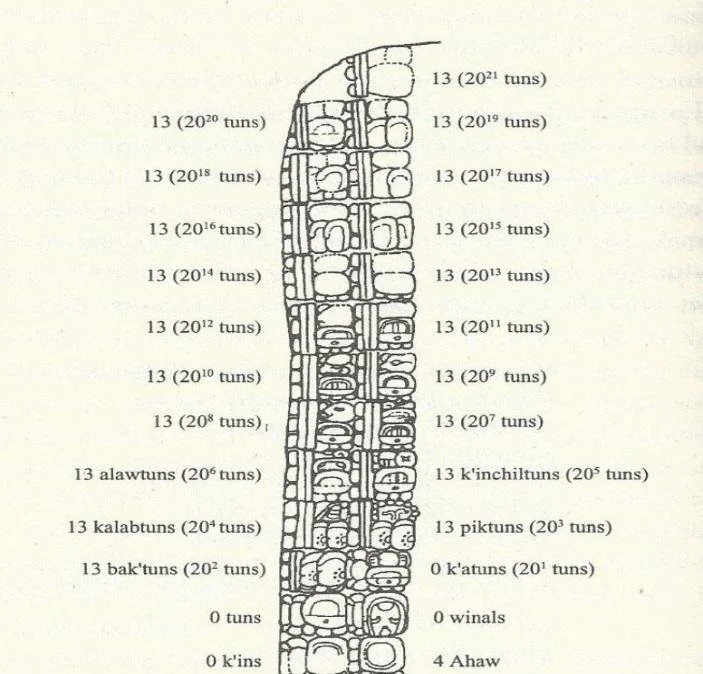
Figure 1: the Coba Stone
Figure 1 offers a partial image of the Coba stone which specifies a particular day or kin, 4 Ahau, on the bottom right. This corresponds to our 21/12/2012. The actual stone notes additional information about it on seven lower levels that are not relevant for our purpose. The upper panels describe a series of time intervals that rise from 13x20² tuns to 13x20²¹ tuns, where 1 tun equals a 360 day year, the basic unit of Mayan sacred time. This last number is almost unimaginably large: 20¹⁴ times greater than the 16.4 billion years to which, as we shall see, the 13x20⁷ tuns interval corresponds. That such numbers should even have occurred to the ancient Maya almost beggars belief and our incredulity may yet stand as an obstacle to correct interpretation of whatever they were intended to convey.
One suggestion is that the powers of 20 motif is simply an ornamental flourish and that all we really need to understand is that the ancient Maya located the original Point of Creation far back in a deep mythological past. This happens to be over 2014 times more remote from us than the estimated age of our universe, which is also associated with the birth of what our science calls ‘time.’ Given the importance of 20 as a sacred number and its pivotal role in both the tzolkin and the tun, this explanation is likely to be peremptory and dismissive.
Another possibility is that the escalating intervals do indeed evoke cycles of varying duration that increase in length by ascending powers of 20. This could mean that any given day participates simultaneously in every one of the cycles indicated. If so, all must somehow have been active from a Beginning that is inconceivably more remote from us in time than the beginning of our universe, suggesting that a kin-based wave frequency must have been around at least since our Big Bang. Could this have been possible before there was an Earth to rotate on its own axis or revolve around our Sun?
Cycles repeat of their nature and evolution is a fact of current experience. Its rate of change has been accelerating through the course of known time, encompassing the span of historical, biological and material evolution. But recurring cycles alone can’t account for the emergence of novelty. Hence the Calendar as evoked by the stone can’t explain how evolution has been speeding up if the highest frequencies it indicates have all been present from a Creation date which, the stone suggests, vastly predates the origin of our Universe.
This suggests an alternative possibility: namely that time intervals marked on the Coba Stone imply escalating frequencies which, in turn, reflect an underlying evolutionary process. A Swedish biologist, Carl Calleman, favoured this line of investigation (3). Many see his initiative as unwarranted. For them, the stone is simply a date-marking device and the date marked, 4 Ahau, corresponds to 21/12/2012. That is to say, the stone points forward in time to a day when the Long Count was supposedly due to end after 5,125 of our years, irrespective of the longer time periods that it also evokes.
Of Temples and Underworlds
Mayan mythology refers to 13 Heavens and 9 Hells. These were dismissed as superstition by the Spanish invaders. Intuiting that 9 Hells might correspond to different ‘levels of Creation’ within an overarching evolutionary process, Calleman was able to make new sense of the calendar’s structure. Extrapolating from information on the Coba stone, he noted that the vast time spans it denotes build on a 360 day tun base and stretch back towards an almost infinitely remote past in ascending powers of 20.
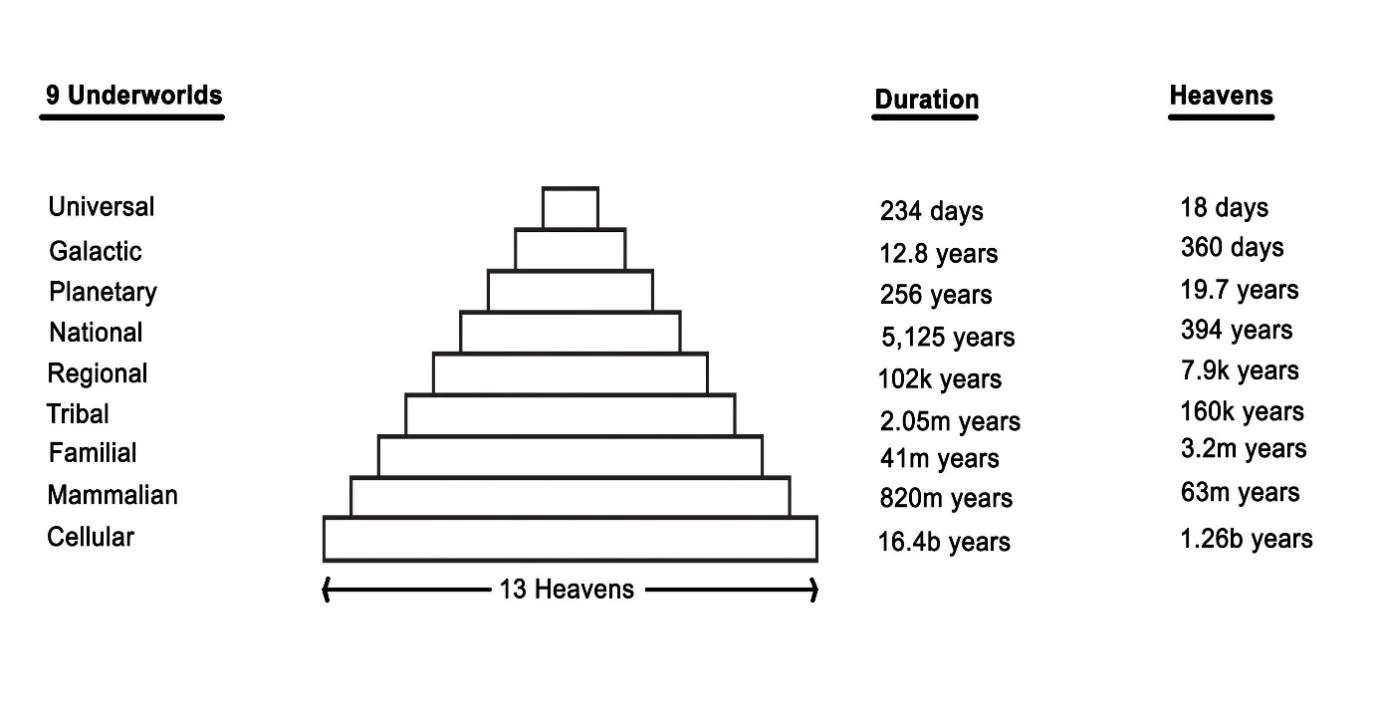
He re-named the first 9 levels evoked by the stone ‘Underworlds’ (rather than ‘Hells’) and linked them with 9-tiered temples found at major Mayan sites such as Palenque, Uxmal and Tikal. Focusing on the 13-fold division associated by the stone with each of its levels, he also linked the Mayan 13 Heavens with 7 Days and 6 Nights of Creation, believing these to evoke a genesis pattern that unfolds across each of the 9 Underworlds, as in our diagram above.
This presents a 9-step temple like those found at many prominent Mayan sites as a metaphor for 9 ‘levels of Creation,’ each of which has a corresponding Underworld, named as above. The diagram is not to scale, as each level would need to be 20 times longer than the next (ascending). This is evident from the duration of Underworlds as we move from bottom to top. The significance of particular Underworld names is discussed below, as is the role of the 13 Heavens (7 Days and 6 Nights), which denote the same qualitative stages of unfolding across every level.
Calleman proposed that the calendar unfolds in 9 waves from a beginning Point of Creation, which for him equates to our Big Bang. Each of these ‘creation waves’ engenders a corresponding Underworld. According to Calleman, the first wave began 13x20⁷ tuns or 16.4 solar years ago. He sees this as the age of our Universe, deviating significantly from the current scientific estimate of 13.8 billion years. His effective interest in the Coba Stone begins with the panel marked 13(20⁷ tuns) on the stone, six rows from bottom on the right in Figure 1.
This marks the beginning of what he calls the first wave of creation, 13x20⁷ tuns ago. A second wave began, on Calleman’s account, 13x20⁶ tuns or 820 million years ago; a third 13x20⁵ tuns or 41 million years ago, and so on down towards the base of the Coba Stone as represented in Figure 1.1. We will see later that this sequence inspired Calleman to propose an alternative end date. For now, please note that 13x20ⁿ tuns = 13x18x20ⁿ⁺¹ kins (days) as 1 tun = 18x20¹ or 360 days). Hence 13x20⁷ tuns = 13x20⁸ days, 20⁶ tuns = 20⁷ days and so on. Also, as 18x20¹ days = 1 tun, so 20⁷ tuns or 18x208 days = 1 hablatun and 13 hablatuns = 16.4 billion of our years. Working in this way from the stone, Calleman deduced that
- a 1st wave began 13x18x20⁸ days/16.4 billion years ago; 18x20⁸ days = 1 hablatun
- a 2nd wave began 13x18x20⁷ days/820 million years ago; 18x20⁷ days = 1 alautun
- a 3rd wave began 13x18x20⁶ days/41 million years ago; 18x20⁶ days = 1 kinchiltun
- a 4th wave started 13x18x20⁵ days/2.05 million years ago; 18x20⁵ days = 1 kalabtun
- a 5th wave started 13x18x20⁴ days/102,500 years ago; 18x20⁴ days = 1 piktun
- a 6th wave started 13x18x20³ days/5,125 years ago; 18x20³ days= 1 baktun
- a 7th wave started 13x18x20² days/256 years ago; 18x20² days= 1 katun
- an 8th wave began 13x18x20¹ days/12.8 years ago; 18x20¹ days = 1 tun
- a 9th wave began 13x18x20⁰/234 days ago; 18x20⁰ days = 1 uaxaclahunkin
It’s not necessary to remember details of these names or numbers but do note that the calendar on this account is highly structured in terms of powers of 20, together with its other constants 13 and 18. Bear in mind also that the Mayan word for ‘day’ is kin, as in tzolkin, or count of days.
For reasons we will soon consider, Calleman proposed an ‘end date’ of 28/10/2011. This, rather than the better known 21/12/2012, is the ‘present’ in relation to which all time intervals specified above are reckoned. The difference seems negligible when regarded from 16.4 billion or 820 million years ago, the start dates of his first and second waves respectively. When we get to the 9th wave, which began in March 2011 and lasted only 234 days, the difference is huge, especially if we invest the end date with vast transformational significance and see the 9th wave as its principal catalyst. This leads us to ask why the calendar should have been and may still be worthy of attention. I will offer a short answer now and develop it later.
To begin, Calleman proposes that his first wave began at the time of our Big Bang, which he dates from 16.4 billion years ago. (We will consider the 2.6 billion years deviation from current scientific estimates in due course.) The second wave began 820 million years ago – a power of 20 less. The next was 41 million years ago and so on up to the last, which began only 234 days before 28/10/11. This, Calleman argues, marks the inception date of a Great Shift about which so much was heard around the time of ‘2012.’ Let us suspend concern with dates for now and focus instead on qualitative implications of this information.
Calleman’s suggestion is that the first creation wave – the first manifestation of what we now might call an ‘evolutionary impulse’ – accounts for the birth of our Universe via a process that started 16.4 billion years ago. This alone regulated the course of material evolution over 15+ billion years until a second creation wave manifested. This took only 820 million years to complete and introduced animal life to Earth. Then, after another 779 million years a third wave emerges which takes only 41 million years to complete and introduces primate species. The pattern here is that the rate of evolution gets faster by a factor of 20 with each new wave so that by the time we get to the 8th and 9th waves the same amount of change is happening in 12.8 years and 234 days, respectively, as took 820 million and 16.4 billion years in our remote past.
This is where the ‘sacred’ aspect of the calendar comes in, according to Calleman: namely, it describes the main stages and internal dynamics of a highly structured, multi-tiered evolutionary process whereby ‘Divine Intelligence’ manifests creatively in existence and time. Specifically, the calendar describes a regulatory schedule that governs the appearance of successive phases of evolutionary emergence, supported by each of its 9 ‘waves.’ As noted, each wave engenders its own corresponding ‘Underworld.’
Holding this thought a crucial question arises: if 9 evolutionary waves all reached their ‘end date’ simultaneously – whether on 28/10/11 or 21/12/12 – what does it say about the world we are living in now and our role in it, if this integral expression of Divine Intelligence has already run its course? What is the nature of the Shift that is supposed to have taken place? How come most of us haven’t noticed if it has? What difference did it make or might it still be making?
The Counting of Days
Before considering these issues we need to look more closely at how the calendar works. There are numbers involved but all that is required to follow is basic arithmetic. If we can establish certain fundamentals early, everything else will fall into place. Just relate my commentary to the first 3 rows of the table below and trust that the rest unfolds along exactly the same lines. Working through this will build awareness and establish a platform for creative applications later.
In the Mayan reckoning of time a kin is a day, a uinal is 20 days, a tun is 360 days, a katun is 7,200 days, a baktun 144,000 and so on through all remaining levels. These are exactly the same numbers that were specified as powers of 20 above. In practical terms, the calendar works as follows, beginning from a given start date (day/kin 1) and reading from right to left:
Baktuns Katuns Tuns Uinals Kins
1) 0 0 0 0 1
2) 0 0 0 0 2-19
3) 0 0 0 1 0
: : : : :
4) 0 0 0 1 1-19
5) 0 0 0 2 0
6) 0 0 0 3-17 1-19
7) 0 0 1 0 0
: : : : :
8) 12 19 19 17 19
9) 13 0 0 0 0
Row 1 specifies the first day of a new start. Row 2 marks the passage of the next 18 days, out to day 19. Adding another day makes 20 kins (= 1 uinal) so the kins column resets to 0 and 1 is recorded in the uinals column (row 3). We are now 20 days/kins out from our beginning. The same sequence repeats over and over: another 19 kins (row 4) becomes 20 and so we record the passage of a second uinal (row 5). When 17 uinals and another 19 kins have accumulated (row 6), adding just 1 more day yields 20 kins. This again changes to 1 uinal, so there would now be 18 in the second column (right to left, row 7) but because 18 uinals = 1 tun, we record this as 1 in the third tun column. We are now 360 (18x20¹) days out.
Eventually we come to a point where 12 baktuns, 19 katuns, 19 tuns, 17 uinals and 19 kins have accumulated (row 8). This is written 12.19.19.17.19. Adding just one more day we arrive at 13.0.0.0.0 (row 9: 13 baktuns, 0 katuns, 0 tuns, 0 uinals, 0 kins). This is the Mayan calendar equivalent of 21/12/2012, or 4 Ahau as specified by the three lowest levels of the Coba Stone (Figure 1.1). It is also 1,872,000 days out from a specified start date. In principle, this unfolding could continue through all ascending powers of 20 implied by the stone.
Applying the above logic permits us to see how the stone might be regarded as a date-marking device. Look at the lower left side of the column in Figure 1.1, specifically the section marked 13 baktuns - i.e. 13x20² tuns or 1,872,000 days. Then look right to the section beside it marked 0 katuns (0 x 20¹ tuns), then left and down to the section marked 0 tuns (0 x 20⁰ tuns), then right to 0 uinals, then left and down to 0 kins and right to 4 Ahau. Together these intervals describe the period of the Long Count, beginning from a start date of August 11, 3114 BCE (as clarified in our next section). The inscriptions tell us that – beginning from this date – a period of 13 baktuns, 0 katuns, 0 tuns, 0 uinals and 0 kins (13.0.0.0.0) brings us to the day specified as 4 Ahau or December 21, 2012.
It is remarkable that a stone of such antiquity should point forward to this modern date. It is even more remarkable that the same stone also refers to unimaginably remote time periods up to 20¹⁹ times more distant from 21/12/12 than the start of the Long Count 5,125 years ago. What events could these possibly refer to and what relationship could the intervals in question have to the Long Count and its proposed end date of 21/12/12?
Apart from noting the ascending powers of 20, most commentators are silent about the higher time intervals, which means that they effectively ignore the most intriguing aspect of this ancient ‘text’ – namely that it points back to an unimaginably remote past. How could ‘Indians’ in a jungle at the time of Christ possibly have come upon such notions? Tata’s ‘creation story’ gives us the Mayans’ own mythically encoded answer – i.e. that the information was provided by ‘Creator’ via great teachers who descended from the stars.
Leaving this mythic approach aside for now, we may note that Calleman’s scientific account is not unsympathetic. Although he disputes the accuracy of a 21/12 end date he does takes account of more extended time periods specified up to the section marked 13x20⁷ tuns. This encompasses the start date of our Universe and is as far as Calleman’s scientific imagination allows him to go. His account is theoretically rich in that it incorporates the 13 Heavens and 9 Underworlds of Mayan mythology. Also, it takes account of the fact that 20 tuns are nested in 1 katun, 20 katuns in 1 baktun and so on up the scale. This implies that, because of the hierarchical nesting relationship, all the intervals specified – and not just the Long Count – must complete simultaneously on whatever the end date is.
Here the mystery deepens: we can’t have named baktuns, piktuns etc. until we have creatures capable of counting them – human ‘daykeepers’ like the Maya. But no human is capable of noting empirically periods of 16.4 billion or 820 million years, not to mention more encompassing intervals older than our universe or later frequencies that didn’t manifest on Earth until long after the Calendar was first devised – e.g. katun- and tun-based rhythms of the 7th and 8th waves, which didn’t start until 1755 and 1999, respectively.
This has prompted speculation that the Calendar must be unimaginably old and may indeed have stellar origins. For Calleman, it is not just a date marking device, as most proponents of the 21/12 end date suggested. Rather it describes the structure of sacred time as regulated by the unfolding of a ‘Divine Plan’ via an evolutionary process that is still under way. This suggests that time intervals encountered on its various levels have an objective standing that can’t be reduced to human cognitive activity. The implication is that the Maya discovered (or were shown) these various ‘rhythms’ of time and didn’t just invent them via simple counting.
Each rhythm arises in sequence, from slower to faster, as governed by the increasing powers of 20 rule noted earlier. It is as if they unfold from the bottom up, as per our pyramid model, with the potential of tuns somehow nested in katuns, katuns in baktuns, baktuns in piktuns and so on going ever farther back in time. Because there is an evolutionary progression involved, it appears that each x20 times higher frequency wave must somehow ‘hatch out’ from its x20 times slower predecessor. This is key to their succession.
Recapping, Calleman describes a series of ‘creation waves.’ Each supports the emergence of a new structural level of our Universe, built on the achievements of its precursor(s). It also engenders a corresponding Underworld, is governed by the same dynamics and ‘ends’ at the same time as all other waves. Because we are now considering a whole series of 9 creation waves and not just a Long Count of 5125 years duration, and because the tzolkin is built into the structure of the Sacred Calendar as an integral regulatory factor, we might indeed expect all 9 creation waves to end as the tzolkin does on a 13 Ahau day. The 4 Ahau of 21/12/12 makes no sense in this regard. Thus Calleman proposed his alternative end date of 28/10/11, as described in our next section.
Before considering this, it is important to note that his account interprets the Coba Stone in a particular way. He sees it as a symbolic device that contains more information than is immediately apparent. I have found his contribution invaluable but just as it is arbitrary for 21/12 supporters to build their readings from the 13 baktun segment only, it is also arbitrary for Calleman to ignore intervals above the 13 x 20⁷ tuns panel where his account begins. Having acknowledged the stone as a symbolic device we must wonder what it expresses as a whole. Allowing that its creators intended their message to be conveyed by this whole, it is arbitrary to exclude from our reckoning information that they took pains to communicate because it doesn’t fit our agendas and we don’t know what to do with it.
Here the excluded information draws us back to an inconceivably remote past, vastly prior to what current scientific understanding tells us was the beginning of our universe and time. Opening to whatever mind and paradigm blowing implications this may have prepares us also to consider anew whatever the Coba Stone may be trying to say about the significance of our time of ‘2012,’ regardless of whether we fix it via a 28/10/11 or 21/12/12 end date. The fact that both have now passed should make it easier to see with fresh eyes whatever the stone was intended to convey. We will return to this having looked more closely at our two ‘end dates.’
3. Two Dates to Mark an End of Time?
Of the two contenders, 21/12/12 was always better known. It stems from an inscription at the ancient Mayan site of Izapan which indicates that the Long Count began on August 11, 3114 BCE. Counting 1,872,000 (13x18x20³) days or 13 baktuns forward from then brings us exactly to 21/12/2012! Calleman never supported this ‘end’ date. One reason for this has to do with the centrality of the tzolkin. We have seen that this encompasses a 260 (13x20) day cycle that is usually taken to run from 1 Imix (Crocodile) at its beginning to 13 Ahau (Sun) as its culminating energy. Because the tzolkin is integrally embedded into the tun-based sacred Calendar, we might reasonably expect all Underworlds – including the 6th, whose duration the Long Count measures – to end on a 13 Ahau day. As noted, the 4 Ahau of 21/12/12 makes no sense in this regard. Hence Calleman suspected that the Izapan start date might reflect a local bias and thus overlook something essential.
Working from an alternative inscription found at Palenque, Calleman posited 17 June, 3115 BCE as an alternative start date for the Long Count. Working forward here yields an ‘end’ date of October 28, 2011. This proved to be a 13 Ahau day and entailed that all 9 Creation waves would ‘end’ at the same time as a completing tzolkin round. Interpreting this as confirmation, Calleman adopted these dates as a baseline for reconstructing the calendar. When we look back 16.4 billion or 820 million years, a difference of around 420 days between 28/10/11 and 21/12/12 hardly seems to matter but it makes a huge difference as we draw closer to our own time. It would mean that the entire 234 day 9th wave – according to Calleman, the greatest single evolutionary catalyst ever to affect Earth – was overlooked entirely by people anticipating a 21/12 climax. To have missed the strongest transformative energies ever seems like an irredeemable loss, which is why Calleman urged his earlier start date strongly at the time.
Against this, many people tacitly projected a sense of impending catastrophe associated with 21/12 on to 28/10 and inferred that because nothing catastrophic or outwardly transformative happened on that day, it must have been a false ‘end’ date. This raises questions to do with what was really going on with all those waves and underworlds before October 28, 2011. Was it all a figment of Calleman’s imagination? Did it ever have any real purchase? And what is its relevance now that the day has passed? The last questions can also be asked regarding 21/12. Does the absence of overtly significant happenings on both occasions mean that all our expectations of a ‘Great Shift’ were simply credulous and should now be forgotten?
Calleman’s Grand Narrative
Having established 28/10/11 as his ‘end’ date, Calleman correlated major thresholds inferred from the Coba stone with developments in material, biological and historical evolution as identified by science. The results were impressive and generally bore out a prediction that major qualitative shifts would accompany the beginning of new waves/underworlds and, on a smaller scale, the beginnings of new Days within them. These findings serve to underpin his presentation of 9 Creation waves that are said to engender 9 Underworlds, each of which is named for events that occur during their final Heaven or 7th Day (remembering that all levels unfold over 13 Heavens up to 28/10, each comprising 7 Days and 6 Nights).
The 7 Days or odd-numbered Heavens follow a sequence from planted seed to mature fruit. They correspond to stages of sowing, germinating, sprouting, leafing, budding, flowering and fruiting, respectively. This constitutes a developmental model in which Days are associated with activity and innovation. Each is ruled by a particular ‘deity’ or energy that specifies its key theme. They are separated by 6 Nights, which are associated with the integration and application of patterns introduced during Days. Each Night is also governed by its corresponding ‘deity.’ All Heavens last 18x20ⁿ days, where n ranges from 8 in the case of the 1st wave to 0 in the case of the 9th.
Calleman interprets this to mean that evolution happens 20 times more quickly as we move through successive Underworlds, engendered by corresponding waves up to 28/10. As noted, the first lasts 16.4 billion years and is called ‘Cellular’ because the first single-celled organism emerges during its 7th Day. The second lasts 820 million years and is called ‘Mammalian’ because the first live births happen during its 7th Day. The first primates emerge during the 3rd ‘Familial’ Underworld (41 million years). Our first specifically human ancestors appear during the 4th ‘Tribal’ Underworld (2.05 million years). Homo Sapiens arrives definitively in the 5th ‘Regional’ Underworld (102,000 years). By the middle of this period we are using language, burying our dead, producing art and showing signs of spiritual awareness.
During the first 4 Underworlds, evolution is primarily biological and regulated by genetic codes which take a very long time to mediate change. From the Regional Underworld on, evolution is primarily mental and is regulated by trans-genetic or cultural coding. Essentially, this means that we tell stories to impart learning that accumulates too rapidly for genetics to keep pace. Such coding has become the hallmark of our species and leads to the generation of culture as a network of reflections. This opens up an inner world of what we may call soul. At the heart of every culture we find shared frames of action, perception, knowledge, thought and judgment. These were initially elaborated by people who would become known as shamans due to their ability to track relations between visible and invisible dimensions of experience.
By the time we reach the 6th National Underworld (3115 BCE), the era of classical civilizations is to hand, starting with Sumer and Egypt. Humanity has now adopted a settled mode of existence in certain locations, shifting away from a nomadic hunter-gathering lifestyle to a settled agricultural one. Writing has been invented, together with warfare, male dominance, hierarchy and slavery. Laws are needed to regulate these more complex social formations and are drafted from the perspective of new power elites. This implicit focus on power becomes explicit during the 7th Planetary Underworld, which began in 1755, lasts 256 years and coincides with our modern period of Industrial Revolution.
Applications of science were then beginning to yield technological means that allowed us increasingly to harness powers of Nature for human purposes. Power is the great theme of this period and our exercise of it has brought us to the brink of destroying ourselves. Hence ethics became a core pre-occupation of the 8th Galactic Underworld. This began on 5th January, 1999 and lasted 12.8 years (13x18x20¹ days) until October 28, 2011. As much evolution happens here in 360 days as happens over 19.7 years in the Planetary Underworld, 394 years in the National and so on in escalating powers of 20 back to the Cellular Underworld.
This apparent time acceleration intensified so rapidly during the Galactic Underworld that we started noticing, so changing our relationship with time. Many were inspired to ‘look back,’ seeking to align with a spiritual Source of evolutionary time and all that happens through it. A more practical manifestation of this impulse was also expressed by the question ‘How can we manage power with integrity?’ This led to a widespread questioning of corporate and governmental power, paving the way for a creative reclamation of personal power that crystallised in the 9th Universal Underworld.
The 9th wave/Underworld began on March 9, 2011 and lasted until October 28 of the same year. Its scale made it subjectively accessible, even as the increased pace of evolution – as much change happening every 18 days as used to take 360 etc. – made it harder to keep up. Its brief duration of 234 (13x18x20⁰) days meant that it was possible to track its unfolding energetically on a daily basis. I did this carefully and concluded as a result that Calleman’s schedule was essentially correct, despite many apparent difficulties that have been noted in relation to it.
The principal theme of the 9th wave, arising from the alignment focus of the 8th, concerns accessing a power of conscious co-creativity. This potential is also driven by energies of remembering and review. There is a long story behind this. Firstly we may note from its 234 (13x18x20⁰) day duration that the 360 day tun base, together with the 20 day uinal, is eclipsed in the 9th Underworld. As we shall see, this foregrounds an 18 count that was always present but had been masked at earlier levels by higher powers of 20. We see this on the Coba Stone, which always refers to 13ⁿ tuns rather than 13x18x20ⁿ⁺¹ kins (days).
Hence the pivotal role of 18 was effectively masked until the advent of the 9th wave. Here 20⁰ becomes 1, leaving 13 Heavens, each of 18 days duration, to yield its total of 234 days. Because the 9th wave was too short to include either a tun or a tzolkin round (360 and 260 days, respectively), we might suspect that its newly introduced frequency heralds something truly novel. We will pursue this later. By way of preparation, the diagram below shows how the Coba Stone would look in relation to Calleman’s account, including a kin or day base to highlight the newly apparent role of 18.
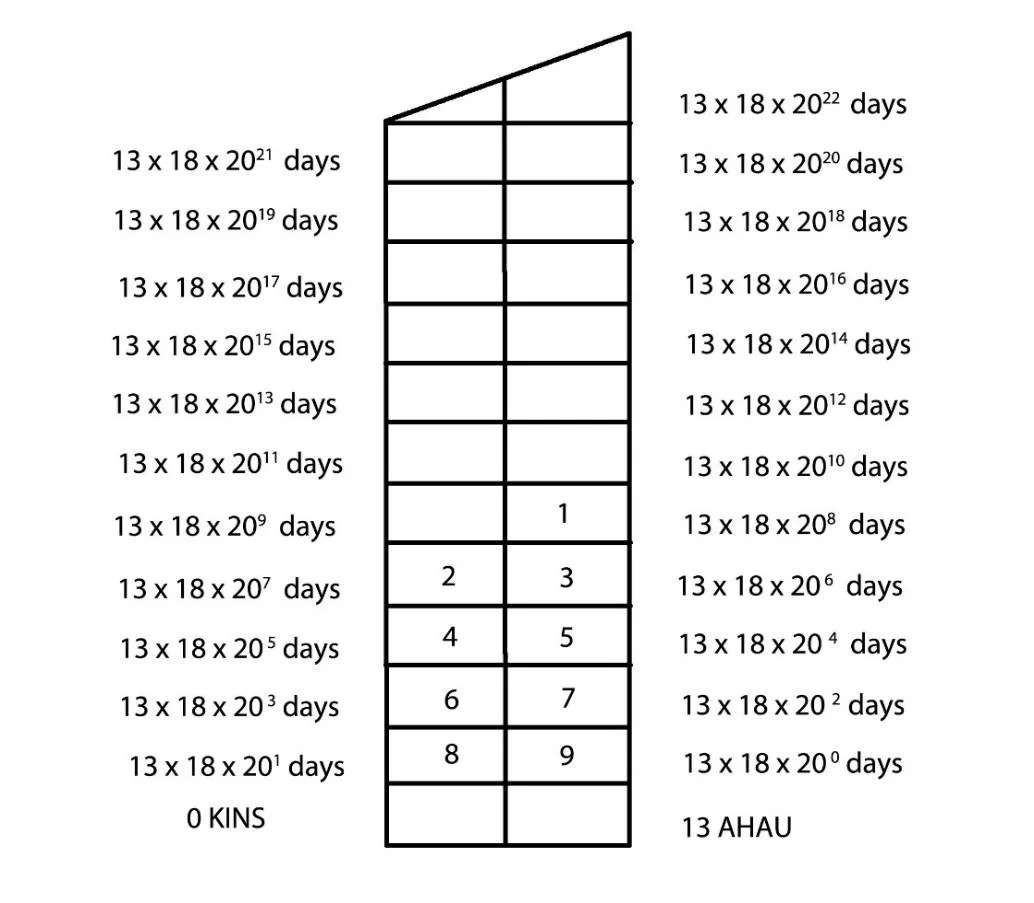
This diagram presents a partial schematic of the Coba Stone, introducing a kin base to bring out the formerly hidden role of 18 in the Calendar and specifying its lower panels in terms of Calleman’s model. This draws on his alternative Palenque start date of June 17, 3115 BC for the Long Count. The numbers 1-9 refer to his primary creation waves and associate them with time intervals during which they emerge and express. We can also read these panels as saying that 13 hablatuns, alautuns, kinchiltuns … katuns, tuns and uaxaclahunkins (18 day periods) have elapsed since our Big Bang. This takes us to the 13 Ahau day of 28/10/11, written as 13.13.13.13.13.13.13.13.13.
Heavens, Days and Nights
From here on, ‘days’ and ‘nights’ will refer to the 24 hour cycles of our ordinary experience while capitalised ‘Days’ and Nights’ will refer to odd and even-numbered Heavens of the Creation waves up to 28/10/11. As indicated, the 13 Heavens are made up of 7 odd-numbered Days and 6 even-numbered Nights. They can be visualised in wave form as in our diagram below. This presents the 13 Heavens in Wave Form, encompassing 7 Days and 6 Nights. The odd-numbered Heavens (1-3-5-7-9-11-13) are Days and appear above the line while even-numbered ones (2-4-6-8-10-12) are Nights and appear below it.
Then, narrowing our focus to just the first Day and Night of the 9th or any wave (below):
Note that as Days rise above the horizontal axis and Nights fall below it, the 18 day rhythm of the 9th wave becomes visible as 9 up/down (1 to 9 ascending and 9 to1descending on the left) and 9 down/up (-1 to -9 descending and -9 to -1 ascending on the right) through its Days and Nights, respectively. This intrinsic balancing pattern has been operative through all levels of the Calendar but only recently became apparent to consciousness, as powers of 20 ceased to figure in the 9th wave. The balance is partial only because no 7th Day is matched by a following Night up to 28/10/11.
This 13 Heavens pattern occurs across all waves. The same stages of a Seed-Fruit progression are also observed throughout and are ruled by the same ‘deities’ in all cases. These ‘deities’ represent specific evocations of ‘powers of the Universe’ that apply particularly during 1st Days, 1st Nights and so on across all waves. This means that the same ‘powers’ govern corresponding Heavens across all waves so that the whole Calendar is governed by a principle of fractal resonance, whereby the same patterns recur on all levels of scale. Thus if I meditate during Day 1 of the 9th wave, I am in resonance with 1st Days on all other levels at the same time. This used to be the calendar’s prophetic core: knowing what kind of energy (‘deity’) ruled a period allowed for predictions of what kind of events were likely to happen in it. This has now changed radically. To explain why, we must first consider what happened during the ‘shift’ of 28/10.
My approach to 28/10
Nobody knew what would happen after 28/10. Calleman ventured several gloomy predictions but none was borne out: there were no earthquakes, days of darkness or renewed financial crashes. Many wondered if it had all been a false alarm. My sense was that, given the priority of Consciousness, the whole affair could simply play out in Consciousness and it did so for me.
I had participated in several ‘Sacred Plays’ to mark the approach, beginning and mid-point of the 9th wave. I had also tracked it energetically throughout. Thus, as 28/10 drew near, I felt myself to be as well prepared as I could possibly have been. I knew that the 9 waves had arisen successively 234 days, 12.8, 256 and 5,125 etc. years previously, right back to the Big Bang when our space-time universe first manifested. I also knew that the 9 up/down structure of the 7th Day of the 9th wave, which lasted 18 days, reflected the 9 step pyramidal structure of the Calendar as a whole.
Because of this fractal resonance across different levels of scale, a diagram of the 9th wave's 7th Day serves as a diagram of all 7th Days and of the entire Calendar. It was thus possible to recap in consciousness the unfolding of the whole Calendar, including its simultaneously completing 7th Days, starting from the inception of our Big Bang and ending with its ‘completion’ on the night of 28/10/11. (It is far easier to accomplish this experientially than to register it in words, which is why I chose to work through Sacred Plays.)
Specifically, in a Play to mark this occasion, our group enacted the ascent-descent pattern of the last 18 days, simultaneously echoing the ascent-descent pattern of all 9 Creation waves and of all 7th Days. Then, at a point of symbolic midnight on 28/10, as the Shift was due to happen, we completed our descent from levels 9 through 1 of the sacred temple. We then paused at the zero level of Earth’s surface and turned to receive energies that Mayan myth evokes as the descent of a ‘9-part god.’ This is symbolic language, referring to what happens when the 9 Creation waves finally come together on Earth in time.
I lay down on the floor for over an hour, absorbing their impact directly in my spiritual Heart (chakra) and waited to see what this would bring. Although the impact felt gentle and benign, its effect was overwhelming. I finished presenting the Play and was too exhausted to do anything but rest for the next 4 weeks, as my physical system strained to accommodate the frequencies absorbed. I wrote some articles over this period that allowed me to reflect on what had happened. Despite the absence of global catastrophe, this was certainly not nothing. It took me several months to get clear about what had been involved and years to formulate it lucidly. I will explain this as we go but first we must return to our tale of two end dates.
Issues with the Coba Stone
Before plunging in, recall two issues with Calleman’s use of the Coba stone: he ignores its specification of 4 Ahau as an ‘end’ date and also ignores all tun values indicated above the power of 20⁷. This leaves him with 9 mythically ordained levels, starting from an outer interval that encompasses the age of our universe. He advocates this despite a 2.6 billion years gap between science’s current 13.8 billion years estimate and the 16.4 billion indicated by what is effectively his theoretical model.
Against this, the fit between his Palenque start date (17 June, 3115 BC) and the ‘end’ of 28/10 as a 13 Ahau day is truly remarkable, as is the level of correlation between thresholds implied by his model and developments noted in the scientific record. This contrasts with a total lack of independent evidence available to advocates of a 21/12 ‘end.’ They too awoke to a day like any other but have no Calendar-based wisdom to offer now that one Long Count has ended and another is said to have begun. I persist with Calleman’s approach because it opens vistas that are vastly more instructive.
The fact that both dates have been so prominent suggests that comparisons between them could serve a purpose of advancing consciousness. Most Mayanists agree that the later of the two is the true ‘end date’ of a 13 baktun cycle. This is distinct from Calleman’s entirely grander 9-tiered scheme. Not only was 21/12 favoured by the Maya, it is also designated by the Coba Stone on which Calleman bases much of his argument. As we have seen, this features two columns of time-related information and specifies 4 Ahau as an end date that arises after the passage of 13 baktuns, no katuns, no tuns, no uinals, no kins (13.0.0.0.0), starting from the Izapa date of 13/8/3114 BCE.
Again I stress that higher powers of twenty times tuns (20) that are also represented are still ignored. Applying the same logic to these higher levels, the date 4 Ahau would be fully described only if twenty 13s were to precede the four 0s rather than just one. These would specify all the periods that have elapsed from a mythic creation that is unimaginably more remote than modern datings of the Big Bang which gave birth to our Universe – i.e. 13x18x20²² days ago, a figure which is 20¹⁴ times greater than the 16.4 billion years Calleman over-estimates as the age of our universe, presumably because his model demands it.
This is usually countered by noting that, as before, the higher powers of 20 simply point to the fact that cycles of time were believed to stretch far back into a mythic past. The stress on powers of 20 would be grossly misleading if this were all that was intended. It seems far more likely that the 13 tones x 20 aspects structure of the tzolkin is echoed here for some absolutely fundamental reason and may also be embedded in more encompassing cycles of the structure of metaphysical time. In this respect, it is not plausible that 14 pre-Cosmic powers of 20²¹⁻⁸ would be carved in the Coba stone just for effect.
Nested Waves and Underworlds
If we view the Coba stone as a date-marking device that specifies periods of time due to elapse between a given start date and some projected end, this implies a cyclical accumulation of nested time intervals. We know that there are 20 kins in a uinal, for example, 20 tuns in a katun, 20 katuns in a baktun and so on. This yields a nested hierarchy in which successive waves are activated sequentially but then unfold simultaneously. This means that, instead of a period of 13x20²¹ tuns elapsing and another of 13x20²⁰ then beginning, the second period would be nested in the first, having begun 95% of the way into it.
Adopting this rationale, Calleman proposed his series of 9 waves, where each unfolds 20 times faster than its predecessor, having been instigated 95% of the way through it. Hence there are 9 creation cycles. Each has its own distinctive rhythm (13 Heavens of varying length, as regulated by the powers of 20) and nests within its predecessor in the array. For example, the second Mammalian Underworld lasts 820 million years (1/20th of 16.4 billion) and its entire unfolding coincides with the last 5% of the first Cellular Underworld. Likewise, the Familial Underworld lasts 41 million years – i.e. the last 5% of the Mammalian.
The diagram below helps clarify this. It applies to the relationship between the 1st wave and the 2nd, or 8th and 9th, and all other precursor-successor couples in between. It shows how, during the 7th Day or 13th Heaven of any given wave, its successor is seeded into existence. This seeding of new waves 95% of the way through their predecessor’s trajectory has been a major stimulus to evolutionary development, contributing ‘quantum leaps’ of accelerated growth from the 1st wave to the 9th.
This diagram shows how each precursor wave, 95% of the way into its whole trajectory and 35% into its 7th Day, ‘seeds’ its successor. All but the 1st and the 9th are embedded as precursors and successors in this way, the 1st being a precursor and the 9th a successor only. Issues of scale make it impossible to show all waves simultaneously in their nesting relationships. The pair above could be the entire 9th wave nested within the 7th Day of the 8th or the whole 8th within the 7th Day of the 7th and so on back to the whole 2nd wave nested in the 7th Day of the 1st. We must imagine all these nesting relationships superimposed, from the 1st wave to the 9th.
With regard to detail, Calleman has been criticised for highlighting phenomena that support his case and ignoring others that don’t. While the fit is not perfect, neither is it random or capricious. There is a clear case to be made for his model as a visionary articulation of the evolutionary process, if not an exact scientific description of it. He has also been criticised for positing 9 Underworlds because this motif is present in Mayan and other mythologies. I doubt that this was ever a priority as his work aims to be strictly scientific. Either way, his account of 9 Underworlds is very powerful and compelling. He has also been criticised for linking the 13 Heavens of Mayan myth to a genesis pattern of 7 Days and 6 Nights, although they manifestly evoke a developmental sequence where the 7/6 imbalance favouring active Days supports a building up of complex structure prior to the Shift.
He has even been criticised for inventing an 18 day time cycle. This comes of applying the x20 times compression rule uniformly while working down the time scales from hablatuns to tuns (13x20⁷ to 13x20¹). An exception has traditionally been made here because a tun comprises 18 uinals each of 20 days duration. Calleman could have followed suit but instead applied the 20 times compression rule, dividing 360 by 20 to yield 18 rather than 18 to yield 20. This reveals a 9 up/9 down rhythm that was always implicit in the tun-based system of time-reckoning but also hidden by it (again, 13x20ⁿ tuns = 13x18x20ⁿ⁺¹ kins). Hence 18 (9+9) is constant across all levels of the calendar before 28/10, despite being masked by tun-based waves up to the 9th.
Recapping, an 18 count is present at all levels of scale in the Calendar’s structure. The only difference is that the 13 Heavens (Days/Nights) of each preceding wave or Underworld get 20 times longer as we pass up through levels of the Coba stone. Hence a ‘Heaven’ during wave 9 is 18 days long; 360 days during wave 8; 7,200 during wave 7; 144,000 during wave 6 and so on. Again, the same essential structure is found on all levels of scale, where it regulates a continuous, dynamically fluid relationship between Night/Day, yin/yang and Dark/Light elements of the calendar. It also underpins a pattern of fractal resonance throughout, meaning that the same organisational dynamics are found at all levels, from the 1st wave to the 9th, distinguished only by applicable powers of 20. The 4 Ahau-21/12 date generates nothing of this visionary sweep.
A Mythic Perspective
My Calendar story is intentionally mythic. Myths convey essential truths rather than literal facts. It’s not necessary to believe that a new katun rhythm actually started in 1755 or a tun-based one in 1999 to get the point that evolution has been building steadily in a way that is punctuated at decisive thresholds by quantum leaps up to ‘2012’ or that decisive change is imminent after a peaking of ‘driven’ evolutionary acceleration at that time. The same is true regarding temporal horizons opened by the Coba stone. I am not saying that the x20 times rule doesn’t apply, just that it doesn’t have to for Calleman’s account to be worthy of note. Both his researches and my own experience of the 9th wave incline me to treat his model with great respect.
I see it as a mythos of our postmodern age, one that aims to raise and resolve crucial issues in the mode of science but whose success is qualified by the nature of the material it seeks to engage. In particular, because human beings ‘step out of flowers’ in Tata’s words – because we emerge from an evolutionary process and are ourselves integral expressions of it and because this process is not yet and may never become transparent to itself – it can’t be fully described using an objective approach. We will understand why better having reviewed Jean Gebser on consciousness structures and Joseph Campbell on the functions of myth in Part II. For now, we are at least forewarned by Calleman’s theoretical opportunism in ignoring longer time intervals that are also specified by the Coba Stone.
That said, his model does open vital critical perspectives on modernity by illuminating why our focus on yang innovation has been necessary and unconsciously motivated up to a present in which we need to become balanced, conscious and responsible. We will see later that the calendar’s functioning post-Shift greatly assists this latter process. I am aware that neither Calleman’s thinking nor my own is that of a Mayan priest but, instead of lapsing into epistemological despair on this account, I am heartened that a tale half-told by an ancient culture and half by a modern one may become a source of wisdom that can guide us in our time of crisis towards renewal.
We live in a dynamically unfolding, radically integrated information universe (Part V). Within this unified self-articulating field, diverse perspectives constantly surface, merge, fracture and recombine in ways that enrich the whole. Humanity is now attempting to generate a robust global culture that aligns with this ongoing process and able to participate sustainably in it. We need all the inspiration we can muster towards this end. Thus I am happy to offer a mythic re-interpretation of the Calendar for the new time it has been taken to proclaim, just as I will offer a new account of ‘the Grail after 2012’ in Parts V to VIII. Even our most revered stories warrant re-telling to address the needs and challenges of new times, mindful of Tata’s aversion to lies.
The Momentary Fusing of all 9 Waves
Since the 9th wave was never due to seed a 10th, some new application of the seeding principle had to apply. My sense was that, rather than literally seeding a successor, the 9th wave’s fruition entailed planting a seed in prepared human consciousness that would be activated around the ‘Shift’ of 28/10. The 21/12 date tells nothing of this but its 4 Ahau profile suggests a day for assimilating enlightenment. Both dates can be related if the second is approached as an opportunity to harvest gifts of the first. It doesn’t matter if people were unaware of 28/10: potentials it induced can still be accessed. To test this, I adapted my Sacred Play to mark the end of 28/10 for restaging over the weekend of 21/12/2012, relocating themes of personal spiritual creativity within a calendar-based macro frame. This merged what had formerly seemed like distinct threads in my work, consistent with an awareness that human response-ability and creativity must come to the fore now that the driving power of the primary creation waves has already been absorbed into Earth’s energy field, if not yet articulately into the collective consciousness of a species that aspires to be her steward.
This is not a point for debate. It is clear that if we don’t transform our collective consciousness urgently, we will irreversibly undermine planetary systems needed to maintain our continued existence. We need to retrieve this situation quickly and our pragmatic horizons don’t offer much encouragement. This is why so many of us pin our hope on dates like 28/10 and 21/12 to effect some kind of Pentecostal deliverance. We are in the throes of crisis now and know that our present attitude cannot be sustained. Perversely, few of us choose to entertain such thoughts. Yet a fear of impending catastrophe is rampant. Widely repressed on levels of mainstream reflection, it manifests as apocalyptic speculation whenever plausible thresholds come around. This was very much the case with 21/12. New Age commentators even acclaimed 22/12 as ‘the Beginning’ but never said specifically of what. If it was just the start of a new cycle of 13 baktuns, the proclamation is trivial. It may have been an accomplishment for the ancient Maya to predict that ‘2012’ would be a time of great change but it is hardly so for people who are living now! It is clear that we are in a crisis period and knowledge of the calendar doesn’t improve our ability to note this. That said, it is sobering to reflect that if – as in the Mayan myth of previous worlds – ours can’t produce fully human beings, ‘the gods’ will elect to destroy it and start over.
[Mayan mythology tells of three earlier ‘worlds’ that arose and declined before ours. The gods attempted to engender full human beings in each but met with only limited success up to the end of our 4th World and the beginning of a 5th (which traditionalists believe is already under way in the form of a renewed Long Count). These earlier worlds were destroyed three times in order that the experiment could start over, each time getting closer without meeting the required standard. We are now in the final stages of our cycle and the message is that if we can’t become fully human quickly, during the window of ‘2012,’ our world too will be destroyed. If this happens, it won’t just be due to prophecy but also the precarious relationship we maintain with our planetary environment, including each other. The question of what constitutes a full human may seem moot but is decisively illuminated by mystical accounts of ‘awakening’ and ‘enlightenment.’ Both entail remembering all that we are (for) as spiritual beings. Whence the widespread anticipation that a radical transformation of consciousness will suffice to redeem humanity and spare Earth further devastation. Peculiarly, despite cherishing this aspiration, we are conspicuously inept at realising it: whereof more later.]
My sense was that the role of 21/12 involved focusing human consciousness with regard to changes that had already occurred during the Shift of 28/10 but what was the substance of that shift? Essentially: 9 sequentially released and by the end simultaneously unfolding creation waves fused momentarily in time, reconstituting in the explicate sphere of manifest existence the primal integrity of a formerly implicit Oneness that was apparently motivated to move through a Zero Point of Creation (0) in order to remember itself as One (1) in the mirrors of space and time. Hence the fusion engendered a point from which Consciousness-in-time could remember its origins beyond time.
The Fusion of all 9 waves at symbolic midnight on 28/10/2011. Problems of scale make it impossible to diagram this fully but it is evident that every precursor-successor pair ‘ends’ at the same point. This is clearly illustrated for the 8th and 9th waves above, so imagine it extended to include the 7th-8th, 6th-7th and so on, as suggested by the end phases also indicated. The key point is that all 9 waves ‘peak’ (attain their highest quantum state) at precisely the same instant and fuse momentarily at that exact time, represented by the point of convergence on our x-axis above.
We are the primary agents of this remembering and a trace of the fusion point is now imprinted in human collective awareness, encoding a potential that still awaits activation in most. When I repeated my ‘Sacred Play’ of 28/10 on the 4 Ahau day of 21/12, I found that not only were Shift energies still available but also that they could be integrated more easily in consciousness, even as they were working to transform it. An experiential programme associated with this stream built powerfully as a result, leading to the Grail series described in later Parts V of this work and seeding thoughts that are merely adumbrated here but will be carried to fruition later.
4. Renewing the Count of Days
Three major developments occurred during or as result of the shift of 28/10. The first was a fusion of all 9 waves as described above. Recall that these had been moving in parallel, albeit at different frequencies, having ‘descended’ sequentially out of pure Consciousness to kick-start material evolution in existence, space and time. Their convergence thus ranks as significant, and not just symbolically. My sense, having attended carefully through the process, is that this moment initiated what Calleman has called ‘the highest quantum state of the universe.’ It was achieved at symbolic midnight on 28/10/2011, because each wave had by then attained its maximum power and because all fused momentarily in that instant. This latter event also triggered a capping of the rate of evolutionary change, which is the second of our three major developments.
Consider: there was no 10th wave so there could be no quantum leap to add a new accelerative frequency to what we might call ‘the winds of pre/history,’ nor will there ever be again. After a hectic build-up through preceding months, this abrupt cessation contributed to a sense of time having slowed down. Contrast what then felt like the cosmically mandated buoyancy of 2011’s Arab Spring with the agonised morass that still lingers, or the overt turmoil of financial markets then with the tightly managed uncertainties of now (September 2015). It does feel as if ‘winds of history’ are no longer gathering pace, so that we find ourselves marooned in a gap between determinations of our past by formerly rampant creation waves and aspirations to freedom induced by their cumulative impact.
This doesn’t mean evolution has come to an end: only that its acceleration by divinely mandated ‘winds’ has. There could be no consequence whatever if we continue to behave unconsciously in ways that are still ruled by prior inertias. That said, the 9th wave, building on all others, did stir our collective un/consciousness towards an awakening that entailed widespread mania around 2012 and the ‘end’ it was rumoured to be bringing. Then winds that might have swept us on to full resolution stopped short. This suggests that we have been prepared for freedom to participate consciously in evolution rather than automatic elevation beyond it. Our position demands that we realise and exercise a capacity for freedom that would have been pre-empted had the waves that brought us to 28/10 also carried us through to universal rapture, but they didn’t. Instead of a 7th Day ‘seeding’ a new 1st, all 9 fused momentarily before continuing down into a Night, which introduces our third major development:

Here we picture all waves falling into Night after 28/10. Problems of scale still apply so our diagram focuses schematically on the 8th and 9th waves. Like all other waves, both fall into a 7th Night after 28/10 for a period determined by their respective frequencies. Hence the 9th wave rises into an 8th Day after 18 days, the 8th wave after 360 days, the 7th after 7,200 and so on. Hence, in an inversion of pre-Shift sequencing, successor waves re-emerge from Night before their former precursors and do so 20 times more often than them. This pattern is indicated here regarding the 9th and 8th waves but applies for all others too.
Our previous diagram showed how all 9 waves ‘complete’ simultaneously, having descended from +9 to +1 towards ‘symbolic midnight’ on 28/10/11. This occurs at the precise instant when they reach zero point on the x-axis and before they fall into an unprecedented 7th Night, as above. Their fusion in that watershed moment engenders an image of the Point of Creation in existence and in the Akashic field that informs it (V.1). This is now active at the centre of my spiritual Heart. The image is a positive reflection, a fulfilment of the original evacuated Point from which material unfolding began at the time of our Big Bang. The streaming of all 9 waves into one fleetingly constituted Point also illustrates how 9 ‘parts’ of the Mayan ‘9 step god,’ sundered and in need of remaking in time, actually come together for the purpose.
This is also a perfect metaphor for the numerological process whereby the infinite potential of implicate Void/0 goes through 9 stages of building in order to arrive at an explicate Unity/1 that recognises itself by looking back and intuiting the epochal awareness I AM THAT I AM! I am not suggesting that the Maya ever read this into the Coba Stone array, just that I am now reading it out. I am not doing so gratuitously but because the pattern is beautiful, revelatory and matches my direct experience of the Shift. If there is merit to this initiative, it will become clear through all that follows.
Discontinuity and Balance
It is important to stress that the waves never ended but a signal discontinuity was introduced by their simultaneous recall into Night. This also contributed to a sense of time slowing down. Never before in the pre/history of our universe had all 9 waves been in a Night together. It followed from the first and only time that all 9 had been in a 7th day. We need to be careful here. Although the 7/6 Day/Night imbalance certainly drove a building up of light structure in existence, this has effectively been concentrated within 7th Days, which seed the 1st Days of successor waves. For a Day to follow a Day is truly momentous, precipitating quantum leaps or qualitative stage transformations in the evolutionary process but we must also remember that, across individual waves, the 1st to 6th Days were consistently balanced by 1st to 6th Nights, respectively. Apart from this quantum leap provision – which gave us new waves, new Underworlds and newly accelerated levels of evolutionary unfolding – balance and integrative opportunity have also been integral aspects of the Calendar’s unfolding.
The historical record may seem to belie this over the last 5,000+ years, where yang assertiveness appears to have increasingly eclipsed yin’s integrative receptivity more than the Calendar alone would dictate. I believe this is true but we must consider additional reasons for it and will do in Part IV. Also, the startling fact remains that post-Shift there is no further provision for ‘quantum leaps.’ The highest quantum state of the universe has already been attained, creating a stage on which we can exercise our nascent powers of freedom and inspired creativity, if we can survive our mooted birthing to become full (spiritually realised) humans. This may seem ominously vague but the rest of the book will provide necessary detail. For now, I stress the self-evident discontinuity that arises across pre- and post-Shift conditions, highlighting the emphasis that the Calendar’s post-Shift schedule places on balance and integration, together with the central responsibility it places on conscious humans to make good an apparent evolutionary shortfall created by the abrupt cessation of ‘divinely mandated’ creation waves.
For now, instead of dismissing the current prevalence of Nights as coincidence, it would be wiser to acknowledge it as a balancing response to the frenetic surge that led up to 28/10. In Calleman’s terms, all waves were then ‘deactivated.’ I would say they entered an integrative phase, each conserving its maximised pre-Shift frequency. Beyond that, there has been no wave-driven Seed-Fruit acceleration since. Also, as noted, from 28/10 on, a balancing of previously favoured yang energies was assured: every Night is now followed by a Day at all levels and vice-versa. This means that the ongoing waves now actively serve to promote balance across yin/yang, Night/Day energies. Moreover, their pre-Shift rhythms are still in play. Hence the 9th wave moves from a Night into a Day every 18 days, and vice versa, again favouring balance and integration. The 8th wave does so every 360 days, the 7th every 19.7 years, the 6th every 394 and so on. This means that all waves but the 8th and 9th have been in permanent Night mode since 28/10/11 and will remain so until 2031, when the 7th wave will again rise into a Day.
In the meantime, accelerating winds are no longer blasting through, propelling us towards tomorrow as they had been doing so rampantly pre-Shift. This creates a chance of finding stillness: in meditation, for example, where a re-centring of consciousness in Heart is now warranted. In January 2012 I felt a still Point of Creation opening decisively in my Heart. This stems from the fusion moment of 28/10 and has been a constant aspect of my experience since, after two initial months of overwhelm. Anyone can access this and, through it, a potential of Creator Consciousness. The alternative is to stay identified with established inertias, seeking diversion in faster broadband, smarter phones and bigger profits, relative to ever more rapidly dwindling ‘resources.’ We can continue to let unconsciousness maintain artificially the unbalanced runaway tendencies of our pre-Shift, yang-dominant dispositions, ignoring a platform for new balance that has now been given. The choice is really between awakening to new Consciousness or continuing to act out of habitual addictive patterns.
A key difference is that we are now ‘built’ to choose because our actions are no longer wave-governed as they were pre-Shift. Whether we embody extant frequencies consciously or habituate to them unwittingly, we are more than ever the ones driving evolution. The Divine has forfeited any option of pulling strings in order to let freedom play while also acting through us in existence. We thus have a possibility of opening to unprecedented horizons of spiritual co-creativity so evoked. Continuing to act unconsciously, we maintain a sense that (outer) evolution is unfolding as rapidly as ever, if not more so, in terms of established production criteria but this misses the option of awakening and confirms us on a course that is already set for destruction. The very starkness of this scenario is itself part of an apparent evolutionary design, whereby our gravest challenge affords our most urgent stimulus to radical transformation and we must now face right into it.
Also as a matter of apparent evolutionary design, continuing waves won’t resolve this challenge for us. They are finely tuned across repeating cycles of innovation (Days) and integration (Nights) at all levels, but only the highest frequency 8th and 9th waves have begun alternating at this point, to support rather than determine our awakening desire for unity and balance. Due to the absence of accelerative surges, this process is far more subtle than before. And because the 9th wave still plays over all others and operates at a frequency that is 20, 400, 8000 etc. times higher than them, we can still avail of its now fully established energies of remembering to promote healing across all levels. This is crucial because we need to heal our relationship with all Underworlds, individually and collectively, before we can assume our mythically mandated stewardship role by helping to birth a New Earth. There are many wounds to clarify from a deep and troubled past in this regard.
Capping the Rate of Change
After 28/10, Calleman announced that the formerly limiting power of 13 no longer applied. Instead of the Calendar clock resetting and all waves entering the 1st Day of a new round of 13 Heavens, they all entered a 14th Heaven or, more precisely, a 7th Night. The reason for this qualification is important: essentially, each of the 13 Heavens, even Nights, had been defined pre-Shift in terms of its place within a Seed-Fruit progression and its correlative association with particular ‘deities’ or cosmic powers. But the frequency of all 9 waves was capped post-Shift at the maximum rate it attained on 28/10. Hence, since there is no longer any systemically mandated accelerative force moving through, the Seed-Fruit progression no longer applies except in a mode of cyclical recurrence on the various Underworld levels. Thus established inertias can continue to govern our conduct and experience, especially as embedded within habitual cultural patterns, or we can take this opportunity to remember ourselves in a fuller, more integral and sustainably healing manner.
Unlike Calleman, I saw 7th Days entering a 1st Night rather than a 7th after 28/10 because a massive discontinuity is introduced by the fusing of all 9 waves in time and this needs to be marked symbolically. Otherwise, there is no substantial difference between our positions. That said, the fusion of 9 ‘parts’ to make One/Whole is now our major platform for attaining a newly explicate Unity Consciousness: in the absence of wave-driven determinants, we are called upon to exercise a capacity for freedom which it has been the aim of evolution so far to produce. This is the great change introduced by our Shift. The cumulative impact of all 9 waves, peaking on 28/10, awakens an appetite for freedom and greater awareness if we become sensitised to it. Delivering us into a gap between longing and fear, it opened a space where our potential to evolve consciously can still be acknowledged and pursued. This can’t be done for us without negating the whole purpose of evolution, which has carried us to a threshold of conscious co-creation. To actualise this potential, we must first allow that our actions have mostly been unconsciously determined thus far and our world(s) unconsciously co-created, subject to patterns of causation that we hardly suspected.
A core aspect of the 28/10 Shift is that it has brought us to a brink of self-remembering and left us with supports needed to step through, but no more. Capping the pace of evolution means our actions are no longer actively impelled by accelerating energies. This invites us to seek balance and integration but doesn’t mean that rampant innovation won’t continue; only that it doesn’t have to, unconsciously. If we stand in the gap of freedom long enough, new horizons of choice and awareness become evident. If we act consistently with these, new worlds can be born. If we remain governed by the inertia of long-standing addictions, individual and collective, we will continue to chase illusions that have brought our planet to its knees and our future into question. We have a freedom, potentially, to realign our energies with evolutionary wisdom derived from the Flow of Creation up to 28/10. This option has been subtly empowered by continuing Calendar waves since.
The focus of unfolding time is now on balance and integration rather than producing novelty per se. The 7 Days/6 Nights build-up happened pre-Shift so Consciousness-in-time could achieve a capacity of reflexive-reflective awareness that would allow it to recap its origins. Once this level of complexity was reached at the end of wave-driven time as we knew it, Light-Dark relations could be reframed in a more balanced pattern that lets (embodied human) Consciousness-in-time raise issues of destiny and co/creative response-ability as never before. This happens because the predominantly yin energy of Nights impels us to look back and within, while the predominantly yang energy of Days keeps us moving forward and out. These properly complementary tendencies are now held in a balanced alternating sequence that facilitates innovation and integration equally.
Thus, after an externally impelled build-up has brought us to a level from which we can consider our passage to a threshold of new freedom, we are now asked to enact it by completing the pattern alone or, better, by remembering that we are agents of Divine Consciousness in time experimenting with new gifts of freedom, awareness and co-creative potential. The ‘Divine Plan’ – if it may still be so regarded – is not determined beyond this point. We are free to open in alignment or not, drawing on all the powers of Spirit we can muster. As we shall see, this requires transcending our deeply ingrained, pre/historically shaped ego dispositions.
*
Regarding the talismanic date of 21/12, there is nothing to be said. While there was a marked shift in energies before and after the ‘end’ of 28/10, there was no change at all after 21/12 aside from the impact of co-ordinated human activity. I set myself to see if energies of 28/10 could still be accessed and found that they could, with absolute clarity. My sense is that this can be repeated at any time. Our ‘moment’ registered in the Akashic and so is not lost (V.1). Deep remembering continues to be inspired by the fusion process of 28/10. The cumulative impact of all 9 waves can still be focused in our Hearts to ignite a vital sense of Source-based Consciousness and creativity. This informs our continuing self-recollection as Divine Children who have remembered our origin in Divine Consciousness and are thus moved to assume our response-abilities as spiritual adults. It is crucial not to dismiss such symbolic language prematurely. We will learn more about this later.
Meanwhile, it is timely that driving pre-Shift waves have given way to more settled frequencies. These offer subtle support for ongoing efforts to assume a coherent stewardship role in birthing a New Earth. This has long been a mythically mandated focus for our creativity that now urgently awaits fulfilment. What happens in time from here is down to us. It always has been in a sense but we were unaware. In the last hundred years we have begun to remember our un/conscious creativity. We have come to realise that we co-create our reality with Powers of the Universe even when we act without awareness. Now we are poised to discover what might be achieved if we set about doing so consciously. This doesn’t mean that the Divine has retired from the course of evolution but rather that S/He has awakened in (it) and seeks expression through us. Consciousness in time, awakening in time, ends time in the sense of realising its origins in a timeless Beyond. Hence it becomes free to exercise its creativity not from a vantage point outside time but from within the self-remembering fabric of space-time existence. This realisation makes wholeness holy; for us the only difference is an awareness that evolution has served to promote.
It is no accident that our awakening to this coincides with our awakening to the almost irreparable harm that we have caused to our planet. The incredible truth seems to be that there is a schedule involved. We are being called on our spectacularly unbalanced yang inventiveness just as we approach the tipping point of environmental degradation. The Tao Te Ching says ‘Woe to one who innovates while ignorant of the Constant.’ We have been doing this with escalating consequences as growing technological power has allowed through recent Underworlds. Now, late in our 12th hour, we have begun awakening as Consciousness-in-time to the memory of Consciousness beyond time. We practise ‘spiritual alignment’ in the hope that ‘higher’ forms of conscious co-creativity will help us turn our situation around. I don’t believe the Maya had an explicit grasp of this. Nevertheless, indications that they left behind pinpoint our condition with astonishing prescience. The truth of this is far more remarkable than any fiction I could conjure while ignoring the Constant.
Resetting the Calendar
The end dates don’t actually matter much now, as long as we understand the principles by which the calendar is currently operating. Calleman’s model is certainly the best way to approach the unfolding of time up to the Shift of 28/10 but, even if we adopt 21/12 as our correct ‘end’ date, a key question arises as soon as it is reached: How does the calendar reset in order to track a new count of days? Most scholars reckon this by focusing the Long Count only, from baktun level (20² tuns). I applaud Calleman’s extension of this schema up to hablatun (20⁷ tuns) level but would also look further to include unnamed powers of 20 back to a mythic Beginning. However, even starting from his 1st wave, which engenders a Cellular Underworld carried by the hablatun rhythm, we find that things aren’t so straightforward.
We can write out 9 13’s, for example, separated by period markers and find that they take us only as far as the panel that specifies ‘0 uinals’ on the original Coba Stone. But if we count down from the hablatun interval (13x18x20⁸ days), noting Calleman’s 9 13’s as explained (p. 21), the 0 kins panel must be included for a complete description of his 13 Ahau end date. This makes no apparent difference pre-Shift as the Calendar moves towards the end date 13.13.13.13.13.13.13.13.13; from hablatuns to uaxaclahunkins (18 day periods). But when we try to mark what happens after, say the next day, the number of uaxaclahunkins remains at 13, since no further 18 day period has elapsed. At this point we must restore the overlooked panel, corresponding to kins, to reveal a still ongoing flow of time. Hence the full description of our 28/10 ‘end date’ should be 13.13.13.13.13.13. 13.13.13.0.
With regard to renewal, one option is to let the number of baktuns, corresponding to the Long Count, stay at 13. Then the Calendar would resume from 13.13.13.13.0 (using Calleman’s 28/10 notation from baktun level and correcting for his failure to specify a 0 kins slot). Hence we might restart on 29/10 with 13.13.13.13.1. In any case the 13 settings must remain until enough of the lower intervals have accumulated to warrant a change – e.g. after 18 days a complete oaxacuhunklin has elapsed. Calleman’s reckoning would then become 13, 13, 13, 14, 0. It has also been suggested that the 13 might reset as 0 after the Shift. The next day would then be marked as 0.0.0.0.1. In practical terms this makes little difference – think of how we refer to the half-hour after midnight as 12.30 or 00.30, for example. For symbolic reasons, however, and to ensure that our post-Shift Calendar marks a huge difference regarding liberated potentials of human consciousness, the 0.0.0.0.1 notation could be used – although it makes no effective difference once necessary awareness has been secured.
The radical break this suggests appeals intuitively, especially due to the unprecedented fusing in time of the 9 creation waves disclosed by Calleman’s schema. Since I actually experienced this, it is not a matter of theoretical nicety for me. Calleman’s frame provides a better means of comprehending my experience and so I favour it over others that focus on 21/12. In any case, the difference between both end dates is effectively superseded once the Calendar resets. The important thing, after all the fuss, is that we should be able to derive guidance from it towards wise conduct into our future. Symbolically, in this regard, the fusion of the creation waves in time engenders a template for us to integrate all 9 ‘parts’ of the Maya’s ‘9 part god’ in existence. This evokes how a once-driven evolutionary unfolding has now been recast to support a process of conscious evolution which our species is asked to carry, so realising our response-able status as ‘fully human.’
If anything could mark the start of a ‘New Age’ this would be it but the outcome is far from assured. The 9 waves have commissioned our potential for freedom but not our salvation in any sense. If we don’t do what needs to be done, it won’t happen. This is a condition of our mooted coming of age, or ‘rebirth.’ To mark the occasion, let us say that all 9 13’s of Calleman’s ‘end time’ dating reset to 0 (zero) at symbolic midnight of October 28 into 29, 2011. This brings an end to a ‘driven’ multi-tiered 7 Days/6 Nights evolutionary process that was apparently directed towards timely assumption of responsibility by us as stewards of Earth pertaining to our own destiny, which is also the destiny of Consciousness awakening or seeking to awaken in time. Describing how the Calendar now works will help to clarify this further.
To begin, let us review our options with regard to ‘end’ dates. Again, only basic arithmetic is involved but applying it leads to an important conclusion regarding the nature of any reset and a signal difference between Calleman’s dating up to 28/10 and that associated with 21/12. Even if you are willing to proceed on trust, it will deepen your awareness to work through the sequences. Here is 28/10, specified from baktun level only and corrected for Calleman’s omission of a kins column:
Baktuns Katuns Tuns Uaxaclahunkins Kins
13 13 13 13 0
29/10 would then be
13 13 13 13 1
or if we reset completely, starting over from a new zero point
0 0 0 0 1
The same specification obtains for 21/12 into 22/12 if we opt for a complete reset.
The Calendar pre- and post-Shift
Calleman’s model portends nothing less than an apotheosis of time brought about by the awakening of Consciousness in time but, because nothing spectacular happened on 28/10 or clearly as a result of it, his position moderated to a reasonable claim that it will take time for associated changes to manifest outwardly. He also holds that the ongoing process of the 9th wave particularly will continue to push this development. Hence he stresses continuity over discontinuity and so prefers the …13.13.13.13.1 option above. He might have expressed this by saying that the 9th wave entered a 14th Heaven on 29/10/11 were it not that ‘Heavens’ are historically tied to a Seed-Fruit progression that, strictly speaking, no longer applies. There couldn’t be a 14th Heaven if it did but rather the 1st Heaven of a new Seed-Fruit progression. Hence, he says, the 9th and other waves entered a 7th Night on 29/10 and I will follow suit as it makes no practical difference (but read Note X at the end of this Part now).
It does, however, entail something vital that becomes clear if we look at both dating systems’ ways of specifying the day before their end: 27/10/11 and 20/12/12. Taking the latter first, our designations would be
Baktuns Katuns Tuns Uinals Kins
12 19 19 17 19 --- 20/12/2012
13 0 0 0 0 --- 21/12/2012
Proceeding from the right, when 1 kin is added to the 19 kins of 20/12, we get 0 kins on 21/12 because 20 kins = 1 uinal. This is then carried left, yielding 18 uinals, which again becomes 0 because 18 uinals = 1 tun. Once more this carries left, yielding 20 tuns, which becomes 0 because 20 tuns = 1 katun. This is in turn carried left, yielding 0 because 20 katuns = 1 baktun. Carrying this left yields the 13.0.0.0.0 specification of 21/12 found on the actual Coba stone.
Turning now to Calleman’s pre-Shift rendering of 27/10 – the day before the ‘end’ in his schema – we find something very different. A description similar to that given above for 20/12 cannot apply, even substituting 18 day uaxaclahunkins for 20 day uinals as below, although logically it should. Taking Calleman’s …13.13.13.13.0 as an accurate description of the Gregorian date 28/10/2011 – row 2 of our array below – we subtract 1 kin to get back to 27/10/11. This leaves us with …13.13.13.12.17 – i.e. 17 kins where before there was a complete uaxaclahunkin:
Baktuns Katuns Tuns Uaxaclahunkins Kins
13 13 13 12 17 --- 27/10/2011
13 13 13 13 0 --- 28/10/2011
There is a subtle and important issue here for Calleman’s account: namely, it implies that only the 9th wave (uaxaclahunkin rhythm) completes on 28/10 rather than all 9. If this weren’t so, the other 13’s couldn’t already be in place. Thus we have an apparent anomaly. Far from being a theoretical disaster, however, this anomaly serves to illustrate why the pre-Shift calendar in Calleman’s schema can’t be a simple date-marking device, as the Coba Stone is generally said to be.
Rather it is a multi-tiered tracking instrument that monitors a phased emergence of multi-dimensional consciousness as expressed by different wave frequencies through time. For this reason, it can’t be linear. It is more like 9 different calendars than a single progression that unfolds cumulatively from right to left. Hence 28/10 can only be described unitarily as 13.13.13.13.13.13.13.13.13(0) after all 9 wave frequencies have converged. Prior to this, as on 27/10, a unitary description can’t be applied. It has to be described multi-dimensionally, in terms of 9 different rhythms. From baktuns down, for example:
(a) Baktuns Katuns Tuns Uaxaclahunkins Kins
12 143,999
12 7,199
12 359
12 17
The rule is: because there are 18 kins in a uaxaclahunkin, subtract 1 to get 17 and back to 27/10; 360 kins in a tun, subtract 1 to get 359; 7,200 in a katun, subtract 1 for 7,199; 144,000 in a baktun, subtract 1 for 143,999 and so on. The above array may also be rendered as
(b) Baktuns Katuns Tuns Uaxaclahunkins Kins
12 19 19 19 17
12 19 19 17
12 19 17
12 17
Adding 1 kin to all levels and then adding all levels is necessary to move from 27/10 to 28/10/11 as it is the same multi-dimensional kin charged with different frequencies that is being added in all cases - i.e a kin charged with uaxaclahunkin, tun, katun, baktun… frequencies, respectively. Hence, only by adding 1 kin (or different frequencies of the same kin) to all levels of the above array can we arrive at Calleman’s …13.13.13.13.0 without anomaly.
Baktuns Katuns Tuns Uaxaclahunkins Kins
13 0 0 0 0
13 0 0 0
13 0 0
13 0
Only integrating all levels yields 13.13.13.13.0 because this describes a multi-levelled and not a linear unfolding. These separate calendars track different frequencies that converge in time only with the fusion moment of 28/10 and start to diverge immediately after. All ‘parts’ of the ‘9 part god’ become One in that instant, engendering a template of wholeness for us to realise in existence. Thus it is only by integrating the yields of all 9 that the ‘god’ of our full humanity can be realised in existence and time. This process extends to include lower frequencies by applying the ascending powers of 20 rule further, per the Coba stone, and subtracting 1. Hence the next piktun level description of 27/10 would be 12 piktuns and 2,879,999 kins. The rule applies back to hablatun level, which encompasses the origin of our material universe (4).
The first of our two arrays above – (a) rather than (b) – is the best way to represent a pre-Shift date in Calleman’s scheme because it conveys his sense of a baktun rhythm, for example, that first manifested on Earth c 3115 BC and hence could not be made up of actual katun and tun rhythms that only manifested in 1755 and 1999 CE, respectively. This entails more than humans counting in powers of 20. As noted earlier, if such higher frequencies had been present from the beginning there would have been no ‘carrier’ for evolutionary acceleration and its chronological imprints wouldn’t reveal anything like the patterns disclosed by Calleman’s researches.
Focusing on his 9 primary ‘waves’ for now, we may note that each requires its own level of description and comes to full ‘fruition’ only when all waves converge in time and all 9 series of 13 Heavens indicated by the Coba stone complete. This happened simultaneously for all on 28/10 as they fused momentarily before separating again to go on moving multi-dimensionally in time. The difference now is that their moment of integration has brought them into a new relationship. This is a powerful symbolic indicator that reflects and supports a newly integrative thrust in human consciousness, which is still beset by problems linked with our relatively unconscious passage through the Underworlds.
This is one reason why the waves need to go on after the Underworlds have completed: Unity Consciousness presupposes a successful integration of all modes. It is not reducible to any one in particular, although the 9th wave – being ‘universal’ and of highest frequency – is the primary carrier of the integration process. Such work is now vital to actualise a potential that was seeded by the momentary fusion of all 9 waves, whose role changed in that instant from one of determination to one of empowerment and support.
Calleman was therefore justified in identifying uaxaclahunkins as penultimate units in the calendar’s ordering of time. If we divide these into 18 parts revealed by the 9th wave as the basic count underpinning it and all earlier waves, we arrive finally at the kin-based rhythm of our ordinary lived experience. This encompasses days and nights, meaning that it becomes possible to relate the day/night pattern of ordinary life not just to uaxaclahunkins but to all tun-based rhythms that make up the structure of the calendar. Hence we can relate patterns of empirical time as lived to those of Sacred Time, integrating both to mark an end of time as we had known it.
This triggers an awakening of Divine Consciousness through us in time. To see how it would look, we start by resetting Calleman’s 9 13’s to 0. Hence 13.13.13.13.13.13.13.13.13.1 becomes 0.0.0.0.0.0.0.0.0.1. It is now 29/10/11, the day after the Shift and 1 kin has been added to signify this. For convenience, I will again illustrate only as far as baktun level in what follows but the same rationale extends to hablatuns and beyond: in principle, to all higher powers of 20 indicated by the stone. So, starting at 29/10, we specify the first day of our renewed calendar as
… Baktuns Katuns Tuns Uaxaclahunkins Kins
… 0 0 0 0 1
My choice of 0.0.0.0.1 over 13.13.13.13.1 is made on symbolic rather than logical or empirical grounds to mark a radical discontinuity induced by the momentary fusion of 9 primary creation waves in time on 28/10. This discontinuity is evidenced in the Calendar’s integrated mode of functioning post-Shift as compared to the parallel streams of before. We may note a certain fullness of time in this regard because all the lower frequencies (corresponding to columns waiting to be filled as we move left) are already established, such that every new kin participates simultaneously at all levels, something that was not possible when the structure was only building up and the tun rhythm did not exist although katuns did, for example. Kins did, as physically determined phenomena, from late in the 1st Underworld but weren’t vested with all the multi-dimensional frequencies they now are, and which consciousness can now realise inwardly as a result.
It follows that there is no simple symmetry across a Y-axis separating pre- and post-Shift manifestations. Time has undergone a qualitative transformation in the course of time, the significance of which remains to be disclosed. A vital clue is given in the fact that as new kins accumulate, they tend steadily away from the …0.0.0.0.1 we started with on 29/10/11 (as in the Beginning it echoes) and asymptotically towards 1.0.0.0.0… This inverts a progression implied by the Coba Stone, not just with respect to the visible Source of our Big Bang but also the invisible Source of its metaphysical origin in Be-ing. Ultimately, this conjures an image of the perfect fulfilment of a once implicate Unity that dreamt time into existence in order that it might play through both and rejoice at coming Home in the explicate-reflexive mode of I AM (THAT I AM), from 0 (…0.0.0.0.1+) to 1(0.0.0.0….). So we come full circle in an abundance of articulated (self-) awareness, with 28/10 as our symbolic turning point away from the 0 of implicate Void and towards the 1 of explicate Unity.
The Calendar post-Shift tends to Unity
Again, following the numerical progressions below helps to clarify this and build awareness but if you dislike numbers and are willing to trust, you can just read essential qualitative summaries in the italicized paragraphs of this next section. In any case, building from our first day post-Shift:
… Baktuns Katuns Tuns Uaxaclahunkins Kins
… 0 0 0 0 1
the next level in our sequence has to be
0 0 0 0 2-17
This covers the next 16 days (kins) after 29/10, taking us to 14/11/11. Then on 15/11 the kin value changes to 18: 18 kins = 1 uaxaclahunkin, so our setting now changes to
0 0 0 1 0
Then it becomes
0 0 0 1 1-17
for the next 17 days until on the 18th (18 days equalling 1 uaxaclahunkin) it becomes
0 0 0 2 0
The next level of unfolding may be represented as
0 0 0 3-19 1-17
Because, just as 18 kins become 1 uaxaclahunkin, so 20 uaxaclahunkins become 1 tun. Hence adding just one more day (kin) to the above array, we get 1 tun
0 0 1 0 0
Then, generalising from this:
0 0 1 1-19 1-17
Again adding just one more day yields
0 0 2 0 0
Generalising further we get
0 0 3-19 1-19 1-17
so that adding another day yields
0 1 0 0 0
We are now out to katun level: 7,200 days after the Shift/fusion moment of 28/10.
This calendar looks very different to that described by Calleman pre-Shift. Its levels are now effectively integrated. They unfold simultaneously, as one: holistically we might say, although the whole remains multi-dimensional in that each continuing wave retains its own distinctive rhythm/frequency. This fullness of time, its super-abundance, is conducive to intuitions of transcendence, the significance of which is pursued below.
Generalising further brings us to the threshold of another completed katun.
0 1 1-19 1-19 1-17
Adding just one more kin delivers the array below. We are now 14,400 days after 28/10:
0 2 0 0 0
The cycle then repeats on a more encompassing level to yield
0 3-19 1-19 1-19 1-17
And then, on the next day, 144,000 days (approximately 394 years) out from 28/10, we arrive at the first completed baktun post-Shift:
1 0 0 0 0
Exactly the same logic takes us to the next piktun level (2,880,000 days) as
0 2-19 1-19 1-19 1-19 1-17
becomes, with the addition of one more kin
1 0 0 0 0 0
The same unfolding process generates all ‘higher’ levels of the Calendar as depicted on the Coba Stone, out to Calleman’s hablatuns and beyond, back to an implied metaphysical Beginning in the invisible Source of our visible Source, the latter now commonly known as our Big Bang.
It is important to be aware of this re-ordering: relative to the 13.13.13…0 arrangement that obtained at the moment of our Shift, the 0.0.0…1 that was found directly after now tends towards ever higher levels of explicate Unity [1.0.0.0… from ...0.0.0.0], all having begun in the implicate (0) Unity of Void. The most important issue is that Consciousness-beyond-time had to generate 9 parallel streams to build towards engendering a Point of Integration in time from which a revolution of Consciousness-in-time could begin, such that it could turn around and begin finding its way Home but not back Home, as the process entails a transformation from the 0 of implicate Void to the 1 of explicate-reflexive Unity. There is much to be said about this and we will make a fresh, qualitative start over the coming sections.
5. Days, Nights and the Breath of God
The 9th wave reveals a 9 up-down/down-up rhythm as the structure of alternating Day/Night uaxaclahunkin periods. Also, ascending through all tun-based frequency rhythms (tuns, katuns, baktuns ...), this same rhythm repeats across every level, varying only with respect to the length of Day/Night intervals. I see these as ex- and in-hale motions of the Breath of God, corresponding to days and nights or Days and Nights, respectively. Under this arrangement, every yang out-breath (d/Day) is balanced by a yin in-breath (n/Night). A 13 Heavens/Seed-Fruit progression obtained through the pre-Shift period to drive a building of complex structure so that Consciousness might attain a power of explicate reflexivity in time. The primacy of its yang inflection was evident in the 7 Days/6 Nights pattern of all Underworlds. This early developmental phase of the creation waves is now complete and as effects of time acceleration subside, whether through conscious assimilation or passive habituation, the lost momentum is best replaced by carefully aligned practices of conscious evolution.
This requires constantly bringing the innovations of d/Day into right relationship with the integrative wisdom of n/Night. We will see that there is more than poetic fancy involved here. Indeed, this discipline is exactly what the Calendar has been set up to support post-Shift. Evolution didn’t stop after 28/10; it aims to become more balanced and more conscious but needs our active participation to succeed. It too is called back constantly to Source via alternating in/out expressions of the Breath of God. This arrangement encompasses at least as many ascending powers of 20 as are implied by the Coba stone and always tends towards a Unity that becomes ever more differentiated and enriched as a result. It also evokes a primal Unity that was present before it conceived the option of dreaming itself alive as existence in time, evidently to know better What (It) Is. It is still trying to find this out with our cooperation, as complex Consciousness forms that are also awakening to the memory of our origins. Due to a transfer of onus from driving waves to conscious evolution after the Shift, it is unclear if this mythic goal can ever be finally realised, or even what this might mean. It can be realised experientially, however, at any fractal moment, including this very instant, now.
Seeing this, we see also that time was never just linear. It is more like a skein, self-enfolding; a cat’s cradle of tangled connectivity where instants of time now are for example 18x20⁴ times less dilated than in a human past where mutually resonant multi-dimensional traces are everywhere present and echoing. Thus we can be present in ways that are haunted by a virtual infinity of reflections, all available within this vast matrix of space-time, or we can step through in awareness, beyond the noise of such distractions into the generative bliss of a Unity from which the Breath of God arises. This trajectory is evoked in symbolic terms as a long journey from Beyond to Beyond, from 0.0.0.0.1 to 1.0.0.0.0 or, more exactly, reading right to left: 1.0.0.0.0 <= 0.0.0.0(1), where the bracketed 1 signifies a hidden, undeclared, implicate Unity that constantly presses to be disclosed.
Completing this trajectory in imagination, we arrive at our Beginning, knowing the place and ourselves (as Consciousness) for the first time, such that the perfect simultaneity of our grasp is only slightly tempered by echoes of existence and its call to ever-beckoning, ever-opening adventure. This tells us that our ‘arrival’ is not finally complete but just another point of departure, a new stage for Becoming in Be-ing, either or both of which we can embrace, dissolving into the unmixed ecstasy of the latter or bearing its spirit forward in the lists of meta/physical time, now sacredly disclosed. Such ‘mixed’ consciousness is dual but not dualistic: I call it non/dual for reasons that will become clear through later sections of this work.
My differences with Calleman start here. They stem from uncritical conflation of Night/Day structures in his Calendar account with the yin-yang symbolism of ancient Chinese Taoism, a mystical philosophy which more than almost any other reaches back into the mists of archaic consciousness and from which it is possible to develop an articulated view of both the metaphysics of cosmogenesis and the mystery of duality in Oneness (VI.1). We turn now towards preliminary consideration of this.
The Way that can’t be Spoken
The Tao, or Way, is a core symbol of ancient Chinese yin-yang philosophy. It derives from the I Ching or Book of Changes, which is said to be over 5,000 years old. Its most precise and mature exposition is found in the Tao Te Ching, said to have been written by the legendary sage Lao Tzu sometime in the 6th century BCE. This work contains certain key formulations which we must review in order to correct false understandings that arise from casually equating yin-yang with Dark/Light, Night/Day and other binary opposites created by Western dualistic thinking.
To begin, the Tao is not transparent, nor is it celebrated as an Abode of Light. Lao Tzu says it is ‘mysterious and dark.’ Being such, it cannot be expressed in words without remainder. (‘The Way that can be spoken is not the true Way.’) Efforts can be made to express its true nature but these are ultimately futile. Hence Lao Tzu’s characterisations are marked by negative statements (which assert what it is not, as above). Paradox is also used in advising how it works and needs to be approached.
It is even referred to as ‘the uncarved block,’ an intact Source Reality that remains undiminished by the myriad manifestations (‘ten thousand things’) it gives rise to. These are seen in terms of the ‘watercourse way’ of nature, whose forms co-evolve and are held in constant balance within ever more encompassing levels of structure. It is in this flowing context of mutual arising that ‘The Tao does nothing and nothing is left undone.’
That is to say, patterns of action and experience arise within its self-regulating whole. ‘It’ is the One/Whole that acts without acting, such that all its non-actions (‘The Tao does nothing…’) are regulated by an intelligence that is itself ‘mysterious and dark,’ informing while also transcending individualised (part) centres of consciousness. Hence an attitude of unreflective naturalism is advised, allowing even self-conscious beings like us to experience the fulfilment of total engagement in the Flow of What Is as it becomes. By this means, we discover that the Way of Heaven is already Heaven.
The tenability of this balance becomes strained if we identify with an ego form of subjectivity that underpins self-consciousness rather than the all-pervading reality of the Tao in which it arises. Such identification leads to impressions of separateness and discordant actions: ‘Woe to one who innovates while ignorant of the Constant (Tao).’ These actions are excessively assertive and lacking in regard for the whole. They thus express unbalanced yang, as indicated by a further precept: ‘Know the male but keep to the role of the female.’
How can we reconcile this advice with our modern tendency to interrogate, analyse, dissect and assert relentlessly: to act in an unbalanced yang mode that has now become endemic? The Calendar partly illuminates how this has come about by positing a recurrent structural provision whereby 7 yang Days are systematically favoured over 6 yin Nights throughout the build-up phase of the 9 primary creation waves. Now that this phase has run its course we must become more urgently attentive to the specificities of Night, precisely so that we can ‘keep to the role of the female.’
Note that innovation as such is not disapproved above, nor ‘maleness’ – only ignorance, especially of the Constant (Tao). This is what must be overcome, beginning with a lop-sided impression that Night is simply the opposite or ‘negation’ of Day. The associative links between yang, male and innovative are crucial here: especially regarding the yin, female constancy of a Tao that is mysterious and dark. Awakening to this warrants rebalancing the Light-obsession of patriarchal spirituality, which can’t see the radiant darkness of the Tao due to the blinding intensity of its own projections.
Yang is a masculine power that arises spontaneously within the Constant and is integral to but also mythically contained by it. Freed, it fuels an inherent tendency towards self-expression-disclosure-articulation-revelation within the Tao. This inner tendency is what makes it a Way: a moving, evolving Unity as well as a fundamental constant One. Problems arise when yang-driven consciousness forms evolve as part(s) of this spontaneous unfolding but become alienated and imbalanced in their individualised patterns of awareness.
They then become self-insulating, self-regarding, self-centred, self-motivated … and forgetful of the Constant. Hence our innovations become ever more woefully alienated, precisely as the Calendar reflects. The astonishing thing is that there again appears to be a schedule, as if the realisation of our imminent ecocide is also intimately bound up with its potential to fuel a radical awakening. There is an issue of no longer deniable feedback patterns involved here but the 12th hour timing in our window of ‘2012’ has also stimulated conjecture regarding a ‘Divine Plan’ that is often portrayed as redemptive.
I see this as wishful overstatement, an anthropomorphic projection that is also philosophically pre-emptive with respect to a Tao that remains mysterious and dark. Unbalanced light-obsession is still a problem for us and continues to distort our response even to the ongoing 9 waves. In order to make this clear, we must clarify the relationship between yin-yang and Nights/Days. It is crucial to understand this if we are to appreciate not just how the Calendar worked pre-Shift but also and more importantly, how it is working now.
*
According to traditional Chinese medicine, the mind is programmed to descend into Heart every night for rest and recreation. If it succeeds completely, there will be no dream activity. Traces of dreaming indicate that the mind is over-active and so unable to surrender into night for renewal. Even allowing for idealisation, this insight represents a microcosmic vision – on a scaled level of kin-based human experience – of what is also a macrocosmic phenomenon, whereby processes that are set in motion by yang/out-breaths of God are also recalled periodically for information and re-orienting. This is the proper role of night and Nights, even after our Shift, when human intelligence has been released towards unknown territory. Under these circumstances, we must learn to enter our wounded Heart(s) again and, through this, come back into right relationship with the Heart of Earth, Cosmos and Void – that is to say, deploying our ultimate mythic symbol, the Heart of God. This renewal process entails yin/yang, inhale/exhale periodicities of Divine Breath across all 9 levels of our ongoing creation waves.
Macrocosmically, the mind of innovation seeks the Heart of Constancy every n/Night of every d/Day, when we are drawn back spiritually through a Point of Creation at the centre of our personal Heart(s) into the Heart(s) of Creation and of Void (Note 1, Part II). These are One: simultaneously the Heart(s) of existence and Be-ing. We will learn more about this later. A similar drawing back happens multi-dimensionally across every level of scale through all the n/Nights of all the d/Days specified by the ‘9 part god’ of our Calendar unfolding. After every such n/Night journey, we are projected back towards existence by d/Day, carried on in- and ex-hale motions of the Breath of God as winds of pre/history that manifest yin-yang principles of trans/cosmic governance in time.
I intuit this after 30+ years of practising tai chi, where in/ex-hale motions power the receptive-assertive, yin-yang gestures of form in existence. Through every enactment of this universal Play, a straight spine and clear Heart bear witness to the constancy of a Tao that can’t be spoken, forever still in the midst of flowing limbs. That said, all flux is driven by Love, and specifically by yin-yang cycles that express Love’s dual tendency to draw in and reach out. We relate to these macroscopically as in/ex-hales of the Breath of God, winds that blow and waves that run two ways. Calleman’s exclusive focus on the building of form in existence out of the formlessness of Be-ing echoes the yang bias of a human mind that forgets its first nature as a reflection of Source Consciousness/Be-ing.
Hence just as, microscopically, mind doesn’t always make it clearly back to Heart by night, so wilful human beings committed to yang paths of assertion have failed to flow graciously with – or even notice – call backs that have always sought to nourish and renew under cover of darkness. (A perfect example is when we forget that we dream and still more why.) Instead we eschew darkness, populating it with the troubled ghosts of our denial. That said, this imbalance was structurally mandated by an over-riding need to build complex forms to a point where we become capable of registering the reflexive awareness of ego-mediated self-identification and seeing through or transcending it in Consciousness. We have now reached a stage in our evolution where such transcendence has become a pressing need that sees us poised between a promise of radical spiritual transformation and the threat of imminent collapse. The urgency of our collective mania around ‘2012’ reflected a felt awareness of this pressure.
Our present consciousness has been structured by the ‘fruiting’ of nine waves. Its debugging is therefore best accomplished via systematic clarification of outstanding traces – wounding imprints and derailments left over from our passage through all 9 underworlds that they engendered. As noted, these patterns relate directly to those of our un/consciousness, especially with regard to Shadow issues that prevent us from approaching Night and Dark with unspoilt eyes. This is another reason why nights and Nights persist: so we can rediscover our innocence and genius in relation to them. A new balance would follow, including of lop-sided ‘western’ cognitive-emotional perspectives that have been exported globally and now need urgent integration with respect to patterns of planetary mind and universal consciousness. This is prerequisite for attainments of ‘Unity Consciousness.’ These grow from integrative acts that prepare ways for the Grace of Enlightenment to find us. It is only by participating consciously in the yin mode of Constancy through n/Nights that the innovations of our d/Days can become properly aligned.
Night-Day and yin-yang
Calleman’s pre-Shift account evokes a multi-tiered unfolding whereby Consciousness comes to remember itself in time. Our Shift suggests that this marks the beginning of a renewed evolutionary process rather than constituting an end in itself. The primary waves express evolutionary impulse, which goes on. The calendar was never just about humans counting through powers of 20 and calling the result katuns, baktuns etc. A core implication of Calleman’s model is that the baktun frequency only entered existence in 3115 BCE, the katun in 1755 CE, the tun in 1999 and so on. This staggered emergence, distributed over 13 Heavens at all levels, governed evolutionary acceleration up to 28/10. Now it is governed by human freedom, which includes the possibilities of ignorance and inertia.
It may seem anomalous that people could reckon time according to such categories before they had become a part of lived experience. (One suggestion is that the Maya went open-toed and so counted in base 20!) It may even be that this consideration illuminates why no katun or higher frequencies figure actively on the original Coba stone (although they are implicit as sub-units of more encompassing intervals). The katun, tun and uaxaclahunkin rhythms of later periods of Industrial, Information and Spiritual Revolution are certainly pertinent to our modern sense of time acceleration.
The capping of this post-Shift introduces a whole new set of concerns. If all Days and Nights are now uniform, then the difference between them is catapulted into prominence as the core structural dynamic of the ongoing waves’ renewed promotion of evolutionary development. As indicated, this process is now far less determined than before, bringing human freedom and responsibility into critical relief. What can the relationship between Days and Nights portend in this regard? Calleman sees Night as the negation of Day: all that is left when a Day is ‘deactivated.’ He also equates Night/Day with yin/yang. This conflation is erroneous and misleading. Let us start by noting why.
Again, the left side of our diagram below could serve as an image of the whole Calendar up to 28/10. It could also represent a Day of any wave cresting above the line in 18 steps, 1-9 up/9-1 down:
The right side represents a Night. Instead of cresting above the line (x-axis), it dips beneath to form a trough. We mark this as a sequence ranging from -1 to -9 and then back again from -9 to -1 on the other side: the 18 (9 + 9) days of a first Night, let us say. This alternating pattern (of +1 to +9 and back interspersed with -1 to -9 and back) repeats out to a 7th Day or 13th Heaven. It also characterises all earlier waves and their continuing forms, post-Shift (where we no longer speak of 13 Heavens as the Seed-Fruit progression no longer applies).
The peaks and troughs of our array also serve as turning points. Each crest evokes an extreme at which the maximum value of ascending yang energy (1 to 9+) is achieved and, secreting yin, begins to wane (9+ to 1). This waning continues below the x-axis into the ‘negative’ yin values of Night (-1 to -9) until an extreme yin value is reached that secretes its yang opposite, so-called. (I know that the actual extremes/turning points exceed +/-9 and will comment on the significance of this in due course.)
Attempts to describe such continuous functions in terms of discrete categories ultimately fail, creating problems similar to those recognised by ancient philosophers who asked how many points are needed to make an infinitely divisible line. Despite this, we continue to assert conceptually that day is ‘opposite’ to night while knowing empirically that one blends gradually into the other and that both are modified by more encompassing cycles, as seasons affect the days and nights of ordinary experience. But what of Days and Nights, formerly the odd- and even-numbered Heavens of Calleman’s primary waves? Again he is in no doubt: Night is opposite to Day, as ‘off’ is to ‘on’ and yin supposedly to yang. Bearing this in mind, let us examine our diagram again.
A Day rises through steps 1-9 and then crests as explained. At the very moment of its cresting, as it attains its maximum yang value, a minimum yin power is secreted and passage back down the other side begins. As our wave moves below the line and into Night, yin power increases from -1 to -9 until its maximum value is reached. Again, from this point of maximum yin, minimum yang is secreted and a new upwards progression begins, from -1 to -9 below the line and then on to +9 above it.
Two key points now become apparent. Firstly, maximum yang secretes minimum yin and vice versa. Hence they cannot be ‘opposites’ in a logical sense of mutual exclusion. The dual metaphor of secretion perfectly captures the sense that each is somehow implicit in the other. This aspect of mutual inter-penetration is conveyed by the white dot in the dark portion of the tai chi diagram, and the black dot in the light (below). These are best seen as two great waves that are constantly moving around and being pulled through each other, maintaining a fluidly dynamic equilibrium in the process. This is again very different from Calleman’s static opposition model.
Tai Chi diagram showing mutually interpenetrating yin-yang waves
Furthermore, looking again at our model waveform above, yang motions start below the line, moving up from the lowest point of maximum yin to peak at the highest point of maximum yang. Yin motions start from this same point and move back down to maximum yin, where the cycle starts over again. That is, with reference to our diagram, yang motions start in the depths of Night and yin from the height of Day. Hence yang cannot simply be equated with Day as a discrete Calendar abstraction, nor yin with Night. Thus, if yin-yang symbolism is truly applicable to the Calendar it must serve some deeper, non-cosmetic purpose.
In this regard, the ‘secretion’ by maximum yang of minimum yin and vice versa not only reflects an unfolding waveform accurately, it also fits perfectly the manner in which our 9 count turns back on itself (in a qualitative sense of looking back, as Nights are wiser than their Days). This phrase occurred to me while I was exploring the 9 count through early stages of the 9th wave. My sense was that it pointed to something fundamental but formerly hidden in the Calendar that needed to become apparent. Its presence had been masked by powers of 20 and, with this, subtler implications of yin-yang dis/continuity issues. I then realised that the 9 count was calling us to look back and that this involved reconsidering the role of Nights.
*
What is meant by being recalled on an in-breath of God? It has nothing to do with going to any place. It involves consciousness being drawn back from pre-occupation with the surfaces of manifest existence into the hidden interiority of Be-ing. This opens awareness of an inner life within us, the inner life of Be-ing, and becomes a Source of inspiration and (sacred) action, beyond news of external events that our media relay. That keeps us focused on ‘the latest,’ mostly sensationalised trivia or exercises in self-interest and power-grabbing. Cultivating inner life, by contrast, awakens finer feeling(s) to do with compassion, beauty, harmony, justice, love and an intuition of all beings as manifestations of Be-ing or whatever name we attribute to the Mystery of this One, struggling-to-awaken dynamic Unity.
Where does consciousness go during n/Nights. What happens there? In what world/level of Consciousness does this occur? The wave doesn’t go anywhere physically during n/Nights but it affects Consciousness in (human) form differently than it does during d/Days. As a carrying vehicle, it inspires us to act assertively by d/Day (yang) and integrate receptively by n/Night (yin). This is what happens during n/Nights and is not nothing. But we usually have no recollection of it and dismiss it as such. This happens because we identify pre-emptively with the ego aspect of waking (masculine) consciousness, which keeps us from knowledge of other worlds/dimensions. My Father’s House may have many mansions but ego-I typically has no idea what this means or experience of it. This would not be true of a full, self-remembered human.
Our journey ‘back’ to Source is not physical. We don’t actually go anywhere, nor do we arrive at an actual place, despite those bracingly allusive Eliot lines (We shall not cease from exploration / and the end of all our exploring / will be to arrive where we started / and know the place for the first time…). The entire process happens in Consciousness even as it’s carried by the physical process of existence. It is for this reason that n/Nights take us within: so we can pay due attention. We have dream cycles to facilitate this at the level of kin-based experience. We can also reflect, integrate and re-orient with respect to the Nights of more encompassing wave forms, when we have opportunities to relate our innovations to the Constant and evaluate them in the light of a much bigger picture. We don’t often do this. Nevertheless, Calleman’s survey of Day/Night ‘creativity’ shows that overt feats of innovation happen far more often during Days than Nights.
Also the most sensitive among us – yin/receptive souls – are driven to explore as Eliot says, to find our way ‘back’ to a state of belonging and participation (Home) rather than compound a yang-assertive sense of being cut loose. We don’t actually arrive back at any ‘place’ but we do know it as if for the first time by virtue of an articulated consciousness that our lives in time and history have forged. The difference is again between the implicate, purely felt awareness of Void (Unity as tacit) and the explicate-reflexive awareness of I AM THAT I AM (Unity as self-remembered), the sense of which becomes ever more richly differentiated and expansive as the unfolding of Consciousness continues through existence in time. This is an exquisite affair and we will have much to say about it across remaining Parts of this work.
We all undertake pilgrimages every night, for the most part unwittingly, as winds of (y)in-breath call us back to other worlds/levels of Consciousness, towards Centre as far as we can go. This happens constantly but preoccupation with ego agendas by day prevents us from noticing. To remember and restore the balanced awareness due to full human beings, we must look back with awareness, especially during ‘2012,’ when all but the two primarily integrative waves (8th and 9th) are held semi- permanently in Night. This process is regulated by Krishna’s ‘intelligence beyond the mind’ (also that of the Tao) and explains why our individual minds descend nightly into Heart: because this is our organ of pure Knowing at the Feeling level of implicate awareness, where all is known in seamless Unity.
*
The extreme value of ascending yang energy contains the seed of its ‘opposite’ yin, enabling a smooth flowing relationship between what appears to be ‘two’ but is actually the core manifestation of a mysteriously dynamic Unity. Our minds tend to obscure and over-ride this by imposing inadequate conceptual frames. Such frames must prove inadequate in this respect since, as projections of polarising mind, they have no option but to dissect the very Unity they would ‘explain.’ Hence a Way that can be spoken can’t be the true Way.
This implies a mode of knowing that is unformulated and Heart/Feeling-based. Poetic language offers a bridge between such mystical knowing and more orthodox conceptual forms (of which science is one). The language of the calendar is mythopoetic in this regard. The ‘Days’ of its ‘Heavens’ are counted in agrarian images that correspond to stages in the maturational process of a planted seed. They also correlate analogically with periods of action, innovation and visible development. What happens during Nights is relatively mute but certainly not nothing.
As the 9th wave continues moving us, its frequency remains available to waking consciousness. We can still align directly with it by tracking its ascents and descents per diagram above. We are thus still in a position to co-create consciously with energies of its Nights as well as Days. This opportunity is unprecedented in history. It offers a vital platform for efforts to restore dark yin feminine sensibilities to human consciousness and culture. This process is greatly facilitated by moving with awareness through Night and Day phases of all waves, synthesising in experience and awareness the gifts of both.
It also has related macroscopic implications now that Earth’s feedback system is making clear that yang excesses have pushed her ecology to the brink of un-sustainability. A re-balancing is needed so that we can come back into right relationship with her. This is part of a long-forgotten promise that the 9th wave can also help restore: fulfilment of our mythic stewardship role. We need to co-respond here, initiating practises that honour the yin intelligence of Night and attend with clarity to our cycling through Nights as well as Days. This is not the same as switching off because nothing is said to happen during Nights. It is the difference between ego-mental and Heart-felt (spiritual) awareness.
Our aim must therefore be to restore feminine sensibility in a balanced unfolding of continuous yin-yang interaction, not to overcome it. Rhetoric about overcoming darkness perpetuates a fundamental conceptual opposition of dualist consciousness between light-dark and, by associative extension, good-evil, male-female and other symbolically equivalent couples all of which implicitly assert the priority of a ‘positive,’ ‘visible,’ ‘male’ term over a ‘negative,’ ‘invisible,’ ‘female’ one. This legacy of lop-sided patriarchal sensibility must be healed if our talk of Unity consciousness is to be anything more than pious aspiration.
In becoming visible via the 9th wave, the 9 count revealed a formerly overlaid pattern that permits possible inner realisation of the Calendar’s structure as a whole and, with this, a decisive re-visioning of subjectivity and Consciousness in time. Indeed, when Consciousness remembers itself in time through us, time as it was comes to an end. We become conscious agents of Eternal Be-ing, still mysteriously active in the field of time. This is what esoteric references to an ‘End of Time’ in ‘2012’ were deeply and primarily about.
6. Source: Visible/Invisible
Our notion of the Big Bang represents a contemporary mythic evocation of what I call ‘visible Source’ because it is observable by science. Visible Source is not itself fundamental as it rises out of a mysteriously un-manifest Ground of Being, which is what powers above 20⁷ on the Coba stone point to. It is of necessity a meta-physical postulate and as such is not amenable to routine forms of scientific observation. But as Calleman is correct in noting that our Big Bang happened within the 13x20⁷ tuns range of the Cellular Underworld, this suggests that slower frequencies evoked by still higher powers of 20 may also refer to a rhythmically structured metaphysical time, before the physical time of manifest existence (see Rudolf Steiner’s Cosmogenesis: Part II, Section 1). The farther back we go in this sequence, the slower its rhythms become until eventually it tends towards stillness, back to a non-time before the Breath of God appeared to stir at all.
Inspiration rises from Source as from a wellspring that relays the pure potential of Void into existence. It enters time along a horizontal line that serves as a schematic x-axis for the Calendar’s unfolding. All waves that carried Underworlds arose sequentially out of this line, creating a nested hierarchy. This is actually an over-simplification: as our universe expands volumetrically out from the Big Bang, there could be any number of lines or ‘arrows of time’ proceeding volumetrically out from Centre in all directions. To aid, focus a 2D cross-section in an imaginary sphere divided into 360 degrees marked by lines or ‘arrows’ of time. Then picture a 3D sphere divided equally into 360 such cross-sections. This alone yields 129,600 arrows of time, all ‘x-axes’ from which primary creation waves arise. We only need focus imaginatively on the one that gives rise to our world. Also, since these waves are vibrations their number isn’t a problem but it does help to have a sense of how they radiate from Centre out through space and time.
Conscious co-creation requires active alignment with the energy of these waves. It also requires tracking them with awareness below our line into invisible Night spaces and surrendering there to dark yin tides that underpin existence (cf. vast inner spaces of sub-atomic structure; also dark matter and dark energy: VII.6). This is an integral aspect of ‘going with Flow’ that has been largely under-valued through our history. Essential for inclusiveness and balance, it has continued to be overlooked until recently. Only as a 9+9 count became apparent was it noticed that Nights dip below the axis of unfolding time. This is a metaphor but it has intriguing implications: ‘up’ phases correspond to yang (Out-)Breaths of God that project Consciousness into existence while yin ‘down’ phases draw it back for consolidation and reorientation: anthropomorphically re-minding it of All That (It) Is (part of).
Like the Coba stone, our story echoes Steiner’s account of spiritual involution (II.1). This also specifies non-material phases of unfolding prior to manifestation. The 7/6 imbalance that applied up to 28/10 favours a building process required for Consciousness to remember itself in time. The Shift of 28/10 made clear that a stage is now set for this to happen. The 9th wave, instead of seeding a literal 10th, helps us realise the meaning of our whole trajectory, empowering us as agents of Consciousness-in-time to look back to Source and remember our origins in Consciousness and a Void of pure potential that was there before Light [reflection(s)] arose in existence. This realised Unity of existence-in-Being redeems our formerly driven yang tendency to cut loose from Source, returning us to a newly knowing relationship with it. This is what Nights have always been about.
Yin-yang as waxing/waning pulses of Dynamic Unity
The great advantage of yin-yang symbolism is that it helps get around the binary opposites of Western conceptual systems that impose polarity on a Unity that is not ultimately polarised. All X-axes start as Breaths of God, express through a Point of Creation and become organised in time according to a hierarchically ordered frequency regulator like the Coba Stone. Behind their constant activity of waxing and waning lies the dynamic stillness of Creator Consciousness, found at the Heart of Creation and the centre of every spiritual Heart. All movement in Creation starts from this, animated by in/exhale motions of Divine Breath, evident in the 9 down/up and up/down motions of our Calendar array.
Think of our X-axis as marking Earth’s surface or a borderland between existence and Be-ing. Everything above that line represents structures raised in existence and becoming progressively more complex. These are carried by out-breaths or yang wave motions of God. Beneath our line is a ‘pre-space’ of virtual interiority. This is dark, mysterious and a direct expression of pure dimensionless Be-ing, from which existence continually surges forth. The left wave form indicates its visible yang aspect. Here yang associates with positive values of the 9 up/down portion of every second uaxaclahunkin (18 day) cycle, again focusing the 9th wave for expediency.
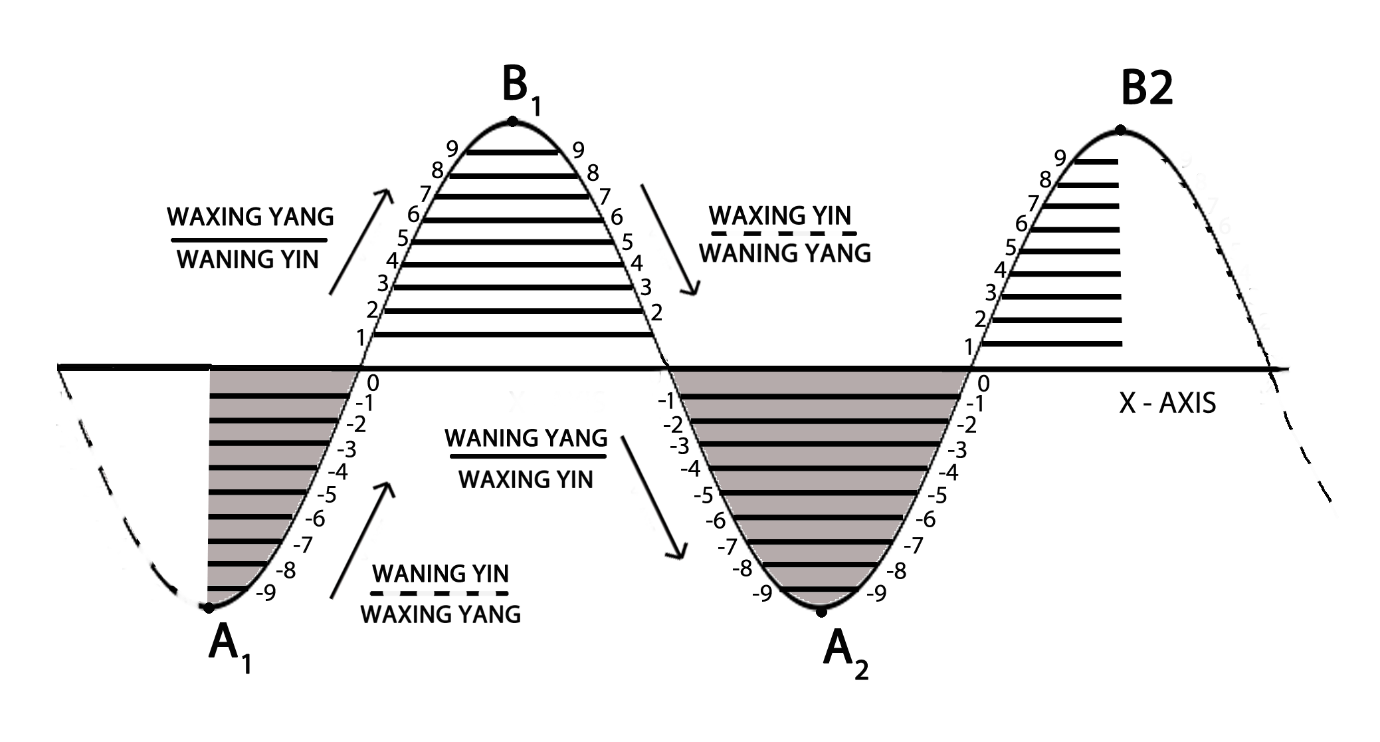
This aspect engenders ever more complex form(s) in existence. The complementary 9 down/up yin portion tracks an alternating call-back under the line of surface visibility. It ranges through palpable yin values of -1 to -9 and vice versa, turning at an invisible Point of Creation (A1). This is also the ‘Heart’ of Be-ing/Void (VII.6). Actually, as yin-yang waves are constantly being pulled through and around each other in reciprocal bouts of mutual waxing and waning (per our tai chi diagram), even that relationship can also be diagrammed conventionally as above. All this involve is making the traditional image more explicate.
Doing so reveals yin and yang as prototypes of immanent duality that are literally halves of one process such that, as decreasing negative yin values ascend from the Point of Creation towards the line of visibility so do corresponding yang values. They reach a mutually balanced 0 state at the X-axis, where after yang continues its ascent towards visible manifestation (1-9) and yin, having released it, becomes passively engaged, masked by an ascending yang that again releases yin’s minimal promise at the height of its own maximum attainment, i.e. at symbolic noon of every d/Day of unfolding time.
Four major states of this relationship are indicated in our diagram, qualitatively evoked as waning yin/waxing yang (-9 to -1, from A1 or symbolic midnight up to visible surface: 0); waxing yang/waning yin (1 to 9, from surface to B1 or symbolic midday); waning yang/waxing yin (9 to 1, from B1 to surface) and waxing yin/waning yang, from surface to A2. Broken lines signify that the waxing quality is masked by the waning one until it is released through a balanced zero point on the x-axis.
Both ascending and descending streams pass through this Zero Point. We can meditate on their motions, the generative stillness from which they arise, or both. This helps us integrate what used to feel like separate spheres of action and contemplation. We can even refine our actions by such means until each one expresses an awareness of Eternal Being awakening to itself in time.
Once this has been achieved an inner state of virtual timelessness arises. Agitation is eclipsed as, centred in Heart, ‘I’ breathe in and out the Breath of God. This can be done by inhaling the potential energy of Void from all directions and exhaling it spherically out into existence. Cosmos is renewed in awareness as Breath is in/exhaled repeatedly from the Heart of Void/Creation via arcs of contraction and expansion, respectively.
The same pattern is also observed across the Days and Nights of other waves, which are still going on. When Consciousness elected to dream existence into Being, the 7/6 imbalance favouring Days over Nights was warranted but we have now internalised this pattern, suppressing the wisdom of Night and its invisible ‘feminine’ realms. We know that the Underworlds have completed while the waves continue after 28/10. What is the significance of this? Considering the ‘Underworlds’ first, already their name provides a vital clue, as does their presentation in terms of levels of a sacred temple.
What world, we may ask, are they ‘under’ in relation to? A short answer is one we would consciously co-create having healed wounds and imbalances incurred during our largely unconscious passage through them. This passage was unconscious in the sense not only that our awareness was building as we went, but also that it focused increasingly on yang-masculine-assertive aspects to the detriment of yin-feminine-integrative ones. Hence we lost sight increasingly of yin constancies and came to act as if we were separate from Earth, each other and All That Is.
With all 9 Underworlds now in place and the action potentials of their corresponding waves fully charged, we stand metaphorically on top of a temple, able to re-view the course of our ascent while also close enough to Heaven to call for the descent of a ‘9-part god’ that many of us are almost ready to embrace. Preparing for this moment has been the purpose of evolution to date. We live now between the promise of its unscripted future and the un-cleared wounds of our still un-redeemed past.
This is why the waves must go on: to re-present time in ways that offer recurring opportunities for healing and conscious integration across all levels of our passage through Under-worlds that have only recently been declared. We need to clarify our collective past before it will be possible to attain our full human potential by embodying Divine Consciousness in time.
Yin-yang and Night-Day as aspects of one integral creative cycle
What is most distinctive about yin-yang symbolism applied to the Calendar is that it illuminates how something is carried from the Heart of Day into the Heart of Night and vice versa, where both motions serve the same vital purpose of disclosure and revelation. The means of this ‘carrying’ is two equal but opposite forces that are actually one in that they serve a unitary process and help it grow. How this works can be verified in relation to the Calendar. For example, it is now 24/10/15 and we are approaching the end of the 47th Night of its continuing 9th wave. During the 18 days prior to October 7 – the Day before the 47th Night that began then – I found myself writing prolifically, by hand, in a notebook. The material came easily, as if insights were literally flowing out. I wrote more than 10,000 unreasonably coherent words over that period, supported by the relentless yang force of an expansive-generative-innovative Day.
Then, abruptly, it stopped. Trying to forge new connections proactively felt like wringing blood from a stone, as if the very force that before had been pushing them out was now adamantly holding them in. This happened as we entered the yin tide of a contractive-receptive Night of the 9th wave. Knowing the form of its periodic alternations, I admitted the reverse flow of this balancing force, allowing it to carry ‘me’ in also. I stopped trying to write new words and spent the time in a relatively passive mode, typing what I had already written and making changes only as needed. Throughout this Night, my most creative periods occurred in the early morning, directly after waking, when my well used mind registers newly-forged insights and associations that have been presented as gifts by the yin consciousness/intelligence of n/Nights. This is explicable in terms of the yin-yang patterning of day-nights of our ordinary kin-based experience, where the ego relaxes during sleep and subconscious information-processing continues although ‘I’ is no longer in a position to supervise.
The phenomenon is well documented in the psychology of creativity, which tells how vigorous conscious scrutiny hits a block, can’t force its way and (crucially) gives up. A period of unconscious incubation follows, leading later to inspiration in cases where a yielding ego is receptive enough to take note. My frequently yielded ego generally is so I am often able to discern by morning unexpected patterns that my waking yang disposition had been unable to grasp before sleep. The same phenomenon happens more extensively across Days and Nights of the 9th and other waves. It is crucial to bear in mind here that yin-yang patterns also characterise the kin-based cycles of ordinary night-day empirical experience and are active through Days and Nights of all ongoing waves. They can be ‘activated’ simply by giving them attention and then relaxing, as in my example. Cultivating such inwardness helps us to participate more responsively in the continuing flow of multi-dimensional time.
Unity after the Shift
The Coba Stone offers a symbolic evocation of accelerating rhythms of the Breath of God, structured with respect to the sacred numbers 13, 18 and 20. The second of these had been relatively eclipsed due to the primacy of tun-based measures – i.e. the reckoning of intervals as 13x20ⁿ tuns rather than 13x20ⁿ⁺¹ kins. Mayan priests of the Classical era were themselves in a baktun rhythm and thus would have been more sensitised to it than others. The subordinate measures of katun, tun and uinal were available to them as cognitive tools needed for time-keeping but not (except perhaps in spiritual imaginings of an elite) as accelerated evolutionary rhythms. Adopting the Izapan start date of 1 August 3114 BCE for the Long Count, its 13 baktuns necessarily end on 21/12 in our terms. This in itself is remarkable but even more important is the fact that the Coba Stone specifically marks an ‘end date’ as such and associates it with the number 13 and our present.
I agree with an academic consensus that the ancient Maya would have expected the baktun cycle to start over, still regulating some variant of their known world. I also agree that attributing knowledge of accelerating evolutionary intervals to their priests is an anachronistic error, again with the possible exception of an elite who, discerning the implications of more encompassing intervals featured on the Stone, might also have been able to project forward. Even projecting so far back seems like an astonishing accomplishment but the fact is that the Stone exists, complete with inscriptions, so someone had the vision of an astonishingly remote cosmogenesis that points forward to a major threshold date in our time of ‘2012.’
That said, it is clear that modern people are more likely to infer an accelerating evolutionary pattern from the evidence of the stone considered as a symbolic device. This is no reason to disqualify their insight. In fact it has been proposed by modern scholars of hermeneutics – the study of assigning meaning to ‘texts’, including those from remote culture worlds – that such dialogical interaction is inevitable across cultural space and time. This means that the meaning of a ‘text’ is never finally given but remains forever subject to new readings from new perspectives. Rather than bemoaning this as a theoretical scandal, we might note that it’s actually closer to how meaning evolves.
We might even acknowledge it as a manifestation of Divine Intent that things had to happen this way during the process of humanity’s collective evolution, which warrants reconciling different insights and positions. I had a chance to discuss with Tata the dilemma faced by his people in responding to calls from within their own tradition to release its treasures to the world while also relinquishing control over what the world might make of them. He feared that the world would get Mayan culture wrong and so was travelling and speaking tirelessly to ensure this would not happen. My view was that it must, in the course of becoming integrated into an evolving world culture. This doesn’t imply that care should not be taken to ensure that only the best ‘readings’ prevail.
Calleman’s account ranks among these. It evokes an evolutionary intent that is intelligently structured and shows clear evidence of design but not (in my opinion) of a pre-set plan whose outcome is already assured. Rather it expresses the ideal form of a generic structuring tendency that creates and falls foul of unforeseen contingencies which it then needs to find ways around. Consciousness evidently needs awakened human agents on the ground, as it were, to achieve this (having unconsciously co- created many of the problems). That is why we must now remember our troubled passage through the Underworlds: to eliminate old wounds and shadow traces associated with them.
Our deformations, relative to an ideal of effortless flow borne by spontaneously arising creation waves, are necessarily linked to processes of wounded self-consciousness and attachment to given form, including psychological form. Calleman’s healing prescription – that we ‘download’ light vibrations from Days (only) of the 9th wave – is of little benefit in this regard. In fact, it could hardly be more reactively dualistic in regard to what we noted earlier concerning the feminine intelligence of n/Nights, as well as the need to heal Shadow traces deriving from our collective passage through the Underworlds.
A space of human freedom arises via deviations from ideal patterns and with it a response-ability to finally come into our own – i.e. to become fully human. We will see later all that this entails. It‘s trying to happen now under circumstances that are similar to those evoked by Mayan accounts of the end of earlier ‘worlds.’ Then the gods withdrew support as it became clear that our humanity would not be realised fully. We appear to have come farther this time around, almost to a point of collectively remembering our origin and destiny. We are also on the edge of destroying ourselves. Calleman’s reassurance that we are products of a tightly synchronised ‘divine plan’ rather than mere chance falls short as a corrective, as does his failure to address our destructive tendencies.
Instead he speculates that after a new generation, born post-2011, ‘downloads’ 9th wave frequencies, ‘we’ will be better able to live in our Hearts and the world will thus be more peaceful. This is facile. It falsely dismisses the continuing threat of unresolved Shadow issues and fails even to note questions that have been raised by orthodox theology for millennia: e.g. what is the salvation of those who lived before it was possible to ‘download’ 9th wave frequencies and so live peacefully from the Heart? Can their suffering ever be redeemed or did the ‘Divine Plan’ knowingly exclude them? And what of people like Jesus and Buddha who did live from Heart and endeavoured to bring peace to the world long before a 9th wave download option was available? How did they manage?
Pressed beyond this point, Calleman’s account is wildly over-weaning. Up to that point, in my opinion, it presents a valid but idealised reconstruction. Over-extending its applicability reduces its ideal patterns to errant scientism. Was it a Divine Plan that we would brutally degrade Earth, or that billions should live in fear and suffering over millennia until a 9th wave finally arose to be downloaded by those lucky enough to live post-Shift. As a redemption narrative, this is conspicuously weak; so is Calleman’s rhetorical advocacy of ‘unity consciousness.’ Not only does he leave its nature unclarified, he also continues to repress by omission yin-Night-feminine aspects that make up half the Unity! This prevents the integration of related psycho-spiritual issues, perpetuating conflict and imbalance rather than fostering a sacred marriage of Light and Dark by bringing them into right relationship so that the full potential of our divine humanity might at last be realised.
7. Time and the Timeless
The 9th Wave lasts 234 days: 13 uaxaclahunkins (18 day periods) or 18 trecenas (13 days). A next stage in the Coba Stone progression, 13x18⁰ x20⁰, would reveal 13 as fundamental and brings us to the scale of ordinary experience, where kins encompass combined day-nights and the trecena marks the basic rhythm of our lives, next to the kin. This has always been the case, implicitly. No theoretical manoeuver is needed to make it so: the 13 of the trecena can thus be realised as fundamental. The Seed-Fruit progression has also now been eclipsed by 13 tones that cycle repeatedly from primal Unity through repeated Ascension into ever more elaborated patterns of greater Unity.
These constitute an evolutionary progression in themselves, which we can engage by following the tzolkin consciously. Its focus on kins with distinct energy profiles as the basic physically patterned temporal units of our lives brings us into an order of subjectively intelligible lived experience that can also open to the flowing presence of Sacred Time. This too is attained by following the tzolkin. It involves realising an implicitly constant intersection between timelessness and successive instants of empirical time in daily life. Experiencing this intersection transforms our experience of time so that it is no longer ordinary but rather becomes known as ‘sacred’ in that it participates directly in Eternity, from which time arises.
13/1 evokes a genetic pattern that inheres in Oneness: 18x260 = 13x360 is thus a basic equation. It shows that the most important sacred numbers – 9, 13 and 20 (18 = 9+9) – are mutually implicated through all levels of the Calendar. The highest frequency at which all these patterns are fully enmeshed is that of the 8th wave up to 28/10 – a span of 12.8 solar years or 4680 (13x18x20¹) days. This suggests that something new must happen in the 9th wave, since the tzolkin can no longer be contained there, as 260 days exceeds 234. This realization only became fully explicit after consistent application of the x20 times acceleration rule exposed the uaxaclahunkin (18 day) rhythm, leading to new effects of disclosure.
Reducing 20 to the power of 0 in the 9th wave focuses attention on another basic organising principle whose role had previously been obscured: the 9 up-down/down-up pattern which characterises every Day and Night respectively. As noted, 20 associates in the Calendar with an invariant sequence of Day signs that unfolds most coherently from Crocodile to Sun. This gently ascending spiral circuit is accelerated and compounded by energies of 13 tones in the tzolkin and 13 Heavens in tun-based rhythms of the Calendar pre-Shift. The 13 of the trecena links intuitively to that of the Heavens but there is one important difference.
In the empirical course of our trecena experience, days and nights flow easily into one another, waxing and waning together; in tun-based Calendar rhythms, Days and Nights are seen as discrete. Calleman distinguishes them in terms of an off/on, de/activation process that effectively reduces Night to a ‘negative’ of Day. Hence Days are said to be active and innovative while Nights are not, appearing only as ‘switched off’ Days. Drawing on experience of empirical days and nights and authentic yin-yang inter-activity, we know that Night has its own specificities, including a distinct form of visionary-integrative intelligence.
Calleman’s relegation of this, in my opinion, is the weakest aspect of his theory and leads to mistaken conclusions which I will clarify as we proceed. The point we must stress now is that ascending powers of 20 have drawn attention away from subjectively evident patterns of experience. It clearly becomes more difficult to track Heavens, now Days and Nights, the longer they last at different structural levels of the Calendar: 360 days, 7,200 days, 144,000 days and so on.
Also, as noted, the 9+9 composition of the 18 count has been consistently eclipsed by the primacy of tun-based symbolism: 13x20ⁿ tuns rather than 13x18x20ⁿ⁺¹ kins. The breaking of this pattern with the coming of the 9th wave, 13x18x20⁰, forced us to look more closely at this and realise that the 18 day (9+9) rhythm of all waves constantly turns back on itself, moving ‘down’ towards in/visible Source after every phase of being projected out from it (5). Moreover, it does so in a fluid continuous way that conforms to the observed nature of mutual yin-yang waxing/waning rather than the on/off binaries of Calleman’s theoretical model.
The role of 13 after 28/10
While the Seed-Fruit progression stopped after 28/10, the trecena got stronger because the full power of all 9 creation waves now expresses through it. In fact we can see the entire Coba Stone progression as leading up to a scenario where the tzolkin or count of kins – day-nights rather than Days and Nights – is foregrounded as the nucleus of a virtual ‘10th wave’ that doesn’t come with a guaranteed 20 times greater acceleration or a prescribed evolutionary focus. Instead it concentrates awareness on energies of the unique day-night (kin) pattern that we are living in empirical time, helping us to be fully present and at the same time open to the unique developmental promise that every new ‘day’ brings.
We can co-create powerfully with this trecena rhythm but only via pro-actively conscious alignment. This brings us into the flow of Sacred Time, including an integral 13/1 Unity-Ascension-Unity progressive cycle that is exactly of the type manifested by the watercourse way of a planted seed in nature and the Tao. It is carried by the trecena and expresses an initially constrained evolutionary tendency. Here the progressive potential of a ‘seed’ is ruled by a given cyclical form/frequency in time, like seasons of the year. It inheres in Be-ing but depends on freely engaged co-creative intent rather than imposed pre-Shift ‘accelerations’ for continuing liberation and fulfilment. Without such conscious participation, inertia will prevail.
Hence I engage the tzolkin platform after our Shift, not as someone seeking an auspicious time to pray to an external power for this or that. Rather I see it as a way to align with a stream of Becoming that inheres in the pure activity of Be-ing, resolved to co-create with this power where our ancestors might have been content to petition. This represents one aspect of coming into spiritual adulthood and reveals a purpose for the extended sequence engraved on the Coba stone, subject to Calleman-inspired amendments.
Consider: the stone’s hierarchically nested series of unimaginably long pre-cosmic Days and Nights continues through the creation of our Universe to the momentary fusion of 9 primary waves, bringing us to a point where the Seed-Fruit progression abruptly stops. We are then thrust into renewed awareness of the tzolkin as a device that regulates the expression of Divine Consciousness in time and highlights tangible day-night units of ordinary experience. This happens not just due to a developmental impulse that inheres in the tzolkin but also because the evolutionary force it regulates has been amplified through 9 quantum leaps and Seed-Fruit progressions, corresponding to 9 palpable creation waves.
The Stone also indicates 14 precursor waves, stretching back to a beginning of time, not as scientifically defined in terms of physical cycles but rather to a moment when the apparent stillness of so-called transcendent Consciousness first initiated movement, and thus sequence, and thus what we may call metaphysical time. We have seen that the process involved is highly structured. This is hardly surprising as it manifests an intelligence capable of birthing universes. The same intelligence is apparent in Calendar structure as evoked by the Stone. Again, it shows scant respect to disregard specifically noted intervals as superfluous because they don’t fit a favoured schema. We need to improve on this.
The best I can propose for now is that the 13x20²¹ tuns segment, at the top of the stone, points upwards, indicating a ‘higher’ realm beyond time, a timeless Source from which what we call ‘time’ and material reality proceed. Hence, the powers of 20 might extend back indefinitely to a 13 Heavens progression of such low frequency that it approximates the apparent stillness from which it arises. We will see that this arising happens via a primal de-coupling of formerly undifferentiated yin-yang powers, regulated by the active self-commissioning of a mythic Breath of God. Such ‘poetic’ language is necessary to pursue essential metaphysical relations outside the boundaries of physical space-time.
In any case, the visible intervals suggest a systematically ordered sequence of accelerations that happen within a highly structured unfolding. This reflects the underlying intelligence of a metaphysical Source that it also expresses, to a point where it successfully dreams existence into Be-ing. At the same time, qualitatively, it might also be taken to indicate a series of ‘precursor universes’ that were necessary to establish an informational platform adequate to support the emergence of our universe, bequeathing sufficient complexity for it to have a real chance of producing ‘full human beings’ (V.1).
There is no need here for a ‘God’ to know in advance what a ‘full human being’ would be like. From a philosophical perspective, ‘God’ functions as a mythic symbol that reveals or conceals (depending on our attitude) the mystery of pure Be-ing/Consciousness that it purports to name. ‘Fully human beings’ refers to evolving consciousness forms that have awakened sufficiently in time to remember our origins in pure Be-ing/Consciousness beyond it, without precluding scope for further development. I will argue later that this awakening is what the Shift of ‘2012’ is really about but there are other patterns that must first be made explicit.
Let us begin by noting a convergence with the Mayan myth that tells how ‘the gods’ wanted to create a fully human being. This relates to why Calleman chose the 13x20⁷ tun segment to mark the beginning of our universe. It is arbitrary with regard to an over-arching cosmogenetic process suggested by the Stone but fitting with regard to the time span it indicates. We might even suspect that earlier universes failed to generate enough complexity to get past the level of Calleman’s first wave. Ours would then become the first that proves capable of sustaining the developmental unfolding of a 9-step ‘god,’ thus making possible the emergence of a fully human being.
We will learn more about this later but it is worth stressing now the mythic resonances of a 9 stage developmental process. Not only does this fit with the Mayan and other mythic traditions, it also fits a broader numerological schema where a tacit, undifferentiated Unity (Void) projects out of itself and unfolds across 9 stages to achieve articulated Unity at a new level of awareness. The ‘1’ of this articulated unity then enters into relationship with the implicate unity (0) of its Origin in Void, signifying that the new Unity is now explicate and marked by reflexive awareness. This represents a crucial stage in our quest to become full (spiritually aware) human beings.
With regard to the Coba Stone, it suggests that it is feasible to propose that intervals above Calleman’s 13x20⁷ tuns segment refer to precursor universes or at least pre-cosmic information waves, while those including and below it refer to a 9 stage developmental process required to engender a fully human being (awakened agent of Divine Consciousness) in time. Hence the Coba Stone as a symbolic device indicates that there is a direct, continuous and highly structured relationship across all intervals from 13x20²¹ tuns down.
This apparently aims to equip (evolving) consciousness (forms) in time to be fully present here, where being fully present entails remembering all that we are and have been, including our origin in a Source beyond existence and time. For this reason, it is no accident that the Stone markings compress evolving consciousness into ever more frequently occurring ‘cycles,’ shaping it from dispersal across virtually infinite, subjectively intractable meta/physical time intervals into ever more concentrated spans, down to the 18 day rhythm of our 9th wave.
I qualify my use of the word ‘cycle’ because it is a theoretical and hence idealised term that doesn’t apply exactly because – even across 13 Heavens of the same wave – an evolutionary power moved the Seed-Fruit progression such that no two Heavens could ever be exactly alike or, therefore, ‘cyclical.’ Pressed to its ultimate conclusion, this implies that no two moments could ever be exactly alike, because there was always a growing evolutionary force moving them on. Post-Shift this is no longer so. The force of evolution has attained maximum value(s), calibrated across 9 levels to promote 9 specific developmental projects that have yet to be fully integrated to actualise the consciousness potential of a fully human being.
This 9-step god, in order to become whole, must integrate her/his ‘parts’ as One. Our role of agency is critical in this regard. The immediate issue we must face is that divinely impelled evolutionary acceleration has ceased, meaning that if I attune to its maximum values as I am carried by them – let us say in meditation – I become unmoving in relation to their constancy, much like Einstein riding an imaginary light beam. But yet I still find myself moved to evolve from within. How can this be and what can it mean?
Again it suggests that there is something intrinsic to the nature of Be-ing as pure activity that disposes it to become. An un-manifest becoming of Be-ing is evoked by precursor waves on the Coba stone – i.e those above the 13x20⁷ tuns segment that introduces Calleman’s 9 creation waves. These manifest the becoming process as they govern the evolution of material rather than immaterial form. Once a material universe has been projected by Consciousness and life forms engendered, evolution becomes more and more explicate as its rate of unfolding increases.
The process achieves a crude reflexivity as human life-forms attain ego-centred self-awareness. This is initially debilitating in a spiritual sense because it focuses awareness on ‘inner’ subjective processes that appear to separate us from ‘outer’ reality. When this initial stage is followed by a later one of ‘awakening’ our ego-driven illusion is shattered, allowing us to remember our origin and find our specific purpose in relation to Be-ing/Consciousness.
Such awakening in us is also an awakening in and of Be-ing/Consciousness. It constitutes a watershed moment in evolution whereby Be-ing/Consciousness becomes increasingly articulate/d and disclosed. The ‘awakening’ of reflexive human consciousness in existence and time thus serves to make the entire process self-aware. Also, our availability as awakened agents of conscious evolution means that chance elements can be reduced in future unfolding.
To achieve this, we must align our local knowledge co-creatively with the structuring intent of Divine Intelligence. This requires opening to inspiration and being guided by it beyond our ‘rational’ ego need to stay in charge. A radical transformation of our psychology, individual and collective, is thus warranted. This stands between our goal of ‘awakening’ and its realisation. Again, current calendar provisions support but can’t force our deliverance, ultimately from a mistakenly diminished sense of what we are.
Time/lessness
Time inheres in timelessness and vice versa. We see this as we realise that every instant, no matter how fleeting, is shot through with the flow of Becoming. Equally, every instant is also one where timeless Be-ing can be intuited as a pre-condition of Becoming, which also expresses Be-ing. Once we admit an intuition of timelessness into our experience of time, everything changes. ‘13’ evokes the most constant developmental cipher across all segments of our amended Coba Stone, from 13¹x18¹x20²² kins to the trecena (13¹x18⁰x20⁰ kins).
Dividing again by 13 brings us down to single kins (13⁰) and the inter-penetrating day-nights of everyday experience. Then, regarding the symbolism of 13/1 – where ‘13’ represents the genetic-evolutionary principle and ‘1’ the Constant of Unity – we see that ‘13’ could in principle be divided infinitely into any unity to yield ever more microscopically focused ‘instants’ which are simultaneously windows on the pure activity of timeless Be-ing and vehicles for its expression as Becoming in time.
After the Shift of 28/10, people reported a sense of timelessness or of time slowing down. This was at first attributed to the descent of all waves into a receptive ‘Night’ phase (since the activity of Days was suddenly ‘deactivated’ in Calleman’s terms). The explanation proved to be only partly correct as it later became clear that no wave-driven evolutionary increments were any longer motivating a Seed-Fruit progression, meaning that it no longer applied as before. It was thus much easier to be still while attuning to the constancy of an ongoing 9th wave, including through Nights where the same impetus carries us in rather than out, as during Days.
This was certainly a feature of my experience and heightened my sensitivity to timelessness and the transcendent, disposing me to reconcile long-standing impressions of evolutionary mysticism I associated with the Calendar with a renewed sense of transcendental mysticism that ‘the end’ had mysteriously precipitated. At the same time, my experiments with a virtual ‘10th wave’ made clear that the shortfall in evolutionary impetus entailed by a capping of all 9 waves at the frequencies attained on 28/10 urgently required substituting fully human initiative for the regime of driven acceleration that had previously obtained.
Division by 18 is a pretext for disclosing this metaphorical 10th wave, suggested by the precedent of reducing 20¹ to 20⁰ to disclose the 9th. Doing so brings awareness to kin-based patterns of ordinary experience, where accessibly fluid day-night patterns replace supposedly abrupt alternations of Days and Nights at more encompassing levels. I realised then that the Coba Stone array had always been building towards inserting embodied consciousness fully into physically patterned rhythms of our human being as fundamental relative to the virtually infinite extent of higher tun-based intervals and the infinitesimal focus of my earlier realisation that an evolutionary impulse moves through every instant, no matter how minute.
Thus my formerly tacit pattern of unreflective immersion in the natural scale of worldly experience was blown open, in keeping with a general implicate to explicate developmental tendency. Within this, the power of the trecena as a carrying wave became increasingly apparent, far more than before because I was now more consciously engaged in the patterns of my own experience, more focused in every moment, more still and more aware of timelessness around and even in time. This led to an awareness of Sacred Time as a constant intersection of timelessness with ongoing moments in the flow of empirical time. (The significance of this will be developed later.) It also permitted me to realise how the tzolkin has now been empowered by the Shift and has the maximum energies of all 9 waves flowing through, amplifying the un/conscious intent of all our actions.
At this level of awareness we are disposed to make our own sense and our own choices – aided by persistence of the tzolkin and the inertia of all 9 waves, now continuing at maximum power through mutually balancing Night/Day cycles. These can help us achieve newly harmonious creative expression, provided we do more than indulge habits engendered over decades, centuries and millennia prior to a Shift that sought to make actual a divine urge to ‘seed’ Consciousness in full (self-remembered) humans on Earth. This evokes a process I have experienced ever more strongly while writing: from recollecting my origin in a Sacred Mystery that was there before what science views as time to dreaming my future as integrally aligned with its continuing self-disclosure through ongoing evolution in existence.
Notes:
(1) Mayan culture reached the height of its creativity during a ‘classical’ period that lasted from roughly 200 BCE to 850 CE. It had suffered total collapse by the end of the 9th century, evidently due to effects of warfare and drought. Although the culture revived partially thereafter, the Long Count has been neglected since. The 16th century brought a Spanish invasion that sought to eradicate all trace of indigenous spiritual forms. Books were destroyed and priest-shamans killed, leaving only a handful of codices to augment mysterious stone records that were mostly found in old cities, many of which had already been abandoned and reclaimed by jungle.
(2) The Calendar is ‘sacred’ not in a vague New Age sense but because it purports to reflect the unfolding of Divine Intent through multiple cycles of empirical time from a point of origin that arises in Consciousness before time. It asserts the primacy of Sacred Time – time as informed by the timeless intelligence of transcendent Consciousness – against the repetitive banality of profane ‘empirical’ time. That’s why it is important to recall the symbolism and rhythms of its tun-based (360 day) year throughout an accumulation of 365.25 day solar years imposed by the Spanish to promote colonisation, efficiency and true ‘faith’ over direct participation in the unfolding of Divine Consciousness through time. Note that the Resolution of 12 adverted to in text reconciles diverse energies in harmonious balance, letting the Ascension power of 13 gather in its midst. This leads to a fruition of one cycle and the seeding of a new, higher one. Ascension follows from gifts of new awareness so induced. Never repetitive, 13 forever begets new Unity. As fruit and seed, it carries adventures of Oneness through cycles of self-realisation in time. In western esoterica it evokes the Christ principle, which we will later present as the evolutionary Consciousness of Divine Being made manifest through the revelatory process of existence (Parts VIII, IX).
(3) See Carl Calleman’s ‘The Mayan Calendar and the Transformation of Consciousness’ for an exposition of his pre-Shift position and ‘The Nine Waves of Creation’ for a more recent account.
(4) This scenario permits us to see how a ‘9 part god’ is virtually re-assembled in time when all its constituent frequencies are simultaneously compressed into a minimal instant that mirrors in existence and time the Zero Point of Creation from which all the ‘parts’ emerged. It engenders a template in time, imaged at the centre of our spiritual Hearts, for the existential realisation of an explicate Unity (1) that derives from the primal implicate Unity of pure Be-ing (0): i.e. for a spiritual awakening as implied by the words I AM THAT I AM. The significance of this is developed greatly in later Parts.
(5) The 18 had always been hiding in plain sight. There are 18 uinals (20 day periods) in a tun but 20 of everything else everywhere else, all the way up the Coba Stone. Before Calleman, no one had thought it amiss to divide tuns by 18 to establish 20 as fundamental at uinal and kin level although it is clearly anomalous with regard to the x20 rule that governs frequency escalations on the Stone. Applying this principle consistently reveals 18 as fundamental also, suggesting that it serves a basic purpose. It does work, in other words, while the alternative of dividing by 18 is merely a case of formal necessity made to seem primary by the overlooking of something more essential.
(x) There are grounds for confusion here. Firstly, the root metaphor of a Seed-Fruit progression is just a metaphor. Hence there is no suggestion that spring will now no longer lead to summer, just as there was none before. The point is that there was always an underlying cyclical structure through which a super-natural evolutionary impulse played within, between and across waves such that its effects registered primarily on human Consciousness in time and only indirectly on our natural and cultural worlds as a consequence of this spiralling developmental process. The rate of associated developmental change accelerated according to our 13x18x20ⁿ formula up to the simultaneous completion of all 9 primary Creation waves at symbolic midnight on 28/10/11. The spiritually mandated acceleration process reached its maximum value on that occasion. There would be no more ‘forced’ acceleration from that point, meaning that our human consciousness is now left to make what it will of a fully charged calendar system, e.g. by remembering per 9th wave yin indications as noted and/or continuing a pattern of runaway yang tendencies exponentially induced since the 6th wave. Our challenge is to find a balance here.
Calleman’s point is simply that, since the simultaneous completion of a 13th Heaven/7th Day across all waves, and since all 9 fused momentarily on that occasion, there is no longer any triggering of a quantum leap to a new x20 times accelerated wave frequency. Hence there is no longer any need to start over from 1, as if on a new level, after every next 13th Heaven is reached. Thus Calleman counted 29/10/2011 as the beginning of a 14th Heaven for all waves and has continued in that vein ever since. This doesn’t mean that the evolutionary impulse as charged up to 28/10 simply disappears but rather that it persists at the same rate, leaving us to adapt as we will with regard to old patterns that continue to recur, presenting us with constantly renewed opportunities to achieve balance across intrinsically balancing Day-Night pairings that continue to recur, including every 7th Day as now balanced by a recurring 7th Night (something that couldn’t happen before 28/10). Hence the 13.13.13.13.13.13.13.13.13.0 will never again be observed. Rather it becomes …13.13.14.0 after 18 days/kins because 18 kins = 1 uaxcahunklin; and 13.14.0.0 after another 6 uaxacahunklins/108 days because 20 (14+6) uaxacahunklins = 1 katun. As 20 katuns = 1 baktun etc. the whole series tends towards as ideal of achieved Unity that will be attained 16.4 billion years from 28/10/11 and may be represented as 1.0.0.0.0.0.0.0.0.0; i.e. the reverse of 0.0.0.0.0.0.0.0.0 (1), with which our trajectory from implicate to explicate Unity mythically begins (see I.7).
Nevertheless, despite qualitative discontinuity introduced by the fusion moment of symbolic midnight on 28/10, the internal structure of the old wave patterns should also be expected to persist, at least theoretically, without the forcefully determining impact of before (pre 28/10). This is so because the impact of the earlier waves (1-4) has long since been superseded by the impact of later, higher frequency ones, again exponentially from 6 to 9. Our challenge is again to bring new patterns associated with the 8th and 9th waves, particularly, to bear on attaining a harmonious balance across the entire spectrum, especially with regard to the ruinous impact that unclarified traces (habits and wounds) inherited from earlier Underworlds still have. Consider for example Nazism’s embrace of the ancient Teutonic deity Wotan, or militant-expansionist Islam’s of a sectarian Allah, or 21st century Israeli fundamentalism’s of 3,000 year old Yahweh, once a jealous god of storms and war, currently revived as such. All these are manifestations of Calleman’s 6th (National) Underworld that have been paid forward into our time and now need re-processing in light of ‘higher’ perspectives introduced by later waves and, especially, an integrative potential made possible by 28/10. There is a huge backlog of clearing to be done in this regard, largely due to our failure to appreciate first time around how pre/historically determined patterns of collective un/consciousness were engendered and why/how some still need healing via a mode of second coming that unfolds in and by means of Consciousness. These themes will be specifically addressed through later volumes of this work.
Part II: The Spirituality of 2012
On October 28, 2011 I participated in a Sacred Play to mark the ‘end’ of 9 Creation waves described by the Mayan calendar. Its impact left me physically exhausted for a month. During this time, I wrote several articles that helped me understand the nature of what had happened. This had little to do with catastrophes or instant transformations of consciousness. In fact, a lack of such obvious signs inclined many to dismiss the date as mistaken and focus instead on the better-known date of 21 December, 2012. I felt impelled to focus on a Heart meditation that I had practised for several years and to review major intellectual sources that I had admired during an earlier period of my life but had not attended to for decades. I was surprised by this and not very pleased, having spent most of the previous 20 years shifting the centre of my consciousness gradually out of my head into my Heart. Over the last five years, I had succeeded and grown used to acting from my own intuition and wasn’t sure what it might mean for me to revisit scholarly sources or what it might imply in the longer term. Having started, I realised that my goal was to establish a clearer understanding of what was happening with the calendar in the period after 28/10/11 in relation to 21/12/12. This proved to be more revealing than I could have anticipated.
1. Rudolf Steiner’s Cosmogenesis
One major difficulty I faced in pursuing my review was a lack of integration between academic and esoteric sources. My sense was that it is too early to bridge this gap definitively but necessary to make a start. Intuition directed me to Rudolf Steiner for a baseline. Steiner lived from 1861 to 1925 and was truly a universal genius, perhaps without equal. My focus here is on his Creation myth. Unlike orthodox scholarship, which starts from a beginning point in time and traces the unfolding of consciousness from that, Steiner’s esoteric approach assumes the priority of Consciousness and seeks to illuminate how it organises the emergence of material form in space-time.
Since he operated in a Christian cultural milieu, Steiner couches his account in terms of a gradual ‘descent’ of Consciousness through levels of angelic hierarchy. Thus he reveals that the Seraphim ‘gave of their substance’, which was taken up and worked on by the Cherubim, who in turn gave of theirs. This process was repeated down through intervening levels until it was the turn of the Archai, Archangels and, lastly, Angels. Humans were then ready to emerge, assuming a vaporous, water-based form on Lemuria. It wasn’t until its successor civilisation, Atlantis, that we developed physical bodies. No dates are provided until after Atlantis, beginning with (Asian) Indian civilisation, which is said to have flourished from 7227 to 5067 BCE.
This is much earlier than orthodox histories of India, which usually start from 2000 - 1500 BCE. Steiner’s account is esoteric, of course, and was said to derive from direct clairvoyant reading of the akashic record, a facility normal scholars are denied. Steiner proposes that the role of Indian civilisation was to develop the etheric body, which animates and holds together the physical body. This represents a first crucial stage in humanity’s separation from the spiritual worlds.
The next major step was taken in Persia between 5067 and 2907 BCE, where the astral body developed. This is said to leave the physical body during sleep and travel out into spiritual worlds, returning with impressions that are meant to guide embodied consciousness in its passage through the material world. The next major civilisation that Steiner describes, the Egyptian, flourished from 2907 to 747 BCE and cultivated the sentient soul. This underpins an intelligence of pure feeling and is responsive to imprints deposited by the returning astral body. It thus satisfies a further condition for the possibility of our independence from the spiritual worlds.
The next civilization Steiner describes is the Greco-Roman. It lasted from 747 BCE to 1413 CE and was charged with developing what he calls the intellectual soul. This supports a nascent power of individual thinking and fosters the emergence of a robust ego structure around which consciousness reconfigures. This rise of the ego in conjunction with the intellectual soul consolidates our growing separation from the spiritual worlds and by the year 30 CE, in the context of the Roman Empire, human consciousness has descended utterly into the decadence of brute materialism.
At this point, according to Steiner, the Christ being descends from the Heart of the Sun into a specially prepared human vehicle, Jesus of Nazareth. This happens at the moment of his baptism by John. Following Jesus’ crucifixion, the consciousness of the Christ being enters Earth’s consciousness field with his blood. Its impact serves to ignite a movement of spiritual evolution back towards Source, following a period of spiritual devolution down to incarnation of the Christ being as described.
Further development of the intellectual soul is an integral aspect of this evolution. The separation from spiritual worlds that it promotes was necessary in order that human beings could develop a capacity for freedom that manifests as independent willing and thinking. This jumps to new levels in the next civilizational cycle Steiner describes: the Northern European, which runs from 1413 to 3573 CE. Its purpose is to develop the consciousness soul.
The task of the consciousness soul is to integrate accomplishments of the intellectual soul. This entails realising the need for humans to have asserted a wilful mastery over nature by technological means and then moving to rehabilitate the wounds that this engenders by filling Earth with compassion and love. The turning point is the start of the 20th century, which is also when Steiner began his mission as a spiritual teacher. He insists that devastations wrought by humanity’s wilful, separatist, technologically enhanced intellectual consciousness are integral parts of a Divine Plan. Without getting lost in unconscious pursuit of a latent destiny, we choose our return to a path that was always prepared for us, aiming to enfold hard-won gifts of freedom back into a continuing process of spiritual evolution.
[Steiner includes the current US in Northern European civilization. He also evokes two later civilisations, the Russian (3573-5633) and the American (5633-7793). Their purpose is to develop what he calls the Life Spirit and Spirit Soul, respectively. It is not possible to discuss these consequentially now since their purpose far exceeds our current horizon, whose focus is still to redeem the career of the intellectual soul and the gift of freedom it endows. It is also worth noting that each of Steiner’s cycles lasts for 2160 years. We will return to this.]
To my mind, Steiner offers an example of mythic thinking that frames a relationship which is crucial for understanding what is trying to happen on our time – namely, integration of the intellectual soul. We will see that this is profoundly congruent with the vision of Jean Gebser, a 20th century mystical intuitive who was also a prodigious scholar. Noting this, I realised that I had been charged through my review to integrate certain fruits of my early career and thus to accomplish a personal rehabilitation of my own intellectual soul. The consciousness soul can’t flourish without this integration.
2. Yogis, Yugas and Big Numbers
I want to extend our framework by reviewing an (Asian) Indian creation myth. It tells how Vishnu lies stretched out on waters of the Cosmic Ocean, asleep. As he sleeps he dreams and as he dreams, a lotus grows out of his navel. Its petals open and the god Brahma emerges from it, sitting upright and four-faced. Being four-faced entails that his gaze projects the four directions and with them impressions of our world. In fact, every time that Brahma blinks a new World Age is initiated.
A World Age divides into four stages which, taken together, constitute a Maha Yuga (Great Age). A Great Age lasts for a total of 4,320,000 years. It happens that Brahma blinks 1,000 times for every one of his ‘days’, which brings us to 4, 320, 000, 000 human years. There are 720 days (kalpas) in one of Brahma’s ‘years’ and 100 such ‘years’ in every life of Brahma, which amounts to 311,040,000,000,000 human years.
At the end of this time, the directions and the world are drawn back into Brahma, who is drawn back into the petals of the lotus, which is drawn back into Vishnu’s navel. The navel is drawn back into the sleeping god and the god into a formless, once more undifferentiated ocean. There follows a period of dreamlessness and silence. This lasts until the cycle is renewed and the whole process starts again, over and over, repeatedly, each time playing out in exactly the same way.
There are many points that could be made in relation to this story. I will concentrate on just a few. The first is that its stress on eternal recurrence is generally taken to stress the utter unimportance of the ego in Hindu tradition. We have seen how markedly this contrasts with Steiner’s emphasis on the need for ego development as an integral aspect of spiritual evolution. This is largely explicable with regard to different Underworlds in which the two mythologies arise.
Even now, there is a suspicion of Hindu spirituality in the modern West as regressive (in Jung, for example) because it seeks to draw consciousness out of time and back to ‘Source’ rather than forward into the adventure of existence. As we shall see, there is a pressing case for integration here. Attempts at bridging are currently under way: witness our appreciation of the need for non-attachment to ego accomplishments even as we allow their historical necessity viv-a-vis differentiations of consciousness in time.
Also, the Vishnu story names a Great Mystery that is overlooked by most exponents of Big Bang theory. The Big Bang has happened. A great fireball flared for a million years, generating inconceivable light and heat. As it cooled, an ocean of hydrogen atoms was left behind which somehow evolved into everything we know today as the elements of our Universe. But how did the ‘Big Bang’ come to be? And how did its unfolding come to be marked by such exquisite signs of non-accidental, intelligent design?
In our myth, Brahma represents what I refer to as Visible Source, much as the Big Bang does in our current scientific mythology. Behind this visible Source lies an invisible infrastructure, whose symbolic role in our myth is to suggest how Divine Source or Pure Consciousness ‘dreams’ the world into existence, projecting it via a proximate ‘tangible’ Source which must not be mistaken for an ultimate intangible One. (This is why Steiner never speaks of ‘God’ in his mythological rendering of the Mystery and also why Meister Eckhart says we must get rid of ‘God’ to go to God. It also relates to unnamed higher-order time cycles on the Coba stone that Calleman and everybody else leaves unremarked.)
There is another Hindu teaching that can be usefully considered at this point. It has to do with the ‘5 Sheaths’ and describes various bodies, gross and subtle, that enfold Spirit in us, thus conditioning our experience as incarnate. From the outside in, the first is called annamayakosha, or ‘body made of food’ and refers to our physical body. The next ‘sheath’ in is called pranamayakosha, or ‘body made of prana’. This is the first of three subtle bodies and corresponds to Steiner’s etheric body. The next is called manomayakosha, or ‘body made of mind’. This refers to what we might call the mental body and corresponds to a level of individualised, embodied intelligence that we identify with from the perspective of ego consciousness.
The next sheath is called vijnanamayakosha, or ‘body made of wisdom’ and refers to the presence of Divine Intelligence in us, and in all nature. If this seems abstract, consider a zen maxim that states
sitting quietly, doing nothing,
the grass grows quietly by itself
Vijnanamayakosha is an order of intelligence that regulates the growing of the grass, without need for thought or intervention by us. It precedes and succeeds us. In fact we are expressions of it, as it regulates all forms of organic generativity, from sexuality to the production of myths and dreams. These emanate from a much deeper, higher level than the rational mind can hope to comprehend.
Anandamayakosha is the innermost sheath, our ‘body made of bliss’. It evokes a generative core, or ground (arche), of spiritual consciousness from which all forms of life pour endlessly out into existence, without thought for what fate is to befall them. The nature of this core spiritual awareness is pure bliss and if we were able to access it we would instantly lose all attachment to the forms in terms of which our experience as embodied is given. Seeing past form, we shed attachment and become free, living out from this radical, core experience of bliss.
In fact, apprehended at the level of manomayakosha only, the phenomenon of life makes no sense. Grass is driven up week after week only to be relentlessly cut down. What is the point of this? We are born, become conscious, suffer, grow old and die. Why? Where is the purpose in it? What justification is there for it? Existentialist philosophers, reflecting on such issues from the perspective of manomayakosha only, conclude that there is no justification, no reason. Hence they conclude that all life – especially human life, which is afflicted by self-awareness and can notice – is fundamentally and irredeemably absurd.
No rational argument can circumvent this. It is only by maintaining a relationship of openness to a deeper, more encompassing level of ‘mind’ that manomayakosha – or what we might call rational consciousness – can function properly and be fulfilled. Trying to operate alone, it produces only effects of alienation and discontent. This is what rational-scientific consciousness has attempted during the modern period and also what it has achieved. Only by re-orienting via the mythological consciousness of vijnanamayakosha and connecting again with the formless bliss of anandamayakosha can the truth of our existence be realised, not just by intellectual means. This echoes Steiner’s call for rehabilitation of the intellectual soul.
Finally, whether we date them from 7000 or 2000 BCE, the enormity of time spans envisaged by our Vishnu myth is quite staggering. They dwarf the 16.4 billion years proposed by Calleman’s calendar reckoning and raise intriguing questions as to how human imagining could apprehend such numbers so early, as orthodox scholars would say, in the development of our classic civilizational cycle.
It is also remarkable that all the large numbers in our myth add up to 9 and that all are multiples of 2160, which is the length in years of Steiner’s civilizational cycles. These numbers spread from India into Sumer. They were then inherited by the Babylonians and absorbed by the Hebrews, who carried them on into Biblical and mystical Christian tradition, as in the Book of Revelations. Numerologically, 9 marks the end of one phase or cycle and heralds the start of another. We have already noted its prominence in Mayan tradition, especially with reference to the 9th wave.
Also 2,160 is the number of solar years in one month of a Platonic year – i.e., the length of time it takes our sun to pass through one House of the Zodiac, as viewed from an Earth perspective. It takes 12 such ‘months’, or 25,920 solar years, for a complete revolution. Many calendar commentators note that the Mayans speak of 5 ‘Suns’ and associate this with repetitions of the Long Count: five Long Counts would take 25,625 years to complete. This is not very far from 25,920, which is also linked to a 26,000 year precessional cycle that is said to culminate on 21/12/12 (1).
From the perspective of a Mayan Daykeeper such opportune conflations rank as unmitigated scandal but they also help to account for recent proliferations of interest in our 21/12 ‘End’ date. This has been compounded by media sensationalism and could be dismissed as a casually posited, cynically exploited consumer fetish. Against this, the date had a potential to focus human co-creative intent in a conscious and consciousness-promoting manner. It has also been non-coincidentally triggered by the Izapa dating and retains a power to excite awareness and focus debate in what remains a time of great crisis and opportunity.
3. Jean Gebser’s Consciousness Structures
Jean Gebser was a German linguist, poet, philosopher and cultural historian who lived from 1905 to 1973. As well as being a prodigious scholar, he had profound mystical tendencies. This is reflected in the title of his best known book, ‘The Ever-Present Origin’. Published in 1952, it evokes a primal state of consciousness that remains available to humans through a series of decisive restructurings in both our personal and collective evolution. Many theorists propose developmental stages but say that as we progress earlier levels are left behind unless our growth is derailed. Gebser is unique in positing that all structures remain present and alive in us, even though we tend to identify with the most current. This resonates with the calendar, where all waves continue to co-exist simultaneously down to a common ‘end’ point and beyond.
Gebser calls the first, fundamental consciousness structure archaic. This comes from a Greek word arche, which means ‘ground’ in the sense of ‘origin’ or ‘foundation.’ Archaic consciousness refers to what consciousness was at our beginning and is also what Gebser claims to be ‘ever-present’. Despite this, in a finely argued, densely printed text of over 600 pages, less than three are devoted to this fundamental state. Since it is pre-verbal and pre-conceptual, we have no language to describe it or memories to hang our words upon. One of the few references Gebser cites in relation to it is a quotation from Confucius that ‘The true men of old never dreamt’. Never dreaming implies a complete lack of psychic differentiation: no ego or unconscious in need of reporting to it by indirect means. This implies a condition of seamlessness, of no separation, within and without, as at our absolute beginning.
Again, I have been following a Heart meditation since 2006. It opens with the words ‘Spirit take me deeper, deeper and deeper into my Heart/ Take me right back into the Point of Creation/ Let me be and act always from this Source of All within…’. I have had several quantum leap experiences with this practice. During the first week of January 2012 I was meditating around the same time as I was re-reading Gebser. When I came to the line ‘Take me right back into the Point of Creation’, this point opened at the centre of my spiritual Heart and ‘I’ had the experience of a Void or ‘Quantum Field’ opening in me, as if ‘my’ consciousness both contained and was contained by it.
The most astonishing thing about the Void is that it’s not empty, even though there are no ‘things’ of any description present in it. Rather it consists of pure creative potential, pure generativity. My experience of it was ecstatic, as if I had chanced upon an Abode of Bliss. I knew immediately when it happened that ‘I’ – or Consciousness in me – was experiencing what Gebser calls ‘the ever-present origin’ and that this corresponds, terminology notwithstanding, to anandamayakosha in the 5 Sheaths tradition. The experience lasted about a half hour and was repeated several times during that first week. I also found a way to develop it in relation to Gebser’s second consciousness structure, the Magical, through sacred movement (2).
The magical consciousness structure refers to a gradually manifesting point of view that emerges within the archaic but is still utterly embedded in the flow of enveloping nature. There is no experience of separateness involved, although differentiation has begun to unfold. Imagine consciousness on first finding itself in a body, looking out through a pair of eyes at a tree, a rock, an animal, or river. With every refocusing, new content arises to fill the screen of a beholding which doesn’t yet know itself as other than the beheld. When does it become conscious of itself as the common denominator across a shifting spectrum of visual arrays?
This question reminds me of Brian Swimme’s description of the quantum vacuum as seamless and centration as a primary power of the universe that manifests within it (below). He gives an example from the early universe when, after several hundred thousand years, a vast ocean of hydrogen atoms comes into existence. No sooner does this happen than the ocean fractures into a multiplicity of centres that give rise to galaxies which, in turn, centre within themselves to produce stars. Likewise, I realise, I centre in myself every time I wish to produce something new in alignment with universal creativity. This too is an example of the universe centring on itself and illuminates the genesis of our magical consciousness structure (3).
The process of centration goes on as long as the universe produces differentiated centres of consciousness, including us. Gebser’s magical structure evokes an early stage in this process where differentiation is under way but has not led to any sense of separateness yet, much less distinctive self-awareness. He cites an anthropological record of a Bushman hunting ritual to illustrate: a woman and two men go early to a clearing. One of the men outlines the figure of an antelope on the ground. As the sun rises and light strikes the image, the woman shouts. One of the men throws his spear into the image, piercing the ground. The spear is then withdrawn and the two men set off. Hours later they return carrying an antelope, whose wound matches exactly that of the figure on the ground. The image is then washed with the antelope’s blood and the ritual is complete.
The success of the magical operation described here turns on intimacy of communion between human actors and their environment and the innocent, unselfconscious nature of their immersion in it. So integral is their participation in processes of the natural world around them that they experience no difference between their will and that of Nature. Under this condition, when intentional consciousness whole-heartedly (innocently, un-self-consciously) communicates its desire to a responsive energy universe, the universe responds, as in our hunting magic example. Such whole-hearted, un-self-conscious immersion is the essence of effective spell-casting.
We moderns are residually prompted to similar modes of action when we pray or ‘set intentions’ to bring about desired results. Problems arise, however, because we entertain doubts that arise from beliefs about our un/worthiness, in/competence etc. We rarely feel un-self-conscious and whole-hearted. Inner division accrues by virtue of ingrained effects stemming from our own lives compounded by the legacy of our species’ troubled past. Our intentions often don’t bear fruit, at least not ones we had hoped for. The potential never the less remains. We need only re-establish innocence in relation to it. Only!
The third major consciousness structure that Gebser describes is the Mythic. Myth appears as humans start telling stories to make sense of things and the relationships between them. This implies a power of speech that we associate with Calleman’s Regional Underworld and hunter-gathering practices of the Paleolithic (Old Stone Age) that may date back 100,000 years. Initially, as noted, these stories develop out of the experiences of shamans skilled in seeing beyond the visible surfaces of things.
Later, salient powers of the universe are symbolised as different gods and goddesses, such that ritual practices can be developed to keep these powers in favourable relationship with human communities. New depths of soul are opened by these mythic articulations of the universe. Human interiority is discovered by this means. The fabric of Paleolithic myth is woven out of the images and experiences of hunter-gathering bands that travelled in clan groups of around thirty members, as determined by the carrying capacity of the regions through which they moved.
Then, from the start of the Neolithic period (c 10,000 years ago), things started to change. Population density forced more and more of us to settle, beginning in the Middle East. This process was mediated by two transitional forms: herding and horticulture. The herders regulated the movement of animals, including horses, and became warriors. The horticulturalists practised ‘soft’ agriculture, cultivating wild grains, initially without technologies like the plough. They became settled farming peoples. Great changes followed from this.
Paleolithic societies were dominated by images of a Great Mother/Goddess as the Source of Nature’s generativity and bounty. Women, in view of their obvious reproductive powers, were venerated by association. This matricentric focus was carried over into early horticultural societies but was eventually overrun by the later development of patriarchy. There were several key factors involved in this.
Firstly, the development of agriculture – distinguished by the introduction of new technologies such as the plough – led to the creation of surplus wealth and rapid population increase in settled communities. This gave nomadic predators, the herders, something to covet and expropriate. Previously in hunter-gathering societies, everybody knew, did and owned pretty much the same as everybody else (except that men were generally hunters and women gatherers!). This warranted the introduction of defensive measures and, eventually, a large-scale militarization of society. One result was that males came to occupy a culturally central role that they hadn’t before.
Around the same time, domestication and breeding of animals led to widespread observation of the male role in procreation, something which had not been widely understood before (at least by men). Patriarchy, meaning ‘the rule of fathers,’ hadn’t been an option. Now, discovery of the principle of paternity coupled with the institutionalising of warfare led to a radical shift in human modes of social organisation. Women went to live with their husbands’ people rather than vice-versa, and descent was reckoned through the male line.
Amongst the wealthy, in particular, where there was property to pass on, policing of women’s sexuality was introduced to ensure correct succession and morals (codes of good and evil) to encourage it. In the words of Friedrich Engels, this constituted a ‘world historic defeat of the female species’. The defeat was also reflected in the sphere of mythology, where the power of the Goddess was increasingly reduced. Thus She passed from a position of cultural pre-eminence through a variety of consort/partnership roles before eventually becoming subordinate to a range of male ‘God’ figures.
A primary instance of this pattern occurs in Babylonian mythology around 2000 BC. The Babylonians were a warrior people who inherited the earlier civilisation of Sumer, which dated back to 3,500 BC. The Sumerians had acknowledged the role of the Goddess, especially as personified by Tiamat, whose body was the Cosmos. In Babylonian mythology, a new solar god (Marduk) is assigned to challenge her. He duly slays and cuts her up, using parts of her dissected body to create the world. His accomplishment is then recorded and transmitted as the core of a new creation myth.
The former primacy of the Goddess is thus obliterated by a new ‘male’ technology of writing. Earlier oral records are superseded by what is presented as a superior form of knowledge. This introduces another major change: in paleolithic society, the shaman’s authority was based on direct spiritual experience. In classical civilisations, such power was vested in priests who knew how to read the books (Law) and invoked this power as the source of their authority. (Thus began a now well established power-knowledge conjunction from which modern science is said to be exempt, but can’t be.)
The institutionalisation of patriarchy closely parallels the emergence of Calleman’s National Underworld. He associates this with the emergence of cities, writing and left brain dominance. This is certainly relevant but to see it as the sole or even primary causal factor is simplistic. Early classical civilisations were characterised by hierarchy and dominance relations but these can’t be explained by a sudden hegemony of the left brain. If they could, everyone would be equally dominant and there would be no hierarchies! A subtler, more far-reaching consideration of cultural ecology is required.
For example, certain left brains had the wit to stake property claims close to water and the muscle to defend them. Such initiative warranted a major restructuring of relations within and between human groups. This led to a new political ordering of existence in society that was pragmatic as well as pious. It informed the rise of ‘kings’ and the emergence of military and priestly aristocracies to serve them, along with artisanal and peasant classes. This new order remained intact until the rise of the Planetary Underworld (1775 CE) and, with it, the appearance of an industrial mode of production that would introduce a new (anti-) mythology of its own.
Finally, it is worth noting that Tiamat was often seen as a Dragon. Hence Marduk becomes the Solar Hero of humanity’s first Dragon Slayer myth, establishing a powerful motif with profound symbolic ramifications: St George slays a Dragon in Christian myth, as Siegfried does in Germanic and Tristan in Celtic. This is presented as a triumph of spiritual good over animal evil and affords a salutary glimpse of what became of our once innocent, unself-conscious immersion in processes of the natural world. Its association with a world historic defeat of the Goddess is echoed by Christian vilifications of the Serpent (kundalini), as in Genesis, where ‘God’ decrees enmity between its seed and that of ‘the woman’.
The next consciousness structure that Gebser describes is the Mental. He divides this into two stages, the first of which he describes as ‘non-perspectival’. It lasts from 800 BCE to 1400 CE. The 15th century then serves as a crucial transition into a second phase that comes into effect from 1500 and runs to the start of the 20th century, when a whole new period of restructuring begins.
Gebser dates the emergence of a mental consciousness structure from the 8th century BCE. This is the first structure for which he gives specific dates, since only the mental mode is concerned about time. The Magical and Mythic modes are loosely associated with the Paleolithic and Neolithic, respectively, but the gradually manifesting point(s) of view of the Magical stretch way back into our human origins while the Mythic also has deep roots in Calleman’s Regional Underworld. And just as magical consciousness persists into the mythic era, subject to elaborations and constraints associated with formalised, tradition-bound ritual procedures, so a Mythic substrate persists into the Mental.
Gebser links this with the Greeks due to their development of alphabetic writing. Unlike earlier hieroglyphic/pictographic forms of Egypt and Sumer, for example, information processing associated with writing is abstracted from imaginal content and centred in the left brain. Against this, early hieroglyphic texts retained a high degree of imagery. This was bound up with the metaphorical nature of mythic thought and required high levels of right brain processing. For this reason, Egyptian culture was essentially sensual and never, according to Gebser, produced specifically intellectual accomplishments to rival Greek philosophy and drama.
The advent of a mental consciousness structure, starting with the Greeks, introduces a mode of abstract, conceptual thinking which is different from that which characterises mythic consciousness. Myth doesn’t say what things are but what they are like: whence its intimate association with metaphor. It specifies things in terms of each other. This means that thinking is constantly in the midst of ‘things’ and retains what the developmental psychologist Jean Piaget described as a ‘concrete operational’ nature. Conceptual thinking, by contrast, aspires to analyse and define, to clarify essences beyond ordering in terms of function and resemblance.
Within three centuries, around 500 BCE, a fusion of the new ‘mental’ consciousness with spiritual awareness led to what has been called ‘the axis time of humanity’, when a whole generation of sages across different cultures simultaneously exhibited notable powers of intellectual acuity and spiritual intuition. Think of figures like Parmenides, Heraclitus, the Buddha, Zoroaster, Confucius and Lao Tzu, for example. This Golden Age is often thought, within a western frame, to have reached its peak with Plato (424-344 BCE) and Aristotle (384-324 BCE), the first of whom particularly sought to translate mystical awareness into lastingly accessible intellectual forms (below).
Despite this, after several generations of evolutionary efflorescence, more inert modes of orthodoxy came to prevail. The self-encapsulating world of mythic consciousness became increasingly doctrinaire. Intellect eclipsed experience and inherited teachings triumphed over mystical awareness. The closed frame of the myth became literal and self-absolutizing, particularly in dogma-governed observances of the main patriarchal (monotheistic) religions. Primal myths had always tended towards polarisation with a view to articulating the field of experience and maintaining balanced relations within it: light-dark, male-female, Apollo-Dionysius. The myths of late classical societies, however, became increasingly dualistic, normative and politicized. Consider the series
Light : Dark :: Good : Evil :: Man : Woman :: Us : Them
A moralizing subtext is apparent here even as implicit metaphorical relations on which it is based are concealed behind concepts that are assumed to articulate reality: Light is to Dark as Good is to Evil as Man is to Woman as Us is to Them. Experts who know about light and dark, good and evil, man and woman, believers and heathens – having read the necessary books – pass judgments within frames of power-knowledge that become increasingly less fluid and end in self-righteous paralysis. All sense of balance is lost as terms opposed in what look like innocent binary pairs are unequally weighted. The lead term is always favoured, triggering an overflow across pairs that distributes politicised quasi-spiritual bias across all aspects of the discursive system in terms of which thought and experience are now organised.
This first phase of the Mental structure is called non-perspectival because there is no appreciation of depth across its artistic representations. Clearly, anyone who spears fish or shoots arrows must have a sensori-motor appreciation of depth relations but, when it comes to painting, all images are presented as flat and 2-dimensional, as in a mythic world that has no sense of time. The importance of a figure is conveyed by making it bigger, from cave art to the late Middle Ages. Then, throughout the 15th century, things start to change (as Steiner dates emergence of the consciousness soul from 1413). Evidence of depth awareness appears in late 15th century European painting just as early navigators are expanding awareness of the ‘known’ world, venturing past the edges of its reportedly flat horizons.
This process culminates in Columbus’ 1492 ‘discovery’ of a New World, which entailed a shattering of psychic boundaries associated with the Old. Soon after, Spanish galleons began charting the coasts of the Americas. In 1519 Cortes landed in Mexico with an expeditionary force that soon became an army of invasion. Even here, it seemed, the static world of the myth had been blown open. Maps needed redrawing, inner as well as outer.
Then, in 1525, Albrecht Durer produced a woodcut which thematised new ‘laws of perspective’. It shows a male artist at one end of a long table. A grid-like screen is set in the centre of the table, similar to those we are now taught to use while learning to draw. On the far side of the screen a naked woman reclines, the object of the fully clothed artist’s attention. He views her through the lens of his grid. This represents a new way of beholding Woman, Nature and the Body of the Goddess: in pieces, dissected according to the measure of a grid.
This may be seen as a sublimated reiteration of the Babylonian Creation myth in which the Solar Hero Marduk dissects the body of the Goddess Tiamat. Durer’s dissection is symbolic, of course, but premonitory none the less. Within a century, the conventions of scientific atomism were introduced. This views Nature (the Body of the Goddess) as a complex whole that is best known through analysis: by breaking it down into simple constituent parts and noting relationships between them.
The symbolic portent of this agenda assumed a more tangible and overtly aggressive form a century later when mechanistic science provided both the worldview and the technology to escalate an extraction of ‘resources’ that many feminists and ecologists have denounced as a ‘rape’ of Nature. It is important not to dismiss such evidence of patriarchal carry-over as alarmist or circumstantial. Our industrial civilisation is now manifestly in crisis due to its implementation of an unqualified ‘use paradigm’ with regard to the natural world.
It is also important to note that it was an artist who flagged this coming wave ahead of science. Art responds more readily to unconscious promptings. It conveys images of a rising mythology long before this can be grasped rationally. Myth is like a collective dream in this respect, a dream with collective significance. It rises up from depths of soul that exceed details of the dreamer’s personal psychology. This is the source of its representative status, even if it’s not recognised at first.
We can relate this pattern to Steiner’s sense that the role of the consciousness soul, initially, was to integrate and apply accomplishments of the intellectual soul, whose dates correspond closely to Gebser’s dating of his non-perspectival phase. His later perspectival phase also relates closely to the first phase of Steiner’s consciousness soul, up to the start of the 20th century. Then, according to Steiner, a difficult transition begins during which the consciousness soul must work to repair effects of splitting that have been induced up to that point. Gebser also speaks of a difficult transition which starts around 1900, during which consciousness undergoes a decisive restructuring towards what he calls its Integral mode.
The Integral consciousness structure is still emerging. It is aperspectival, a term whose sense is clarified below. It entails a balancing and integration of male-female and masculine-feminine elements of experience. Above all it requires effective integration of earlier consciousness structures, such that the Archaic, Magical, Mythic and Mental can at last be brought into efficient relationship. This happens by virtue of an integrative momentum associated with the last, Integral structure. Its role is to ensure that no one of the others can dominate or hi-jack the rest, which happens when chronologically earlier modes are not allowed due expression. (This is a complex element in the regressive psychology of fascism, for example.)
A similar point applies in the case of Europe’s ‘rational Enlightenment,’ which sought to divorce itself from emotional-instinctual and, by extension, spiritual aspects of experience. Within this milieu, modern science saw itself as a knowledge form that was inherently superior to myth rather than a revised form of it. It also tried to divorce itself from emotional, instinctual and spiritual domains of experience. Hence it failed to maintain right relationship with forgotten depths of soul and heights of spirit. A debacle – war, Holocaust and ecological degradation – ensued, akin to what happens when manomayakosha neglects its need for bliss and wisdom. This being so, what evidence is there that a transition towards an Integral consciousness structure is under way?
Firstly, Steiner began his mission to redeem the intellectual soul publicly in 1901, an undertaking that is profoundly congruent with Gebser’s vision. Then, in 1905, Albert Einstein wrote a paper that established a foundation for his special theory of relativity, which entails that every observer has her/his own experience of space-time. This was at variance with a belief of modern science that space and time were absolutes while science itself expressed an objective, universally binding point of view. Then Picasso started producing pictures whose torqued, truncated figures create an impression that they are being viewed simultaneously from all points of view. It seemed that ‘laws of perspective’ proclaimed by Durer’s 1525 woodcut were no longer assured and that a new mythos was breaking into play, one that was indeed ‘aperspectival’: conscious of ‘laws of perspective’ associated with a late mental, ego consciousness structure but no longer bound by them.
At the same time as Picasso and other painters were violating ‘laws’ of perspective in art, depth psychology was exposing the allegedly unitary nature of the rational ego as a discursive construct of modern ideology. Also at the same time, quantum theory was compounding Einstein’s fears regarding the ultimate nature of reality as disclosed by scientific observation of the behaviour of subatomic particles. These can’t be said to exist objectively because they only assume determinate form while interacting with an observing consciousness. This implies that nothing can exist independently of our (and other species’?) co-creative role as differentiated centres of consciousness.
More pointedly, quantum theory teaches that there is a Reality which transcends our particular embodied subjectivities but that we can never be objective in relation to it because we are both expressions of this process and its co-creators! (We co-create with ‘powers of the Universe’ that themselves operate in and ‘create’ us.) Imagine that I want to know the truth about Mr X, for example. I ask many people, all of whom provide a detailed response. There are points of overlap in their reports, but also different impressions that are specific to individual witnesses. Observing more closely, I note that certain people even seem to bring out potentials in Mr X that might never have become apparent otherwise, even to him.
According to quantum theory, Reality is like Mr X: an indeterminate process that is never fully disclosed but reveals itself through different engagements of consciousness in different ways at different times. Each of us helps realise different potentials within this Reality, opening new perspectives under diverse conditions, and all of these perspectives are true, even at the same time. Truth encompasses them all, all possible perspectives, but also more. This ‘more’ is the essence of aperspectivity. It is more even than the sum total of all possible perspectives. We realise this when we drop our ambition of seeking to know Reality as if from outside, mediated by cumulative operations of successive consciousness structures, and instead become still to know it from within, with the immediacy of an ever-present origin again becoming present to itself in a mode of conscious self-awareness.
*
At one point during this work, looking beyond Gebser, I asked Consciousness how the shift from non-perspectival to perspectival consciousness took place and why. I awoke the next morning with a response, one that presupposed all I had learned from earlier researches. I knew that Constantinople had fallen to the Ottomans in 1453 for example and that as a result Greek scholars had fled to Italy, where a Renaissance was brewing. They brought with them copies of ancient texts, including works by Plato and Aristotle. This influx served to restore awareness of Europe’s forgotten past. As in psychoanalysis, where ‘depth’ serves as a metaphor for past-ness, so restoration of Europe’s forgotten past served to bring forth an awareness of depth that had also been hidden hitherto.
I saw then, as if by magic, that the sense of depth that suddenly erupts in perspectival painting stretches back to a vanishing point that was hidden in time, akin to the arche or Point of Creation that Gebser’s work implies. (I exceed his authority here, buoyed by experience in meditation and the renewal of a Magical consciousness that is unfolding apace.) Evidently, a reminder of what had been way back cracked open a static frame of mythic representation that projected impressions of eternal order in the interests of power elites (per Divine Right of ‘kings’ etc.). This contrast was made possible by slower rates of evolutionary change and the Creation waves which informed them up to, it seems, a Renaissance that was oddly sparked by intimations of ancient origin.
Time-developmental consciousness entered the frame implicitly at first and then with increasing vigour through pioneers like Newton and Vico in the 17th to 18th centuries and a whole slew of evolutionary theorists in the 19th, including Darwin, Lyall, Hegel and Marx. Revolution had already challenged Divine Right in England and France, but not elites as such. It was perceived that ‘myth’ could serve to promote as eternal and natural arrangements that were actually historical and imposed. Progressive thinkers, inspired by the achievements of physical science, resolved to demythologise society and thought, without realising that they were acting in the slipstream of still un-comprehended Power. We must review contributions of Brian Swimme before attempting to clarify what this means.
Finally, according to Gebser, archaic consciousness is dimensionless. It brooks no geometric representation. Magical consciousness is represented by a point and Mythic by a circle. This latter derives from the image of a serpent eating its tail, signifying the closed nature of the mythic universe as commonly experienced and understood (but see the views of Joseph Campbell below for further clarification). Mental consciousness is represented by a triangle whose apex breaks beyond the closed world of myth. The last, Integral structure is represented by a sphere and fulfils the whole series when Einstein posits a 4D space-time continuum to integrate the emergent stream of time-developmental consciousness in relation to a volumetrically expanding universe. This completes a series from 0D (Archaic), 1D (Magical, point), 2D (Mythic, circle), 3D (Mental, triangle) to 4D (Integral, sphere). The sphere also evokes the idea of a 4D time-developmental universe that expands from an arche-ic Point of Creation.
4. The Universe as Story
Brian Swimme was born in 1950. He describes himself as a mathematical cosmologist but has the sensibility of a nature mystic. He was mentored over a long period by Thomas Berry (1914-2009), a cultural historian, Catholic priest and visionary ecologist. Thomas’s influence gives Brian a sensitivity to worlds of culture that is rare among people trained in natural science. In 1992, they wrote a book together called ‘The Universe Story’. In it they maintain that the universe is best regarded as a story rather than as any kind of ‘thing’. We must back-track a little to see why.
There was more to the paper behind Einstein’s special theory of relativity than has so far been told. Einstein was a consummate dreamer, a scientist who valued imagination over knowledge. He was also an artist and mathematics was his art. Brian imagines him hunched over his desk, awakening from a trance-like state to view equations now spread before him on a page. He thrills and then shudders to note what they imply. The Universe is expanding! No human being has ever entertained this thought. There is no frame of reference that makes it comprehensible. Unsure how to proceed, Einstein doctors his equations and suppresses their radical implication.
Twenty years later Edward Hubble, a colleague of Einstein’s at Princeton University, was preparing to direct his new 100 inch telescope at the night sky. His aim was to determine if there were other galaxies besides ours. Amazed by what he saw, he called Einstein to come and take a look. Einstein peered through the lenses and also saw that there were countless galaxies, all rushing away from each other as if from a common origin. His equations had been right! The universe was expanding. This awareness became the source of hypotheses regarding the instigating event of a Big Bang, background radiation from which was first observed in 1965.
The whole business was astonishing. Newtonian science had viewed space and time as absolutes, and the universe as a kind of ultimate container within which things evolved. That the universe itself might be evolving – growing in some way – seemed unthinkable! But if it is evolving, we are in the midst of this process and are ourselves expressions of it. Its evolution, no less than ours, remains unfinished. It can be said to have a beginning but its end remains unclear. It is like a story in this sense, a work in progress. This story has become conscious of itself through us only in the last hundred years. It is still unfolding and we have become key players in determining how it will proceed. Reviewing it may even provide a key to understanding our role in the plot.
What is our proper role as humans in an unfolding time-developmental universe? In evolutionary terms, we were never obviously special: not particularly strong, fast or anything of note. We differentiated from chimpanzees, our nearest primate relatives, around 6 million years ago but still have 98.6% of our genetic material in common with them. The main difference is expressed in a regulator gene that slows down our developmental process. Effectively, this means that the young of our species have a very long childhood – so long, it seems, that we may never recover from it.
There is a vast evolutionary design behind this. We can’t remain children and helpless for so long without having at least one parent who is instinctively pre-disposed to care for us through a period of extended dependency. This is crucial because the essence of childhood in primate species is to play, to be spontaneous and curious, to explore the world in ways that are not immediately functional or tied to survival-related routines. We have been given an extended dose of this programming, so it might seem that our real purpose is to play. Why should this be?
I remember sitting in a box around age 8, making extravagant car-like sounds – lots of squealing brakes and roaring engines – as I vied to reach an imaginary line ahead of peers who were similarly absorbed. I never thought to question the validity of our pursuit. To me, it felt every bit as real as the Monaco Grand Prix or other F1 events with which I was only vaguely familiar. We were utterly, whole-heartedly engaged in pure symbolic play that totally transformed our physical environment. In this respect, I have never changed. So what?
Symbolic play is a key to developing powers of mind, imagination and creativity. It engenders a facility for abstract thought that projects our species beyond the evolutionary horizons of any other. Even as adults, we retain a penchant for absorption in scenarios that we mentally create. Brian refers to humans as ‘sexually mature primate juveniles with a blazing imagination.’ Our extended childhoods leave us prone to curiosity and wonder, inclined to look closer where others might incline to flee. When lightning set fire to trees a million years ago, for example, other species ran away but we risked getting burned to incorporate the power of fire into our lives.
We did this many times over such that our early worlds of imagining and play became abiding worlds of culture, mind and symbol. With all our stories, reasons, myths and arts, we are still curious to find out what we are and what for. We have also amassed great mental power and have used it to dominate other species, the elements and even ourselves. Indeed, the hallmark of our emergence as a species has been our ability to incorporate what Brian calls ‘powers of the universe’ and shape them to our ends (4). Thus we incorporated the power of animals and used it for clothing, food and shelter. Likewise we incorporated the powers of planted seeds, beasts of burden, waterwheels, windmills, steamships, internal combustion engines, atom bombs, silicon chips and are still counting.
Now we have absorbed these powers to such an extent that, despite our philosophies and science, we have brought a planet to its knees. We know that things are not going well behind our rhetoric of progress. How can this be? Brian has never referred to the Mayan calendar to my knowledge but if he did, the first thing he might note is that there was no need to wait for 2012 to anticipate catastrophe because we have been for decades in the midst of the greatest mass extinction event that Earth has seen for at least 65 million years. We find such reminders unsettling and indigestible but what are we to do, living amidst unspoken awareness of impending cataclysm?
We know that oceans are dying, rainforests being destroyed, topsoil being eroded, icecaps melting, temperatures rising and so on. Should we be permanently miserable as a result, never looking up from woes that we have helped to create? (Brian estimates that the crisis is a thousand times worse due to our involvement than it might have been without us.) Nobody actually wants to produce these effects and yet we seem unable to stop doing so. What might we learn from looking again at our story – which is also the universe’s story – and striving to update it?
With regard to the calendar, Brian’s claim that we are being called to awaken at the last moment, just as Earth is dying and the universe becoming self-aware, is certainly correct. This was a specific function of the 9th wave. We are asked to participate now in a mode of conscious co-creation with ‘powers of the universe’ that we have been deploying for aeons in largely unconscious ways. It’s as if an opportunity has been presented whereby we can at last grow up and take responsibility for powers of mind and imagination that we have developed over millennia but largely used to ill effect. This is not a case of gratuitous moralising: Steiner, Gebser and Calendar logic all agree that the way things are is how they had to be up to now, but must not be so any longer.
It really is our time to awaken. Invariably, this entails making unconscious patterns conscious. Let us do so now by reviewing briefly key reasons why we have persisted for so long in unconsciously co-creating a world that no-one really wants:
1) As a mammalian species, we are instinctively programmed to fill our environments with offspring to the limit of their carrying capacity. In a natural setting, this process is regulated by the mechanics of natural selection but how long is it since we have lived in simply natural environments? At least since we first settled, we have relied on mental power and technological fixes to supersede this regulation and keep bailing ourselves out. No problem was admitted through the industrial age but now there are 8+ billion of us with nowhere left to run. We know we can’t solve our problems by further application of the means that produced them and yet many of us still seem resolved to carry on. How can this be?
2) As primates we are instinctively disposed to see things from the viewpoint of our species’ project. This is also subject to nuances of psychological identification across various in-groups: our club, county, country, race, creed etc. We also tend to operate simplified models of causation in relation to these identities, seeing things partially rather than holistically. We thus fail to anticipate higher order effects. Brian cites as an example our ancestors’ advance through the Americas 30 to 25,000 years ago, hunting the mega fauna of that continent to extinction as they went. It’s only as we settle that a sense of due limits is discerned.
3) Patriarchal myth aggravated by consolidation of the mental consciousness structure has led to systematic subordination of female-feminine powers in the psycho-spiritual and socio-political realms. This also led to correlative distortion of male-masculine powers. Gebser’s integral structure explicitly seeks to overcome this imbalance, a programme that is also advised by our Grail mythos. This is not widely appreciated because scientific rationality sought to divorce itself from myth as superstition. The effect was deeply alienating because myth serves as a form of trans-genetic coding to facilitate rapid dissemination of cultural learning. By vilifying myth, a culture blinds itself to vital information that arises through vijnanamayakosha (for now, the largely unconscious presence of Divine Mind in us), thus condemning itself to spiritual illiteracy.
4) The most poignant reason why we repeatedly produce effects that nobody wants has to do with the extended childhood from which our great gifts of wonder, spontaneity, curiosity and imagining derive. Extended childhoods mean that for a long time we are tender, vulnerable, impressionable and easily hurt. We are born with anticipations of unconditional love and hunger for it but our parents, themselves likely scarred by our species’ 5,000+ year legacy of systemic violence – are often unable to provide it. Old wounds are passed on and we carry them, limp and fearful, in ways that inhibit full expression of our gifts. Our Hearts close and we act according to un-transcended imperatives of our lower centres: survive, reproduce (accumulate), control, again and again, across wars, Underworlds and generations.
This attitude has built a world that Steiner says we must now fill with compassion and love, in order that Gebser’s arche – a Point of Creation at the centre of our Hearts – can open and admit new spiritual energies. It is good to be reminded of this but can it help us face a cataclysm by which we are already engulfed? When we look into difficult situations, really look, something turns, inducing a subtle shift by means of which everything can change. This applies particularly to the energy of cataclysm, which we also need to admit and let flow consciously in order that what needs to be let go in us may be acknowledged and released.
If we look into our cataclysm and acknowledge that ‘Yes, we are the species that has brought Earth to her knees’ we are also implicitly acknowledging the great power we have accumulated but have been wielding unconsciously, without appropriate wisdom to guide it. Having done that, we may then ask ‘If we can produce such devastating effects by co-creating unconsciously with powers of the universe, what might be achieved if we co-created consciously with them instead, admitting our power and exercising it with integrity?’ Such questioning dovetails precisely with themes of our 8th and 9th waves as discussed in Part 1.
Indeed we might add to our list a consideration that, until recently, formative powers described by the calendar were impelling our experience and behaviour in ways that were mostly unconscious and often overwhelming. These determinations have also been greatly relaxed, and replaced by an ongoing dynamic structure that is evidently designed to promote awareness, balance and discretion.
To recap, as we acknowledge our destructive powers of unconscious co-creation, we also acknowledge our response-ability – our ability to respond – in ways that have been forgotten or inhibited for too long. We intuit and re-lease a potential for conscious co-creation that we also carry, whereby powers of the universe come to achieve expression through us in a mode of conscious self-awareness.
5. Joseph Campbell on the Functions of Myth
If we allow that myth isn’t just falsehood or someone else’s religion, we will likely be drawn to clarify its positive nature. Joseph Campbell lived from 1904 to 1987 and is the man from whom I first learned about myth. I want to look here at his account of the four main functions of an integrated mythological system. The overall aim of myth, according to Campbell, is to put us into effective contact with the worlds of culture and nature around us, including unseen dimensions from which spiritual powers arise.
This mystical or metaphysical function arouses feelings of awe, reverence and wonder. It serves to relate human individuals and communities to a transcendent order of Being from which spiritual energies stream forth, animating life and imbuing it with a sense of purpose and direction. More specifically, it promotes awareness in space and time of a Source that transcends both.
The cosmological function of myth provides an image of the universe that is intelligible within the knowledge frames of particular cultures. Hence the mythology of a hunting society will be different to that of an agricultural one. Even mystical substance needs expression in terms of local forms, but it can only be communicated when we see past these forms to a transcendent realm that they evoke. As Campbell put it, echoing mystics of all traditions ‘The best things cannot be spoken’.
The sociological function of myth serves to bind people to the order of their society by validating its political-economic system with regard to the mystical and cosmological functions. This means that the society as a whole experiences itself as participating in a significant metaphysical process, which provides a sense of meaning and purpose. Without this, a culture is reduced to reckoning itself in terms of economic prowess and the availability of material goods.
The fourth function of an integrated mythological system is the pedagogic. This is concerned with guiding individuals through stages of the life cycle, especially with regard to great transitions, such as those from childhood into adult life or old age into death. When the mystical function of myth is disabled, whether by religious dogma or scientific incredulity, its sociological and pedagogic aspects reduce to administrative fables and vital information is no longer relayed from arche-ic soul spaces.
Invariably, a culture’s symbolic resources are drawn on regarding all four functions. Hence communities are more or less well served according to their wealth and depth. Modern industrial society followed the lead of science in aspiring to debunk myth. This was a final step in the process Steiner describes of human severance from the spiritual worlds and has become the occasion of necessary awakening in our present time of greatest need. It is also no accident that a decisive unfolding of the Mayan calendar should come at a time when we are asked to open to a radically new mythos.
Until we awaken, Campbell notes, we will continue being misled. There is no inherent conflict between religion and science; only between the science of 2,000 BCE and that of 2,000 CE. Apparent differences are inevitable because mythologies have to be articulated with respect to the knowledge frames of their time and place. (‘Scientia’ is the Latin word for ‘knowledge’.) Cosmologies evolve and so must the cosmological forms of myth. However, there is more involved here than a progressive sequence that reflects our species’ growing cognitive capacity over time.
The best things cannot be said. Hence, in accordance with the mystical function, all mythologies offer windows on the Transcendent insofar as they promote awareness in space and time of a Source that transcends both or, to use another expression that Campbell especially liked, insofar as they remain ‘transparent to the Transcendent’. Think of stained glass windows in a cathedral, for example, colourfully decorated with religious forms that give a particular inflection to light passing through. If we regard these in a mode of dogmatic literalism and see the forms as ultimate reality, then our experience stops at this point.
If we see through the forms, however, and beyond them towards the Source of light that they focus in our lives, then the mystical purpose is served and we are awakened to awareness of the metaphysical dimensions of existence. Again, if we discount spiritual forms as superstitious, there is also no chance for this to happen. The mystical function gets choked off and we are left without an integrated mythological system. The need for integration so implied directly supports Gebser’s call for a recollection of earlier consciousness structures via his emergent Integral form.
Following Campbell, a mythic universe is not inherently closed. All depends on how its symbols are experienced, symbolically or literally, consciously or as prescribed by dogma and indoctrination. A distinction between esoteric and exoteric readings is familiar in the Mystery traditions, as is awareness that inquisitorial interest calls for discretion. The hidden knowledge of integrated mythological systems has long been secretly courted but outwardly reviled by Power Elites, projected as superstitious caricature and publicly disavowed.
Such is the legacy transmitted by a scientific-industrial culture that considered itself to be above myth rather than the newest expression of it. We have inherited a cosmology that prides itself on not being open to the Transcendent. It therefore cannot provide a source of meaning or direction for those who live within the particular (Planetary) frame of power-knowledge that it expresses. This is why Swimme insists that we need a new story. We will soon see further how the disposition of calendar energies after the 28/10 shift serves our need in this respect but there are other threads of remembering that need to be admitted first.
6. Terence McKenna’s Eschaton
Terence McKenna was born in 1946 into a US culture that lacked a fully integrated mythological system. A visionary without a mythos, he went to the Amazon in 1971 to find one. He evidently impressed local shamans there because they helped initiate him into the sacramental use of their sacred hallucinogenic plants. Terence felt illuminated as he watched his ego slip away. The spirits of plants communed with him, as well as a being he referred to as the Logos. Everything there was chaos and mythic revelation, in his words.
He wondered how he might bring this learning home and developed a type of sacred scientific vocabulary, drawn primarily on his interest in biology. Returning to the US, he wrote a series of books that established him as a deeply eloquent icon of the counter-culture movement. His work centred on what he called novelty or complexity theory, which holds that more and more novelty is introduced more and more rapidly over the course of evolution. This means that we are immersed in a constantly accelerating process of ‘complexification’, which is also implied by Calleman’s 13 Heavens/9 Underworlds reckoning of the Mayan calendar (along with precise timing).
Calleman’s work didn’t become well known until after Terence’s death in 2000 and to the best of my knowledge was unfamiliar to him. In any case, Terence reasoned that a scenario of increasing, ever-accelerating complexification couldn’t be sustained. A point would have to come when (human) consciousness would reach saturation and, unable to digest more novelty, be overwhelmed or radically transformed. He devised a mathematical model and came up with a timeline which indicated that this point would arrive in 2012, around the time when the Mayan calendar was said to be coming to an end. He became interested in the calendar as a result but remained modest with regard to an evident convergence, admitting that he didn’t know exactly when ‘it’ would happen or to what effect.
He did, however, symbolise ‘it’ in a way that holds great interest: eschaton is a Greek word that is nowadays encountered only in theology. It means the last or final thing. Terence used it to evoke whatever it is that would happen at the end of the complexification process he described, the point beyond which it can’t continue. He also uses the term ‘concrescence’ (growing together) to characterise this point as the moment when everything is maximally connected with everything else. This state of maximum connectivity is integrally related to (human) consciousness, which registers and helps produce the connections that make for complexity.
Terence can’t envisage his eschaton exactly, nor say what will occur when it arrives. He refers to it as ‘the Transcendental Object at the end of time’ and evokes its impact in apocalyptic terms, where ‘apocalypse’ connotes revelation more than catastrophe. Of course great change will be involved. This implies a quantum leap of some kind since we will be unable to assimilate more of the same. A qualitative transformation is required but Terence can only speak of it in metaphorical terms such as our being ‘metamorphosed into the stars’.
Relate this now to Joseph Campbell’s description of the mystical function of myth as promoting awareness in space and time of a Source which transcends both. Here the Transcendent is eternal, beyond and outside time. In Terence, the Transcendent(al Object) is drawn into time and presented as some kind of apotheosis that will manifest at the ‘End of Time’, which was also to have been the end of the calendar.
This ‘end’ has already occurred, allowing either a 28/10 or 21/12 ‘end date’ and overwhelming complexification neither fried our minds nor metamorphosed us into stars. Instead a beautifully simple resolution was achieved: a universal speed limit is now in place. Why? To what effect? Addressing these questions will bring us back to consideration of what the calendar is doing as of now (August 2013). Before we can answer them, it is necessary to integrate more insights from ancient Greek philosophy.
7. Eric Voegelin’s Anamnesis
Anamnesis means remembering and is the antidote to amnesia, even of the kind our culture drew upon itself when it presumed to have dispensed with myth. The term comes from Eric Voegelin (1901-1985), a formidable German-born philosopher and the last scholarly figure to whom intuition directed me for a complementary vista. His magnum opus is a multi-volume meditation on history and politics called ‘Order and History’. Two volumes of this work are devoted to the early centuries of classical Greece, which spanned the rise of Gebser’s mental structure, Steiner’s intellectual soul and humanity’s axis time (500 BCE). This section draws on Voegelin’s treatment of the period, from the first mystical philosophers to the era of Plato and Aristotle.
Around 500 BCE the Greek philosopher Xenophanes (c 570-480) stated that ‘The One is the God … (a) living being, though not of articulated form’. This was remarkable when all talk for millennia before had been of gods and goddesses, who did have profiles in relation to each other. Then a younger contemporary, Parmenides (520-450), commented on the nature of this invisible Unity, noting that ‘(It) is uncreated and imperishable, whole, all-encompassing and without end’. To understand this, imagine looking back before our Big Bang, before there was space, time, light, form or existence. All there is is Consciousness, beyond existence, a pure Consciousness of Eternal Be-ing: uncreated, imperishable, without form, beginning or end.
These early Greek statements represent mystically inspired rational articulations of a Mystery that we have already seen mythically evoked by the Hindu tale of Vishnu’s dream, in which Brahma features as manifest Source. Behind him, however, is a dreaming that itself arises from an Ocean of un-manifest Being. Out of this ‘ocean’, by turns, come Vishnu, his dream and the Lotus/Tree of Life, incorporating Brahma as the visible source of our world. But why should Consciousness outside existence be moved to dream at all, to conjure existence into Being?
Plato (427-347) helps to illuminate this question in his dialogue ‘The Symposium’, where he presents a philosophical story about Love. Love, he says, was born of the god Plenty and the goddess Penury on Aphrodite’s birthday. By virtue of its parents, Love is at the same time marked by a sense of abundance and lack (Plenty-Penury). It desires to share abundance and overcome lack. It is thus in the nature of Love to reach out and draw in, to eliminate the gap between what it is and is not (yet). Love, in other words, is the source of all movement and Becoming.
Moreover, being born on Aphrodite’s birthday, Love has a particular affinity with Beauty. This affinity manifests in different ways across different stages of maturity. At first, Love is drawn by Outer Beauty, let us say for the sake of example in human relationship. As Outer Beauty fades, Love grows to love an Inner Beauty that Outer Beauty once manifested for it. In time, it happens, the one who was the bearer of this Inner Beauty passes, but Love doesn’t stop loving on this account. Rather it grows and is carried Beyond, elevated and refined towards a love of Eternal Beauty, which earlier forms once manifested in time.
Plato’s story about Love is at the same time a philosophical myth about the nature of humanity. As Love is never fully in need or out of it, being born of Penury and Plenty, so we are neither fully in time nor out of it. Our essential nature, Love, carries us Beyond insofar as we are ‘mature’ (aware). Our deepest longing is for the Eternal. Voegelin, commenting on Plato’s account, characterises the essence of human being as ‘an incarnate openness to the Beyond’. Plato’s deeply poetic vision was developed by his more prosaically inclined pupil Aristotle (384-324) in a book called ‘Metaphysics’, which means ‘beyond the physical’.
Aristotle was the first human, as far as can be told, to explicitly formulate a rational Metaphysics. To speak of a Beyond, to envisage, long for and be drawn by it, is to be both privileged and deprived; in between. Reflecting on this in his abstractive manner, Aristotle notes that all wo/men by nature desire to know. This desire is an expression of (our) Love, our first nature. In Voegelin’s reformulation, we humans live in a quest(ion-ing search) for the Ground (arche) of our being. This is Being itself, that One which is the God: uncreated, imperishable, whole and without end.
Elaborating, Voegelin notes that we live in between the Transcendent and Immanent poles of our experience, neither wholly in time nor outside it. (‘Immanent’ refers to what exists in and evolves through time.) The dynamic tension that characterises human existence in time is conditioned by this irreducible polarity. It ordains that we are at once creatures of Eternity (abundance) and Time (lack), motivated by an all-consuming desire (Love) to be One again, as One was before Vishnu’s Dream – representing an expression of Consciousness outside time into it – projected worlds and filled them with impressions of Many-ness.
But why should Consciousness outside time – primal Unity, pure Being – have any such aspiration? Why should it desire to dream worlds and beings into existence? Because the nature of the Divine, in whose image we are dreamt alive, is also Love. It too longs and reaches out in order to draw close. Thus when we awaken to our first nature as Love in time (incarnate openness to the Beyond), Divine Consciousness awakens in time also, through us. Our longing is not just for the Divine but of the Divine. This realisation by Consciousness in time is the End/Purpose of Time. It brings Awareness to Love and Love to Awareness.
It also illuminates the substance of the Mayan Elders’ assertion that we live in a Time of No Time, simultaneously, as we awaken into Timelessness while in Time. The calendar now actively promotes such awareness. Before examining how, we must stress the difference between ‘incarnate openness to the Beyond’ and McKenna’s vision of a ‘Transcendental Object’ at the End of Time. This collapses the transcendental pole (eternal aspect) of our experience into time and in so doing obscures its nature as ‘an incarnate openness to the Beyond’. In Voegelin’s technical language, it forces ‘an immanentization of the eschaton’.
Then awareness, instead of being dynamically suspended between Immanence (in time) and Transcendence (outside), gets fixated in time and we lose consciousness of the Beyond; of a Source/Ground (Arche) that transcends space-time. We lose Consciousness and sicken for it, because our awareness in time is unduly constrained by a mistaken story that has been falsely imposed. This happens via dogmatic literalism in classical religious mythology and, later, its disavowal by a self-denying scientific mythos. The latter, finding its purchase in time, negates transcendence. The former, as patriarchal monotheism, devalues all that is material and immanent. The existential tension of being in-between is lost on both accounts.
Remembering Arche, we recall that our fulfilment as human beings is to be found in a wakeful realisation of our standing as ‘incarnate openness to the Beyond’, portals between eternity and time, in both of which we participate simultaneously, especially in our Time of No Time. Three and a half Underworlds ago, it took the extraordinary vision of a genius philosopher to discover and express this. Its promise is now widely available due to the rise of 3 new waves and the completion of all 9 since Plato’s day. Intellectual virtuosity isn’t needed to awaken. Rather, as Steiner says, we are asked to fill our world with compassion and love. This is an undertaking of Heart and as such, something everyone is equipped to achieve.
Our review of calendar levels and complementary vistas has made clear that something new is striving to be born through us as initiators of conscious co-creation. This has to do with consciousness first and foremost and can be managed in consciousness. Now that the Underworlds are complete, we are no longer obliged to acquiesce in unconscious patterns forced on us by driving waves that leave too little time for integration. New horizons of consciousness and forms of participation are available. We have discovered our power and the cost of wielding it without integrity (wholeness; lack of inner division). As we bring healing to our wounds, we also clarify our gifts and become conscious of powers of the universe that are poised to enter a mode of self-awareness through us.
8. The Calendar Revisited
Terence McKenna expected an apotheosis in time, a moment when its Transcendental Object would finally manifest amidst a tumult of chaotic revelation. In the event, accepting ‘2012’ as our End, this didn’t happen. The creation waves fused momentarily before slipping from Day into Night mode and a universal speed limit was imposed whereby a cap was set on the rate of evolutionary acceleration, meaning it would never get faster than it was on 28/10. Indeed, the effect of all waves entering a Night actually seemed to slow time down.
This also signals a balancing development with regard to the soaring complexification levels described by McKenna. Calleman’s 13 Heavens and 9 Underworlds lends structure and precision to our understanding of this. In any case, a period of rest and integration was sorely needed after the rampant time acceleration of wave 9, building over 8 earlier waves that were already completing their 7th Days.
The unprecedented descent into a series of 1st Nights lasts 18 days, 360 days, 19.7 years, 394 years and 7,880 years for waves 9, 8, 7, 6 and 5 and so on, with all waves unfolding simultaneously from the point of fusion at their own frequencies, having now been integrated in time. A 7 Night/6 Day sequence is not ‘slower’ than a 7 Day/6 Night one due to arithmetical inversion but because deities (powers of the universe) that formerly ruled active-expansive Days now alternate with receptive-integrative Nights for its duration. This also presents opportunities for balancing and integration, both within repeating cycles and across them, precisely as Gebser’s integral consciousness requires.
[Gebser’s account of an emergent integral structure – which, far from just being given, presupposes a reintegration of all earlier structures, including the archaic – is particularly relevant because it doesn’t assume that later stages, having deposed earlier ones, can then presume to have dispensed with them. The calendar’s simultaneously repeating waves mirror Gebser’s logic absolutely in this respect.]
Having established that waves are repeating rather than their Days and Nights merely accumulating, it seems clear that the Calendar is now set to facilitate integration as envisaged by Gebser and Swimme and also to facilitate a re-ordering in consciousness of unconscious patterns left over from industrial, agricultural, hunter-gathering, anthropoid, primate and mammalian levels of our being. All these levels correspond to Underworlds that are now complete and waves that carry their frequencies on, making dysfunctional traces associated with them available for healing and integration.
Also of interest is the fact that, for 234 days beginning June 19 2012 the 9th wave again manifested its seed-fruit progression, meaning that everybody who missed out on it first time around had a second chance to harvest its gifts (and will have a 3rd, 4th etc. in due course as needed). This was followed by another 7 Night/6 Day repetition, again for purposes of balancing, meaning that unbalanced innovation will never again be mandated across any of the calendar’s still unfolding 9 levels, although it might still be observed due to our inertia and unconscious addictions.
Hence our aim must be to permit integration in consciousness of healing and learning warranted by our earlier, largely unconscious passage through the Underworlds. There has always been a focus on balance and integration at all levels through the calendar, even as it drove an accelerating generative process throughout. This utility has now been maximised following the resolution achieved on 28/10:
- The 9th (20⁰) wave carries energies of the Universal Underworld and plays over earlier waves just as Gebser’s integral structure plays over earlier consciousness forms, with a view to integrating them. Its goal is also to facilitate a process of integration across levels that results in attainment of Unity Consciousness.
- The 8th wave (20¹) carries energies of the Galactic Underworld, of Information Revolution and ethical renewal of our relationship with Power.
- The 7th wave (20²) carries energies of the Planetary Underworld, the Industrial Revolution and of problems associated with efforts to extract and harness Nature’s power.
- The 6th wave (20³) carries energies of the National Underworld, the Agricultural Revolution and of a still ailing, still reactive patriarchal mindset bent on sectarian domination.
- The 5th wave (20⁴) carries energies of the Regional Underworld, of Hunter-Gathering societies and our difficult transition into settled communities.
The next 4 levels stretch back through cycles which predate the emergence of explicit human culture and focus milestone events in the process of biological evolution:
- The 4th wave (20⁵) carries energies of the Hominid Underworld and of unconscious patterns that persist following a psychologically incomplete differentiation from our primate ancestors.
- The 3rd wave (20⁶) carries energies and structures of the Familial Underworld, including those having to do with primate emergence within the Mammalian matrix.
- The 2nd wave (20⁷) carries energies of the Mammalian Underworld and of the evolution from single- to multi-celled organisms.
- The 1st wave (20⁸) carries energies of the Cellular Underworld, the emergence of organic life in cosmic evolution and stellar origins that lead back through visible Source to intuitions of Arche as the Ground of Being.
This expresses through a Point of Creation vested in Gebser’s ever-present origin, whose recollection by an integral consciousness structure admits spiritual energies back into human culture. It also activates an evolutionary awareness that has been incubating inside us, allowing us to participate actively in the course of our unfolding rather than remaining subject to the once compelling power of pre-shift Creation waves.
*
Calleman used to say that the 9th wave alone would bring about Unity Consciousness by virtue of what he called ‘the Cosmic Round of Light’, a theoretical model whose core prediction was not borne out by 28/10 (5). He nonetheless insists that a continuing 9th wave is still ‘grinding out’ Unity consciousness. This fails to address issues of balance, integration, creativity and freedom that are now crucial: witness our reviews of Steiner, Gebser, Swimme and Campbell, for example, not to mention how the calendar itself is now behaving.
It has also been suggested that the calendar, having moved through an ‘overall yang’ phase pre-shift, has entered an ‘overall yin’ phase since, such that earlier ascent will now be balanced by descent. Here too, it makes no sense that a dynamic structure so long in the making should be made to self-dissipate. The completed Underworlds offer a platform on which human beings, remembering, can fulfil an ancient promise to become stewards of Earth. This requires becoming masters of ourselves in service to everything else. Repeating waves afford an ideal platform to facilitate this.
Also, there can be no ‘overall yin’ or ‘overall yang’. The whole point of the tai chi symbol is to show that these polarities are mutually engendering aspects of an intrinsically dynamic Unity, visible and invisible. Taoism exhorts us to seek balance in established patterns of Nature and then cultivate it in ourselves, especially if subject to effects of quantum acceleration over building waves: Woe to one who innovates while ignorant of the Constant. This situation has now changed and the pressure has relaxed. Repeating waves now empower rather than compel. What happens next is our down to our response-ability, just as what happened before was designed to foreground this.
The Constant is I AM Consciousness beyond time. It realises itself as such – attains conscious self-awareness: I AM that I AM! – by virtue of being remembered in existence and time. This happens through a still point at the centre of Heart, the site of our ever-present origin (arche), when I remember to be still and know that I AM God; when we do nothing, like the Tao, such that nothing is left undone. Grass grows quietly: anandamayakosha expresses through vijnanamayakosha and, if we are still, we get the point. Such awakening qualifies us to emulate Jesus’ recognition that I AM (immanent, in time) that I AM (transcendent, beyond time). Each such realisation activates Divine Consciousness in time – making a Time of No Time – and outside time, making it ever more Loving and Aware.
*
Our present combination of completed Underworlds and continuing waves offers perfect support for such remembering. It was hard to achieve stillness before the shift because, even if we had established inner clarity and could resonate with the highest frequencies available, the force of accelerating evolution was always pushing through, impelling Consciousness-in-time on to tomorrow. We had to be truly focused in the stillness of Heart not to be swept away. Now that the highest frequency has been achieved and a speed limit established, we can sit quietly in resonance without being upset by constant accelerating energies. And even when surges come for extraneous reasons, they can be accommodated by anyone who has done their basic work of clearing. Surrender is key here but frightening for a species shaped by history to survive (1st chakra), reproduce/accumulate (2nd) and control (3rd). Ego would like to do whatever transcending is required but can’t because in the end it is what must be transcended, which is not to say dismissed. This is currently the greatest obstacle to our ‘ascension.’
*
Underworlds represent stages in the unfolding of Consciousness through time to a point where it is able to recollect its origins Beyond. This doesn’t imply an end of evolution in time but of the illusion that evolution in time is all there is. The end of this illusion portends a mode of evolution beyond ego, one that unfolds via a process of conscious co-creation with a Universal Power that is poised to enter a state of conscious self-awareness through us. This is so because we are expressions of the universe and of the Beyond that it expresses. Thus as we awaken the universe awakens and so does the Beyond, as we awaken in and to it also (per Voegelin’s ‘incarnate openness’ prescription).
9. Gebser, Unity, Mythos
Mythos refers to the storied frames in which human experience unfolds. Even when we are capable of transcending discourse by meditative means, as soon as we try to communicate what we have found we must resort to language or other symbolic forms. And although mystics of all traditions agree that the best things can’t be said, the evocative power of language remains indispensable for structuring our approach to realms of Heaven we might never come to remember otherwise.
Unity (Consciousness) is the best of the best. It transcends apparent separation in the phenomenal world. I evoke it in the Taoist mode of negative definition as an absence of separation, illuminated by awareness and love. Paradoxically, such illumination is possible only after Unity appears to have been lost. What actually happens is that we lose our sense of connectedness and experience disjunction. Paradise Regained is more keenly savoured on this account, after the small self of narcissistic entrapment has ventured past its fear of daring more and re-opened to the allure of All That Is.
As noted, Gebser’s insights offer a valuable perspective on our current standing in regard to the calendar. While many theorists note stages of consciousness development, he focuses on structures. The difference is that stages are expected to give way in an unfolding sequence of succession, such that the later subsume the earlier in a one-way flow. By contrast, Gebser’s structures are relatively autonomous. They persist after later structures manifest and retain a specific integrity even when consciousness comes to identify with these later forms.
When I am adolescent, I think adolescent thoughts in adolescent ways and am not concerned with childhood memories, at least not consciously. As an adult, I don’t (usually) think adolescent thoughts in adolescent ways but, although I am not consciously concerned with childhood or adolescent memories, this may change for reasons to do with a desire to be/come One, i.e. to attain Unity. I have explored this territory a lot and found that the significance of early experiences is never fully given or realised at first blush. Zen wisdom teaches that an experience fully lived leaves no trace, so that there is no need to ponder or revisit it. Trauma and overwhelm are conditions under which the truth of this principle cannot be upheld. If an experience is too damaging or vast for me to comprehend, I am numbed by it. My capacities are exceeded and boundaries undone. It may take lots of work to put this right.
Notwithstanding injunctions to Be Here Now, my past can still remain a cornucopia, especially as the impact of early wounds is erased. (As the Origin is ever-present so also ‘the past’ can resemble a welling Grail.) I have written two fictional autobiographies, for example, one thirty and the other ten years ago. The first took two years and entailed intense cathartic-expressive immersion. This allowed many issues to arise for healing and integration. The second took only three weeks. It entailed an aesthetically motivated redrafting of the earlier text after another twenty years of additional work.
It served to clarify towards free expression a variety of gifts that had been derailed or buried under the impact of early conditioning. As wounds were reviewed beyond a need for clearing, gifts that they had overlain began to flow again. Eventually, I came to realise that these wounds had also been gifts in the sense of lures to discovery, even if their potential as such could not be realised until many years after they were first sustained, notwithstanding the wisdom of our zen maxim.
Thus I have recalled sitting in a box around age 7 playing Formula 1. From this came memories of playing solitary football games (left foot versus right); enacting battles between armies of thousands and comparable feats of imagining. In recollecting such episodes I wasn’t just gathering memories, I was also remembering my Self in a far more fundamental sense, retrieving a power of creative imagining for expression now, having freed it from the tyranny of un-clarified memories. I even found this combining spontaneously with adult awareness.
So I came to project Sacred Plays around the Grail, the 9th wave and ‘The Spirituality of 2012.’ I even came to birth a Divine Child having unknowingly brought into effective relationship in myself diverse powers of (different) consciousness (structures) that Gebser refers to as archaic, magical, mythic, mental and integral. In the course of this I found that the gifts of earlier structures are clarified and enhanced by those of later ones and vice-versa. For example, my grasp of philosophy was wildly renewed by a power of deep imagining that had been all but extinguished at school.
Writing fictional autobiographies helped to free me of my story, especially by freeing spiritual imagination form stricken memory. I first noticed this in January 2011, when a process of recovery from devastating bereavement prepared me to hold Unity Consciousness by March, when I presented a Sacred Play to mark the start of the 9th wave. The element of unconscious design here was uncanny. At all points, I just followed a sense of what was the next right step. I believe that similar turn-arounds can be achieved by our whole species after 28/10, such that our powers of creative imagining are cleansed beyond the limiting impact of old wounds, including those from our deep collective past.
This will not happen automatically although continuing waves can facilitate the process decisively. What does happen will depend on our response-ability. Gebser’s is the only developmental frame I know that illuminates phenomena like these. Ken Wilber has applied this model to personal growth, presenting it as a developmental theory where earlier ‘stages’ are subsumed by later ones under an idealised rubric of ‘transcend and include’. This conflates ‘stage’ with ‘structure,’ obscuring Gebser’s primary emphasis on an ‘ever-present origin’ (6).
I intuited ‘Source-based spirituality’ in February 2011 while preparing the Sacred Play noted above. This served to facilitate my responsiveness to a then imminent 9th wave. I had already intuited a ‘Point of Creation’ at the centre of my Heart, through which our lives are infused with spiritual energies (if it’s open). I had known Gebser’s work before but it wasn’t until early 2012, when I re-read it while preparing ‘Divine Child’ (below) that I realised the radical nature of the connection: Archaic consciousness is the consciousness of Source (Arche) in time but it is and necessarily remains wholly implicit – not explicated on the level of reflective-reflexive awareness. The process of self-articulation that occurs in Consciousness between these levels is a core driver of all manifest evolution.
The role of later structures, properly realised, is to clarify and refine powers of the earlier. The reverse is also possible but this integrative potential can’t be fulfilled until the integral structure comes into play. This has several radical implications:
1) The potential of earlier ‘stages’ can’t be fully realised until the last has arisen to facilitate their renewed disclosure. We are now in the midst of this wakefulness-dependent process.
2) The promise of all structures, including Integral, is only fully revealed as right relationship is established between all. Again, fulfilment of the later depends on the earlier and vice-versa.
3) This revelatory process is ongoing since earlier structures continue to manifest creatively according to their specific nature.
4) The ‘ever-present origin’ carried by archaic consciousness continues to infuse experience with new energies, such that a ‘Source-based spirituality’ can now take over from 9 Creation waves whose fusion stimulated its realisation (most certainly in me).
5) Unity Consciousness (which, like the calendar, Gebser doesn’t speak of) is achieved via integration across all structural levels and not just by arriving at the ‘highest.’
There is a parallel here with our 9 calendar waves. Calleman thought wave 9 alone would bring Unity Consciousness. This didn’t happen. The role of wave 9 was and remains integrative. It stimulates a re-viewing/re-configuring of ‘levels’ of consciousness potential engendered by all waves. It is this which leads to Unity (functionally parallelling Gebser’s Integral structure: 11). The waves empower all who would attain this synthesis but can’t confer it. The role of freedom is supported here, not pre-empted. Also, more frequent recurrence of the continuing 9th wave makes it an ideal platform for attempts to integrate residual wounds, shortfalls and gifts from earlier levels.
*
Archaic consciousness is utterly undifferentiated: within or without is all the Same. It knows the Universe as alive, not conceptually but immediately because it is moved by the same energies. These flow from a Source that is implicitly (not explicitly) known as such per Gebser’s ‘ever-present origin.’ It can still be known after later structures emerge because the archaic structure itself goes on. All depends on the relationship between ‘levels’. Magical and early Mythic structures (at least) build from persistence of the Archaic mode but the Mental tends to obscure it while, intriguingly, the 8th and 9th waves serve to restore awareness of it. In my experience, these associate respectively with alignment- and Source-based forms of spirituality, both supportive of emergent Integral consciousness.
The Magical structure corresponds to a gradual emergence of distinct points of view within the undifferentiated flow of Archaic consciousness. It endows embodied consciousness with a tacit sense of itself as a centre of action and perception that remains deeply embedded in and coordinated with all aspects of its environment. A unitary flow of life-bestowing energy is still experienced, but from a now dimly apprehended Source. Thus when a hunting party’s nascent intentional consciousness is exercised within a responsive energy Universe, ‘magical’ effects ensue. This is especially striking from the perspective of abstracted Mental consciousness, which severs all immediacy of engagement through its efforts to conceptualise the process. (Yet, if these ‘structures’ could co-operate, new awareness might arise.)
The Mythic structure offers an intermediate platform by attempting to articulate experience around a psycho-logic of metaphor, which classifies objects in terms of functional and formal resemblance rather than abstract categories. Things are known in terms of each other, as are natural and super-natural phenomena. Powers of the Universe thus become symbolised with respect to pantheons of god/desses and tales associated with them inform ritual practices that are observed to keep these powers in a balanced relationship that is experienced as favourable to community interests.
Such deities become masculine and aloof as the Mental structure rises to prominence (despite an early period of synthesis c 500 BC). Abstract theologizing predominates to the late 15th century, after which a new ‘perspectival’ form of Mental consciousness emerges. This expresses the increasingly emboldened viewpoint of a rational ego that thinks of itself as the pinnacle of evolution and in charge of its own experience. The violence of the 20th century shatters the illusion of this self-denying mythos even as a new consciousness structure (the Integral) begins to emerge, supported in due course by the calendar’s 8th and 9th waves.
Considering the role of this Integral structure helps illuminate the role of a repeating 9th wave. Ideally, we might imagine, Gebser’s early structures would bow to their successors so that smooth transitions could occur, with all entering into harmonious relationships of mutually realised inter-dependency. However, lack of awareness and distortions introduced by the power plays of vested interests prevent this. Hence, as with levels of the Underworlds ‘pyramid,’ much work of healing and creative renewal still needs to be done. The emergent integral consciousness structure and the repeating 9th wave are timely allies in this regard.
*
Gebser’s Archaic structure evokes the first awakening of Consciousness in form and time. Magical begins as Consciousness becomes reflective while still embedded in all levels of its surrounding environment(s). Mythic serves to articulate this hitherto implicit process, introducing distinctions that are primarily relational: meaning that even slowly differentiating centres of human consciousness are still known in terms of their relationships rather than as separate entities. The rise of a Mental structure coincides with institutional consolidations of patriarchy, as in Greek and Roman law. It also introduces elements of abstraction that serve to distance people, and especially elites, from direct participation in the world of nature.
The tendency towards ever greater differentiation reaches its peak in the late Mental phase when the ‘rational ego’ proclaimed itself sovereign over experience. This led to a surfeit of alienated (separation) consciousness. There had been palpably felt dis/continuity across structural levels up to this point but it was a defining trait of the so-called rational ego to declare itself autonomous regarding earlier structures that had prepared for its emergence. This is reflected by science’s favouring of later forms over earlier ones, and by Calleman’s claim that the 9th wave alone would bring Unity consciousness. All fail to discern a need for retrospective integration, such as our knowledge of personal development might indicate.
Gebser thus proposes an Integral structure that characterises our post-modern period and serves to redeem the rational ego’s irrational postulate of its own sovereignty. This was necessary at one point to bring a sense of freedom and explicitly differentiated self-awareness to consciousness-in-time. Now that it has been accomplished, ‘ego’ needs to be re-integrated i) so that effects of separation can be overcome and ii) so Consciousness can be transformed as a result of having lost its archaic sense of implicit belonging only to retrieve with an added layer of non-overriding explicate awareness, for example. Such unfolding is the purpose of all evolution and is evident also through the course of individual lives.
A convergence between Gebser’s vision and Steiner’s suggests that we are on the verge of a decisive breakthrough in this respect. In particular, contrasting the mental-perspectival and integral-aperspectival structures helps to clarify our situation. The mental structure’s discovery of perspective and its laws led to great concern about establishing the best perspective and rules for distinguishing it from other options. Rational egos expressing via scientific method emerged as this best until psychoanalysis, quantum mechanics and relativity theory arose to complicate the picture, just as Picasso and other artists proved to be transcending so-called laws of perspective in the course of violating them.
Perspective was identified as the more or less consistent standpoint of a more or less stable ego. Hence consistency and stability were posited as key criteria for rationality and truth. This tends to institutionalise the stable ego as a cornerstone of all that is rational and true. It also institutionalises separateness, making the attainment of Unity Consciousness impossible. The position was finally undermined by the number of contending perspectives that it gives rise to and the discovery of unconscious motivation, quantum uncertainties and creeping relativism in efforts to adjudicate rationally between them.
As Gebser’s naming of his final structure makes clear, ‘Integral’ is something other than ‘Mental’. It entails breaking through to a new level of consciousness rather than a simple re-ordering of already established patterns. Aperspectival consciousness is aware of the multiplicity of available perspectives but not limited by them. It doesn’t entail reconciliation at the level of understanding but rather a new mode of knowing and experiencing. It sees ‘wholly’ rather than in terms of this angle or that. Moreover, the Integral structure doesn’t just serve to integrate its Mental predecessor but all structures that arose before it, right back to Archaic. Only a comprehensive reconfiguring across all structures can support sustainable Unity consciousness.
The key issue is that Archaic Consciousness retains an implicit memory of Origin which the post-Mental, trans-rational Integral structure can then assimilate on a level of explicated awareness that also reframes it within an articulated vision of Unity. Archaic consciousness knows the world to be sacred and alive, immediately, in a felt mode of direct participation. Integral consciousness can accommodate this. It can do likewise for gradually dawning points of view that awaken in consciousness during the Magical period, are storied through Mythic and reach their apotheosis in the late Mental perspectival phase. Potentially, it can tolerate multiple perspectives without friction due to its quasi-Archaic awareness that all arise as angular self-reflections within a seamless Unity that would know better what it is/for.
This remains a work-in-progress and co-ordinates tellingly with developments in the Mayan calendar since 28/10. No exact correspondences can be expected here, nor are these necessary. Both discourses come from different culture worlds, making evident convergence between them all the more striking. The repeating 9th wave, in particular, might have been designed to underpin the work of Gebser’s Integral structure. Not only does it stimulate a review of earlier ‘waves’ that correlate with major stages of the evolutionary process, it also recurs with a x20¹⁻⁸ times greater frequency than other waves, making repeated opportunities at integration available for all who need them.
We have seen how extant Underworlds make grounds for conscious transformation available to us, but we must be prepared to avail of them. Continuing waves also serve this purpose by making available frequencies at which mineral, plant and animal consciousness were introduced, in addition to others that supported the emergence of earlier consciousness structures in the evolution of Homo Sapiens – i.e., those which regulated the unfolding of Tribal, Regional, Planetary and Galactic Underworlds as well as vestigial patterns inherited from Mammalian and Primate consciousness.
Even the Universal Underworld, carried by the 9th wave, was largely unconscious because its formation was governed by energies that were incompletely revealed up to 28/10. Hence most people were unaware of them and still are. The same is obviously true regarding older Underworlds, more emphatically so the deeper their origins lie in pre/historic time. The big difference in our present is that all 9 Underworlds are now fully revealed and energies associated with the consciousness levels they promote are potentially available if we can learn how to engage them. This writing is directed towards that end.
Let us start by establishing preliminary correlations between Gebser’s structures and Calleman’s Underworlds, focusing on those that support proto/human consciousness. Dates on the right are Calleman’s and apply up to 28/10. Rough dates for the onset of Gebser’s structures are provided in the central column. I cite them for convenience although he insists that dates were of no concern prior to inception of the Mental consciousness structure c 800 BCE.
Note: b, m and kya in the table below refer to billion, million and thousand years ago:
16.4 bya Cellular
820 mya Mammalian
41 mya Familial
2.05 mya Tribal
102 kya Archaic Regional
Magical
5.1kya Mythic National
800 BC Mental 1
(non-perspectival)
1500 CE Mental 2
(perspectival)
256 ya Planetary
1900 CE Integral
(aperspectival)
12.8 ya Galactic
234 days ago (from 28/10/2011) Universal
The above affords an approximate indication of correspondences but is also deceptive as the whole point of Gebser’s account is that the structures and impulses of earlier periods persist into later ones, even after they have been overlaid. This is also what the Calendar’s nested waves sequence imply. A qualitative review is needed to illuminate hidden relations
.
Firstly archaic consciousness evokes a memory of Origin which remains ever-present in so far as Archaic consciousness persists through later periods/Underworlds. Let us assume that it first registers in proto-human consciousness during the Tribal era. It doesn’t disappear with appearance of the Magical structure during the Regional but rather endures as a deep structural awareness from which innovations of the Magical are launched. Specifically, archaic consciousness is the structure that first allows Consciousness to experience itself reflexively in space-time. This process is mediated by the capacity of forms available to bear it and is therefore only faintly differentiated at this stage.
Magical consciousness arises when a first wave of differentiation opens within this state, giving rise to centres of reflective awareness that remain so embedded in their as yet undifferentiated spiritual-material environments that they still experience themselves as facets of an enveloping whole which is not known to them as such but only from within, implicitly. The Mythic structure heralds incipient self-articulation within this process, as consciousness embodied in human form starts to tell stories about its experience. Again there is a tacit carry-over. Thus, as the Regional Underworld continues to be marked by Archaic consciousness, so does the National, although both are now characterised by a Mythic overlay that posits an Origin and seeks to secure favourable outcomes by aligning correctly with spiritual energies emanating from this Source.
The Mental structure introduces abstraction and aloofness, intriguingly reflected in postulates of a Sky Father/God who resides off-planet and supplants earlier images of a Goddess/Mother Earth. This shift from a feminine-immanent concept of deity to a masculine-transcendent one is part of a greater journey from implicit to explicated (self-) Consciousness but its emergence was also attended by exercises of political power, so introducing elements of systematic repression that for the first time compromise the ease of transition from an earlier consciousness form to a later. That is to say, the shift from early matricentric to later patriarchal Mythic consciousness is compromised to an extent that seeks to conceal and jettison earlier forms rather than conserve and include them. This was the true occasion of our species’ Fall, when power distorted cultural transmission by adjusting Myth to promote sectarian interest rather than the integral unfolding of a once immediately apprehended whole.
The first phase of our Mental structure is non-perspectival because embodied consciousness evolving in time has not yet achieved sufficient ego-strength to question, comprehend or emulate the transcendental (non-)perspective attributed to its all-seeing, quasi-transcendent male deity. During the later Mental (perspectival) phase, this projection is reabsorbed and internalised as a ‘rational’ ego, which thus acquires the strength needed to proclaim itself as sovereign, the Lord of (its) experience. This became the occasion of a new repression but its core conceit proved unwarranted and unsustainable because it entails under-valuing ‘Powers of the Universe’ (as evoked by mythic deities) with which we have always co-created. Rationality’s suppression of such ‘deities’, whether in the name of religious or scientific orthodoxy, banished them and our sense of connectedness into unconsciousness.
It was only when, in Jung’s graphic image, we noticed that we were fishing on the back of a whale that this unconsciousness began to be redeemed. Its redemption remains the defining task of an emerging Integral consciousness structure. Gebser dates this from c 1900, when depth psychology, quantum mechanics, relativity theory, aperspectival art, industrial warfare and reflexive evolutionism all combined to shake the rational ego’s confidence in the sovereignty of its too many perspectives, undermining its belief in its inherently magisterial nature and rendering it amenable to transcendence in a spiritual sense. As ego-consciousness became free from the yoke of its own conceit, it also became possible for spiritual unfolding to resume through us. And, as Steiner noted, the field of Consciousness would be radically reshaped by this apotheosis of ego and its ongoing transformation towards a goal of achieving transcendence in existence.
*
The unfolding of Gebser’s sequence is relatively straightforward up to the late Mental phase, when the ‘rational’ ego presumes to deliver itself from a superstitious past by disowning myth and dissociating itself from all expressive modes associated with earlier consciousness forms. This represents a specific enactment of the underlying progressivist ideology of modern science and the Planetary Underworld in general. It assumes that an earlier developmental stage exists only to promote the emergence of a later one such that, when the latter has been achieved, the earlier can be dispensed with. It is thus particularly insensitive to qualitative differences across consciousness structures and their cumulative significance for the evolutionary process.
According to scientific orthodoxy, it is only the ‘cutting edge’ – the most recent manifestation of developmental unfolding – that counts. But in order for the qualitative significance of evolution to be realised in Consciousness, we need not only an articulated sense of where we are now but also of where and what we have been. Remembering is also required: a revaluing of the past in the light of new awareness that comes with consciousness of an evolving Present, which leads in due course to the experience of an evolving Presence – of Be-ing that Becomes (qualitatively) more. Without this realisation, talk of Consciousness growth is mere shibboleth (7).
Notes:
(1) Earth’s orbit is affected by a phenomenon called ‘precession’. This refers to a wobble in her axis that causes it to lean away from centre, describing a circle in the heavens as she rotates. This circle is symbolised by the Zodiac. It takes Earth’s axis, imaginatively extended, 2160 years to pass through each of the twelve houses and 25,920 years to make a complete circuit.
(2) I would soon present a Sacred Play called ‘Birthing the Divine Child’ that includes explorations in archaic, magical, mythic and mental as well as integral consciousness. It emerged from the same wave of inspiration as this writing and I was eager to see where it will lead (V.3).
(3) More broadly, Swimme envisages a state of maximum differentiation, subjectivity and communion where differentiation involves the establishment of distinct centres of consciousness, with maximum self-awareness (subjectivity) and inter-relatedness (communion). This evokes a process of relationship that happens of necessity in a Unity (Consciousness) Field that becomes articulated in ways it hadn’t before so that everything appreciates everything else in its sacred depths. We might also say ‘when everything is appreciated as arising out of arche, the Ground of Being’.
(4) In classical myth, ‘powers of the universe’ are represented by the attributes of particular god/desses whereas Brian provides carefully abstracted conceptual-relational profiles.
(5) Calleman misuses yin-yang symbolism, using it to refer to a series of static Light-Dark oppositions that were to have been finally resolved in favour of Light at the end of wave 9. This didn’t happen because yin-yang isn’t about a triumph of Light over Darkness; on the contrary, it expresses awareness of a constant need to balance yang-expansive and yin-receptive tendencies.
(6) Despite his notion of ‘transcend and include,’ Wilber-inspired accounts adopt a broad evolutionary premise that what comes later is more developed and thus superior to what came before. The specificity of Gebser’s views regarding the ever-present origin tends to get lost in such accounts.
(7) All Underworlds have completed but the waves go on so Consciousness-in-time can be empowered by a stage that is now set for us to realign with a cosmic order from which we had been sundered. Per Steiner, this option had to become available via ego once Consciousness dreamt itself into form so its implicate nature could be unpacked and so, like us, it could know itself better through integrating reflections of its existence in space-time.
Part III: The Grail Before 2012
The Holy Grail as a symbol of wholeness evokes union with the Divine, especially in Christian frames of interpretation. It is also associated with a Quest, which evokes a desire for union. Since we can only desire and quest for what we don’t have, the very idea of a Grail Quest suggests a lack in our psychology. The Grail story is also a myth. It resembles a collective dream because it springs from a deep soul place that has representative significance, transcending the personal dispositions of those who bring it forth. Many strands have contributed to shaping Grail mythology across different times and places, adding to its aura of universality. It is especially relevant now because it highlights quintessentially modern themes of individuation, fe/male imbalance and Earth as Wasteland. Before addressing these, we must review some major sources of Grail mythology.
1. Backgrounds to the Grail
The Grail story was first written down during the Middle Ages, in the period between 1180 and 1220. This spanned the rise of the Troubadour movement, overlapped the Crusades in the Middle East and saw the rise of the Inquisition, which had a predictably negative impact on the flowering of spiritual creativity. We will start with the troubadours, several generations of poet-minstrels whose compositions often secreted esoteric lore and gave expression to what came to be known as ‘courtly love.’
Marriage in the Middle Ages was a political-economic institution whereby ambitious families sought to negotiate favourable alliances. Modern ideas of romantic love played little part and women were typically used as the means of exchange. This arrangement served to maintain a hierarchical order that reached back to the early days of institutionalised patriarchy, featuring a king, priesthood, warrior aristocracy and artisanal/peasant underclass.
The troubadours threatened to unleash change by celebrating the notion of romantic love as an autonomous source of personal motivation. This entailed living by the truth of one’s Heart, beyond rules of mercenary convention. It proved very popular with youthful members of the wealthy classes and a detailed code of courtly love was soon elaborated. This love almost had to be adulterous as most girls/women were already placed in or marked for marriages contracted on grounds of economic calculation rather than personal desire. A revaluing of women and the feminine was thus implicitly involved.
Mystically, the Beloved (woman) was revered as an embodiment of the Sacred Feminine. This entailed a tacit reinstatement of old notions of the Goddess, at least on a level of sentimental awareness. It also encouraged a sense of individual women as ‘prizes’ for which men would have to vie through feats of arms and other means that the women had a say in determining. The code of courtly love specified basic rules for regulating such illicit romantic engagements. Its peculiar combination of poetry, spirituality and sexual politics soon became linked with a new genre of Grail narratives that was also emerging at the time, drawing on other strands, most notably Arthurian legend.
The historical Arthur appears to have been a native Briton, trained by the Romans as a war leader before they withdrew. Their departure left formerly occupied areas of Britain vulnerable to invasion by Angles, Saxons and Jutes from the European mainland as well as by Picts from Scotland to the North. Arthur emerged as a distinguished leader in the defence of Celtic Britain which contracted as new waves of invaders gradually assimilated down to the time of a Norman invasion in 1066. This is the source of our earliest images of heavily armoured knights riding large, purpose-bred horses into battle. Following their triumph the Normans built castles and established courts where itinerant bards regaled them with tales of old Celtic heroes, preserved by oral transmission over many generations.
These were relayed back to the courts of France, where they began to be written down throughout the 12th century. Mainland European audiences proved to be less interested in tales of the historical Arthur than in the legendary deeds of his ‘knights.’ Thus old Celtic heroes were gradually reframed as medieval knights and the super-natural backdrop of ancient hero tales was revised to accord with the prevailing mythos of Christian Europe. The burgeoning tide of courtly love provided a suitable wave on which newly reconfigured tales of chivalry could travel. Grail imagery exercised an almost magnetic appeal within this genre because of its deep (perhaps even unconscious) association with themes of the Goddess or Sacred Feminine and with the adventure of questing for (Her) Love.
It is generally agreed that three major Grail narratives stand out among many that were written at the time. The first is by Chretien de Troyes, evidently a cleric employed at the court of Marie de Champagne. This was composed in French around 1180 and remains unfinished. The next was by Wolfram von Eschenbach and written in Germany sometime around 1205-1210. Wolfram was a Bavarian knight who had seen active service in the Crusades. He had also been exposed to Islamic culture in the Middle East and indirectly, it would seem, via the Moorish courts of Southern Spain, from which he claimed to have obtained his version of a story that he said Chretien hadn’t properly understood. I share Joseph Campbell’s sense that Wolfram’s is the most profound account and will for now focus primarily on it.
A quite other story, ‘La Queste del Saint Graal,’ was composed in Old French by an anonymous Cistercian monk sometime after 1215. This purports to be definitive and became a source of many later variations. As we shall see, it Christianises many elements of Wolfram’s telling. Thomas Mallory’s ‘Le Morte d’Arthur’ is essentially a translation into English of this and other works from Old French. Completed in 1485, it became the primary source for English speakers’ impressions of Arthur, Guinevere, Lancelot and so on. The mythic legacy of the Grail, however, runs far deeper.
In Celtic mythology it is associated with the Cauldron or Womb of the Goddess as She who gives life, takes and renews it. This cauldron is known symbolically as a source of sustenance, regeneration and rebirth. In one early Welsh tale, for example, the Goddess Ceridwen has given birth to a son of ‘Dark Countenance.’ She prepares a special brew in her cauldron with a view to bestowing on him great gifts of wisdom and knowledge that will cause people to overlook his lack of physical appeal. When her concoction is almost ready, she leaves it under the care of the youthful Gwion. As he stirs the boiling liquid, a drop splashes out and scalds his thumb.
Instinctively he thrusts his thumb into his mouth and immediately receives the gifts that Ceridwen had prepared for her son. These gifts allow him to sense her outrage as soon as she returns. Instantly he transforms into a hare and dashes off. Ceridwen becomes a sleek hound and gives chase. Gwion changes into a fish and takes to a river. Ceridwen becomes an otter to enable her pursuit. And so it goes through many cycles of shape-shifting. At last, exhausted, Gwion turns himself into a seed in the midst of a vast pile of seeds. Undeterred, Ceridwen swallows them all in the form of a hen. She becomes pregnant and nine months later gives birth to a boy with a Radiant Brow. She wants to kill him in her anger but cannot do so, both on account of his beauty and because she must acknowledge him also as a child of the Goddess.
She wraps him in a basket and sets him afloat on a river. The river carries him to a weir where he is found by a king’s son and named Taliesin for his radiant brow. Already able to speak with poetic force, he is taken to the court and grows up to become the Chief Bard of Britain, second only to Merlin in visionary power and standing. The ancient resonances of this story are evident: it starts with a Mother who oversees a work of transformation that harks back to early Stone Age roots of Goddess worship, a time of human emergence when our primal sense of deity was distinctly feminine and expressed in many forms through the visible world.
It is interesting to contrast this with an Irish tale related via transcription by Christian monks. Here the Salmon of Knowledge has been caught by Finnegas, a Wise Old Man who proves more forgiving than the Goddess when youthful Finn unwittingly sucks his scalded thumb and acquires a wealth of knowledge that the Elder had prepared for himself. No shamanic recriminations ensue although it is implicitly allowed that Salmon retains a primal association with deep wisdom because, of all creatures, it knows how to find its way back to the deep Source or Ground of its existence. It is also hinted that the wisdom found a proper home in youthful Finn, who will later became a renowned leader, even as the role of Goddess creativity is overtly eclipsed by Finnegas’ appointment as Master of the Cauldron.
Little of this depth is knowingly conserved in Christian iterations of the Grail story, whereas it is implicitly carried forward by Wolfram’s account, which also takes pains to include Christian mysticism. In both Chretien and the ‘Queste,’ however, as in Christian versions generally, the Grail is specifically linked with the Cup used by Jesus at the Last Supper and by Joseph of Arimathea to collect the blood of Christ as his body was washed after the crucifixion. Joseph later made his way to Britain via mainland Europe, according to different accounts. Here he established a ‘Second Table of the Grail’, modelled on that of the Last Supper.
This in turn became the model for Merlin’s Table Round, which is said to have had an Inner Circle of 13 places: 12 pre-assigned and one ‘Siege Perilous’ left vacant for the Christ (or a ‘Judas’ figure who would be annihilated should he attempt to usurp it). This is considerably less than the 149 + 1 places at the Table presented by Guinevere’s father on the occasion of her marriage to Arthur, around which the Knights of his Court would gather at Camelot, the centre of his newly constituted realm of light and virtue. Mythically this evokes an order of Heaven on Earth and it is not unusual for an esoteric core, or inner circle, to remain hidden in mythic tales.
A third major tradition to flow into Grail lore is the Islamic, with its controversial focus on Lucifer who was once the first among angels. The Christian perspective has it that Lucifer precipitated a War in Heaven when he refused to obey God’s command to bow before Man. This is usually attributed to his signature sin of Pride. The Islamic view is different, holding that Lucifer’s defiance actually signifies obedience to an earlier command of God that the angels should bow only before Him. Here Lucifer’s refusal is motivated by loving fidelity rather than its opposite. Some of the angels sided with Lucifer on this issue and some with God; others remained neutral. It was these neutral angels who are said to have carried the Kabba Stone at Mecca down to Earth.
Within this tradition, the Grail is also said to be a stone or emerald dish fashioned from a part of Lucifer’s crown that fell to Earth as he was being cast out of Heaven. His ‘fall’ as a Light-Bringer who carries illumination into existence precedes and informs ours (Lucifer: lux, light and ferre, to carry). In Wolfram’s text, the Grail is presented as a stone dish, a lapis exilis – fancifully, a stone of exile, also known as the Philosopher’s Stone – which inspires humans to quest for wholeness and knowledge of the Ground of our existence: its Uncarved Block so to speak.
There is also a Kabbalistic tradition that flourished in Arab Spain from the early 13th century which tells how Adam falls ill after his exile from the Garden. His son Seth journeys back to Eden and pleads for help. The Shekinah as the Compassionate Presence or Feminine Face of God agrees to return with him and ease humanity’s journey through the world. This feminine aspect is also strongly evoked by the Grail.
Wolfram was evidently aware of all these strands and others that will come to notice later. His work represents a unique synthesis that stands as an accomplishment of evolving Consciousness in itself. Indeed, it should be noted that he specifically denies having made his story up. Instead he claims to have received it from one Kyot of Provence, who in turn is said to have received it from an unnamed Moorish alchemist in Toledo. This story about the story may well be part of the story and thus factually untrue. What is certain is that Wolfram wants to underline the collective, trans-sectarian nature of his telling, which is actually a re-telling fashioned to meet spiritual needs of his time.
I want the same to be true of my telling. Forged from the representative dreaming of many ‘bodies’ across different cultures and articulated at the radical beginning of our modern world, Wolfram’s tale looks back towards ancient origins while also crying out for timely reformulation in the midst of our global Wasteland crisis. I have sought to remain faithful to the spirit of his story while adapting it to meet modern needs. This is not something I undertook deliberately but an outcome of the dreaming as it happened in me.
2. In The Castle of the Grail (i)
Our tale begins with the career of Gahrumet, a knight adventurer who journeys to the Middle East as a crusader and enters into service with the Caliph of Baghdad. In the course of this service, he lifts a siege on the castle of one Bellakane, known also as the Black Queen of Zazimanc. Smitten with gratitude, she responds by offering him her hand in marriage. A happy time ensues and a child is duly conceived. So enamoured is Bellakane of her new husband that she prohibits him from taking part in further battles. Now Gahrumet lives for adventure and is unable to abide this arrangement. Hence he slips away one night and is heard of no more in those parts. In time a son named Feirfiz is born, stout of heart and limb, with a mottled black and white complexion.
Gahrumet returns to Britain where the White Queen, Herzeloyde, has organised a tournament. The victor’s prize will be her hand. Gahrumet enters and wins, impressing all with his fortitude and prowess. Another marriage is contracted and another son duly conceived. Like Bellakane, Herzeloyde doesn’t want her husband’s life put at risk. She agrees to one monthly tournament but the plight of a comrade obliges him to return East, where he resumes military service and is killed by an unchivalrous blow, a spear to the head. Soon after, a second son is born in Britain. His mother, sickened by the very thought of knights and warfare, withdraws from Court and moves her infant son to an isolated forest in remotest Wales. Her retinue is forbidden ever to speak of their old life.
The boy’s childhood is idyllic, removed from all trace of conflict and lack. He remains his father’s son, however, although he has no idea what that might even mean. He fashions javelins for hunting and uses them to kill small animals. Then, seeing the suffering that his actions have induced he cries, for he is also his mother’s son. Two streams vie within his Noble Heart. His mother tells him nothing about warfare or knights; only angels and God. She doesn’t even call him by his name. He only hears himself addressed as ‘Good Son’ or ‘Beautiful Face.’ Enchanted by songbirds, he wonders what they might see above the trees. He relays this to his mother who has them strangled for fear that curiosity might cause their paradise idyll to come undone.
*
One day, when he is 14, Parzifal is out checking his traps. Hearing loud commotion on the track that runs through his forest, he conceals himself to take a good look. A party of knights is riding past. Mistaking these majestic beings for angels, he prostrates himself before them. ‘Get up boy,’ their leader admonishes, ‘you shouldn’t bow to anyone but God.’ ‘But I thought you were angels!’ he protests. ‘Nonsense lad, we’re knights.’ ‘How can I get to be a knight?’ ‘Just follow this road all the way to Camelot and ask for Arthur. He’ll fix it for you.’ The knights pass on and the boy rushes home to his mother, elated. ‘Mother, I saw knights,’ he gushes, ‘and I’m going to Camelot tomorrow to become one!’ Herzeloyde faints.
She realises that she cannot dissuade him but thinks that maybe if she dresses him in a fool’s attire, his appearance will draw such ridicule that he’ll feel humiliated and come running back to her for shame. So she makes a coarse hempen tunic that reaches to his knees and chooses a dilapidated nag for him to ride. She also offers pointed instruction: he must cross rivers only at shallow points; steal kisses and a ring from all the women he meets, greet cheerfully everyone met on his way and ask advice of people with grey hair. Undeterred, Parzifal sets out eagerly next morning, hunting spears crammed into a quiver on his back. With eyes only for the road, he doesn’t notice that Herzeloyde falls dead as he passes around the first bend.
Later, he comes upon a woman sleeping in a generous pavilion. Remembering his mother’s words, he plants a rustic kiss on her sensual lips and snatches the ring on her finger. She startles and bids him desist. He grabs at her brooch. Alarmed and fearing worse, she resists. A tussle follows. Perceiving his callowness, the Lady Jeschute pleads for the return of her ring lest her husband, the fierce knight Orilius, might think her unfaithful. Parzifal, unfazed, takes the brooch and devours food left ready for the couple. Then, stealing another kiss, he leaves. Orilius returns soon after and, noting the rumpled covers and missing ring, becomes suspicious. Jeschute protests her innocence. It was just a kiss with an oafish lad, albeit beautiful. Enraged, Orilius thrashes and forsakes her, making her walk thereafter behind his horse wearing only the clothes she had on in that moment. Consumed by a desire for revenge, he resolves to scour the forest in pursuit.
The oaf knows nothing of this and continues on his way until he hears a dreadful keening. A woman, distraught, slumps beneath a jagged rock, cradling her dead husband. ‘God be with you,’ Parzifal intones per Mother’s advice. ‘Was he killed by a javelin?’ he persists, getting no response. The red-eyed woman looks up. ‘No, in a joust. Who are you anyway? What is your name?’ ‘My mother called me Beautiful Face.’ ‘Oh! You must be Parzifal. I am Sigune, your cousin. My husband was killed by Orilius while defending your land. Your father broke your mother’s heart by leaving and you grew up in the shadow of that grief.’ This is more than Beautiful Face had expected. Absorbing it as best he can, he pledges to avenge the fallen knight and moves on towards his dream of Camelot, away from the burden of naming that has just been imposed.
*
There is great agitation around the castle when Parzifal arrives. A knight dressed in magnificent red armour has just ridden out, a goblet in his hand. He directs Parzifal to remind the company inside that if anyone wants revenge, they will find him waiting but do apologise to Queen Guinevere for the spilt wine was an accident. Parzifal enters the castle amid mayhem. People are shocked by the Red Knight’s outrage, to challenge the king openly and then dash wine over his Queen, so fortune smooths his path to Arthur. He asks to be knighted but is told that trials are first required. Everyone is preoccupied with talk of Ithir, the Red Knight.
Realising that this could be his chance, Parzifal slips away, intending to challenge the upstart outside. As he leaves, a woman guffaws loudly at his Fool’s garb. It has been said of Lady Cunnaware that she would never laugh except in the presence of the finest knight of his age. Despite this, and stung by her disregard, Arthur’s seneschal Kai punishes the outburst. Parzifal notes this and silently promises revenge, even as his thoughts turn to his opponent.
His challenge is received with contempt. The Red Knight reverses his lance to deliver a blow that sends both Parzifal and horse sprawling. He rises angrily, pulls a javelin from his quiver and sends it straight through the visor of the Red Knight’s helmet, striking him dead. The Red Knight collapses in a heap, caught out by this unchivalrous blow. Parzifal rushes to claim his prize. He pushes and tugs at the polished armour to work it free but has no idea what he’s doing and gets nowhere. A young page comes to his aid, advising Parzifal that he should discard his Fool’s tunic. Parzifal refuses, as yet unready to shed this token of his mother’s influence. A crowd gathers, bemoaning his treacherous strike.
On the level of psychological allegory, Parzifal’s killing of the Red Knight suggests that a vast bank of energy that was before ruled by instinct is now being redirected into what we might call his ego system. We need to bear in mind that this had been virtually undifferentiated until now: he has only recently learned his name, having lived wholly in the emotional atmosphere of his mother’s being, without any acknowledgment of an outside world. He had to ‘kill’ her for this reason, in order to go unknowingly about his father’s business. In mythology, this is a coded reference to the pursuit of a specifically personal destiny, beyond early enchantment by his mother.
Parzifal paces awkwardly in his new armour, receiving the briefest of introductions to sword, shield and lance. Then the page helps him mount the Red Knight’s horse. It bolts immediately. Parzifal has no idea how to make it stop and is carried at a gallop all day. Then, as night is closing in, the horse slows. There is a castle in sight and an elderly man outside who grants permission to enter. His name is Gurnemanz and he has lost three sons to knighthood. Thinking at first that he will play host to the notorious Red Knight, he is astonished to find a raw youth in coarse hemp under all that shining armour. A promise has been made, however. He also sees that the boy has great potential and offers to train him in the ways of knighthood.
Parzifal learns the use of weapons, horsemanship and the honour system proper to a knight. He proves to be an excellent pupil in all respects. Now Gurnemanz also has a daughter for whom he thinks Parzifal would be a good match. He offers her hand when the training is coming to an end. This is the best arrangement the Middle Ages was likely to offer a youth in Parzifal’s position: a castle with land and title, not to mention a comely bride. But he is uneasy and reflects that ‘a man should earn his wife’. Although he has no words for the situation, something in him knows that his adventure will wither prematurely if he settles for convenience over destiny at this point. He declines the offer and rides off sadly the next day. For Gurnemanz, who accompanies him a little way, this feels like the loss of a fourth son.
*
Parzifal has no special destination in mind. Leaving the horse’s reins slack, he resolves to go wherever it may lead. As dusk approaches, he finds himself near another castle. There is an army camped on its far side but he manages to gain entry unopposed. He bathes, dines and is shown to his chamber for the night. In the early hours, he is awakened by rustling at the side of his bed. He opens his eyes to find Condwiramurs, the young queen of that place, kneeling tearfully before him. Immediately accommodating, he says: ‘If you need a place to sleep I’ll move over there and you can take the bed.’ ‘That won’t be necessary. If you promise not to wrestle me I’ll climb in and tell you my story,’ she replies. Although Condwiramurs is ‘dressed for war’ (wearing a shimmering night-gown), Parzifal sees nothing untoward. He promises and she gets in beside him.
Without hesitation, she launches straightaway into her tale. It transpires that she is the same age as him and an orphan also. Alone, she is now the target of a local king who has laid siege to her castle, intent on pressing her into marriage and seizing her lands. She would rather throw herself from the ramparts than bow to such a fate. Listening, Parzifal senses an inner affinity that is also mirrored by outer report: Condwiramurs is of equal age, an orphan and has a similar attitude towards forced marriage. ‘So this man will come calling in the morning?’ ‘His champion, yes.’ ‘No problem, I’ll look after it.’ He then turns on his side and goes back asleep.
Next morning he rides out to meet King Clamide’s champion and duly vanquishes him. He is about to behead his opponent when the man surrenders. Parzifal instructs him to yield to the Lady Cunnaware at Arthur’s court. This will become the first of many occasions when Parzifal sends defeated knights back to Camelot. Psycho-spiritually, it signifies a gradual reconfiguring within the self of dissident elements that are first ‘tamed’ and then turned to a new order of relationship, under the rule of a coherent centre. It is significant that the yielding elements are warring males and that a woman receives their surrender. On the surface, Parzifal directs vanquished foes to Cunnaware out of a sense of obligation and to increase her standing at Court. More deeply, it has to do with bringing alienated heroes (male-masculine energies) back into right relationship with a maligned Goddess.
When Parzifal returns to Condwiramurs, her hair is piled high in the manner of a married woman. They agree to share a bed again that night, which passes chastely in their inexperience. The same thing happens the following night. On the third night, they find a way of entangling limbs that leads to a discovery of how such things were always meant to happen. They are just sixteen years old when they consummate a marriage that has been entered into without any representation of third party interests or the hand of any priest. This love was conceived in their souls and is now fulfilled by a sacramental act of sexual union. There is no trace of guilt or shame involved.
A period of happiness ensues during which Parzifal consolidates his knightly status. King Clamide is also defeated. Sent the way of his former champion, he will later marry Lady Cunnaware: another reconfiguring that involves integrating fe/male energies. Condwiramurs gives birth to a first son and a second is conceived. Then Parzifal gets to thinking about his mother and asks his Queen for permission to go and visit. Condwiramurs approves and Parzifal sets out, already having broken a pattern laid down by his father.
*
Although he knows the way, Parzifal again lets the horse’s reins go slack. This is a telling detail in the context of medieval Christendom, where Nature (represented by the horse) was believed to be suspect and ‘fallen.’ That Parzifal should trust (the horse’s) instinct to bring him where he needs to go implies a tacit sensitivity to the flow of spiritual magic in the natural world that was extraordinary for its time. In any case, the horse carries him to a lake as evening is about to fall.
A man is fishing in a boat on the lake. Finely dressed, he sports a fancy hat with a peacock’s feather. Parzifal asks this dandy if there is a night’s lodging to be had anywhere in that area. The reply directs him to a castle down the road and up a hill to the left. He is advised to take care. Many people get lost while attempting to find their way to this place. If he arrives there safely, the dandy will be his host for the night.
Unknown to Parzifal, his destination is the Grail Castle and his host-to-be is the Fisher King. It is said of this Fisher King that he rode out as a fresh young man, ablaze with the zeal of idealistic love. He was riding across a meadow when a pagan knight emerged from a forest on its other side. Roaring his battle cry ‘Amor’ (Love) the young Christian knight levelled his lance and charged. The pagan knight did likewise. They collided in the centre of the meadow, where the Christian’s lance killed the pagan instantly. The pagan’s lance pierced the Christian in the groin, emasculating him and causing terrible pain.
When the Christian knight is taken back to his castle, it is found that the tip of the pagan’s lance has lodged in his groin. Upon removal, it is seen that the word ‘Grail’ is inscribed on it. In spite of this, his agony persists and the young king is inconsolable for ever after. His wound is so grave, it is said, that he can neither live nor die. The only relief he can find comes when he goes fishing on a nearby lake. Thus he spends all the time he can doing so, surrounded by water, the primary medium of the Goddess.
His wound prevents him from entering into a whole relationship with the feminine principle of life. As a result, his kingdom has become a Wasteland, a place where nothing grows and all the rivers have run dry. This relates to an ancient belief that a king, in order to promote the fecundity and welfare of his land, must be capable of maintaining a generative relationship with the Goddess. The Fisher King’s wound prevents this so the land and its people suffer also. A vital hint regarding the significance of this is found in the ‘Grail’ inscription on the head of the pagan’s lance.
The message it conveys, in Campbell’s words, is that ‘Nature intends the Grail’ – i.e. that Nature serves as a vehicle for the unfolding and attainment of Spirit. This contrasts markedly with medieval views of Nature as a ‘fallen’ realm which the spiritual element in ‘man’ must seek always to transcend. The outcome of this sundering, which the story metaphorically relates, is that Nature (pagan knight) becomes dead while Spirit (the King) is deprived of vitality and rendered impotent. It is not Christian practice to put maimed kings to death, as would have happened in ancient pagan societies. Hence this Fisher King can ‘neither live nor die.’
Instead, in psychological terms, he spends all day worrying over his issues, maintaining a tenuous link via his fishing line with ancient depths from which his malady ultimately arises. The effect of this wound is known by all at Grail Castle, and the fact that it can be cured only by the spontaneous action of a Noble Heart. Everyone knows that the young Fool Parzifal is of this calibre and that, were he to voice his compassion, the Fisher King would be healed and the curse lifted from the land.
Innocent of this, Parzifal rides away from the lake and finds his way to the Castle without incident. It proves to be a fine affair indeed, far grander than any other he has seen before. He is shown to his quarters. Here he is helped to bathe and put on a fine robe for the banquet. Then he is escorted to a Great Hall, where it seems that some kind of procession is about to get under way. The dandy from that evening is carried in on a litter, writhing in an agony that Parzifal can’t begin to comprehend. He is moved to compassion, however, and longs to ask what he can do.
At that moment, a male retainer runs through the hall, brandishing a spear from whose tip blood streams down over the shaft. There follows a company of twenty-four maidens, followed by a twenty-fifth, their Queen, who holds the Grail aloft on an emerald cushion. Halting then, she puts it on a low table before the stricken king. Now all in that company, some four hundred knights, are immediately fed from this vessel with whatever their Heart desires. Only the wounded king is unable to receive. Parzifal is again moved to pity.
Words form behind his lips: ‘What ails thee Uncle?’ This is precisely the question that would heal the stricken king and lift a curse that has been set upon the land. Parzifal gathers himself to pronounce the fateful words. But he remembers from his training that knights don’t ask unnecessary questions (and who is he, a Farm Boy, to speak at such a grand event?). Everybody waits for him to speak. He rallies himself, then hesitates; rallies and hesitates again. Then the moment is past.
The Grail is withdrawn and if anybody else is disappointed, not the slightest sign of it is shown. The Fisher King presents his guest with a sword (to which there is a prophecy attached that it will break at a crucial moment). Parzifal accepts the sword and retires to his chamber, inwardly disappointed but also relieved that none of the company seems to have noticed his shame. He goes to sleep and wakes up next morning to find the Castle utterly deserted. Apprehensive, he feels that he needs to get away from there as soon as possible.
Urgently, he gathers his weapons, puts on his armour and saddles his horse. Mounting quickly, he rides flat out for the drawbridge, which is already rising as he approaches, so rapidly in fact that it ticks the horse’s hooves as they jump clear. He thinks perhaps that he has missed a call to battle. Many hoof prints on the ground outside suggest this but, following them into a forest he finds that all the tracks diverge, making many paths. Looking back, he sees the Castle has completely disappeared. Parzifal feels desolate, as if he has already missed the purpose of his life.
Forlorn, he chooses a track blindly and goes on until he hears a piercing cry of lament. There before him, kneeling under a tree, a woman of uncertain age with a bald head, red eyes and waxy complexion keens over an embalmed corpse. ‘Can I help?’ Parzifal asks, moved to compassion. The woman looks up and is stirred to recognition, both of the youth and his splendid new sword. ‘It is you Beautiful Face. I see you have been to the Grail castle. That is a rare privilege granted only by the highest Grace. How I have wished the Old King to be released from his pain. Did you put the question?’
‘No,’ comes the mumbled reply. ‘What!’ She responds angrily, berating him. ‘You could have lifted the curse on this land. You were in his presence and yet said nothing! You disgust me.’ She turns away. Crestfallen, Parzifal continues down the track. The day grows warm and he removes his helmet. Soon after, he sees a young woman in rags astride a bony horse. Her hair is matted and her eyes downcast. Hearing his approach, Jeschute of the generous pavilion looks up. Recognising him she bids him go quickly on his way for her vengeful Orilius is just up ahead. At this moment her horse whinnies and Orilius comes thundering back, fully armed. Parzifal lowers his spear and spurs his horse. They clash. A fierce battle follows in which both are unseated and many brutal blows exchanged until Orilius is finally overcome.
Parzifal obliges him to report to Lady Cunnaware (who proves to be his sister) but not before testifying at a nearby shrine to Jeschute’s innocence and returning her stolen brooch and ring. Orilius, at last convinced, confesses his remorse and the couple is reconciled. Soon after, on the way to Camelot, they discover Arthur’s tents pitched nearby. Learning of yet another mighty champion directed to his service via Cunnaware, Arthur confides that he has come out to search for this mysterious knight and invite him to join the Round Table.
Parzifal at that moment is just a mile away, in the forest. Crestfallen still, he can think of nothing but to continue his knightly wanderings, hoping by virtuous acts to find his way back to that Castle again. He has no sense of being on a Quest but knows implicitly that this is what he must do. A burning desire to come once more into the presence of the Grail replaces the plan to return to his mother. He can’t go ‘back’ now, only ‘forward’ in order to get home, much like the enigmatic Quest structure of any human existence (Part IV).
Alerted by Orilius, Arthur despatches scouts. It is winter and the country is under a blanket of snow when, next morning, Parzifal makes his way out from the forest. A hawk has killed a raven, whose red blood and black feathers on snowy ground remind him of Condwiramurs’ ruby lips, dark hair and pale complexion. He sits astride his horse, transfixed by love. Arthur’s scouts draw near and report back. A knight is sent to bring him in.
Entranced, Parzifal ignores the summons. Indignantly, the knight charges to force compliance. Without breaking his gaze, Parzifal instinctively nudges his horse to side-step and sends his assailant crashing to the ground. A second knight, the seneschal Kai, is despatched with the same result. Then Gawain, Arthur’s most experienced knight, rides out. This man recognises a love trance when he sees one. He dismounts and walks forward slowly. Pulling out a green kerchief, he covers the mesmerising display.
Parzifal snaps out of his reverie. ‘What’s happening?’ he asks uncertainly. ‘Relax,’ Gawain assures him. ‘Arthur’s come all this way to honour you. Why don’t you ride back to his camp with me? It’ll be fine.’ Parzifal by now is not averse to company and feels drawn to Gawain so they ride back together. Arthur acclaims him generously and a blanket has just been spread for their feast when a pink mule appears on the crest of a nearby hill. On the mule sits a woman in very fancy clothes. She has the face of a boar, long whiskers and monkey hands. She is also wearing a particularly fancy hat. Remembering the Fisher King, we anticipate some connection with the Grail.
She glares at Arthur and demands to know why he has brought disgrace on his court by admitting that infamous oaf into its midst. She then rounds on Parzifal and shames him by telling the story of his failure at the Grail Castle, how it was within his grasp to lift the curse on the land but he couldn’t find the resolution needed to ask just one simple question. Mortified, Parzifal withdraws, the barrage still ringing in his ears. As he saddles his horse, he hears the Old Hag – or Cundrie, the Grail Messenger, for such she is – announce a new quest for Arthur’s knights. A castle has been put under a spell and now stands in need of disenchantment. Good men are needed for this job.
Before anyone can reply a strange knight rides into the camp, slandering Gawain and challenging him for having treacherously slain his lord some years before. Their duel is to take place in Ashpfanzan forty days hence, in the presence of King Vergulath of Ascalun. Honour-bound, Gawain accepts and turns to Parzifal, wishing him ‘Godspeed’. ‘Don’t talk to me about God!’ Parzifal snaps in response. ‘I hate God. I’ve dedicated my whole life to Him and look where it has brought me!’ At a loss to respond, Gawain watches as his friend’s silhouette recedes into the distance.
*
Parzifal is at his lowest ebb. He feels disillusioned; betrayed out of what had been his innocent attitude to life until that moment. Bitter and resentful, he truly does hate God! For years he wanders in wild forests and between them, haunted by a sense of failure and deep shame. No victory, no matter how great, can ease his grief; constantly he looks towards new horizons, seeking one that might lead him back into the presence of the Grail and salvation, whatever that might mean for a seeker now divorced from God.
One morning the Red Knight, resplendent as ever, comes on a meagre trail in the vast forest. Here he meets an old knight on foot, accompanied by his wife and two daughters. Why is the Good Knight armed on this day? What day? Today is Good Friday. The pilgrims are going to pray with a hermit in the forest. They invite Parzifal to share food and accompany them. Agitated, he tries to ride away but feels compelled to return. Asking directions then, he spurs his horse ahead.
The hermit Trevrizant is pleased to see him. No cleric, this man has been a lover and a warrior in earlier times. His cell is a simple cave lined with books and softened by a bed of hay. Grief rises in Parzifal. He remembers having passed this way before, years earlier when he swore to the innocence of Jeschute. Trevrizant offers food and asks him to say Grace. ‘I never say Grace. I hate God!’ ‘What an unfortunate disposition,’ the hermit intervenes, ‘for God gives back a thousand-fold what we bestow. If you sow love, you reap it. If you sow hatred, so shall you reap.’
Parzifal rails about injustice but something in the hermit’s words has triggered new awareness. Trevrizant is really saying that he, Parzifal, is responsible for the image of God that he professes. It wasn’t God who failed to speak up in that wretched castle, after all. In this moment, Parzifal begins to remove the Fool’s Tunic that his mother had bequeathed long ago, and with it the childish image of deity she had relayed. Trevrizant, the hermit, goes on to speak about Cain and Abel and how discord between brothers has brought such misery to Earth.
Parzifal feels moved to confide. He himself carries two major griefs, the absence of the Grail and his remoteness from Condwiranurs. Trevrizant repeats what Sigune has already intimated: you can’t attain the Grail by acts of will; it is a matter of Grace and so must be preordained. He has seen the Grail and knows something of it. Parzifal says nothing and lets Trevrizant continue. ‘I will (get back),’ he resolves, silently, under his breath.
There is a war in Heaven between Lucifer and God, Trevrizant relates. Some angels chose one over the other, according to their sense of good and evil. Some remained neutral and it was they who brought the Grail stone to Earth. Renowned as a Source of purity and abundance, it contains at its Heart a mysteriously tangled knot of light and dark. When this is not valued, the strangely creative tension it engenders is muted and lost. Thus God appoints servants to look after it. Every Good Friday a Heavenly dove brings down information which appears on the stone but vanishes as soon as it is read.
Anfortas, the present Grail King, was inflated by the power of his calling while still a young man. Thus he was grievously wounded when assailed by a pagan knight. Abiding in the presence of the Grail keeps him alive but cannot heal him due to the betrayal of his office caused by a lack of humility. With its king disabled, the land has fallen into ruin. A message had been received that a young knight was coming to ask the question that would relieve the King and bring healing to the land. Unfortunately, when this youth appeared he remained silent, causing bitter disappointment to all.
After the briefest pause an answer comes ‘I was that youth. I am Parzifal, son of Gahrumet.’ ‘Then you are a master of failure. As your mother’s brother I should know. The Red Knight Ithir was my brother also and you killed him, and your mother when you left her in the forest.’ No! Parzifal exclaims inwardly. ‘Anfortas is my brother too and you left him in agony.’ At this point, Parzifal can bear no more and retires.
Each night for the next two weeks Trevrizant goes deeper into the story of the Grail, explaining its relationship to the life of Soul and Cosmos as well as the web of family relations that has now constellated around Parzifal. The truth of the Grail can only be found through humility. This is disclosed through failure as much as success. And as the Grail is like a woven tapestry, so wisdom comes of allowing our many strains, dark as well as light, to flow together. Hearing this, Parzifal is overwhelmed by sorrow. Tears pour out as he recalls his own ardent displays of ignorance, callowness and brash presumption.
He cries for forgiveness until it is granted. Something of him dies in that instant but something else is set free. Much has been shed by the time he takes his leave of Trevrizant. He feels more open and restored to life as his wanderings resume. Still he longs for his Lady and the Grail, although Trevrizant has said that it won’t be won through longing.
As Trevrizant is a brother to Anfortas, the Fisher King, and also to Herzeloyde, his mother, Parzifal has a deep family connection with the Grail. Anfortas was his uncle! Yet the hermit had also said that no one could get to the Grail Castle by an act of will. This can only be achieved spontaneously, by the grace of innocence. Parzifal is now in a state of what Goethe called imperfect consciousness: exiled from the Garden of his infancy, self-conscious in the midst of seemingly aimless wandering, farther than ever from his goal of Paradise Regained.
3. Gawain at the Castle of Marvels
In the meantime, Gawain’s journey to his appointment at Ashpfanzan is under way. Unknown to both, his adventure will overlap that of Parzifal closely. Indeed, it soon becomes clear that Gawain’s quest is integral to Parzifal’s and provides essential information for a proper understanding of the Grail Quest as whole. As we join his story, Gawain is approaching a knight who has been temporarily unhorsed. This knight is King Vergulath, son of the Lord whom Gawain was said by his challenger to have treacherously slain. We have learned enough of Gawain to know that this is unlikely. For all the honour vested in the chivalric code, it seems, comrades of fallen champions remain susceptible to harsh feeling and bitter reflections. Neither party recognises the other at their meeting.
Gawain asks the location of Aschpfanzan and is told it’s just a little further down the way. His informant will be detained a while longer but will attend him at the castle presently. In the meantime his sister will certainly make the noble visitor feel welcome. She does this so whole-heartedly, it transpires, that her opening kiss inspires more rigorous explorations. Antonikie is a beautiful woman and Gawain’s reputation as a lady’s man is well-deserved. They are getting to know each other beyond the call of duty when an elderly knight walks in, a man old enough to recognise the miscreant who treated the former lord of this castle, Vergulath’s father, so lamentably.
‘Is it not enough that you have foully murdered our lord,’ he cries, ‘but now must ravish his daughter!’ Raising the alarm, he summons an avenging host. Gawain picks up an iron bar and, with a chess board as shield, manages to keep his assailants at bay. Together, he and Antonikie back their way up a staircase towards her room, next to the tower. Vergulath returns and, enraged by what he is told, joins in the fray. Then the knight who had originally challenged Gawain comes and indignantly calls a halt. He has promised Gawain safe conduct up to the moment of their combat. This promise has now been breached, along with other rules that govern knightly encounters. The fighting stops. A new way of reconciling differences will have to be found.
After supper with Antonikie, Gawain is shown to a separate room for the night. Consulting with his advisors, Vergulath reveals how he had once been defeated by a magnificent knight in red armour who obliged him to quest for the Holy Grail through a year and a day. Should he fail within that time, he was to present himself to Condwiramurs. The purpose of this departure from Parzifal’s usual routine is to let us know that Gawain’s quest is intimately linked to his. This becomes clear when – as part of a new accord whereby Vergulath drops his grievance, Gawain is obliged to take over the Grail Quest from him. Gawain accepts this and, after a dramatic leave-taking from Antonikie, continues on his way.
Following a series of intermediate adventures, he comes to a place where another maturely beautiful woman sits near a cleft in the rock from which water bubbles forth. Her presence at this wellspring links her to the Lady of the Fountain. She is, at least, a messenger of the Goddess, especially in this Land where the Water of Life has run dry. She volunteers nothing. Gawain, seeing only that she is even more beautiful than Antonikie, is immediately smitten. Of all the women he has known, he now has eyes only for enchanting Lady Orgeluse.
She dismisses him when he proclaims his love. Undeterred, he perseveres. ‘I bring only grief,’ she warns. ‘No matter,’ he replies, ‘I can cope.’ ‘I’ll give you a rough time.’ ‘You’ll just be wounding yourself.’ She consents at last to travel with him. They undergo a series of adventures that show him to be a knight of great nobility and skill. Despite this, she continues to address him caustically, with arrogance and disdain. Gawain continues to persist. Eventually they come to a river near the Castle of Marvels, that same castle which the Grail Messenger had said to be in need of disenchanting long before, when she had also humiliated Parzifal in front of Arthur and the assembled company.
A mighty knight challenges Gawain at the river and, having been defeated, refuses to surrender. Gawain spares him anyway but is attacked from behind for his scruple. Again he prevails and is merciful. A watching ferryman, impressed, offers lodgings for the night. Orgeluse goes ahead to the castle, which Gawain can just about see from his room in the ferryman’s house. He regards it with apprehension, recalling how the Grail Messenger had ranked other adventures as child’s play by comparison.
He can see only women from his vantage point. They seem to move lethargically, as if in a stupor. The lawns around the castle, which should be worn from jousts and military games, are pristine. Perplexed, he asks the ferryman and his daughter for news of what has caused this state of affairs. Both recoil in terror at the question. Ask them anything but that, they plead. Gawain asks for any useful advice. He is told how to gain entry to the castle and where he must go once inside. He is also instructed to be most vigilant just when he has come to feel safe. He settles down to sleep then, resting ahead of the trial that is to come.
Next day he enters the Castle of Marvels and follows the ferryman’s directions until he comes to a large room at the end of a long hall. The room is empty except for a huge bed on rollers at its centre. As advised, he approaches the bed, intending to lie on it. It shies away as he approaches. He tries again from the other side. Again the bed moves away. After several further attempts he takes a run at the bed and launches into a flying leap that carries him to its centre. At the precise moment of his landing, the bed starts to buck and plunge furiously, like a wild horse determined to unseat its rider.
Taken unawares, Gawain hangs on, clutching desperately at his shield. When this proves to be of no avail, he surrenders himself to God. As soon as he does, the bed stills. Breathing a sigh of relief, he relaxes. Then, remembering the ferryman’s warning, he curls himself tightly under his shield. Immediately, it is struck by five hundred arrows loosed from as many bows; by five hundred shots from as many slings and five hundred bolts from as many cross-bows. The shield is battered and dented out of shape. Raising his head, he sees a huge lion about to pounce. The lion lands on top of him, striking fiercely with its giant paw.
So violent is this strike that the paw becomes embedded in the shield. Gawain severs it with his sword. Both he and the lion are sent tumbling on to the floor, which becomes so wet with blood that it’s hard to keep his feet. Again and again the lion attacks and is repulsed until, at last, with one final effort, it throws itself headlong on to Gawain and is about to engulf him when he drives his sword into the beast’s heart. It falls on him, impaled. He barely has time to roll out from under its weight before he succumbs to countless wounds. Ladies of the castle, now disenchanted, rush anxiously to his aid.
One plucks a piece of sable from her gown and, holding it before him, sees it stirring faintly with his breath. Their deliverer is still alive. They set about treating him and carry him to a less perilous bed for recovery. He begs them not to divulge the extent of his wounds before falling into a long, deep sleep.
*
The significance of Gawain’s trial in the Perilous Bed is best seen as preliminary to others that have yet to unfold. For now, suffice it to say that this bed expresses metaphorically the reluctance of a child or forced bride when time comes to honour the obligations of her wedding. What follows vents the stifled rage and unconscious fury of generations of women who have suffered this arrangement, been seduced and traumatised by it – rendered unconscious like medieval sleepers, four hundred of whom were to be found walking around the castle in a drugged state, as if they had been plucked from the rhythms of nature and separated from male-masculine counterparts who have remain invisible to this point.
We may note a striking symmetry here regarding the Grail Castle. There four hundred knights were to the fore, with no mention of corresponding ladies (hardly surprising since they are Knights Templar, an order of warrior priests and appointed Guardians of the Grail). This represents one species of imbalance, whose complement is found at the Castle of Marvels. Indeed the solitary pre-eminence of knights in one castle and of ladies in the other marks both as counter-players in the overall structure of our tale: Grail Castle is the masculine location, where the male manifestation of a curse that afflicts the land may be engaged. A female manifestation is displayed at the Castle of Marvels, cast by a spell that affects women and can only be lifted when a man of noble heart and staunch resolve undertakes to face repressed fury that seethes beneath trapped female energies in that place.
*
Next morning, Gawain rises early and sees Orgeluse approaching the castle with a strange knight. Heedless of unhealed wounds, he dons armour and rides out to challenge this hapless rival. After his easy triumph, Orgeluse notes a severed paw still embedded in his shield and is impressed. She proposes another trial for him to face. He agrees to ride our with her that very evening. The other ladies of the castle, fearful of his wounds, are distraught but powerless to intervene. As in Grail Castle, there is a scenario that must be played out. Not even Gawain’s mother, grandmother and sisters – all of whom are among the disenchanted – can prevent his departure.
He accompanies Orgeluse into a forest and beyond it to a place from which the sound of rushing waters can be heard. We gather that a trial associated with the Perilous Ford lies ahead. Orgeluse tells him what is to be done. He gallops forth unhesitatingly, building speed with the intention of clearing the water in one mighty leap. His horse strains and jumps valiantly. Its front hooves touch the opposite bank but cannot gain purchase there before it is swept back into the fierce torrent of the river. Gawain is thrown clear and manages to scramble ashore. Desperately he rushes to a spot downriver where he can try to seize the horse’s reins and pull it to safety.
Orgeluse, watching from afar, swoons with worry that he will be swept back into the torrent. After an anxious struggle, he succeeds in leading the horse out. He mounts again and rides out of her sight, not stopping until he comes to a grove where a special tree grows from which he is to pluck a wreath. He does so unopposed and is plaiting the wreath around his helmet when a formidable knight – Sir Gramoflanz, the defender of that place – rides up to challenge him. Noting Gawain’s battered shield, he remarks that he too would have been required to undergo the trial of the Perilous Bed were he not allied with the magician Klingsor.
Such is his knightly standing that he never fights less than two opponents at one time. The only exception he would make to this rule would be for one Sir Gawain, who murdered his father most foully. Also, since the interloper had obviously come from the Castle of Marvels, would he mind bearing this ring back there as a token of affection for the Lady Itonje, whom Gramoflanz has long admired (despite her being unavailable due to an enchantment which has evidently now been broken).
Itonje happens to be Gawain’s oldest sister and a niece to King Arthur but he says nothing of this, promising only to carry the ring as requested. He does admit to being Gawain, however, and a date is set for their encounter sixteen days later, at Easter. To bring honour to this occasion, Arthur and his Court will be invited, as well as the disenchanted host of the Castle of Marvels. Gramoflanz himself will bring a retinue of fifteen hundred. They take leave of each other then until the appointed day.
Gawain gallops back to where Orgeluse awaits him, this time experiencing no trouble at the Perilous Ford. When she sees him coming, the wreath plaited around his helmet, she bows down and proclaims herself unworthy of such a steadfast champion. Thinking that she is mocking on account of her past record, Gawain is finally incensed. He won’t tolerate her poking fun at knighthood in that way. She protests that she has spoken in earnest, truthfully. Sceptical, he demands that she prove this by at last granting her favour in that very spot, right away. ‘What? To be held in those arms of iron!’ ‘The same.’
She bids him not to press her further but promises not to resist that night, back in the Castle. Appeased, he helps her mount but notices while doing so that she is crying. Unlike once callow Parzifal, Gawain asks right away what is the matter. Crying still, Orgeluse relates how Gramoflanz had murdered her husband in their youth and usurped the Grove of which he had been champion. Since then, she has used her beauty to inveigle knights with a view to avenging her beloved and correcting this usurpation. She once sought to recruit a mighty Red Knight who felled five of her company when they tried to force him. He alone had spurned her advances, proclaiming himself sick of the Quest on which he was already engaged and in no mood to take on another. Even young Anfortas had ridden out in her name, bringing further grief. Gawain is not well set to take note, but we must be.
These details further underline how closely Parzifal’s Quest is interwoven with that of Gawain, as assigned years before, during their encounter with the Grail Messenger. We also learn that Orgeluse is not just crazy, as might have been inferred from her early treatment of her most recent champion. Rather she is heart-broken and aggrieved. A hunger for revenge underlies her mistreatment of Gawain and the manipulative, predatory character of her sexual power. She is an embodiment of Goddess, as he intuited, but a stricken one, deposed and dispossessed. We know as much from an even deeper story on which this one is evidently based – that of the Grove of Nemi, described by G.E.S. Frazer in ‘The Golden Bough.’
*
The Grove of Nemi was sacred to Diana, the Roman Goddess of Nature. It was attended by a priest who was known as the King of the Wood. One benefit of this office is that he became a consort of the Goddess for his tenure, a role that expressed symbolically an uneasy transition between old Goddess-centred cultures and evolving patriarchal ones. A drawback of this office is that every would-be priest-king who aspires to it has license to kill the current incumbent, even taking him unawares during sleep. The king’s life thus became a constant vigil. The sign of his office is a golden bough, believed to be green mistletoe that was once sacred to the Druids. This turns gold when dried and is taken to signify the high spiritual level of those who have proven capable of winning it.
The Lady Orgeluse bows down before an echo of this sign, utterly sincere as she had claimed. Indeed, this whole section of our story has many resonances with Frazer’s account. Firstly, it confirms Orgeluse as a representative of the Goddess, however stricken she may be after deposition at her husband’s death. This comes after the Roman pattern was established, Christianity has been institutionalised (from the fourth century) and imbalances associated with it have become destructive to a point of ruin symbolised by the Wasteland, raising issues of right relationship between political orders of Kingship and an almost defunct sense of Goddess spirituality.
These issues are still in need of resolution and it is this state of affairs that the Grail myth primarily addresses. As Wolfram evidently knew, the Nemi story – and thus his version of the Grail legend – dates back to a time when the right of kingship was conferred by authority of the Goddess rather than a patriarchal God. For this relationship to be sustainable, a king had to be capable of maintaining a balanced generative relationship with the Sacred Feminine, including the Land as the Body of the Mother. Ancient cultures developed rituals to sanctify this relationship, often around Easter as a time of Goddess regeneration. Kings who proved inadequate were deposed or even put to death.
The Fisher King has clearly failed in this respect but due to new patterns introduced by Christianity, his Court is unable to rectify the situation in the old way and possibly achieve healing of the Land as a result. A new form of healing is required, one that integrates new spiritual values of love and compassion while also acknowledging the robustness of old pagan roots. We have yet to see how this plays out in Parzifal’s adventure but before we can, we must learn further how our tale unfolds at the Castle of Marvels.
Gramoflanz doesn’t defend the Grove in Orgeluse’s honour. Rather he has sought to impose his will on her as a conqueror, much as King Clamide sought to impose himself on Condwiramurs by ‘marrying’ her to take control of her Land. Orgeluse has rejected him and a stalemate (Wasteland, enchantment) prevails. This exposes a previously hidden aspect of the Grail problem: Gramoflanz, backed by the magician Klingsor, has never dared the trial of the Perilous Bed. Thus he can’t know a woman as Goddess but only as subject to his rule. Gawain’s completion of this trial establishes a healing bridge between the sexes, and between Divine Feminine and Divine Masculine energies across space and time.
He later learns about the shadowy magician figure from his Grandmother. Klingsor had once been an Italian noble of repute but suffered castration when caught in embrace with Queen Iblis of Sicily (1). Disempowered in this way, emasculated like the Fisher King, he journeys to Persidia and there learns the Black Arts. He then dedicates his powers to stopping others from participating in the Flow of Life in ways that have been denied to him. He usurps the Grove and enchants the Castle of Marvels to serve as a lure for would-be liberators. His arrangement with Orgeluse is that anyone who succeeds in breaking the enchantment and defeating his champion Gramoflanz will inherit the territory. Those who fail will either die or come under his enchantment. So far, no-one has succeeded.
Gawain also chances on a huge tower that has been erected by magical means above a high platform at the centre of the Castle. Every inch of its surface is covered by images of whatever is happening in every direction within a six mile radius. Thus it serves both as control mechanism and detection device. A phallic symbol, it also stands in the midst of four hundred stupefied ladies as a counterpart to womb symbolism associated with the Grail in the midst of four hundred equally un-partnered (unbalanced) knights, with Klingsor in the background.
There is a clear parallel here with regard to shared emasculation. Both Kingdoms are affected by variations of the same spell and ruled by men incapable of knowing the Goddess as sovereign. To break this spell, the trial of the Perilous Bed must first be undergone.
*
At last the day appointed for the encounter between Gawain and Gramoflanz arrives. Arthur’s Court has set up camp nearby. Bene, the ferryman’s daughter, has begun to attend the Lady Itonje, Gawain’s sister, who has now accepted Gramoflanz’ ring. Both know that either a brother or beloved must perish in this duel that is to come. The women – Gawain’s disenchanted relatives – complain bitterly to Arthur about the cruelty of this arrangement but there is little he can do to intervene in matters where knightly honour is at stake. Then a strange knight in red armour is seen approaching, with a golden wreath plaited around his helmet. Although it is just after dawn Gawain is already up and rides out promptly to meet this adversary, not wishing to be thought a coward.
The two knights engage before the gathered retinues have time to assemble. Well-matched, they launch into a fierce struggle. It soon becomes clear that Gawain’s opponent is steadily gaining an upper hand. Envoys from Arthur’s court to Gramoflanz, returning at that moment, call out to the beleaguered Gawain. Hearing that name, the Red Knight immediately salutes his ‘kinsman,’ who has been greatly fatigued by their exchange, with the words ‘I am fighting myself.’
People are only now arriving for the anticipated contest, Gramoflanz and his entourage among them. Seeing Gawain’s weakened state, he postpones their encounter until the next day. Learning of the circumstances, Parzifal – the Red Knight who, passing by the undefended Grove, had chanced to pluck a golden wreath – offers to fight in Gawain’s place. This arrangement is deemed unsatisfactory by both antagonists since it implies a stain on Gawain’s honour and leaves Gramoflanz’ desire for vengeance unappeased.
Bene, Itonje’s young attendant, rounds fiercely on Gramoflanz. ‘You faithless dog,’ she roars, ‘you have no idea what loyalty to love even means!’ Never before can a knight have been addressed so by a serving girl. It seems that Goddess energies are really on the move. Chastened, Gramoflanz retreats but despatches envoys to learn how affected Itonje really is by his desire for revenge against her brother. Word comes back that the case is serious indeed.
Parzifal rises at dawn the next morning and, again wearing the wreath which he happened to innocently pluck, rides out to the field of battle while everyone else is preparing for mass. The showdown is known to be happening later. Gramoflanz, magically alerted by Klingsor, is also obliged to defend his office against this formidable new opponent. He too rides out early and they clash. Parzifal is clearly on the point of victory when Gawain and various spectator groups begin to arrive. Gramoflanz’ strength is almost gone. Now it is Gawain’s turn to offer a day’s grace before their meeting. ‘Is that really necessary?’ Arthur asks.
For Orgeluse, seeing the usurper all but vanquished, it has come to seem less so. Her heart has softened in Gawain’s embrace and she no longer wants to risk her champion without due cause. Gramoflanz’ heart has softened also. Gawain is Itonje’s brother after all and he has already all but lost his office (and its obligations) to this redoubtable Red Knight who has, moreover, already defeated Gawain. This outcome entails that Parzifal is now implicitly acknowledged as the King of the Wood such that, were he to go on and become Grail King, these two ancient offices would be united in a way that heals a disabling historical breach between old pagan and later Christian observances.
The fight is cancelled, there no longer being any reason for it. Old grudges are let go and new matches struck that feature many lately disenchanted ladies. A spate of weddings follows, including Gawain-Orgeluse and Gramoflanz-Itonje on Easter Day. Unprecedented merriment ensues. Only Parzifal is unable to take part. Condwiramurs alone bears the face of the Goddess in his eyes but he can’t be united with her as long as his Quest stays unfulfilled. The company’s joy exacerbates his loneliness so he resolves to leave at once.
4. In the Castle of the Grail (ii)
Parzifal sets out, alone again, leaving the Castle of Marvels and its festivities behind. He journeys all morning. Then, early in the afternoon, as he is crossing a meadow, he sees a pagan knight emerging from the forest on its other side. As if by instinct, both knights lower their lances and charge. They collide somewhere in the middle and both are unhorsed. They scramble quickly to their feet, draw their swords and set about each other with ferocious zeal.
Neither is able to gain advantage. They match each other exactly, feint and parry, cut and thrust, blow for blow. Parzifal has never met a worthier opponent. He concentrates harder and renews his assault, meeting the other’s battle cries with his own, evoking the home castle where Condwiramurs and their boys even now await his return. Then, at a crucial moment, just as he is delivering what might be a decisive blow, his sword breaks. He accepts his fate with a sense of love unfulfilled, knowing that he has no chance against such a skilled warrior without a proper weapon.
Then, to Parzifal’s surprise, the pagan knight sheaths his sword, saying: ‘I don’t fight unarmed men. Let’s talk.’ Parzifal takes off his helmet and sits down. The pagan knight removes his helmet and does likewise. His face is mottled black and white and it happens that his name is Feirfiz. He has come from Angevin where Parzifal’s father is also said to have owned land. Working from a peculiar sense of affinity that they both feel, it is soon established that they share the same blood. Feirfiz, having been engaged on his own Father quest, is sad to learn of Gahrumet’s death but rejoices to have found such a valiant brother.
Parzifal then mentions the great party that’s happening back a ways for Gawain and Orgeluse’s wedding. Feirfiz, sensing romantic opportunity, is immediately drawn. The two brothers, Christian and Pagan, make their way back to the Castle of Marvels and the vast encampment that now surrounds it. Feirfiz’ exotic complexion causes a huge stir among ladies of the Court. Parzifal still feels incomplete but resolves to bear this for his brother’s sake.
Then, just as all is seeming to go well, a pink mule appears on the brow of a nearby hill. On it sits a woman with the face of a boar, hands like a monkey, long whiskers and a very fancy hat. This time she also wears a cloak embroidered with turtle doves, a sign of the Grail. ‘Not again!’ thinks Parzifal, fearing the worst.
The Grail Messenger makes straight for him, acclaiming him loudly as a Flower of Knighthood who, by unstinting fidelity to his task, has earned the right to visit Grail Castle for a second time. The Messenger will herself be setting out there shortly and Parzifal is respectfully asked to accompany her. His dark companion is welcome to come also. This declaration produces audible gasps from onlookers. Not only is it unprecedented for a Christian knight to enter the Grail Castle twice, it i unthinkable that a pagan knight should be allowed anywhere near it. Nevertheless, it is happening and the little party sets off in due time.
They head straight to the Castle and are granted access at once, having been escorted over the final stretch by a company of Templar Knights (whom Cundrie, the Messenger, has to restrain the brothers from engaging). Inside the Great Hall, preparations for a procession are already under way. The Fisher King is brought in on a litter, still writhing in his pain. Parzifal closes his eyes and prays silently, asking that the Mercy of God might work through him. When he opens them, the Grail Maiden is waiting on the margin with her retinue, each more beautiful than the next but none as beautiful as she, Repanse de Schoye.
Parzifal, his eyes now open, retains a clear focus. The servant with his bleeding lance goes by, then the rest of the procession. The Grail is set before Anfortas. Parzifal walks up to the litter and asks: ‘What ails thee Uncle?’ The Fisher King immediately relaxes. A lightening occurs that opens into radiance, like a sudden onset of late blossoming. Sustenance from the Grail is already flowing.
In that moment, something shifts in Parzifal too, now that his obligation is discharged. A universal form of the Grail question rises in his consciousness: ‘Whom does the Grail serve?’ Immediately an answer comes ‘All Life’; and then another question ‘But what of me? Whom do I serve?’ ‘All Life.’ Parzifal is transported in the certainty of this knowing and held in bliss such as he has never known before.
At that moment his reverie is disturbed. Repanse and her entourage are standing centre stage. All eyes turn to Feirfiz. Rumblings of consternation abound, for Feirfiz is totally smitten by Repanse and she by him. It is even said that Feirfiz can’t see the Grail because, for him, its bearer is the highest vision of beauty in the room.
His staring triggers scarcely muted gasps of dismay. Repanse really is a Maiden but, judging by the way she and Feirfiz are looking at each other, that might be set to change very soon. Alarmed, an old priest rushes out and returns quickly, dragging a stone baptismal font, intent on meeting the problem with a sacrament.
‘What’s wrong with him?’ asks Feirfiz. ‘He wants to baptise you.’ ‘What’s baptise?’ ‘He wants to turn you into a Christian. It will help.’ Parzifal gestures towards Repanse. ‘Is she a Christian?’ ‘Of course she’s a Christian!!!’ thunders the priest. ‘No problem,’ comes Feirfiz’ blithe reply.
The baptismal font is almost empty but as soon as the Pagan Knight, seeing beyond form, consents to ‘marry’ a Christian Maid for Love, water streams out from the Grail into the font. This produces more audible gasps. The pagan is going to be baptised with the Water of Life, and so singularly acknowledged by a Grail he is said not to see!
This marks a symbolic freeing of the waters, releasing back to Flow all that had been held in stasis in that Kingdom for so long. Brought about by the prospect of imminent marriage between Feirfiz and Repanse, a Pagan knight and Christian embodiment of the Goddess, it begins to heal the Wasteland straight away.
It also transpires that Feirfiz can see the Grail once he is baptised. This detail, like the healing of the Fisher King rather than his execution, allows that Christianity has its beautiful moment too. An inscription appears on the Grail that reads ‘Should you ever by the Grace of God come to rule over an alien people be sure to extend them their rights.’
This entails what might be described as an expansion of Consciousness to look beyond particularities of race and creed towards a universal intuition of equality. It is not yet Unity but surely tends that way. Then, on Easter Sunday, the Old King ‘dies.’
In terms of psychology, this means that a part of the soul represented by him – a part that can’t do anything but continue to hang on – dissolves, such that energies held within or blocked by it are released back to the flow of present awareness.
A soul can reconfigure totally around such experiences and it is only as one aspect of this process that the Fisher King wound can be released. Parzifal must be ready before Anfortas can let go. As this pattern completes, Condwiramurs appears with the two boys.
One of these, Lohengrin, is destined to become the next Grail King after his father. The other will preside over the secular-political realm. An affinity between them, like that between Parzifal and Feirfiz, will promote healthy exchanges across both domains.
The boys represent the manifesting of new potentials into a future made possible by a sacred marrying of Divine Masculine and Divine Feminine elements, here represented by the re-uniting of Parzifal and Condwiramurs. Thus Parzifal, who set out to return to his mother, has attained a new level of relationship with the Sacred Feminine, represented by Condwiramurs, the primary embodiment of Goddess in his life.
The fact that the King of the Wood is now also Grail King entails that past antagonisms between Nature and Spirit are now resolved in his person. (This development is consolidated when Parzifal’s pagan aspect, his brother Feirfiz, appears and is baptised – a sacramental initiation that lifts his vibration to a point where he can see the Grail without diminishing his passion for its earthly bearer.)
At that point Parzifal’s uncle, the hermit Trevrizant, comes in. Saluting his nephew, he says ‘By your tenacity you have changed the laws of God.’ This is another proclamation that, like the outwardly directed Grail inscription – which addresses the political sphere – threatens to shake the foundations of medieval Christianity.
This is so because Parzifal has shown that, having lost your innocence and experienced a ‘fall’ in this sense, it is still possible to find a way back to the presence of the Grail, both as symbolic of Divine Grace and Wo/Man’s (striving for) Unity with the Divine.
Parzifal’s journey evokes the Quest structure of human existence (Part IV) whereby we are pushed out from a primary phase of unselfconscious immersion during an early Paradise stage into a world of secondary reflections and culturally induced self-consciousness that separates us from a Garden we thus forfeit. This exile may result in despair and disillusion, as in Parzifal’s case when he abandons God. It threatens to become his Fisher King wound, leaving him disabled and stuck, unable to accomplish more than stew in the bile of his resentment.
He proves loyal to his Quest for Love, however, so exhibiting the primary virtue of a medieval knight. This leads to his ‘chance’ encounter on Good Friday: a Day for Sacrifice and Atonement, when a symbolic King is slain to renew the vitality of Earth (pagan dispensation) and redeem the virtue of a species (Christian amendment).
Somewhat sensitised, Parzifal lets his horse take him to the hermitage, where he still vents a now warped spontaneity (‘I hate God’) but remains open to correction of his infantile theology. Trevrizant thus serves as the third in a series of ‘god fathers’ (after Gurnemanz and Gawain) who appear to assist him on his Quest, starting before he even knows that he is on one.
Significantly, at the end of the hermitage dialogues, Parzifal stays faithful to the truth of his Heart, knowing clearly from the depths of his being that he must regain entry to Grail Castle. Thus a sense of profound inner alignment underpins his apparently defiant commitment to personal will.
This equates with hubristic conceit in modern humans but is distinguished at this stage in Parzifal’s journey by work of soul cleansing that he has accomplished on the way: all those knights returned to the feminine centre of Arthur’s court, all those ladies released from bondage and abuse, and all episodes of ‘marrying’ to which this in due course has given rise.
Psychologically, his inner disposition continues to be transformed by experiences of exile that become the source of a new form of soul authority in him. Emboldened by a clarified spiritual instinct made available in this way, he unthinkingly asserts its authority in face of the hermit’s proven wisdom. The Fool persists in his folly and so becomes wise.
Hence, at the end, Trevrizant salutes the ‘tenacity’ which allows Parzifal to discover a new centre of creative power in himself, a seed that leads to radical renewal as he becomes the Grail. This happens without any clerical intervention (even by Trevrizant, retired knight and now forest sage), in keeping with his deep mystical awareness that ‘Nature intends the Grail.’
It leads to a discovery in due course that the Kingdom of Heaven is indeed within and can be accessed via proper re/ordering of the soul in existence. From this point on, it is known, ‘The Way to Heaven is already Heaven.’ Quest imagery adds a dash of yang wilfulness that needs tempering by and alignment with the Constant of Divine Intelligence/Will. Once this is achieved, our story tells, things start to happen really fast.
5. A Path of Heart
The hallmark of modern European tradition is indicated at a point in the Grail story where Arthur’s knights, spreading out from the Round Table, declare that it would be a disgrace were they to journey into the ‘Dark Forest’ as a group. Each must follow the path of his own Heart, which is unique. This resolution stands in marked contrast to other traditions where gurus have mapped a whole path in advance and students measure their attainment relative to an ideal embodied by their teacher. For better or worse, the ‘Western Way’ prioritises individuation.
It is vital to note that, despite tensions it raises with regard to older traditions, individuation arises as an expression of Love and commitment to a promise of unique destinies. The Church rightly anticipated that this principle would sew chaos in relation to feudal political structures. It then happened that individualism added further chaotic fallout through capitalist economics, colonial expansion and consumer ethics. Individuation is not individualism but it is why Arthur’s knights had to undertake a quest in the first place.
Parzifal’s ‘I will,’ far from imposing a pre-emptive arc of ego ambition, expresses a soul necessity that follows his failure to complete the pattern constellated at Grail Castle. It is a matter of destiny, not conditioning or whim. In fact, his defiance of the Hermit reverses the deference and hesitancy of that ‘first coming.’ Like Lucifer’s before God, it is truly a gesture of love. Parzifal acts spontaneously fuelled by a tacit wave of inspiration that has become the dedicated energy of his Quest. It is clear that he will stay the course. He cannot return early to Condwiramurs because of his fidelity to Love and the way in which this must be realised.
Thus it is a key moment when the Hermit finally acclaims Parzifal’s tenacity as a force that has changed the laws of God, marking the dawn of a New Age where pre-set limits of an ‘old paradigm’ are broken open by a knight who serves what would later be identified as an evolutionary love impulse, even to a point of altering our terms of relationship with the Divine. In psychological terms, this contrasts markedly with the Fisher King’s hanging on, although we know this is necessary until Parzifal comes of age.
He does so by surrendering constantly to winds of inspiration that carry him here and there, even to plaiting the golden wreath that will lead to his becoming King of the Wood as well as of the Grail, so reconciling formerly sundered pagan and Christian streams. He doesn’t oppose God through his law-changing initiatives but rather acts in service to Love such that its true nature might become ever more fully disclosed. This is also the spiritual role of evolution, beyond the rule-bound God(s) of spiritual infancy.
The essential point is that Becoming is inevitable. Indeed, the impulse to individuation suggested by Parzifal’s Quest presages what became the distinctive mythos and paradigm-bursting energy of the modern West, one which radically transformed medieval laws of God. Despite this, mystics insist that only the apparent face of God changes with humanly apparent ‘laws’ and not the Constant Mystery behind them.
*
Individuation entails fulfilment of all we must become in relation to the material and spiritual frameworks of our lives. These categories are viewed differently by different cultures. Nevertheless, fulfilment in relation to context is what Love – the dynamic path ordained by our inmost Hearts – inclines us towards, not rampant expressions of unqualified yang tendencies. The Grail myth is ultimately about bringing masculine yang energies into right relationship with the Sacred Feminine. The absence of such relationship is shown as a condition of the Wasteland, where nothing grows. A knight’s quest, however unique, is undertaken with regard to a symbol of wholeness that secretly associates with the Goddess and Her values.
The Chinese Tao Te Ching says ‘Know the male but keep to the role of the female.’ Centuries later, at a time when male knowing had become dangerously preeminent in the order of human culture, a new mythology – that of the Grail tradition – arose to say essentially the same thing: the female is our ‘parent’ form and links us to super/natural cycles of experience. Quests were undertaken in this regard, entailing phases of withdrawal and return. This matches the essential pattern of individuation: to set out on one’s necessary (yang) journey with a view to coming Home one day, having attained an explicated sense of right relationship with regard to What Is (yin, Constancy) along the Way. At the highest level of realisation, it can even be seen as a paradigm for the journey of all existence/Becoming (yang, light) in relation to the seeming Constancy of Being (yin, darkness).
It is precisely when the dark yin aspect of the Sacred Feminine becomes eclipsed and overlooked that the balance of Tao is lost and Wasteland values prevail. Our story gives specific instances of disrespect for the feminine: Gahrumet’s desertions, Gurneman’s presumption in offering his daughter and the rapacity of dark knights laying siege to man-less ladies. Ironically, these tendencies culminate in emasculation of the Fisher King who, wounded in his youth, lacks not only a Queen but also male erotic-generative power and ability to maintain Divine Order in his Holy Land. A land so deprived becomes a Wasteland, such as we are still making.
The Grail myth charts a course for raising consciousness from benighted ego up to awakened Heart. This lesson was too abstract and remote from streams of common experience to have widespread transformational impact in 13th century Europe but its enduring appeal shows that it addresses a theme of fundamental significance. Now, when our whole species is called to awaken into Heart, it has a much broader currency and even more vital relevance. At the end of our modern cycle, indications given at its start can still help us plot a prudent course. Our myth explains what is always trying to happen in the individuation process. Our problem is that we have forgotten how to see through symbolic form to its healing purpose.
*
Gahrumet lives to fight, the very embodiment of a warrior. So, less sublimely, is the young Anfortas, whose early service to Love needs enemies against whom it can be asserted. Such antagonistic dualism is alien to Love and ignorant of the Unity Love serves. Being projective, it causes his pagan knight to manifest in Britain. A generation later, Gahrumet having sown new seeds of apparent division, the pattern repeats. This time two actual brothers ride against each other. We know this human story has been going on a long time but now there is a difference. Parzifal has been to the Grail Castle. Raised in isolation by his mother, he has deep respect for feminine values. Feirfiz has been similarly formed. When the sword breaks an alternative mode of relating thus becomes available. The Fisher King never had that chance. Formed as he was, he saw only enemy and opportunity, to kill or be killed. So wounded, he can’t draw healing from a Grail procession that happens in his ‘castle’ every night. A broken man, he is divorced from Nature and the life of Spirit on Earth.
In time he is healed by a spontaneous expression of Parzifal’s compassionate Heart. He dies as Grail King so a new King can be born, one who is pledged to revere the Constant (Sacred Feminine) and capable of calling an enemy brother. It takes years of experience for Parzifal to achieve this marrying of innate compassion and warrior prowess. Only his encounter with the Hermit, another archetypal source of wisdom cultivated outside the mainstream, saves him from bitterness and despair. His tenacity then, his constancy in pursuing the guiding impulse of his Heart, keeps him on a true path. Only at this point, when bitterness and a tendency to isolation have been overcome, does his Shadow reflection surface. Feirfiz, also engaged on a parallel quest, about one father’s business, appears and a shared legacy of knighthood is enacted by unknowing brothers shaped in the image of their different Mothers’ love. This gives them options other than killing or being killed.
It transpires that both gain access to the Grail, healing effects of death and maiming brought about by an earlier Fisher King’s initiative when he killed his ‘brother’ (as part of himself) in an act of righteous disavowal. This re-uniting of unwitting brothers also heals effects of sundering created by their father’s actions. The essence of the Grail Quest is to heal such sundering. Thus, after Parzifal’s initiation as Grail King, Condwiramurs shows up with sons (potentials) he has barely glimpsed before. A right order of fe/male balance is restored and of this, new life will be born. Parzifal has known the male and kept to the role of the female, even though he also had to break his personal Mother’s Heart.
This detail marks an element of avoidable tragedy. It shows how imbalance can affect women as well as men. Compare Parzifal’s experience with a tale from the Native American tradition that tells what happens when it is time for adolescent boys of the village to undertake a journey that will help to make them men. Tirelessly, their mothers explain the attractions of journeys to the South, East and West. On no account, they warn, should the youngsters go North. The boys, conspiring among themselves, decide to go where it is most dangerous and forbidden. So agreed, they steal awat by night. Unknown to them, their mothers are gathered in the women’s lodge. This offers a commanding view of the road North, a place of Mystery and Big Teachings. Carefully, one of their number squints through a flap and reports that the little warriors are indeed heading North. Excitedly the mothers congratulate each other on a job of promoting individuation well done.
In our unbalanced culture, where women are wounded by men’s absence on different levels, boys too are denied knowledge of their fathers’ ways. Consider the young Parzifal’s bewilderment when, as an innately gifted hunter, he kills a bird and finds himself tearful at suffering this has caused. There is no-one who can hold him through both sides of this equation. The same might have been true even if his father had been present. His anguish at the apparent paradox that life must feed on life for life to thrive, is overcome only as a mystical vision of Unity is built slowly, from ‘Can I help you?’ (Sigune) through ‘I am fighting myself’ (Gawain) to ‘Whom does the Grail serve?’ We learn thus to act from the compassion of our Hearts. ‘What ails thee Uncle?’ shatters a lie of surface un-relatedness and unconcern, restoring Love to the centre of cultural and psycho-spiritual life, allowing formerly displaced elements to regroup around it.
When Parzifal becomes Grail King he assumes the authority of his experience. This is valued over what he has merely been told. No longer a Fool in his mother’s tunic, he becomes consciously innocent. He has learned the wisdom of his Heart, which is universal, being one with every Heart. Such innocence is the accomplishment of a Divine Child, one who has realised her/himself as such in time. It comes as a result of attaining sacred marriage between Divine Feminine and Divine Masculine aspects. This was always the purpose of his Quest. Jungian psychology helps to clarify: most ‘marriages,’ it advises, occur in the mode of a ‘false conjunctio,’ where male and female are turned away from each other, joined only at the base of their spines. They carry the weight of the world on their averted backs, as Eve and Adam are said to have done following their expulsion from the Garden.
In true ‘conjunctio,’ the man turns towards the woman and vice versa. They are thus aligned at all chakra levels and all life is held in their embrace. This already presents the image of a fulfilled Grail. The male has come back into right relationship with the Sacred Feminine in the female (yin) form of a Grail vessel, after the expansive yang adventure of his search. But what does Parzifal go looking for? At first, it seems, his mother, who passed with his childhood. What does he find? The Grail: an emblem of the Sacred Feminine, or Goddess.
He searches for the mother of his infancy but finds the Goddess of his spiritual adulthood instead. His new office entails marrying Her sacredly in incarnate form as Condwiramurs. But what prompted his search? He had no reason to go looking for the Goddess beyond a mother who was already too closely present. Indeed not, he left unwittingly about his Father’s business which was always to come back into right relationship with the Mother, including the feminine principle of life. This is the Heart of all apparent yin-yang disaffections. As with our Native American mothers, motivation runs deeper than is clear to youthful eyes, or modern ones that have neglected secret depths and heights.
The procession, the outer castle, even the wounded king are all reflections of an inner process. These details would be of no consequence, no healing could take place, if Parzifal didn’t already carry the whole pattern within. It is precisely a lack of sophistication and male conditioning that underpins his openness to promptings of his soul. Early isolation, although risky, serves a purpose in this regard. Innocence promotes openness but suppresses discernment. Parzifal therefore needs to be disillusioned, betrayed out of childish naivete. He must also overcome bitterness and stay true to his task, innocent though no longer naïve. Fate obliges and he responds heroically. He is again called to the Castle – a depth in his soul where the Water of Life runs free – and on this occasion is prepared to speak the truth of his Heart, accessing reserves of compassion that unacknowledged grief had covered over.
This heals dysfunctional Kingship patterns and inspires new ones. It makes renewed marriage with the Goddess possible and restores fecundity to the land. It is also what needs to happen in our time. Becoming aware of Parzifal’s example facilitates this for modern wo/men too, for whom the rich potentials of this tale are equally vital as the rigidities of traditional gender polarisation fall away, a tendency which is further reflected and reinforced by ongoing Calendar waves, newly synchronised and re-balanced.
*
The yang adventure of existence that we call modernity has all but run its course. Calendar teachings suggest that even its excesses haven’t been mistakes. Rather they show that we have always been creators, albeit unconscious ones. Like Parzifal we now have an option of becoming more conscious and thus more consciously (co)creative (in tandem with ‘powers of the universe’). We become conscious creators by becoming conscious. Parzifal’s modelling of conscious innocence provides a vital example of this. His first nature is to act from his Heart. His life is an expression of its love. Its purity was maintained because his mother removed him to a place of idyllic solitude, away from his father’s violent world. His father’s ways are in him nonetheless. He hunts well without instruction and shows innate aptitude for war. At appointed hours, he must break his mother’s heart and again Anfortas’ sword. He has no choice in this. It was always a matter of destiny.
On the first occasion, he doesn’t think to ask permission nor consider that his leaving could have fatal effects. Without even a memory of his father to inspire, he sets off. Arriving at Camelot, his rude skills defeat the fearsome Red Knight, releasing a first chakra power that he naively assumes. This leads to a teacher who sees past the Fool’s tunic. Parzifal needs teaching to turn the oaf who bullied Jeschute into a gentle man while blending Sigune’s news of his true name with formidable warrior energies of the vanquished Ithir. Still, innocence says that he doesn’t love Gurneman’s daughter, despite benefits that marrying her would bring. Rather than inherit a castle, he resumes his adventure and meets a girl for whom he risks his life. Having earned her in this way, he admits an affinity that blossoms into love. He thus enters into new relationship with the Feminine. As a result, a new level of masculine power is born (sons). When he thinks to return to his Mother, he knows that he must ask permission of the ‘Queen’ who has made him a King (sovereign man).
Trusting instinct (horse), he is led to the Fisher King, who symbolises what most needs healing in his soul and land. This encounter leads on to the Grail but its promise falters due to conditioning and inexperience. Parzifal’s spontaneity has been corrupted by a rule system that he lacks the awareness to transcend. Bewildered, he longs to know the beauty of the Grail again. This longing persists for twenty years, let us say, from youth into middle age. It is only when his loyalty to Condwiramurs has been proven (when he flees sexual temptation at Gawain’s wedding after the trial of the Perilous Bed) that his ‘pagan knight’ appears. A huge opportunity for healing is to hand. Their fight ends when the Fisher King’s sword breaks at a crucial moment as foretold. This too is a matter of destiny (and secretes a latent parable of disarmament).
Inured by years of knightly service, Parzifal is reconciled to a death he thinks must surely come but he has attracted an ‘Other’ who mirrors his own qualities. Talk confirms their kinship and they return to the wedding (scene of integration) together. This restoration of the natural (pagan) to Parzifal provides an energetic impetus needed to grant renewed access to the Grail. Now even Cundrie acclaims him. The Hermit salutes a tenacity that has changed ‘the law of God.’ Heathen Feirfiz will be admitted to the Grail. His pagan nature sees that it is not just an ethereal cup or stone dish. Its bearer, a woman, is the miracle his eyes behold. Centuries later, Dan Brown spelt out a hidden message that woman as Goddess, bearer of the Christ Child and embodiment of the Sacred Feminine is the Grail. Church denial has long suppressed this awareness, contributing to problems of our Wasteland.
In our story compassion prevails. The land is healed and Condwiramurs, a sexually active Goddess to whom the Grail King is married, returns with their sons, signifying renewed generative potential. Gahrumet’s desertions are redeemed. The split they evince between male and female aspects of Divinity is also a split that underpins the Fisher King’s agony. It is healed when waters of compassion flow. And it isn’t, despite Dan Brown, just mothers of biologically distinctive Christ children – distinguished by Holy Blood or exclusive DNA – that qualify as sacred vessels. All children are Christ children as all women embody the Grail, including Condwiramurs and Repanse. Readmitting the Goddess and the Grace of the Grail means there is no longer a cultural need for sexual guilt, aggressive displacement or sectarian neurosis.
*
A daring born of innocence takes Parzifal to the Grail Castle first time around. Psychologically, this is a place in his soul where a promise of wholeness endures, forgotten but intact. He has never accessed it before and lacks experience to honour it with truthful words when called on to do so. He is shattered when his vision fades and soon finds himself expelled. He now has direct knowledge of how it feels not to belong and yearns for a return on that account. His integrity was always incomplete for knowing too little of the father role. He stands as a cipher for alienated modern humanity in this respect, lacking inspiration from an absent Father/God and clear holding by a grief-stricken, soul-deranged Mother/Goddess. Parzifal has no idea of complexities involved, only a tacit sense of urgency around them.
His task thereafter is no longer to visit Herzeloyde. Condwiramurs has become the new face of Goddess for him but he can’t return to her either as long as his quest remains unfulfilled. He can’t go home without finding right order in himself. She must trust his constancy while questing as he trusts in hers unbeknownst. Innocence sustains him in this regard. He knows he hasn’t succeeded but doesn’t feel a sense of active shame. This doesn’t arise until his acclaim at Arthur’s court threatens to bestow a knightly ego. Then Cundrie appears and with her abject humiliation. This drives him to solitude, now a bitterly wounded man in his own right. But the primal integrity of his early years endures. Harsh experience has come late so he despairs but isn’t totally destroyed. The Hag also serves the Grail. Her arrival deepens his quest. Parzifal has no idea of this and bitterness turns to disillusion as passing years bring him no closer to his goal. He is lost when his soul brings forth the Hermit on Good Friday, a dark time portending Resurrection.
Parzifal needed to reach the abyss of cursing God. Only thus could the extremity of his journey become a template for everybody else’s. Awakened by Trevrizant’s counsel, he returns to the promise of ‘wedding.’ Innocent still, he retreats from ladies of the Court out of fidelity to his Queen. Then, having countenanced shame, overcome despair and proven loyalty, he is ready to meet the dark twin of his soul. Feirfiz, his pagan ‘other,’ appears and is reconciled. The broken sword shows that even his early failure was part of a design: an entire culture’s dissociation from feminine nature needs healing, not just one crippled King’s. Awareness is required for this, not naivete. Strengthened by this integration, Parzifal feels emboldened to return to wedding. A path opens back to vision. Scattered parts start flowing together again.
*
Parzifal could be any boy, an innocent who must grow to be sovereign. A first step is ‘killing’ his mother. Thus released he goes ‘North,’, open but also naïve. Experience curbs his naivete and threatens his openness. Innate compassion and a sense of destiny sustain him past bitterness. Attempted return to the mother of his childhood evokes a new face of the Goddess, a wife he has earned and mother too but also an age-mate and lover, his equal in authority and power. Any boy who would grow to be a King must find his way to Mother-beyond-mother, the Goddess in Everywoman. He must win independence and enter new relationship with her as an individuated man.
This is what Parzifal achieves. His first quest is to realise the Grail as a symbol of Goddess integrity embodied by Everywoman. To complete this work a man, having won independence from one all-powerful woman, must surrender to another, not in a mode of helpless relinquishment but rather one of clarity and devotion (as modelled by Gawain towards Orgeluse) . In such surrender he finds renewal and rebirth. This is necessary if the male is to be known and the role of the female adhered to. It is symbolic of the path of individuation in its dual aspects of breaking free and coming Home, renewed, with greater awareness of what it means to be here and alive. This too is a form of Second Coming as spiritual rebirth.
Its symbolic aspect is primary. Our tale doesn’t apply obviously in the case of a woman who journeys to express her masculine potentials in right accord with her feminine soul but it does counter gender polarisation. In modern cultures, men and women are seeking to integrate both masculine-assertive and feminine-receptive aspects of our integral human being. Although our story points this way, a fresh perspective is required to demonstrate its relevance to issues of contemporary fe/male inner marriage.
This is readily accomplished in an age of psychology, for which myth used to double. Now, at the end of modernity, reflexive awareness encompasses knowledge of soul, making it as explicit as sensitivity allows. A political reading would register all the points made so far. There are other lessons to be learned about how men behave in troubled worlds and the consequences of such behaviour. But myth projects from untold depths of soul. It isn’t about actual men or women but masculine and feminine potentials in both. The Grail story tells us now, because we are ready to hear, that all humans need to bring both potentials into right relationship within ourselves.
In order to attain integral humanity, every wo/man must ‘marry’ their feminine and masculine aspects. A man must dis-cover the Sacred Feminine within and around him. Transformation is required for this. Our yang aspect must make necessary journeys, remembering always to come Home, as in-breath follows out and Night Day. The same is true for every modern woman. She also is asked to individuate, to remember and deliver her gift. Parzifal is a model for her too in this regard. In the course of achieving integral humanity, she must make necessary journeys and remember to come Home, open beyond ego to the Goddess that she is, having found right relationship with the Divine Masculine inside her.
Condwiramurs is not an orphan for the purpose of needing to be defended. A much deeper affinity is implied. She too must be about her Father’s business, which – in mythic coding – means that she also has a destiny to fulfil. On a level of spiritual reading, the story is not suggesting that women must stay at home while men go off to have adventures and find Grails. It is not about actual wo/men but potentials found in all humans that need integrating if a right order of living is to be attained, within and without. This arrangement is a microcosmic reflection of the order of Cosmos, where yin-yang secretes a fundamental polarity that manifests outwardly as fe/male and is also mysteriously found in a strange light/dark ‘conjunctio’ at the Heart of Wofram’s Grail.
This ‘Philosopher’s Stone’ is a chip off the Uncarved Block. ‘Exiled’ in existence for a purpose, it carries within itself all the latent creativity of pure Be-ing (which the Uncarved Block also enigmatically images). Central to this Mystery, what keeps its creativity intact, is the dynamic stillness of mutually checking, mutually inter-penetrating yin-yang, both charged erotic tendencies (that draw in and reach out, respectively) expressive of the nature of Love. The source of all duality, their sundering precipitates existence, where it manifests as fe/male, dark/light and so on such that a generative balance needs to be upheld in order to maintain awareness of underlying Unity and a right order of flowing experience.
This is precisely what is missing in our Wasteland Earth and why the Grail was first brought here: in mythic terms, to convey the sense of a deep order that is currently lacking but always immanent, waiting to be realised. As a chip off the Uncarved Block, the Philosopher’s Stone also contains within itself the generative integrity of pure Be-ing, imaged as Almighty God/dess, un-sundered, un-blemished and teeming with potential. We need now to regain a sense of this generative integrity (unity and wholeness) in ourselves via a process of Sacred Marrying as described, so birthing a Divine Child or Fool Consciousness that restores us to an implicit sense of our full humanity and the Quest appropriate to this, from origin to destiny.
The spiritual imagining of 13th century Europe didn’t allow widespread sensitivity to this vision but we need to get it now. Parzifal’s exploits are fore-grounded because i) constancy doesn’t make news, ii) handling male/masculine aggression is a problem every culture has to face and iii) the yang aspect maps new paths by straying or appearing to. Yin spells Constant: the Sacred Feminine is present everywhere, making Home simply by Be-ing. Modern men need to realise this in ourselves and so do modern women, not instead but in the course of necessary journeys. Inner marrying is a signal accomplishment of the spiritual warrior, male and female. Parzifal is a model for all humans in this regard, living out of innocence into greater wholeness.
Myth needs to separate these elements because duality prevails in time but a deeper Unity is always implied. That is what the symbolism of Quest and (ever deeper) marrying always points to. Parzifal is not an historical figure, nor is he meant to evoke one. The same is true of Condwiramurs. He represents a masculine potential that is present in everybody’s soul and she a complementary feminine potential. In the 13th century duality ruled, and polarisation: yang/masculine was equated with male and yin/feminine with female. In our 21st century, we know this doesn’t work.
Depolarisation is under way. We must realise this as a condition of becoming fully human. Girls too must ‘kill’ their mothers and leave home to find Home. The challenges of individuation apply equally to them. If we have no fathers to assist, we must make good this deficit from within (drawing on archetypal resources: IV.7). Then a need to contribute our gift will bring us back, filled with awareness and compassion. But what of the Grail itself, said to be symbolic of the Sacred Feminine and embodied by all women? This identification is correct. It signals a vital historical awakening and must stand. But it is not the whole story. There is still a deeper mystery to unveil.
*
The great yang wave of existence, the light show of our expanding universe, arises as a dream of Being, out from un-manifest Void. The tai-chi diagram shows light/dark waves in a state of balanced existence. Framed in black, it implies that both arise from unfathomable reaches of No-thing, whose invisible imprint registers as empty reaches of atomic structure and vast oceans of dark matter/energy. Yin confers form and holds it through existence, latent in the inner emptiness of every shape it moulds. Yang is super-structure, that which exists visibly and ‘acts’ (per-forms).
It is the same with the order of a soul. Light codes that manifest as existence and equip us for it draw primary attention. But soul essence arises from dark depths of Void and is heavy with the promise of Becoming. This is true whether the soul is that of a woman or a man. There is no avoiding No-thing at the core of (our) Be-ing. Light inflections create surface us as vibrant, dynamic and unique. The male inflection is one chromosome out of 46, a necessary supplement to our parent female form. This suggests divine intent, an added stroke to speed the unfolding of Creation, making it throb with longing for a wholeness that was once known, elsewhere and before.
Outside existence, God is neither male nor female. Inside it, S/He manifests as one or other but not yet both. Our attempts at sexual loving aspire to transcend this sundering in time. Only by becoming Love can we succeed. The dark ground of No-thing is always present behind superstructures of existence. The deep soul is mysterious, feminine and dark; not just in women but men too. We are all remembering this together now. Any wo/man, having focused passion on a goal of recollection, is already in quest for the Grail of their feminine soul. This means that men too can embody the Grail.
We do so by raising memories of Goddess in ourselves, of the Divine Feminine as Mother-beyond-mother and Lover-past-compare. Achieving this ensures that we never wilfully mistreat another Goddess form again. Condwiramurs and Parzifal are ciphers in this respect, not of 3D gendered types but of yin-yang spiritual dispositions intent on finding right relationship in the order of a unitary human soul (2). Its masculine aspect is dynamic, precarious and brilliantly insecure (3). It needs yin to hold form. Marrying both is necessary so that we may become integral humans, each in our distinctive way, which frames without erasing gender and other specifying attributes. Our Quest ends as we become vessels for channelling pure love into existence. This is what it means to become a Grail.
6. The Dark Side of the Moon
In Wolfram’s procession, the Grail Maiden is preceded by a male retainer carrying a lance that drips blood. He is followed by two young women who carry a sword and a platter, respectively. Together with the Grail, these objects make up the ‘four hallows’ (Cup/Dish, Spear, Sword and Platter) of Grail tradition, two of which are roundly feminine and two pointedly masculine. Christian readings associate the lance with the spear of Longinus, the Roman centurion who pierced the side of Christ at Calvary. The lance thus becomes associated with the ‘Holy Blood,’ which Joseph of Arimathea is said to have collected in the Grail Cup. This lance is also said in Christian telling to deliver the ‘dolorous stroke’ that wounds the Fisher King, whose wound is thus assimilated to the suffering of Jesus as the prototypal Fisher of Men.
In terms of a far older tradition, the bleeding ‘lance’ and holy ‘cup’ evoke the lingam and yoni of ancient fertility rites. In this tradition, the political King’s annually consummated Sacred Marriage with the Virgin Goddess of a freshly awakened, newly generative Earth maintains a correct relationship between the male order of statehood and the Divine Feminine (Goddess) realm of Nature. This awareness is the heart of a delicate balance found in so-called partnership cultures, following the eclipse of early matriarchal forms by the emergence of warfare as a human institution that favoured the superior musculature of men (4).
The primary esoteric intent of Wolfram’s retelling is to remind the medieval Christian world about the necessity of maintaining this generative balance, the consequences of losing it and the way to get it back. Since these warnings weren’t effectively heeded, its message continues to ramify in alarmingly heightened ways down to our time. Annual renewal of the land ensures its continued fertility. Ritual marriage between King and Goddess consolidates this arrangement. Its failure causes blight in a Wasteland when the Fisher King proves unable to uphold the generative relationship of sacred marrying because, Wolfram implies, of a wound sustained when Christianity cut off its own vital roots in pagan antecedents.
This calamity is symbolised by the young king’s killing of a Moslem knight and the wound he himself suffers in the process. The sexual nature of his wounding (emasculation caused by a lance that pierced his ‘thigh’) precludes his participation in the sacred marriage, both physically and spiritually (having regard to the mind-set that produced his wound). The impact of the Christian ethic of love, together with an undertow of patriarchal power play, means that simply sacrificing the deficient King is no longer an acceptable remedy. This is where the Quest aspect comes in: to find a new Way. A solution is symbolically heralded when Parzifal is reconciled with Feirfiz, the pagan knight who is also his brother, and even more by the latter’s impending union with Repanse, the Virgin Keeper of the Grail. The very promise of this event causes the Water of Life to flow again.
*
Within the matriarchal frame of an ‘Old Religion’ that dates from early Paleolithic times, the pre/Celtic Cauldron of Re/Generation is ultimately the Womb of Goddess. As such it gives, takes and renews all life. This Old Religion was centred on fertility and moon cycles, the tracking of which gave rise to our first calendars. Solar calendars only became prominent with the later advent of agricultural societies. They are also associated with sun-worshipping Cro-Magnon peoples who came into Europe from Asia about 35,000 years ago, long after their Neanderthal predecessors.
Sun calendars typically specify 12 ‘months’ but didn’t displace the 13 moon/month calendar of early Stone Age peoples until much later. We saw evidence of this in II.3 regarding the Babylonian Sun King Marduk’s slaying and dismemberment of the Goddess Tiamat. This ‘event’ was recorded around 2,000 BC and legitimates the institutionalising of a patriarchal mode of social organisation via a new written mythology that not only established the Sun God’s elevation but also marked the demotion of an earlier Goddess-centred religion following a long period of sometimes uneasy partnership, rivalry and conflict.
We need to look more closely at this apparently vanished Old Religion, which is still nostalgically evoked in pagan-inflected versions of Arthurian romance. It seems to have been decisively eclipsed with Christianisation of the Roman Empire in the 5th century although tension had existed between lunar and solar religions, according to Stan Gooch, since Cro-Magnons first came to Europe. In any case, as noted, this Old Religion was centred upon fertility and cycles of the Moon/Mother Goddess.
Its calendar was lunar and divided the ‘year’ into 13 moons or ‘months’. These lunar ‘months’ comprised 13x28 day cycles that associate closely but not exactly with the observed menstrual cycles of actual women, which the Moon was known to affect. Even now modern women have an average menstrual cycle of 28 days. Individual cycles fluctuate around this but can be stabilised by introducing light into women’s sleeping quarters where, Gooch contends, it serves as a substitute moon.
Given that women’s menstrual cycles synchronise when they live together, as would have been the case in early human hunter-gathering groups, and that these groups lived physically under the moon and stars, with no technological interference, Gooch speculates that the 13 moon-months of our first calendars were actually 13 ‘average menstrual months,’ each 28 days long. This gets around the problem that a complete lunation actually takes 29.53 days (yielding a lunar ‘year’ of almost 384 days, as distinct from the 13x28 plus 1 of our old Celtic expression ‘a year and a day’).
Despite this, phases of the human female menstrual cycle were also intuitively correlated with moon phases, with ovulation being linked to the new and menstruation proper to the full moon. In fact, there are 13 new or full moons every alternate solar year. This already creates a primal dynamic between 12 and 13, the sacred numbers of sun- and moon-based calendars respectively. Also, as moon phases were associated with ovulation and menstruation, calendar-regulated sacred practices of the Old Religion focused specifically on synchronising menstrual cycles with ritual processes that celebrated the culturally central powers of female sexuality and fecundity.
Men were largely peripheral to this arrangement, being less obviously bound to its vital rhythms of fertility and generation. The role of paternity was not widely acknowledged, although it was almost certainly understood by female leaders in early matriarchal cultures. Sexual relations were unrestricted and descent was traced through the female line, maternity being self-evident. Gooch contends that religious festivals were held at every full moon to celebrate the menstruation (or intrinsic creativity) of the Goddess and that a major festival involving male human sacrifice was held at the Winter Solstice, when the Moon was believed to have ritually sacrificed the Sun before resurrecting or re-birthing ‘him’ the next day (5).
There is unavoidable speculation bound up with this account but Gooch makes his case persuasively. It is evidently true that ritual human sacrifice was practised systematically in early matriarchal cultures and that the victims were largely or exclusively male. Gooch argues that these were actual or surrogate kings who had intercourse with the Goddess, as represented by a menstruating priestess, before being put to death by ritual castration. This mode of execution anticipates the peculiar wound – of being pierced through ‘both thighs’ by a dolorous stroke – suffered by the Fisher King and unwittingly commemorated by Christian renderings of the Grail story, despite their euphemisms.
The reason for this gruesome method of execution, according to Gooch, was that the slain king would then resemble a menstruating woman and that his blood also could then serve to fructify and regenerate Earth. In the context of a fertility-based, Goddess-centred religion this makes compelling sense and is also consistent with what is known about the ritual sacrifice of Sacred Kings in matriarchal cultures. The important thing for our purpose is that it illuminates the mysteriously sexual nature of our Fisher King wound and links it convincingly with the ‘Old Religion’ of early pre/Celtic times (6).
The arrangement was gradually softened by growing patriarchal influence. Hence substitute – criminals or volunteers, to begin, then animals and later fruits and grains – were introduced in place of actual kings. However, when the fertility of the land was endangered and a king deemed incapable of sustaining it via a generative relationship with the Sacred Feminine, ritual sacrifice continued to be an option. The stream of Grail romances that emerged from the late 12th century needs to be understood against this much deeper background. Even if its truth value proves to be of a more psychological than historic nature, its persistence reflects tellingly on the troubled state of current feminine-masculine and fe/male relations, and so on psycho-political imbalances that play over a rancorous Shadow tide with deep collective roots (IV.7).
Despite widespread Christianisation of later European culture and, in time, of the tales themselves, Wolfram is evidently aware of hidden soul depths that underlie Grail mythos. His version of Gawain’s adventure at the Castle of Marvels, for example, clearly suggests familiarity with stories about the King of the Wood at Diana’s Grove. This myth derives from classical antiquity but harks back implicitly to the much earlier time of a moon-centred, fertility-based religion. (Diana/Artemis was originally a Moon Goddess.) This is underscored by a crisis of fertility associated with the Wasteland and the nature of the wound that emasculates the Fisher King, rendering him unable to maintain a generative relationship with actual women or the feminine realm of nature. Virtually all scholars now agree that this wound is a symbolic euphemism for castration.
Christian accounts that present it as echoing the ‘dolorous stroke’ that pierced the side of Christ on Calvary strain credulity. The Fisher King is Christian, of course, but his problems derive ultimately from the nature of a wound that he both suffers and perpetuates. The problem that Wolfram seeks to address concerns a long-standing, seemingly endemic antagonism between the role of the Sacred Masculine and Sacred Feminine in human affairs. This antagonism has been consolidated and kept hidden by the manner in which forms of the Old Religion were assimilated. Hence the Grail as symbolic of the Womb/Cauldron of the Goddess becomes the Cup of Christ and a pre/history vital to clarifying toxic Shadow elements in current fe/male relations is suppressed.
An alternative recourse has been demonization, as when full moon celebrations are denounced as foul witchery or Satanic rites. While Gooch’s suspicions may illuminate this tendency, a more topical example is found in patriarchal culture’s removal of the number 13 from symbolic prominence and its representation as ‘unlucky.’ We are told that Friday 13th is unluckiest of all – Friday being Freija’s Day and Freija being the Norse Goddess of the Moon, ensconced at the Heart of an Old Religion that we have been schooled to forget. Such forced forgetting is repressive and creates Wasteland problems that Wolfram was already diagnosing eight centuries ago. This is not a case of Good versus Evil dualism but of vital and necessary balance. Repression can’t be overcome through ‘progress.’ Until lifted, its impact increases with the passage of time: whence the pressing contemporary relevance of our Grail story, especially with regard to collective Shadow issues.
We will never get anywhere with these if we persist in seeing the bloody lance of the Grail Procession as just echoing a Saviour’s Holy Wound. Mythically, it evokes a far more primal cut that was inflicted on sacred kings during primordial Moon rites, engendering antagonisms that have been multiply compounded by patriarchal backlash. And even if this never happened, its sheer persistence as a mythic trope establishes it as a profound psychic reality. Wolfram’s story aims to bring healing to devastations caused by such imbalance. In mitigation, we might note that the bleeding lance could also evoke a phallus dripping with the blood of a menstruating woman or a virgin taken by force. Our task is still to bring it into right relationship with the Womb of the Goddess. This is symbolic language whose relevance will become clearer the deeper we progress into this work.
*
James Joyce condenses the whole of the above scenario into a single word, cropse, which suggests how the corpse of last year’s king becomes the crop of a new season. This motif harks back to the very origin of agrarian charter myths where a young god, usually having made love with a maiden, shows where his body is to be buried. This becomes the place where new crops grow most prolifically. My aim is not to argue the historical accuracy of this scenario but again to establish the depths of psychic resonance it carries.
These needed recalibrating in the13th century, as did the terms of our whole story, when it became apparent that Christianity’s subjugation of pagan attitudes had extinguished the vitality of our being in relation to the Goddess as woman and as Earth. It also stipulated that an ineffectual king could not be ritually slaughtered so a new perspective on replacing spent Kings of the Wood had to be found. That is why Gawain’s collateral adventure is so central to our story: it re-presents ancient issues in transformed guise via tales of a Fisher King who resembles the Sacred King of ancient mythic streams but has also eliminated his (repressed) pagan Other and so been rendered impotent himself.
Wolfram’s Fisher King will not be deposed by ritual violence but relieved through new depths of compassion that surface in the soul of a gentle man – a Celtic hero turned Christian knight – who, although hardly pious by the standards of Mother Church, has nonetheless absorbed the mystical aura of a risen ‘god’ that transcends its dogmas. This god did not promise physical food alone nor die for it but for a vision of full human life on Earth (immanence) as in Heaven (transcendence), both at once. Thus our Quest as a consciously undertaken ‘Way’ itself becomes Heaven when we see past stories as they bind rather than set free; give on to the transcendent rather than insulate us from it.
The knightly code of chivalry is meant to offer guidelines in this respect, in terms of spiritual symbolism rather than regulatory convention only. Like all rule systems, it cannot pre-empt inspiration or intimations of an evolutionary impulse that we find ourselves obliged to honour. The valuing of dogmatic rule over vital inspiration – ‘a knight does not ask too many questions’: how is a Fool to know the difference? – leads to paralysis and unregenerate entrapment. Established structure must stay open to innovative power that, flowing from Source, is unavoidably mindful of the Constant. Otherwise Wastelands follow. Wolfram’s Parzifal offers both diagnosis and way out in this regard, at least with respect to a medieval world that lived in myth while also trying to respond to early overtures of a nascent modernity.
This evocation has been superseded by our recent transition to something that is now called postmodernity, unhelpfully except insofar as it acknowledges certain arrogant excesses of the late mental consciousness structure. As we have seen, it eschews myth, is ignorant of the Constant and institutionalises pseudo-sovereign egotism as the psychological substance of our contemporary Fisher King type. This no longer bears the mantle of Christ, long since dismissed as infantile superstition, but it still retains a potential for great opening. Traditions carrying knowledge of the Constant know this, as the emerging integral structure of our present knows that it is rash simply to dismiss mythic or mental perspectives. Rather it seeks to bring these, together with earlier archaic and magical impressions, into a dynamically balanced mode of integral relationship in our souls and culture worlds. Gebser’s integral consciousness, like the continuing 9th wave, promotes integrative remembering towards this end, non-coincidentally in our time of ‘2012.’
*
Wolfram is emphatic: the Grail is a stone and not the Cup of orthodox Christian tradition. It may be that this stone fell to Earth from God-banished Lucifer’s crown or it may have been conveyed by neutral angels fleeing the War in Heaven. Randall Carlson (IV.5) makes a gallant attempt to provide a scientific explanation: the stone was a comet, the war in Heaven refers to cosmic upheaval and the light-bearing (Lucifer) aspect to the introduction by this means of new elements that stimulated greater evolutionary complexity here. This is all clearly plausible but, as Carlson allows, there is also a metaphysical dimension.
In particular, Wolfram stresses that at the Heart of the Grail we find a dynamically balanced state of creative tension between Darkness and Light: what I have referred to earlier as un-sundered yin-yang interactivity. It is not yet possible to provide a full account of how this works (see VI.1) but the essential consideration is that in the time before the Beginning, before Becoming began to stream out of pure Be-ing, the generative dark-light polarities of yin and yang were dynamically held in a mutually checking, implicitly dual, undifferentiated yin-yang state. Their sundering and subsequent expression in temporally staggered cycles as Divine Breaths of variable frequency – now yin (in) and now yang (out) – gives rise to the duality of existence with all its manifest polarities.
This is an effect of sundering. It introduces rupture, however gently, into the primal integrity of pure Be-ing/Consciousness. The Grail, whatever its objective form may be, encrypts a knowledge of this process pre- and post-, both and, which any vision of it tacitly confers. This involves experiencing the Divine Consciousness of pure Be-ing insofar as we may be capable of it, both in its primal undifferentiated state and otherwise. The effect of this vision, of our coming Home to and by means of it, introduces an element of Second Coming whereby Divine Consciousness becomes known (as if) for the first time. This effect is integral to the Becoming of Be-ing.
There is no need to ‘marry’ what was never set apart. Our task is to be worthy of a vision to which we aspire from depths of our soul longing. This is where the Quest dimension enters, leading to a reflexive sense of re-cognition, initially tacit, prior to the epiphany of I AM THAT I AM. The substance of our preparation for this encounter is the essence of our Quest and the difference between first and second coming. We need to marry sundered yin/yang, fe/male and immanent/transcendent polarities in our own experience to become the Grail. Then the Divine Child/Christ Consciousness of an enlightened Fool comes upon us, such that we are made innocent again. My experience of this process, articulated over a series of Sacred Plays, is described in Parts V-VIII.
7. Christian Days and Solar Knights
The Church was not kindly disposed to tales of ritual castration and Goddess power. Hence it produced its own accounts to eclipse carefully sublimated echoes in Wolfram’s story. Parzifal is no longer the central figure in later Christian versions such as L’Estoire del Saint Graal and La Queste del Saint Graal, which seem to have been written soon after 1215 by different Cistercian monks. The first serves as an introduction to the second and introduces the figure of Galahad, who is an altogether more ethereal character than Wolfram’s Parzifal. Galahad is presented as the last scion in a lineage of Grail Kings that begins with Joseph of Arimathea. Known as an uncle of Jesus, Joseph is said to have fled the Holy Land with his sister and her pious husband Bron, carrying the Grail Cup from the Last Supper with him.
They eventually arrive in Britain and found the first Christian church there. Bron succeeds Joseph and is known as the Rich Fisher because at one point in their travels, he feeds a whole company with the one fish he has caught. This blends Celtic images of a Cauldron of Plenty with Jesus’ miracle of the loaves and fishes. In any case, a line of Rich Fishers is engendered, down to King Pelleam in the time of Galahad. Pelleam is known as the Maimed King because he has been pierced in both thighs, evoking the Fisher King wound. His son King Pelles is father to Elaine of Astolat and anxious to see a prophecy fulfilled that she will bear a son fathered by Arthur’s champion, Lancelot. This child, Galahad, is fated to become the perfect knight, excelling in physical and spiritual prowess. He will also become the hero of a new Grail legend, the version that is now most widely known through Mallory’s translations from Old French.
Lancelot is deceived and lies with the Lady Elaine, believing her to be his lover Guinevere, who is also Arthur’s Queen. Young Galahad is sent to be reared in a nunnery (7). Years later, when he is of age, a beautiful damsel arrives in Camelot during a vigil to mark the feast of Pentecost. She asks Lancelot to accompany her to a convent in the forest where he bestows knighthood on his son. The next day, a giant stone floats down the river past Camelot with a magnificently jewelled sword embedded in it. Neither Gawain nor Parzifal is able to release it. When Galahad is presented to the court on Pentecost Sunday, he claims the sword with ease and also the vacant Siege Perilous at the Round Table, which now bears his name.
After dark, as the knights are waiting for supper, the Grail suddenly appears in their midst. Borne by angelic miracle, it radiates from under a cover of white samite, filling the hall with intense light. As soon as it disappears, Gawain immediately proposes a Quest to behold it unveiled, one that will last for a year and a day. His call is taken up enthusiastically. Arthur is anxious, fearful that the Round Table may fracture as a result of having too many of its champions absent at once. The ladies are also concerned. Some even propose to follow their men.
A hermit appears to quash this suggestion, making it known that the imminent Quest is not for Earthly things and is fit only for the worthiest of knights: by implication, those who won’t be led astray by the temptations of female presence. Despite this a large host rides out the next morning, each in his own direction, entering the forest at this point or that, wherever it seems thickest, such that there is no path or way. That is to say, each knight sets out alone with a view to finding his own unique way into adventure, one that has never been forged before.
This detail resonates deeply with parts of Wolfram’s story. Its stress on individuation proved crucial to the nascent ethos of modernity but there the similarity ends. Many knights encounter hermits or monks a few days into their quest. Galahad comes through splendidly and is given a Templar shield by a Christ-like figure. Perceval, chaste and unmarried in this telling, learns of a distant connection with the Grail lineage. Lancelot is persuaded to confess and wears a hair shirt as penance for sexual transgressions. Gawain, the most quintessentially pagan of all Arthur’s knights, is exhorted to give up womanising and other sinful practices. He declines and is written off as a candidate worthy of attaining the Grail (8).
Lancelot, accepting the assigned penance, journeys by ship to the Grail Castle of Corbenic, which is ruled by the Maimed King Pelleam, grandfather to Elaine. When he arrives, it appears to be deserted. Alone he moves uncertainly through silent corridors until he finds a door ajar. Peering in, he sees an old priest celebrating Mass. As he raises the host, Lancelot sees two elderly men holding up a youth whose weight they seem to thrust on the priest’s raised hands. Lancelot runs forward to assist but is met by a blast of fiery light that overwhelms him. He is found next morning in a trance that will last for twenty-four days. Awakening, he declares himself ecstatic to have been held so long in the vision of all he had been allowed to see. Were he less of a sinner, he might have been allowed to see more.
In their time Bors, Galahad and Perceval/Parzifal also arrive and are presented to the Maimed King. Other knights come from all over but only these three are permitted to stay for an exposition of the Grail. A figure bearing the marks of Christ’s Passion emanates from it and acknowledges Galahad with a transmission of the highest grace. All three will carry the sacred vessel to the mystical city of Sarras (a higher frequency New Jerusalem and counterpart to the old city) but only one will return to tell of it. Already Galahad has experienced such spiritual bliss that his body now feels like an encumbrance he would gladly put aside. He longs for total immersion in supernatural ecstasy but, having used the bleeding spear to heal the Maimed King, prepares to set out (9).
Arriving in Sarras, the companions are imprisoned by a jealous king. The Grail as Cup sustains them as it had Joseph of Arimathea in his time. The king, growing ill of his impudence, craves forgiveness but dies on receiving it. Galahad takes his place. Exactly one year later, a mysterious bishop appears to celebrate a Mass for Our Lady, the Mother of God. Midway through, he reveals himself to Galahad as Joseph of Arimathea, progenitor of the Grail family, and salutes him as an equal in piety. As Galahad ingests the communion wafer, a host of angels bears him up to Heaven. Then a hand reaches down to gather up the Grail. Thus it is withdrawn from the realm of Earth, at least temporarily.
Following Galahad’s apotheosis, Perceval is left behind as the new Grail King, qualified by virtue of his otherworldliness and innocence. The latter refers not just to his foolishness as in Wolfram but also the fact that he doesn’t marry in this Christian rendering until after his succession, an arrangement which is necessary to ensure that he himself will be succeeded in due course. Bors, the last of the three knights to attain a vision of the Grail, is already a husband and father at the time of their Quest. This status binds him to the ordinary world, thus it becomes his role to witness the Quest and bear news of its outcome back to Camelot.
Arthur’s court serves as a fragile analogue of divine order on Earth. It is already disintegrating when Lancelot returns to Guinevere, its queen. As the incarnation of an ancient triple goddess, the Welsh Gwenhwyfar, she embodies the sovereignty of Britain and is indispensable for Arthur’s reign. (It is also suggested that he is unable to get her with ‘child,’ echoing the plight of Anfortas.) Hence the kingdom falls into chaos for lack of right relationship between Hero-King and Goddess-Queen, leaving the alleged menace of ‘courtly love’ sharply exposed. In the version I read as a child, Gawain’s treachery undermines last ditch efforts by Arthur and his former champion to make peace, laying ultimate blame squarely at his door.
*
The Queste is a Christian book. As such it aims to supersede earlier accounts. Courtly love is reduced to venal self-indulgence while Galahad is presented as a chaste alternative to Gawain’s pagan hero and even Parzifal’s innocent Fool. Parzifal is sanitised and Lancelot exposed as fallen, with Guinevere the occasion of his fall. The creative possibilities of loyalty to love disclosed by Wolfram’s ecumenical approach are not remotely countenanced. Hence they are in need of further countenancing.
In orthodox Christianity there seems to be little difference between the Mystery of the Eucharist and that of the Grail. This is underpinned by an association of both with the Blood of Christ and the Last Supper. Unlike other initiatory dispensations, the Church purports to make this central Mystery available through its ‘sacrifice’ of the Mass, as if engaging it in this form were all that is required for the living of a fully human life. This may be true for some people but I have never found it to be adequate for me.
I always found the symbolism of the altar rail as a threshold beyond which I dare not pass anathema, along with the thought that only self-regarding members of a hierarchy can safely do so when the Grace is flowing. While I can allow the prudence of this arrangement and possible dangers of juvenile rebellion, something in my seventh decade self still wants to vault the obstacle, walk boldly up to Tabernacle doors, open them in trepidation, gaze upon the Sacrament and beyond it into the Heart of Mystery. I know this expresses the urgency of my desire to participate fully in the Quest of existence, which grows keener rather than diminishing with age. It may be that such exposure would ‘kill’ me but I don’t regard this with the slightest dread – it is, after all, presaged in different ways by the fates of Lancelot and Galahad, not to mention Jesus himself.
Celtic tradition has no difficulty acknowledging the symbolic content of this reduced mythos as far as it goes, or appreciating the sublime esoteric content of mystical Christianity. It knows that Mystery is unconfined in ‘a Church not made of stone’ or, in the words of Jesus, that ‘the Kingdom of Heaven is spread upon the Earth but men do not see it.’ This arises not because we are sinners in a traditional sense but because we are wounded, sacredly and radically, in order that a turning point for the journey of Consciousness in time can happen through us – i.e. that it should remember its Divine Origin in the Ground of Be-ing and its Destiny as incarnate openness to a Beyond.
This prospect is symbolically evoked and continually empowered by a transformation of the Mayan calendar that crystallised for me on 28/10/2011. Its realisation is not a once and for all accomplishment but something that continues to develop and unfold as we deepen ever more into awareness of a Mystery that becomes luminous to itself by virtue of our perpetual opening and re-opening to it. To penetrate more deeply into the Heart of this Mystery and for our Hearts to be penetrated ever more deeply by it, we must continue to vault the rails of pre-emptive traditions, which after all are part of evolution too.
While doing so, innovating, we must not become ignorant of the Constant. This is why we attend to myths, from the Grail to the Tao. In the end, as Joseph Campbell put it, the mystical images of all integrated mythological systems sing only One Song. It is not that this or that mythic corpus is the Constant but rather that all point constantly towards it as transcendent. This pointing is part of the Constant, as is our tendency to be moved by it, like a moth that batters itself endlessly against unseen glass in order to become One with the Flame within. This ‘within’ is also ‘without,’ as we realise when our battering eventually grinds down a core of ego identifications that constitutes the glass and keeps us feeling other in ourselves. Again, such experiences are more readily accessible after 28/10 as this has made the timeless pole of our experience more available to facilitate a Shift of Consciousness in time.
*
The Queste reverses the neutral angels’ gesture of bringing the Grail Stone down to Earth by calling its more etheric version back to Heaven, so serving to pre-empt widespread realisation of the ultimate Mystery of Oneness: namely, that the Grail is a symbol not just of spiritual union but also of our Quest for it. This pinpoints a peculiar creative tension at the Heart of Grail lore, namely that it simultaneously evokes perfect Unity and also something in that Unity which longs to be more. Hence it encompasses the un-sundered yin-yang of implicate Be-ing and also their primal separation as yin and yang.
This motivates an inherent tendency of all existence to ‘return’ to a Unity that once was. But this primal Unity is no longer simply available because its nature is to evolve. Thus we must move ‘forward’ in order to get ‘back’ but, by virtue of this forward movement, that which we seek to get ‘back’ to moves ‘forward’ also: evolves in the course of our efforts to attain it. We will see that experiences of ‘transcendence’ resolve this conundrum but it is still not the same as our idea of an already finished God who initiates a Creation which then evolves of itself back to Him.
In a similar vein, our Church story also ‘heals’ the Fisher King wound, nominally and pre-emptively, via pious application of a weapon turned holy relic that originally caused it. This first dolorous stroke pierced the side of the first Fisher of Men. Christian retelling interprets the ‘low blow’ that wounds Pelleam literally rather than in the moral sense of chivalric propriety. It implies that, since the wound is healed, there is no longer any need to be concerned about it, much less entertain disturbing thoughts about menstruating priestesses or castrated kings. This also serves to obscure still repressed aspects of a problem that ‘feminist’ readings point to.
Even if these are not to be taken literally, they at least indicate residual antagonism and grounds for mistrust between wo/men. Beyond that, they imply the possibility and necessity of overdue sacred marrying between dissonant female-feminine and male-masculine energies in our time. As it is, women hardly figure in the Queste except for sinful Guinevere, the reduced triple goddess blamed for bringing down Camelot and Perceval’s virgin sister, Dindraine, a fellow innocent who gets to board that fateful ship to Sarras but who dies early having given blood to save a leprous queen on the way.
*
Arthur’s knights are Celtic heroes thinly veiled, except in overtly didactic Christian accounts. As the oldest of these knights and the one most obviously linked with pagan virtues and Goddess ways, Gawain provides the clearest example. It is said that for an opponent to fight him with honour, the encounter must take place in the hours before noon, when the sun is approaching its highest point and Gawain’s strength is also nearing its peak. Thereafter it starts to wane and falls ever deeper into the embrace of Goddess-governed night. It is no accident that Gawain is known as the knight of the Goddess; nor that it is he who dares the trial of the Perilous Bed in order that the Lady Orgeluse – a symbolic incarnation of the Great Mother Goddess Diana/Artemis – might be healed of bitter usurpation and restored to Love.
This contrasts markedly with our record of the first Solar Hero met in patriarchal mythos, namely Marduk. Appearing in Babylon four thousand years ago, when patriarchy was in its early stages and the primacy of the Goddess still in need of being overturned, Marduk’s accomplishment is to have slain the Goddess Tiamat and dissected her corpse, parts of which he then used to create the Universe. Prior to that, Tiamat’s body was the Universe. This suggests that Marduk’s zeal was strictly unnecessary as well as politically opportune. It also produced the first known Creation Myth in written form. This describes the overturning of a Goddess-centred regime inherited from earlier Sumerian civilisation and anticipates later tales of Solar Knights slaying pagan Dragon powers. (Tiamat is often seen as a Dragon, which to the medieval Church signified all that is base, low and in need of extinction.)
Consider the later example of St. George who kills a Dragon and lies dying with his horse under a tree. Sap from the tree revives him. He then uses it to revive his horse but leaves the Dragon dead, so negating Wolfram’s point that a stricken nature entails a sterile, impotent spirituality. This also leaves a conflicted mess in forgotten depths of soul that manifests as lack and strife in worlds we unconsciously co-create out of our maimed disposition. In this respect, it is clearly significant that Arthur’s most Solar Knight should become the consort of Orgeluse, a counterpart of Artemis-Diana, and the first to ‘marry’ again this Mother Goddess after centuries of patriarchal domination had made such a restorative gesture necessary.
8. An Easter Tale
My mythic mentor Joseph Campbell proposed that there is a core nucleus of stories that keep recycling through all editions of our human being. This has drawn frequent criticism that it reduces the variety and startling specificity of myth to moulds of generic sameness. I agree and disagree. To begin, there is a basic mystical awareness that all stories are facets of One Story, as distinct from many stories that are made to seem like one. As each line of evolutionary articulation effects movement from implicate to explicate awareness, so does every uniquely inflected story as part of this One Story, which is also more than a story and no story at all. Like an Undreamt Dreamer, it has no beginning save in Mystery, no middle that can be plausibly gauged and no end as far as can be told. On the other hand, this same Story assumes many forms through every nuanced shade of its telling and retellings, each distinctive with regard to circumstances of its time and place.
It is by means of so many retellings of so many stories that consciousness is raised, not just to a threshold of reflexivity but also to mutually enriching horizons of self-explication. This is the essential point of Swimme’s Universe Story. Moreover, there remains a feasible option that if we can align with even those powers of Cosmos and Beyond that our attempts at self-explication have so far disclosed, we may yet actualise a potential of ourselves that is as remote from our present sense of humanity as this is from precursor hominid species that struggled to survive two million years ago. We have no idea now of what we may become but we do know there is a ‘supreme identity’ that is beyond Story – the identity-less identity of transcendent awareness – which can never be told but can be realised by us, here and now, already.
Even advertisers now assert that our stories make us who we are. They usually do so without awareness of Campbell’s mystical function or the part it plays in our self-realisation as full human beings. ‘Sitting quietly, doing nothing’ is the condition of the Tao under which anandamayakosha expresses through vijnanamayakosha, a wisdom-intelligence beyond rational, individuated mind. In self-conscious beings like ourselves, stories ferment around given states of existence. We identify with these stories and can become attached to them to a point of limiting our availability for further evolution. This scenario becomes dysfunctional if we assert our storied identities over those of others, as with Anfortas and his ‘pagan knight.’
On the level of psychological allegory this ‘pagan knight’ becomes the Fisher King’s internal Other, a manifestation of repressed inner tendencies. Killing this unacknowledged latency cripples the King, bringing conflict and imbalance into his realm. It is worlds away from a life of wisdom, bliss and generative flow – all of which are within the gift of the Grail. Parzifal’s quest for the Grail is thus a bid to come again into right relationship with a world that has been blighted by effects of human imbalance and repression. It involves building new consciousness, symbolised by his youth. This will supersede and release the compromised standing of the crippled King while also raising our young hero above the naïve immersion of his early forest days.
Spiritually, it brings him into the presence (awareness) of a Grail which, like the Tao, can’t be spoken. Images and stories point the way but then, as in Campbell’s mystical function, must give way to facilitate direct experience. The aim of our Quest is to put ourselves in the Way of such experience; to realise that, spiritually, stories define the terms of our relative identities but finally prevent us from realising our true identity as ‘transcendent openness to the Beyond.’ Only awareness of this non/dual quality of our existence – at once immanent in the temporal world of change and at home in the transcendence of pure Be-ing – can free us into our full humanity.
It may seem impertinent to psychologise the mystical cipher of the Fisher King in this regard, one who has been made to bear the mantle of Christ. Nevertheless, this is warranted by what becomes of myth as it enters the epoch of late modernity, whose ego-centred culture is ruled by Gebser’s late mental consciousness structure. This relegates story and myth, which had previously served as our primary narrative means of self-understanding. Science is now supposed to trump both, and especially psychology within the broader frame of science. A decisive reorganisation of soul process marked our transition into modernity: psychology was needed to clarify this and has documented the consequent emergence of a split subjectivity.
Here ‘ego’ attempts to orchestrate experience along lines shaped by culture, such that aspects that aren’t actually expressed by this arrangement are effectively repressed, creating divisions that can become overwhelmingly, pre-emptively severe (IV.7). Depth psychology surfaced to address this phenomenon. It tenders a reduced postmodern image of the Fisher King as a self-styled ‘Sovereign Ego’ whose reign has pathologized human aspirations to Christhood and induced the spreading of a Wasteland over Earth. To counter the effects of this pernicious contraction we must first understand how it works and what can be done to break the enchantment it has wrought. Psychology is thus necessary so that we also can be restored to the Grail’s bountiful presence.
*
Ironically it was James Joyce, un/known as an obscurely great modern writer, who pioneered the resurrection of mythic sensibility in contemporary mass society. His work echoes Campbell’s assertion that the mythic hero images potentials that are latent in Every(wo)man. His ‘Ulysses’ offers a relatively clear example by suggesting parallels between the unfolding of Homer’s Odyssey and a day in the lives of ordinary people walking around Dublin in 1904. The later ‘Finnegans Wake’ is more specifically relevant to our story.
It has a reputation for being impenetrable, largely because it is written in an allusive, pun-based, semantically overflowing language of the unconscious. Its ‘action’ unfolds via the dream of a middle-aged publican sleeping in the Dublin suburb of Chapelizod (Chapel of Iseult). This links it with Celtic myth via Tristan and Isolde while also contrasting piety with our deep evolutionary past (Chapel, Lizard). This dream encompasses recurring patterns of human history, which Joyce described as ‘a nightmare from which I am trying to awaken.’ The same aspiration is well known to all mystical traditions.
Less well known is the ballad ‘Finnegan’s Wake,’ from which Joyce gets his punning title. Tim Finnegan is a builder’s labourer who likes his drink. Paralytic, he slips from a high ladder (the Fall) and is pronounced dead. A wake at which drink flows freely is arranged in his honour. Tim is laid out on a bed and, as proceedings get more boisterous, flying whiskey splashes him. Magically revived, he sits up and declaims – in the raucous version sung by old Dublin uncles for my delight – ‘whirl your liquor around like blazes/ in the name of Jayzus, d’ye think I’m dead!’ Joyce would have delighted at the risen Christ admonishing stunned disciples in such terms.
He appropriates Tim’s fall and rise as a Resurrection narrative. Relating this to his apostrophe-less title (Finnegans Wake) makes clear that an imperative notice is being served. The same title may also be heard as Finn-agains Wake. Finn is the sleeping giant of Irish mythology. Akin to Arthur in the case of Britain, he is destined to rise again in our hour of need. He is also the youth who, plunging a scalded thumb into his mouth, was fed all wisdom by the Salmon of Knowledge boiling in an eclipsed Goddess’ Womb-Cauldron-Grail. Opened by the scale of this forgotten legacy, he becomes a full human – a ‘giant’ so to speak – who actualises what remains mere latency in others, especially prior to our reduction by a mass society in which too many unscripted heroes are inimical to the stability of consumer life.
Joyce wants to awaken the giant Finn again in us, this time from the nightmare of a history that has become ruinously small and belittling. Finn-agains Wake thus introduces a revised option of second coming, akin to that of Parzifal’s second visit to the Grail Castle, where ‘explications’ wrought by history in between ordain that the promise of his first visit has at last become apparent and so can now be fulfilled. As with evolution, the goal of pre/history is an explication of what was once merely implicate. In human beings this process becomes self-conscious, inclining us to identify early with conditioned images of who and what we are. The attachment this entails generally hinders further evolution but the germ of such awareness can also become an occasion of (spiritual) awakening.
A Way that can be finally spoken is still untrue in this regard, even when Joyce speaks it, because the Way as a Whole (Unity) moves in stillness and is still through all its motions, like Einstein riding on his beam of light. Hence Joyce’s words strain always to point beyond themselves. Something more, something like a mystical sense of ‘enlightenment,’ is required to lift us out of the ‘commodious vicus of recirculation’ that ends and begins the appeal of Finnegans Wake. Hence its final part sentence goes ‘A way a lone a last a loved a long the’ … right back to its first, which continues …‘riverrun, past Eve and Adam’s, from swerve of shore to bend of bay, brings us by a commodious vicus of recirculation back to Howth Castle and Environs.’ This evokes a cyclical pattern of history and time that keeps recurring unless, somehow, the Finn in us awakes again to break it.
Joyce adopts his notion from the Italian philosopher Vico (1668-1744), who posited four major stages through which each cycle passes: an early pre-historic stage where the voices of gods are heard in the rumbling of thunder and other natural phenomena; a theocratic stage in which they speak through prophets and priests; an aristocratic stage where strong individuals rule by personal force, and a democratic stage where shrunken demagogues ape vainly the half-remembered legacies of earlier times. Disorder follows this, and chaos. Then a movement of return arises. Thunder speaks and we are drawn, as in Joyce’s book, back into a circular pattern that sees us once more worshipping ‘gods’ that speak through elemental powers.
How might a ‘return’ from our fourth stage to a first be affected by a ‘wake’ that stimulates awakening, and what might the core of such awakening be? The seed of the gods descends to Earth, Vico tells us, in the form of giants. Whence Joyce’s Finn-again: urged towards a Second Coming that counts as such only if the first has been remembered, perhaps when a 9th wave induces us to look back or Gebser’s integral structure seeks to recollect its archaic, magical, mythic and mental forebears. This is analogical convergence but it remains significant for Finn’s ‘giant-ness’ is essentially metaphorical. It evokes the memory of one who has absorbed from Salmon a knowledge of Origin and Source: one who has remembered where s/he comes from.
[Christhood offers an equivalent mythic symbol in this regard. It too links with the notion of a full human as one who has remembered who s/he is. This is what, according to the Maya, ‘the gods’ have always been trying to achieve, even contriving a 9-step emergence schedule for the purpose. A partial fulfilment of this has already been mooted regarding our apocalyptic time of ‘2012,’ whereby a template is now in place but requires conscious agency to actualise potentials that it makes available. We will return to its ongoing facilitation of transcendentally informed awakening throughout. The Christ link will also be specifically reviewed in Part VIII as our most encompassing resurrection story.]
If we see Vico’s ‘return’ as a second coming, what is it about the first that we should be seeking now to understand? Precisely, the nature of ‘the gods’ and our correct relationship with them. Intuiting a transcendent Source of Be-ing – i.e. the Source that Be-ing is – as the invisible Source of all Becoming, we see that we too are part of its unfolding and hence participate in the nature of ‘gods’ as ‘powers of the universe’ with which we can knowingly align. This is an alternative expression of the Coba Stone’s vision of Unity Consciousness as it unfolds from the Zero of implicate Unity to the explicated Oneness of I AM THAT I AM (which is developed with regard to Christian mysticism in Part VIII).
We have seen how the Coba Stone traces the evolutionary process from its invisible Source in Be-ing through a visible Source of existence down to our present in ‘2012.’ Here it has sought to achieve a state of conscious self-awareness through us, on Earth as in Heaven. This means that Consciousness is seeking to remember itself in space and time. It is the task of full humans to assist this by realising what Finn-agains are urged to ‘wake’ to: Christhood by any name. Nomenclature is inessential and may even prove distracting. The essence of the Grail Mystery was brought to Earth ‘in stone’ by neutral angels who refused a dualistic choice between God and Lucifer in order to sow an awareness of transcendent Unity that grows by means of an ineffable creative tension inherent in the weave of Light and Dark, as found at the Heart of Be-ing and the Grail.
*
Arising out of Celtic and other traditions, Wolfram’s Grail myth reconciles Pagan Mysteries with those of mystical Christianity. Our story culminates on Easter Sunday when an old king dies and a new one is born. The focus in 13th century versions was to rehabilitate patriarchal warrior consciousness. Its surface message of underlying Unity is given with regard to antagonistic relations between Christianity and Islam at the time of the Crusades but behind this lies a deeper urge to establish right relationship between Divine Feminine and Masculine aspects of Be-ing, self and soul.
This latter focus is also prominent during our Mayan calendar ‘end time.’ Consistent with it, as we shall see, mystical Christianity doesn’t posit the literal return of an historically unique saviour but rather the awakening of a dormant Christ potential in many. This re-opens vital themes of inner marrying, fe/male yin-yang balance and a birthing of new consciousness that comes of this marriage. Rumi says that ‘Straying maps the Path’. The Tao Te Ching advises that deviation is impossible within the Tao. Thus even straying is not straying, as everything happens for some reason (IV.6).
Our Grail story comprehends this wisdom, which the Calendar also evokes as it charts our species’ growth towards a self-remembering of Consciousness in sacred time. Imperialism, industrialism etc. had to happen as stages in the development of a human spirit that gets lost under waves of grief, guilt, shame and hurt. Redemption comes when a spark of Spirit is raised into the spaciousness of Heart and Consciousness becomes focused there, beyond the bottle-necks of 3rd chakra/ego-awareness.
Only when Parzifal has known all aspects of the Triple Goddess – as Maiden (Condwiramurs), Mother (Herzeloyde) and Crone (Messenger) – can he countenance all stages of Her embodiment as an actual woman. This development is focused primarily through the figure of Condwiramurs, who incarnates the Divine Feminine for him as he undertakes his work of individuation, seeing past his story to the Grail as a universal symbol of integrated fe/male, fully human integrity. Affairs with ladies of the Court could only deflect by comparison.
When Parzifal finds the Grail, the spark of his individuating spirit rises to the centre of a compassionate Heart, no longer hidden by distorting influences of his past. This distinguishes him from an old ‘king’ who fishes in the waters of his wound but is unable to get past a ritualised obsession with it. The difference is fulfilled at Easter when the Fisher King ‘dies’ to make way. Male psychology is transformed as the warrior surrenders and obeys the prompting of his Heart to ask a necessary question. Such questioning is necessary if we are to become fully human.
The spark of realised Christhood is raised up, elevating our Hero into full consciousness of his Sacred Heart while still alive in existence and time. This potential of the inner masculine is now available to women and men as we seek to realise the promise of integral human Mysteries rather than separate fe/male ones that echo the initial sundering of Godhead in existence. (Duality is a condition of existence, better seen as a promise to be fulfilled than a sickness to be healed. We make sickness of it through rigidity or glory through flow.)
When Condwiramurs brings Parzifal’s sons to him, it signifies a crucial integration that takes place in a fully human soul. New waves of warrior energy find correct orientation viv-a-vis God/dess integrity. In chronological time, these sons could be well in their twenties and might even have set out on their own Father Quest, as Parzifal began, but our story unfolds in the Sacred Time of Myth and concerns essential truth, not literal fact.
In this case it reveals that the Divine Feminine in the guise of Condwiramurs, trusting that she hasn’t been abandoned or betrayed, holds everything at Centre while the masculine element pursues necessary ‘straying.’ This has to happen many times to move our One Story on. It brings consciousness not back to an old balance but forward to something new that comes of realising potentials for radical wholeness in our feminine-masculine, yin-yang soul dynamics. These, Trevrizant vouchsafes, are found at the light/dark Heart of the Grail, which evokes the un/sundered yin-yang of Be-ing and existence respectively.
*
Easter is named for the pagan Goddess Eostre, originally a Saxon face of the Great Mother. It celebrates her ‘pregnancy’ ahead of the harvest to come: whence its association with eggs as symbols of renewal and bunnies who portend fertility. It was taken over by the Church which designated it as the first Sun Day after the first full moon following the spring equinox. Thus it has gone from a sacrificial festival that marks Goddess-centred generativity, resulting in abundant crops, to the resurrection of a ‘God’ that dies in order that we might have abundant life, entailing more than physical food per se. The tension implicit here beautifully encapsulates our need to ‘marry’ immanent and transcendent poles of our experience in order to become full humans.
Our telling takes this double sense of Resurrection/Regeneration and applies it to a story that also inevitably registers now as psychological allegory. Hence, although we inherit and must deal with a reduced version of the Fisher King as ‘Sovereign Ego’ installed by the casual hubris of a post/modern age, we must also move beyond this to revive transcendent loadings proposed by mythic tales of ancient memory, from Celtic heroes through mystical Christianity. This Christ-Finn (giant) potential can be read back out of the Fisher King motif even after it has been forced into the mould of visionless consumer democracies: Joyce’s fourth stage of spiritual decline, after Vico (10).
The focus on Easter is of course symbolic, as is my time-dilated compression of events into a single episode at Grail Castle (11). We have seen how Anfortas can only be released when Perceval is truly ready to take his place and a renewed flow of generativity is in place, assured by resumption of a sacred marriage that encompasses divine feminine and masculine powers within and between actual wo/men. We become spiritual adults – self-realised divine children – by virtue of an awakening grace that comes as a result of ongoing participation in such progressive marrying (of immanent and transcendent poles in our experience).
Psychology forces internalisation of the sprawling mythic landscape of Wolfram’s tale. Thus, when decisive transformation is at last achieved after years of relentless preparation, all aspects of the soul shift into qualitatively new patterns of relationship, as evidenced by multiple marriage celebrations at the Castle of Marvels after its disenchantment and again at Grail Castle, where Parzifal-Condwiramurs are re-united and Feirfiz-Repanse betrothed (12). It is in this context that Anfortas dies. Psychologically, an old structure surrenders into transformation. Even this detail is presaged in Robert de Boron’s early ‘Joseph of Arimathea’ (c.1200), which tells how Bron – the first Rich Fisher – has to linger on Earth until his grandson Perceval finally becomes ready to succeed him.
It isn’t possible to graft such awareness by fiat onto post/modern awareness. Hence we must show in detail, particularly through Parts VIII and IX, how the potential of a Christ-Finn still holds the key to realising what it means to be a full human being. We will not only articulate this promise but also consider how it can be attained by presenting a sustained experiential programme that explores the status of the Grail after 2012. To prepare for this, we must first look at what became of human subjectivity as it presumed to denounce myth and re-order itself according to the rational worldview of Gebser’s late mental consciousness structure. This will be our principal focus through Part IV.
Notes:
(1) Joseph Campbell proposes that Klingsor represents a thinly disguised Pope Innocent III, who was persecuting Cathars via the Albigensian Crusade at the very time when Wolfram was composing ‘Parzifal.’ Klingsor evokes the Shadow aspect of dutiful Anfortas; a sorcerer whose way of relating to the Goddess is based on dominance and pre-emptive control. The stupefied mannequins at the Castle of Marvels are of his making as he views life from a phallic tower centuries before Freud. The issue here, rendered with amazing prescience, is that the unconscious lives another life, its own, behind even the most righteous ego system. We learn this as we dare to admit the violence, terror and paralysis of our nightmares: reactive dreams precipitated by deficient order in waking consciousness. The disavowed pagan knight, Anfortas’ Other, is one such manifestation, whose repression cues ‘emasculation’ before a single blow is struck. The great liabilities of a sovereign ego are unwillingness to face its own depths and unruly passions set in motion by failure to maintain a fluid relationship with them. This applies to our animal legacy and deeper levels still (VIII.2). All need sublime re-ordering to make holy the evolutionary sacrifice of all we have been. Short of this we are forever left to process ‘unintended consequences,’ projections of our repressed but nonetheless psychically active dissociated parts. Results vary from a lance through the thighs to Holy Inquisitions and famine-ravaged Wastelands. The consideration that proud Anfortas had been duped into fighting for a pagan nemesis that he abhors adds extra spice, suggesting that virtue in such matters has more to do with compassionate awareness than righteous aggression.
(2) They have ‘sons’ to indicate development. Yang drives evolution in time, including for women. This doesn’t mean the Sacred Feminine lacks developmental potential; only that ‘She’ is beyond need of chasing it. In this regard, male does not equate to masculine/yang nor female to feminine/yin. Only forced gender polarisation makes this seem true. Every wo/man carries a unique configuration of masculine and feminine qualities and must ‘marry’ these appropriately in order to realise her/his full human being.
(3) Think of sperm cells that never find their mark, boys who don’t come home from war and alphas who strut loudly for fear of being ignored.
(4) The roots of this emergence are complex and have to do with a range of converging influences. Chief among these are the development of settled, surplus-producing agricultural communities and the persistence of nomadic groups that preyed on them. Ensuing conflict led to a focused cultivation of military virtues.
(5) Gooch contends that a hybrid culture emerged from early clashes between our Neanderthal and Cro-Magnon ancestors in which the latter prevailed due to superior physique and higher aggression. There was also much inter-breeding, leading to a genetic mix that produced modern humans. Although Neanderthals as a distinct group vanish about 25,000 years ago, Gooch argues, there had already been a disproportionate passing on of Neanderthal genes and values – largely because Neanderthal women could bear hybrid offspring while Cro-Magnon women couldn’t. He also speculates that a hybrid group migrated back to Asia and shared its new genes with the indigenous Neanderthal population there. Hybrid descendants then migrated to the Americas around the time of the extinction of pure Neanderthals in Europe. The later migrating group retained Neanderthal values and, Gooch suggests, this is the reason why 13 continues to figure as a sacred number only in the calendars of this area. (He also argues that the same hybrid stock was responsible for the rise of yin-yang philosophy in China.) On grounds that the only theory is necessarily best, we may allow that this at least deserves attention. Although it falls short of clarifying the evidently mystical status of 13 on the Coba Stone, for example, it could be that it was an un-clarified lunar heritage that secured 13’s elevated status to begin, in which case we have at least got something to work on. [Terence McKenna’s time wave also posits a 13 ‘month’ year of 384 (13 x 29.53) days as a baseline of ancient Chinese calendrics. This supposedly complements 64 hexagrams in the I Ching, each of 6 lines (6x64=384).] See Stan Gooch ‘Guardians of the Ancient Wisdom.’
(6) Despite its compelling rhetorical force, the historical accuracy of Gooch’s argument can’t be empirically confirmed. Nevertheless it has a disturbing resonance that illuminates Shadow issues in contemporary psycho-sexual politics to do with a legacy of hostility and mistrust between the genders. Freud would dismiss it as fantasy: evidence of a ‘castration complex.’ This is no more helpful than the Church’s cursory ‘healing’ of the Fisher King wound (III.7). Both responses beg the question of why this ‘fantasy’ should be so prevalent to begin, both in trans-Christian mythos and Freud’s male clientele.
(7) Galahad was reputedly the father’s baptismal name also but he was renamed Lancelot du Lac by the Lady of Avalon, who fostered him. His rearing in a Goddess environment associates with a tendency to sinfulness in Christian accounts, especially regarding a treasonous liaison with Guinevere that is held responsible for the later disintegration of Arthur’s kingdom. The younger Galahad, on foot of a proper Christian formation, is portrayed as the perfect realisation of his father’s great but errant potential.
(8) His dismissal echoes the tone of the Fourth Lateral Council (1215), which Campbell links with the Queste, in particular its assertion that: ‘There is … one true, universal church, outside of which no one whosoever is saved.’
(9) The spear wielded in Grail stories is usually identified as that used by the Roman centurion Longinus to pierce the side of Christ at Calvary, largely due to the influence of Christian accounts. In some versions, it is also said to be the weapon that dealt a ‘dolorous stroke’ to the Fisher King, thus consolidating the association.
(10) There is a tension for Joyce in this regard that also applies to modern considerations of the Grail. To begin, he is philosophically a champion of ‘the common wo/man.’ His mature work echoes emphatically Campbell’s belief that the mythic hero/ine images potentials that are latent in all. Contrast this with his incorporation of Vico’s ruinous age of democracy and a problem is identified that occurs in many spiritual traditions. It stems from the belief that only an elect can access higher levels of awareness but must be balanced by the fact that opportunities for awakening are restricted in lives ruled by manipulation and lack. In the end, this is part of what every Finn-again must awaken from. Similar considerations arise with regard to the notion of a Grail family, which implies that only people who are like Parzifal in terms of a distinctive bloodline rather than universal spiritual latencies can be custodians of the Grail. Peculiarly, the payoff for Finn-agains who wake is that, if we can be squeezed into the straitjacket of sovereign egotism, we can also break beyond it to realise our full humanity in the mode of Christ Consciousness or equivalent (Parts VIII and IX).
(11) Wolfram’s tale is vast and often rambling in its attention to detail. Hence, aside from necessary compression, the major points of difference are a focus on Parzifal’s silent resolution in face of the Hermits’s wisdom and the accelerated reconciliation that occurs during his second visit to Grail Castle. This was partly to secure a tractable finale for my Sacred Plays (V.6) but also and more importantly, to illustrate on a level of psycho-spiritual allegory how decisive radical reconfiguring can happen in a soul when one formerly ruling principle gives way and another comes of age to succeed it, such that pervasive ‘re-marrying’ ensues. Wolfram, by contrast, defers the reunion with Condwiramurs to a later occasion. Also, the 400 knights at Grail Castle are monks of the Templar order and thus aren’t readily expected to ‘marry’ 400 disenchanted ladies from the Castle of Marvels, although that is what the symbolism indicates and what needs to happen now.
(12) Despite his studied ecumenism Wolfram is more Christian than Muslim, as is clear from his account of the need for Feirfiz’s baptism (and how his son with Repanse goes on to become a great Christian king of the East). This is mitigated by a suggestion that only he truly sees Repanse. It may even be that Wolfram’s nomination of Kyot as the source of his story was designed to conjure an instant pedigree that warranted its implicit treatment of ‘Otherness,’ something that was hugely prescient in addressing the needs of his time and ours.
Part IV: Consciousness and the Quest Structure of Existence
There is a story about a fish that swims under a pier and hears men talking overhead about a mysterious substance called water. ‘Water’ sounds so wonderful that the fish resolves to go in search of it. He communicates this intention to his peers and sets out. After some time he comes back, looking the worse for wear. ‘Well,’ his fellows inquire, ‘did you find water?’ He flashes them a look that may seem ironic or abashed. Shrugging his gills, he conveys silently the impression ‘You wouldn’t believe…’
1. Plato, Aristotle and the Quest for the Ground
Philosophers say that consciousness is always of something. Let us call this something Reality, implying that consciousness is always of Reality. Adding academic polish, we might say that consciousness intends Reality: arises with and is given in relation to it, such that one is inconceivable without the other. We have seen with regard to the Mayan calendar how consciousness arises in time with the unfolding of a process of manifest Reality that (Divine) Consciousness evidently also ‘intends.’ This means that there is an evolutionary dimension involved.
All evolution proceeds from the visible Source of our Big Bang. Consciousness first manifests (as) material form through this point before giving rise to the Cellular, Mammalian, Familial and Tribal Underworlds described by Calleman. Then, at least by the middle of the 5th (Regional) Underworld, 50,000 years ago, consciousness in time turns metaphysical. It becomes spiritual: concerned with issues that go beyond the physical. This happens as our ancestors begin to reflect on the fate of their kin who yesterday were alive, animated by vital Breath, but today are no more: lifeless, absent and inert. What happens to the animating spirit that yesterday was present but today has fled? Where does it go? What is likely to befall it wherever this may be?
We know that such questions arose and were taken seriously because there is evidence of ritual burials in which deceased persons were provided with grave goods to sustain them in an afterlife. Whatever attitude we might hold towards the value of such provisions, they at least establish that our paleolithic ancestors were concerned by issues of life after death. Indeed their efforts to track the fate of loved ones on this ‘other side’ opened a vein of metaphysical speculation that marks the dawn of spiritual consciousness in time and has remained a hallmark of our species ever since. Ultimately, it raises a basic question that we need to address: What is the nature of this Reality that Consciousness is said to ‘intend’?
Aristotle is generally credited with having written the first book ever about Metaphysics – i.e., that which is beyond the physical. In it he makes a statement that appears to be universally true, at least when basic survival needs have been met. This statement asserts that human beings by nature desire to know. But what is it that we desire to know? Say it is some body of research that we want to master. Let us say we achieve this, so that particular desire has now been satisfied. We are still left with our desire to know (more). Thus we are now motivated by a desire to know something else but even when we manage this, our desire to know as such will still not be fulfilled. Always there will be more that we desire to know. What might ultimately satisfy this desire?
Following the lead of his teacher Plato, Aristotle says that ultimately we desire to know the Ground of our existence, the true Source of our being. This is also the Ground of Be-ing as such. But, because our approach to it is constrained by the circumstances of our incarnation in culture, time and space, it seems that we can never arrive at final, definitive knowledge of this Reality that our consciousness intends. Nevertheless, our tending towards it, our quest for and questioning of it, appears to be a perennial feature of our existence as human beings: whence the underlying ‘Quest Structure’ of human existence. This structure has been apparent since the time of humanity’s first myths but finds its clearest early articulation in the writings of these classical Greek philosophers.
Aristotle says that we exist in a questioning relationship towards the Ground of Be-ing. From his characteristically intellectual perspective, this is what our desire to know is finally directed towards. It is also the Reality that Consciousness intends through us. Plato’s account makes the dynamic aspect of this relationship very clear: human consciousness exists in a mode of dynamic tension towards the Divine Ground of Be-ing, the ultimate Reality from which existence arises. We don’t start by knowing this explicitly but there is something in us that predisposes us to try and find out, from the earliest metaphysical speculations of our Stone Age ancestors to self-consciously rational accounts like those of Plato and Aristotle, where the Quest structure of human existence starts becoming transparent to itself as such.
*
It is helpful to recast this issue within an evolutionary frame. We have seen how increasingly complex life forms develop a capacity to support more expansive powers of consciousness. It is usually assumed that more developed forms arise out of less developed ones. Applying this to biological species we may note, for example, that species Y can develop out of species X only if there is something about species X that is able under certain conditions to give rise to species Y. We can trace this series back to the earliest species A without getting any wiser as to how this ‘something’ came to be, not to mention species A itself.
We may then carry our investigation back into the development of inorganic forms, tracing our mysterious ‘something’ through all the stages of material evolution, right back to the Big Bang. Even this doesn’t resolve our question concerning the origin of that ‘something’ about earlier forms that permits them to give rise to later ones. In fact, going back to the Big Bang raises a finally unavoidable question: How is it that the first ‘something’ can arise out of the ‘No-thing’ that must have been there before it? This consideration in turn resurrects two core questions of philosophy, first formulated by Leibniz: ‘Why is there something rather than nothing?’ and ‘Why is this something as it is and not otherwise?’
The first of these is known as the question of existence and the second as the question of essence – i.e. that which makes a thing be what it is rather than anything else. It is clear that pursuing our inquiry back to species A cannot answer these questions, nor even extending it back to a Big Bang. When such an infinitely regressive mode of attempted explanation has run its course, we are obliged to consider the mysterious issue of the divine ‘Ground’ out of which all forms in some sense must proceed. The applicability of the term ‘Ground’ here is intuitively evident as evoking some non-thing out of which all ‘things’ arise but what about this makes it divine?
Consider again the question of existence: why is there something rather than nothing? How can it be that there is (something and) not just nothing? The principles of natural scientific explanation don’t work in this terrain because we are dealing with issues that are ‘metaphysical’ in a quite literal sense. Moreover the second question (of essence) raises further issues of design: how can it be, even granted the mysterious phenomenon of our Big Bang, that what followed from it proved to be so exquisitely ordered and non-random, leading to an apparently scheduled unfolding of structure such as we reviewed earlier in relation to the Mayan calendar?
These reflections lead us to conclude that whatever creative principle was at play to produce ‘something’ out of ‘nothing’ must also have been inherently, intelligently structured in order to give rise to such an orderly unfolding. We may call this creative ordering principle ‘God’ but that merely serves to camouflage our ignorance in the face of Great Mystery with a symbol that has been rendered banal in popular consciousness by fanciful knowledge claims about an entity known as ‘God’ that have been dogmatically imposed in the course of our species’ history. And yet it remains a fundamental truth that this mysterious Ground transcends realms of empirical phenomena and rational enquiry to which it gives rise. It might be thought of as ‘divine’ for this reason, but more compelling alternatives can also be found.
These have to do with considerations of love, including issues of attachment and loss that arise as our paleolithic ancestors start burying dead relatives with a view to promoting their welfare on ‘the other side.’ Even across time and very different patterns of experience, such concern elicits notes of sympathy and compassion in us, attesting poignantly to a power of love that is itself striving to come to awareness throughout the evolutionary process. This realisation sparks a sense that something holy or numinous is taking its course as Consciousness, which was once beyond time and existence, becomes increasingly vested in both. It does so initially by dreaming them alive. This is the point at which the visible Source of our Big Bang appears but there was evidently an immaterial organising intelligence behind this already, as suggested by the stunningly imaginative series of 13x20⁸⁻²¹ tuns inscribed on the Coba stone.
These evoke vast periods of ‘metaphysical time’ when no-thing existed but during which there was also evidently an intention that ‘something’ should come out of No-thing into Be-ing via a process of existence in space-time. Add our capacity for love to the inscrutable nature of this evolving Mystery and you have clear grounds for appreciating why we should regard the originating Consciousness – which intends Reality – as inherently, enigmatically and irreducibly numinous or ‘divine’.
*
Plato’s statement that human consciousness exists in a mode of dynamic tension towards the Ground is for him the statement of a truth that was true even before it was stated. However, someone must first experience this and give an account of it for its truth to become evident in consciousness. Now the language used to describe an experience arises only in the course of its articulation and thus will vary across different contexts in culture, space and time. Despite this variation, however, the human impulse to clarify our relation to the Ground of Be-ing has been of fundamental concern from the time when our earliest aspirations to know were first codified in myth. We can clarify the history of this concern by studying the variety of its treatments across diverse accounts given in different cultures, times and places but the concern itself, the implicit Quest structure of human existence, is a constant of human consciousness across all the stages on which it has appeared. What distinguishes Plato’s and Aristotle’s accounts in this respect is simply that the issue becomes explicit in them to a point of virtual transparency.
Plato sees the basic relationship as follows: Human consciousness is drawn to the Ground of Be-ing by an impulse that arises inside us. We also feel called by it, whence our sense of existing in a state of dynamic tension towards something, even if we don’t know what it is. We can never just rest as we are without feeling constantly impelled towards this Ground of which we are all emanations. The tension of this constant call to move towards ever greater clarification of our relationship with the Ground arises in the soul and may be described in terms of a relationship between polarities of experience that also arise there. We may characterise these as follows, following Voegelin’s analysis of Plato’s seminal account.
----- GROUND – transcendent, timeless (pole)
/
/
SOUL
\
\
----- HUMAN – immanent, temporal (pole)
Plato distinguishes two fundamental poles in our experience, a human pole and a divine one. The ‘Ground’ in our schema above corresponds to the divine pole, which is timeless and transcendent. The human pole is temporal and immanent, which means that it evolves in existence over time. But what does it evolve towards? The human pole evolves towards an ever clearer realisation of its intrinsically given relationship with the Divine. But because this is a relationship and because it is intrinsic, the polarities do not occur and cannot be known independently of the relationship within which they arise and are experienced.
This means that it’s not possible to label the Divine pole ‘God’ and presume that we can give an account of this God as an independently existing entity about whom we can gather knowledge which then is expressed via propositions of systematic theology, for example. By the same token, it is also not possible to isolate the human pole and attempt to provide an objective account of this in divorce from its intrinsically arising Quest to realise all that is implied by the divine pole of our existence as it too becomes apparent in experience. Both are aspects of an integral and unitary dynamic process that supports evolution while also retaining a transcendent aspect. We may refer to this latter as Consciousness-beyond-time, or the Ground as it may have been before No-thing gave rise to something.
In any case, this intrinsically given tension towards the Divine Ground of (our) Be-ing accounts for an underlying Quest Structure that becomes explicit in human Existence. We find ourselves simultaneously immersed in the Dark (Mysterious) Ground of Be-ing and a Light (reflective) Show of Existence that arises with the evident purpose of clarifying its own nature, which includes developing knowledge of its Ground. (The term ‘Dark’ as used here is tacitly metaphoric and oppositional, since it arises in relation to a ‘Light’ that wasn’t literally present before what we call the Big Bang.) A capacity of reflective distance thus arises between human and divine poles of our experience. This creates a potential for attainments of ‘luminosity’ within the process of Reality, by virtue of which it becomes ever more transparent to itself as long as we remain aware of this potential and responsive to it.
This means that we are constantly impelled to achieve an ever clearer relationship with the Reality that our Consciousness intends, and which evidently intends us too. Plato and Aristotle both offer rational articulations of this fundamental structure in human consciousness. Their accounts may seem very rarefied. However, mythic accounts of this structure also exist. We have seen that the Quest for the Holy Grail may be seen as a special example, which can also be illuminated by applying the analyses of Plato and Aristotle. Before this is possible, we must first develop certain other implications of these analyses.
Plato’s term for the relationship between the human and divine poles of our existence is metaxy, which means ‘in-between’. We live in this ‘in-between’. When we awaken to it and are able to experience it consciously, we become examples of what Voegelin calls ‘an incarnate openness to the Beyond,’ alive on Earth and responsive to the human roles we occupy while also at the same time aware of and responsive to the vast spiritual context of our so-called ordinary lives.
This is a perfectly rational evocation of our fundamental mystical intuition of a Supreme Non/Identity. The appearance of paradox here is germane because mystical awareness transcends the conceptual oppositions used to articulate all ego-marshalled dualistic worldviews (where I experience what is as being in some sense other than me). A network of such oppositions keeps our impressions of ego identity in place, reminding us who we are in terms of whatever markers might seem relevant for us (a fair person, spiritual, passionate, inscrutable etc.). Each of these terms carries meaning because it contrasts implicitly with an unstated ‘opposite’ (unfair, materialistic...). Particular combinations of such constructs provides the skeleton of the story in terms of which our relative identities are structured and sustained.
‘Incarnate openness to the Beyond’ goes past all such stories and dispenses with the notion of fixed identity altogether. It names an experience of Mystery that arises in us with every remembering of Consciousness-beyond-time by human consciousness embodied in time. It also fosters an awareness that – while we can’t know Mystery as an object, other than ourselves – we can know it from within because we too are expressions of it, called by and drawn to it as the Divine Ground of a Reality that we intend and desire to know. Plato’s evocation is dynamic because openness ‘moves’ us, just like Mystery and our desire to know it. And as Consciousness intends Reality, so Mystery reveals itself through the course of its unfolding. At the centre of this process, we have no need for an idea of who we are. That would simply block openness and when we are openness – remember ourselves as integral expressions of Great Mystery – we have no need for any idea of either openness or identity.
2. Identity, Timelessness and Time
My experience with the Mayan calendar in the aftermath of 28/10 suggests that it is easier to access the timeless pole of our experience now than it has ever been before. We just need to open by meditative or other means to connect with our divine, timeless aspect. Once we do this, our attitude towards time and the conduct of our lives in time shifts markedly. We live with a sense of the eternal around time and behind it. Our social identity is also eclipsed by a radical new openness and is reclassified as the administrative fiction it always was (IV.7). Failing this, we continue to be governed by the same patterns of wounding and inertia as before. Such inertia prevents us from living in the metaxy as incarnate openness to the Beyond. We may spell out the underlying condition as follows:
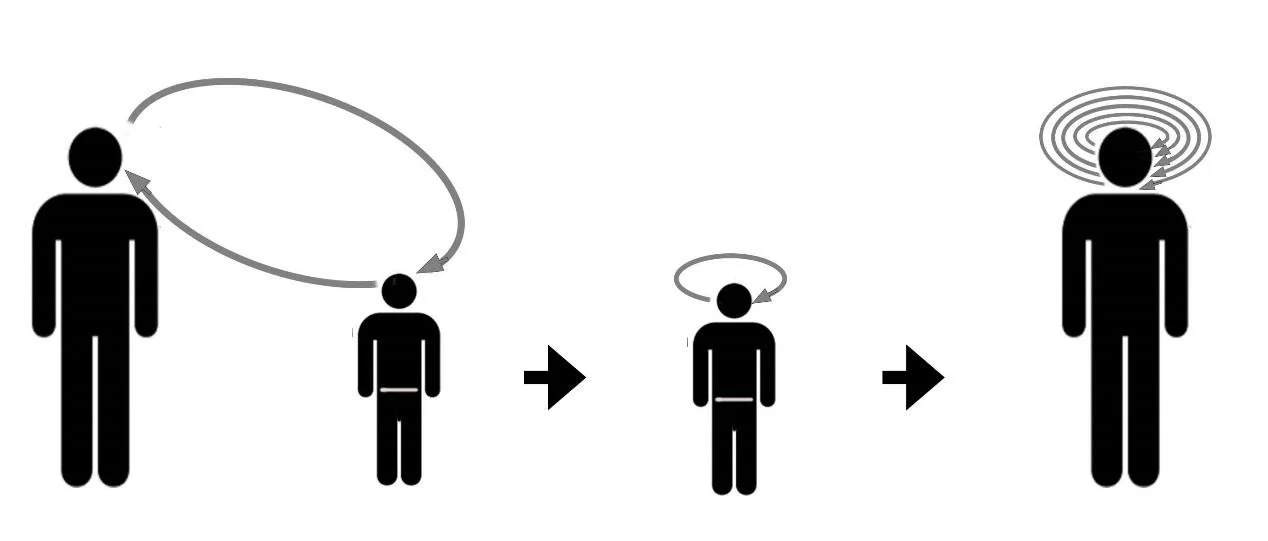
Interpersonal feedback loops structure self-conscious identity: As children we receive messages from adults that we internalise as loops and continue to play inwardly. We receive many such from many sources - some damaging or contradictory - that occupy our inner space and prevent us from being open and at peace as we grow.
As children, we absorb countless messages that are directed at us by adults. In time we learn to respond. This two-way process is represented by a two-way loop, with the second (child to adult) strand arising out of the first (adult to child). Many such loops arise in response to the vast number of messages that many people direct at us over years. We receive our first, formative impressions of ourselves from others in this way. Then, long after they withdraw physically, we are left with impressions they created, now internalised in the form of closed loops that carry all the messages we have absorbed about who and what we are.
This condition dominates our inner psychology and lends structure to our sense of a developed ego identity. As this sense of ego identity becomes established, it precludes us from experiencing ourselves as ‘incarnate openness to the Beyond,’ as such openness transcends all sense of fixed identity. Indeed, it is a strange paradox of the spiritual quest that so many who undertake it are moved by a desire to find their true identity, as if the Mystery of Spirit-in-evolution could be specified in terms of any identity. Our commitment to such an acquired sense of identity may just be a matter of habit and conditioning but it can also be underpinned by histories of trauma that make it more difficult to leave behind. In any case, the greater our commitment to whatever our conditioned story is, the more likely we are to be pre-occupied by closed loops that clog our consciousness and inhibit genuine openness to the Beyond.
All this happens as a part of us that calls itself ‘I’ learns to reflect on another part that it learns to view as ‘me.’ By this means, we come to appear as objects in our own experience. The establishment of this ‘I-Me’ disjunction creates a virtual space of reflection within the Self that wouldn’t be possible without the prior engendering of an I-Me dichotomy that is created by internalising the regard of others (when we come to see ourselves as they have seen us). This process induces division in the self-aware subjectivity that it calls into being. We learn to ‘think’ – reflect, anticipate and set intentions – within the virtual space of this divided self, which becomes so much a condition of our experience that we learn to take it for granted and routinely fail even to notice it. But this legacy of self-division easily becomes agonised when we reel under others’ taunts, applying to ourselves past messages received about our being incompetent, unworthy, unlovable and so forth.
Ego seeks to assert itself as a stabilising power within the volatility of this flux. It refers to our sense of ‘I’ or self-identity and serves to mediate between our inner dispositions and states of the outer world, physical and social. Its functioning is shaped and reinforced by the entire process of cultural formation. This holds open in advance a structure of identity that we learn to assume and enact, thus bringing ourselves into alignment with the expectations and practices of others. We learn what it means to be a child, for example: how we are supposed to act across a range of social contexts, from school to church to playground and so on. Across these diverse situations, our sense of a constant identity is supported by knowledge of our names and essential coordinates of our associated social identity: where we live, school attended, parents, friends, likes, dislikes etc. All these things contribute to making our acquired sense of identity seem more substantial than it actually is. Issues that raise doubts about this feel threatening and we attempt to dispel them through corrective self-talk.
This brings us back to our implicit pre-occupation with identity and networks of intersecting closed loops that provide the impressions of substance we associate with it. The terms of subjective closure and of our opening beyond it vary across time and place but a latent aspiration to go beyond is a constant feature of human experience that achieves active expression wherever cultural conditions allow. This tends to unfold in phases. Initially, we arise out of the Divine Ground and experience a spiritual motivation to return to it as our Source – for purposes of rebirth, renewal, enlightenment, reorientation and so on. Clearly, in order for such a return to be possible we must first have differentiated from the Ground and in order for this to happen there must be a driving force that pushes us out of our initial undifferentiated state. Let us refer to this force as ‘the evolutionary impulse.’ (The waves of the Mayan calendar offer a continuing example of this ‘force.’)
If we don’t move out of our initial state of undifferentiated immersion in the world, we remain stuck in a condition of psycho-spiritual infancy that is anti-evolutionary. Consciousness didn’t dream whole worlds alive so we could just stay put. Rather its aim, as far as can be told, is to grow qualitatively by creating new experiences and learning from them. Thus we are moved to pass beyond the early terms of our embedded, immersive relationship with the world into more challenging and creative modes. This is not a ‘Fall’ in any coherent sense.
Nevertheless, it is apparent how members of a species in whom spiritual consciousness is receding after a Steiner-like ‘descent’ process, or in whom it has only lately dawned, might be moved to return to Source. This aim is clear in classic spiritual disciplines like yoga, which focuses on ‘yoking back’ to Unity: withdrawing from the world into a state of blissful mergence with the Consciousness that originally sent us forth. We associate such traditions with stillness and unchanging Be-ing. A yin emphasis is pre-eminent here, with the sphere of assertive yang activity largely dismissed as illusion. This association is not entirely accurate, however, since the basic ‘resting’ state of Consciousness is anandamayakosha, our ‘body made of bliss,’ which may be understood as a dynamically balanced fusion of yin-yang energies that is at once endlessly expansive and infinitely containing. Bliss is the outcome of their mutual engagement, as is the dynamic resting state of pure Consciousness as such.
*
But anandamayakosha also gives rise to forms of space and time, following yin-yang differentiation as described. It expresses what we call ‘the evolutionary impulse’ via the ideal forms of vijnanamayakosha, our ‘body made of wisdom.’ But for this, Consciousness might never have manifested existence and human consciousness might never have attained even the undifferentiated immersion of Gebser’s archaic structure. Goethe offers a useful schema for looking at this, where our initial unself-conscious immersion in the world equates with a state of primal innocence or ‘perfect unconsciousness.’ This corresponds to early infancy and the Paradise Garden of ancient myth. For the arc of development to rise, however, we must be pushed out from this Paradise Garden into a world of duality, apparent scarcity and contending interests: a world of opposites and opposition. This takes us out of ‘perfect unconsciousness’ into what Goethe calls ‘imperfect consciousness.’
It also corresponds to a stage of Paradise Lost: a mythic ‘Fall’ occurs in our shift from a condition of innocent, undifferentiated, unselfconsciousness into a state of personalised self-awareness that we experience as limiting and troubled. However, since the aim of evolution is to promote awareness, any movement from unconsciousness to consciousness must be seen as positive. The final stage of Goethe’s series sees us delivered out of ‘imperfect consciousness’ into a third level of ‘perfect consciousness’ or Paradise Regained. However the Paradise that is regained can never be the same as the Paradise that was lost. Imprints of learning and experience have registered along the way, meaning that the third phase must entail a new level of Unity, one that has become explicated and rendered self-aware in the course of its emergence.
Exactly the same is true regarding the macro-journey of Consciousness as such through time. It arises initially from a condition of total embedding in the Ground of (its own) Be-ing and moves through a long process of apparent exile during which it is carried primarily by us: members of a species that experiences itself as separate and distinct. Now we find ourselves called increasingly to move beyond this condition of imperfect self-consciousness and open to a new experience of Unity that is at once self-aware and unmarred by illusions of separateness. Millions of us are now calling for this as if it were the most obvious thing in the world and many experienced profound disappointment when the threshold date of 21/12 arrived without any large scale deliverance into such a transformed consciousness state.
A major problem arises for us in this respect with regard to the extent of our commitment to long-held and long-practised images of personal identity. Again, these arise within closed loops of internalised self-reflection that make our experiences of ‘self’ limited, exclusive and debilitating. There are two main levels of engagement here. The first has to do with maintaining a self-image that emerges from the reflections of other people – messages they relay to us about our ‘self.’ Even if there is nothing specifically debilitating about these, they draw us into a narrow sense of ego identity that we would regard as limiting if we were capable of experiencing outside it. We generally lack the ability to do so after the formative processes of socialisation have impacted on us, effectively making us the ones we have been told we are and/or must be.
Indeed, because our experience is so fundamentally organised around core structures of our personal identity, limiting beliefs and horizons associated with its formation come to govern our experience implicitly. Hence I come to know myself as John, the firstborn of Jack and Jill, good at this but bad at that and so forth. I have to wait until I read Voegelin on Plato before I find occasion to remember that I am also more fundamentally an incarnate openness to the Beyond and even then parts of ‘Me’ are likely to require much convincing. The reason is that we are taught to identify ourselves with a story that has largely been prepared for us by others and administered by them until we are prevailed on to assume it for ourselves.
We remain creatures of this story, even its captives, until we take responsibility and achieve increasing measures of freedom in relation to it. This may be urgent, difficult or both depending on its details. Specifically traumatising episodes can make it very hard to get past, for example, not least because we are extremely sensitive creatures and find ways – especially when we are young – to numb wounding incidents out of active consciousness. This introduces a second level of engagement to do with the psychology of trauma, personal and collective, the influence of which was vastly under-rated during preparations for anticipated phenomena of planetary rebirth around ‘2012.’
Logically it is clear that if I know myself as John, the first child of X and Y etc., and if I am pre-occupied by this story that limits my awareness by virtue of beliefs and wounds that bind 'me’ to it, then I am in no position to experience myself as ‘an incarnate openness’ or anything like it. I can’t be open and pre-occupied at the same time, especially if there are unresolved issues in my past that my story doesn’t acknowledge or is unable to get beyond. Healing is necessary if I am to move past this stage of pre-occupation and imperfect self-consciousness to a third level of ‘perfect consciousness.’ This entails bringing previously fragmented parts into a coherent and dynamic Flow of Presence – what we may term a lucid process of Unity Consciousness. It doesn’t need to mark an End State, only to be open rather than internally fractured and blocked.
*
We saw previously that the emphasis in early human spiritual traditions tends to be on Stillness and the Constant. Our emphasis in the modern West has been very different. We have tended to focus on movement, development and progress: all yang-related tendencies whose prevalence is also indicated by the 7 Days-6 Nights pattern of the Mayan calendar up to 28/10. In tacit acknowledgment of this, a core theme of Wolfram’s Grail myth at the beginning of European modernity involves bringing runaway masculine yang tendencies back into right relationship with feminine yin. Moreover, since completion of the Calendar’s 9 Underworlds in October 2011, an enhanced foregrounding of evolution has been precipitated in human consciousness. Together with this, an onus has developed to move beyond a simple urge to attain stillness into an apparently more challenging mode of conscious, balanced evolution.
In fact, the defining quality of conscious evolution appears to derive from awareness of an eternal, seemingly unchanging Consciousness beyond time that dreams time and all the phenomena of time into existence. Hence, just as the Mayan calendar helps to promote awareness of evolution in time, it also promotes awareness of a Consciousness-beyond-time within which time happens and to which we can awaken while in time. This is the role that Joseph Campbell attributes to the mystical function of an integrated mythological system. It changes the patterns of our experience with regard to time, consciousness and evolution. However, in Western religious traditions, our sense of the transition from Consciousness-beyond-time to consciousness-in-time has been obscured by unwittingly metaphorical postulates of a Fall that harbour implicit power agendas while also serving an important symbolic purpose.
Judaeo-Christian myth accounts for our movement from perfect unconsciousness to imperfect consciousness in terms of such a ‘Fall’ from the Paradise of Innocence into a corrupted world of toil and sin. I don’t find such accounts appealing, not least because they overlook the evolutionary ascent process involved. It is possible to qualify this scenario if we think in terms of a ‘descent’ from Spirit into the ‘lower frequencies’ of material reality. Such a ‘Fall’ has no obvious moral connotations. It still entails the metaphorical obfuscation of an evolutionary (ascent) process but doesn’t support practices of psychological manipulation that become possible when a powerful Church convinces people that they are intrinsically flawed and dependent on it for salvation. This pattern has applied in our development as individuals and as a species but no longer serves a constructive purpose, which means that it is ready to be outgrown and so poses a challenge.
References to a Fall are not just melodramatic: they evoke a condition of experience that associates with our capacity to be shamed. It also evokes an apparent truth that we need to be ‘betrayed’ out of a primal state of unselfconscious immersion into troubled worlds of opposition that present challenges for us and, concomitantly, opportunities to evolve. I, for example, felt ‘betrayed’ when I was forced to go to a school that I found fearful and humiliating. (It is impossible to apply language exactly to a condition that registered pre-verbally through walls of numbness and was thus experienced in a largely unconscious way but I am satisfied with hindsight that the word ‘betrayal’ is not misused.) Every minute I was there I felt abandoned and exposed by parents whom I might have expected to care for and protect me. When they didn’t I became resigned to living in fear and grief, again without words. I stress the role of my parents to underline that we can only be betrayed by those in whom we place implicit trust and not with any intent of blame or recrimination. Their participation was every bit as determined as my own.
In general, such ‘betrayal’ mars a pattern of anticipated coherence in our lives. It challenges us to forge new and more encompassing horizons in due course, as I eventually did with problems arising from school experiences noted above. The more fundamental the challenges posed by our betrayals, the more we must work to overcome them. It is generally possible to identify patterns associated with the history of wounds and betrayals we have suffered. Knowledge of these can bring us to awareness of what has been called our Sacred Wound. Such awareness is invaluable because often the overcoming of our Sacred Wound brings with it the commissioning of a Sacred Gift and hence an activation of our sense of purpose in the world. For this reason it is often said that our Gift, Genius or suppressed, unacknowledged creativity can only be found behind or beneath our Wound.
I will look later at the significance of this in relation to transformational opportunities that are available around ‘2012’ but it is helpful to introduce the issue here because I have found working with the Sacred Wound to be crucial in facilitating people’s ability to integrate Shift energies and, particularly, our ability to access and express freely whatever gifts may lie behind these wounds. I have never met a single person to whom some version of this pattern did not apply. Indeed, the theme of the Sacred Wound is so fundamental that it has a primal, mythic quality about it. It is vital to explore this now when so many of us are concerned to liberate our gifts and step out from an ‘old paradigm’ of identity that is now maladaptive, dysfunctional and restricting – born of resignation to a life of grief and fear, and sceptical that there might be any richer possibility beyond it.
3. From Sacred Wound to Sacred Gift
What I wrote earlier about being afraid at school is an important element in the pattern of my sacred wounding but not its core. While it might apply to certain other people there are many more to whom it doesn’t apply at all. This wouldn’t be the case if it touched the heart of a collective wound, for then we would all feel deeply affected by it. Against this, what I wrote about the generic role of betrayal in pushing us out of infantile unconsciousness into imperfectly conscious ‘adult’ explorations applies in a very basic sense to everyone. We have all been socialised into a sense of personal identity that triggers and yet also impedes our potential to become ‘incarnate openness.’ We have all been inducted to a greater or lesser extent into labyrinths of agonised self-consciousness, from the idle chatter of monkey minds to debilitating inner criticism. Whatever about the gravity of our particular manifestation of these states, they do preoccupy us and so prevent us from being available for transcendence.
The mythic dimension of the Sacred Wound is important in relation to our present collective standing as a species. Despite the Good News surrounding ‘2012,’ it is clear from daily news that most of us remain committed to a way of life that perpetuates conflict, hierarchy, injustice, ecological degradation and so on. I doubt that anybody truly wants this so whatever default is in operation must run very deep and be of a deeply unconscious nature. For this reason I will look next at our collective Sacred Wound and a Sacred Gift that, mythic wisdom suggests, is somehow secreted by it. We find a ready reflection in the Book of Genesis, in the passages after it becomes known that Adam has been ‘tempted’ by Eve and followed her in eating the fruit of the Tree of the Knowledge of Good and Evil.
Immediately we know that our species’ age of innocence has come to an end. Having been rudely thrust into the world of duality, a world of Good and Evil, as a result of their ‘fall,’ our first parents become torn and apprehensive. Where once they were spontaneous and unreflective, they are now disposed to hide. They cover their nakedness and turn away from the eyes of a God they feel they have let down. They experience His gaze as all-seeing and recriminating. Thus they pass from innocence to shame, out from a Paradise of perfect unconsciousness into a tortured (imperfect) consciousness of exile from it. Their impulse to cover and hide marks the beginnings of shame, repression and disabling self-consciousness.
It also evokes a condition of narcissistic entrapment that is at the core of our Sacred Wound. The ascent from Eden is typically understood by modern psychology as something that arises in order to push consciousness to new, more encompassing levels of integration and awareness. This is certainly applicable but the pattern described here also evokes a more radical and uniquely distinguishing feature of our species: i.e., an apparently maladaptive capacity for consciousness to divide against itself, not just in terms of negative self-reports but also of a disposition that seems inherently given to fissuring and bifurcation, engendering splits that guarantee anxiety and make conflict unavoidable within and between persons. This is essentially similar to Freud’s conclusion regarding the troubled nature of our species.
Although he never used such language, Freud saw our ‘Sacred Wound’ as stemming from systemic conflict between an urge to secure complete gratification of our instinctual (‘animal’) needs and inhibitions imposed on this spontaneously arising tendency by culturally moulded powers of self-reflection, self-repression, self-hatred and self-abnegation. These, he felt, were inevitable because in the end we – as agents of social conformity – are obliged to suppress and frustrate our natural inclinations so that the order of civilisation might thrive. Every step in this process further aggravates a basic division or wound in our selves. The standard response is that Freud was blinkered by a materialist worldview that severely limited his sense of what human beings could achieve. I believe this is correct with regard to healing possibilities but not regarding his appraisal of the core condition that we need to be healed of.
That said, there is also an element of evolutionary adventure in our Fall that makes it a positive development once we get over allegations that we are incorrigibly flawed and forever tainted by the mark of an ‘original sin’ that engenders a sense of primordial unworthiness. Goethe’s vision of ‘perfect unconsciousness’ alone gives the lie to this account as fundamental, but that doesn’t mean it can simply be dismissed. We do carry shame and it does exert a crippling influence over many lives. Genesis provides an archetypal evocation that describes an essential pattern very clearly but there is also a political dimension involved. (Our ‘first parents’ needed the help of Yahweh’s prohibition to secure their ‘fall.’) Man has been punished and Woman is to blame. Both have been shamed so there is shame within and between them, and antagonism. A curse is set upon the woman, dictating enmity between her and the serpent of her curiosity, which also represents kundalini and an evolutionary impulse that warranted their leaving the Garden of Unconsciousness in any case.
The stamp of a politically institutionalised patriarchy marks this telling, which at once seeks to eclipse female-feminine knowledge, justify its eradication and mould the energies and consciousness of entire peoples around the interests of a knowing male elite. This doesn’t negate the background presence of true mystical content but it does highlight effects of power in mediating how it gets translated into psycho-political patterns. In any case, unwarranted hierarchies can only last as long as they are permitted, which is also as long as we keep looking down, our eyes averted as our first parents’ supposedly were, in shame.
Lacan, Freud and the Basic Fault
The condition of our Sacred Wound is so pervasive and we so accustomed to its presence that even to view it as a wound may seem extravagant. This is what we might expect in a time of ‘paradigm shift,’ when an old frame of thinking, perceiving and experiencing is in the course of making way for a new one. But what exactly is this frame and how did it come to be so entrenched, evidently more than others that have been displaced before? What can we actually do to move beyond our Wound? And what is the nature of the Gift that it conceals?
The essence of our collective Sacred Wound is that we are made to become self-conscious through a process of socio-cultural formation whereby we internalise messages absorbed in the course of interacting with other people. We then apply these messages to ourselves and come to experience ourselves as able or helpless, loved or unlovable, worthy or worthless and so forth. Our sense of self arises in this way, so much so that we wouldn’t have a ‘self’ without it. This is a fundamental point: our experience of self is an artefact of social process. It is crucially influenced by whatever the belief system of our culture happens to be and how this gets mediated to us. It is an essential aspect of being human that we absorb whole frames of identity without even knowing that this is happening, or how our experience of Consciousness becomes organised around them.
Language is centrally involved because as we learn the speech of our community we absorb its worldview and come to know ourselves in terms of it. This is particularly true regarding our use of the word ‘I,’ which denotes a subject position that we believe to be at the core of all our ego-mind deliberations. What is this ‘I’? We implicitly assume that it refers to something that is true, whole, dynamic and essential about us but we have already seen that it actually refers to a sense of ‘self’ that is moulded in culture and could easily have been made other than it happens to be. The French psychoanalyst, Jacques Lacan, echoing mystics from all the world’s spiritual traditions, describes this ‘I’ as an illusion that is conjured by the mirroring processes of human culture.
He associates it with what he calls the ‘mirror phase,’ which arises between the ages of 18 to 24 months. When the child looks in a mirror at this stage, s/he sees reflected there an image that s/he takes to be the referent of ‘I’. Identifying with this image, s/he assumes a psychological wholeness corresponding to the physical whole reflected in the mirror. This provides the illusory substance of an ‘I’ (ego) that comes to speak and so installs itself as the subject of all our later declarations. But suppose we experience trauma and repression, such that aspects of our experience become unconscious, as Freud says must happen to everyone who becomes the creature of any human culture? Are these unconscious elements represented by our use of the word ‘I’? Clearly not, and so we become ‘split subjects,’ committed to maintaining false impressions of unity and wholeness that we share with all others who have been similarly formed.
And what if our circumstances put us under pressure to uphold a particular image or ego ideal? Then the psychological reward system we live under will oblige us to promote our illusion of easy integrity, at a cost of love and recognition if we fail and emotional coherence even if we don’t. This establishes a context for all the self-talk that we tend to indulge under duress, and constant narcissistic pre-occupation that prevents us from experiencing ourselves as beings who actually are not only incarnate but also open to a ‘Beyond.’ Our inner chat tends to circle around subjective preoccupations of the local self, an ‘I’ who speaks out from within a constantly observed matrix of conditioned self-identity.
Narcissism entails such constant self-regard. It is a condition that keeps us feeling separate and distinct, exclusive and excluded – not connected to or part of any greater whole – especially after its imperfect consciousness has been ravaged by barbs of insecurity. It is named for a mythological being who lost his soul to a water nymph called Echo and spent all his time by her pool in the hope of recovering it. It is said that he became so engrossed by his image that he remained transfixed in admiration of it, perhaps venturing adjustments to keep his image up to par. This story has a broad contemporary application: narcissists are so self-preoccupied that they’re not available for evolution. The story goes that our mythic prototype actually died as a result of his arrestment but there is greater depth than has been allowed at play here.
Narcissus was a Greek flower-god in early pagan times and as such is known as an alternate form of Dionysus. Best known as the ancient Greek god of wine and revelry, Dionysus is also associated with Pan (the goat king/god of nature) and Christ. Hence there is something about him that straddles and precedes the rift between pagan and Christian spiritual streams. This concerns his status as a prototypal god-king who is killed and then devoured by followers, Earth having been ‘seeded’ with his blood for purposes of renewal. In later times, bread and wine were consumed instead of flesh and blood, again indicating a strong link with Christian mythos.
In another version of his story, Dionysus is himself caught in the mirroring surface of a pool inhabited by water nymphs. When they claim his soul, the god dies only to rise up later in the form of spring flowers, a clear variant of Joyce’s cropse motif. This again connects to far older accounts of king sacrifice undertaken to promote the renewal of Earth’s abundance, just as Gawain’s journey echoes that of would-be priest-kings to Diana’s Grove at Nemi. I note this to stress a symbolic equivalence between Parzifal’s Foolish Quest to heal the split between Christian piety and pagan excess and the basic conflict that Freud discerns between cultural progress and the repression of animal nature that this entails. The issue, that is to say, remains contemporary, despite modernity’s foregrounding of a supposedly rational ego.
Adding Lacan to Freud, it follows that our self-talk – all our erudite, sophisticated babble – plays over this profound and basic split, forever reinforcing the illusory image of a masterly ‘I’ or sovereign ego that believes itself to be totally present and in charge. But the split has already engendered a reactive unconscious which, if we were to admit it, would bring chaos to this image of our ego ideal and much else. (Eliminate constraining influences, Freud says, and Dionysian regression ensues: something that is readily observable in riots, warfare and other breakdown situations. For this reason, he warns, outer aggression is a necessary part of human psychic economy, because it displaces unavoidable inner conflict.)
It is crucial to note this here to establish i) that the issue is compounded rather than resolved by our modern secularisation of culture and ii) that it exceeds personal psychology and has deep roots in what Jung called the Collective Unconscious (IV.7). Also, where Freud tends to be robustly literal in his proclamation of a ‘castration complex,’ Lacan is more astute in regarding the phallus as a cultural signifier that evokes analogically the commanding posture of an illusory sovereign ego as yang, male-masculine, constantly erect, present, able and in charge. This brings the Fisher King wound of post/modern men and women sharply into view, not least in a consumption-oriented world where advertisers’ screens have replaced mirror pools and church pulpits in the continuing battle to capture ego-identified, shame-crippled souls.
And if we can’t open to the unconscious, to the whole of our ‘selves,’ we certainly can’t open to ‘the Beyond.’ The gift of our spiritual promise thus gets buried under the debris of our soul wound while violence that we perpetrate unknowingly within ourselves is also displaced unknowingly in our conduct towards Earth and each other. And yet Parzifal, as Grail King and King of the Wood, effects a symbolic healing. We need reminding now of the nature of this cure: it involves yang, male-masculine warrior consciousness coming again into right relationship with its yin, female-feminine complement – the Goddess in mythic terms – so that a Divine Child might be born of their sacred marrying and, with this, the promise of our full humanity restored, along with the abundance of a blighted natural world.
This whole programme is necessary because patriarchal religion – for reasons that our Fisher King story merely hints at – denigrated the natural world as female and fallen (carnal, animalistic, heathen, lustful…). The list goes on, attributing shortfalls in associative logic to the vagaries of its target rather than acknowledging them as projective manifestations of a profound repression on which it was always based. This projective fog needs clearing before we can even begin to contemplate truly the core mystery of Light and Dark conjoined that lies at the Heart of the Grail and the Divine. We will learn more of this in IV.5 and later Parts.
For now I will just note that the essence of our species’ Sacred Wound is a state of narcissistic entrapment that arises whenever we are cultured into experiencing ourselves as distinct, self-conscious beings, separate and apart, set against nature, each other and ourselves. This tendency seems to have begun in settled cultures during Calleman’s National Underworld, which corresponds to the period of the Mayan Long Count from 3114/13 BCE to 2011/12 CE and dates from the early institutionalisations of patriarchy. By the time we arrive at the ‘Planetary’ Underworld (1755 CE), corresponding to the rise of industrial society and presided over by the allegedly rational discourse of an allegedly sovereign ego, this pattern has been decisively consolidated and become the mainstay of an ‘old paradigm’ that a ‘new paradigm’ associated with ‘2012’ is supposedly trying to oust. We will discuss the Gift that emerges from the integration of our Sacred Wound later in this section.
Speaking of Shame
John Bradshaw, a leading authority on the psychology of the Inner Child, describes what he calls a ‘shame core’ at the heart of many people’s experience. I envision this as a coagulated ring that wraps itself tightly around the inner chamber of our spiritual Heart, filtering all that we are able to perceive and express. Many of us live from the false core of this filter and are thus prevented from ever expressing or registering the real truth of our Hearts, which is always Love. In order to feel and express Love truly we must somehow dissolve this shame core that holds us in numbed half-life and turns agonising under duress, leaving us sidelined on our litters like modern Fisher Kings, unable to live fully or die.
The general psychology of shame is well understood. It has to do with a sense of unworthiness that ultimately derives from early conditioning influences such as not being truly held by at least one parent figure; being abandoned or routinely criticised; being subjected to persistent boundary violation; undermined in attempts at creativity and so on. Such determining factors often occur in bundles. Once a shame core has been established it exerts a constant and pervasive influence over the affected life.
Shame renders the truth of our Heart inaccessible and inexpressible, except for brief glimpses that tend to be hard won and must be pursued vigilantly if they are to be stabilised and made permanent. Much of my experiential work around ‘2012’ focused on this because a person who is burdened by shame cannot ‘ascend’ in any lasting sense, no matter how many affirmations they recite. The reason is that, as explained, the speaking ‘I’ of a split subject is never wholly representative: the left brain/hand generally doesn’t believe a word the right is saying. However ardently an inflated spiritual ego pushes its case, there is always a comedown in the early hours unless careful work of reclamation has also been done.
The situation is made more difficult because we tend to compensate and conceal our shame whenever we are not simply overwhelmed by it, even in a bullish spiritual culture where ‘positivity’ is taken as an earnest of good standing. We control and manipulate in order not to alienate or give offence. Feeling unworthy in the false core of our learned selves, we can’t experience a vital sense of connection or belonging for who would want to maintain a relationship with us, especially after they find out what we’re really like (which is what incessant shame reports disclose behind the masks of our outer posturing, should we admit the vulnerability this entails)?
Being encumbered by such uncertainty we live in fear both of unmanageable inner impulses and the prospect of exposure and rejection. This usually echoes patterns of early experience and expectation. A fear of exposure makes it hard for us to take inner risks in the sense of becoming truly vulnerable, which is necessary for lasting growth and transformation. Instead, insofar as battered ego horizons permit us to dare, we pay undue attention to our image by way of compensating. I refer here to self-bolstering measures generally and not just overt cosmetic interventions.
If we are resolute and manage our esteem arenas well, we talk our walk with such vigour that balls are always in the air, never at rest long enough for lurking arrows of doubt to strike home. People often let us down, preventing reasonable plans from coming to fruition but being made of strong stuff we always manage to hang on, never letting go of stubborn dreams. This is the essence of our modern Fisher King wound, rendered banal to a point of seeming invisibility by the frequency of its occurrence and a seeming dearth of genuine adventure in our excessively disenchanted world.
To balance: insofar as we are not affected by shame issues, we feel a sense of Connectedness and Belonging. We are able to offer and receive Love. This means that despite the Sacred Wounding of our past we have chosen consciously to open again, past all fear of possible recurrence. Letting this be, which can be very difficult, we find that old expectations no longer generate old results. Rather new gifts are born in the chaos between levels of form. We call the passage between these ‘transformation’ and risk the uncertainty that bears us from one level of containing structure to the next, more encompassing one. This requires surrender, always relative to a Greater Life that is still waiting to be lived, beyond now forgiven imprints of old guilt and shame.
The vulnerability (the ability to be wounded, receive impressions and be touched) involved here entails a freedom to feel deeply and eventually know in a mode of unformulated awareness that we call intuition. It is sustained by a continuing attitude of trust in whatever happens, beyond anxious anticipation or pre-emptive strikes. This contrasts with underlying numbness and fear, which is a residue of shame-based processing, together with a tendency to control and reduce uncertainty in the absence of trust. For the power of this contrast to manifest in a life, it is necessary that the narcissistic arrestment of being held in shame must first be overcome.
This cannot be achieved by the rational presentation of relevant data alone for the terms of our arrestment are not rational and are therefore not amenable to release by purely rational means. It is a primarily an issue of motivation and emotion: of Love and its transformations. These generally turn out to be distortions because Love has no need of transforming except in instances of pure creative expression where it manifests spontaneously as Beauty. This follows because, as we saw already, Love is the ultimate source of movement and becoming, including that associated with what we now call the evolutionary impulse. There is a wonderful story still to be told in this regard.
A Gift in the Wound?
As long as we still have an operating shame core, everything we feel and express is mediated by it. This includes our creativity, which optimally expresses pure Love but can’t as long as our experience remains subject to filtering by un-cleared shame. Then our creativity is ruled by distortions of love: unwitting manipulations that are driven by a desire to satisfy or protect our conditioned emotional needs. We dress this up as meeting Devils at Crossroads, making Faustian pacts or enacting roles of tortured genius, wounded healer and so on. We are now called to evolve beyond such roles for fixing our identity in relation to them is also anti-evolutionary and inhibits attainment of our ultimate goal: to become purely open so that the divine creativity that manifests universes can express through us without having to abide a deluded ego’s need to cut deals or orchestrate publicity. As long as traces of the local self remain entrenched, we are still in a process of being spiritually born. Perhaps this is something that must go on and on, with growing awareness but also without end. It may be the essence of conscious evolution to be reborn in perpetuity, so that Great Mystery can come to know itself better and better by means of such ongoing self-revelation.
I once heard Brian Swimme say in a lecture that, for all his marvellous insight, Plato had no real knowledge of the details of evolutionary process. I was sceptical about this at the time. Plato may have had no concept of mass extinction events, as Swimme noted, but he was thoroughly familiar with the idea of Becoming and the story of Atlantis, which evokes poetically what we might call a ‘World Shift.’ Nevertheless, there has been an undeniable surge over the last two centuries in the prominence of evolutionary thinking. This theme was elevated to centre stage in our run up to the end of the Mayan Long Count. Whether we associate this now with 2011 or 2012 seems to make no practical difference. The fact remains that we are left with a salient awareness of the core role of evolution in our spiritual adventure. This highlights the part played by Becoming in the unfolding of Mystery and complements rather than supplants an emphasis placed by earlier cultures on Stillness and Constancy. We need to bring both these categories into a new and more fully articulated relationship. Let us start by referring again to still pertinent Calendar lore.
We have seen that as the 9 waves progression unfolds from the Big Bang or Point of Creation, the speed of evolution is said to jump by a factor of 20 with the introduction of each new wave. Now even if we dismiss indications of the Coba Stone as fanciful, it still illustrates an undisputed fact: namely that the rate of change increases as evolution unfolds. This serves to accelerate the frequencies at which Consciousness as embodied can operate through us, particularly from the thresholds of Calleman’s National Underworld (writing, warfare, patriarchy), Planetary (industrial revolution), Galactic (information revolution) and Universal (spiritual/consciousness revolution). The last two have arisen within the span of living memory, less than sixteen and four years ago respectively at the time of writing.
No other account provides a generative understanding of the widely reported phenomenon of apparent time acceleration through this period. Indeed, the general process of evolutionary quickening implied by Calleman’s schema explains how millions of people can now be carried towards levels of awareness and awakening that were available to only a select few before. This doesn’t imply a fait accompli. The role of freedom remains absolutely pivotal with regard to established patterns of our past. This fact is of fundamental importance as to how we can best manage the potentially drawn-out phenomenon of any attempted re/birth after ‘2012.’
I noted earlier in this regard how the simultaneous fusion of 9 Creation waves on 28/10/11 can be said to have capped the rate of evolutionary acceleration as driven by pre-ordained cosmic rhythms, thus making it easier for us to rest in Presence. This doesn’t mean that cars and computers won’t continue to get faster but rather that those who produce them have been given both occasion to think again of right relationship between Innovation and the Constant. We have a freedom to continue the addictive inertias of our past or to recalibrate and re-orient, now that a mythic 9-fold process of evolutionary building has carried us to a point of wakefulness regarding core questions of origin, identity and purpose.
I have also noted how through the modern upsurge of evolutionary awareness, there has been a decline in our regard for the Constant, as if we had suddenly evolved beyond a need for concern with such antique notions. Superficially, this is understandable with respect to the upheavals of our present but every present is also a moment for incarnating Presence, marking it as Eternal Now as well as ephemeral now. We would do well not to forget this. Realising it is a necessary part of awakening and implies a need to consciously balance yin-yang tendencies in our still unfolding evolutionary process. This goal is specifically supported by a balancing of these powers across continuing Mayan Creation waves (which must now more accurately be regarded as co-creation waves). It is also a core theme of our Grail story as a cosmic allegory that also evokes the Quest structure of existence on a micro scale.
We might imagine Cosmos as a Grail vessel into which spiritual energies of creation continue to flow, in the form of ongoing Calendar waves and micro-level quantum eruptions that they help to orchestrate. These energies are received and contained but they also inspire transformation, not just of visible structures but also of embodied consciousness in time. As a result our Cosmic Grail becomes a wellspring, capable of initiating change from within itself via the aligned co-creative power of awakened humans. In this regard, since we are already a part of Cosmos, it makes as little sense for us to go off questing for the Grail as it does for a fish to go in search of water. But we do this constantly, in keeping with Aristotle’s analysis of our desire by nature to really know [what we are (part of)]. This reminds us that we are really talking about the extent to which Consciousness as embodied in time can realise the nature of its relationship with ‘the Beyond.’
The astonishing truth we are asked to digest is that it is now possible for millions of us at last to intuit our origins in ‘Transcendence.’ This alters our experience of evolution and transcendence. Both persist but in ways that are now rendered conscious by virtue of human awakening. There are two primary issues that qualify this phenomenon. Both have already been mentioned in relation to our theme of Sacred Wounding. The first is that the reflexive nature of personalised subjectivity naturally inclines us to self-consciousness. This means that our awareness is limited and pre-occupied by discursive loops that maintain the ongoing imprints of early conditioning. Such patterning may seem unremarkable unless there are also traumatic elements involved. In either case, our normal working ‘self’ consciousness is likely to be mediated by a local image only of who we are that precludes our stepping out as incarnate openness to the Beyond.
The second aspect we need to bear in mind is that we are also motivated from within – by the force of evolution expressing through us – to move beyond all such inner clogging and preoccupation, unravelling tangled knots that bind until we can indeed achieve incarnate openness. This requires us to become empty in the way of a resurrected Tarot Fool, spontaneous and innocent again, with the potential of still undisclosed gifts hung on a stick over our shoulder. And if, like Parzifal, we do open on the far side of experience, all the wisdom we acquire in this process remains available as part of the preparation needed to share our gifts and serve our purpose fully in the world. As physicians who have learned to heal ourselves, we learn also how to function in the various spheres of action we are called upon to enter, regaining a sense of Beginner’s Heart despite no longer being naïve.
The key here is a vigilant practice of non-attachment that allows deep gifts to stir and find expression after the shell of our limiting identity has been let go. These are invariably buried with our spontaneity beneath the impact of old wounds, so it is only by healing that our underlying gifts can be freed. This option holds for collective as well as personal psychology. We are a wounded species. Our historical record shows this, and the scale of our repeated deviations from nominal ideals of Love and Light. This doesn’t reduce plausibly to Lacanian mirror phase scenarios. Although that process is certainly relevant, it serves to illuminate the perseverance of chronic dis-ease rather than accounting for its original appearance. What might be the missing cause here? We must look at our collective patterns in more detail to find out. Perhaps this will help us determine why fish go off in search of water and humans in pursuit of the Grail.
4. Legends of a Fall
In 1995 Graham Hancock published a book called ‘Fingerprints of the Gods.’ In it he posited an advanced civilization that somehow went missing more than 10,000 years ago. Academic archaeologists poured scorn on this notion. Hancock’s evidence included a now well-known claim that the Sphinx on the Giza plateau must be at least 11,000 years old since it carries clear signs of water erosion consistent with sustained heavy rainfall, the like of which has not been seen in Egypt since 9,000 B.C. Archaeologists insisted that they knew the Sphinx to be 4,500 years old. They also asked why, if there had been a pre-historic culture capable of building such monuments, no others had ever been found and why there were no other visible remains, like pottery. References to Atlantis and similar mythic tales of ancient flooding were met with derision.
Hancock’s main problem was a lack of evidence for his implicit contention that an advanced civilisation could vanish without trace, despite the fact that many extant, widely dispersed cultures showed signs of having been influenced by a single ‘root’ civilisation. Indeed, the mythology of Atlantis holds that teachers set out from there after a devastating catastrophe with a view to rekindling their lost culture at various locations around the world: Egypt, India, the Americas and elsewhere. The idea of global catastrophe has also been anathema to modern archaeology, and to 20th century academic geology. The main reason is that such a notion is at variance with a carefully forged academic consensus that tracks the rise of modern humanity out of a long paleolithic past that began some 200,000 years ago and is marked by a slow, gradual evolution down to the rise of the Neolithic period 10,000 years ago. This marks the onset of our transition from nomadic hunter-gatherers to a settled agrarian lifestyle. Village communities that developed from this eventually graduated to fully blown classical civilisations, starting around 5,000 years ago, from which our known history traces a progressive unfolding down to our present.
By 2015, however, new scientific evidence had emerged that let Hancock answer his critics and restate his case. In September of that year, he published a sequel to ‘Fingerprints’ called ‘Magicians of the Gods’. This features a comprehensive synthesis of diverse bodies of new information and was further bolstered by his alliance with Randall Carlson, a ‘renegade scholar’ of breath-taking erudition. Hancock’s new case is based on recent developments in various areas of ‘hard’ science, details of which had previously appeared only in specialised scientific journals (1). The findings of this research were bitterly contested because of their radical, paradigm-bursting implications but have now been successfully defended to a point where they have themselves become ‘mainstream’ in the opinions of those rarefied scholarly groups who knew about them prior to Hancock’s popularisation.
The key tenets of his synthesis, based on a scrupulous integration of converging streams of new evidence, are as follows: Earth was hit by a number of cometary fragments around 12,800 years ago. We were still in the Ice Age and the primary impact occurred on the North American ice cap, which was then up to 2 miles deep. The effect was devastating and its traces can be found on the landscape to this day. Temperatures soared, the ice cap melted and vast quantities of water were released, flooding the southern states before being dumped into the oceans. Huge boulders and whole forests were ripped up by this unimaginable torrent, a deluge that pulverised everything in its path and raised sea levels abruptly by 3 to 4 hundred feet.
Super-hot ejecta were also thrown up on first impact. These darkened the sky and fell on primal forests that covered all non-glaciated areas, setting them on fire. A ‘black-mat’ layer of carbon can still be found in the excavated soil. Directly beneath this lie the plentiful fossil remains of giant mammals who went extinct at that time; above it are found the bones of others who remain extant. Approximately 75% of the large mammals in America were killed at that time, including whole herds who seem to have been vanquished instantaneously. Soil deposits consistent with cometary impact have also been found in affected areas. Additional impacts caused by smaller fragments occurred in northern Europe, the Middle East and perhaps elsewhere. The damage was not uniform since, while 75% of large mammals were killed in the Americas, only 30 to 50% died across Eurasia and 10% in East Africa.
Although the epicentre was in Canada and the northern US (above a line from Oregon to Minnesota), the impact was global. Human cultures were devastated worldwide. This is consistent with the tone of Don Alejandro’s Mayan ‘creation story’ (I.1). As noted, traditional Mayans believe we have now entered a ‘Fifth World,’ where the beginning of each world entails resetting the clock – i.e. a renewing of the world. Extinction level events like the one Hancock reports almost occasioned a wiping clean of the human slate in this regard and would certainly warrant a complete renewal. Even the tone of Tata’s story suggested a degree of shock and memory loss that would be consistent with severe trauma not only in survivors but also their descendants.
Not all effects of the cataclysm were immediate. It is known from ice core samples that temperatures, having risen sharply up to 10o C, plummeted directly after the event. The explanation is that the first impact, happening at speeds up to 70,000 miles per hour, threw up masses of muddy water which, despite falling back as thick rain, also clogged the sky, thus preventing sunlight and heat from getting through. This established a prolonged ‘nuclear winter’ which only cleared about 11,600 years ago, following the geological period known as the Younger Dryas. It would have been bitterly cold through this period and impossible to grow anything, even if surviving hunter-gathers had known how. For this reason Tata’s story relates how his ancestors lived precariously underground until the time when a new sun and mysterious teachers appeared. This is consistent with the next phase of Hancock’s argument.
*
Ice core samples show that global temperatures again rose dramatically by up to 10°C circa 11,600 years ago. The reasons for this are less clear but Hancock associates it too with cometary impact. In any case, the result was another abrupt rise in sea levels, presumably due to impacts in the oceans and further de-glaciation. (A spiking meltwater pulse is recorded for this time as for 1,200 years previously.) This signalled the end of the Ice Age. Amazingly, at exactly the same time, work began on an advanced megalithic structure called Gobekli Tepe in modern Turkey, which has only recently been dated reliably. Its construction evidently followed a rise in temperature which would have made growing crops viable again for those with necessary knowledge. (Recall the wonder in Tata’s story when descendants of the original survivors behold their first sunrise and learn how to grow food.)
But who among the survivors would have had such knowledge? Not hunter-gathers who had been struggling for subsistence over 50 generations; nor would these people have been remotely able to build a complex structure like Gobekli Tepe. This entails sophisticated astronomical knowledge, as well as a knowledge of architecture, building methods, the logistics of organising labour and transporting heavy megaliths (big stones), not to mention the difficulties of keeping a huge workforce provisioned with food and water. Hancock’s conclusion is that this could only have been overseen by survivors of an advanced culture who had fled from Atlantis, the sinking of which has also been dated to the very same time.
Tales of Atlantis abound in ancient mythologies. Plato tells of it in his ‘Timaeus’ and ‘Critias.’ He relates that the story came to him from Solon, a Greek law-giver who was told by Egyptian priests around 600 B.C that the ‘island’ had been submerged 9,000 years before – approximately 11,600 years from our present, exactly the time when the Ice Age ended and from which Gobekli Tepe dates! Although only a fraction of this site has been excavated (roughly 2%), ground-penetrating radar has shown that it is 50 times larger than Stonehenge and astounding indications have already come to light. The most notable to date is a profusion of anthropomorphic T-shaped columns, many of which feature elaborate carvings. Column 43 is one such and Hancock interprets it with reference to John Major Jenkins’ account of the Mayan Calendar, which is very different to Calleman’s.
Jenkins sees the Calendar as tracking the course of our sun across the zodiacal constellations over a Great Year of 25,920 solar years. The Maya knew that it would sit over an area of the Milky Way known to them as the ‘Dark Rift’ during the winter solstice of 2012, when Earth would also be aligned with the centre of the Galaxy. They regarded this Dark Rift as the womb of Cosmos, a place of regeneration from which the new sun of a 5th world would be reborn. Intriguingly, according to Hancock, Column 43 at Gobekli Tepe shows the sun sitting over this same Dark Rift in the presence of a vulture and a scorpion. Interpreting these as references to Sagittarius and Scorpio respectively, the main constellations marking our sun’s position in the sky at this time, he contends that the column echoes the Mayan Calendar in drawing our attention to the night skies during ‘2012.’
Given the diameter of our sun this actually covers an 80 year window of alignment with the galactic centre, from 1960 to 2040. The implication is that the builders of Gobekli Tepe took pains to point forward specifically to our present. The Mayan Calendar does likewise, both in Calleman’s and Jenkins’ versions. We will return to these and consider why the ancients should take such trouble, evidently for our sakes. Before doing so, we must first introduce Randall Carlson as a student of sacred geometry (2). We will focus his account of how its principles figure in human patterning of time and space, especially in ancient calendars that were evidently designed to track unfoldings of the Great Year.
We have seen that the Great Year encompasses 25,920 solar years. The cyclical pattern of its unfolding is traditionally represented by a circle divided into 12 ‘houses’ of the Zodiac, each of which takes 2,160 years to be traversed (12 x 2,160 = 25,920). As every circle contains 360 degrees it takes 72 years (the length of an average human life) to traverse 1 degree of the Great Year (360x72 = 25,920). Hence we can say that a human life corresponds to one ‘day’ or ‘degree’ of the Great Year. The ancient Sumerians conjectured that our solar year was once exactly 360 days before some cosmic catastrophe altered orbital patterns to yield our current 365.25 day arrangement. This implies a radical deviation with regard to a supposed ideal state of Cosmos.
This ideal state is still evoked by the 360 day tun-based sacred year of the Mayan Calendar, which governs all the katun, baktun etc. rhythms that we have already noted. These don’t translate into measures that track the precessional cycle. In fact, this could itself have been a product of the catastrophe posited by the Sumerians. In any case, it raises a possibility that the Mayan Calendar, precisely as ‘sacred,’ doesn’t track any currently known physical cycles but rather persists in evoking an ideal state of Cosmos, a practise which other more pragmatically inclined peoples have relinquished for the sake of predictive accuracy. This suggests two distinct motivational strains, both of which must be kept in mind.
We have already noted the ‘strain’ that the Mayan Calendar keeps faith with – the progression of implicate to explicate order (1.0.0.0 <= 0.0.0.1) but what of the more pragmatic strain? Obviously, if it is a product of catastrophe, the precessional cycle can only be tracked after its instigating event has occurred. This being so, the pragmatic motivation would link to a fear of repetition as well as a desire to monitor the passage of time under altered circumstances. The addition of a further 5.25 days to the ancient ‘sacred year’ of 360 (Mayan tun-base) would still serve to link human memory to this ideal scale while also charting the passage of empirical time for more practical reasons.
We have seen that the 72 solar years of an average human life inserts us neatly into the rhythm of the Great Year. Moreover all sacred numbers which comprise the structure of the Great Year are multiples of 72: it takes 2,160 years to traverse each of the zodiacal constellations, each of which corresponds to 30 degrees of the Great Year (30x72). Likewise, each of the cosmic seasons lasts 3 ‘months’ or 6,480 solar years, corresponding to 90 degrees (90x72), while a half a year or 180 degrees (equinox to equinox or solstice to solstice) takes 12,960 solar years. Sustained astronomical observation may have made it possible for our ancestors to note particular stages in this cycle qualitatively, vis-a-vis the sun’s position in relation to specific constellations at particular times. Recall Column 43 at Gobekli Tepe: someone took a lot of trouble to encode this information for the benefit of others far in their future, whom they would never meet.
We are these others and we need this information since Carlson’s research indicates that patterns of the Great Year predict a likely recurrence of catastrophic phenomena, especially around solstices of the Great Year. Specifically, both Hancock and Carlson agree, our ancestors at Gobekli Tepe were seeking to warn us of the likely repetition of a cometary impact like that which science has now dated to 12,800 years ago, plus or minus 150 years. That is to say, a comparable extinction level event is predicted by these ancestors as likely to occur between 2025 and 2325 CE. This figure is derived by specifying the date of the last major impact as between 12,650 and 12,950 years ago and adding 12,960, let us say in 2015. Aligning this Gobekli Tepe notice with Jenkins’ Mayan Calendar data posits a reduced window, from 1960 to 2040. This implies that we need to be especially vigilant for the next 25 years.
That said, while Hancock focuses almost exclusively on the Younger Dryas event, Carlson also specifies others that occurred before and after it. Although the scientific record is not yet complete, he is confident enough to note 16 extinction level events that occurred in the last 160,000 years of human existence. By this he means events which, were they to occur today, would bring an end to human civilisation as we know it, causing the clock to be reset and survivors to start over from scratch, as in the Mayan 4 worlds scenario. Most of these extinction level events cluster around transitions between ‘seasons’ of the Great Year, and particularly around ‘solstices.’ The last such happened 12,800 years ago, which is evidently why the builders of Gobekli Tepe felt we should be attending to our night skies now, roughly 12,960 years after the start of the Younger Dryas.
Carlson links this pattern with recurring alternations between glacial and interglacial periods of dramatic global cooling and warming, respectively. These hark back to the deep ‘pre-history’ of our planet’s relationship with its cosmic environment. (This is the opposite of climate change denial, although it does clarify the background against which humanly induced global warming occurs, especially since our industrial revolution.) Carlson observes that these periodic alternations correlate with cycles and sub-cycles of the Great Year, which our ancestors tracked for this reason. It is not yet clear how long this has been happening but, he asks, since anatomically modern humans have been around for at least 200,000 years, why should we have waited until 5,000 years ago to develop classical civilisations or sophisticated calendars?
Academic archaeology credits the building of megalithic structures only within this latter timeframe. Since the discovery of Gobekli Tepe, whose antiquity has only been known since the 1990’s, they now say that hunter-gathers were somehow suddenly inspired to found agriculture, master astronomy and start building the largest known megalithic structure on Earth in a single generation. This is patently ludicrous. Calleman accounts for it by invoking the onset of his 6th wave in 3114 BC and extends it to account for Gobekli Tepe by positing a ‘pre-wave’ that takes us back to 8,239 BC, the duration of two Long Counts from our present. This is far less plausible than Carlson and Hancock’s contention that members of an earlier civilization survived what is now known to have been a global catastrophe and undertook subsequently to rebuild it at Gobekli Tepe and other centres around the world as soon as conditions allowed.
*
Of course this contention doesn’t clarify everything. It doesn’t explain, for example, how there came to be advanced civilisation and hunter-gatherer societies before the Younger Dryas but it is far more convincing than our conventional academic paradigms and certainly far more helpful for plotting a course into the future. For this reason let us try to sketch a revamped historical picture before proceeding further.
To begin, it appears that Gobekli Tepe was occupied for about a thousand years, presumably as a centre of learning and cultural renewal. Then, bizarre as it might seem, the descendants of those who began its construction buried it in rubble, evidently with a view to safeguarding it as a resource to be sent whole into our present. It is astonishing in this respect that its excavation should finally happen midway through the period of alert signalled by its column 43. The significance of this has yet to be qualified by whatever other information is held in the 98% that still awaits excavation. It certainly makes sense for such a transmission to be offered by remnants of a human species concerned for the welfare of its descendants, having noted the effects of amnesia induced by large-scale catastrophe.
The sealing of Gobekli Tepe brings us to what is now recognised as the ‘origin’ or, more accurately, re-diffusion of agriculture in the Middle East. A period of sustained warmth followed the end of the Ice Age, especially from 9,000 to 6,000 years ago. This is the period of the great Goddess cultures described by Maria Gimbutas and others. It is marked by steady population growth, an agrarian mode of production and consistently high yields. There is little evidence of warfare during this time. The picture changes about 5,000 years ago, with the visible beginnings of patriarchy. Carlson suggests that a meteor hit Earth at this time, landing in the Indian Ocean and causing huge tsunamis that are the immediate source of the Deluge recounted in the stories of Noah, Manu, Utnapishtim and many others all over the world.
Widespread floods led to vast displacements of human groups. The result was a series of encroachments that induced systematic conflict and eventually the militarization of human societies. At this point, we begin to link cogently with familiar patterns of human history, including the rise of distinctly patriarchal civilisations during the 3rd millennium BC. It has long been my impression that there were elements of gravely irrational backlash involved in this and the extended perspective offered by Carlson/Hancock has helped me to see why.
My sense, largely intuitive, is that the impact of the beginning Younger Dryas event was so incomprehensibly vast and sustained (over almost 50 generations), that it induced a trauma so profound and totally numbing that it effectively erased all memory of the instigating event. Consider again the tone of Don Alejandro’s ‘Creation story’ recounted in I.1, noting especially its eerie mix of childlike trust, wonder and apprehension, all wrapped in a palpable layer of remote, post-traumatic inertia. Imagine the impact made on people in this state by the arrival of knowledgeable teachers whose instruction fostered a renewal of agriculture and civilisation, aided by a favourable climate over the next few millennia. A semblance of recovery is conceivable under such circumstances.
Then another meteor strikes c. 3,000 BCE with severe repercussions: widespread flooding and loss of life, followed by large scale displacements of human groups that lead to encroachments and conflict. The effect is deeply traumatic: not as incomprehensibly, all-numbingly so as events that began the Younger Dryas but enough to activate a residual terror of annihilation associated with it. The starkest survival programmes are not only engaged but foregrounded in the way survivors manage the chaos into which their world has suddenly been plunged. We struggle against opponent groups in a hostile world and resolve never again to be taken unawares, nor deceived by easy words concerning Goddess benevolence. We become armed, militant and hardened in our Hearts against anything that might threaten future security.
This brings about subjugation of the female-feminine and also illuminates the extremity of repeated backlash waves throughout the course of patriarchal history. A new order of civilisation emerged during this process, as in the sudden rise of dynastic Egypt, but this time sages were unable to turn the tides of now remembered chaos, even insofar as they were able to resist contamination by it. We have noted the role played by spiritual neurosis in this unfolding: how patriarchal charter myths eclipsed the prior centrality of Goddess forms and, via this act of compound repression, paved a way for the trauma-governed reign of truncated academic narratives about our past. These are founded on a denial of our deepest wound and thus, also, of our deeper gifts.
5. A Stone that Fell to Earth
In his eloquent close to ‘Magicians of the Gods,’ Hancock stresses that over 2,000 flood myths found throughout the world all stress that the Younger Dryas catastrophe was not ‘accidental.’ For now I mark this as singular despite Carlson’s insistence that there have been other such events throughout the course of human history, albeit none as severe. The reason the cataclysm was not accidental, the myths suggest, is that we drew it upon ourselves by virtue of our arrogance, cruelty and strife – all which angered ‘the gods.’ Hancock quotes Plato regarding Altanteans who fell into materialism, violence and greed but still ‘seemed, in their pursuit of unbridled ambition and power, to be at the height of their fame and fortune.’ This may seem reasonable, especially if we intuit parallels between Plato’s account of Atlantean crassness and our current political culture.
Nevertheless, certain details don’t easily add up. Plato’s account refers to the island of Atlantis as being submerged 11,600 years ago. It is likely to have been a much larger ‘island’ before the even greater cataclysm of 1,200 years earlier and the dramatic rise in sea level that it entailed. Is it not likely that even overweening Atlanteans would already have been sufficiently chastened by that event, including those fortunate enough to live on higher ground? There were also hunter-gatherer cultures at that time. Are they too to be charged with overweening cruelty and pride, such as might warrant unleashing an extinction level event upon them? There is no convincing pattern of divine justice in evidence here.
Moreover, in his previous chapter, Hancock cites approvingly scholar G.R.S Mead’s reference to ‘a time when a mighty race, devoted to growth and wisdom, lived on Earth and left monuments… traces of which are to be seen in the renewal of the times.’ This last expression is taken to indicate cycles of cataclysmic destruction, akin to the alternating glacial/inter-glacial periods that Carlson describes. Admitting this multiplicity we must also ask why such a wisdom-valuing civilisation was unwise enough not to learn humility as its power increased over successive cycles. The historical record is not clear enough to resolve this, partly because our academic establishment has not yet been able to incorporate dissonant evidence of global cataclysm(s) into its paradigms. The most reasonable supposition appears to be that not all members of the ‘advanced civilisation(s)’ were spiritually mature enough to stay humble in the glow of their accomplishments. If Plato is to be believed, these probably included the colonisation of less ‘advanced’ hunter-gathering peoples.
Applying the Atlantis parallel to our time, Hancock bemoans ‘Our pollution and neglect of the majestic garden of the earth, our rape of its resources, our abuses of the oceans and the rainforests, our fear, hatred and suspicion of one another multiplied by a hundred bitter regional and sectarian conflicts, our consistent track record of standing by and doing nothing while millions suffer, our ignorant, narrow-minded racism, our exclusive religions, our forgetfulness that we are all brothers and sisters, out bellicose chauvinism, the dreadful cruelties that we indulge in, in the name of nation, or faith, or simple greed, our obsessive, competitive, ego-driven production and consumption of material goods and the growing conviction of many, fuelled by the triumphs of materialist science, that matter is all there is.’
I identify with this list; so fully, in fact, that even momentary contemplation of its like used to leave me feeling desolate and shamed. What changed this was an intuition of transcendence, the discovery of a transcendent pole in my own experience. I will write more about this in later Parts. For now, I will just note that dis-covering it opened an inner spaciousness within that allowed me to contain overwhelming desolation without becoming overwhelmed, so I could consider where it was coming from with regard to humanity’s long list of woes. Our pollution, neglect, rapacity, obsessiveness, hatred, suspicion, sectarianism, aggression, fear, cruelty, indifference, exclusivity, forgetfulness and egotism all stem from hurt, from a deep wounding and residual trauma that has become part of our seemingly integral disposition as human beings.
Consider: trauma happens when we are psychologically overwhelmed; when we undergo experiences that we cannot comprehend or integrate at the time of their occurrence. Parts of us go into shock as a result and this process cannot be reversed, nor dysfunctional patterns healed unless we are somehow enabled to re-member the repressed content of whatever experience we couldn’t fully live.
Imagine that this involved an extinction level event like that which began the Younger Dryas. It would be utterly beyond our powers of comprehension or anticipation. We would be undone psychologically, even if we managed to survive physically. Carlson notes that there would be two types of survivors in such an event: those who survive by accident and those who survive by insight. The former would be totally devastated and reduced to a minimal level of survival consciousness if they weren’t too stunned to act or think at all. The latter wouldn’t be since they were forewarned and so would have a story to provide a context for assimilating the destruction, at least cognitively. True sages would be able to assimilate it spiritually also. People taken unawares would have no such option. Even if they managed to subsist after the event they would still be gravely stricken and liable to severe regression, including relatively innocent hunter-gathers who weren’t given to vanity or materialism.
Their whole world is devastated. There is no light, warmth or comfort to be had. A frozen wasteland obtains all over Earth. The Divine, however it may have been regarded, is no longer trustworthy, certainly not with the enthusiasm it once commanded. Nature has been exposed as treacherous and cruel on an unimaginable scale and humanity’s battered remnants scarcely recollect how it may have seemed otherwise before, when patterns were manageably predictable and we at least knew how to respond. What can we do now to adjust in our helplessness and shock, our numbed grief and incomprehensible loss as ones who survived by accident? Only what stricken children always do: invent stories to establish a semblance of control by blaming ourselves for events that are actually totally beyond us. We fabricate tales of inscrutable beings whom we have displeased and seek atonement through propitiation and a mending of our ways along any lines that feel remotely promising. Thus we appoint ‘gods’ to control what we have been unable to and attempt to control them by our devotion and quiescence. (We even transfer this pathogenic religiosity when sages later speak of ‘God’ as One, creating Demiurges. Yahweh thus becomes the God of Semitic warriors whose enemies are His also, notwithstanding mystical intuitions of Oneness: 3.)
For too long, numb and constricted, we live in recoil, mostly underground in sunless caves. Then one day, generations later, after another catastrophe for which ancestral mistrust has left us better prepared, a new Sun appears. Teachers come as emissaries of the gods – perhaps they are the gods – authorities that haven’t abandoned us completely. Warmth returns to our lives. The words of our Teachers, if we are truly blessed, give us the knowledge to cultivate Earth and even awareness of the Heavens. To us they may well come from the Pleiades, if not the Heart of Heaven itself. Under their tutelage and the light of a new Sun, we prosper and slowly start to trust again. For millennia we honour Goddess in the body of Earth, making sacrifices as we have been taught, according to need and direction.
Then new disaster is visited upon us, let us say in terms of the Great Flood noted above, c 3,000 BCE. Alien groups invade. A terrible fear is unleashed, in us also at this time. Desperately we do what we can to adapt, all that we must. Soon we are venting anger cruelly, driven by a primal rage inside, fighting as if our lives depended on it for they do. In calmer moments, we resolve never to be taken unawares again. The order of our souls is remade and the Goddess deposed. A surer, male/masculine mentality is enshrined in Her place, spread across a new regime of gods, capricious types we can at least relate to even if their ways elude us in dark times. Always, in our depths, we fear disaster and do everything we can to forestall it, using means ordained by those among us with knowledge of the gods. (See also note 8.)
I write these words to engage a feeling that I am trying to express from depths of my inmost being, sensing that I have at last discerned the reason why we still remain disposed to strike pre-emptively, both individually and from within our besieged in-group mentalities. This is how an unbalanced yang male/masculine practice of bending nature to its will became endemic in our species, beyond the reciprocal co-creation found in other, less self-conscious forms. As patriarchy supplanted and reviled Goddess ways, we stopped ‘keeping to the role of the female.’ The Tao was lost in our deranged imaginings but surfaced periodically in the visions of sages, especially in response to local Wasteland intimations.
Recalling Swimme on the plasticity of human beings, with our extended childhoods and blazing imaginations, I am reminded how subject to distortion the consciousness potential of anatomically modern humans has been for the last 12.8 thousand years; how deformed it becomes when unclarified hurts and backlogs of ancestral repression aren’t fully remembered. Instead they are unconsciously relayed into the emotional bodies of children by parents anxious for their welfare, already plotting courses to save them from a world rife with treachery and pitfalls. Thus we impart the roster of our own susceptibilities, wounding soul and spirit as we aspire to render them invulnerable. This is the ancient backdrop against which post/modern diagnoses of ‘split subjectivity’ must be appraised. It’s not just ‘the unconscious’ from which ‘ego’ is divorced but the entire stricken history of our human soul(s), collective and individual.
Recorded history thus becomes a cascade of violence and unfeeling, a mixture that leads relentlessly to cruel abuse: Joyce’s nightmare in which we are trying to awaken. This is not easily done because when Hancock notes that we are a species with amnesia, he leaves unstated the greater part of his disclosure: namely that we are also deeply traumatised. This is what accounts for his long list of maladies cited earlier. No other species tortures others of its kind as we do, for warped pleasure or instrumental gain; no other builds factories to murder thousands of its own kind daily, failing even to acknowledge them as such.* There is a long and troubled evolutionary past behind such extreme alienation and we need urgently to engage it because, as long as the roots of our collective trauma remain hidden we will remain unable to live fully in our present or act clearly in response to what has only lately been recognised as a global ecological crisis, for example.
[*Life doesn’t manifest death camps except under extreme conditions. Humanity has carried the germ of Auschwitz for at least 5 millennia. Something extraordinary happened when Earth became a venue for dissociated warrior tendencies to enact their drama of not finding right relationship with the Sacred Feminine. As a result, the reality most humans experience now derives from a reactive mass of un-cleared trauma upon which a veneer of rationality has been imposed. This give rise to third chakra agendas of mastery and control that fail to admit their distortion by un-comprehended wounds. Failing such admission, we continue to recreate old patterns. Rationality can’t prevent this. It just gets drawn further in, refining the terms of its self-obfuscation.
Auschwitz wasn’t the creation of pre-rational people but of damaged rationality acting from un-clarified roots. Our woes stem from an abyss of deep soul-wounding which, unheeded, also goes unhealed. The same pattern underpins elite addiction to financial dramas. Untrusting and unwilling to open beyond pursuit of short-term gain, we are cultured to see this as ‘rational’ but our fear of losing cash is just a symptom. We fear loss itself and hoard to guard against this. Perpetually threatened, we retrench and cling fast, vest rather than flow in a mode of calculation but not trust. Our sacral centres don’t dream abundance. For us wealth must be earned, protected and increased. Thus we exchange and transact but can’t give with confidence of receiving by return. This is a sign of fearful shame, rooted in the unwitting survival consciousness of our deeply, deeply wounded first chakras.]
This is also the backdrop against which academia’s failure to respond rationally to mavericks such as Hancock must be understood. It is not just a case of personal investment in cognitively favoured paradigms but an unconsciously motivated clinging to a now manifestly inadequate cover story that retrospectively construes our ‘ascent’ to the present as a more or less smooth unfolding, the progression of which we can expect to continue. It is apparently for this reason that now, when we have technology to register long term patterns of climate change, we focus exclusively on a form (carbon production) that we believe ourselves to be in charge of. In an age when ‘the gods’ have been relegated in favour of sovereign egotism, this is a pre-emptive form of denial with regard to mysteriously occurring yin-yang oscillations that produce contractive glacial and expansive inter-glacial alternations, for example.
Our illusion of appearing to be in control is a direct amplification of our culture’s ego-centred psychology and rests on a conspiracy that has deep unconscious roots at the same time as it is superficially self-aware. Of course the US government knows it directs NASA not to panic people by revealing the true probability of possible future impacts. Perhaps it does so for the same reason that Atlantean Magi didn’t reveal the likelihood of imminent catastrophe to their contemporaries but they didn’t have effective technologies for averting disaster as we do, or could if the political will were mustered to invest resources in safeguarding a cosmic environment which we clearly don’t control rather than waging internecine wars according to familiarly dismal principles refined over centuries. Such repetition allows us to disport our stricken souls in a fragmented body politic, exporting inner divisions by means of outer aggression – symbolic, economic and military – against opportunely identified out-groups.
We must dismantle our collective masquerade to change this. Elites must forfeit exalted identities which entitle them to VIP bunker passes while the rest of us are tricked into pledging allegiance to false gods: authorities that lack soul and true foundation because they operate from an unregenerate shame core. We can no longer afford to be compliant: freedom, psycho-spiritual and cultural-political, is necessary to elevate the promise of 28/10 from sown seed into a flowering fruit that can bloom for all.
*
In the Hindu Vedas, everything proceeds from a single point of creation. Many ancient traditions relocate this point to Earth, where it is installed as a sacred centre, navel or omphalos from which creativity flows. Examples are the Kabba at Mecca, the Shetiyah in Jerusalem and the Benben at Heliopolis in Egypt, which is said to have fallen from Heaven. The ‘navel stone’ at Delphi is likewise said to have been fed to Kronos, the Greek god of time. Accustomed to eat his children at birth, he consumed it instead of newly born Zeus. This inattention let Zeus grow to maturity and expel his father from the sky to the depths of the universe, having forced him to vomit up the Stone. It landed in the shrine at Delphi, marking this as the centre of the world.
The same image applies to the naming of Easter Island, Cuzco in Peru, Tiahuanaco in Bolivia and even Gobekli Tepe in modern Turkey. All indicate a ‘navel’ or centre of the world. Hancock notes that the vomit image suggests the tail of a comet, regarding the Delphi omphalos, linking it with the Egyptian Benben as a Stone that marks the place from which creativity unfolds on Earth. Carlson also associates the Grail story with cometary impacts, noting how ‘stones that fell to Earth’ have in the past carried elements required for life to flourish here. Recall also the ‘emerald’ that falls from Lucifer’s crown as he was being expelled from Heaven and the gentler hint preserved in Wolfram’s telling of how the Grail stone was carried down to Earth by neutral angels during the ‘war in Heaven.’
A Grail family and later Knights Templar are appointed to protect this stone through a period of exile during which it periodically attracts communications from Spirit (via doves that descend from Heaven). The lines of association posited here are based on mythopoetic affinity rather than analytic clarity. Despite this, Carlson specifically links the Grail story with cometary impact. He notes a sharp drop in temperature that began around 535 CE to initiate a period known as the ‘Dark Ages.’ This is also the period associated with the historical Arthur, who is believed to have died at the battle of Camlann in 540. Due to a sharp decline in temperature, it would have been hard to grow food. Agricultural yields would have fallen. Contemporary reports note that the sun was faint and sometimes missing for days on end. Carlson cites studies in dendrochronology which show that tree growth all but stopped. Decreased food supply led to poorer diets and weakened immune systems, engendering susceptibility to a plague that swept Europe in 542, eliminating a third of its population.
This conjunction introduces the theme of Earth as Wasteland specifically into Arthurian legend. The Grail is then invoked as a healing agency, associated with spiritual-religious phenomena such as a Cauldron or the Cup of Christ and, in Carlson’s take, an unspecified healing technology. As noted, the Grail narratives were written between 1180 and 1230 during a burst of intense cultural creativity that appears with rising temperatures after the end of the Dark Ages. Gothic cathedrals are being built throughout Europe, Cathars and Troubadors are (initially) flourishing in southern France, a mixed Muslim-Jewish-Christian mystical culture develops in Spain and great creative energy abounds. Also, Celtic stories are being recited in Norman Castles throughout England and migrate to France where they begin to be transcribed. The Wasteland theme is also carried forward from the 6th century and woven into these new narratives, where they become associated unconsciously with memories that derive from much earlier catastrophic times.
Thus, in Carlson’s account of the Grail procession, the bleeding lance evokes a comet, similar to that which devastated Earth 12.8 thousand years ago and others that are less well documented. At first, this may seem credulous but both sword and spear serve esoterically as symbols for comets and it has been known for some time that a core function of myth is to encode astronomical knowledge so it can be relayed by and for those with the background necessary to perceive its deeper resonances (3). Indeed, in Wolfram’s telling, Trevrizant actually explains to Parzifal that every element in the Grail procession corresponds to an astronomical feature. To this extent, Carlson’s case rests on plausible foundations.
Nonetheless, my account steers another course. This is due to the fact that Campbell’s cosmological function is now being served in new ways. Specifically, while myth was once needed as a vehicle for transmitting information about cometary impacts, science is now able to meet this need, as Carlson and Hancock’s own works clearly show. Thus, my sense has been that reinterpretations of the Grail myth must adopt a different emphasis in order to have a healing-transformative impact on postmodern people. Although relevant, assurances that the Grail story codifies important astronomical information are not in themselves sufficient to achieve this, as we will see in our next section.
Hence, having established that profoundly debilitating trauma underpins the amnesia associated with extinction level events, the focus of my retelling leans towards healing on a human scale. How can a true remembering of this story serve to make us whole? Our real issue doesn’t concern the fact that some of our ancestors may have developed an advanced civilisation long before modern archaeology is prepared to allow but rather the restoration of whatever sense of spiritual/existential integrity we may once have been capable of, before a crippling sense of devastation and betrayal came upon us with the Younger Dryas, leaving all but the most enlightened numb as we cried in a desolate Wasteland. I think Carlson is right to locate the root of such images in remote ancestral memory. This bequeathed not just physical ruin but also deep spiritual forgetting. How can healing possibly follow such a grim scenario?
The first answer is of necessity; the second is by following every lead that we can find to search for a Gift in the Wound. The stone of exile is also the Philosopher’s Stone: it brings gifts of wisdom to all who are willing to receive. For Carlson, it eliminates old forms that have reached their evolutionary limit and introduces new elements from outer space that help to renew Earth. The Stone also permits a transcendence of time (the defeat of Kronos), beyond the possibility of literally expelling actual comets back to the deep space from which they originate. I agree with Carlson that the Grail may be viewed as ‘a healing technology’ but see this as psycho-spiritual rather than material in nature and will attempt to explain why in our next section.
6. Deviations and the Tao
Worldly gurus confide that all was well with ‘the Divine Plan’ until our Fall from grace, which they also sometimes say is part of the plan! Why and how we ‘fell’ is seldom clarified. It is apparently enough to know that we developed ego, conflict, pride and other negative attributes as a result. The Tao Te Ching says that there are no deviations in the Tao. This doesn’t mean that cataclysms are specifically intended but rather that when something happens it must be accepted as a part of what is and has been. It can’t be construed as the derailment of a Plan, nor can it be admitted as part of that Plan without questioning the motives of a Creator who would initiate such vast destruction. Ideal patterns can be deviated from: otherwise freedom and indeterminacy couldn’t exist. Our problems start with the notion that an anthropomorphic Father/Mother God plans everything as if S/he knew all outcomes in advance. The Uncarved Block is not like this. There is certainly structure and thus intelligence involved, so cycles of cosmic evolution are not random but neither are they pre-determined nor open to construal, as if their purpose were to humble or exalt at any given level a process which of its nature strives to open and renew. Our discretion relates solely to influencing how this process will go on.
Earlier Calendar explorations have served to establish that the goal of Consciousness evolution in existence and time is to engender a form capable of remembering its origin in Consciousness beyond both. So awakened, this form has freedom to align itself consciously with fresh tides of renewed spiritual creativity, or not. Classic transcendental mysticism has posited that the awakening is all there is, a culmination that comes of realising our essential unity with the transcendent principle of experience. The recent crystallisation of a specific evolutionary mysticism acknowledges this as a crucial threshold beyond which new, formerly unforeseen explorations can yet unfold.
We care for ourselves, each other, our planet, Cosmos and Be-ing towards this end. As soon as we identify with established accomplishments or levels of structure, we frustrate an evolutionary impulse that still seeks to express through us. Our postures become over-ripe and overweening, especially if we think ourselves favoured by ‘gods.’ All our designations are provisional and transitory, even if we are centrally implicated in design principles that underpin the continuing evolution of life on Earth. Should we become fixated in our vanity, like Narcissus, something will happen periodically to shift Consciousness in time beyond the sticking point of its current identification(s). This process is acutely poignant in the course of human evolution because, as self-conscious beings, the effects of trauma impact severely, reinforcing our tendency to cling fast in wounded states, negotiating with imagined entities – our ‘gods – so we may seem to be coping while deep down we remain paralyzed and numb.
The ego is an executive part that arises partly to oversee such vanity, positing entities from the Demiurge to a New Age Father-Mother God so that we can skate more easily over cruel wounds that have befallen us, leaving us unloved in our false shame core. And so we cling tenaciously as sovereign egos, forgetful equally of our sacred origin and broken Hearts to avoid feeling the numbed out pain of our abandonment. There is nothing to do with this except move through to a conscious reclamation of the innocence of Be-ing and Becoming, but this is only possible after we die into transcendence (Parts VII-IX).
In the meantime, we have copious evidence of intelligent design, sacred geometry and divine proportion. This helps us move past premature identifications that keep us less than fully human and so to live as openness to the Beyond. The same was true of the meteor that rendered dinosaurs extinct 65 million years ago, propelling tiny shrew-like ancestors forward to become creatures who now contemplate a similar fate befalling them, despite the sacred calendars that we compiled, forgot and are now remembering again. Why?
The answer is almost self-evident. Our science, no-one else’s, tells us that Earth’s orbit passes through the Taurid meteor stream twice yearly. This is the stream which carried the cometary fragments that devastated Earth 12.8 and probably 11.6 thousand years ago. Vast stretches of it are almost empty; others are more densely clustered. Recent scientific appraisal indicates that one of these denser stretches will cross our path around 2030, inside the Gobekli Tepe window of 80 years. This brings increased risk of another cataclysm, which is presumably what column 43 was meant to warn us about. It is not inevitable, just far more likely than we have ever imagined. What can we do? Avail of it as a stimulus to awaken and take prudent collective action. Otherwise we must eventually suffer avoidable degradation as the clock is reset and we transit out of the Mayans’ fourth world into a fifth.
Divine Consciousness won’t choose for us here; we must. It has no investment in our current forms as we do. It knows within itself that Love of its nature transcends. Love is thus central to evolution and not to be confused with sentiment. It is foresworn to overcome static forms, including vain egos which presume that they know best. What can we do to cooperate? Open in the spirit of Parzival, learning to trust ‘God’ again while remembering to tie up the camel. The words of this exquisite Sufi proverb admonish us to open to the Beyond and take good care of worldly affairs, since that too is prerequisite for conscious evolution here. This entails meeting our mythic responsibility as stewards of Earth, working to protect Her against degradation rather than continuing to vent unconsciously upon Her the hurt of our un-cleared wounds. It also asks us to give up being sovereign egos and risk growing past a legacy that engendered divisive shame-ridden conceit as our first defence, so insulating us from the untold gifts and unfelt pain of our ancient stricken souls.
As Hancock notes, we have the technological potential to deflect cometary fragments away from a collision course but implementing this demands that we attend a night sky that for the moment harbours danger. We can only be delivered from our fear as soon as we admit it but this also requires admitting a wound that even our rational scientific intellects have been turned away from for a very long time. It involves not just an intellectual allowance that yes, there have been cataclysms in our past but also a deep existential realisation that we have been gravely stricken as a result, even if earlier events that Carlson alludes to did inspire our alerted ancestors to look up and track movements of the sun and stars so that next time, we might be prepared. This ‘we’ is not the ‘we’ of facile rhetoric but of a coherent political body, united beyond insulating effects of ego or in-group chauvinism and manipulations that beget sectarian obsession. In fact, this ‘we’ is the political equivalent of what esoteric Christianity refers to as the mystical body, not of an historically unique saviour figure but of our activated consciousness as self-remembered, fully human beings (VIII.4).
Attaining this involves opening towards Cosmos and seeing ourselves as already at home ‘here’ rather than looking out ‘there.’ This difference is exactly the sense of cognitive-emotional insulation that I am trying to point up. As scions of imperfect consciousness, we have made ourselves Other in the universe, addicted to the terms of our alienation as by the still unprocessed impact of a collective wound that will qualify as ‘sacred’ only if we can find the resolution to move through, so empowering our kind to come of age as a whole species rather than a series of partial aggregates (sects, chosen peoples or master races). For most of us, this process must be birthed under cover of Night as the brilliance of our Sun eclipses awareness of its cosmic environment by day.
We have literally thousands of flood myths and a ‘universal’ loathing of comets, yet we have no global budget to monitor the skies for news of impending destruction/creation. This is a form of denial. Likewise our ‘Star Wars’ programmes project a deeply unconscious mistrust into the neglected world of Night, deployed to target ‘enemies’ of our kind, known for being like and unlike our good selves. Thus we export griefs locally, like children fighting in a school yard, while ‘the gods’ await our growth into full humans, able to do without them despite our stricken sense that it was ‘hubris’ that caused our punitive undoing to begin.
I am not suggesting that we become ‘gods’ but rather that we open past all need to invoke them as wardens of our progress, acting directly from Source instead; that we become self-sufficient humans, such that our deflection of future comets will be a sign of spiritual maturity rather than lordly disdain, in the mode of tying up a camel rather than seeking to emulate a ‘deity’ that arose only because we were unable to admit our own painful truth. The fact that we haven’t done so yet and haven’t admitted the persistence of our ‘root’ wounding remains the occasion of our greatest danger.
Divorced from the full context of our existence, an evolving continuum of space-time that our ancestors sought to render intelligible with their sacred calendars, we have no collective sense of what we are or what for. Virtually confined in walled cities, surrounded by artificial light and partisan histories, keeps us fractured, diminished and on edge. It is no wonder that we fear Darkness and fall short of balanced unfolding in the Tao. There is nothing to do here but take Heart that now is a time of return in every sense, including Vico’s. This allows us to renegotiate our relationship with ‘the gods’ as powers of Cosmos and Beyond of which we are and always have been integral expressions, despite institutional manipulations of our ‘Fall.’
Tim Finn-again was never dead. It takes only a splash from the water of life (uisce beatha is also the Gaelic term for whiskey!) to revive him. This is most conspicuously what was brought by Wolfram’s stone that fell to Earth: water of life, even as it streams out from the Grail at the moment of Feirfiz’s Christ(en)ing. Similarly, Carlson notes that a comet that brings destruction also carries elements essential for promoting and transforming life. That said, if the Grail were a material healing technology, the ancients would surely have used it when required. Had they been successful, then the blight upon our souls as well as Earth might have been lifted. It hasn’t been, so we must assume that the ‘technology’ in question is essentially spiritual in nature. We actually need this to be so since the wound of our ‘Fall’ can’t be healed by techno-physical means. Ultimately, the Grail entails a vision of spiritual unity and a Quest that must be undertaken in order that this may be realised in Consciousness.
That is why a stone had to ‘fall’ in the first place: to seed the yin-yang essence of apparent duality on Earth, a knot of dark and light that is also our source of creative renewal. Such awareness was evidently accessible only to initiates during earlier ‘return’ periods, when gods spoke through thunder as more stones threatened to fall from our skies. Now, when the message of Gobekli Tepe is being heard outside initiatory circles and the symbolism of Second Coming is non-dogmatically grasped (in relation to Grail and Cross as Vision and Way respectively) and technologies are available to protect us from imminent dangers of ‘derailment,’ our situation has crucially changed. There is no good reason why we should continue to accept assurances by NASA that cometary impacts happen only every X million years. Rejecting the presumptive authority of ‘gods’ who fear our panic (!) would signal a transcendence of our sacred wound and our coming of age within a properly sacramental communion of Cosmos and Beyond.
*
‘Straying maps the path’ notes Rumi (yet again) and in so doing explains why there is no deviation in the Tao. Things happen as they must in order for Consciousness in existence to find ways past given states towards an intuition of spiritual integrity that beckons always like a strange attractor towards the end of time. We succeed as Consciousness remembers its origin beyond time through us, having made its crippling and empowering Quest through Underworlds of imperfect consciousness and all the rigors that individuation brings. This replicates in embodied consciousness an essential pattern whereby initially implicate unity passes beyond itself towards an explicate-reflexive state capable of realising ‘I AM THAT I AM!’ There is a lot more to be said about this, and discovered after it has been achieved. Sacred Calendars seek to help us progress on the Way.
That said, there is another problem. Hancock notes that if catastrophes can be ignored by archaeologists and historians, similar denials may also occur in other domains. Absolutely. Our whole grasp of the evolutionary process has been systematically distorted on this account. I have already cited Wilber’s ‘transcend and include’ as an ideal provision which rarely applies when non-ideal conditions obtain, as in a human past strewn with episodes of trauma and forgetting. It is in this gap between ideal provision and actual contingency that freedom and genius step out. Again, sacred calendars attest to a projection of ideal structures out of Consciousness whose intelligence truly is astonishing, mysterious and (metaphorically) dark. The geometry of our human bodies in regard to other sacred proportions confirms our integral embedding in this process (4).
Nevertheless, stones must fall and chaos apparently ensue to move consciousness-in-matter beyond its tendency to fixate and (at higher evolutionary levels) identify prematurely with given states of transitory form. Life must continually find ways to overcome itself when this happens, which is why more ‘stones’ must continue falling until we awaken. Consider Hancock’s final words after 20 years of brilliantly sustained vigilance, from ‘Fingerprints’ to ‘Magicians’:
‘It is our choice.
It always has been.
Nothing stands in our way but ourselves.’
This is exactly correct. I have highlighted the last syllable to note their resonance with my articulation of our Sovereign Ego/Fisher King plight. This currently ruling principle in our psychology is imbalanced, unregenerate, over-ripe, ritually addicted and unable to let go. The same is true of govern-mental circles the world over. It is known to at least some in these circles that ‘straying’ has equipped us to safeguard our cosmic environment rather than wage cruelly profitable local wars. The shift implied here can only come at a cost of current states of relative identity. This appears to be especially anathema to those who seem advantaged by present arrangements, who rejoice transiently in relatively privileged relative identities.
It is a truism of spiritual psychology that the ego would rather kill you than be proven wrong. This is the gamble we are taking now. Governors blame our liability to panic for their reticence but they too are affected by the same deep-rooted fear of annihilation that we have all already suffered and even now prevents us from being fully alive or dead. (Consider the abysmal hardness of Hearts that can tolerate famine.) Either way, we cannot relax, let down our guard and disarm. The only way through is to face the prospect of annihilation, known to spiritual traditions as ‘the Dark Night of the Soul.’ Presented with this challenge, a typical ego’s first response is to recall its most extreme psycho-drama and declare that it has already been. This is pre-emptive conceit, as nothing compared to the cumulative history of atrocities that warped instinct and broken spirits have engendered, on foot of a core trauma whose impact left us incapable of Feeling, inured against and in flight from it. This is why it is so hard to get over our ‘selves’ and why we must reckon Hancock’s words midway through this book rather than at its end, so that what remains can focus on helping us to get out of our way and on to the Way.
Carlson and historicity
Carlson notes that in five generations from 1890 to our present, excepting early railroad technology, we have gone from horseback to rocket ships. Why did an atomically modern brain that has been around 200,000 years wait so long to manifest such prolific creativity? He claims it didn’t and that past accomplishments have been erased by effects of prior cataclysms. This may be true but it is nonetheless apparent that the rate of evolutionary change has been accelerating through the course of our present cycle of recorded history, even during the ‘little ice age’ he posits up to 1850. Why were no such developments witnessed across the 120 generations from 9,000 to 6,000 years ago when our climate was warm, harvests rich and population levels rising? Cataclysms don’t preclude waves of evolutionary acceleration but may compound them. There is rich scope for a potential synthesis with Calleman’s ‘sequential waves’ approach in this regard.
It will be clear from earlier Parts that I see the Coba Stone as the core extant ‘text’ of the Mayan Calendar. This implies an orderly, accelerative evolutionary process, governed by a genetic principle of 13, descending powers of 20 and what I will call the spiral-dynamic quality of 9, which brings Consciousness back to itself at ever more articulated levels of unfolding. This schema does not fit a precessional model well. Focusing the Long Count of 5,125 years, which clearly represents the Mayan’s primary arc into ‘2012,’ and extrapolating back through 4 earlier ‘worlds’ yields only 20,500 years, far short of the Great Year’s 25,920. Even gratuitously adding a further 5,125 year cycle still falls short. This doesn’t mean that Jenkins’ ‘2012’ thesis is unwarranted but it does entail that there is also something else that is distinctive about the Mayan Calendar which concerns the evolution of Consciousness into and by means of time.
My sense is that tracking precessional cycles to pinpoint the Sun’s position on the winter solstice during ‘2012’ would have been a minor accomplishment for the Maya. This doesn’t diminish its significance vis-à-vis Hancock’s account but it also doesn’t eclipse the evident truth that there is also another dynamic happening through the Long Count and its higher/lower frequency octaves, as inferred from the Coba Stone. This suggests a series of evolutionary ‘waves’ that have quantum accelerative impacts which are other those of the exobiological forms stressed by Carlson. These waves entail escalating rates of evolutionary change that are independent of precessional cycles and the pre-history of our anatomically modern brains.
All waves after the 3rd impact primarily on cultural-mental rather than biological-genetic evolution. This accounts for the growing surfeit of information in our world up to ‘2012.’ We are effectively stuck with this glut until we enter the Mayan 5th world by fair means or foul. Clearly, if the rate of culturally mediated evolutionary change grows as per our 9 waves model, we would expect more increased levels of innovation from 1890 to 2015 than 890 to 1015 and so on going farther back in time.
It is impossible to be clear about this again because historical scholarship has overlooked the impact of catastrophe(s) for reasons which are at least partly irrational and trauma-related. As a result, we don’t have reliable information about what is currently called ‘pre-history.’ Also, there is no reason why we should expect tun-based cycles of the Mayan Calendar simply to align with those tracked by other calendars that apparently made a major pragmatic adjustment by incorporating a 365.25 day solar year rather than persevering with a 360 day tun that compliments 360 degrees of our Zodiac, as ordained by the ideal order of sacred geometry before it ran up against the contingent recalcitrance of evolving matter.
The implication again is that the Mayan Calendar, as inscribed on the Coba Stone, describes a purely ideal order of unfolding which not only generates complex consciousness forms but also a fund of unresolved experiences that could not be fully lived by embodied human consciousness in time. The result is a series of ‘Underworlds.’ I believe Calleman’s designation serves aptly to evoke a cumulative legacy of Shadow deposits accrued throughout Consciousness’ long sojourn in a non-ideal world where form and flow are still learning to co-exist in trans-formative ways that build memory and free imagination, facilitating coherence and progression within the self-explicating Consciousness of Be-ing. In my opinion Gebser provides the best available model of dis/continuity in need of integration. This remains sufficiently open to include effects of catastrophism and helps illuminate why pre-Flood technologies and worldviews had to be different than those of today.
*
A Stone fell to Earth 65 million years ago to eliminate dinosaurs and lay a path for tiny shrew-like mammals to become us. This was at once the occasion of our rise and fall. It facilitated our ascent from the arche-ic consciousness of Eden and also St. Augustine’s felix culpa, the ‘happy fault’ that warranted God’s ‘only son’ becoming flesh to redeem human existence or, less dogmatically, to initiate Christ Consciousness in time. The immediate point echoes Carlson’s observation that the Grail Stone or Comet brings short-term destruction and long-term renewal, just as Shiva in Hindu mythology dances ‘creation and destruction both.’
These are relative terms, subordinate to a unitary process of renewal that combines the Grail’s symbolic attributes of integrity and wholeness with those of movement and Quest. Movement becomes Quest as we realise in awareness that the Way to Heaven is already Heaven. This is the essence of Christ Consciousness, as we shall see. In the meantime, enactments of our Grail drama of Unity in Becoming must integrate yang masculine powers of spear and sword with yin feminine powers of cup and plate. The balancing power of all Four Hallows, laid out on the altar of the Magus, induces a 5th element of Christ (Gold) Consciousness to manifest from the Stone that fell.
Hence Wolfram tells us that his Stone harbours energies of light and shade, yang and yin, in an enigmatically nascent tangle that is also a fount of creation. This implicate process needs articulation, whence the sacred drama of existence. Earth Herself may be seen as the Stone in this regard, an attractor/receptacle for further arrows of cosmic fortune, including the formative perturbations of Calleman’s waves. The process then becomes actual or non-ideal, subject to in/determination and contingencies of its own partly autonomous unfolding, from which freedom springs. When another stone fell, again say 65 million years ago, and knocked our Stone out of its ideal 360 day/degree orbit with the Sun, it also introduced a ‘happy fault’ into the still seamless web of Creation (rather than a deviation in the Tao).
When our ancestors revised their observations of the Great Year or why the Maya, apparently uniquely, preserved a memory of the original pattern remains unknown but the Coba Stone evidently secretes an ancient and perhaps eternal truth. It amazes me that this pays forward to our time of ‘2012,’ like the Great Year form, evidently in anticipation of a singular upheaval. I have already indicated how I think this works and why it mustn’t be allowed to end badly. We now know what ails us and whom the Grail serves: all Life and Consciousness as it Quests towards the realisation of Be-ing. With this realisation the entire process becomes self-aware, making conscious evolution in space-time a viable path, a Way to Heaven that is already known as Heaven.
As we have seen, the essence of this process (Christ Consciousness) participates simultaneously with awareness in eternity and time, transcendence and immanence. This implies an inner landscape of sacred marrying, an alchemical undertaking through which ‘the Christ’ is born into existence, and it starts by allowing apparently dis-equilibrated fluctuations of yin and yang, fall and rise etc. to happen in our embodied conscious beings so that we become a Grail in the quintessential sense of suffering great changes to happen in and through us, as Jesus did to become the Christ.
Instead of waiting for stones to fall on us so we can be moved past falsely entrenched provisional identities, we can also undertake our own work of conscious transmutation proactively, welcoming the destruction of overripe forms and co-operating in their renewal as ever more truthful disclosures of What Is. Again, this is the essence of conscious evolution and Christ Be-ing. Becoming the Grail in this sense entails bodying forth compressed yin-yang latencies that are energetically secreted in a Stone (matter) that ‘falls’ out of pure Consciousness so that its Source might be more fully known. Serving this purpose is the task of every full human, which Mayan ‘gods’ have laboured to promote from the Beginning.
7. Ego, Shadow, Soul
How can we relate the implications of catastrophism to frameworks of psychology that have arisen in an atmosphere created by them? How can we start to heal the wounding that has followed from this, transmitted for over 5,000 generations, constantly re-establishing grounds for our cruelty, aggression, tribalism, unfeelingness…? I start with a model of shame dynamics:
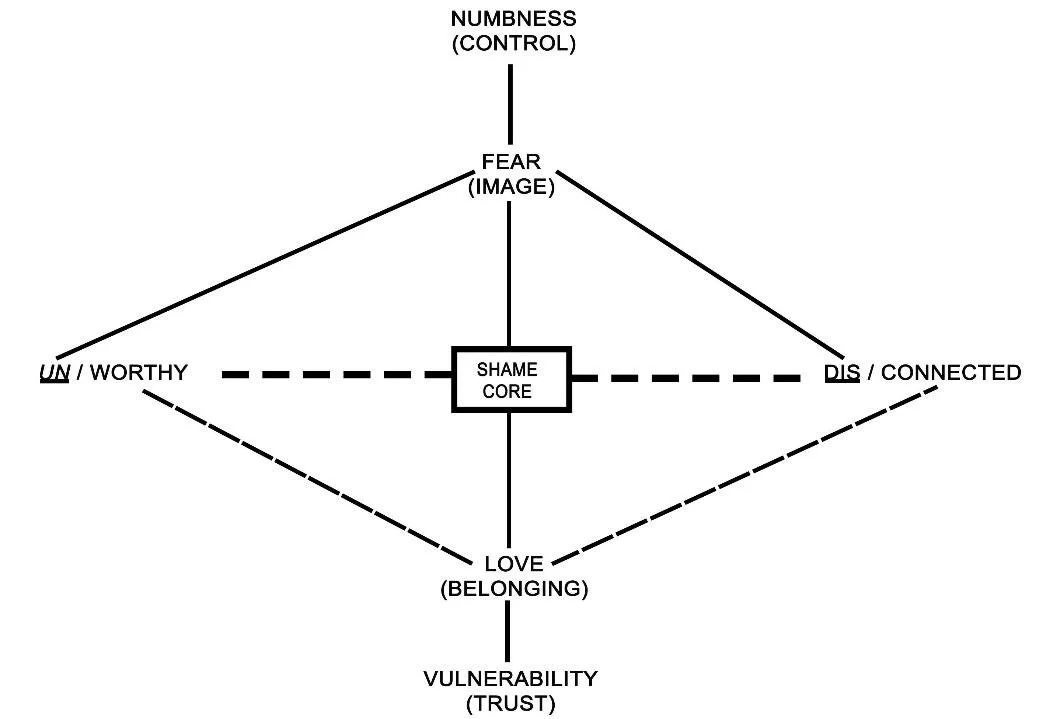
This model makes a basic distinction between people who are motivated by Love rather than Fear. The distinction is schematic so there are elements of overlap, for everyone and everything is fundamentally motivated by Love. An apparent exception, and it is only apparent, arises in the case of people whose lives are ruled by Shame. We need to look at this closely.
A person who is shame-free is able to express and receive Love with relative ease. They experience Love at the centre of their lives and have a sense of Belonging that lets them feel at home in the world. They are also able to admit vulnerability. As noted, this involves a capacity to be touched as well as wounded, so its loss is a grave deprivation. Shame-free people are even prepared to trust in the face of uncertainty and apprehension. This makes them flexible, adaptive and amenable to transformation. They also tend to feel a basic sense of worthiness and connectedness.
People who experience shame, by contrast, tend to feel unworthy and disconnected. This makes it hard for them to receive Love or express it, since they don’t believe they really deserve it and deep down anticipate rejection. It’s also hard for them to experience Belonging since they feel disconnected. Shame thus has an isolating effect. It predisposes us to be withdrawn, to hover around margins, recoil and even disappear (or want to).
In the absence of Love as a felt condition of experience, Fear governs our responses because, unconsciously anticipating rejection, we expect to lose what we have managed to acquire without believing that we deserve it. To bolster a deficient or non-existent sense of intrinsic worth, we strive to maintain an image that varies between the best we can hope for and the least we can expect. This leaves us anxious lest our image be exposed or undermined, making us feel vulnerable and more ashamed. Unconsciousness then becomes a condition of our peace.
Whether we present aggressively depends on our first response: are we overwhelmed or do we try to overwhelm? If the latter, a competitive ego arises, bolstered by compensatory pride. This brings attachment to a self-image which is then imposed on experience. It serves to eclipse fear associated with openness and vulnerability but also obliges us to control a world that now threatens to expose and undermine. The world thus becomes our adversary, especially when fanned by a culture that encourages competitive egos. This makes us forget how to feel, so we become numb in our forgetfulness.
Being afraid and anticipating loss makes it hard to admit vulnerability and trust. Rather than open to the uncertainty entailed by transformation – feeling exposed between one outworn level of consciousness and another as yet undeclared and non-assured – we cling to whatever semblance of structure we can find. We try to control circumstances in our lives and even in others’ lives so that we can continue hanging on. This requires controlling inner circumstances as well as outer ones.
Maintaining a consistent self-image under these conditions thus involves controlling our own feelings. Since it isn’t possible to inhibit feelings selectively, this makes it hard for us to feel at all. Thus we become inwardly numb. Numbness is the antithesis of vulnerability as the capacity to be touched. The dynamics behind it operate unconsciously. The disposition of our egos, irrespective of what they might believe, also arises in response to these same dynamics, as effect rather than cause. Ego is never the master of experience, especially when our self-image demands this. The more we control our inner lives, the more unacknowledged impulses threaten and the more anxious we feel. The paradoxical upshot is that no one is more vulnerable than the person who can’t admit vulnerability.
As long as we refuse to admit vulnerability, not only are our lives cut off from transformation, they are also dominated by unconscious memories and anticipations of hurt: of unprocessed wounding and grief. So stricken, we act out of hurt rather than love, such that our projections visit hurt upon the world and even bouts of vengeful recrimination. This is a chilling summary of our species’ record through historical time. It is compounded by largely undiagnosed effects of anger, blockage and frustration that fuel our violence, without and within. This is the nightmare from which Joyce calls us to awaken and it remains an unspoken legacy across generations.
Our shame dates from our ‘Fall’ and a childish response of blaming ourselves as guilty and unworthy. We feel this in the depths of our unfeeling and in our core as coreless- ness. Even Bradshaw’s shame core is an illusory generic construct: a psychological structure that arises due to the cumulative impact of particular shame episodes. Its determinations are unique in individual cases but it also builds on a deep collective predisposition that is even more unconscious than our familiar range of biographical issues. Thus we need a revamped approach to engage residual effects of forgotten ancestral wounding.
Until this is in place, all talk of ‘coming from the Heart’ is likely to be wishful hyperbole although, since we are fundamentally motivated by Love – as the essence of an evolutionary impulse that moves all to become (more) One – even aspirations to come from Heart do come from the Heart insofar as they don’t just rehearse unconsciously fabricated self-image projections. In any case, it is helpful to harness the idea of a shame core in order to free ourselves from bondage to shame.
Looking back from our present, the shame core appears as a structure that arises in our past. It can be visualised as a ring or filter, as noted. If, adopting a spiritual perspective, we see our timeline as unfolding from a point at the centre of our Heart chakra, we can work with this as follows: imagine looking back along your timeline. See it extending right back to the centre of your spiritual Heart at the time of your birth. Since then, the fundamental structure of your shame core has been laid down, mostly early in life. See it build like a solid ring around your Heart, reinforced by the addition of new layers every time new shame accretions occur.
Now compress this circular structure into a solid wall, interposed between your present and your point of origin. The outer faces and inner mass of this wall contain the history of your deformations by shame. Behind it lies a repressed but essentially intact potential that you have the option of releasing still. This means that the shame core is not a core, although it will continue to feel like one if the hold of its filtering over experience is never broken. As the outer face of this wall mirrors the history of our wounding so behind it lies the promise of our (sacred) gift. This can only be realised by healing our wounds and releasing our shame. To do so is also to release essential creativity. Until that happens all our creativity must be filtered through the ring. This applies collectively also. Hence we must develop ways of bringing our species’ deep wounding into this frame. It may seem hard to envision but we will make a bold start in V.6.
Evoking Collective Shadow
It is helpful at this point to refocus our discussion with regard to the general frame of Jungian psychology, which offers the best platform from which to begin. Consider the diagram below, bearing in mind how ‘deep creativity is traditionally associated with suffering. This association arises because, prior to healing, expression must always filter through un-cleared wounds. Superficial creativity, by contrast, expresses what has limped ahead and adapted to surface conditions at the level of popular culture. (This is a matter of depth and purpose, not genre.) It manifests through a filtering device known as the persona, Jung’s term for the mask structure through which conventionally patterned egos interact socially, per his model:
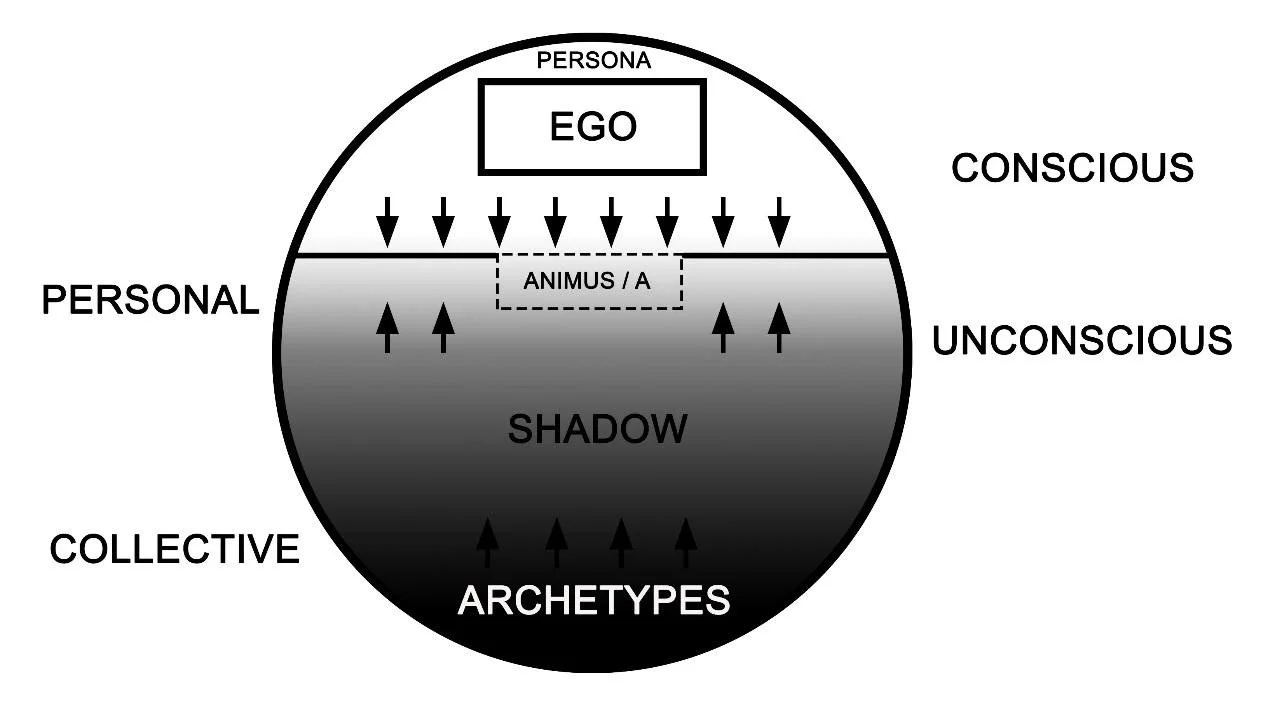
A Jungian Model of the Self System
The core idea of our diagram is that the soul (psyche) is like a circle while the ego is angular and ‘square.’ It naively thinks that it is ‘sovereign’ and rules all aspects, especially those above a horizontal line that demarcates consciousness from the Unconscious. It purports to rule by imposing its angular ways, even on elements of Self that it doesn’t know exists. This is of course a vain ambition.
As our diagram suggests, the best way to engage the Unconscious positively is by integrating our ‘contra-sexual element’ – the animus for a woman and anima for a man. This heralds Jung’s approach to the sacred marriage but most egos aren’t even aware of the option. Typically they repress without awareness impulses that originate in the Unconscious in order to promote what they take to be coherent experience. This usually reduces to patterns that are known as familiar and believed to be safe.
The repressive tendency is represented in our diagram by downward pointing arrows. It may look as if the ego deploys them but this is not the case. They are actually a metaphor for repression which, like all ‘ego defence mechanisms,’ operates unconsciously. Defence mechanisms serve to protect the ego from anxiety which arises whenever unconscious content impinges on consciousness, threatening to disrupt it.
The role of defence mechanisms is thus to block or deflect. The energy that fuels them is siphoned away from the ego-centred pool of waking consciousness, so compromising its vitality and alertness. The typical ego knows nothing of such arrangements. Rather it arises as a result: an effect rather than the cause. Popular psychology has been misled in this regard by early modern presentations of the ego as sovereign. These surfaced in 19th century political-economic discourse and were embraced on largely ideological grounds.
This point has crucial implications regarding the Grail after ‘2012.’ These are pursued in Part VI and beyond. For now, note that it would be more accurate to represent the ego’s ‘square’ angularity with broken lines that stress its inevitable permeability, in spite of defensive patterns that aim to keep it autonomous and apart. These turn away impulses arising from unconscious depths in the sense of not allowing them a place in our self-narrative but they can’t prevent us feeling tense, depressed and exhausted and so forth.
The same is true regarding the line that allegedly separates consciousness from the Unconscious: outside the angular world of schematic models there are no such lines. At the least, it too would more accurately be represented as broken to signify permeability. It is commonly allowed, for instance, that when ego sleeps its defences are relaxed. Hence information from ‘the Unconscious’ (another reified construct) seeps through gaps to achieve disguised expression via dreams.
Such impulses are represented in our diagram by upward-pointing arrows. These evoke unconscious tendencies that sue for expression and recognition in consciousness but are repressed by downward arrows of our ego defence mechanisms. Again naive psychology assumes that the ego is somehow in control of this process but this too is far from the truth.
The ego is decisively formed when the relatively diffuse, unfocused consciousness of our pre-personal ‘I’ identifies with a culturally projected sense of ‘me’ as John or Joan. This invitation is constantly reinforced by the addresses of others and the identification is completed during what Lacan calls the ‘mirror phase.’ The sense of this ‘me’ or ‘self’ is not just evoked by social mirroring (reflections) from other people: it is actively shaped by them.
In order for the bawling toddler I used to be to turn into a civilised school-goer, I have to learn that good boys don’t throw tantrums, pee their pants, bite their peers or take what isn’t lawfully theirs. More broadly, we learn that we can’t act the way we want when we want to. Spontaneity is stifled and this spell becomes a life sentence unless we awaken past it at some point.
In the meantime, forbidden expression becomes anathema for the new ‘me’ so that, in order to become him, I must first become Lacan’s ‘split subject,’ divided by arrows that point up and down but never all the same way. This establishes ‘me’ as ‘I’ now am, formed by an unconscious division that marks a new order of experience and makes wholeness impossible to experience if not to presume. Collective issues are further submerged beneath this, right back to the catastrophic deformations of our ‘Fall.’
The division is unconscious because consciousness is dominated by an unceasing network of reflections that now knows itself as John or Joan. My executive ego, as an artefact of social mirroring, not only survives this process but is created by it and strives tirelessly to maintain a viable self-concept by exercising discursive control over intimations of shame, guilt, inadequacy, unworthiness… Any impulse that doesn’t fit is over-ruled as best it can be. Such generic repression is consolidated in particular cases by personal wounds that cause further effects of ‘splitting off.’
Ego is our name for the condition of waking consciousness that pushes on after each such incident, modifying its story in a continuing bid to secure workable order in its life, such as this may be. It ‘progresses’ by developing its story but can’t transform without opening rigid borders to admit impressions of vulnerability that they are designed to keep out. Ego is thus in charge of very little, especially up to the moment when it comes to acknowledge this.
As for sleep, what happens is that processing resources available to ‘the ego’ no longer have to cope with external stimuli that normally pre-occupy it and so have greater latitude to address internally arising impulses. This is the stuff our dreams are made of at the level of material determination. What the ultimate reference of these internally arising impulses might be is an entirely different matter.
Despite Freud’s almost exclusive focus on sexuality, a lot more happens in our dreams than the reactive assertion of counter-repressive tendencies. Before there is repression there was the un-de/formed nature of all that gets repressed. This is driven by an evolutionary love force that constantly seeks expression through us. It is the ultimate source of our upward-pointing arrows and its gifts are potentially of an infinitely higher order than the level of in-formation vested in energies that maintain their repression.
Of course it can be urged that without cultural de/formation, we would remain at the level of animals. This may be true but it also restates in an arrogant and forgetful way what is already more subtly understood by our mythic traditions: namely that we must be wounded out of infantile innocence in order to discover what undisclosed treasures might lie buried in our Foolish Hearts.
Once de/formed as egos, however, we tend to get lost in illusion, since un-awakened ego mistakes the part that it is for a whole, without ever wondering which whole. We do sometimes get around to that, perhaps more now than ever before. All our ‘counter-repressive tendencies’, all those urges that agitate for release, actually express a deep desire to be One – i.e. for a restored consciousness of Unity, beyond our masks and veils of separation.
*
Changing our ego disposition alters whole patterns of relationship within the Self, including the status of our line separating consciousness from ‘the Unconscious,’ rendering it more permeable. An awakening ego serves to facilitate rather than inhibit this process: whence popular notions of ‘going with the Flow.’ But there are pitfalls: to begin, we can only learn what is unconscious by projecting it and then coming to recognise ourselves as the source of our projections.
This is also what happens in the course of spiritual evolution, including Spirit’s own evolution, except that – in the Beginning, which is more than a time before time – there was no repression and no Unconscious: just movement in Consciousness from implicate towards relatively more explicate states. This is what humanity is still trying to accomplish but it can’t be done without many individual leaps contributing towards a collective, critical mass attainment of what we call ‘enlightenment.’
This has nothing to do with overcoming Darkness but is rather its fulfilment (VI.1). We achieve it by acknowledging our projections and clarifying them as key means by which unconscious content manifests. Our diagram shows that this process arises from two distinct levels of Shadow: personal and collective. These overlap substantially because our personal lives take shape in fields of historic and evolutionary time that exert a determining influence. In theory, however, personal Shadow refers to psychic content that the ego has disowned and can’t access, although it derives from aspects of our individual biography.
Collective Shadow derives from our species’ past. It encompasses what Jung calls archetypes: deep structural tendencies that have been engendered over the course of evolution and have a capacity to channel psychic energy in ways that can be beneficial or disastrous. Which is more likely depends on how our ego-mediated conscious disposition relates to its own depths. If we engage these and work with them, we may even build platforms to clear ruinous influences from our ancestral past although shame has no specific archetype, so deeply buried are its cosmogenic antecedents.
Still, powers of the archetypal Father (strength, protection) and Mother (nurturance, love) are beneficial in allowing us to re-parent ourselves, for example, but only if we engage them after clarifying imprints that arise from our personal experiences of being parented. If such experiences are part of a traumatic shame profile, it is likely that their impact will also be largely repressed (on a feeling level). This blocks spiritual access, inhibits latent archetypal powers and distorts the ego’s relationship with both its internal and external environments.
The same applies to other potentially available archetypal streams, including that of the Divine or Eternal Child. Jung’s ‘Self’ is itself an archetype, symbolically located at the centre of Soul and proposed as an alternative to ego. In our Grail story, for example, it evokes the emerging coherent centre (Arthur’s Court) to which Parzifal directs the re-leased energies of formerly dissident knights for ‘marrying.’ These unruly yang manifestations arise from what Jung calls the Collective Unconscious and filter through un-clarified aspects of Shadow, personal and collective. If they are turned back to fester amid the deformations, frustrations and repressions that splitting engenders, the results are destructive expression and a conflicted inner life, which again gets displaced as aggression towards ‘others’ and the natural world.
This is almost inevitable since the soul is intrinsically motivated to express towards wholeness and individuation: attainment of the most complete and authentically integrated experience it is capable of. Reactive ego structures, including defence mechanisms set to conserve pre-established levels of coherence and stability, frustrate this process. Together with the continuing hold of un-cleared culturally transmitted wounds, they serve to make Shadow toxic and full human being unattainable, which is why our Grail Quest impresses as a vital healing journey.
Failing its success, we continue to experience Shadow unfeelingly as a repository of dark powers that are set to overwhelm and undermine apparently coherent ego experience, despite unconscious turbulence that doesn’t register unless we attend to our dreams! The shortfall is reflected in worlds we unconsciously co-create with these same uncultivated powers as we continually disown latent gifts without awareness, ultimately because they lie buried beneath our deepest wounds. A further consequence is that, fearing ourselves – our unacknowledged, un-integrated powers – we come to fear everything and manage this fear by projecting it on to Darkness, thus compounding patterns of cultural dualism that are already deeply ingrained and the shame that keeps our eyes turned down.
As Freud noted, we find relief by projecting on to others, persons and groups that serve to mirror a disowned inner malaise that we tend to punish in them as opportunity allows. This condition underpins the vast mess we have created in our unconsciousness (ultimately by turning away from all that seeks expression through us) and must be put right if talk about ascension and global transformation is not to remain at a level of compensatory fantasy: a reactive formation, as Freud would have said.
This doesn’t have to be the end. If we can detoxify Shadow, including deep collective traces of extinction-type events, the generative innocence of Darkness can be reaffirmed and our relations with it made clearer. Then we can also honour Nights as well as Days and cease being afraid of each other and ourselves. Projection remains our primary means toward this end, consciously pursued. We shall see that it has a much deeper history and purpose than the canons of formal psychology allow.
Shame: Jung and Beyond
A shame disposition arises in our Jungian schema as the cumulative result of different shaming episodes. The discursive nature of a shame core as such – the fact that it is created in language – is suggested by problems we encounter while trying to locate it in this more inclusive model. That said, a shame disposition does arise out of early experiences of being shamed. It does pre-dispose us to contractive withdrawal tendencies, even if these are masked by the confident projections of an assertive persona that strives constantly to over-ride a base that is more anciently fragile than we know.
But still events in the 3D world hook into residual dispositions, cueing experiences of numbness and fear. Then our ego story kicks in to restore its alleged pride of place. The real challenge presented by shame dispositions with regard to our Jungian model is that their controlling tendencies incline us to cling tenaciously to old ways, whether frankly depressive or falsely ebullient. If this stops us from trusting a vulnerability that is prerequisite for transformation, counter-repressive tendencies that sue for expression will be systematically inhibited.
Thus traces of ancestral wounding fester invisibly in hidden depths, assuming a permanently depressed position that is impossible to engage or transmute as long as we deny the radical trauma that underpins our amnesia. Their influence registers without awareness in shaping basic cultural norms like: survive, re/produce and control, consuming pleasures as best we can. It takes great effort to access deep Collective Shadow issues and we will look later at ways to do this. For now, note again how odd it is to characterise as ‘counter-repressive’ spontaneous tendencies towards expression that were present long before curtains of shame were ever drawn around them.
*
Allowing that there are no deviations in the Tao and yet that many have evidently occurred – including one that allegedly knocked Earth off her divinely appointed axis – requires adopting what we might call a ‘new perspective’ or, in Gebser’s terms, a newly integral a-perspective. Either way we are left to fathom the imprint of an all-loving Father-Mother God who doesn’t mind killing most of us off in order to renew the world; otherwise it’s all just a cruel accident or something else. I favour something else.
If ‘2012’ is really so important in this regard, such that a solstice of the Great Year and a fusion of 9 Creation Waves occur within a geological hair’s breadth – we might expect that something truly novel is presaged, perhaps even the attainment of our full human being. This would require our species to come of age by moving into a new pattern of conscious evolution rather than suffer the terminal phase of its possible extinction, whether induced by falling stones or vicious energy wars. It requires our awakening as whole citizens of cosmic space and time rather than lingering on as the split subjects of all too familiar local disputes.
Seen through the eyes of Spirit, it requires truly conscious, fully embodied agents to awaken as such and actually facilitate the process of divine evolution by mediating creatively between ideal forms and contingent patterns, so that existence can awaken to the needs of its highest potentials, so to speak, and collaborate in their fulfilment rather than waiting for calamity to move things on. Prerequisite for this is a radical opening of Heart sufficient to comprehend a legacy of near-extinction events along the Way, including derivative imprints of shame terror and betrayal. These have consistently led to locally focused but still pervasive manifestations of incomprehensible cruelty that are a hallmark of our imperfectly conscious, ego-governed species (and not just in ‘extremists’).
Opening to Cosmos from an Earth platform also involves reawakening to the wonder of artificially eclipsed night skies and rescinding childish projections that in our wounding we have visited on Darkness. Only then can Terence Mckenna’s metamorphosis into stars occur, metaphorically, in Consciousness. This too requires growing into an awareness of ourselves as Divine Children of a Tao that is mysterious as well as dark, expressions of an Uncarved Block that, despite being supremely intelligent (By what criteria could we possibly dispute this?) is not omnipotent or omniscient in the anthropomorphic sense projected by us as damaged offspring of a mythic Father and/or Mother God who saw fit to almost destroy us.
[This tendency evidently began with a rekindling of agricultural civilisation after the Younger Dryas, with the positing of a ‘Great Mother’ who was then deposed following a cataclysmic Flood event c. 3,000 BCE as described by Carlson. Her replacement by a battery of patriarchal gods was already complete when early mystical intuitions of transcendent Unity as ‘the One’ were devastatingly assimilated to more dogma-friendly images of ‘God’ as a Supreme (male) Being. This facilitated the institutionalisation of patriarchal religiosity and a concentration of power-knowledge within emergent cultural hierarchies. The newly beguiling dramas this gave rise to effectively eclipsed unhealed legacies of deep wounding which they played over, not least via alternative symbolisations of our ‘Fall’ that actually focus our guilt and unworthiness, converting an original wound into ‘original sin’ (5).
My sense, largely intuitive, is that the impact of the beginning Younger Dryas event was so incomprehensibly vast and sustained over almost 50 generations, that it induced a trauma so profound and so totally numbing that it effectively erased all memory of the instigating event. Consider again the tone of Don Alejandro’s ‘Creation story’ recounted in I.1, noting especially its mix of childlike trust, wonder and apprehension, all wrapped in a palpable layer of remote, post-traumatic inertia. Imagine the impact made on people in this state by the arrival of knowledgeable teachers whose instruction fostered a renewal of agriculture and civilisation, aided by a favourable climate over the next few millennia. A semblance of recovery is conceivable under such circumstances.
Then a regional cataclysm strikes c. 3,000 BCE with immediately severe repercussions: widespread flooding and loss of life, followed by large scale displacements of human groups, leading to encroachments and conflict. The effect is deeply traumatic: not as incomprehensibly, all-numbingly so as events that began the Younger Dryas but enough to activate a residual terror of annihilation associated with it. The starkest survival programmes are not only engaged but foregrounded in the way survivors manage the chaos into which their lives have suddenly been plunged. We struggle against opponent groups in a hostile world and resolve never to be taken unawares, nor deceived by easy words concerning Goddess benevolence. We become armed, militant and hardened in our Hearts against anything that might threaten future security.
This brings about subjugation of the female-feminine and also illuminates the extremity of repeated backlash waves throughout the course of patriarchal history. A new order of civilisation emerged during this process, as in the sudden rise of dynastic Egypt, but this time sages were unable to turn the tides of now remembered chaos, even insofar as they were able to resist contamination by it. We have noted the role played by spiritual neurosis in this unfolding: how patriarchal charter myths eclipsed the prior centrality of Goddess forms and, via this act of compound repression, paved a way for the trauma-governed reign of truncated academic narratives about our past. These are founded on a denial of our deepest wound and thus, also, of our deeper gifts.]
Mystically, Father/Mother God symbols still serve as valid projections of our mythic consciousness structure and I continue to value them as such. Nevertheless, we must also bear in mind that as symbols they are ultimately fingers that point at the Moon and not the Moon itself. To become full humans we must put away all childish (as distinct from childlike) things. We must admit a looming Dark Night for Earth and our role in it, whether induced by cometary impact or wars waged in pursuit of dwindling energy resources. We must admit, accept and integrate all our ancient wounds and Shadow traces so we can be fully present to this challenge and the opportunity it brings, without needing to invoke wrathful deities or other such wounded-childish constructs.
The best precedent I know to gather ourselves in this regard is Nietzsche’s version of ‘eternal recurrence.’ This involves opening to all sufferings of this world, imagining the same pattern repeating over and over in never-ending cycles and still saying ‘yes’ to life, consciousness and existence. He posits this as the ultimate criterion of authenticity for his full human being. The vision is essentially similar to traditional Hindu teachings except for one crucial difference. This concerns the option of transcendence, which typically requires at least temporary withdrawal from the world to attain a level of awareness that is not dependent on but permits total acceptance of all that happens here, even to the point of passing through a Needle’s Eye on the frame of a Cross.
The tragedy of Niezsche’s lifetime (1844-1900) was that the symbolism of this Way had been closed to modernity’s late mental consciousness structure while Gebser’s integral mode had not yet crystallised ahead of our extended time of ‘2012.’ The precise role of ‘transcendence’ will be clarified later (Parts VII-IX). Nietzsche was precluded from it by his intuition of ‘the death of God.’ This marks a prophetic moment in human sensibility and consciousness evolution. It carries us beyond childish faith in a politically correct, symbolically balanced but still literally espoused Father-Mother God and beyond any lingering traumatised commitment to a capricious Mother or vengeful Father who at least cared enough to punish us for deviating from their inscrutable will.
That said, it also falls short of Meister Eckhart’s reflection that we need to get rid of (limiting concepts of) ‘God’ in order to go to the mystical realisation of God. Contrasting wounded child-ish reflections with Rumi’s ‘Straying maps the Path’ brings us close to the awareness that Nietzsche was approaching. Traditionally, also, attainment of transcendence after withdrawing from the world is acclaimed as the end of our spiritual striving. But the stream of evolutionary mysticism noted earlier sees beyond this necessary threshold to an entirely new level of consciously co-creative evolutionary participation that is informed by the experience of transcendence and ever more richly fulfilled by continued participation in the processes of time and existence.
We will see later that this is a hallmark of Christ Consciousness and opens a Way to Heaven that is already Heaven. In the meantime, the work of Martin Heidegger will help us bridge between Western constructions of ‘God’ and Eastern experiences of transcendence, both of which we will need to draw on later.
8. Martin Heidegger’s Ineluctable Quest for Being
Martin Heidegger was a German philosopher who lived from 1889 to 1976. He is acclaimed by some as an epochal thinker and reviled by others as a verbose, nefarious charlatan. I tend towards the first assessment. The second is based on the complex style and content of his writings, together with what seems to have been a brief but ignominious period of active engagement with Nazism. I want to clarify the grounds of my admiration while also aiming to integrate crucial insights that he has helped bring to notice.
When I was a child I had a game where I would close my eyes and try to make the world disappear. I would get as far as a clear sky and think that all ‘things’ were now gone. The sky itself remained, of course, so I would try harder, calling down a night and imagining pitch darkness as the closest I could get to nothing. But there was still ‘me’ hosting this experiment or, when I really got absorbed, a mysteriously self-sustaining consciousness that was there even if I forgot about ‘me.’ I somehow came to realise, wordlessly, that there can’t be just nothing. There is always ‘some-thing’, even if it lacks all the attributes of ‘things’ and is more like no-thing. This was my first intuition of Be-ing. It triggered a life-long passion that I later learned I shared with Heidegger.
Such experiences allowed me to marvel at the first great question of philosophy noted earlier (Why is there something rather than nothing?) and to share Heidegger’s sense of radical astonishment before this primal wonder at Be-ing – that there is Be-ing, that Be-ing is, that anything is, including no-things (non-objects) such as consciousness and love – when there might have been nothing at all. But there is not nothing; there is Be-ing. Heidegger challenged me to move past a flair for easy wonder and pose the question of Be-ing as such, looking past the stark ineluctability of the fact that Be-ing is.
He said it was the distinctive role of humanity to think Be-ing, to question it with a view to understanding. He dared to ask ‘What is this Be-ing that is?’ and he did so without ever imagining that a solution would one day arise to cancel all need for further questioning. On the contrary, he saw such questioning as a necessary meditation that is optimally always under way because from it we humans derive our specific dignity and fulfilment.
Without it, we lapse into a forgetfulness of Be-ing. We forget the value of our own be-ing, and then of all beings’. Forgetting Be-ing, we lose the Ground of our personal and collective authenticity. Remembering it reveals that the role of humanity is to care for Be-ing in all its manifestations. This is hardly the stuff of brutal Nazism. Behind it lies a story that needs unravelling.
Being and Time
Notwithstanding my Foolish enthusiasm, Heidegger insists that we cannot engage Be-ing as such. Instead we must address its presence in the form of beings through which it is disclosed. This is especially so regarding the case of ‘Man’ as the being who uniquely questions Be-ing. Man is a Dasein: literally, a there-being or a being-there who is ‘thrown’ into the world without choice or deliberation. When Heidegger examines the nature of human being-in-the-world he finds that we are always extended towards a future that we’re constantly engaged in creating. That is to say, Be-ing is constantly projecting itself and unfolding through us in time.
Whence the fundamental assertion of his most famous work, Being and Time, which was published in 1927: Be-ing, far from being timeless and unchanging as is commonly assumed, is deeply implicated in time. It is an activity, a process rather than a state. It implies presence but not completeness and is perpetually disclosed as well as concealed by particular beings that manifest it. (I can’t see ‘Be-ing’ when I look at a dog but I also couldn’t see a dog without its and my be-ing, both of which presuppose Be-ing as such!) This is particularly true for humans because we can let ourselves serve as a ‘clearing’ in which such disclosure or ‘un-concealment’ happens with awareness.
The presentation of Heidegger’s work, its style and content, is deeply affected by considerations of cultural embedding. A provincial German nationalist with a prodigious intellect, he grew up steeped in ultra-conservative Catholic tradition. As a boy he had intended to become a priest. Later he opted out of studying theology having lost his faith but never fully shed the influence of a religious education that he formally disavowed. (Although Heidegger vehemently repudiated attempts to psychologise his work, there is no binding reason why even a famous philosopher shouldn’t also remain a ‘split subject.’)
Heidegger chose to work on fundamental ontology. This studies the nature of Be-ing or what is, unlike the special (ontic) sciences which study particular types of being(s). Their accounts can never be well-founded or complete unless they are rooted in an understanding of the Be-ing that characterises all being(s). Heidegger aspires to provide this. Without it, human intellectual culture becomes disoriented and debased. We have lost our way because we have forgotten Be-ing.
To find it again we must first remember Be-ing. The thinking of Be-ing and, soon after, its forgetting both began in ancient Greece. The first thinkers came before Socrates and didn’t even know they were ‘doing’ philosophy, which hadn’t yet been named. It was Heraclitus who first described a philosophos as one who loves (philein) the sophon, which Heidegger glosses as a realisation that the One is All or, in his own terms, that all being is gathered in Be-ing. A proper task for philosophy, once it has been constituted, might be to clarify the meaning of this statement but that promise was never fulfilled.
Instead what happened after Socrates was that Plato linked unchanging Be-ing with ‘Ideal Forms’ that exist outside of time while Aristotle posited an ‘Unmoved Mover’ as the ultimate Source of all forms that arise within it. Our primal sensitivity to Be-ing got lost in waves of philosophical and theological speculation that grew out of these formulations. We lost the facility of relating directly to Be-ing, as opposed to abstract discourses about it. Hence, says Heidegger, our metaphysical tradition orchestrates a forgetting of Be-ing that leaves us pondering notions of ‘God’ or more polished symbolic-theoretical equivalents in ‘His’ place.
Under such conditions we cannot think Be-ing or question what it is that is or even what this is means. Forgetting Be-ing, we cannot care properly for it, ourselves or any beings. This opens a vein of deep ecological thinking in Heidegger that was truly prescient for its time and led to a hugely insightful critique of technology that starts in ancient Greece, where the root of the verb to be (Sein in German) is phusis. This means nature but also implies a driving, generative power that brings forth organic forms. Heidegger associates it with a purely integral creative activity of poiesis as well as the more instrumentally focused mode of techne.
Poiesis links to poetry and encompasses all the forms of symbolic expression whereby we participate in the self-disclosing activity of Be-ing. Techne is the root of our ‘technology’ but can also be perfectly integral as a form of action that shapes the world in correspondence with intimations of Be-ing, as when a farmer cultivates soil with a view to making it sustainably productive: enriching rather than despoiling. Such an attitude, whether exercised in a mode of poiesis or techne, exemplifies Man’s proper role as ‘the Shepherd of Be-ing,’ the being that cares for Be-ing’s welfare. As we forget Be-ing, techne becomes dissociated from poiesis and mutates into a rampant, exploitative practice that serves only its own pragmatic ends.
Now that this has happened we have lost our way. How to find it again? Heidegger starts by looking to language records left by the ancient Greeks of their engagements with Be-ing. Before Socrates, he asserts, the Greek language was able to register Be-ing in its full immediacy, without any of the distortions induced by later doctrinal elaborations. By listening carefully to primary revelations of Be-ing in words of the pre-Socratics, we awaken in ourselves a sense of what it means to love the One that is All, or the Be-ing in which all being is gathered.
The Greek language retains vital, pristine echoes of Be-ing. Heidegger aims to uncover such primal traces via a practice of judicious etymologising that seeks to rekindle our sense and remembrance of Be-ing. He aims to revive our amnesiac tradition by this means. By running an awareness of what was realised at the very beginning of western metaphysics through all the distortions it induced, he will not only eliminate the distortions but also establish a way forward towards a reoriented, reinvigorated future.
Heidegger’s etymological practice also intends to illustrate a key principle of listening to (the word of) Be-ing, of attending to and waiting on it with care instead of rushing in to classify, dissect or impose the requirements of some current, pre-compromised, historically conditioned doctrine. His credentials rest on an unswerving belief in his own acuity and supposed qualities of the German language that allow it to render the carefully harvested ontological yield of ancient Greek seminally into modern times.
[A core example is that the German word Sein designates both the verb ‘to be’ and the noun ‘being’, which reveals be-ing as an activity/process that can be named. This may not seem to matter because if we compare the verb ‘to be’ with others such as to paint, kiss, eat, throw etc., it seems null and void of content. We are thus inclined to relegate and forget it. But, Heidegger counters, it wouldn’t be possible to paint, kiss or eat if it weren’t first possible to be. Everything depends on this overlooked and fundamental process of be-ing. I hyphenate the word Be-ing to designate this formless activity, capitalising it also to distinguish it from particular instances of be-ing.]
Such remembrance is only half the battle. It needs complementing by an ontologically informed social critique that will expose alienating effects of human forgetting and help open us again to receive the word of Be-ing. We have already noted Dasein’s (Man’s) special relationship with Be-ing as the being who singularly questions, thinks and seeks to understand it. Tenure of this privileged position, which Heidegger has evidently assumed, is threatened by the fact that we are ‘thrown’ with others into the world. We share with them a jaded, used-up language that serves only ‘to pass the word along’ rather than reveal and disclose.
Having to ‘be with’ them inhibits me from living authentically. There is no fulfilment in adjusting to the norms of this ‘They.’ Heidegger calls it Das Man: an anonymous, impersonal aggregate that we conform to and internalise, thus relinquishing our authenticity, together with our capacity for astonishment and receptivity before the call of Be-ing. He refers to this compromised condition as Verfall: a simultaneous falling away from Be-ing and from self. It has often been observed that this scenario evokes a secular Fall, a possibility that Heidegger was perhaps too quick to deny, observing that it had nothing whatever to do with ‘original sin.’
In fact, he argues, this fallen condition is actually positive in that it moves those affected by it to a sense of disaffection, anxiety and even guilt at what their lives are failing to achieve. This inspires a striving for authentic existence which entails coming into relationship with Be-ing (a development that is also indicated by our generic Fall narrative, and even the passage from unconsciousness to consciousness evoked in IV.2). Such striving and the anxiety (Angst) which attends it, is felt most keenly with regard to the prospect of death, others’ and our own.
The prospect of death, with its promise of personal annihilation and threat of nothingness beyond, focuses our Angst and tacitly restores our awareness of Be-ing (as that which nothingness is not). It inspires Dasein to re-order its existence as a being-unto-death, such that the bracing effect of this initiative frees us from the trivialising obsessions of Das Man and returns us to a condition of personal authenticity that pivots around an anxious awareness of our finite relationship with Be-ing.
However, because our being-in-the-world is at the same time a being-with-others, the fulfilment of our authenticity must finally be achieved in relation to them. This entails a sense of collective destiny that can only be served by practices that build communion and community. Heidegger sees this as indispensable for correcting groundless, modish, uprooted forms of free-floating intellectuality that surface in the alienated, mechanised, dehumanising societies that result from our forgetfulness of Be-ing.
He advocates a community that lives ‘alongside’ (in remembrance of) its dead, in keeping with his sense that a tradition coheres most effectively by ordering its unfolding from a point of origin in continued awareness of Be-ing. Only such a sense of ordered unfolding can provide a sustainable way into the future. I have heard indigenous elders say such things and be hailed by modern sympathisers as oracles of the highest wisdom. When a German intellectual says them in the culture world of looming Nazism they assume another meaning altogether, especially with hindsight.
Perhaps due to the many ramifications of its deeply embedded reflections, Be-ing and Time struck deep chords. Although many critical scholars have objected that Heidegger’s etymology is at best creative and at worst wildly arbitrary, as many supporters felt it was also highly evocative and genuinely restorative. Presumably for this reason, it was received with widespread acclaim in Germany and shortly afterwards secured its author’s fame on an international stage.
Language, Poiesis, Be-ing
When Hitler came to power in 1933 and racist policies began to be implemented in German universities, Heidegger was asked by colleagues to stand as Rector of Freiburg, apparently on the grounds that his fame would help protect the institution. With no previous history of political involvement, he agreed, was elected and rapidly became an eloquent advocate of Nazi agendas. For a year he lent his reputation actively to its cause, evidently believing that he could have a refining influence and channel the raw energies of this political movement that seemed to have arisen in response to his summons, or rather that of Be-ing in its ineluctable becoming. It turned out that Party ideologues saw no need for a fundamental ontologist to augment its inner genius and, after eleven months of servile efforts to ingratiate himself, Heidegger returned to philosophy and his classroom, where he is said to have behaved with integrity.
Nevertheless, the question has been asked if there are elements in his teachings that were instrumental in promoting Nazi policy. Apart from the fact that both emerged from the same deeply alienated culture world, I see no point to this. Given all that fed into the Nazi catastrophe – everything that Adorno described as ‘the revenge of Nature’ on grounds that are largely congruent with Heidegger’s analysis – the belief that he could be held responsible for events that followed is as vain as his own briefly deluded sense that he could somehow orchestrate them.
As noted, there is no binding reason why philosophers with vast intellects shouldn’t also be split subjects. I believe Heidegger is wholly correct to note our forgetfulness of Be-ing and the consequences of this; and also that Be-ing is a source of Becoming that projects its own disclosures by whatever means and through whatever structures are to hand, including those that are malformed from lack of due care and attention. Thwarted expression becomes counter-repressive tendency. That is to say, considerations of pathological rupture adverted to in IV.4 also apply at the level of our collective being through all its pre/historic de/formations.
The fact that Heidegger claims to practise ontology rather than merely ontic science offers no immunity from this condition, as his Nazi miscalculation demonstrates, and if he could be so mistaken about that, he might also be mistaken about other things, including aspects of his philosophy in Being and Time. Despite its solicitous call for Man to wait upon (the word of) Be-ing, Heidegger’s language in that book is forceful and driven in service to a programme that is confidently anticipated from its beginning. In fact, he came to believe that his effort to think Be-ing while attempting to break away from the systematising tendencies of western metaphysics hadn’t been successful and perhaps could never be (6).
For this reason, his practice of thinking moved away from the strenuously asserted propositions of Being and Time, which remains unfinished, to a more restrained but no less exacting mode that is also, he says, a thanking: a gesture of gratitude for all that is given to those who wait in attendance on the word of Be-ing. He sees the figure of the poet as central in this respect, articulating the profoundest disclosures of Be-ing, far from the plaudits of Das Man. In this respect, Heidegger achieves in his own late work what George Steiner calls a lyric humanity that, in the words of Martin Buber, ‘belongs to the ages.’ I echo this assessment and infer from it a passage of learning and redemption, notwithstanding Heidegger’s much publicised failures to disavow his Nazi involvement.
He later wrote that language is ‘the House of Be-ing.’ It speaks us rather than the other way around. This has since become an academic catchphrase. Heidegger’s aim was to stress that humans are pivotal to Be-ing only when operating in a mode of service to it rather than presuming to be its executive directors. He nonetheless remained adamant that the course of his lifework followed a single trajectory: a persistent questioning of Be-ing. I want to focus now on his sense of what Be-ing is. This is impossible to define since Be-ing is a forever under way and a necessary precondition of any definition.
I am tempted to associate his stance here with Voegelin’s account of conscious human being as an incarnate openness to the Beyond but Heidegger pre-empts this by refusing the possibility of any Beyond. He considers Be-ing totally immanent and dissociates himself emphatically from all notions of transcendence, stating that the purpose of Being and Time was to debunk ‘onto-theological’ constructions of Be-ing as a kind of transcendent Super-being: i.e., ‘God’ or equivalent.
This point is well made but isn’t conclusive regarding his dismissal of transcendence. How could it be? Has he mastered yogic consciousness and found it wanting having done so? Has he practised Buddhist meditation and found its highest teachings, which posit no onto-theological constructs, to be erroneously based? No, but he has attempted to think Be-ing faithfully and elevated this calling above others, perhaps on grounds of personal ambition or ethnic chauvinism (whereby the German language is the appointed heir of Greek, which used to speak Be-ing with clarity but doesn’t any more, such that it needs succeeding).
I sense something foolish here, in the sense of unwise rather than naïvely innocent. It may also be traumatically inert, like a Shepherd caught in history’s spotlight, mortified by undertows of repression and counter-repression both. Again Heidegger refuses all application of psychological categories to his work. He alone has dared the fundamental ontological quest to think Be-ing and, as in his response to charges of ersatz theologising, puts himself outside the range of merely ontic reductions. I find this posture over-determined.
I agree that the nature of Be-ing is misconceived as any kind of Super-being and obscured by being identified with God or an Unmoved Mover. I also agree that references to it as ‘Great Mystery’ are glib and unavailing if those who make them leave it at that, pre-empting further thinking and thanking. I agree that Heidegger’s question ‘What does it mean to be?’ is necessary and vital in the way that he describes but am not persuaded by his answer (as distinct from his answering) to it.
Be-ing is but also emerges. We are expressions of its emergence. Simply disavowing Super-being theories because they reduce the ontological to the ontic itself pre-empts a deeper possibility that there might be more to Be-ing than an immanence that is simultaneously concealed and revealed by beings. This contention is now strongly supported by testimony from mysticism and science. Both attest that un-manifest Be-ing is: quantum reality is part of the One that Heraclitus loved before there was philosophy (or existence). Sub-nuclear ‘particles’ come from no-thing that is not nothing but rather an invisible modality of Be-ing in all its marvellously undeclared potential.
[Admitting quantum reality doesn’t diminish in the least what Heidegger says about Be-ing. On the contrary, quanta move into and out from a No-thingness that is already an example of Be-ing, perhaps a clearer example than any other. Quantum reality doesn’t exist, however. It has no tangible self-sustaining form and in that sense is antecedent to and transcendent of our manifest world, which arises from it as beings do from Be-ing. It is too early to say more about this. I will try again having examined Ervin Laszlo’s contemporary account of ‘Akasha as an Information Field’ (V.1).]
Be-ing is pure activity before transcendent essence (Being-ness). The latter is a secondary abstraction. Its bogus primacy is challenged by Heidegger’s claim that the activity of Be-ing is wholly immanent, with no role for transcendence. This too is over-determined: we have no problem allowing that transcendence makes sense only in relation to that which it transcends, whatever exists immanently in relation to it. But if this relation applies in one direction, must it not apply also in the other, as a means of articulating the indeterminate Unity that (Be-ing) pre-eminently is?
Transcendence and immanence are mutually dependent, so Heidegger is right to say that there is no ‘transcendence’ as such. But, for the same reason, there can also be no stand-alone ‘immanence.’ He wouldn’t have to disavow other people’s ‘God’ if a transcendent pole didn’t arise persistently in our experience. But what can it mean that a transcendent pole arises in the experience of beings who uniquely question Be-ing except that this is part of Be-ing’s self-revelation?
Be-ing as pure activity transcends space-time location and all given states. Evidence shows that its becoming is an orderly process. Within the ordered whole of this unfolding, the polarized nature of mind ordains that language symbols arise as binary pairs in an overall system of mutual determining relationships: ‘up’ implies ‘down’ but would we conclude because we favour ‘down’ that there can be no ‘up?’
This relational property lets language symbols articulate the dynamic nature of Be-ing as it becomes beyond isolated acts of naming. Naming evokes within a unitary field of Be-ing, existence and language-as-system. This power of evocation moves the whole insofar as it is true to the self-disclosure of Be-ing through us. Whatever philologists might say while decrying Heidegger’s creative etymology as arbitrary, it is such metaphorical extensions of meaning – from serpents in the sky (comets) to ‘Language is the House of Being’ – that orchestrate the leaps through which wholeness evolves and is conserved in Consciousness, from relatively implicate to explicate states.
It is also because of the systemic nature of language that Voegelin’s point holds: the pair immanent-transcendent expresses an inherently dynamic tension that serves to articulate the unitary field of Be-ing from within itself. It is mistaken to isolate either and posit as autonomously existing some ‘entity’ that corresponds to one or the other pole alone: an onto-theological God as purely transcendent or an embodied gene-machine as purely immanent. Isolating either one collapses the dynamic integrity of the whole, reductively obscuring the Truth/Mystery of Be-ing.
If we admit the reality of un-manifest Be-ing as underlying all that is revealed by forms of manifestation and allow that this is before the space-time field of existence, then we also successfully reconcile with Be-ing a concept of ‘nothing’ to which it is falsely opposed by treating as separate ‘entities’ that arise relationally in language – i.e. since Be-ing is, always and forever, there can never be ‘nothing’ except as a linguistic fiction.
Un-manifest Be-ing is no-thing but not nothing, as I naively discerned while lost in childhood reverie. Reflecting decades later, explicitly, I understand that Be-ing comprehends nothing in a way that nothing, as a negation, could never match. Heidegger says that the negation of nothingness is Be-ing but (I stress) the negation of Be-ing is not nothingness. It is impossible to negate Be-ing because every attempt necessarily presupposes what it aspires to erase. There can be no negation of Be-ing except as an ideal semantic exercise.
Despite this, Be-ing is not Other than our world. It is rather an integral, unitary, all-encompassing process where Be-ing emerges as beings do via existence, while also remaining primary and transcendent in relation to it. The transcendent and immanent poles of our experience arise in the course of this emergence but not actual entities that correspond to either taken alone, whether super-deities or automata. Neither is extrinsic to the field of existence in Be-ing; rather both are part of Be-ing’s self-disclosure, given to articulate its mysterious unfolding to itself.
Nothingness outside existence has traditionally been called ‘Void’. This is now known to teem with un-manifest potential and is thus commonly referred to as a ‘Source’ or ‘Quantum Field’. It is significant that in our time of ‘2012,’ science has manifested a ‘New Paradigm’ that asserts the priority of Consciousness over Matter (and, implicitly, of Be-ing over existence) both in terms of genesis and resolution (V.1). Consciousness as un-manifest presence is admitted as the underlying nature of a Source Field from which inherent, undeclared tendencies of Be-ing foam into existence while consciousness embodied in existence is also acknowledged as necessary to resolve seemingly chaotic emanations that arise out of no-thing to become intelligible forms of Be-ing (beings) in the world.
The primacy of Be-ing that Heidegger asserts is presupposed everywhere here. As a dynamic process, Be-ing orchestrates its own unfolding. It entails presence but can never be totally present since it is forever initiating its disclosure through existence and time. It is constantly becoming, questing for the fullness of its truth. This quest is never fully realised but is always under way. Be-ing becomes and is thus temporal as Heidegger says but it is eternal too in that there has never been a time when Be-ing was not, for nothing presupposes it.
In the end, Heidegger’s Quest for Be-ing is an instance of Be-ing’s quest for itself. It is telling that this Quest finally involves an eloquent waiting on rather than a knightly riding out, or the apocalyptic seizures of a ‘Total War’ that is as far as Consciousness can get from owning its projections. That said, the fact that Be-ing can never be wholly present to us, even as we wait on its word, doesn’t mean that we can never be wholly present to it: via practices of transcendence cultivated by Eastern spiritual traditions, for example.
9. Consciousness and the Adventure of Existence
The Grail as a spiritual symbol evokes our Unity with the Divine and our longing for this. At the most comprehensive level, it can also be seen as Cosmos or the Body of Goddess, a receptacle into which the Divine Power that manifests evolution is constantly pouring forth, forever birthing anew. At certain times, occasions arise during which leaps in consciousness occur within this process. We are in the midst of one now and feel moved to reinforce our still implicit sense of Unity with regard to a continuing desire to realise it more fully in ourselves. Here we have the essential terms of our mission as fish searching for water in an ocean: the constancy of Be-ing allows us to grasp the radical depth of our participation in an adventure of Becoming that continually disturbs our balance in an ongoing Quest for greater consciousness and life. This is an excellent place from which to launch a renewed attempt to clarify the adventure of existence. Let us start with Plato and Goethe.
Goethe offers a developmental schema that moves from ‘perfect unconsciousness’ through ‘imperfect consciousness’ to ‘perfect consciousness.’ We can also relate this to a shift from pre-personal through personal (self) consciousness to transpersonal consciousness. Plato, writing over two thousand years before, proposes the more compact: Ground<=>Wo/Man. It is possible to unpack this further now the in light of experiences undergone around the turning point of 28/10, considered in relation to our sequence of 9 primary Creation waves.
The idea of ‘going with Flow’ is as old as Taoism, let us say two and a half thousand years, dating approximately from the time of Lao Tzu’s legendary composition of the Tao Te Ching. Older again is the Indian tradition of Yoga, with its central goal of connecting back to an unchanging Truth of Source. The ideal of Taoism – expressed through the moving meditative practice of tai chi, for example – is to emulate the Way of Heaven in our conduct and manner of being on Earth. It is akin to Yoga in that its core goal involves manifesting awareness of the Constant, albeit with eyes that have opened to revelations of a Nature that intends the Grail: whence its central symbol of the Way.
During Calleman’s Galactic Underworld (began January 5, 1999), ancient notions of aligning with the Way of Creation became widespread and gradually acquired a proactive sense of facilitating, regulating and even helping to direct the course of evolution via consciously deployed co-creative intent. This platform became consolidated and more popular as the 9th wave (carrying energies of the Universal Underworld) broke in March 2011, focusing ever more attention on issues of human response-ability and evolutionary leadership.
The role of human stewardship was fore-grounded, together with projections of anticipatory consciousness required to avoid disaster and promote renewal. People began speaking openly about Passion, Purpose and Destiny. Trainings and practices sprang up to facilitate the pursuit of all three till it became clear that a vital dimension had awakened in the sphere of humanity’s collective spiritual awareness: namely an idea of evolutionary response-ability and a form of consciousness that looked forward rather than just back (to Source) for the purpose of attaining fulfilment. This proactive evolutionary aspect came alive in millions of people during that short period and the trend is still continuing.
Goethe’s ideal of ‘perfect consciousness’ seems prescient in this regard. Unpacking Plato’s apparently compact Ground<=>Wo/Man formula helps us clarify. We will examine it now, bearing in mind that the emergence of three Underworlds/Creation Waves or, at least, three intensified accelerations of the evolutionary process since Plato’s time – makes explicit a dynamic that was already implicit in his account and can now be expanded as below (after Voegelin):
--------------------------------------------------------------------------------------
| GROUND (Destiny) |
| (ii) | \ |
SOUL WO/MAN Reflective Distance |
| (i) | / (Luminosity) |
| GROUND (Source) |
---------------------------------------------------------------------------------------
The articulation evoked by this schema occurs in the soul: a first phase of development (i) sees human consciousness achieve a measure of differentiation in relation to its Ground, the Source from which it rises. Hence early human spiritual forms, mindful of this, seek a way ‘back’ to consciousness of this Source as a means of attaining spiritual enlightenment. This was especially true in the East and is still typified by Yoga. In the West, by contrast, especially in modern times, a widespread focus has emerged to do with moving ‘forward’ towards Ground seen as a Destiny rather than Source only. This development comes with a rise in evolutionary awareness from the beginning of our modern period and, in particular, a felt intensification that has become apparent over recent years.
From the vantage point of mystical awareness of Unity, there is no substantial difference between these two evocations of one Ground (of Be-ing) as Destiny and Source. The Ground is present before, behind, within, after and beyond you or me. The awkward application of spatial metaphors helps to clarify that the true difference between the Source and Destiny conditions of which we speak has to do with a re-orientation of human spiritual consciousness that comes about following three waves of intense evolutionary acceleration. Their impact ordains that we are no longer content just to ‘yoke back’ but rather seek to assist co-creatively in the benign unfolding of our evolutionary potential, together with that of Earth, Cosmos and Be-ing itself.
This is the substance of our potential as shepherds of Be-ing, in Heidegger’s terms, or in our more traditional designation as stewards of Earth. We experience the pursuit of this potential as a fulfilment of our Passion, Purpose, Creativity and Destiny: the Way to Heaven as already Heaven. Realising this, we can experience movement and stillness, Evolution and Constancy, Time and No Time, all at once. This isn’t something that would have surprised Plato since it is precisely what he was advocating over two thousand years ago. All that has really changed is that accelerated evolutionary frequencies have brought this prospect into focus for many more of us, as Good News surrounding ‘2012’ would have us believe.
By contrast, Plato knew he was speaking in his own time to a very, very few. In a more expanded sense, however, he also knew that he was speaking on behalf of all. He indicates that a certain ‘reflective distance’ arises in the metaxy or space between immanent and transcendent poles of our experience. This too arises in the soul, creating a possibility for articulations in Consciousness of the nature of the Reality that Consciousness intends, not as something other than itself but rather as something it elaborates in the course of expressing its own nature.
Reality becomes luminous to itself as this happens, at least in glimpses, supported by empowering waves of culture and Creation. Spiritual people take note, and pains to become informed by traces left in time of such philos sophia (love of wisdom). ‘Mortals’ have no inkling of it whatever while ‘Fools’ – in the sense of unwise rather than innocent – know about it but refuse to let go their pre-occupations and become incarnately open. The spiritual people who let go of relative identity become immortal in that their Consciousness becomes One with a Divine Reality that simultaneously unfolds in time while also enfolding it. This evokes a true marriage of immanence and transcendence.
There is much to say regarding this last paragraph and I will leave most of it for later but would add now that, while our Sacred Wound is associated with a virtual epidemic of self-centred consciousness that distinguishes our species as Homo Sapiens Sapiens, it also creates the conditions for a redemption of this sometimes agonised state. This happens when we assume the courage and inspiration required to open past entrenched dispositions that mark historically conditioned ego attitudes. We are called now to realise Universal Consciousness, not just in the sense that is fortuitously associated with Calleman’s 9th Wave but also in the radical sense of being open to new possibilities that are currently arising.
In this regard, as we open past our small, self-centred, local consciousness we retain a power of reflexivity that developed in conjunction with it and also a power to formulate complex intentions. These powers continue to be available as Consciousness in us opens to more encompassing horizons of Homo Universalis, to use Barbara Marx Hubbard’s term. We might also speak of Christ or Buddha Consciousness regarding established mystical traditions, as when St Paul says not I (the ego-self) but Christ (the Awakened One) in me. Such terms evoke an enlightened consciousness that transcends former identifications with local and often wounded self-concepts. They also go beyond Universality to Unity (IX.3).
Nevertheless, when our released powers of reflexivity and intentionality attain the level of Universal Consciousness, this entails that the process of Universal Reality becomes self-aware and self-reflective through us. This awareness encompasses explicit realisation of itself as transcendent Ground, incorporating Destiny and Source. At the same time, the process of cosmic evolution acquires a power of conscious and intentional self-regulation. This is the Sacred Gift that comes of our Sacred Wound, if we can secure our healing. Even the phenomenon of reflective distance that Voegelin notes with regard to Plato arises in this way, through many more of us now than in Plato’s time.
Now that this possibility has been engendered and all 9 Underworlds have completed, and all 9 Waves are continuing past their fusion moment in a newly balanced state, why can’t we just wake up to create a better world, especially since time is running out for our old one? The main reason has to do with the depth of our residual commitment to old wounds, a theme that is resumed in Part VI.
Broaching New Horizons
In the beginning, before the Big Bang and before something manifested from ‘No-thing,’ Consciousness was the only Reality available for Consciousness to intend. Hence Consciousness was of Consciousness alone. We call this pure Consciousness and the fact that it intends anything (according to our philosopher’s tale) implies a certain inner dynamism, in addition to the ‘stillness’ that we usually associate with the pure Consciousness of pure Be-ing. We can even attain this after the bustle of our monkey minds drops away and agitated content is allowed to settle. There is no ‘content’ in pure Consciousness, only pure intent.
A dynamic pulse within pure Consciousness is suggested by inscriptions on the Coba Stone and by our account of anandamayakosha as a balanced interaction of inherent yin-yang tendencies – i.e. of Love that simultaneously gathers in and reaches out in equal measure, meaning that the state of pure Consciousness aspires at once to be both infinitely containing and infinitely expanded. These two complementary tendencies balance each other, frustrating both aspirations. Erotic tension arising here illuminates the bliss character of Consciousness (ananda) in its paradoxically dynamic resting state. This can only be dispelled, expressed and fulfilled by going out of balance to give birth.
Specifically, for its power of inner tending to be released as ‘outer’ manifestation, a temporal disjunction must be introduced between yin-yang phases such that they become separately apparent (and apparently separate) despite a reciprocal relationship that continues to obtain between them. As before, a maximum yang value secretes minimum yin and vice-versa, so that both these fundamental polarities constantly give rise to each other. The frequency with which they do so reflects the patterning influence of pulse/rhythm in what I have called the Breath of God, which was opaquely contained before it was allowed to ‘move’.
Then, as per the Coba Stone, ‘13’ is introduced and with it a continuing imbalance that systematically favours 7 yang over 6 yin phases across a nested series of Heavens whose frequency increases by a factor of 20 with every new cycle up to 28/10, or 21/12 according to indications on the stone. That difference need no longer detain us. It is of more pressing concern that the reason for escalating frequencies was always to bring existence into Be-ing. An apparently underlying intent to manifest a material world framed within a context of evolving space-time seems to have crystallised virtually down to the interval specified as 13x20⁸ tuns, whereon the physical sequence described by Calleman kicks in. The details don’t have to be exactly right in order to provide a coherent mythic evocation of how it was that something first came to emerge out of No-thing.
The word is that Consciousness, tired of in-tending only itself, contrived to dream existence alive so that it might be reflected by the mirrors of its dreaming, as we are by ours. The whole development is carried by Light (yang, Days) and held together by Love (yin, Nights). The 7/6 favouring of yang within each of the Mayan Heavenly cycles supports a graduated increase in the complexity of life forms, until they eventually became capable of embodying consciousness at a level that allows it to remember its evolution through existence and its Source/Destiny beyond. In the course of this process, we become self-aware – and the Universe with us as we become full human beings.
Under the auspices of a 7/6 yang-yin differential, existence came to flourish as a Light show that continues to provide Consciousness with ever more complex reflections of its own nature. This process reaches a peak as consciousness embodied in time develops a capacity to remember its origins in Consciousness as such. Consciousness ‘externalised’ itself in material forms in order that it might come to know itself better having absorbed the reflections of its own dream (of existence) as we, creatures of that dream, awaken to our true nature and begin manifesting our latent gifts of spiritual creativity here on Earth.
The realm of existence is also the realm of Light, at least relative to the Dark Mystery of un-manifest Be-ing that was there before. ‘Darkness,’ which we see only via reflections made possible by Light in existence over time, remains the invisible Source of all Light that surfaces in existence to clarify the hidden (dark) nature of Be-ing, or the Great Mystery of What Is. As with all mythic discourse, it is appropriate to recall here the metaphorical nature of these designations. This doesn’t diminish their relevance one whit.
We have already seen how building and innovation predominate during Mayan yang periods, or Days; integration and reorientation predominate during yin Nights. The fact that the first Days of successive waves arose out of the last Days of preceding ones up to 28/10 ensures that the yang building process was consistently favoured up to the climax of our Shift. In narrowly self-conscious life forms – those characterised by an intermediate level of ‘imperfect consciousness’ in Goethe’s terms – this apparent prevalence of yang energies of innovative doing has led to widespread political, psychological and spiritual imbalance (10).
The Grail myth warns against the dangers of this and proposes steps to be followed in order to restore harmonious integration. As a collective, we are finally beginning to take note during our threshold time of ‘2012,’ but not until long after unbalanced ways have threatened to create a global Wasteland. In the midst of this, existentialist philosophers – unwittingly carried on the same waves of yang surfeit – reflect that humans, by virtue of our intensely reflective self-consciousness, are set apart from the rest of existence. This feeling of apartness engenders our desire to go ‘Home’ – motivates our ‘quest’ to achieve Unity (with the Divine or What Is). Equivalent imagery is also found in early Heidegger. Even the Grail Quest is a mythically transposed instance of this general form.
It is a product of human culture as a sphere of reflections but it also evokes a deeper pattern whereby ‘Light’ emerges from ‘Darkness,’ leading to reflections that illuminate its origins and course. Our self-conscious reflections arise as a part of this more encompassing pattern and they are approaching a level of self-transparency in our time. This is no accident with regard to the epochal fanfare surrounding ‘2012.’ Behind this, however, there are several issues of absolutely fundamental significance that need to be highlighted now.
The first is that it is no coincidence that we are awakening to our responsibility as stewards of Earth at the same time as we have been compelled to recognise the power of our collectively unconscious actions in bringing her to ruin. The second is that it is also no coincidence that this should be happening just as the 9 waves described in Part I have fused in time to engender a quite different, balance-inducing pattern for the period after 28/10. The systematic favouring of yang has come to an end, promoting balance and integration, which is of course urgently required. Neither is it a coincidence that ‘divinely mandated’ evolutionary acceleration has also come to an end, foregrounding the role of human consciousness in determining whatever is to happen from now until the rise of our ‘5th world.’
This follows because, when the pace of evolution was being accelerated from outside, so to speak, we had no option but to be affected by it. Now that this is no longer happening, we have opportunities to reflect, take stock and modify our conduct accordingly. If we don’t do so and continue acting out of inert tendencies, we will continue to perpetuate more of the same. Either way, deliverance will not follow automatically: neither as the result of a predestined global catastrophe nor of worldwide Pentecostal rapture. Both these scenarios miss the crucial role of freedom brought out by Steiner’s contribution as recapped in Part II.
Its essential point is that spiritual evolution is not an automatic unfolding. If it were, there would be no point to it. Nothing would be learned and nothing gained. Evolution would be little more than a series of vain reflections that arise as the pastime of a God striving to offset boredom. The whole purpose of existence as Quest is to illuminate the nature of the Unity it happens in. This remains fundamentally mysterious, even to itself. Existence has a revelatory purpose, as does Be-ing. We are agents of its self-illuminating process, whose outcome is again not pre-assurede. Neither is it just a case of realising intellectually that we have been integral aspects of Cosmos all along. Understanding this cognitively won’t alter our fraught spiritual- emotional disposition in the world and until this happens we will continue to wreak havoc.
It is the essence of our freedom to stand consciously in a gap between remembrance of our wound and the promise of its healing and choose healing. This implies a possibility of choice and our capacity for it. It is not something that can be done to or for us. Neither are we in a position simply to proclaim what must be achieved by clarifying relations with disturbing influences of our past, individual and collective. This involves freeing ourselves from traces of shame, sorrow, wounds, grief and guilt. Otherwise we remain bound to a ‘paradigm’ of old, unconsciously espoused identities, irrespective of initiatives conceived by developed ego parts alone. A full human being must first be made whole and it may be that our Grail story still has surprising things to tell us about this.
Notes:
(1) The ‘Comet Research Group’ is comprised of over twenty fully credentialed professional scientists whose fields of expertise ranges from analytical chemistry to oceanography. Hancock’s account of their research is spread over chapters 3 to 6 of ‘Magicians of the Gods,’ with details of primary sources given in corresponding footnotes. See especially pages 94-98.
(2) For information on Randall Carlson’s work visit his website at Sacred Geometry International.
(3) See ‘Hamlet’s Mill’ by Giorgio di Santillana and Hertha von Dechend.
(4) See Carlson’s dvd presentation ‘Cosmic Patterns and Cycles of Catastrophe.’
(5) We can shed the dogma of exclusivity here by viewing Jesus as a representative mythic figure who models a potential that is less developed but still latent in all humanity, to be fulfilled with the Second (critical mass) Coming of a Christ Consciousness whose first attainment he pioneered.
(6) Heidegger claimed that the text of Being and Time was unfinished and published prematurely to secure academic promotion. A final section was to have dealt with the relationship between Being and Time but was never written, apparently because he lost faith in its programmatic nature. Reviewing this entire piece at 71, I am less enthusiastic than I was at 17, when Heidegger offered a seminal vision of Be-ing that I still value as a Godsend.
Part V: Tantra of the New Grail
Heidegger’s stress on the pre-eminence of Being tends to relegate the ‘second great question’ of philosophy: why are things as they are and not otherwise? Referred to as the question of essence, this is now of great interest to scientists examining the nature of evolution because it has become clear that random variation and natural selection alone cannot account for levels of complexity apparent in our universe, particularly regarding conditions that govern the emergence of life. ‘Scientific philosopher’ Ervin Laszlo proposes a new paradigm that hails the notion of in-formation as a developmental-regulatory process that aims to transform the nature of human participation in the world.
1. Akasha as an Information Field
Akasha is a name given to space in the ancient Vedic tradition. Unlike the notion of space proposed by classic Newtonian physics, Akasha is not imagined to be empty. Rather it is said to be an ‘ether’ that teems with pure creative possibility, much as the quantum vacuum is said to in our era. Intuiting a fruitful convergence and drawing on ancient notions of Akasha as the memory of Being, Laszlo presents evidence that our universe arises and is held within an all-connecting, information-carrying and -conserving field (1).
As noted, the rise of science precipitated a deep sense of rupture between humanity and our experience of cosmos as an ordered whole where we could belong and feel at home. This consolidated an already established sense of separation that dates back to early impressions of our ‘Fall’. Its main consequence has been to rip us from an archaic sense of oneness with nature and the Universe. We have lost our once integral sense of participating in a sacred, living world marked by relationship and inter-connectedness. This alienation contributes to entrenched exploitative habits that now confront us with a prospect of imminent ecological disaster.
Laszlo believes that by replacing an outmoded and mistaken ‘old paradigm’ of scientific understanding with his new one, we can not only bridge the rift between intuitive and rational modes of human sensibility but also accomplish a revolution in consciousness that will transform our relationship with the world and conduct towards it. This was the essence of his intended contribution to the Shift of ‘2012,’ mediated by a scientific re-articulation of Akasha.
*
Our Big Bang is typically held to have arisen out of random instabilities in the ‘pre-space’ of our universe. This ‘pre-space’ is seen as a quantum vacuum in which a huge explosion somehow came about, giving rise to a fireball of staggering heat and intensity. The story told earlier regarding Brian Swimme’s objections follows from this, as there are many aspects of the observed universe that classic Big Bang theory can’t account for. Chief among these is the fact that the level of coherence it exhibits is extremely unlikely to have arisen from random fluctuations of an underlying quantum realm. Its emergence must somehow have been primed.
As if to address this, the Mayan Calendar proposes a series of formative creation waves. Cosmologists propose the alternative notion of a Metaverse or ‘Mother Universe’ that exists prior to our universe and perhaps others that came before it. There is no plausible explanation for observed levels of order in a one-shot, single cycle universe in ‘old paradigm’ science that is also hostile to the notion of metaphysical waves, but what if there were precursor universes that leave traces of their evolution in a ‘pre-space’ from which later ones arise?
This would mean later universes are pre-in-formed by evolutionary accomplishments of earlier ones. It implies that the sequence of eternally recurring universes posited by Hindu mythology would indeed be cyclical but not repetitive. This follows because Akasha, the pre-space/quantum vacuum in which they arise, conserves a memory of all that has gone before, paying it forward to others that come later in the sequence. It also explains how non-random, pre-tuned fluctuations could give rise across a series of universes to one in which complex systems such as living organisms can emerge.
For this to be possible, it must first be true that this arrangement applies at the quantum level, where the smallest identifiable units of energy are found as they fleetingly enter and exit form. These discrete ‘packets’ are called quanta and although they are essentially immaterial, they can have matter-like properties such as mass, gravitation and inertia. They manifest as waves and particles and are instantly ‘entangled’ no matter how far apart they might be. Hence at this most minute, fundamental level of what we perceive as physical reality, the universe appears as an extended network of nonlocal (space-time transcending) interconnectivity.
This means that every quantum is simultaneously everywhere in space-time. Indeed, until it is observed, a quantum has no definite characteristics but is said to exist in all the different potential states that it can assume once it is observed (whence our association of quantum reality with a state of pure potential). Moreover the property of entanglement entails non-locality, meaning that these most basic constituents of the universe participate in an information field that instantly registers the status of all particles and conveys it immediately to all others, especially those in corresponding or conjugate states (below).
A similar pattern applies at the level of biology, where instant multivariate correlations are found to obtain between all parts of living organisms, between these organisms viewed as wholes and between them and their environments. Laszlo remarks that they are almost as entangled as micro-particles in the quantum state. In the absence of such pre-tuning, living species couldn’t mutate into viable new forms without being eliminated by natural selection (as they would be too vulnerable during prolonged transitional stages). Functioning in a state of dynamic equilibrium requires high levels of coherence and instant long-range correlations throughout the system.
Laszlo’s essential contention is that as quantum physics reveals the primacy of wholeness in the micro-domain, it also reveals the universe and everything in it to be a single integrated system within which our impressions of separateness are illusory. All parts are always inter-connected by a constantly subsisting information field that can be observed indirectly through its effects. Its influence is apparent not only in the macro- and micro-domains of cosmic and quantum reality; it also governs the realm of biology, where it co-ordinates countless interactions of the organism’s molecules, genes and cells as well as correlating entire organisms and even species with their environments.
The greatest challenges regarding the applicability of Laszlo’s thesis arise at the level of consciousness. Among modern people, this is typically seen as a function of brain activity. It is also regarded as private, exclusive and unique to those in whom it occurs. This is an effect of historical conditioning. Native peoples are known to share information over distance without tangible forms of contact and this principle has begun to be rediscovered via studies of remote healing and intercessory prayer, whose efficacy warrants a non-local connective medium.
Work in the area of transpersonal psychology indicates that even present human consciousness remains susceptible to a subtle, all-encompassing inter-connectivity that ancient people were aware of but which we have forgotten due to the impact of modern technological culture and the prevalence of ego-governed processing habits within it. Increasingly, however, it is again becoming apparent that our individualised modes of consciousness are also profoundly and integrally linked with others’ – a finding that Laszlo explains in terms of his underlying, interconnecting shared information field.
To recap: the universe as a whole manifests on a cosmic level the same degree of finely tuned correlations that are apparent in the quantum realm. Such coherence entails that there is more than just matter and energy in play. There is also a far subtler in-formation process that connects all things in and through space-time. Science now locates this Akashic (A-) Field in the quantum vacuum, revealing it not just as a sea of energy but also information. Laszlo sees it as a holographic information mechanism that records the historical experience of matter.
The picture that emerges is of a universe where everything is immersed in a super-dense, super-fluid cosmic vacuum where all activity produces waves whose impact is recorded and constantly moves the vacuum out of its originally given ground state. This can be likened to the impact of passing ships creating patterns of agitation on an ocean surface. These patterns carry information about events that instigated them. In the quantum vacuum, unlike a sea, the traces of all such information persist over time. They are not over-written: rather information waves superpose, one on the other, such that the resulting ‘interference patterns’ become like holograms that carry the memory of the entire universe through all its formative states.
*
The A-field produces very high levels of correlation and coherence: a mutual in-forming of everything that is universal but not uniform. This follows because in-formation passes most strongly and directly between ‘things’ that are isomorphic (have the same basic form). The scientific term for this phenomenon is conjugation, whereby an element meshes most with others that are most like it. A holographic pattern is conjugate with similar patterns, however vast the array might be. We can picture this in terms of resonance effects or the finely gradated disclosures of a Web search. The essential point is that things are most in-formed by others that are most like them. This tells us how our world got to be as it is and not otherwise.
The A-field also links events in the universe at a billion times the speed of light, thus accounting for observations of virtual simultaneity in the quantum realm. This ‘vacuum’ existed before our universe was born. In fact, Laszlo says, the Metaverse as a strongly interconnected system that builds on information it has already generated is ‘probably not finite in time.’ Even science’s current ‘rediscovery’ of Akasha can be seen as rendering explicit a feedback process that has always been implicit in the greater process of Be-ing. We might link this also to notions of Archaic and Integral awareness, or the relationship between a ‘paradise’ that got lost and needs regaining for some mysterious spiritual purpose that remains beyond the scope of current science. We will pursue such matters later.
For now let us recall briefly Laszlo’s vision of how the A-field interacts continuously with ‘matter’ at every level from the sub-atomic to the cosmic, in-forming how living things grow, adapt and evolve. It reveals Cosmos as an intrinsically creative process that conserves and renews the imprints of everything that has ever existed. Akasha supports this as an active memory field that embeds and encompasses the matrix of space-time as it too grows, adapts and evolves. This picture evokes early mystical intuitions of the Universe as a self-engendering process, before these were eclipsed by monotheistic notions of a Creator God. Such religious outlooks were in turn eclipsed by science from the mid-19th century, following the impact of Darwinian biology and the secularisation of Newton’s vision of a clockwork universe (which needed a ‘Prime Mover’ to set it in motion).
The Big Bang’s postulate of a self-growing universe then appeared to eclipse further the role of a Creator God. As we have seen, classic Big Bang theory holds that the instigating explosion was triggered by random instability that occurred in a fluctuating cosmic vacuum, the ‘pre-space’ of our universe. In Laszlo’s new cosmology, by contrast, the Metaverse was not created by our Big Bang, nor will it end as our universe runs down. The quantum vacuum didn’t originate in the explosion that produced our universe but evokes the ‘far deeper reality’ of a pulsating sea of energy and information that generates periodic explosions, giving rise to local universes out of instabilities in the Metaverse’s perhaps eternal quantum vacuum.
All local universes arise from, evolve and die back into this Womb of a vast, apparently eternal Metaverse. They are succeeded by others that are themselves in turn succeeded. If there was no causal relationship between successive universes, each would have to start from the same random configuration of basic parameters so that no evolution could happen across them and all would have the same miniscule chance of giving rise to complex systems such as living organisms. This is not what has been observed. In Laszlo’s alternative cosmology, our universe was informed at its inception by the cumulative traces of all precursor universes, each of which had already left its imprint in the underlying vacuum which embeds it.
As stated, these ‘holographic traces’ aren’t cancelled out or over-written when a new universe is born; rather they superpose to effect an ongoing transfer of information across local universes, such that the Big Bangs of later ones are informed by traces of all that have gone before. Hence the parameters of later universes become more and more finely tuned so that they don’t just collapse back on themselves shortly after birth or expand so rapidly that they end up only as extended gaseous clouds. Instead each evolves farther and more efficiently than its precursor, resulting in our current universe’s highly tuned potential for evolving complex life forms. This is possible only because the ‘vacuum’ in which our universe arose was already modulated by the traces of prior universes.
Laszlo then asks how initial conditions of the Metaverse itself were determined. Clearly, if this ‘Mother Universe’ could give rise to a series of progressively evolving local universes, it is most unlikely that it could have arisen out of a series of random, un-modulated fluctuations. Against this, as it is said to have come first, it can’t have benefited from the fine tuning impact of prior traces. Laszlo sees no option but to conclude that there must have been an originating ‘creative act.’ We will return to this, having considered his views on the ‘end’ of our universe.
Tending towards an End?
A universe is like a quantum with multiple potentials in that its final state can’t be known until it is achieved. This entails that its evolution has no pre-fixed goal; just like evolution generally. However, all universes have a clear direction in that they are all evidently oriented towards producing ever more structure and complexity, allowing ever clearer realisations of consciousness in existence. In this respect, the Metaverse itself evolves with and by means of successive local universes which were at first primarily ‘physical’, then ‘physical-biological’ and then ‘physical-biological-psychological’ (meaning that elements of self-awareness are introduced from that point). It is difficult to use language accurately in this regard since it is not well tuned to vagaries of the quantum world or nuances of their seeming applicability at more encompassing levels of self-organisation.
Nevertheless, Laszlo allows, our ‘primary reality’ is the quantum vacuum as the energy- and information-filled ‘pre-space’ that underlies our universe and all other universes in the Metaverse. Local universes are secondary products of this ‘vacuum’ that was present before there was any ‘thing’ at all. This view echoes that of ancient rishis, for whom all the beings in existence represent distillations of prana as the basic underlying energy of the cosmos. Our physical world reflects the patterns of more subtle realms, and these of others subtler still, such that all existence entails a progressive movement down and out from one primordial Source.
In Hindu mythos, the ultimate end of physical existence is a return to Akasha as the original womb space from which all arose. Everything returns to formlessness, dissolving back into the state of pure potential from which it emerged. This entails re-joining Brahman, a state that is strictly beyond attribution but is nonetheless said to be still, undifferentiated and dynamically creative in its ‘stillness.’ We have already noted that when Brahma opens his eyes a universe is born, and withdrawn when he closes them. We may relate this to our equivalent mythic image of breathing in and out the Breath of God, and to the notion of anandamayakosha as a dynamically balanced order of undifferentiated yin-yang tendencies that later opens into periodic multivariate oscillations that create and sustain all forms and worlds.
Laszlo seems not to have flexible access to this mythological register. His outlook is more pragmatic, seeing ancient images as mysteriously exact precursors of modern scientific concepts and patterns of reality they encode as intuitive evocations that need rational clarifying and empirical proof (overlooking the fact that meditation and other inner practices can be wholly empirical and also permit inter-personal replication of observed states). I still appreciate the spirit of his ‘scientific fables’ and will respond to them from a complementary perspective that sees current scientific horizons as constituting a necessary strand of our contemporary mythos and draws on them in order to assemble an integrated mythological system for our time, after Campbell.
According to Laszlo, in any case, Brahman evokes ‘the state of ultimate Being’ from which temporary worlds of Becoming arise. This engenders cycles of samsara (from Being to Becoming and back) and with them the apparent substance of lila, Brahman’s divine play of unending creation and dissolution. Our manifest world is thus seen as a derivative, secondary reality. To see it as real over the absolute reality of Brahman would be to succumb to illusions of maya, mistaking the projections of Consciousness for its underlying truth. Beyond this, Laszlo suggests, we can see both of these (primary and secondary, absolute and derivative) realities as together constituting a co-created and constantly co-creating whole. He relates this to the Vedic tradition of advaitavada (non-duality), so raising questions about the nature of the relationship between Reality and Consciousness, to which we must now turn.
*
The ego, and all cognitive-affective patterns associated with it, exercises a filtering role in regard to experience. This restricts us to small, familiar but sometimes threatening worlds. If it were possible to discard such filters responsibly, as in carefully attained meditative states, it would be possible to admit feelings and intuitions that are generally overlooked in our defensive, agenda-driven busyness, thereby increasing access to the A-field. It might even be possible to enter into deep communion with ‘the being of the universe’ such that all our cells resonate coherently with holographic information embedded in the quantum vacuum.
Every human who has ever lived has left a holographic trace in the A-field. Individual holograms also combine to form super-holograms corresponding to the imprint of a culture or tribe, for example, and at a more encompassing level, a super-super-hologram holds the memory of all people. The same is true for all events and event-types. We can resonate with and ‘read out’ from the A-field insofar as our hologram is conjugate with others present there.
The largely unconscious filtering that usually governs our lives limits us to our own ‘read-ins,’ i.e. patterns that we project implicitly on to the field, thereby preventing us from accessing alternative information. We feel obliged to stick with this for the sake of preserving ‘sanity.’ However, we should also bear in mind that these patterns of so-called sanity are often unwittingly governed by patterns of normality in a human world that is now tearing itself apart and in danger of imminent collapse. This is why we need a consciousness shift! Clearly, we’re not going to get one by adhering to established norms. Transformational work is also required.
We have already noted the broad trajectory of human consciousness in this regard, from pre-ego to ego-bound to trans-personal levels. We must now realise the latter, individually and collectively, having read all about them. Transpersonal consciousness is more open to the information field as it transcends the barrage of limiting filters that shape our ego-dispositions. When these barriers are lifted, as in advanced stages of mysticism, the reports that follow are consistent and clear: they tell us that the true nature of Reality is Consciousness and that all stages of unfolding in existence reflect Consciousness at various stages of its self-revelation. Laszlo cites the work of Stan Grof to show that modern people can access this awareness in ways that are accessible to and intelligible within an extended scientific frame:
‘(Seekers) describe what they experience as an immense and unfathomable field of consciousness endowed with infinite intelligence and creative power. The field of cosmic consciousness they experience is … emptiness, a Void. Yet, paradoxically, it is also an essential fullness. Although it does not feature anything in a concretely manifest form, it contains all of existence in potential. The vacuum they experience is a plenum: nothing is missing in it. It is the ultimate source of existence, the cradle of all being. It is pregnant with the possibility of everything there is. The phenomenal world is its creation…’
This is Laszlo’s paraphrase. He goes on to note that similar realisations are available through yoga and other meditative forms. Vedic sages, for example, hold that Consciousness is a vast, all-encompassing field that ‘constitutes the primary reality of the universe.’ Although it is unbounded and undivided, we can experience it once gross layers of mental activity have been clarified. Beneath these layers of so-called ‘ordinary’ (ego-mediated) consciousness pure Consciousness can be found: unitary, non-local and unlimited. More and more ‘new paradigm’ scientists, he says, are increasingly being drawn to the same conclusion.
2. A Schema for Reckoning Imponderables
Information processing in ‘altered states’ (‘altered’ with regard to a baseline of ego mediation) doesn’t happen in our left-brained, linear-sequential mode. This takes time to happen in and generally requires deliberate analysis. ‘Unity’ experiences register at the level of what we may call ‘pure feeling’ or ‘unformulated awareness’. It is significant that the pattern reported by Grof’s seekers highlights ‘an unfathomable consciousness field endowed with infinite intelligence and creative power.’ This suggests that the consciousness, intelligence and creativity are all of a piece: an emergent unity whose inter-dependent aspects arise mutually. It is just one step beyond this primary recollection of causal consciousness to the experience of pure or non-dual consciousness, which knows that Reality and Appearance, Stillness and Movement, Consciousness and its evolutionary projections are One; i.e. that the Being that is is also the Be-ing that becomes.
Indeed, the quantum vacuum has been called the implicate order by physicist David Bohm, who notes that the selection of a quantum’s surface state (as it interacts with observing consciousness) isn’t random but rather is determined by a deeper, directly unobservable level of reality. This ‘implicate order’ is a holofield where all possible states of the quantum are permanently coded and enfolded. Our manifest reality emerges from it via a constant process of unfolding that gives rise to the ‘explicate order’ of surface conditions. The whole process is driven by an evolutionary impulse that moves through the cumulative information field of the quantum vacuum so that Becoming constantly occurs in a unitary process of Consciousness- Reality-Be-ing, out from its hidden ‘implicate’ state into ever more revealed or ‘explicate’ ones, much as Heidegger’s disclosure thesis warrants.
Relating this to Mayan cosmogenesis involves a complex backdrop that we need to understand. The rishis propose an infinite cycle of eternal recurrence so precursor universes are a given but not the progressive slant that Lazlo urges by positing information transfer across them. The classical Maya saw time as cyclical. This is reflected by indications of the Coba Stone but so is a progressive evolutionary track associated with accelerating frequencies that it also suggests. There is no talk of precursor universes although earlier ‘worlds’ are noted within the pre/cosmic creation waves frame that Calleman has discerned.
The rishis’ Akasha, being eternal, doesn’t question ‘the Beginning’ as such. Rather it offers a mythical cover story: existence is a cyclical phenomenon, subject to the rhythms of Vishnu’s dream and Brahma’s blinks, with the ultimate reality of Brahman kept discretely intact behind the scenes. The problem is that intentional acts of making holy, like Jesus’ Passion or Parzifal’s tenacity, make no sense in a frame of eternal recurrence where evolution is illusory and repetition assured. Evolutionary mysticism needs integrating here to clarify discrepancies between the rishis’ Mythic characterisation and Lazlo’s Mental appropriation. Regarding the origin of our universe, the issue is that if there were precursor universes, there would already be a quantum or Akashic Field in place before our Big Bang to account for the complexity it gives rise to.
This is not an issue from our Coba Stone perspective. Be-ing didn’t need to wait for physical existence to start being intelligent. The Stone makes an obvious case for intelligent structuring across metaphysical time, via ideal forms or frequencies that are set in motion by a primary yang act of intent. When a critical threshold frequency is attained, manifest existence becomes a possibility. An ongoing dynamic structure of Divine Intent then initiates ongoing cycles of interactive yin compression that provoke corresponding yang reactions across whole series of pre-cosmic waves that eventually give rise to our Big Bang, from which all else follows per Calleman. This seems more parsimonious than Lazlo’s account as no precursor universes are needed but that is not for deciding now.
Also, if the evolutionary impulse expresses through the A-field, it follows that this is more than just the memory of Be-ing; it is also the self-renewing ground of Be-ing’s perpetual unfolding. Laszlo asks what we can do to open more to this A-field that is forever tending to in-form our consciousness towards greater awakening and development. We must balance a fear of overwhelm on the one hand against our need for growth on the other, now that this evolutionary impulse has become conscious in us. Our fear is based on an assumption that if ego is not in charge of experience, everything will fall into chaos. However irrational this may seem, it is affirmed and consolidated by traumatic patterns of our personal and collective past. Hence, although our assumption isn’t true, espousal of it makes opening to any ‘Beyond’ terrifying for deeply unconscious, highly resistant soul parts.
Despite this, the intelligence of Be-ing expressing as vijnanamayakosha (wisdom sheath) also works in us at all times, carrying towards awareness information from the A-field that is specifically relevant at given times. This happens through feelings, flashes, intuitions and urges when we’re not too pre-occupied to notice. It can also happen via the naturally occurring ‘altered state’ of sleep, where dreams serve to promote unity by carrying reports from the intelligence of Night. These highlight aspects of our being that are currently blocking development and others that are pressing for re-lease into greater wholeness, as with the down- and upwards pointing arrows of our repression model.
*
According to traditional cosmologies, Laszlo says, ‘universal consciousness’ separates from its ‘primordial unity’ and becomes localised in particular structures of matter. A problem surfaces here because as soon as ‘universal consciousness’ splits, it ceases to be universal in the sense of all-encompassing. We might qualify this with reference to our earlier account of the Quest Structure of existence, noting that the split-off portions of ‘universal consciousness’ become in mythological terms the Lover who longs for return to a Beloved. We might further note that this Beloved must also be ‘split-off’ unless S/He retains full awareness and oversees the programme, as Brahman does.
Such language may be confusing for people not used to thinking mythically. It can also be confusing when filtered through added layers of scientific discourse. I believe there is something of great value in what Laszlo is trying to express and, in order to bring this to light, must ask exactly what it means to say that ‘universal consciousness’ separates from ‘primordial unity.’ Laszlo notes that the proto-consciousness of the quantum vacuum becomes localised as ‘particles’ which emerge from it and evolve into atoms, molecules, cells, organisms and whole ecologies. This is a good starting point that clearly associates an early, implicit mode of proto-consciousness with the ‘primary reality’ of the quantum vacuum but it remains unclear what is meant by ‘primary reality.’
Let us refer the matter to Heidegger’s fundamental ontology, which addresses the primary reality of Be-ing as such. Brian Swimme, adopting an approach similar to Laszlo’s, says that the quantum vacuum is the ‘ground of being,’ meaning the ground from which particles emerge to evolve into atoms, molecules and so on. But the quantum vacuum is already an instance of Be-ing, poised between Be-ing as such and existence proper. It cannot be the ‘ground’ from which Be-ing emerges, since it needs a ‘ground’ itself and Be-ing precedes all emergence, even as it emerges. We might better see the Ground of Be-ing not as that which ‘grounds’ Be-ing but rather as the Ground that Be-ing is. This acknowledges Be-ing as the ‘primary reality’ within which all arising, becoming, emerging and evolving take place. The quantum vacuum may be the ‘ground state’ of beings in existence but it is not the Ground of (pure) Be-ing/Consciousness.
Be-ing here overlaps the Hindu symbol of Brahman. This refers to a transcendent reality for which Laszlo has no equivalent. When he posits the Metaverse or quantum vacuum (QV) as the ultimate Ground, he has no Brahman in reserve as the rishis have. Thus when it produces particles which evolve into atoms and molecules etc., so moving beyond its ground state in terms of akashic imprints, there is no Ground left to transcend the immanence of the Metaverse/QV’s becoming. Likewise, the Metaverse/QV could not have been the Ground of the ‘original creative act’ that was required to constitute it as such.
[Mythic systems evoke such matters in imaginal terms that bring clarity or confusion, depending on the coherence of their articulation. Also, as we learned from Joseph Campbell, unless mythic images – Divine Father, Mother, Child etc. – are acknowledged as symbols that point beyond themselves, ultimately to a transcendent realm of pure Consciousness, their proliferation can wreak havoc with our understanding. So can their appropriation by well-meaning scientists. All mystical traditions agree that pure Consciousness is the primary reality and Ground of Being from which worlds of manifestation arise but Be-ing is also pure activity: specifically, the (pure) activity of (pure) Consciousness.]
The rishis posited a form of eternal recurrence based on a vision of cosmic periodicity. On a deeper (esoteric) level this symbolism also points to the truth that Akasha has no beginning in time, being an eternal ‘Ground’ for recurring cycles of universal birth and death that it also informs. The same is supposedly true of the quantum vacuum as a symbolic equivalent of Akasha in the discourse of Laszlo’s ‘scientific fable,’ which assumes the role of Campbell’s mystical and cosmological functions in an integrated mythological system (II.4).
Also, from a logical perspective, Laszlo’s ‘original creative act’ might well have been applied directly to our universe per traditional Creationist accounts. The positing of a Metaverse makes no explanatory difference apart from bringing precursor universes into the frame. The difference is that these are acclaimed as progressive rather than repetitive. This exceeds the rishis’ advocacy of eternal recurrence and reflects the spiritual currency of an evolutionary process that has been made increasingly apparent by the reflexive (self-regarding) mode of human awareness, especially since the start of our modern period.
Nevertheless, Akasha is a ‘primary reality’ only in the sense that it is more fundamental than the local universe(s) it gives rise to. It is not the self-grounding Ground of (pure) Be-ing but is the primary expression of this Ground. As such it directly manifests causal consciousness, the second from top level identified in a hierarchy of stages of spiritual unfolding across the world’s mystical traditions. The full series, viewed from our human evolutionary perspective is: Physical, Biological, Mental, Subtle, Causal and Pure. The reverse holds from a perspective of spiritual involution, whereby Spirit enters form in time, per our diagram below:
Stages of Spiritual Involution/Evolution: a process of spiritual descent arises in pure Consciousness and unfolds in stages down the left side of our diagram, so structuring a reverse process of physical evolution via the ascending arc on the other side. This process correlates with the ‘5 sheathes’ introduced in section II.2.

‘Involution’ starts with the pure expressivity of anandamayakosha (Bliss Body), which modulates between Pure and Causal levels. Pure Consciousness equates to Brahman, which the rishis hold in transcendent reserve. It is characterised by a state of anandamayakosha where unitary yin-yang dynamism remains undifferentiated. Once this differentiation occurs, such that we have staggered cycles of yin and yang, we enter the sphere of causal consciousness with its rhythms, cycles and pulsating energy seas.
In the rishis’ symbolization, this undifferentiated state of pure Consciousness/Be-ing corresponds to Brahman. The differentiated state corresponds to Vishnu and Brahma, sources of generativity and regulation who fill the Metaverse with frequencies of Divine Intelligence, a portion of which (only) has been allocated for the purpose. This matches my earlier notice of a first yang gesture of Divine Intent (Laszlo’s ‘original creative act’) that establishes the Invisible Source of Brahman as such, while primary yin-yang differentiation as noted above corresponds to the birth of causal consciousness within and out of pure Consciousness, to be carried forward by Vishnu/Brahma.
The modulation from Causal to Subtle consciousness, the next level ‘down’ in our involution sequence (left side of diagram), is mediated by vijnanamayakosha (Wisdom Body). This structures Divine Generativity at the level of Ideas, Archetypes or Essences, so preparing the emergence of our next two ‘sheathes’ of mano- and prana-mayakosha (Mind and Breath), both of which are generically classified as ‘subtle.’ The first of these modulations, from Subtle to Mental, engages manomayakosha (Mental Body), seeding vijnanamayakosha (Divine Intelligence) into the immanently self-organising dynamics of Cosmos through to Biological (prana-) and Physical (anna-mayakosha) form. The process of spiritual evolution starts from this point, inverting the above sequence having already been pre-structured by it. This seeding from ‘above’ means that in/organic forms are not random by the time they come into existence in Be-ing and are already primed to respond to later motions of evolutionary impulse, as in the upward arc on our right-hand side.
From a spiritual perspective it is vital to note that involution is already evolution. Its mythic ‘descent’ was always a qualitative ‘ascent’ in the making but it is only after the left-side spiritual involution arc has led to the emergence of physical reality that an e-volutionary process as commonly understood can begin. This happens at the base of our ovoid curve, its turning point, which also evokes the Visible Source of our Big Bang and of Calleman’s 9 ‘visible’ creation waves. All that happens down to the moment of that ‘singularity’ entails a spiritual pre-structuring that is recorded in the Akashic and corresponds to 14 metaphysical creation waves (13x20²¹⁻⁸ tuns) of our Coba Stone array. These seed the quantum vacuum successively, lacing it with cumulative structure and complexity, all the while preparing potentials to be actualised on the Home-ward leg of Consciousness’ ascent through existence (cf. Steiner’s spiritual vision of cosmogenesis: II.1).
The purpose of this is evidently to create conditions necessary for incarnate openness to Beyond – full humans, self-realised as consciousness forms made in the image of ‘God’ – to come about. This process renders the Mystery articulate – I AM THAT I AM – while leaving open the adventure of finding out ever more exactly what this I AM THAT I AM actually is. The rishis are correct: this process is eternal but that doesn’t mean it has to be eternally repetitive. It is a failure of spiritual imagining to think otherwise and imagination fails when it labours in the Shadow of a Wound. That is what our misapprehended, self-aggressing doctrine of Original Sin is trying to express behind all our concerns about lack and manipulation: that we are sorely wounded after the Divine’s unavoidably Ideal provisions hit illusory walls of identity, materialism and separateness. And now?
Now we are trying to remember how the promise of incarnate openness might be realised as Consciousness-in-form follows a trajectory past 9 waves of Calleman’s envisioning, up the right side of our diagram, rendering explicate as it goes all that was seeded enigmatically into the Akashic/QV before the declaration of our Visible Source, which is only fully declared as we remember it. So, following our counter-clockwise arc back up, we find that everything has already been given in the quantum vacuum as potential, implicitly condensed in its primary manifestation as causal consciousness. This secretes other ‘levels,’ which gradually become explicate as the evolution unfolds from implicate seamlessness in the QV through revelatory processes of existence, always subject to unforeseen contingencies. It also becomes reflexive as particular forms awaken to memory of their origin.
As One Hand Clapping
The inner bounded area of our diagram represents the ‘pre-space’ of the QV as the formless form of causal consciousness. Although not fully manifest, it is fully in Be-ing. Early material and organic forms arise within it on our ascending arc, pre-in-formed and capable of supporting the emergence of more complex structures that will finally exhibit individualised powers of mind and consciousness. Then a capacity for self-reflection arises and is transcended by members of our species. Causal consciousness is attained in human embodied consciousness as we witness without attachment phenomena that arise constantly from quanta to cataclysms. This ‘witness state’ of observing consciousness entails a realisation of stillness in Be-ing and can thus register motions of Be-ing as it Becomes.
The non-dual nature of pure Consciousness is realised as a split that is still implicit here between witness and witnessed resolves back into the bliss of Be-ing in its originating, undivided boundlessness. This is paradoxically evoked by the outer bounded area, signifying the infinitude of pure Consciousness/Be-ing, within which All That Is is and all that exists arises. This (pure) Consciousness is the self-grounding Ground of Being – the Ground that Being is – from which all beings arise. It lives in the contained bliss of anandamayakosha which, sundering its primal Oneness, lends pulse ecstatically to Breath, so initiating frequencies that will give birth to Many forms.
Pure Consciousness is absolute only in the sense that it is all-encompassing and eternal. Be-ing cannot not be, which means that it must always be and have been. Trans-finite, it cannot be diminished. The pure activity of pure Be-ing is its sole unmediated expression. In the mode of spiritual involution, causal consciousness projects it towards manifestation via metaphysical creation waves that pass through the quantum vacuum. This is formless but also in-formed (as quantum omni-potentiality is) and in-forming (of evolutionary progressions to which it gives rise). It is also the level at which the unformed activity of Be-ing first becomes observable, indirectly, via its effects. How is this possible? Not by virtue of an ‘original creative act’ that can have no purchase in a realm without beginning but rather by virtue of a tendency to (self-) disclosure that is evidently intrinsic to the nature of Be-ing.
Akasha as quantum vacuum is the first product of this process and is constantly moved beyond its current ground state by information that is generated via the continued evolutionary pulsing of Creation waves. Thus the Be-ing of Consciousness, as well as being self-grounding, is also self-informing. It is therefore involved in evolution but only by virtue of its projections – in the first instance, metaphysical creation waves – and the reflexive impact these have on its awareness. Anandamayakosha, the bliss body that expresses the joy of (pure) Consciousness in its (pure) activity of Be-ing drives this. Anandamayakosha links pure Consciousness to causal consciousness, which carries Be-ing’s inherent tendency to self-disclosure into manifestation and existence. How?
Let us say the quantum vacuum arises as an immaterial ‘pre-space.’ Then particles emerge and evolve into atoms, molecules and whole ecologies which in time produce beings who think and write about this process, having developed reflexive awareness to a point of remembering ‘I AM THAT I AM!’ As ‘God’ was made in the image of ‘wo/man’, so S/He reveals, conceals and attains ever greater self-knowledge by dreaming. In Hindu myth Vishnu dreams worlds alive through the Nights and Days of Brahma’s vigil: eyes open and close, universes rise and fall, as if riding out and in the Breath of God. The whole process is radically self-informing so that, as a result, Be-ing becomes in a way that Heidegger evokes. It is always present but never fully so: tomorrow’s forms will be no more exhaustive of infinite potential than today’s but they will be even more in-formed.
Heidegger’s mentor, Edmund Husserl, showed that appearance is not other than reality but a mode of reality. Heidegger extended this insight to the sphere of Be-ing, showing that appearances (phenomena) are a mode of Be-ing that simultaneously disclose and conceal it, since all that Be-ing is could never be crammed into any number of form(s). This means that the Absolute (primary reality of pure Consciousness) is not simply real nor the secondary world of manifestation unreal. Rather the latter is a means by which the former discloses and informs itself, causing it to move constantly beyond its previous ground state. Mystics may still see through form(s) to intuit Oneness, but these forms are no longer be dismissed as merely illusory as it is also clear that Unity is emergent and evolves in a way that is dependent on the emergence of prior forms. This process is open-ended, like a series of local universes that are born, die and in dying seed the birth of their successors.
For all the brilliance of his observations to this effect, Laszlo misses one final point. He writes: ‘In the course of innumerable universes, the pulsating Metaverse realises all that the pulsating plenum held in potential… The cosmic proto-consciousness that endowed the primeval plenum with its universe-creating potentials becomes a fully articulated cosmic consciousness – it becomes and thenceforth eternally is, the self-realized mind of God.’ This posits a ‘Metaverse’ that begins and ends in ‘God’ – the former via association by default with an ‘original creative act’ that might have been applied directly to our universe and the latter via a flourish that overlooks his earlier insight that the ‘end’ of our universe cannot be known until it has actually been achieved. It is impossible to credit in respect of Be-ing, which cannot cease to Be and in Be-ing continues to Become via an ongoing, self-informing process of disclosure that both Heidegger and Laszlo bring to light in different ways.
The latter’s ‘God’ is not a consciously urged mythic symbol but an onto-theological construct in Heidegger’s sense, deployed prematurely to secure meaning and subdue Mystery. Mystery is mysterious, even to itself. It is this which inspires our radical astonishment in the face of Be-ing. It is also the reason why Be-ing ‘dreams’ – as Vishnu does, and we who are made in his image. The goal of ‘2012’ as an opportunity for collective awakening is to help us grow in lived experience of the ever-growing Mystery that the Way to Heaven is both Way and Heaven, forever by appearance two-in-One.
*
Heidegger states that we need to think Being. This i) reminds us of the fundamentally miraculous nature of existence, inspiring a constant sense of radical amazement that while there could be Nothing, instead there (Be-ing) is; and ii) urges us to question with a view to pushing beyond any tendency simply to rest in wonder, such that the meaning of Be-ing might continue to be revealed through us. I used to resist this step but have found that if we allow a practice of meditative thinking that is not totalising, instrumental or power-driven then Heidegger is right: human consciousness becomes a clearing where the self-disclosure(s) of Be-ing can register in perpetuity, such that all is always under way and fully realised but never finally so. Laszlo’s demonstration that the evolutionary process of existence is self-informing entails that this unfolding is also progressive.
Hence a third aim of Heidegger’s insistence regarding ‘2012’ might be that more of us will become capable of remembering Be-ing in the sense of realising it existentially. This is more likely to rescue our culture from effects of its de-basement than having intellectuals work everything out and relay their solutions from mental consciousness to mental consciousness without souls ever being transformed, wounds healed or spirits raised. Wide-spread spiritual realisation is needed now, including self-realisation, not just intellectual comprehension. How could the latter alone help us reverse effects of shame and repression in the aftermath of primal trauma? It can’t and without such reversal there can be no significant transformation, individual or collective.
Laszlo offers the authority of his new science to retrieve a situation that was largely induced by excessive faith in an old one that also pushed its specific framework as universally binding, subordinating alternative knowledge forms in the process. If he were right about the Metaverse’s origin and end in ‘God’ there would be no need to think Be-ing at all, and yet he grants that such matters are trans-empirical, putting them beyond the jurisdiction of science. Also, it is far from clear how just spreading the word about a ‘scientific revolution’ that lends new credibility to ancient notions of an inter-connected universe might bring more people to actually feel connected and so experience an epochal shift in consciousness.
Lazlo adopts his Akashic frame from ancient sages as if he need only translate their insights into scientific language to assimilate the authority of their spiritual vision to his new paradigm, overlooking the fact that they don’t discern progression across universes. They do provide a symbolic articulation of the Mystery of Beginning; Lazlo ends by declaring ‘the self-realized mind of God.’ There is no Mystery left when he has finished because he solves it! It may therefore seem that we have only to shed the errors of old paradigm ways for a ‘Shift’ in consciousness to occur.
This is a hollow, merely intellectual accommodation. There is no Dark Night, Shadow encounter or ego death involved; just a sanitised rationalisation of our place in the world that is held to be transformative of itself. Anyone who has experience of spiritual work knows that revised understanding alone is not transformative in this way. It may be a helpful prerequisite but only if the split subject of understanding then sets about healing her/his split by trans-rational means. Otherwise, the split persists and with it the distress that underpins our cruelty, greed and other symptoms noted by Hancock’s long list of human woes.
*
Enlightenment begins as we learn to rest in Witness consciousness, acknowledging cycles of change that rise and fall in the dynamic stillness of Eternal Be-ing. But, awakened evolutionary consciousness now reveals, these cycles are not just repetitive. They constitute an ongoing revelation of Be-ing by means of existence over time. This is fulfilled many times over as consciousness-in-time remembers its essential unity with Consciousness-beyond-time. A version of this happened to me after 28/10 when, following months of decompression, my life in the flow of ‘ordinary time’ was transformed by an awareness of participating simultaneously in unchanging Now. This is the Mayan ‘time of no time,’ a sacred time lived in between the transcendent and immanent poles of our experience. New quanta are always stirring and yet the Way to Heaven is already Heaven. As we come to cherish this we make in Beauty and in Love, restoring even techne to the memory of Be-ing.
3. Birthing the Divine Child: a Sacred Play in Story, Magic, Music, Dream and Dance
The Divine Child is a mythic symbol. It evokes an indestructible essence that is born into life with each of us. It also evokes a potential for awakening that is still available following completion of 9 Underworlds of the Mayan calendar on October 28, 2011. This established a template for integrating 9 major levels of consciousness evolution and is still supported by 9 continuing Creation waves. Our Play aimed to give expression to this Divine Child essence and to develop awareness of it as a human psycho-spiritual potential around which a much publicised radical transformation can yet occur.
I introduced the Divine Child symbol after 28/10 to evoke a potential in human beings that is ready to awaken in response to unprecedented transformational energies that became available then. It plays a role similar to that of Parzifal as the Divine Fool who carries a developmental energy needed to redeem our ailing Fisher King selves and initiate a Quest for the Holy Grail of our full humanity. This is achieved via a ‘marrying’ of male-masculine and female-feminine powers within and between actual wo/men, such that we can then ‘birth’ the third force of our Divine/Christ Child potential and bring healing to the Wasteland we have made of Earth in our forgetting.
The first step in developing this programme was simply to establish the notion of the Divine Child as a psycho-spiritual reality in the experience of a representative human group. I designed a Sacred Play to facilitate this – i.e. a sustained experiential practice that combines elements of story, magic, music, dream and dance. It takes the form of an extended creative ritual that combines Archaic, Magical, Mythic and Mental streams in the spirit of Gebser’s emergent Integral structure. Plays start on Friday and run through to Sunday evening. They are fully residential, with 9-10 movement sessions ranging from three quarters of an hour to one and a half hours interspersed with periods of rest.
These integration phases are as important as the active ones, much like Night/Day alternations in the calendar. Each session has a particular focus within an overall unfolding story. Each is supported by appropriate carrying music, themed as per sub-heads noted under major sections named in the outline below. The format combines cognitive and experiential learning effectively by engaging whole-brain, full-bodied responses while also allowing outer movement to facilitate inner transformation in an environment that is safe, supportive and conducive to Heart-opening. Dream work figures both as a collective structuring device and individual healing means. Magic happens as Play sequences interact creatively with latent soul tendencies, honed by careful preparatory work.
All Plays are underpinned by the driving force of powerfully evocative music. This carries the mythic story of a three day journey in movement that, augmented by shared preparation, makes for a highly charged group dynamic. The sum of these parts is far less than the whole that emerges mystically from them. It is not possible to describe fully in words the atmosphere so created. Thus mine must manage as best they can by appealing to the power of your imagination and its longing for wholeness. I ask you now to take a little time to consider the following outline. This will help your awareness transition out of the discursive style of earlier sections into the poetic register of our Play.
Birthing the Divine Child
a sacred play in story, magic, music, dream and dance
May what I do flow from me like a river,
no forcing and no holding back,
the way it is with children.
Then in these swelling and ebbing currents,
these deepening tides moving out, returning,
I will sing to you as no one ever has,
streaming through widening channels
into the open sea.
Rainer Maria Rilke
The Divine Child is a mythic symbol. It evokes innocence, spontaneity, wholeness and a power of spiritual integrity that was present before the impact of psychological de/formation. This power can be re-established as a centre of awareness and expression in the life of every human. Our Play aims to access this wellspring, move from a sacred centre it expresses and co-ordinate it with a Point of Creation evoked by earlier work around the Mayan Calendar.
Friday Night: Introduction: Awakening the Child
Saturday am: Mother, Personal/Archetypal
The Mother’s Spell
Mammy do you love me?
Rites of Passage
White Wo/Men Weep
Mother Beyond Mother
Father, Personal/Archetypal
House of Many Mansions
My Father’s Hand
What place is this (I want my Daddy)?
Sorrow of the World
God Pours Light
Saturday pm: Divine Parents
Echoes of Before
Divine Parents
Born Again of Water
And the Spirit
A Path with Heart
The End of Childhood
Clouds of Glory
Father-Mother God
Labyrinths
Light and Dark
Freedom Sky
Sat Night: Requiem for a Life Unlived
Annunciation
Embracing the World
A Flame that Died
Requiem for a Life Unlived
Resurrection & Rebirth
Sunday am: Conscious Co-creation from Source
Flow: Entering/Engaging
The Way of Heaven
Riding Winds of Time
Out of No-Thing
Whole Being Prayer
Conscious Realignment with Source
Straying Maps the Path
Song of my Soul
The Point of Creation
Holy Breath
In My Heart Whole Worlds Are Made
Sunday pm: The Impossible Transcendence that I AM
Centred in the Heart of Void
Soul Melody
What is my Com/Passion?
Lifting Seven Veils
Birthing the Child (Four-fold Alchemy)
Friday Night: Introduction
We begin in a sitting circle. Our room is warm and dimly lit. Familiar music cues an influx of energies which many of us have felt building over weeks. We come together by sending a rope of golden light clockwise around the group. This braids with repetition and from it we construct a symbolic vessel into which energies of our weekend start to flow. We move then in a clockwise circle, following an established pattern that builds until a stage for creative engagement has been set. When we are done a sense of ‘strong feet’ and Earth connection has been achieved.
I recall a Native American proverb: Sometimes I go around pitying myself but always I am carried by Great Winds across the Sky. Music of this Great Wind starts to play. We let ourselves be moved, adding generous arm movements to express the energies of these winds while also retaining strong feet. Our music invites surrender. Surrendering, we make Beauty in our dance. Next we ponder the nature of Great Winds. Recalling the birth of Light from an infinitesimal Point of Creation, an event celebrated in our science as the ‘Big Bang,’ we gather around a diagram that shows a central point from which Light streams out in all directions.
We focus on a line that runs from Source into the Heart of Earth. Refocusing, we note that this same line of evolutionary force also flows into the centre of our spiritual Hearts. We then play music of an especially powerful wind, aligning in Consciousness with the Point of Creation through which it streams. Our inspiration is to channel its power consciously via bold movements, breathing its energy into an expanded sphere projected around our physical bodies from the centre of our Hearts. We build this sphere over two minutes of intensely focused action. The music ends and we walk slowly in our spheres, consolidating them energetically until they are well established.
We then let these established yang spheres be and focus on tender stirrings that rise spontaneously in our Hearts as new music starts to play. This evokes pure yin (Divine Mother) energies. There is an intense yearning around this love that draws in, even as it allows the expression of a complementary yang love that reaches out. This yang love expresses protective energies of a Divine Father archetype. It is bound up with maintaining our expanded Heart spheres and, once established, allows tender yin sensibilities to surface also in awareness.
We switch attention between this yearning centre and the solid sphere that now surrounds it, feeling simultaneously open and protected in this state. We then let both be and attend to a new piece as it starts to play. This evokes a third energy that rises in us when Divine Father (pure yang) and Divine Mother (pure yin) energies are brought into right relationship. I call this third power Divine Child energy. It comes to us on sublime winds of new music. Letting ourselves be moved, we stretch to new limits as we give form to generous impulses that well up from forgotten depths of soul.
Fully protected, we let every tender feeling surface, granting full admission to all traces stirred, shaping them intuitively to our bodies’ most beautiful gestures. Re-leased in this way, they express through dance and find coherence in the Flowing Presence of our movement Now. Thus, with expanded spheres, tender Hearts, strong feet and bold gestures we fashion winds of inspiration into generously moving forms, securing integration and release through a flow of pure expression. No talk or thinking is required. The energy of Great Winds is now a tangible reality for all.
Expanding our Heart spheres further to encompass the whole room, we let our energy arms stretch out to touch new limits of experience. Iron gates fly open as we reach past edges of forgotten longing and reclaim a freedom to participate fully now. This second expansion entails that we are moving in each other’s Heart(s). It will be the same through all later sessions.
[All processes engage general structures and transformational dynamics. Within this frame, earlier sensitizing preparation lets everyone address the particulars of their unique patterns. Wo/men routinely enact contra-sexual roles. This never causes problems since we all have masculine and feminine tendencies that long to be expressed and integrated. The same applies to other superficially forbidding challenges: we face them readily because we want to be One, within and between, and so dive joyously into any scenario that promises to facilitate this. As will become clear, the appeal of these sessions is directed beyond our supposedly rational ego to unconscious parts and tendencies that rule over it. The force of this appeal, overwhelming defensive scepticism and reinforced by all elements of our Play as outlined, makes for effective transformation.]
Awakening the Child
Our first session raised Divine Father, Mother and Child energies on an intuitively accessed archetypal level. Now we must ‘awaken the child’ in a more consciously focused way. We need to do this ahead of our main journey, which will start tomorrow. We begin with a young girl because, although every soul has a masculine aspect, it is the feminine power of feeling that gets damaged first, most often and most gravely.
We are familiar with notions of kundalini rising from the Eastern yogic traditions. No precise Western equivalent survives due to the repressive impact of dogmatic forms but glimpses remain in our old stories – for instance, those which describe a Genius Fire that enters the world with every human birth. This tends to get crushed under the weight of harsh emotional histories. A Divine Spark endures, however. It becomes hidden from us but remains available for discovery and resurrection. Traces of this awareness are found in stories where a genie (genius) is found trapped in a bottle, clamouring for release. This first session begins the process of freeing our genie.
A woman feels dreamy and tired, having come under the spell of ancient Mother music. Something about this engages her deeply. She was thinking about childhood when hearing it activated early memories. Realising how strongly her life has been affected by the legacy of her personal mother, she resolves to persist and falls into reverie, remembering a game she used to play in imagination as she was drifting off to sleep. Recalling this helps her sink deeply into the atmosphere of childhood. She finds herself drawn back towards recollection of a particular episode which we enact, carried by the wave of her music:
It’s winter. The countryside is thick with snow. Even the river has frozen. You see yourself as a little girl skating on its icy surface, cutting fine patterns as you go. You are alone and immersed in the exhilaration of your play until something unusual captures your attention. There seems to be something under the ice! Intrigued, you stop and see that this is so. A figure lies trapped beneath, pale face and hands pressing desperately from the other side, clamouring for release. With a start, you realise ‘It’s me!’
This breaks the enchantment of your reverie but, determined to go on and supported by new music, you resume a moving meditation, letting yourself be carried down into dark areas of the unconscious. Everything here looks jumbled and confused, with objects strewn wherever they were left years before. Introducing new awareness has an effect of stirring things up. Forgotten energies start to move. Agitation spreads rapidly and is reflected in your dance. Soon the entire contents of the subconscious, activated by your wild abandon, are thrown into a spin. Old memories surface fleetingly as long stagnant patterns are set tumbling like clothes in a high speed dryer.
The pace grows frenzied and chaotic until premonitions of a deeper order start to rise. Slowly, the emergence of a new rhythm is suggested, some intrinsic order of soul that is now pushing up, having been pressed down for so long. Agitation has this effect of shifting things. It causes an unfreezing that lets the soul’s voice be heard through layers of a numbed past. ‘Let me live!’ it cries, claiming your life as its aloo. These entreaties issue with such urgency, they are impossible to ignore. You have no wish to deny them, such is the torrent of galvanising energy now released. Why undertake a journey of descent if not to provoke some return?
An inner leap follows whereby, as formerly repressed depths of soul push up, a buried but un-extinguished Spark of Spirit breaks into flight, availing of commotion to escape its bottle as any genie would. You give yourself to the music of its eruption. An exuberant jig is danced whole-heartedly by bodies whose joyous re-enchantment leaves burdens of shared tiredness far behind. Our room reels and pitches with strong energy as you find yourself propelled from one level of your dreaming to another. Eventually you come back to a ritual space but it no longer feels like the one you entered just an hour before. Your devotion has transformed it, together with that of other vibrant Hearts from which surging energies of release continue to pour even as our music fades.
New music plays then, faintly to begin. A sound of dripping water is heard. Ancient echoes, rich with memory, ripple through. A thaw is under way, such that parts of life long held under ice become re-animated. Fragments of deep soul-remembering rise up. A robust melody takes shape. We feel moved from within by newly vibrant waves of soul impulse. Beneath them, the once-buried flame of a Genius Fire resurges, pushing to be known past the thaw. The intensity of its pressing grows until layers of numbness by which it had been held give way. The Flame erupts into a new space of consciousness, guttering furiously, having been contained for too long. Our music shifts. A piercing flamenco rhythm is heard, fanning the raw fury of our Spirit Fire out from our base up to ardently expectant sacral centres.
Once our sacral centres are also aflame a gentler, more tentative negotiation begins as masculine and feminine soul elements strive to enter new relationship, beyond the wreckage of earlier wounds, betrayals and mistrust. Such re-marrying is an integral aspect of birthing a Divine Child in any soul. After it has been seen to, still rampant energies rising from Base start pressing on our Solar Plexus. This is the seat of ego, the level at which unconscious resistance manifests restricted awareness. Our fires continue rising. This thawing process continues through the night, engaging other circuits of repression that impede the passage of our Spirit Fire up to Heart. Preliminary awakening of a Divine Child spark has now been accomplished, meaning that our journey is already under way.
Saturday am: Mother – Personal/Archetypal
In pre-patriarchal times, up to 5,000 years ago, Goddess-centred spirituality prevailed on Earth. Women were pre-eminently associated with Mysteries of Creation because of their obvious role in childbirth. The status of Mothers was universally appreciated long before the role of paternity was widely understood. It was only with institutionalisation of warfare as the primary organising principle of human society that men were elevated centre-stage, or seemed to be. This apparent elevation was secured at a cost of alienation and deep sundering.
Great Mother music plays as we begin. Archetypally the Mother’s role is to provide unconditional love, nurturance and holding. Due to human histories of violence and neglect, many mothers have never received such unconditional love and are thus unable to provide it, unless extraordinary healing takes place. This option always exists because, as Jung noted, all human beings retain access to symbolic-energetic resources of an archetypal Mother in the Collective Unconscious. By raising these into consciousness we develop a capacity to ‘mother’ ourselves: to engage energies that let us accept all parts of ourselves with an attitude of love and support. Such acceptance is prerequisite for transformation.
Our present session aims to make this possible. We start by considering patterns that are less than ideal, where actual mothers unwittingly orchestrate arrangements that keep their children small, confined and unaware of latent gifts. Two archetypal scenarios are presented: the first from a male-masculine perspective and the second from a female-feminine one. In gender-polarised societies, masculine is equated with male and feminine with female but we all have feminine and masculine aspects and now, as we aspire to become integral humans, are moved to start marrying these in ourselves. This will provide the psychological substance of an inner Sacred Marriage from which our Divine Child will be born.
Access to archetypal energies is mediated by the impact of actual parents. Thus we must include elements of review and clearing in our practise. Participants were asked to complete a series of preparatory exercises beforehand in order to facilitate this. We also display childhood photos to serve as windows during moments of reflection. We view these as we go, letting memories stir, expanding our Heart-spheres to admit returning feelings before shaping them towards integration and release through ongoing movement.
Our first song is by a man and explores themes of how mothers, for reasons of their own unconscious need, can choke their sons’ masculine urges to assert, express and fly. Follow the link in note 3 past Sinead O’Connor’s one-pointed focus to the equally intense conviction with which the men, hardened rockers all, deliver their lines. This is a sure sign that something absolutely fundamental has been raised and begins to raise confining aspects of a Mother role that was filtered for each of us according to our personal histories.
The next song expresses a female point of view. The typical ‘male’ scenario describes a boy’s attempts to break free of his Mother’s spell, despite underlying enchantment. In psycho-spiritually coherent societies, the Father’s role helps resolve this dilemma. This presupposes his presence, physical and emotional, which is something we have learned not to take for granted. In either case, the girl’s ‘masculine’ urge to individuate is often less supported in this way and she is thus more likely to be left unconsciously identified with the Mother role. Our song reminds us how this pattern tends to play out.
The scene now set, strongly weird music starts to play, such as might inspire a person to set out on their journey into life. Engaged, you embrace the adventure but become aware as you do of a restraining force that impedes your passage. It feels like a weight that trails inescapably behind. Impatient, growing angry and desirous of freedom, you venture darts and bursts to shake it off. Each effort seems only to consolidate its hold. Urgently you check and twist, sprint and turn – to no avail. The music shifts, becoming faster and eventually chaotic, amplifying an energy that escalates with your now palpable sense of frustration. You give all your power to trying to shake this burden from your shoulders. Its grip tightens despite your best attempts.
The music stops. You do too, defeated and confused. You stand in silence, breathing hard, waiting as unnamed energies gather towards what will become a single moment of unqualified, whole-hearted expression. On cue, we scream our rage without inhibition for 20-30 seconds, sharply, leaving nothing unexpressed. The power of this throws an image of the Mother’s restraining hold off your back. You turn silently and see her before you on the floor: docile, quiescent and available. You visualise restraining bonds that run between her body and yours: ‘ties’ that bind you to her in unconsciously restraining ways. Then, as directed, you draw a prepared Sword of Light from the scabbard of your spine and apply its luminous blade to dissolve all trace of ties that manifest on the surface of your body.
Being made of Light, this blade penetrates inside also, reshaping itself to serve your need, healing scars and sealing wounds that might otherwise have lingered. You check carefully to ensure that every trace of every tie is cleared. Next you approach the figure of your mother and repeat the process carefully on her behalf. Then, having cleared all ties and sealed all wounds, you use the Sword to dissolve remaining traces of the bonds themselves. You then thank your mother and ask her to withdraw. New music plays as she obliges, giving expression to a sense of common tragedy and harshly thwarted love.
Slowly, you begin to realise how it feels to move without the encumbering drag of old ties. You dance tentatively to explore this, longing for a renewed connection with the Mother, a Mother-beyond-mother as you have dreamed Her. An ancient invocation of the Divine Mother starts to play. Consciousness shifts as, following this music to its Source, we take blankets and cushions to create a warm Heart space at the centre of our room. Divine Mother energies rise gently and wrap themselves around us. We rest gratefully in this soft haven, asking Mother-Goddess to hold us unconditionally as She fills us with Her energy and grace, intelligence and love. Held thus in Her arms, splits within me start to heal as if from foundations deep in the Heart of Earth. We linger there until this process feels complete.
Father: Personal/Archetypal
The presence of Mother/Goddess surrounds us everywhere in Nature. The same isn’t true of Father/God. His face is largely hidden: a spirit wind, invisible, known only through billowing sails and swaying trees. Such inaccessibility makes Father energies harder to engage, a fact we find reflected in psychological tales of absent fathers. We cannot raise what never came alive in us beyond scars of censure or neglect. It seems there is something elusive about fathers, something that makes them essentially aloof and unavailable. As the archetypal Mother role provides unconditional love, this sets a secure emotional tone for the microcosm of a child’s early experience. The Father’s role is to protect and support this primary sphere and in due course to lead the child out from it, beyond the spell of Mother into a greater world that is made safe by virtue of his presence. If this doesn’t happen, problems are likely to arise and often do in modern societies where fathers are likely to be absent, physically or otherwise. A father can be absent for many reasons: a job, war, newspaper, affair or the un-comprehended longing of forgotten dreams.
Energies of our Divine Mother audience still linger. A pile of soft objects still marks the Heart/h space of our earlier session. This atmosphere is altered by a song which tells how fathers must sometimes visit places where women and children can’t follow. Because many modern people lack a clear sense of a positive Father archetype, we start by conjuring an experiential sense of what it entails. Then, having established this foundation, we build on it to address whatever issues might actually have arisen in our lives.
You are two years old. The time is approaching when your father will enter the maternal Heart/h space to which he has long been a frequent and trusted visitor. This time there will be a difference: your father will lead you out as his child and take you to some new place, perhaps a high place from which the world looks bigger than you had ever thought.
We dance in a clockwise circle, invoking the Father’s protective energy around our maternal Heart/h space, echoing collectively the expanded yang sphere from last night. As we become strong in our appreciation of this benignly supportive energy, we drift back gradually one by one to the soft, maternal Heart/h to experience it anew as receptive children. When everyone has done this our music shifts to mark the beginning of a Fatherhood ceremony. An exquisite African melody evokes the image of a Father coming to lead his child out on their second birthday, away from the Mother’s realm to a bigger world. You feel uncertain about this, excited and also reassured to know that your Father will be taking you because you are used to feeling safe when held by him.
You feel your Father enter. He offers his outstretched right hand, which you accept with your left. He then leads you wherever your dream would have you go. At first you feel small in the company of this giant, your hand held high, absorbing strength and blessings that flow from him until gradually you feel yourself filling to a point of overflow so that you are moving confidently with him into new worlds of ever more expansive horizons. In future time, you know, you will trust the world when called upon to undertake such ventures by yourself.
You end by moving as a Divine Child, a spiritual adult remembering what it is to be loved, protected and supported; one who knows what it means to bring forth these capacities in yourself. We then apply them to particular ways in which these great contending Mother/Father powers related in your early years. (I recall, for instance, being threatened with punishments on my father’s return from work. This was an integral dysfunction within the tight emotional world of my childhood, very different from ideal archetypal relations as evoked.)
Our music is appropriately epic, inciting vigorous movement that shakes out memories and feelings with regard to the gallery of photo images that surround us on the walls. As our music pitches and lashes, swells and subsides, everyone revisits aspects of their personal story by means of it. By the time it has ended, we are ready to fast-forward.
You have reached adolescence. Your father is working in the city, your nation’s capital. You are due to join him there. The prospect feels exciting. You could be nervous but you know your father will be waiting to meet you. It seems like you are entering a new phase of your life as you walk expectantly to the station, accompanied by your mother and extended family. After prolonged farewells, you board. The train pulls out slowly before gathering speed and you find yourself abandoned to an uncertain future.
You experience brief surges of alarm as the journey progresses but always you are reassured to know that your father will be there, waiting for you, his strength your safeguard against an unfamiliar world. Finally, the train slows. Is this the outskirts of the city? It is. For a long time, it seems, you are shunted slowly towards the centre. At last a crowded platform comes into view. You scan it eagerly, hoping to discern your father’s face. It can’t be seen. No matter, you may have missed him in the crowd. He will be there. The train stops. Doors open. You are shoved out onto the platform.
All is noise and confusion. You are still being pushed and can’t see where you are going. Anxiously you look for a familiar sign, a smiling face or hand held high in greeting. Even if your father were here you couldn’t be sure of finding him in this crowd. Perhaps near the exit? He might have anticipated and be waiting for you there. You are being jostled towards it anyway. No sign. You find relief behind a pillar. Everything here is so strange. You feel helpless, overwhelmed. A part of you wants to offer your hand but you’re too old and your father isn’t present anyway. It’s still the same after the crowd has thinned.
You double-check before easing yourself into the sunlight, feeling assailed by raucous bustle that again confronts you. Already you are being swept along. At last you duck into an alley on the left and move warily through a series of small streets, noting as you go that your steps feel increasingly guided, as if they were carrying you of their own accord. You arrive at an old, deserted square. There is a fountain at its centre, ringed by a low wall. Your father lies before this wall, looking tired and dishevelled, as if to suggest the reason he was unable to meet you.
You move forward slowly, sensing ties that bind you to him on approach. Coming close and finding him unconscious, you draw your Sword of Light and mindfully, with compassion, use it to sever bonds around your body first, dissolving ties and healing scars as before. You then repeat the process for your father and clear away all traces of the bonds. Awakening then, he looks straight at you, mingling sign of love and regret. You thank him for coming and ask him to withdraw for now. Filled with a sense of sadness on seeing him depart, you express this in movement. By the time our music finishes you long to encounter the energies of an archetypal Father who has and never will fail to meet you.
You sink to your knees and pray aloud (‘Father this is X, feel me coming …’) for a connection with Divine Father energy (4). A sublime piano melody plays over your closing words ‘… fill me with your energy and grace, your intelligence and love.’ As we channel our energy signatures with extended arms up to the Heart of Heaven, the voice of a Divine Father is heard. We draw his love down into our circle as ‘God Pours Light.’ Meshed arms reach out and up, extended Grail-like to receive a blessing we have craved forever. When the music ends, our cups are full to over-flowing. Filled with energies of this Father, we turn to our photo images, take the Divine Child we once were into our Hearts and lead her/him with confidence out to greet signs and wonders of the world.
Saturday pm: Divine Parents
A zen koan challenges us to ‘Show me your face before your father and mother were born.’ A koan is a spiritual riddle that aims to frustrate ordering tendencies of the rational mind, leading it back to Mystery and Emptiness. This one provides a key for our opening.
Supported by strong music, you visualise two soul lines – those of your parents, one male and one female – streaming out from the Heart of Heaven. You track their development imaginatively as they unfold through space and time towards a meeting that will trigger your conception into Earth. Anticipating, your soul confirms its intention to be born.
You dance its descent through unnamed spiritual worlds, down to a point where it hovers above the moment of conception, waiting to be drawn. This happens and the body of a foetus grows slowly around your incarnating spark as it carries forward through gestation and on towards birth. All unfolds in Beauty and in Flow, registered via the consciousness of your Higher Self.
The time comes for you to be born. This too is experienced as a marvellous unfolding within the swell of Divine Perfection (Born Again of Water). Your spirit, a Divine Spark, now incarnate, notes its achievement on becoming embodied in space-time and sets itself to master the vibrant shuddering mass it has now become.
You bear witness as this separate body grows around you in the familiar atmosphere that is called your Home. Its ideal pattern unfolds in beauty as you discover what it is to slide, crawl, stand and later walk. Then, when you are five years old, a screen door is left open and you pass through into the Garden of your World.
A gate at the end of this Garden is also left open one day and, arriving there, you step through it, out into a Forest where every plant shines and every insects is a living revelation. You continue following this Path of Heart until, one evening, you remember yourself in its midst and awaken in a room charged with sacred resonance in the city of Kilkenny, Ireland.
The End of Childhood
The Higher Self resonance of the last process leaves us in a charged and altered state. Our next phase adapts this awareness and runs it through the chronology of our empirical lives, with all the difficulties these have entailed. Towards this end, participants first review timelines charting their development to date. These have been prepared in advance and serve as valuable props, along with photo images still posted on the walls.
Music of early childhood plays as we re-convene. We recall the idealised trajectory of our last session and move with clear awareness of it through a room into which we now admit episodes and events drawn from timelines of our actual lives. Thus we will move in sequence through our gallery of prepared memories, granting beautiful form to whatever arises in terms of the ‘accept, admit and shape to integration’ principle outlined during our Introduction.
You dance the basic melody of your life. It has just begun to stabilise when the energy of your Mother sweeps in as new music from your left, threatening derailment. Rather than resist you admit this fully, acknowledging it as an integral aspect of your destiny and allowing it the most complete expression you can give. No sooner is this accomplished and provisional stability restored than another wave surges on your right, presenting your Father’s energy. You admit, accept and shape this also to a point of integration and release. Then, balancing these elemental powers, you revert to a simpler rhythm that restores the essential character of your personal energy.
Next you recap events of your timeline from early through middle and late childhood. Our room again becomes a gallery, filled with images projected from the timelines of our lives. You move with tenderness and grace, buoyed by music and the still-building momentum of your journey, moving aspects that warrant reshaping towards further integration and release. This process shifts into a more sharply focused consciousness through adolescence and young adulthood. New music then carries it forward to your present.
Your path becomes clearer and lighter as you go. In fact, it proves to be ascending, leaving behind pitfalls of your life as it carries you up the slope of a high mountain. Such is your clarity and lightness that this ascent poses no problems, although you see that the summit is under cloud. The closer you get to it, the clearer your sense becomes of an underlying pattern in your life. Before you can consider this the music shifts again. You break through the cloud cover and find yourself walking on its upper surface. There is no sign of a mountain anymore.
People from your early life, grandparents and other elderly relations, are visible in the distance but don’t communicate directly. Your Mother then approaches from your left. You behold her as never before, filled again with Higher Self-awareness of all that she has been for you and how her imprints have helped shape your evolution. You feel grateful and blessed to note that she too is perceiving out of Higher Self-awareness. You embrace her with love, exchanging words as you will, far removed from awkwardness or shame.
After a while your Mother points past your shoulder. You turn as your Father approaches from the other side. Your Mother steps back quietly to let this second meeting take place. You behold your Father with the awareness of your Higher Self. He beholds you in the same way. Whatever the hardships of your shared past may have been, it is now clear that there was only ever One Love expressing through it. You embrace whole-heartedly and say what needs to be said. Then your Mother draws close once more and you walk forward held between your parents.
The music ends. The cloud recedes and you find yourself alone on a high plateau, looking down upon the pattern of your life to date. It is time to re-join this but you do so now with the intention of letting it transform as it must. Sensual, grounding music plays to support our descent from Freedom Sky back to Mother Earth.
Saturday Night: Requiem for a Life Unlived
It is known beforehand that this sequence will unfold entirely in the context of a dream through which we move from start to finish. Within this dream, all is experienced from the perspective of the atman as a Spark of Spirit that lives inside.
It begins with a musical crescendo that marks the procession of your soul out from the Heart of the Divine. This happens in stages, as particular qualities are fashioned down through spiritual realms, from Pure Consciousness to the fringe of manifest existence. All signs point towards a rich and fulfilling experience for this incarnation. Preparation has been thorough so you look forward eagerly to a life of purpose and adventure.
The time comes to relive your multi-dimensional birth across a spectrum of awareness that stays open by virtue of mindful descent through multiple realms. This birthing represents the expression in space-time of a ripple of Divine Intent that could never have been fulfilled without prior differentiation of your soul and its willingness to serve as a vehicle for the self- remembering of Divine Consciousness in time.
New music plays. You have been on Earth for several years now and occupy a body that continues growing steadily around you. You have also acquired basic information about your identity: you have a name, for instance, and people who look after you and tell you what to do. You have begun going to school, where you learn more about principles and rules. So, equipped with name, carers and a growing knowledge of rules, you begin to see the world in a new way. Everything still feels like an adventure.
Our music changes. The body around you is bigger now but you still feel carried by a current that has shaped the direction of your life. Things happen faster. You make choices that bring consequences but still you have that sense of being carried, as if there were some destiny towards which you are being drawn. This is not a principle that has been relayed in your schools but rather an impression that inheres, an instinctive knowing that is deeply and intuitively held.
The current dwindles over many years and adult you no longer feels carried. Lately you have a gnawing sense that something vital has been left behind. You no longer hold a vision of where you’re going or what it is you’re meant to do but you still feel vaguely immersed in a great procession: the slower unfolding of your life perhaps or even all life but somehow the experience fails to cohere. Other people walk alongside but seem unable to perceive you, as if you have become invisible.
The atmosphere is suddenly funereal. You see a black car up ahead, turning slowly in through cemetery gates. A stream of mourners walks solemnly behind. You recognise members of your family, followed by friends. You call but no-one answers. A Lacrimosa starts to play and you are startled to realise that you are attending your own funeral! You move to protest but protest is of no avail. No one can hear you. You have lost your ability to influence this world.
The Lacrimosa ends. The crowd gathers around an open grave. You have no problem passing undetected to the front. A coffin is lowered into the ground. Prayers are recited, tears shed and condolences passed. Slowly then, the crowd disperses, leaving you standing alone at the edge of a dark rectangular hole, looking down on the coffin that contains a body which once obeyed your will, but no longer.
A sense of sadness overcomes you, of frustration and disappointment to recall the undoing of a life that once promised so much but now has come to this… The biggest frustration is your utter helplessness to do anything about it, although you feel moved by the strongest urge imaginable. You pour this feeling into prayers of longing and regret.
Suddenly you feel impelled to reach with extended energy arms through the lid of the coffin and into the Heart chakra of your corpse within. Eagerly, you retrieve the Diamond Essence of your human life and gather it as a Burning Flame in cupped etheric hands. You hold it preciously before you, grateful but unsure as to what might now be allowed.
New music plays. You feel yourself turning away, holding this Spirit Fire before you, moving in a direction it is drawn to follow. The music swells, filling you with a sense of hope and purpose. You surrender to the inspiration it provides and feel yourself carried once more to a point where you are moved to install the Flame at the centre of your spiritual Heart.
The music shifts. You find yourself moving intently in a darkened room, brimming with concentration and relief, impelled from within by a power that is again clearly felt at the centre of your Heart. Your feet are strong and movements clear. Your body feels reassuringly solid and fluid. Your mind is quiet, completely beyond thought, sensing what you must do if the promise of your life from now will this time be kept. You retire then, carrying this awareness into sleep.
Sunday am: Conscious Co-Creation from Source
The next morning everything feels new. I feel a new awareness birthing in my Heart as we wait for our first session to begin. A soulful voice sings: Everything is new, everything is new/ your face and my face, tenderly renewed… Knowing glances pass around our circle, as if we are seeing and being seen for a first time.
To be reborn as a Divine Child in a human body is a metaphysical accomplishment. We have always been Divine Children but were induced to forget this as we learnt disciplines of naming in the way of local schools. Now we have been induced to remember ourselves as children of a Divine Dream. Such remembering is experienced as a rebirth, much like our Resurrection of last night. This pattern has consolidated during sleep and we must learn now how to live it.
The first thing we do is ground our new awareness into Earth: ‘Mother, this is - /Feel me coming /Open to receive me /Acknowledge me as your servant and your Child / Take me deep into the Heart of your Womb/ Fill me with your Energy and Grace, your Intelligence and Love’. As these words are spoken, you drop a grounding cord from your Heart centre through your Base down into the Heart of Earth. With practice you will feel an energetic return. This process is totally empirical and can be verified by anyone with the patience to pursue it. In our Play, it comes supported by music and the following tale:
A symbolic Flame of Pure Consciousness burns at the centre of Earth. We invoke the energy of this Flame via our power of conscious intent, both integral elements in a co-responsive Energy Universe. Its impact fans into awareness a Genius Fire that has lain dormant at the root of our Base chakra, awaiting activation if it hasn’t already been released. We met this Fire on our opening night but now we must stabilise our access and integrate it with regard to everything that has happened since.
Music of awakening plays. You respond with strong feet and awareness of your grounding cord, so that all ensuing movements arise in clear relationship with the spiritual body of Earth. You feel the Flame at its centre rise into your Base, igniting the Spark of Spirit in you as you start to move. So animated, your body surges, awakening the deep Source of this Spirit Fire inside you, burning brightly through your Base as you dance.
Our music shifts. You watch as this Flame, emblematic of Genius/Spirit Fire, rises swiftly to your Sacral centre, releasing a stream of consciousness that is dreamy, sensuous and erotically fluid. Abandoned, you surrender into its motion of pure Flow, like an underwater plant bent by subtle currents moving around you. The Genius Fire burns brightly, intact at the level of your second chakra and the first.
New music plays. The Flame leaps up to your Solar Plexus, igniting a sense of personal will that is determined not to be thrown by a rampant Power that assails it from below. The Solar Plexus as the energetic seat of ego is ruled by a form of psychological survival that tends towards pre-emptive fixity under duress, and fearful anticipation rather than unencumbered experience of Now. Its priority then is to stay firmly in control. You engage initially as a rider determined not to be thrown by the careening wild horse that would unseat it.
Thus you dance it over newly rising golden-yellow fire, shaping it to rhythms that invite masterly containment by the skill of your adaptive ego dance. The music goes on however, beyond the point by which it has been mastered. Motions of flowing containment persist as wave after wave pours through, inciting newer flight. Your dancing ego, seduced, dissolves into the Flame that it would master and feels itself lifted by Great Winds into the Sky. When this music stops you find that you have let go and, surviving, that you truly love to fly.
Without pause or reflection, our music shifts into its next phase. Your extended energy fingers clear a pathway from Solar Plexus up to Heart. As this happens, Genius Fire rises into Spaciousness that may only have been intuited before. Arriving in Heart, it is met by a Greater Wind that blows constantly from Source. We don’t attempt to understand but rather allow a subtle, all-encompassing Heart Consciousness, newly activated, to engage and be transported. The experience proves radically opening and moving. New awareness is fanned radically alive.
Implicitly, in this moment, we are operating within the space-time model of a tangible Big Bang Source that lies somewhere behind us (let us say 14 billion years back in time), such that great motivating currents of existence pour through, animating lives from this seemingly remote point. Now however, in the midst of our dance, the connection feels anything but distant. Instead, it feels wholly integral and present.
We test this, dancing back through timelines of existence into mists of Void from which all forms arise. Assisted by new music we cavort indulgently in a quantum vacuum of pure potential, wrapping its subtle energies around us many times, donning multi-layered cloaks and allowing generative powers of Divine Intent to fill us towards undisclosed ends.
So refreshed, we move slowly forward again, back to the threshold of Void and step out into existence, now animated by a renewed sense of purpose that insists from within. Drawing back veils over Heart, we let this new energy project strenuously before following it like a beam of destiny into the world. Met by a music of pulsating evolution as we step out, we suffer ourselves again to be swept up by stronger winds.
There are gaps in our music, intervals of silence during which we practice becoming aware of unique destiny lines that still project subtly from our Heart(s), supported by music but persisting independently of it to direct our unique expressions in the world. Even if this personal thread accounts for just 0.1% of the total creative force by which we are now moved, it remains indispensable. This is true not just regarding the fulfilment of individual purpose but also the fulfilment of our collective species role.
[Raising the Flame of our personal Genius Fire into Heart allows it to become aligned with Great Winds or Creation Waves that stream out from Source. My sense, informed not only by evidence from preparing this event but also by experiences in meditation before and since 28/10, is that the purpose of completed Underworlds in Calleman’s account has been precisely to empower the ‘birth’ of a Divine Child consciousness whereby we become aware of ourselves as an aspect of Spirit that evolves in time while also participant in Eternal Be-ing. Specifically, this completion supports a newly awakened energy of intentional co-creativity in human beings but we must act co-creatively in order to realise it. Full engagement of our 0.1% is needed to replace the formerly determining influence of rapidly accelerating Creation waves. Without the awakening of intentionally regulated conscious co-creativity – as represented by our activated destiny lines, for example – the promise of Creation cannot be fulfilled. It is thus time for fully human beings to assume due response-ability in this regard, beyond the force that determining waves used to exert. This is part of what it means for evolution to become conscious.]
We pioneer this process in our Play, showing that it works beyond the awkwardness of constrained rational scientific discourse. Thus we ride the energy of 9 Creation waves that come from ‘behind’ while also staying aware of the thread of our own willing as intentionally aligned within this. The risen Flame of our Spirit Fire marks an enlightenment of ego in this respect, so that it no longer strives to be constantly in charge but knows itself as the servant rather than master of a far greater process. At the same time, Heart is illumined by the raising of a formerly repressed Spirit Fire. Its tenderness turns Sacred as a result and a new level of motivational impulse is introduced to our practices of conscious evolution.
Conscious Alignment with Source
It may seem odd to align consciously with Source having already begun to flow co-creatively from it. Indeed this process covers similar ground from a different perspective. Before, we played with the image of a naively extended model of space-time. Here we work with a sense of Cosmos as something that itself passes into and out of manifestation with periodic exhale/inhale motions of Divine Breath. These arise from the centre of Heart, per mystical images of God as an intelligible sphere with centre everywhere and circumference nowhere. As Void is trans-finite and beyond measure, so its Centre/Heart is everywhere, beyond concept and mental apprehension. All this is tacitly given in imagination. The Universe, for example, will be more expanded tomorrow than it is today. Everyone immediately understands as I point this out, although the empirical pattern is not yet fulfilled. It is also already known in the Dream of God/dess that projects it. Becoming conscious in this Dream, we become conscious of all that it projects, including ourselves as expressions/reflections of God/dess.
We stand facing away from our music/Source, expanding Heart spheres to encompass our extended arms, workroom and then Cosmos. You then turn within this sphere and start moving back towards a Point of Creation represented by the (music) Source ‘behind’ you in space-time. Inwardly, you find yourself slipping into ancient depths of your soul’s evolution, away from surface details of ordinary life and into the Mystery of its Origins. This happens easily due to all our work so far.
The music shifts, heralding your admission into deep soul territory. Since our souls all emanate from one Source, the lines we follow all lead back to one Point of Creation. Eventually, you reach the end of your line and approach this Point of Creation. Stepping through brings you again into the Void. You wander there expectantly, as if awaiting some signal revelation. What will you do now? Where will you go? To centre? Where is the Centre of Void? Everywhere your sense of self is not! The music of your soul, playing still, entails that you have brought separation in here with you.
It stops and there is Silence. As soon as you surrender to this Silence you are Home, arrived in the non-place of Void, whose centre is everywhere and circumference nowhere. My voice figures only for essential co-ordination. In the event, as always, our progression is carried by music and/or silence. Again, the method used throughout of channelling the energy of self-consciousness into whole-Hearted movement ensures that, whenever a trapdoor opens in total immersion, you step through in a rush of innocent trusting and let go, deliberative tendencies pre-surrendered into a willingness to (be) move(d). This simulates the process of ego-yielding to which all spiritual paths inevitably lead.
Thus you find yourself in silence at the Heart of Void. You just needed to ‘step back,’ out of manifest existence, to get here. Then what happens? Nothing, it seems, except that you discern the Breath of God rising and falling in clearly audible ex- and inhale cycles. Attuning, you perceive it more distinctly. Soon your awareness is full of this moving out and in of Divine Breath as it conjures worlds into and back out from existence. The pattern of this breathing amplifies until you are wholly engulfed, wholly moved and wholly activated by it. Then, as its intensity is becoming such that you can bear no more, the music of your soul is heard again.
Still vibrant with the Breath of God, your soul consciousness knows it can’t remain entranced in this Heart of Void forever. You must leave now and return to serve your purpose in the world, albeit with renewed memory of Source. You turn and glide back slowly towards existence, as if through a spontaneously manifesting tunnel. Approaching its threshold, you see all as the projection of an unfathomable Love that swells suddenly in your Heart. You realise that in all your journeying through all your lives, you’ve never been anywhere outside the expanded sphere of this One Heart that contracts and expands with inhale/exhale motions of the Breath of God. (There is no explaining this realisation. It has to be directly known, such that consciousness can re-order around it.)
You step across the threshold, back into a world of space and time, meeting it with strong feet as new music cues a renewed surging of the Flame of Earth in your Base, Sacral and Solar Plexus chakras. You feel it gathering as a Divine Fire that strains to erupt. A female lyric soars above our music and with it the Fire lifts into your Sacred Heart, where it bursts forth as an expansive Golden Sun, triggering decisive realisation of a Sun of New Consciousness about which indigenous elders also speak. As a mythic symbol, the Truth this evokes must first be sought in Consciousness. Finding it there, we can then facilitate changes around our outer Sun.
Sunday pm: The Impossible Transcendence of I AM (i)
Our weekend might have ended in a blaze of glory with the climax of our last session but this would have left us ill-prepared for life on the next day. A further sequence is needed to focus this impossible transcendence, in which we are both in time and beyond it, Becoming as well as Be-ing. If I AM Consciousness is One with All That Is, how does this equate with my being the one that I am, which involves being other than the one you are and also seems to change from moment to moment?
We start by stepping again into Void, which again means stepping back through the Point of Creation at the centre of our spiritual Heart(s). Once more we luxuriate in energies of pure creative possibility that abound here, wrapping ourselves many times over in benign swathes of unconditional love. But what are we to do with this? It is clear that our egos don’t have to decide. We have now had many experiences of letting go and finding that disaster didn’t strike. The destiny lines of our soul dispositions are well established and poised to express from this Heart centre, making it easier to let go into No-thing one more time.
We have only to realise this and follow where it leads to stay aligned with All That Is, even as it flows in perfect unison towards what it must become (i.e. more fully itself). We build slowly towards this realisation, starting with the question ‘What is my Com/Passion?’ Ask it from the depths of your being, conscious that this will be your last chance to re-orient before returning to the swings and roundabouts of life after our Play. The answer doesn’t come as a verbal report but rather is evoked by music of that moment, with which you co-create the finest expression of all that you are and are moved by.
This happens beautifully. Then you are asked to step back into Void, where all potential again becomes available for expression according to gifts of your soul. You wait, not knowing what to do and even need reminding to ask ‘What is my Com/Passion?’ New music plays, inducing you to express without remainder the Passion of your presence in that moment. This happens seven times across a range of melodies. Each evokes a different aspect that sues for recognition and expression. Every time this happens it becomes easier to let it happen again. Seven veils (of which we will learn more in our next Play) are relinquished in this way. Your (relatively) enlightened ego has less and less trouble letting go and finds that more and greater freedom accrues as a result.
In the end a layer of self-disclosure impends that has never dared to express before. The urgency and vulnerability associated with it are conveyed through preliminary waves of ‘hatching’ music. So primed, focusing awareness in your expanded and receptive Heart, you let storms come and make beauty of each one in your moving. In time, this revelation completes and you breathe more easily for it. It becomes clear that every such wave evokes another and that there will be no end to this revelation; this process of remembering to make beauty. By such movement of the Divine through us Love is brought to Awareness and Awareness to Love.
The truth of this is better realised amidst bliss practice than by bringing cognitive filters to bear on words alone. There is nothing to be done here other than finding your own bliss but this won’t prevent my saying that, in the end, our Com/Passion is to become One, birthing new(ly realised) Unity from moment to moment. Cosmos has always aimed at this but we can now achieve it consciously, with Awareness and Love, knowing what the Underworlds were always for: namely to prepare us as full humans to manifest a ‘higher’ Over-world of Beauty, Truth and Love.
Even granting this, our sequence is not complete: admitting and expressing something that was formerly hidden, we reconfigure boundaries between Consciousness and what remains unconscious in us, making ready further expressions into the future. For now let us say that our present admission of beauty triggers a qualitative realisation that expresses in stages across a ‘four-fold alchemy’ of Heart-opening that I discovered while preparing this work.
Our next music supports a declaration of the first stage: an uninhibited throwing open of the intrinsic, unlimited spaciousness of Heart such that there is ample room for All That Is to be held in and expressed out from your inner Void without fear of cramping or resistance. Our physical room doesn’t get any bigger as this happens yet we move more expansively than before, with confidence not just in ourselves but also in everybody else, as if a virtually infinite space has opened – as indeed it has, qualitatively, from the centre of our (One) spiritual Heart. We call this the Green expansion and it tends constantly Beyond (5).
The next stage of opening is heralded by new music as we relay pure Pink unconditional love out from the centre of Heart to fill a virtually infinite space that now envelops it (evoking Steiner’s vision of the Consciousness Soul flooding the world with love in our time). The intensity of this outpouring overwhelms and again transforms the ether in which we move. The third opening moves towards a full flowering of our creativity (Gold) on Earth, expressing out from Void into manifestation. We facilitate by sculpting the rarefied space around us according to self-clarifying patterns of our embodied souls in motion.
Miraculously, it seems, because all this happens in the expanded sphere of One Heart, there is no friction between my Passion and yours. My Passion is to become One. Our Com-passion is a natural fulfilment of this, not just regarding my cast of inner characters but also yours. All are mutually arising elements in the co-creative field through which we now move together. As the Mayans put it: you are another myself.
The next music, our finale, celebrates a unified expression of all converging strains in a final, unqualified expression of the Clear Light of pure Spirit moving through. There is no complexity involved in this last stage, nor thought of any kind. Our impulse is simply to give beautiful form to all we are since otherwise all that Be-ing is may never be known. This impulse is the Love force of evolution, identified by Plato as the Source of all movement and Becoming.
4. Lecture on Heaven
There is a story about a spiritual event that happens in the concourse of a major university. Two large rooms open off this concourse. The first bears a sign that reads ‘Heaven’; the second a sign that reads ‘Lecture on Heaven’. The first room is empty; the second is already full yet huge queues continue to form ahead of the lecture.
How can this be? An answer is found in the maxim ‘You can’t see God and live.’ Seeing God is Heaven but the encounter shatters whatever ‘you’ used to be. As a rich wo/man can’t enter ‘the Kingdom’ so the one who aspires to enlightenment is never the one who finds it, because the separate seeking one ‘dies’ in the course of fulfilling their aspiration.
We can’t see God and live but the issue for lecture-goers is that they’re not prepared to die: to let go and get lost in the transcendence of separation that is Heaven. It is a safer and more popular option to hear about the adventure than to risk losing oneself in it. For this reason, the first room is often empty and the second always full.
Ego can relish its brilliance while savouring the fine points of a lecture, secure in the knowledge that it won’t be asked to die as long as the talking goes on. Coordinate-less Heaven, on the other hand, is far scarier: an option regarding which one is well advised to be prepared in advance, to have mapped the terrain, know exactly what to expect and so forth.
There is a point to careful preparation – books, courses, workshops – but only up to a point where we are asked to let go in trust and step beyond the known structure of conditioned identities to experience the freedom and transcendence of the Unconditioned. Such moments invariably arise and demand absolute surrender.
We can prepare to approach our moment but never so well as to eliminate impressions of risk associated with it. Ego must relinquish its defensive urge to be in charge to savour the abundance of greater life. Yielding, it dies to become a different (kind of) ego, repeatedly until it’s finally prepared for total surrender. For us, Unity is Consciousness beyond separation. It is the stuff of Heaven and knowing this, realising it, is not the same as merely knowing about it.
All spiritual traditions tell of moments of surrender and the need for them. Preliminary talk is needed to help bring these into view and perhaps establish them as survivable. Beyond that, talk may well be countervailing, leading to over-ripeness and a tendency to procrastinate in the hope of minimising whatever our ‘trial’ must be. Trial cannot be avoided because from it we learn that it’s possible to let go and live more.
Doing so we surpass the apparently defensive nature of ego by moving beyond whatever the conditioning forces of its past have been. If on the other hand we are called to trial and refuse, we are liable to lose our way. The only thing we can do then is await a new challenge and let go into it on that occasion with more awareness than was possible before.
*
Heaven is a state of Unity (Consciousness) or non-separation. Those who only attend or give lectures are distanced from it by their efforts, especially if it is urged that any ‘Shift’ can secure change without also requiring courage, sacrifice and response-ability. At first it was conjectured that our egos wouldn’t have to die. We could be reborn into Unity without having to do anything but wait for a New Age to dawn. This didn’t happen on 28/10; nevertheless, a similar naïve expectation was still projected on to 21/12.
I recall the story of a man who visits a therapist. When asked about his desired outcome, he says he wants to be the same as he is now, only happy. This resembles the attitude of people who crave enlightenment but are unwilling to ‘die’ into it. We project a mysterious, divinely planned rapture that will see us through but, as mind is polarised and we live in unconscious fear, we also project its opposite: catastrophe. Really we want change without having to change.
This isn’t an option. We are involved in evolution to a degree we can’t control. We can only open to it or resist. The latter course brings greater suffering. Transformation entails a shift in consciousness, a leaving behind of given patterns that cues the assumption of new ones. In between lie uncertainty and seeming chaos, when old structures have been abandoned and new ones not yet disclosed.
This intermediate phase of helplessness and vulnerability is familiar to anyone with experience of spiritual surrender and it remains a source of terror to many who are still being called to move. The promise of 2012 was never to pre-empt the rigours of spiritual freedom but rather to bring more and more of us within its range.
The purpose of the evolutionary process is to promote consciousness growth, initially in space and time. Let us say this happened via the unfolding of 9 primary Creation waves up to 28/10/11. It entailed serial disruptions that had the effect of shaking things up, such that movement from one level of structure to another could ensue. Following completion of the Underworlds, we have reached a point where a particular consciousness form can say ‘It’s now possible to facilitate this process (of trans-formation) so that it can happen in another way, gentler and more beautiful.’
This is a core purpose of the awakening of Consciousness in time. It involves aligning our intent proactively with powers of the Universe that continue to unfold in and around us at all times, devoting our ego power of self-reflection to this end rather than allowing it to impose the patterns of its conditioned wilfulness unchecked. This requires a more nuanced view of ego than we are used to.
*
The ‘End of Time’ doesn’t come when all our clocks are broken and Cosmic Wheels implode. It is an attainment of consciousness that involves a recollection by consciousness-in-time of its origins beyond time. Calleman’s account of the calendar as proceeding from a Point of Creation or Big Bang is already a mythic declaration of this consciousness. The build-up through 9 Underworlds to 28/10 was directed towards promoting realisation of our origins beyond time. This was the end/purpose of time up to that time.
Admitting consciousness of the Beyond brings an end of time as previously known. This has been achieved before by relatively small numbers of isolated mystics but capping the rate of evolution makes it possible in principle for anyone to achieve Presence now. 28/10 established an enabling platform for clearing towards this end but an appropriate response is needed for anything to come of it.
A Universal Speed Limit means that our rate of evolution stops accelerating in ways that are externally decreed (there are no more levels left on Calleman’s Pyramid). This doesn’t mean that our technologies will stop getting ‘faster.’ Inertia alone dictates that they will but we no longer have to stay addicted. Now that frequency acceleration is not cosmically mandated, we have an option of stepping back from frenzied ‘evolving’ into an intuition of timelessness that radically alters the nature of our participation.
Events in my life continue to move very fast, not because of residual driven-ness but as a result of attending early to potentials that are pressing to unfold and co-operating so thoroughly with this process that it manifests with extraordinary speed. For instance, in the three weeks it took to write up the Grail Play described in V.6, a new one, its unforeseen successor, formed fully in my awareness.
This was not an automatic process but required creative engagement with an Akashic field that is now available as never before. This is not just due to the rate at which external frequencies vibrate us but also our ability to let patterns that originate outside time enter the flow of existence via conscious receptivity. It demands an attitude of trust, surrender and allowing that lifts us out of lecture mode and into Heaven.
I became increasingly aware of this following a breakthrough in meditation at the start of 2012. Inspiration for ‘The Spirituality of 2012’ and ‘Birthing the Divine Child’ both grew from this root. The latter was first presented as a Sacred Play in May of 2012 and offers a condensed dramatic framing of developments that I experienced over several months in the course of its preparation.
This process led to the birthing of my ‘Divine Child’ in May 2012, so consolidating my realisation of a potential that was triggered by the shift of 28/10. The essence of this shift confers an ability to live between developmental unfolding in time and an apparently timeless state of Creator Consciousness from which time was originally dreamt. This fits perfectly with Voegelin’s metaxy as the ‘in-between’ that arises regarding immanent and transcendent poles of human experience.
*
I was surprised through spring 2012 while preparing ‘Spirituality’ and ‘Divine Child’ that a new theme arose to do with strengthening my Solar Plexus. It became clear in meditation and echoed Steiner’s emphasis on the role of ego in the course of spiritual evolution. My work had been Heart-centred for years. What could this new direction portend? Basically, it cued awareness of the ego’s creative potential. Pursuing this required going beyond an intellectual appreciation of Steiner’s insight to an existential realisation of all that lay behind it.
Often in spiritual discourse, the ego is negatively viewed. Even in ‘post-modern, post-mythic’ strains inspired by Wilber’s Integral Theory, it tends to be seen as reactive: a self-regarding structure of consciousness that is primarily invested in protecting its own image and established patterns. This makes it anti-evolutionary, especially regarding the kind of changes implied by the difference between attending a lecture and ‘ascending’ to Heaven.
These points are well made but the fact remains that no structure is primarily reactive. It must first be a creative manifestation of whatever evolutionary impulse it once expressed. Ego arises in the course of evolution as a manifestation of Divine Will (or whatever name we assign to our basic motivating, transpersonal intelligence). Steiner affirms this powerfully and so, peculiarly, does Freud.
For him, ego is the means by which consciousness accesses ‘secondary process’ reality, i.e. achieves a fundamental orientation in relation to something that is (known as) other than itself, beyond a primary narcissistic sphere of blind instinct. In this ‘primary process’ there is no distinction between the undifferentiated self and anything else. Only with the advent of a secondary process are we opened to worlds of physical and social reality. An emergent ‘ego’ manages our relationships with both.
Continued channelling of pre-personal energies of instinct into this secondary process of ego development is a basic evolutionary strategy that fuels the emergence of more complex psychological and socio-political forms of human organisation. Hence ego is fundamentally creative. Its creativity doesn’t come without a cost however, for we must continually repress instinctual urges of our animal past if the constructed order of our personal and social worlds is not to be regressively overwhelmed.
To paraphrase Freud, civilization engenders discontent: systemic conflict that plays out not only in our psyches but also in displaced forms as aggression between individuals and groups. Being systemic, such conflict is unavoidable. Freud believed ego to be the pinnacle of evolutionary unfolding but also a poison chalice that was at once humanity’s gift and curse. All this fits the psychology of our first three chakras as identified within Eastern yogic traditions.
Nothing of it was known to Western psychology until one of Jung’s clients baffled him with dream reflections of a kundalini rising (where energy coiled in the base chakra ascends through higher centres). A resulting encounter with Eastern spiritual literature convinced him of its validity, including intimations of an order of psycho-spiritual reality that transcends ego awareness. Familiarity with Grail mythos had already alerted Jung to potential Heart opening, even in Western peoples, but he was unable to reconcile these traditions effectively beyond nominating the ‘Self’ as a psychological vessel for such greater consciousness.
Steiner’s more expansive frame helps flesh out this picture. He notes how ego development was necessary in the course of evolution so humans could become separate from the spiritual realms and discover powers of mastery in relation to the natural world. Only after this is accomplished is it possible for us to realign freely with spiritual worlds out of choice. We can’t have freedom to reconnect unless pre-given links are first severed. For Consciousness in time to choose to re-join the trajectory of Spirit as expressed through it is one purpose of all evolution. Accounts that view it as pre-determined miss this point.
Without imposing any particular spiritual gloss, civilisations had to be built, wars and famines had to occur, and ecological catastrophes, so we could acknowledge our unprecedented power among species and our consequent need to take responsibility for it. This is an initiative of Steiner’s Consciousness Soul, which lasts from 1413 to 3573. We are now in a decisive phase of its mission to rehabilitate the Intellectual Soul (747 BC-1413) by filling the alienated, objectified world which the latter has created with compassion and love.
This accords beautifully with awakenings of the Heart as foreseen by Jung and other versions of chakra theory (6). I have experienced the process myself over 20 years. It is now nearly complete, having been decisively supported by the completion of 9 Underworlds described by the Mayan calendar. This can certainly have a positive bearing on our species’ shift towards an intuitive Heart-centred mode of felt knowing, which remains our primary alternative to letting compensatory attachment to lop-sided accelerative tendencies continue unfelt and unchecked.
The current state of the calendar also foregrounds and supports the dimension of freedom that Steiner makes central. I have covered this already and will not repeat except to say that our capacity for freedom is still snagged in a series of Underworlds that remain in place and whose un-cleared legacies remain in need of healing. They provide a structural underpinning required for Consciousness in time to awaken to itself as such while also recollecting its origins beyond time. This can’t be a matter of intellectual awareness (lecture) only. Full existential realisation is necessary if Heaven is to be attained.
Also, as the emergent process of ‘ego’ is fundamentally creative it must remain so at core, despite the obvious fact that it (we) can be traumatised into stasis and reactivity. Fear and wounding are the problem here, not ‘ego’ per se. It is possible for ego to become courageous and flexible, even to open beyond itself towards realisation of a greater life that it pledges to serve. In the end, ‘ego’ is a word that evokes a conditioned structure in which our experience of personal consciousness arises. It is the primary developmental vehicle for human powers of reflection and choice and also mediates our decisions to stick, flee, fight or leap in faith.
Ego can be transformed by positive choice. As this happens our Solar Plexus opens, allowing passage of spiritual energies up to Heart. ‘Birthing the Divine Child’ presents a condensed dramatic version of this process, with one caveat: Eastern yogic traditions date from an early stage of humanity’s awakening and are motivated by an urge to re-join Source while our calling is to realise Source Consciousness on Earth and in time by reconciling our runaway yang creativity with the Constancy of yin. (Recall that our Divine Child is born of creative inter-play between yang/Divine Masculine and yin/Divine Feminine aspects of our inner Reality.)
It is now known how consciousness in existence comes to equate itself with identities shaped by social and cognitive-emotional formation. We see ourselves in terms first assigned by others. This makes us self-conscious. Experience becomes reflective and reflexive as our thoughts loop back on themselves, from adolescent angst to metaphysical inquiry. Wounding arrests this process, causing it to become reactive and stuck but this is not its first nature, despite batteries of defence mechanisms (strategies, patterns) that develop to keep it as is.
Evolution continues to call and with it inducements to open beyond wounds but this first requires that we open to them. We are thus faced with a choice: to stay put or step out in pursuit of greater life, following trails of inspiration back to reconnection with spiritual worlds. This is the condition of freedom that Steiner describes. We are ‘free’ to stay stuck as long as we cling to forms of conditioned illusion that centre on our sense of local identity but ego is primarily a specialisation of Consciousness that arises to secure this spiritually pivotal state. Its early outer-directedness transforms the undifferentiated, implicate, archaic, oceanic field that was Consciousness before.
Introducing reflections from an ‘outside’ so created into the inner environment of embodied consciousness opens up the territory of soul. This is first articulated in terms of myth but becomes more insulated as an atmosphere of dualistic opposition builds, culminating in a rational scientific stance of objectivity which, although it tells a bold story about connectedness, also inhibits its attainment. This makes our subjective worlds tighter and ever more reflexive, catalysing a postmodern frenzy of self-consciousness that opens to Gebser’s integral structure, which knows countless viewpoints are available but is not bound by any of them.
When a modern ego opens, transcending the multi-layered, inter-textual core of its origins in history and discourse, something wonderful occurs. The consciousness that emerges from this trans-personal break is very different than the pre-egoic form that was there before. It realises connectedness keenly due to the pain of separation it has endured, while its power of reflective-reflexive awareness becomes an attribute of Consciousness at large, so that it too becomes known in an explicate-reflexive way. This is a gift of the Consciousness Soul but can’t be delivered unless the ego is prepared to open past arrested states into the flow of Greater Life. Failure to do so marks the plight of post/modern Fisher Kings.
The Fisher King/ego can’t die until an alternative ruling principle is ready to take its play. This is the role of Parzifal as Divine Child, which explains why I felt intuitively drawn to work with both Calendar and Grail streams regarding ‘2012’ and, especially, the symbol of the Divine Child as a way to realise the currently accessible potential of our full humanity. It was necessary to develop awareness of this potential in a representative human group before elaborating it further in relation to our Calendar/Grail framework. This first consciousness-raising exercise is reported above (V.3).
The point I wish to stress now, viewing our Grail story as a psycho-spiritual allegory, is that intelligence beyond the mind (vijnanamayakosha) oversees the emergence of Divine Child archetypal potential in our souls. Our Play sequence charts its course towards attainment of innocence beyond experience, after knowledge of the world has been acquired, together with mastery of necessary skills, including those of a warrior. But this warrior must be a lover too – of women, children and God beyond God in Eckhart’s sense. Our story thus offers guidance regarding stages through which Parzifal must pass in order to serve truly as Keeper of the Grail.
It is not enough that he turns up, he must also be conscious. This is why a second coming is required. It is hard for us as humans to be consciously innocent, given all we have endured. Many of us remain like Parzifal when he felt divorced from an abusive God. We behave as over-compensating rejects. Striving to be lords of a managed Earth, we subject it to unconscious, vengeful regimes that pre-emptively conceal the truth of our radical vulnerability. For this reason I chose Wolfram’s tale to help guide an established group of seekers towards a fully human attainment of Divine Child/Christ Consciousness (V.6).
5. Growing ‘2012’
On 22/12/12, the day after a supposed ‘end’ of the Mayan calendar, Barbara Marx Hubbard announced the Birth-of-Something-that-couldn’t-be-named. She even assembled a Welcoming Committee of 12 ‘evolutionary leaders’ to grace the occasion and organised a global media event to mark it. I, still ordering my 28/10 experiences, had written that 21/12 would be a day like any other apart from the coherence and intensity of human energies focused on it. Barbara’s focus has been honed by a lifetime of service to the idea of conscious evolution. Her event was thus highly coherent but I thought her declaration was likely to be premature and, more importantly, misleading.
In 2014, she released details of a programme called ‘The Sacred Journey of the Conscious Evolutionary,’ which bears a resemblance in some respects to what had become of my work with the Grail through 2013. My sense is that we are trying to be born through ‘2012.’ I also agree that the process is fragile and in need of careful attention. I will say more about our related trajectories after laying out some essentials of Barbara’s work.
In 1980 her book ‘The Revelation’ presented an evolutionary vision of the New Testament that saw Jesus’ ministry as paradigmatic for the potential of our species as a whole. Inspiration told her that there was already a select group of people on Earth whose purpose was ‘to carry the miracle of the Resurrection forward’ by means of action in this world. It also directed her to form such a group in service to that end. She tried without success until the summer of 2013, when she formed a small ‘pod’ to pioneer a course that has been shared via the internet from early 2014.
The main tenets of Barbara’s programme, to my knowledge, are i) it is based on a vision of radical connectivity between humans which counters a condition of separateness that has afflicted us from the time of what we call our ‘Fall’; ii) it is spear-headed by a vanguard of dedicated souls who are ‘attracted to the future of the world,’ and iii) it follows the example of Jesus, to the point of entailing the development of a light body like the one he appeared in after his Resurrection.
Barbara’s first task was to develop a sustainable form of trans-personal consciousness that goes beyond the self-conscious, ego-centred norm to which we are accustomed. To achieve this her group had to move past conditioned experiences of ‘I’ to the formation of a new ‘We’ and from there to attainment of a ‘new whole’. This is important because, Barbara notes, humanity is currently involved in a mass extinction event for which we are mostly responsible. Our alienated consciousness underpins this crisis and the evolutionary record predicts only two outcomes: catastrophe or transformation.
Whichever of these manifests is down to us and, since nature tends to form larger wholes (more encompassing units of coherent self-organisation) in times of crisis, it behoves us to facilitate (co-create) this option by consciously striving to bring it forth in ourselves. At first this must happen in small groups, each of which will seed collective consciousness, making it easier for more and more of us to follow. The first step is to get the process started. Barbara’s projections in this regard are based on early inspiration and the accomplishments of her pioneering group to date.
The general principles involved here are augmented by a modus operandi that has arisen spontaneously in Barbara’s core ‘pod’ of six experienced participants. Each person’s ‘essential self,’ which corresponds to and expresses the truth of their soul, is first brought into harmony with everyone else’s within the new ‘multi-human organism’ of the pod. This is co-created as a cocoon of light in which participants focus on ‘the highest frequency of the Divine.’ In Barbara’s pod, as I understand it, this is achieved by focusing on the figure of the risen Christ, since that story resonates for everyone involved.
The idea is that the pod serves as a vehicle for ‘consuming the frequencies of celestial beings,’ thereby raising the awareness of its human members and of the new whole which is greater than all of them taken separately as its parts. From biology, Barbara takes the notion that a new membrane forms around this multi-human organism, binding the new whole as such and making it more intelligent as a result. Within the rarefied spiritual atmosphere of this new structure, according to Barbara’s reports, inspiration runs high, enabling feats of high eloquence and insight that both evoke and facilitate our transition as a species from Homo Sapiens to what she calls Homo Universalis.
The consciousness ‘field’ of this new human (level of) wholeness stabilises with time. In fact, Barbara reports being in it when she joins group internet calls and even of being activated by it. The goal of this emerging spiritual form is to incarnate latent potentials so accessed rather than to transcend Earth or the embodied state that mediates our dealings here. Despite this, she also notes that inspiration flows best over the phone, with eyes closed in virtual encounter, physically removed from possible pitfalls of human face-to-face encounter. This is very different to the deeply embodied practice of our Plays.
That said, the Grail structure we have been working with since 2013 serves exactly the same purpose as Barbara’s pod in terms of offering both a container and landing place for ‘quantum jumpers’ (V.6). It also facilitates the attainment of trans-personal consciousness. What is unclear is whether it or Barbara’s pod already presents a form of higher consciousness or is at first a means of attaining it. With regard to earlier discussions of the Akashic Field, I incline to the latter view. Although important developments may follow, it is too early to say. Barbara doesn’t know what will come of her courses while I also hoped (at the time of first writing) to understand more after my still unreported Grail Plays had been staged.
In any case, Barbara’s course starts with a ‘Discovery’ phase that involves bringing people together in groups and tracing the rise of an inner evolutionary impulse to a point where we can identify with and feel activated by it. This already carries us past the relative fixity of assigned social identities. A second ‘Emergence’ phase then anchors our evolutionary impulse into the context of an actually experienced and specifically facilitated shift in awareness away from our egos and into our ‘essential selves.’ This happens in ‘evolutionary circles’ because it is found that change occurs most easily and rapidly that way.
A third ‘Metamorphosis’ stage works towards the incarnation of our ‘highest self.’ Thus manifests in Barbara’s experience as a light body that ‘holds the codes of our future evolution.’ She believes this work will lead to incarnation of ‘the highest frequency of our beings.’ Pods are introduced ahead of the next ‘Co-creation’ phase, whose goal is to co-create new wholes comprised of multi-human organisms, each bound by its distinctive membrane to form higher level units motivated by the specific purposes of individual members and emergent purposes of the unit as a whole. Her hope is that enough of these pods will surface to awaken humanity’s collective consciousness to new possibilities of opening to the Divine.
Barbara’s evocations are intuitively accessible because, she says, we are coded to engage them. It is inevitable that there will also be uncertainties. I have found her work helpful in clarifying my own trajectory. This arises in a different stream but may prove complementary within a more encompassing, presently undeclared frame. It is significant, not least regarding the A-Field that I don’t need to enter Barbara’s pod in order to ‘fuse’ with her work. I haven’t followed her course, however, and don’t know what solutions she might offer to problems that I have availed of our encounter to articulate, as follows:
Within a mythic frame, the idea of ‘resurrection’ is significant against a backdrop of earlier ‘death.’ Hence it is unclear how Jesus’ resurrection could be carried forward on behalf of all if those intending this haven’t also experienced death, at least in a radical psycho-spiritual sense. It can be argued that Jesus has already accomplished this and sown its memory into the Akashic. Indeed, it is said that he spent three days between his crucifixion and resurrection harrowing Hell in order to redeem the karma of the world. But if he is seen as an evolutionary pioneer, his example demonstrates what each of us can achieve; not something already done on our behalf. Even granted that his karma-clearing was successful, it can only have applied up to his day. Many collective Shadow traces have registered since and persist in need of clearing, making his accomplishment representatively indicative rather than perennially binding.
Consider our situation from the perspective of a Vedic tradition that distinguishes 5 key stages in its emergence cycle. It starts with i) a movement of the evolutionary impulse that initiates ii) a new wave of manifestation but also holds that this process can’t complete without iii) a destruction phase, during which old structures that no longer serve the purpose of greater unfolding are removed. This is followed by iv) a period of incubation, in which a reconfiguring takes place that eventually leads to v) resurrection, encompassing what Barbara calls a new level of wholeness.
The destruction phase is associated in Hindu tradition with Shiva, also known as the Destroyer. Brian Swimme refers to it as a power of the universe and calls it ‘cataclysm.’ He asks how, via our newly garnered awareness of this process, we can participate consciously in it so that our renewal might happen more benignly. His answer is the familiar one of aligning proactively, such that we may co-operate with awareness in the process of our own necessary ‘destruction’ but can only do this insofar as we admit the full extent of our wounding.
Jesus demonstrated how this can be done as a Way-shower but couldn’t pre-empt the cycle, only point a way to its completion as a representative figure. Hence I doubt that Barbara’s procedure takes adequate account of the destruction phase regarding Shadow aspects of our collective disposition. This involves a stage described by mystical Christianity as the ‘Dark Night,’ which can’t be approached in a mode of heroic endeavour because it demands a total annihilation of ego prior to any transfiguring enlightenment. Annihilation can’t be an ego achievement in any sense except where ego knowingly yields itself, as Jesus did in order to become the Christ. Such cases establish a lineage of sacrificial heroism, served by lives whose purpose was always to make holy – like all lives, potentially.
[The first thing I look for in Change Leaders is awareness of the Constant, including how it generates distress. How do they relate to Karma and Shadow? Are they representative or distinguished? I recall tensions in ancient Greece when heroes who began as representative, thinking themselves exceptional, fall foul of hubris as a tragic flaw. This option was denied the hero of Calvary, whose Dark Night was not of ego but of Soul. How many of Barbara’s Leaders were tested to this limit of despair, exposed to the darkness of God; a revelation of maya so extreme that their leading was made humble and extinct? I don’t know but issues raised here are pursued below.]
Jesus’ sacrifice of maps a Way in this respect but can’t without continuing emulation redeem the likes of Auschwitz, Hiroshima or ongoing collective imprints of the Younger Dryas. We must follow his example in a mode of Second Coming, this time knowing like the mature Parzifal what is to be done. All who are ready to engage consciously in our ‘destruction’ must thus be prepared to face Shadow issues on behalf of our collective, as representatively human rather than distinctively elect. It is clear that if such issues are engaged by even a few, it makes them more accessible (via Lazslo’s Information Field) for many, together with intimations of repressed creativity. We need to refresh our creativity urgently at this time but can’t do so fully without releasing unfelt pain that makes us brutally unfeeling.
Apocalypse brings revelation and destruction, transformation and catastrophe, not either/or. Healing our Sacred Wound is thus the Way to radical and sustainable change. This wound includes our histories of contraction and trauma, involving blockage and frustration of latent powers. Energies caught in this impasse, their deforming effects on experience and blocked gifts of unfulfilled potential, individual and collective, all need releasing for our ‘highest frequency’ to be attained. Barbara’s trajectory ‘from me to we’ may need augmenting in this regard as modernity’s rational ego, falsely absolutized as sovereign (self-present, masterful, in charge…) has become the default focus of our hollow Fisher King psychology and is not at all disposed to let go lightly.
It has also served as the linchpin of a supposedly rational psychology and political economy. Lacan’s exposure of the sovereign ego as a cultural illusion refutes this vision. Only the shattering of this illusion in us and a release of energies held captive by it can fuel radical cooperation with processes of evolutionary emergence. This isn’t just a matter of paradigm change but also of an ego structure that operates this old paradigm giving itself up as a psycho-political construct, even as it remains enshrined as the axis of an old order and discourses tirelessly on our need for a new one. This is well known and Barbara addresses the issue by arguing that we need to emerge from ego to essence.
However, if our analysis holds of ego as an essentially adaptive function that steers between inner need and outer environments, physical and social, it follows that before we can ‘emerge from ego to essence,’ ego must first become re-aligned as integral to an ‘essence’ that it must somehow have served (‘essence’ being prior and social/physical survival integral to our welfare). Evidently, our ‘Fall’ thwarts this arrangement, deforming it so that healing is required. Only then can ego open beyond itself in order that essence might continue unfolding into the transpersonal, following our trajectory from implicate to relatively explicate states. Ego is thus an evolutionary expression by means of which ‘essence’ emerges, not the other way around.
And just as a mature Parzifal must present before the Fisher King can release, so a higher ego must evolve to mediate the soul’s availability for spiritual transformation. Only its surrendered cooperation can facilitate an opening of rational-mental consciousness into trans-rational realms, bringing fulfilment and renewed connectivity to a properly integral aspect of our wholeness that got lost in culturally fostered dreams of supremacy and permanence. This integral aspect is ego as the executive stream in charge of negotiating our physical, social and intellectual environments in service to the whole. Our problem is not that a functional ego is intrinsically anathema but rather that our imaginary ‘I’ – in flight from unconscious hurt and shame – pronounces itself sovereign and tries to usurp the whole, generating phenomena of isolation, dominance and backlash.
Its compensatory attachment to self-image is then indulged to keep repressed impulses at bay. Such an ego cannot ‘emerge’ into anything without first looking back, no matter how many celestial frequencies are consumed. The terms phenomena and attachment as used above are crucial, for it is in regard to the illusion world of maya that ego becomes stuck by seeking to master and control impressions that arise, assimilating them to a template that tends to ossify rather than learning from developments in relation to them. Bear in mind that our illusion world arises as a reflective medium by means of which Consciousness can better realise What [It (S/He)] Is. This is the agenda that we also are designed to serve, including our egos.
Indeed, Jesus’ career demonstrates more than any other the necessity of developing an evolved ego, not just to debate Pharisees and pass stealthily between Jerusalem and Galilee (evading Herod’s patrols) but also to achieve a position of being asked and being able to give everything. Even after all his signs and wonders, Jesus still has to suffer the terror of his destiny, the agony of its enactment, despair at its seeming futility and even apparent abandonment in its final hour. Even if this were just a story it would still carry highest wisdom and still be urgently needed (Part VIII). Jesus’ dark night is extreme because it must encompass the trials of all who would follow the mythic pattern it outlines, extinguishing imaginary, narcissistic ‘I’s towards a point where a whole species can say (potentially) ‘I live yet not I but the Christ lives in me.’
And even though Jesus is rightly acclaimed as an evolutionary pioneer, he was also a master of transcendence who knew that ‘I and the Father (transcendent principle) are One.’ This entails that the process of evolution in time is also comprehended by Consciousness beyond it. Thus if we are to evolve consciously we must participate with an attitude of grateful awareness regarding all earlier accomplishments rather than leaving them behind. This involves clarifying Shadow traces that have come down to us from ancestors, honouring and augmenting their efforts to make holy (sacer facere) while also realising these as one with our own. Otherwise their sacrifice goes unfulfilled, even if comprehended by Consciousness beyond space and time.
Laszlo’s account entails that a memory of all we have been is held in the Akashic, including ‘destructive’ imprints. In principle, we are already privy to this ‘mystical body’ of all we collectively are and, granted pure imagining, ever could be but our powers of imagining are limited by unconscious memories of hurt. Nevertheless structures are already in place, as in our Vedic in/evolution sequence. Thus I don’t see Barbara’s pods in the same evolutionary light as she does. Becoming fully humans entails claiming our birth-right to participate consciously in the mystical body of all we have been although we are hindered in this by effects of repression. Christian mythos teaches that this must be overcome by living through a Dark Night before we can be born again of water (tears) and Spirit. Granted the persistence of karmic Underworlds, there is no reason why ‘2012’ should relieve us of this obligation.
Barbara thinks that a ‘birth’ happened on 22/12/12. The baby was fragile, of course, but it was here. Our spiritual traditions – Christian and Vedic, for example – tell us that a death phase is necessary before a spiritual birth can occur. This crucial detail was overlooked due to euphoria around the supposed ‘end’ of 21/12. If the baby is here we don’t need to look back at dark shadows, only to ride metaphorical winds that are assumed to have carried us past the moment of birth. The truth is that we collectively, for ‘2012’ concerns us all, remain stuck in a birth canal, choking on residual inertia. Also, it is wrong to see the Calendar as a mechanism calculated to deliver a guaranteed birth, even of Something-which-cannot-be-named. It is more accurate, I think, to view it as an enabling platform that serves, even symbolically, to galvanise (human) consciousness in time towards remembrance of what it is, where from and what for.
Those who claim that something is already birthed can’t say what it is but invoke the Calendar to justify their assumption in any case. My Calendar work suggests that it is ‘we’ as a species who are waiting to be born, potentially, as full humans. This hasn’t happened yet and may never, at least not in our current cycle. We are stuck in a dangerous transition. Neither the Calendar nor the creative energies it tracks could ever have secured our birthing, any more than Jesus’ Passion could spare us from having to face our own. We are like awakening senses of the Divine in this regard: it depends on our best intelligence as we must on its. Ultimately, there is no distinction here, our entire Cosmos being in the end a play of the Divine (Maya).
Our collective emergence as a species in a second coming of Christ-ed Consciousness is nonetheless indicated. This is what the Calendar’s current schedule promotes. We, sadly, remain stymied: being so deeply fractured in our personal and political dis/ordering, we have no idea how to respond collectively. We know intuitively that a new order of wholeness is required and so undertake exercises like meeting in pods to elevate ourselves via small group bootstrapping initiatives. This is very welcome but can’t be the full story. A Way that is already mapped says every ‘Resurrection’ must come through a prior ‘Destruction’ phase, consciously affirmed. There is always a Passion to live first.
Christian mysticism points the Way: we must arrive into an awareness where ‘not I but the Christ lives in me.’ It even recommends a specific ‘imitation of Christ’ to achieve this. The rishis say that the way down is also the way up, as in our involution/evolution sequence which, they vouchsafe, happens wholly in (the) Consciousness (of God). We must return to a level of causal consciousness to ascertain this: from our ego-mental state to an intelligence beyond the mind and, thereafter, the bliss of Divine Consciousness from which everything arises. We and ‘It’ through us can now, potentially, apprehend this in an explicate-reflexive Second Coming mode of the I AM THAT I AM.
Unacknowledged shame at the root of stuck egotism inhibits this recognition. We know that the root of our shame core stretches far back into pre/history, engaging Collective Shadow issues that can’t be healed by addressing trans-personal and forward-looking trajectories only. Unconscious aversion to a legacy of deep ancestral wounding prevents our opening to any Beyond. We must thus begin to address this now. Our first step will be to align Divine Child awareness with the energies of 28/10. The Grail is introduced here as a container within which integration of these energies can happen and our Divine Child come of age, using Wolfram’s Parzifal as a model.
6. The Grail after 2012, Part I: Tantra of the New Grail
I introduced the Divine Child symbol after 28/10 to evoke what in us is ready to awaken in response to unprecedented transformational energies made available on that occasion. It plays a role similar to that of Parzifal, the Divine Fool, in carrying a developmental potential needed to redeem our ailing Fisher King selves and initiate a Quest for the Holy Grail of our full human being. This birth comes of ‘marrying’ male-masculine and female-feminine powers within and between actual wo/men, so we can better realise the third force of our Divine/Christ Child potential and bring healing to the Wasteland we have made of Earth in our forgetting. The first stage of this process involved cultivating awareness of the Divine Child as a psycho-spiritual reality in the experience of a representative human group. Our next step was to develop this awareness by incorporating it into a more ambitious Play that locates it with respect to the mythic grandeur of the Grail and still available energies of 28/10. Its specific title ‘Tantra of the New Grail’ refers to a sacred marrying of divine masculine and feminine energies in those taking part, all of whom were veterans of earlier Plays.
‘Divine Child’ went very well except I noticed that a difficulty arose for some people when it came to moving beyond the stage of healing as a process of recovery from (trauma) into one of moving towards (wholeness). The core issue seemed to be a deeply unconscious commitment to the details of old stories and patterns of wounding associated with them. This reminded me of Parzifal as Divine Child and the Fisher King as our core part that can’t let go. I then developed processes to facilitate this shift, drawing on Calendar and Grail traditions.
I also began having extremely graphic dreams about atrocities. These kept coming until I realised that they were drawn on the endless stock of humanity’s Collective Shadow and could never be cleared by ‘me’ as such. I had to detach from any sense of heroic calling in this regard and any hooks of residual shame associated with scenarios I felt obliged to entertain. I saw that this deluge could only be resolved by accepting such material into I AM Consciousness in me without any subjective involvement whatever on my part.
As soon as I allowed this the dreams stopped. I saw that another Play was needed to bring this pattern to full awareness in myself and others, and that deep shame with profound collective origins underpins our peculiar modern commitment to the condition of our Fisher King wounding. This also helped to clarify further points about the Grail after ‘2012’ that had previously eluded me. Hence ‘The Grail after 2012’ became the title of a new Play. It was staged in Ireland from November 29 to December 1, 2013 and is reported below.
*
Many traditions describe a third force that balances the energies of primal opposites. This ‘third force’ entails recollecting in awareness a primal Unity that was there before the process of duality in existence even began, like yin-yang before yin and yang. The purpose of this is evidently to allow the now articulated Unity to become consciously self-aware as I AM THAT I AM. The Calendar suggests that originally compact Unity/Consciousness approaches this in time by expressing its powers of creativity at ever more accelerated rates.
Divine Intent drives the process till a point is reached when Consciousness in time awakens to express these powers, having remembered them in awareness. A further stimulus arises from the fact that we have severely degraded our planet in the course of discovering our freedom to co-create un/consciously with these same powers. We therefore need to exercise conscious Love-based creativity instead of distortions built up across Underworlds.
As noted, the subtitle of our Play, ‘Tantra of the New Grail,’ refers to the sacred marrying of divine masculine and feminine energies in those taking part. A primal Unity that is only apparently shattered by their separation is then renewed via the birthing in time of a Divine Child who recollects her/his Origin in Spirit. This opens us past conditioned narratives that bind us to limitations of the local self, evoking an inner longing that persists under all our deformations and awakening a spark of spirit that endures behind the walls of our shame ‘core.’
At this point, I ask you again to consider the outline below by way of transitioning into the energy of our Play:
The Grail after 2012, Part I: Tantra of the New Grail
a Sacred Play in story, magic, music, dream and dance
‘Birthing the Divine Child’ retrieves our sense of innocence, spontaneity and Divine Origin. ‘Tantra of the New Grail’ integrates this awareness with Shift energies of the Mayan calendar, building a Grail vessel to facilitate their embodiment and awakening memory of the Divine Feminine with respect to Cosmos, Earth and Self. It also incorporates a contemporary enactment of the Grail Quest, uniting Divine Masculine and Feminine aspects in right relationship such that integral powers of Divine Child creativity can be released beyond shame towards fulfilment of humanity’s critical stewardship role.
Friday Night: Heart of Darkness Lights the End of Time
Over Nine Waves
The Highest Quantum State
Descent of the 9 Part God
The Heart of Darkness is the Heart of Love
Re/Birthing Light
Saturday am: In the Castle of the Grail (1)
Forest Idyll
Camelot
Good Man Flesh
Guide to Love
Grail Castle
Deep is the Well of the Past
In Desolate Times
Descent
The House of Self
Girl that Sings Forever
Heart Song
Saturday pm: Recovery From/Movement Towards
Awakening
She Gives of Her Substance
Seven Seals
All Come Home
Thousand Petal Lotus
Sacred (Heart) Fire: Transmutation
Burning Ground
Going to the Fire
Violet Flame
Passion Unleashed
The Path Sublime
Sat Night: Dark Night of the Soul
Mountain of Salvation
The Temple of the Grail
Into That Darkness
Akasha as an Information Field
God/dess Before Dawn
Sunday am: In the Castle of the Grail (2)
Journeys Outer are Within
My Father’s Business
Revelation of the Grail
The Son Also Rises
Company of the Grail
The Road to Awe
Bringer of Joy
Shame Core
Diamond Essence
The Fountain of Creation
Coming Forth by Day
Sunday pm: Remembering Unity
Called to Oneness
Dancing Light and Dark
After Words
Gifts in the Wound
The Impossible Transcendence of I AM (ii)
Friday Night: Introduction
Our group sits in a darkened room lit by a solitary candle. We send a rope of golden light around the circle clockwise from our Heart centres, braiding it with repetition to renew a collective Grail already made strong by weeks of preliminary meditation. Then we stand and drop a grounding cord from our base chakras to connect into the Heart of Earth. Powerful music plays. We let ourselves be moved, opening our Hearts to accept, transform and release whatever may come after our weeks of preparation.
Again, we focus a time-line that runs from a remote Point of Creation into the centre of our spiritual Hearts, connecting with a Flow that now moves through us, as if from behind. New music plays, evoking a great wave that impels us towards greater evolution. We breathe a solid yang sphere out from the centre of our Hearts, moving as inspired. All our energy goes into projecting this sphere so it is again solidly in place by the time our music ends.
Letting this yang sphere be, you feel a tender yin point arising palpably at its centre, supported by new music. These yin-yang forms resonate with Divine Mother-Father energies respectively and once they ‘marry,’ a third Divine Child energy manifests, carried on a tide of creative love that also emanates from Source. We stand thus in a remembered Flow of Creation, our expanded Hearts open to this third energy as it streams through. Our bodies are moved to express, sculpting exquisite feeling into beautiful form.
This time we move with great awareness, knowing that a Divine Child is also a spiritual adult, consciously engaged in recollecting All That S/He Is (part of). Expanding our personal Heart spheres to encompass the room, we recall that we now move within the Dreaming of One Heart. Our journey will serve to consolidate this awareness in relation to both Calendar and Grail, beginning with the first.
Heart of Darkness Lights the End of Time
A Divine Child knows herself to be carried by Great Winds. These emanate from a Point of Creation beyond space and time. The Calendar portrays them as 9 great waves. All 9 fused momentarily at the moment of symbolic midnight on 28/10. This induced what Calleman has called the Universe’s ‘highest quantum state.’ Pre-Shift, each wave divided into 7 Days and 6 Nights, such that ‘seeding’ of the next wave by its predecessor happened one third of the way through the final ‘fruition’ phase of its 7th Day. Since no 10th Wave was ever due to be seeded by the 9th, it was unclear what its gift regarding fruition of the Whole might be. My intuition before and experience since suggest the seeding of a potential in human consciousness to remember its origins beyond time.
This was activated by the fusion of the Creation waves on 28/10. Symbolically, it happens after we reach the top of our 9 stepped temple, carried by the cresting of all waves, and later turn to receive them as they descend from above into Earth. Incorporating this highest quantum state energy empowers the awakening of a Divine Child within us; i.e. empowers us to become self-remembered embodiments of Consciousness in time. One huge problem is that the vast majority of humans were unaware of this possibility and so could not avail of it. I have found that it is still possible to integrate ‘Shift’ energies and be decisively transformed by their impact. We aim to recap this effect in tonight’s process.
Music from the first session plays as we reconvene, reminding us of our Divine Child openness to the Flow of Creation towards an ever-beckoning Beyond. We start by reviewing the role of the waves using a diagram of a 9-stepped Mayan temple. Then, supported by powerful music, we call in energies of the 9 primary waves, align with and are carried by them to the base of our imaginal temple and gradually, one by one, up through its levels.
The cumulative force of all waves deposits us on the near side of its summit and continues rising to a maximum yang turning point. As this happens, before the waves begin their journey back to Earth, we explore horizons opened by this highest point of visible Creation, noting gifts of hindsight that it makes available. Then we gather on the far side of the summit and ride the cumulative force of our now descending waves back down through all 9 levels. We do so mindfully, cherishing the vision of all that has been learned in the course of our long evolutionary ascent.
We arrive on Earth’s surface at the stroke of symbolic midnight. Forming a circle around the temple from which we have just descended, we turn, reach up and call the Shift energies of all 9 waves to fuse directly in our Hearts. This works as powerfully now as it did on the first Shift night. Our efforts are also supported by a collective Grail vessel, constructed energetically via meditation exercises that have been under way for weeks. We have also ‘built’ individual Grails to support acts of personal integration within this collective structure.
When our Grail/Hearts are filled to overflowing we let surplus energies relay through into the Heart of Earth and thence, imaginatively, out to the Heart of Cosmos and of Void, being drawn down also in our imaginal bodies. Approaching the centre of Void, we enter its Heart of Darkness just as maximum yin is secreting minimum yang and the energies of Night release those of Day. At this point of ultimate Darkness yin Love gives birth to yang Light, perhaps forever.
We experience this in Consciousness and also a faint stirring of yang energies. These emanate from an invisible Point of Creation (the Source behind our ‘visible’ Big Bang) and gather momentum slowly as the wave arcs up, borne by music that builds powerfully as they rise. Passing magnificently through gates of dawn, it swells to a crescendo as Consciousness in us quickens to a vision of illuminated Earth and yang power goes on to birth a new day. This ‘quickening’ registers in each of us and with it the promise of a new Sun that it also seeds. Full-filled we take this promise into sleep.
Saturday am: In the Castle of the Grail (1)
Unbalanced male-masculine (yang) energy must undertake a Quest in order to come back to right relationship with the yin constancy of Goddess. As a victim of his mother’s over-compensation, Parzifal needs to move from living unconsciously under her spell towards the recovery and integration of estranged Father energy. He also needs to use this in service to the Goddess/Divine Feminine, as represented by Condwiramurs. This story is told in Part III and I won’t repeat it except to say that it recaps symbolically the passage of runaway yang power that must break free from restraining yin before returning to it for balance and reorientation, always after due measures of expansion and individuation have been achieved.
We enact our story next morning after breakfast, aided again by powerful carrying music. This unfolds in stages that match those of our tale: the enchanted days of Parzifal’s forest idyll, the tears occasioned by his hunt, his wonder to meet the passing knights and the resolution that carries him past Herzeloyde’s fainting onto his Hero Path. We enact his battle with the Red Knight, his struggles with unyielding armour and runaway horse, his time with Gurnemans, and encounter with Condwiramurs, his defeat of Clamide’s champion and, finally, the start of a progressive marriage with his Soul Woman. Their union flourishes but destiny still beckons. On the way back to his Mother, he meets a dandy fishing on a lake and is directed to Grail Castle. Here he witnesses the Grail procession, fails to ask a necessary question and is given a sword. Next morning he hastens to leave the deserted castle and, looking back, realises that the purpose of his life will be forfeit unless he can return. In that moment, the castle disappears.
Parzifal needs to return because he was not mature enough to behave appropriately during his first, unpremeditated visit. Our enactment serves to activate Quest energies in us all, women as well as men. That accomplished, our next task is to facilitate the finding of a way back to this symbolic Castle while also doing everything necessary to ensure that we will be prepared to respond appropriately to challenges we will find there, having arrived. As Parzifal’s spontaneous powers of feeling and expression were eclipsed by the impact of conditioning, we must work in the meantime to address issues that exercise equivalent inhibiting power over us. We start by initiating a process of recovery from whatever our soul wounds have been. Again, prior work has been done to ensure that Play processes will engage these patterns from our past effectively.
Deep is the Well of the Past
You move through a desolate landscape. Years have passed. It seems that something precious has been lost, a great treasure. No one can remember what it is but you feel urgently driven to find out. Thus you continue moving day after day, following the longing of your Heart and the slackness of your horse’s reins, hoping to come upon this great treasure, not knowing that today is a day when it will happen.
Stopping intuitively, you check your horse, dismount and move to a beckoning hollow. It opens as you enter and you feel yourself being pulled down, deeper and deeper into Earth, as if back through time. After many spiralling repetitions, you land on bedrock. The place is dimly lit by some invisible source. It resembles a kind of labyrinth but could also be the ruin of an ancient city, criss-crossed by many alleyways and lanes. It could also be the basement of your House of Self. Still drawn, you set out to explore.
Eventually you arrive at a narrow corridor. Curious, you go on, sensing an opening far down to your left. Approaching, you see that there is indeed an opening, a room of some kind behind a door-less frame. Pausing at the threshold, you peek in and see a little girl, maybe three years old or younger. She sits on a sack and seems to be playing with coloured blocks. Utterly absorbed, she starts to sing.
Her song is the most beautiful you have ever heard. She sings without any expectation of being heard. You are held spellbound on the threshold, not wishing to disturb such beauty. After a few minutes the singing stops but the girl continues to play. You want to approach but are wary of frightening her. Slowly you enter the room and do what is required to befriend her.
At first she seems surprised and even suspicious but you reassure her gently. After a while she lets you take her hand and later sits easily in your lap, sharing her blocks before returning them to the sack. You rock her gently then, to and fro until she falls asleep. Her head nestles softly on your Heart. Soon she is completely yielded.
As this happens, you feel her song stirring in your Heart, or perhaps it is your Heart that is now singing. Moved, you make your way to a Living Room, the Heart/Hearth of your House of Self. You sleep there also, carefully holding this girl that sings forever as she merges ever deeper in your Heart.
Saturday pm: Sacred Wound, Recovery From
A measure of wounding is required to betray us out of the unconscious innocence of early experience into the jagged awareness of one who feels loss and is thus moved to quest in order to restore a sense of coherent life. We don’t usually appreciate that such ‘personal’ questing happens in the context of a more inclusive unfolding that starts at the hour of our birth and even before. Our quest as Parzifal began this morning in both these senses and continues. In our story we are still asleep. In our sleep we dream and are urged in our dream bodies to enact the process of our dreaming. Immersed in our stories, this is what we must do to go free.
The girl who sings is stirring in your Heart. Determinedly, she rummages through her sack and brings out a red parcel which you know contains the red block she had been playing with before. She offers it to you, intimating that a time has come for restoration. You take it gamely and start to un-wrap a now tattered seal that has been set upon it for defence, preserving essential integrity. Our music reflects the apprehension you feel as you hold it to your Heart.
This ball represents the sphere of your base chakra, to do with survival consciousness and the now fragile passion of your link to Earth. It is frightening to imagine what might happen were this ever to become exposed again but, buoyed by your soul’s insistence and the memory of last night’s expansions, you persevere through echoes of alarm that register also in our music. Removing all layers of the seal you inspect the ball closely, noting every dent and scar before polishing and cleansing it as best you can.
Then it is time to slide it into place. With extended energy fingers you clear a path and ease it down to its position at your Base. Our music suggests disturbance as this happens. Still you persist, pausing only to make necessary adjustments. A forgotten sense of re-lease slowly registers. You renew your efforts, willing the contracted ball to flower again and open into Earth. New music inspires movement to assist. Your world becomes a burgeoning red sphere as the chakra suddenly re-opens, resonant with the passion of its calling. Soon, your Earth connection restored, you are dancing expansively on the Body of your Mother.
Later, as its music fades, your sphere reverts to normal size but continues flowering into Earth. At once you feel energies straining to move up. Already the girl who sings is rummaging in her sack. She presents you this time with an orange pack. Again murmurs of resistance stir. It is one thing to have reconnected into Earth but another to open in relationship to a world that forced your closure to begin. Impelled by your soul’s insistence, you stay unwrapping, cleaning, polishing and taking note until it is time to slip the sphere back into place. Again there are tensions that warrant energetic intervention but soon you are dancing confidently in an expanded orange sphere that flowers as it opens front and back, blooming in new trust towards a flowing and revivified world.
No sooner has its music faded and natural proportion been restored than energy presses once more to ascend. Already the little girl is rummaging. This process continues until all 7 seals have been opened and all chakras restored to full flowering in their rightful place. The third chakra is especially delicate because it is here that surrendering control is most intimately felt, as if one’s very grip on life were being usurped. This is an illusion that music helps us to transcend. The rising and opening into Heart that follows feels exquisitely subtle, as the girl’s return has already had an impact of awakening.
The Throat adjustment is also finely nuanced, as dormant streams of creativity press on inhibitions referred from lower chakra wounds before flowering past stuckness in manifestos of untrammelled promise. Our rekindling of spiritual vision at the Brow is also tentative, over-shadowed at first by phantom traces from below but these are soon clarified and a sense of Inner Seeing is restored. Re-opening of the Crown then leads to renewed blossoming of our thousand-petal Lotus link to ‘higher’ worlds, a prospect that is truly beyond saying.
Thus, in turn, we reclaim, unwrap, cleanse and polish 7 blocks or seals that had been set upon major chakras that regulate primary channels of our multi-dimensional awareness. We hold each in turn to Heart so it can be ‘clarified and renewed’ by energies of Source that surge through a Point of Creation already opened there. Every chakra expands spectacularly as this happens and we dance in its expanded field for the duration of its music.
Our movement lends form and coherence to each such reconfiguring as it happens. As every one of our chakras is treated in this way, we let it find its proper dimensions and slide back to its natural position. All thus find renewed relationship with the Point of Creation at the centre of our Hearts and also a newly integrative relationship with each other, by virtue of that same Heart renewal.
This exercise prepares us not only for vital work of the coming night but also for the permanent opening of all seals in due course. Before that can happen, however, we must shift the imprints of wounds and habits that prevent us from stepping out as situations demand, such as happens when Parzifal first enters the Grail Castle. Our next sequence entails moving into a Sacred Fire of transmutation in order that such traces may surface for burning away. Again, we have done preparatory work to activate memories of core wounds and shaming episodes from the past. This ensures availability for the purpose of our session.
Sacred (Heart) Fire: Transmutation
Spiritual healing may seem ineffective if it fails to relate in practical ways to patterns of subjective experience. To offset this, all participants have prepared for our sessions by completing in advance assignments that serve to identify core patterns of shame and wounding from their past. These patterns are now well known and laid out on a time line. The processing associated with identifying them and completing other tasks means that related issues which might have stayed unconscious are also ready to shift and transform, given an appropriate context of elicitation.
We begin by moving to an unadorned soul melody, suspended in consciousness somewhere between the continuing influence of old patterns and a growing urge to move past them into wholeness and fulfilment. Crucial to this transition is a willingness to relinquish all commitment to our wounds and a sense of constrained identity associated with them. If we are truly to become Divine Children, reborn of Cosmos and Beyond, we must first become free of attachment to stories of the ones we used to (believe ourselves to) be.
With this in mind you move in darkness towards a Burning Ground. Approaching resolutely, you pledge to surrender all your issues to its fire. You enter tentatively, registering the sublime heat of dancing flames. The closer you get to the centre of this fire, the higher its flames leap around you. Soon you are enveloped by them, inside and out. Moving ever deeper into centre, you reach a threshold and step directly into a searing Violet Flame of transmutation. It burns with fierce intensity, dissolving knotty tangles and attachments to old ways.
You pass then into the Heart of Fire, the origin of its searing heat, past all outer flames. Doing so, you experience an instant review of the timeline of your life and a rapid burning of old traces that still dog you. Emboldened by the rampant music that accompanies this inferno, you give yourself so fully that you feel yourself becoming Fire, yielded beyond reserve. After what feels like a long time, the music reduces in intensity and with it the fire. You turn away and move slowly back to the edge of our Burning Ground, parts of your body still aflame.
Even after we have left the Fire entirely, a Sacred Flame continues burning brightly in our Heart(s). Participants later tear up prepared lists of wounds and shaming events, burning the fragments and scattering their ashes to the wind. This is an appropriate symbolic resolution and perfect preparation for our imminent return to Grail Castle.
Saturday Night: Dark Night of the Soul
The philosopher Eric Voegelin, echoing Plato, said that it is the essence of every human to become ‘incarnate openness to the Beyond.’ This pre-supposes a fundamental realisation of transpersonal consciousness that is clear of inhibiting traces of conditioned identity. It requires becoming free of old stories that used to limit awareness. We must die to our ‘selves’ in order to achieve such clarity. Otherwise, we are liable to stay struck in the pre-occupations of a disabling self-consciousness that took root when wounding first projected us out from the unconscious innocence of childhood into throes of self-divided experience. The psychological discomfort of this condition, as well as residual promptings of an inner evolutionary impulse that is never finally stilled, move us still to go beyond: whence our continuing interest in transcendence.
The essential difference between psychological and spiritual models of its attainment is that the latter acknowledge a need for (ego) ‘death.’ We must surrender the complexities of our reflective self-divided state, ‘die’ to them, in order to enter a Heaven of conscious union with the Divine, because it is they which keep us separate. Tonight’s session not only makes this requirement explicit but also facilitates its attainment by building on earlier work with the Sacred Wound, behind which our Gift can be found. This is necessary to get beyond the stasis of our Fisher King legacy, the part that is unable to let go. In mystical Christianity, the Dark Night is a soul process that brings about a radical extinction of all personal attachments.
We begin by focusing imaginatively on preparations for an outer journey that will take us into foothills of the Mountain of Salvation, at whose summit the Grail Castle is known to be mythically located. Our passage overland is rigorous and long. There follows a difficult ascent through narrow ravines, thick forests and fast waters. At last we break the tree line and see a Castle in the distance, bathed in moonlit splendour. Gradually drawing near, you see that its gates are closed but feel impelled to approach nonetheless, confident that a way in will somehow be found.
Passing through a magic door, you feel your way across an outer courtyard in ghostly half-light, drawn inexorably towards the Great Hall. After some delay, you find a way in there also. It is dark inside apart from an eerie emerald glow that seems to issue from the centre of the room, at the exact point where you remember once seeing the Grail placed before a wounded King. Mesmerised, you continue your approach. Coming to the centre, you can see by its light that an emerald dish has been inlaid in the floor. It beckons to you as a receptacle, like a bed in which you are called to rest.
Unable to resist, you lie into this emerald bed and, despite an anxious feeling that arises, fall asleep there. In this sleep you dream and in the dream you find yourself asleep on an emerald bed in a mysterious cavern, totally dark but also infinitely vast. You are then impelled to rise in your dream body out of sleep and explore this place. By arrangement, all participants put on blindfolds as we rise from our sleep positions. (Relinquishing vision is a psychological mechanism that signifies total surrender into Void-like darkness where no ego-control tactics apply. Some people found this unnerving but everyone persisted, eventually through to a sense of selfless liberation.)
At first you just explore this pitch-black space, knowing that deliverance from it requires that you keep moving. Our music shifts and with it the atmosphere of your immersion. It feels as if you have entered an extended corridor that gradually slopes down. All along its length, on both sides, images arise from your personal past, projecting scenes of shame, wounding and whatever else may bind you in depths of your subconscious. As ever, you accept and admit these images, just letting them be or shaping them via movement towards integration and release. They persist for a long time before fading. Then another threshold looms.
The music shifts again. You find yourself moving into what feels like a great gallery, also totally dark. Images from your story still gather and hang before you in the blackness. You continue to admit and accept them, realising now that their persistence reflects your continued attachment. After a long slow dance you are resolved to let them be. This heralds the beckoning of yet another threshold, again signalled by new music. Carried forward, you step through in your altered state to a boundlessly creative energy of Void, knowing that anything you project here can manifest instantly.
Imbued now with a growing sense of allowance, you cease to project. Everything becomes just so. The Heart of Darkness once more stands revealed – immediately and non-didactically – as the Heart of Love. Entering the space of this One Heart without agenda, you find yourself also at the Heart of Creation, where the yang radiance of pure Light is forever born from the yin nurturance of pure Love. A quickening occurs, as if a Sacred Flame has been ignited and Wellspring unleashed. Feeling this in your Heart, you are transported in a whirlwind of renewed passion back to an emerald bed at the centre of a dark cavern where your story will continue the next morning, after you rise from a deep in-forming sleep.
Sunday am: In the Castle of the Grail (2)
You wake next morning in the same immense cavern, still dark. Vague traces of last night’s journey slip in and out of consciousness, fragments of what may have been a dream. Yet the music of this day carries new inflections, signifying transformations wrought in you by virtue of your dreaming. You recall being brought to an enchanted place where you lingered long after midnight. Remembering, you feel a sudden urge to rise. The darkness remains constant. Slowly, tentatively, you get to your feet and move out into what still feels like a vast cavern.
You explore with growing resolution, increasingly moved by new energy that gathers and builds, again reflecting changes brought about by night. You continue to explore and as you do, a renewed sense of purpose slowly gathers. You again have a sense of moving towards a threshold. Our music shifts and you feel yourself passing into a corridor that slopes gradually up. A destiny line is activated, projecting its course out from the centre of your Heart. You follow with utter resolve. After a while a glimmer of light splits the darkness before you.
A door stands ajar at the end of the corridor. Peering through, you see that you are back on the edge of the Great Hall, in the very Heart of Grail Castle. Our music shifts. Again you step into the Hall, knowing you must go swiftly to its centre. A procession is about to begin: 400 knights wait in their places, the Fisher King writhes in agony on his litter. The Grail Maiden is approaching with her retinue, bearing the Sacred Grail. She sets it on a low table before the stricken King just as you reach the centre of the room. All are instantly nourished by its emanations except the King, who continues to writhe in pain.
Again you are moved to compassion but this time words form promptly on your lips: ‘What ails thee Uncle?’ As you speak, some grievance deep inside the Fisher King releases and you experience a parallel opening in yourself. A burden seems to lift from the whole company. A new, universal form of the Grail question is rapidly declared: ‘Whom does the Grail serve?’ The answer immediately comes: ‘All Life.’ ‘And I,’ the sequence continues, ‘what do I serve?’ ‘All life’ again. ‘But how?’ ‘By becoming the Grail.’
Our music is already shifting into a new wave that supports this awareness. As it builds, you feel the Water of Life gathering behind innermost membranes of your Heart, fine veils that only serve to separate ‘you’ from the Heart of All That Is. The music, like this process, builds to a crescendo. As it breaks a dam of illusion bursts inside and the Water of Life gushes forth abundantly from your Centre, confirming you as its Source. You move in a tide of endless compassion, awakened now as if to Bodhisattva consciousness that participates joyfully in Sorrows of the World. You have become the Grail, Wellspring and Receptacle, imbued with powers to clarify, contain, initiate and transform more than you can know.
The intensity of this opening slowly fades. New music plays. In the Great Hall, 400 ladies are marrying 400 knights, the Hermit appears, and Condwiramurs along with sons, now grown. Feirefiz and Repanse embrace. Even the old priest seems appeased as the company enters a newly benign pattern of relationships. At the same time, core aspects of your soul are reconfigured to accord with a radical shift as your Fisher King ‘dies’ into the flow of present consciousness.
Gradually, the intensity of this transformation fades. When everything has found its place, a sense of inner emptiness prevails, secreting a promise of deep fullness. Quiescent, you register this as a primary yin manifestation. The infinite Grace and Compassion of All That Is flow through, awakened and made palpable in the Grail(s) of our embodied Sacred Heart(s). A sense of Love and Beauty abides. We move in this energy long after its physical music has passed. Then, Wellspring and Cup, we step away from Grail Castle into a world of nature, trees and grass, letting beauty shine out to the world.
The Road to Awe
For this session, I had asked participants to identify five core episode-types that distil essential patterns of their experience with shame. I asked them to order these chronologically, linking each with a name or image, and relate them to a parallel list of creative interests that may have been important in childhood or later life. The aim was not to force resolution but to induce preliminary processing that would make issues available for transformation during our sequence. How this works can be illustrated by my own examples:
My first ‘shame form’ features a 15 month old version of me called ‘Muscles.’ He stands in studied pose, arms flexed and body tense to comply with frequent request. This image evokes unwitting attempts to align my nascent ego powers with the tight emotional atmosphere of my childhood and tight spiritual forms of the Irish Catholicism that overshadowed it. Above all my pose echoes an invitation to contain all that was/not happening in and around me.
The next image is called ‘Pissy.’ It sees me aged 3-5 drying my vest before a small electric fire. This came about because Muscles proved unable to hold everything effectively and one way in which compensatory leakage occurred was through bed-wetting. This became a point of vulnerability that drew shaming attention whenever I needed putting down. It also contributed to the emergence of a third, related form.
‘Narco’ is named for Narcissus and narcolepsy. His image conjures a mode of sleep-walking through life that is at once numb and exceedingly self-conscious. It crystallised around age 7, when I learned that they hit you at school for not knowing unfathomable things. This ‘crystallisation’ left me fearful as well as tense, often breathless and incapable of speech.
I outline this succession to show how earlier shame forms condition the emergence of later ones and that clear lines of influence run between them. The same is true of relations between such patterns of wounding and gifts they (can) serve to commission. Again this can be illustrated by relating my early shame forms to creative streams that arose later in my life.
Muscles, for example, having been tense and contained, went on to discover a love for tai chi and other sacred movement forms. Pissy likewise became drawn by notions of the Tao as a watercourse way, of Flowing Presence, Waters of Life and living as a river in the River. Likewise, Narco, once breathless and incapable of speech, now tells stories about the Breath of God.
Similar lines of influence obtain for us all. It doesn’t matter if we understand explicitly or not. Once preliminary work of activating relevant circuits has been done, the processes of our sequence engage and impel all that is found waiting towards transformation. In this way, our wounds truly can serve to disclose ‘lost’ gifts.
*
We begin with music from our previous session. This brings us back into energies of the Grail and restores our sense of being open from a yearning, compassionate Heart. Looking out from this Point of Creation at the Centre of your Heart, you see the timeline of your life stretch out before you, with 5 core shame images lodged at certain points. Your task is once more to dance along this line, pausing at intervals to pick up stricken forms of your earlier selves and hold them in Grail-endowed awareness of your now open and compassionate Heart.
Music plays. A sense of yearning builds as you set out, moving mindfully towards the first critical juncture. When the time comes, you pause, bend down, pick up your wounded child self and take them into your Heart. The cramped form of this coiled-up, shame-stricken trace gradually relaxes in the warmth of its new holding. Our music slowly shifts from pathos to jubilation. Re-leased, your body soars in the flight of its most beautiful expression. Delighted now, your once un-held and rigid shame-filled ‘self’ joins in, loosening up and rising high in every sense, abandoned in a surge of flowing presence.
Then exhilaration fades and new challenge looms. Undeterred, you move to meet it, intent on freeing yet another coiled up part. You do so lovingly and hold them also through to a fresh round of jubilant expression. This cycle continues for a third, fourth and fifth time. Our bodies express more and more freely as the sequence unfolds until all five fugitive aspects are restored. A final bout of integration follows then, drawing other parts that are also ready to release before we return into our present.
We look back then along the line we have just danced, picturing our shame core as a brick wall set between us and an Origin that is also the Source of our undistorted creativity. We focus to summon all residual traces of anger left inside: those that surface when we look back via reflections like ‘How dare they!?’ and ‘By what right!?’ (Every violation entails the over-riding of a once natural anger response that rises to prevent it. A history of violation thus leaves a backlog of undischarged anger. This is historically directed inwards against oneself and only becomes available as we process memories of old hurt. To truly go clear, we must gather all such traces and focus them with the intent of smashing through a Wall that looms residually between us and our Creative Source.)
The shame core is not a core in any substantive sense. It is a construct, an illusion, warranted by the accumulation of difficult experiences that can be retrieved and dispelled over and over until all regressive patterns have dissolved. Neither is energy we summon intrinsically ‘angry.’ It is just made to seem so by the same experiences as engendered the impression that we harbour an actual shame core. Our purpose is to render formerly bound energies of in-rage available for creative incorporation into Present Flow and, in so doing, learn more about what comes of de-constructing this falsely assembled ‘core.’
Rousing music blares, the most rousing you have ever heard. Galvanised, you hurtle towards your Wall, slam into it at breakneck speed and begin a feverish process of dismantling. At times you tire and resolution wanes. Then you recollect your anger and tear into it again. After several such waves, only a pile of rubble is left. Nothing remains to tear down but the energy of your onslaught is not spent. Desperately you search amidst the rubble, seeking out roots of shame so you can rip them away. You don’t find much, only thick nerve-like fibres that seem always to lead elsewhere, crossing others more and more as you rip away trying to find a root. In the end your anger is played out but not your resolution to keep looking.
At peace, you bear witness to this inner metamorphosis. Our music shifts. Your quest continues, now driven less by anger than compassion. A sense of longing comes to the fore. Lifting fibrous lines you have uncovered carries you past the inner edge of a no longer solid shame core, behind the wall you have demolished. An attitude of radical acceptance, implicit in the Bodhisattva Pink of Universal Compassion fills you, especially for yourself. This empowers you to admit and let be all that you have been.
The music of your longing surges, igniting bold expressions of your inmost creativity (Gold). Feeling moved, you move wildly, spontaneously, beautifully, to accord with a deeply resonant pathos you now feel in and all around you. Still you don’t discover any roots, nor has this changed by the time you finish traversing the ‘Diamond Essence’ of your soul’s code, virgin territory long cut off by defences heaped upon your shame but now let go.
Instead the lines you have been following seem to coalesce. They lead back to the centre of Heart, exposing a Point of Creation that inheres there. New music marshals your approach until it becomes a headlong rush. Swept up, you charge into the centre of your Heart, exiting promptly on an Other Side. Half-recollecting dreams from this other timeless space, you wrap yourself in impossibly fine textures of the Void/Quantum Field. Enmeshed in invisible threads of nascent structure and suffused by energies of pure potential that vibrate them, you let go your search for a Taproot, Source or Point of Personal Beginning.
Magically, our music shifts. You feel shattered as a Wellspring of Compassion bursts open in your Heart, overflowing all of Cosmos and Beyond. Dimensionless and infinite, you feel – immediately, purely, traceless – that where you are is the Centre of Be-ing and that you, empty of self, are the Source of All That Arises. This impression grows as longing becomes be-longing and expression a radiant delight, a Shining that spreads of its own accord. Inevitably, then, you are called back towards existence, impelled by the very source of your own Shining.
Steadily, you are carried again across the threshold of Heart, this time from its Other Side. Delicately, you pull back separating veils and step out boldly, once more to recap the timeline of your life, including all that touches and is touched by it. Doing so, you realise that you are now moved by a Clear expansion of pure Light that rises within and fills you, informing and illumining your Way. You feel quickened after your journey to the Heart of Darkness/Void, where Light is forever born from the point of maximum yin. This once happened according to Day/Night rhythms of the calendar and still does but access can also be gained intentionally now, as our process has just shown.
Thus we travel back into our ‘ordinary’ lives, suffused and shining. Nothing can ever compromise this Pure Light of spiritual essence that we all carry, borne into manifest yang form from its un-manifest yin Ground. Such Light is forever pristine and inviolate. It has now become the realised, embodied Source of our renewal: a moving expression of I AM Consciousness in time, unspoilt and undistorted. My Highest Truth, it has nothing to do with ‘me’ but evokes another story altogether and is the only ‘root’ that we will ever need. Living from it we flourish beyond shame and guilt, pride or aspiration, knowing inwardly the Truth of I AM THAT I AM.
Sunday pm: The Impossible Transcendence of I AM (ii)
Divine Consciousness awakens in space-time when it realises ‘I AM THAT I AM’ while still in embodied form; when Consciousness that has been identified with a particular body and shaped by a particular biography finally transcends its story to know itself as One with All That Is. This recalls Grail symbolism as evocative of our union with the Divine and of our desire (Quest) for such union. Consciousness streams into Existence, first establishing it as a receptacle (Vessel). This happens across different levels of complexity until a life form arises that is capable of grasping reflexively its origin in Divine Consciousness and giving creative expression to its discovered nature as such, so enacting an evolution of the Grail from Vessel to Wellspring.
This is the progression we have observed in our Play. It follows a process of cosmic unfolding that attained a crucial moment in October 2011, when 9 levels of Consciousness merged in time as the Vessel of Existence became full-filled with 9 formerly separate streams of Divine Grace, triggering an epochal fusion that catalysed what the Mayans mythically evoke as the descent of a 9-part God. I want to stress here that the Vessel of Existence has now been filled to over-flowing with tangible spiritual support for extant Life/Consciousness forms. At this same moment, the coming together of all 9 levels (or ‘parts’ of the 9-part God) activated a potential for free expression in all human beings.
This means that the Grail as an archetypal vessel of Creation, whose image is deeply resonant in humans, can also serve as Wellspring or Source, acting through a Point of Creation in every Heart. It can be catalysed in individual cases by drawing down the ‘highest quantum state’ energies of 28/10. We recapped this moment of cosmic quickening by integrating latent Shift energies on our opening night. We then facilitated their transformative impact as a stimulus to recovery from old wounds and movement into wholeness, drawing on images of the Grail as a vessel for containment and transformation.
On our second night, we followed this transformative impact through to a moment of radical surrender. This was a necessary preparation for releasing our Fisher King wound, as symbolic of parts in us that can neither live fully nor die. It also freed us to attain the Grail, both as evocative of our intrinsic state of union with the Divine and our seemingly perennial Quest for realisation of this. Our Grail as Wellspring becomes relevant from this point with regard to ‘the impossible transcendence of I AM.’
The reason for this is that we are indeed made in the image of God/dess. S/He too as a primal face of Mystery is One, the only ‘I AM,’ and is yet driven to explicate this Unity via processes of evolution in time. Hence Divine Consciousness both is (Constant) with regard to manifest levels of structural complexity and is not. The yin gathering and holding aspects of God/dess Consciousness underpin this quality of Constancy/Be-ing in our experience but are also constantly offset by dynamic manifestations of yang expansiveness reaching out. These yin-yang tendencies can be perfectly balanced in states of dynamic stillness but already in the admission of ecstasy (ex-stasis) an urge to transcend, to Be more or Become, is indicated.
This implies that the Grail, the union of the Divine with itself, is never simply given but rather must be re-discovered, surrendered and quested for, with each new phase of yin-yang sundering until the entire process becomes conscious of itself from impossibly unimaginable Beginning to finally unattainable Beyond. Such realisation transforms human consciousness from being culturally formed as self-ish to spiritually realised as self-less. It also entails a further development that has yet to be made explicit.
That is: when the aspect of Grail as Wellspring opens in human consciousness in time, so too does the essence of Divine Creativity. This is rooted in Love and serves to bring implicate Love to explicate Awareness of itself as I AM THAT I AM! It is as if, after aeons of being blown towards a point of full-fill-ment, Divine Consciousness forged as a receptive structure in time, has now been quickened with a power of active expression. Freed from determining schedules evoked by the Mayan calendar up to 28/10, it now has the option to act freely (i.e. consciously) in time, assuming responsibility for all that it co/creates and revealing ever more what Be-ing is as it Becomes.
It is one thing to talk about such matters and another to experience them directly in the context of a Sacred Play that enacts through story, magic, music, dream and dance the nature of the process it evokes. Thus, having induced awareness of the Grail as Wellspring we now explore what this means for the conduct of a human life through the final session of our Play, with reference to horizons beyond. Music of extraordinary beauty supports.
To consolidate our sense of being a Wellspring beyond Receptacle and to expand our sense of story beyond identification with the local self, we begin by enacting the emergence of unique soul lines from within the Heart of Void. The music of this (Be-ing’s) self-articulation propels you forward towards existence, to a point where your soul melody for this lifetime can be heard. At first it feels starkly essential, unadorned. Then, gradually, a music of coming Passion is heard, activating a latent sense of Quest.
Because our enactment builds on clarified remembering and because we have let go our commitment to old wounds, no restriction stifles spontaneous expression. A flowering of the Base chakra follows easily. You dance ecstatically with clear Heart, strong feet and flowing body. The same pattern repeats in due course from Sacral to Crown, so that all the primary centres of your capacity for multi-dimensional awareness become active. You stand now on the threshold of a Great Re/Birth as 7 un-sealed layers flow experientially together, converging in Heart such that a newly vibrant wholeness expresses boldly from there.
Sensing imminent birth, your Heart opens a Green expansion of pure spaciousness to facilitate. All of Space (Vessel) and more (Wellspring) is available for your ‘birthing’ to grow into. Once this intrinsic spaciousness of the Witness Self has been secured, a Pink expansion of the Compassionate Self follows, as infinite Love flows into and out from Hearts that are again fully permeable. With this overflowing of Love in place, it feels natural for a Gold expansion of the Expressive Self to follow, and it does as gifts of your essential creativity are restored, radiantly so, beyond the cast-off fetters of old wounds.
This Gold expresses the unique creativity of our souls as individuated facets of Love. Back of it, there remains an essential spark of Spirit that usually manifests indirectly through distinctive soul colours. This is our ultimate Wellspring, the atman of Divine Consciousness in existence and time. You summon it now towards manifestation in experience. I refer to this as a Clear expansion of the Transcendent Self. It happens in the mode of Wellspring, in the quintessential form of pure God/dess creativity, a shining tide of liquid quartz that carries all wherever it must go.
It carries us now in a simultaneous celebration of uniqueness and belonging, at once coherent and ecstatic, flowing and still, before culminating in a sustained note of poignant exhilaration that projects our destiny lines out towards a ‘future’ that is still radically ours to co-create. Our room has become a crucible of transformation by the time its music fades.
We continue walking slowly, moving gradually back to stillness as we return to the form of a standing circle that now embodies the mystical substance of our collective Grail. We allow energies to settle and impressions to rearrange within this empowering structure, taking time to experience its fullness silently within.
There is no move to close what we have worked so ardently to open. Instead, as new music plays, we turn away from the circle of our collective Grail as if from Source itself, resolving as we step away to express out from it forever, letting Beauty shine into the world.
*
I left our venue thinking that stage 2 at least was now complete. The very next day, while watching a film, I got the inspiration for a second Play in ‘The Grail after 2012’ series. Part II would focus on ‘Embodying the Transcendent.’ By the end of that week, I had the overall structure, component storylines and, most amazingly, all the music. This Play was presented at Easter 2014. By June I had completed a report that would become section VI.2 of this work. Immediately afterwards, I got inspiration for a third Play. This dealt with ‘Embodying Christ Consciousness’ and, I knew instinctively, would bring my attempts to realise the substance of a full human to some kind of conclusion. It was presented over Easter 2015, leaving me nine months to develop the processes and myself by means of them. Another four months of inspiration followed after as I ordered my impressions via the writing of Part VIII. Then I felt called back to India, where the whole cycle came to fulfilment in me (7).
It is ironic that I should be recalled to the home of classic transcendentalism in order to reconcile the germ of a new evolutionary mysticism in myself but there is always more than can be said to declarations of Great Mystery. Christian mythos holds that we are constantly engaged in a process of Luciferic rebellion against the Divine. Given the example of Parzifal’s ‘I will,’ this makes only impoverished sense. Hindu tradition ordains that we are held hostage as dupes of illusion by virtue of our attachment to transient worlds of form. Volume 2 will turn both these propositions inside out in a spirit of loyal opposition, restoring innocence to our experience of Be-ing as Becoming and our peculiar existential role as creatures of both.
Notes:
(1) Laszlo has written many books on the subject. The one I refer to here is ‘Science and the Akashic Field.’
(2) Regarding Laszlo’s conflation of mythic and mental forms, it is necessary to be frank: if the Metaverse is ‘(probably) not finite in time,’ then we (probably) have no way of dating an ‘original creative act’ and not just for practical reasons but because the notion is incoherent. Even if the Metaverse is ‘finite in time,’ a problem of inception still arises regarding a quantum vacuum that once was not but now is. How did that come about and how did its ordering capacity arise? There is no answer. Also, if we allow development over the rishis’ eternity, such that we have infinite progress mediated by increasingly ordered precursor universes over limitless time, it is stupefying that Divine Intelligence couldn’t come up with something more impressive and less dysfunctional than us, acclaimed by our own publicity as a flagship species made in God’s image. Our capacity for Love is for me most striking, and our seeming incapacity to combine this with Awareness. We will move to overcome the latter by trans-rational means.
(3) Sinead O’Connor’s version also shows how easily women can relate to the scenario. Insert this Youtube link to get a sense of how music can drive our events: http://youtu.be/gZ2tluarzZs.
(4) ‘Father this is -, feel me coming/ Open to receive me/ Acknowledge me as your servant and your child/ Take me deep into the Womb of One Heart/ Fill me with your energy and grace, your intelligence and love.’ This prayer doesn’t imply naïve belief in a literal Father God but does acknowledge the power of mythic symbols to reconcile different consciousness structures in our pursuit of Unity Consciousness.
(5) I refer to the openings of this ‘four-fold alchemy’ as Green, Pink, Gold and Clear expansions:
The Green is fundamental since, if we are shamed, our shamed part immediately recoils. It doesn’t want to be seen, exposed or called out; just to curl up and disappear. The force of this impulse overwhelms ego consciousness such that, once it has taken hold, we are unable to summon Love. To reverse its contractive tendency we must first expand awareness via conscious deployment of the Green yang sphere. This shows we are more than a shrinking numbness that threatens to engulf us, bringing a sense of spaciousness and protection. Linked to traditional notions of witness consciousness, it gives us ‘space’ to comprehend panic or shame responses and hold our peace by not identifying with dramas they induce.
Once a Green expansion is in place, Pink can follow: our capacity for unconditional love is forever undiminished but can’t register while our consciousness is dominated by turbulent emotion or traumatic recoil. Opening the Green first allows us to admit traumatic content with awareness but without identification. The radical compassion and acceptance of Pink then becomes a possibility. Once achieved, a Pink expansion allows stricken parts to uncoil and dissolve in the flow of present awareness. (Difficulties always arise with the stirring of parts frozen in recoil from a past that has yet to be fully integrated.) It also establishes the ground for a subsequent Gold expansion.
This happens of its own accord as a result of the radical self-acceptance that is entailed by a Pink opening. As formerly contracted wound- or shame-governed responses dissolve, so formerly suppressed gifts of creative spontaneity come back into play. I experience this process imaginatively as the rising of an Inner Sun from Solar Plexus into Heart and once saw it as the essential manifestation of Divine Child consciousness. Clear followed as a purely transpersonal spiritual manifestation.
The Clear expansion opens a wholly new level of I AM Consciousness as it enters time and existence through us. One aim of our Play is to promote this development by making it explicit and embodying it more sustainably than was possible before. I AM Consciousness has nothing to do with personal biography or soul history. These represent unique lines of articulation in the evolutionary process of inherently creative Divine I AM Consciousness, which is utterly transpersonal. A Clear Expansion expresses the essence of this Consciousness as it manifests to a point of self-awareness through us in space-time (as distinct from manifesting us). See ‘The Impossible Transcendence of I AM,’ the final session of our next Play, reported in V.6.
(6) See Anodea Judith ‘The Global Heart Awakens.’
(7) As indicated, the participants (12 of whom finished the series out) prepared specifically for each Play and were encouraged to keep up basic practices throughout. Thus momentum built for them also across the series but the reports are based primarily on my experience since the inspirations came to me and I had intimate access to details of their growth and transformation. For the moment, I must let the symbolic content of our processes register tacitly but it will become clear as Volume 2 unfolds around reports of ‘Embodying the Transcendent’ and ‘Christ Consciousness’ that our Plays serve as vehicles for a radical deepening and opening of experience. In this, they parallel initiatory practices of established traditions, making key issues accessible to modern people and providing the experiential depth required to follow our Quest through to fulfilment, beyond intellectual accommodation.