
Features occasional updates and available drafts of work in progress that will later transfer to ‘Books.’ The first pieces are based on my 2025 talk Remembering Spirit in an Age of Loss and notices of new work. The drafts offer an overview of the revolutionary teachings of a recent Indian miracle saint and are best read after introductory material presented under ‘Kaleshwar.’
I aim to avoid market-related content on this site. Thus I ask anyone interested to spread word of it as you see fit. If you want to download or copy material please donate to a charity that supports the homeless and unfed. This respects a key principle of balance in Kaleshwar’s spiritual worldview, not to be ignored. Thank you - John
Short
This slot will feature pressing thoughts of a moment, week or however long it takes for new ones to arise. Right now, I feel moved to stress a need for spiritual people to regain access to the transcendent Reality of Source and integrate it into humanity’s shared cultural life.
We (Irish) need to access Transcendence, beyond local forms and allegiances, given the state of Earth and a history of double colonisation, political-economic and religious-spiritual, that shattered the memory and coherence of our native tradition. Estrangement from our Mother Tongue compounded this loss. Our writers have drawn gifts from the wound, straining the limits of an alien language to express what couldn’t otherwise be registered. Something similar appears to be involved in my recent work with a discarnate Indian saint whose cultural line, despite also having been subject to military-political domination, kept a vital thread of spiritual memory intact, all the way back to Source/Consciousness. This deep remembering is now a global human legacy, not exotic indulgence but a resource urgently needed to address glaring fractures in our burning world.
These thoughts first occurred to me regarding Ireland’s 750 plus years history of dual colonisation. In Truth it now applies to our whole planet, with all humanity currently adrift in a fog of illusion created by barrages of ludicrous claims made around a pending global conflict that yet again centres on an ancient/modern Middle East. Here waxing/waning patriarchal-imperial powers continue to vie for dominance. They have always done so in the course of circumscribed historical memory, constrained by layers of unconscious trauma that we habitually replay for lack of any evident alternative. Vedic wisdom provides a means to overcome such chronic alienation. To appreciate and apply it we must regain access to Transcendence as a basic cultural resource: a restorative, regenerative Reality beyond the babble and clamour of our violent immersion in the Wasteland we continue to make of Earth. No matter how well intentioned we may be, even spiritual people who don’t have access to this Re/Source are likely to stay captured in the maya (illusion) and get hurt by it. A way out will be proposed across this site, beginning with Remembering Spirit, Part I below.
Website launch and upcoming talk
Dear All,
Some of you may recall that towards the end of my talk on Remembering Spirit in an Age of Loss last June, I noted that when we finally come to say ‘I will that Divine Will be done through me’ with whole Hearts and one-pointed Awareness, the Divine takes us at our word, meaning that personal plans often go awry. It happens that, after the June talk, both Cathleen and I felt that an autumn sequel would be timely and so pencilled in October 5. The original outline was intended for that date. Un/predictably, for reasons beyond our control, it wasn’t possible to pursue this, which freed me to do other work. This led to amazing breakthroughs in ongoing research into Mother Divine’s Holy Womb/Sri Chakra, which specifically addresses how Her Cosmic Womb/Cosmos as Womb manifests Creation.
In keeping with Sri Kaleshwar’s request that I share my personal experience of his teachings, this is what I now propose to do. The teachings date from a time in ancient India when the rishis (saint-sages) were able to commune directly with Mother and received them from Her. Later observed worldwide, they suffered an almost total global eclipse in our historical time of patriarchy. Kaleshwar’s goal is to restore this knowledge, building on foundations laid by Jesus. My April talk will go to its root, focusing Kaleshwar’s wish that our lives should become as Sri Chakras, mediating healing spiritual energies into a troubled material world. Beyond but including Bhakti/Love, this warrants reclaiming Shakti/Power. Our aim will be to build an experience of this.
Two years ago, while in Kaleshwar’s ashram, I offered to give up my writing if required. His answer was to go on, relating my experience of his teachings to work already in place. That is why I had to start with Mayan etc. framing last June This year, per instruction, the focus will be on aspects of my own process, streamlined to take us to the Heart of Mother’s Womb, there to engage with the mechanics of Creation on a personal micro and macro Cosmic scale. This finally involves being able to change nature by supernatural (Shakti) means, i.e. miracle energies. There will be those who want to have knowledge of this, others who want to experience its healing benefits first hand and some who want their lives to actively become as Sri Chakras. Our talk will address all three levels.
There will be lots of knowledge but its role will be subordinate to framing the introduction of radically healing spiritual exercises. Issues on the topic list below will be addressed in support of energy work that will also come forward into the first half of my presentation. I haven’t revised the list because my directive has been to let inspiration flow on the night, so we can see and feel together what that’s like. For this reason, it’s not necessary to have attended last year’s talk to participate in this one. I have also launched a website where you can access relevant background material, starting with introductory content under ‘Kaleshwar’ and Vedic Tales of Beginning in Part II of last year’s talk under ‘News.’
The content of the website is diverse and draws on over thirty years of my conscious spiritual life. New content will be added regularly. Its overall purpose is to show how apparently scattered parts of our sometimes disparate lives always tend towards integration, despite blocks and resistances that need attention on the way. This is especially true in an age where human coherence seems to be falling apart, beyond currently known powers of retrieval. Humanity’s ancient Vedic legacy, or at least indispensable spiritual information that has been preserved within this tradition, is now needed to pull us back from the brink of threatened civilizational ruin, which also stems from imbalance between Love and Power.
Any spiritual practice that fails to address this is incomplete. The deficit always relates to a repudiation of Shakti/Power and a tendency towards compensatory indulgence of Bhakti/Love that arises as a result. Recall the Mandela-linked quote: Our deepest fear is that we are powerful beyond measure. There is a deep Truth behind this that finally turns on repression of the Sacred Feminine and more specifically, of a Womb Power that I aim to address via both website and talks. In my case experiencing this process has entailed lifelong preparation for what now feels like a culminating late duet with Kaleshwar. It also involves stepping out from the over-shadowed post-colonial Ireland of Magdalene Laundries and Industrial Schools to ecstatically recollected visions of Cosmos and Beyond.
The website presents various angles on this journey and will eventually reveal an integral design that has carried me from the Heart of Wounding to renewed Hope for Love. The journey strikes me as representative and I ask you please to check the website for this reason. Everything there concerns our often mystifying and usually unconscious efforts to reconcile Power, Love and Awareness as an essential condition for realising Truth. That said, sacredplay.info is essentially a literary site, best viewed in desktop for the first time. I invite you to sample its categories and hope that you will find something of value. Here is the notice for my April talk:
Engaging Mother Divine’s Holy Womb
Royal Marine Hotel, Dun Laoghaire, Dublin
April 23, 2026, 8.00-11.00 pm, cost €30
For bookings please contact Cathleen.Morley@gmail.com
This talk aims to clarify the spiritual vision and healing legacy of Sri Kaleshwar (1973-2012), an enlightened Indian saint acclaimed for reintroducing ancient teachings about the true nature of Mother Divine and how we can access Her miracle energies to restore balance and healing on Earth. We saw in an earlier talk how Satya, Dharma, Shanti and Prema (Truth, Duty, Peace, Love) focus a crucial ‘Fifth Knowledge’ to enable conscious co-creation from Mother's Cosmic Womb. Our next meeting is built around an experiential demonstration of how this works. Inspiration for it was seeded by an experience I had at Kaleshwar’s ashram during spring 2024. Centred on the relationship between Love and Power, this is shared below to set energy for our meeting. The occasion is the morning after Shivaratri, the Night of Shiva, when the God turns benevolently towards Creation, including its Source, the Mother Goddess Shakti. To mark this re/Union of Divine Masculine and Feminine principles, a 9’ tall living statue of Mother, sacramentally inaugurated by Kaleshwar, is ritually bathed and dressed behind veiled glass in celebration of the Mystery:
A group has assembled on the veranda outside Dwarkamai, where a ritual dressing of Mother is under way behind glass doors. The sun is already strong, making it uncomfortable to sit in garden spaces opposite. Thus I easily find a vacant chair in front of Mother’s curtained-off form. Closing my eyes, I focus Her Womb Chakra, begging support from it to strengthen my own. Immediately a steam of empowering energy shoots out, filling my Womb to overflow and moving up to Heart, which also spills over. I realise that my challenge with such Heart-opening experiences has never been to feel but to turn a latent Power of Love to consequential action. I haven’t often felt healing Love pour out effectively despite the intensity with which it regularly rises. Noting this, I direct a continuing overflow from my Heart chakra back to Mother’s, which proves totally receptive. I then find myself in a steadily escalating loop that requires me to commit my power to its renewal as energy from Her Womb continues streaming repeatedly into mine, up to my Heart and back to Hers.
I have no sense of whatever elevation is being broached but know that a vibrant connection has been established, obliging me to channel actively to maintain it. Trusting this, I make no effort to alter or comprehend what remains a constant pattern for the hour or so that passes in this way. Meanwhile our company sings bhajans. Occasionally I hear gasps and exclamations, perhaps as Mother’s curtaining veil is temporarily withdrawn. I can’t say as I am lost in shut-eye communion the whole time. Sometimes variations of sun and shade bring people around me. This makes no difference: I continue to feel the same vibrant cycling, only later disclosed as a response to last night’s Shivaratri prayers. Then the curtain opens to reveal Mother in all Her morning after glory, prompting a delighted response. I have eyes only for Her face, now plainly visible from my seat. Bodies start to shift, milling around for more favourable views. Unfazed, I close my eyes again and feel the loop of communion streaming as before, imprinting yet another pattern that I must learn to cultivate at home.
Part 1: Love, Power, Truth, Illusion
Opening Meditation
How Mantra Works
Truth and the Illusion
Love, Power, Ego-Mind
Karma<=>Trauma
Winning a Wo/Man’s Heart
- Break –
Part II: Engaging Mother’s Holy Womb
To activate and strengthen your own Womb Chakra
Connect with your personal mother’s Holy Womb
Create healing between your Heart/Womb chakras and your personal mother’s
Connect with Mother Divine’s Holy Womb through that of your personal mother
Heal and be healed, express and be expressed from Mother Divine’s Holy Womb
Develop this sequence towards lasting expression
Closing Meditation & Resources/Discussion
[Free parking is available in the hotel’s underground facility; tickets validated at Reception]
Remembering Spirit in an Age of Loss (Part I)
1. Introduction
2. Yugas, Ages, Structures
3. Big News from Ancient East
4. Mayan Calendars Point to Eternal Be-ing
5. Be-ing, Consciousness, Bliss
6. Shiva, Shakti, Ardhanarishwara
7. Introducing Sri Chakra
8. How Kaleshwar Found His Dharma
9. California Dreaming
[Note: This text is a compressed version of material that will eventually appear in elaborated form in volume 7 of The Calendar and the Grail. Beginning readers are referred to Parts I of volume 1 under ‘Books’ for a more complete account of the Mayan Calendar.]
1. Introduction
As a child I was fascinated by stories about the Holy Grail and read many different versions of core tales. A detail that stayed with me most vividly involves a representative of the Faery realm pleading with a group of humans never to forget her type because, she says, they can’t continue to exist without our remembering. On the whole, it seems that we as modern people have let her down and that as a result, our world is now bereft of spirits. Many commentators have recently associated such forgetting with a ‘disenchantment’ of experience and call for a re-enchanting of our world. This may inspire a renewed acknowledgment of ‘spirits’ – those of people, places, animals and ‘things’ like plants or stones. At a stretch, such inspiration might be extended to include the restoring of an anthropomorphic ‘God’ who has lost ground steadily over the last three centuries of scientific materialism.
There is a huge difference between remembering ‘spirits’ and ‘Spirit’ with a capital S, although we may argue that to acknowledge spirits is implicitly to acknowledge a spiritual Source from which they derive. The difference here is between a mysticism of Cosmos and a mysticism of Source. In the first of these our world is given and, within it, a recognition of the spirits of ancestors, animals, rivers, mountains, trees etc. These are all mundane categories, somehow imbued with an immaterial quality that heightens our sense of reverence and participation. Attending to them can also serve to eclipse awareness of a Source beyond even subtly manifest realms, from which all arises. Forgetting our capacity for a mysticism of Source entails the loss of a ‘transcendent’ Reality that precedes, energises and in-forms Cosmos such that, by remembering, we can draw on it to address crises that arise here, including those of the Wasteland that humanity is currently making of Earth.
This is vital for we know that even the bravest and most skilled of traditional shamans have been unable to thwart devastating machines and armed invaders who come to plunder their ancestral lands, nor can we pray for assistance to a God by whose image such rapacity has historically been accompanied. Vedic India is virtually unique in that it remembers Source, not in a vague mythopoetic or anthropomorphic sense but exactly, including methods whereby we can engage the eternal nature of transcendent Reality and transform patterns of our worldly experience in relation to it. It does so by drawing on a yogic science which knows that Source, in order to be Source, must give rise to something (seemingly) other than itself by virtue of which it then becomes a Source. To realise this we must clarify, master and enact principles of right relationship between Source and Cosmos or, mythically, Creator and Creation. This warrants a broad cultural restoration of the Sacred Feminine principle of Be-ing and its rebalancing with respect to a correspondingly revisioned Divine Masculine.
2. Yugas, Ages, Structures
The Source-Cosmos issue can be pursued in terms of the following table. which presents Vedic Yugas in relation to Ages of Greek mythology and a modern scholarly account of ‘consciousness structures’ through which humanity is said to have passed in the course of our evolution to date:
Yugas Ages Structures
Satya Golden Archaic
Treta Silver Magical
Dwapara Bronze Mythic
Kali Iron Mental
The ancient Greeks echo Vedic rishis in positing a Golden Age that came first, closest to ‘the Beginning.’ This was followed, according to the Greeks, by a succession of Silver, Bronze and Iron Ages which together signify a steady decline as we move ever farther from the from the pristine order of that Beginning. Decline is here indicated by the increasingly degraded quality of the metal with which each successive Age is associated. Also, this decline seems to be irreversible as all we have known since the dawn of the Iron Age is more refined technological elaborations of that base metal, which primarily contribute to the increasing lethality of our devastating wars. Another remarkable feature of the Greek sequence is that it is far from clear what exactly made the Golden Age golden. We are told only that it obtained for early generations who lived long lives of peace, stability and abundance, the latter evidently associated with Earth’s spontaneously arising bounty. It is also said that misfortune began when women were introduced into existence as separate beings.
Vedic Yugas are relatively well explicated. The first Sat(ya) Yuga evokes an age during which Truth is said to stand on four legs and a state of natural abundance obtains. There is no need for philosophy or theological reflection as gods and creatures unthinkingly live virtuous lives that effortlessly express a divine nature that is fully realised in accordance with principles relayed directly by Mother Divine to the rishis. In the second (Treta) Yuga, Truth stands on only three legs, inducing doubt, uncertainty and reflection. This makes us become more self-focused as we seek to comprehend the 25% negativity by which our experience is now affected. The problem increases to 50% during the next (Dwapara) Yuga, when Truth stands on only two legs and is even more precarious. The situation becomes ever worse in our still current Kali Yuga. Here Truth must manage on only one leg and 75% negativity applies. We will learn a lot more about this as we go. For now we must stress that, whereas the Greek symbolism as it has come down evokes a pattern of irreversible decline, Vedic Yugas come in recurring time cycles and are distinguished by an ascending stream that balances the descending one already noted.
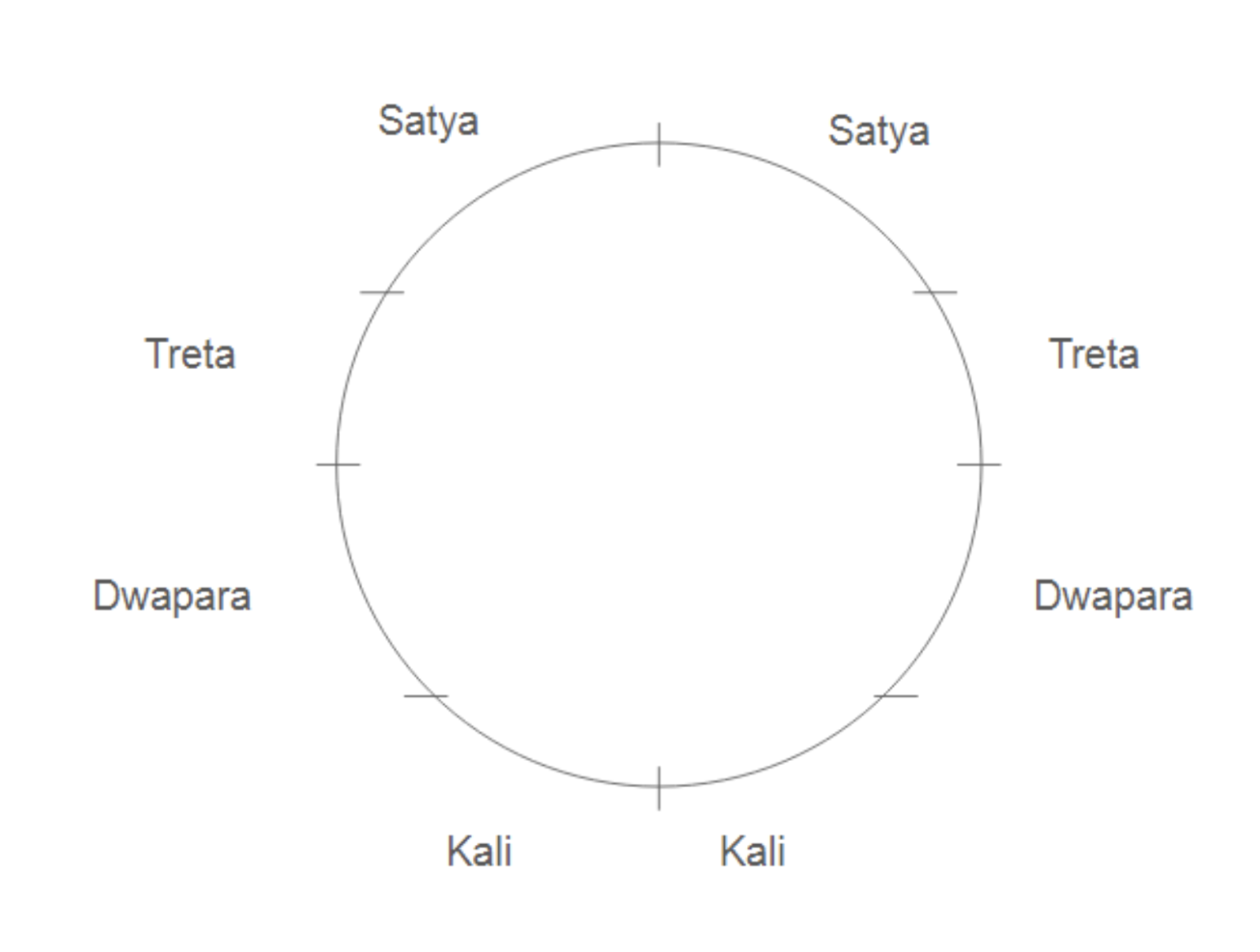
At the top of this cycle we experience two continuous stretches of Sat Yuga and at its bottom, two of Kali. We are now approaching the end stages of the second of these, which should lead into the start of a balancing upward arc through ascending Dwapara. Jesus is said to have incarnated at a critical point in our double Kali period when human consciousness was at its lowest, most vehemently materialistic ebb up to that point, as represented by the Iron Age cruelty of a sprawling Roman Empire. The aim was that his teaching and the Truth of Consciousness he modelled would serve to transform our experience and conduct, leading to a radically revised mode of human existence. This mission turned out to be what Kaleshwar calls a ‘successful failure.’ We will consider reasons for this later, to do with what is now known as a ‘second coming’ of Christ Consciousness. Here we must note that the persistence of Kali Yuga over the last two millennia has continued to generate accumulating negative karma so that we now have enhanced Iron Age power to destroy or degrade whatever civilizational accomplishments we have managed to achieve in our short official histories and inscrutably deeper past. The intervention of Sri Kaleshwar, a recent Indian saint and spiritual master, is thus extremely urgent at this time.
[There are many competing visions regarding the length and appropriate dating of Vedic Yugas, just as there are intractably many different schools and perspectives within the Indian tradition. I have no interest in these except insofar as they figure in Kaleshwar’s teachings and his specific aim in drawing on them to help us thrive beyond our present crisis. Towards this end, he worked from a body of palm leaf manuscripts which ancient rishis began to produce at least 10,000 years ago when they feared for the accurate relaying of vital spiritual information via master-pupil oral transmissions that had sufficed until then. This new provision relates to the declining fortunes of Truth across successive Yugas and is of particular relevance now because the manuscripts contain information that harks back to the Sat Yuga of unalloyed Truth and, combined with other Vedic lore regarding the stages through which we have since passed, offers an invaluable resource for current efforts to renew our flailing spiritual civilisation. Such is the urgency of this focus within our current time cycle.]
We recognise a need for this when we turn attention to our third column. Based on Western scholarly work (after Jean Gebser), this details a series of ‘structures’ through which human consciousness is said to have passed, given what is known of our evolution and pre/history. The first ‘Archaic’ structure corresponds loosely to the Greek Golden Age and the Vedic Yuga of Truth. Significantly, Gebser can say little about it, precisely because it was characterised by a form of direct experiential knowing that warranted no ‘ologies’ but did presuppose a mode of direct Awareness that is no longer available to us. Vedic tradition confirms that this entailed experience of a transcendent Reality that was also known as the Source of our world. India is unique in having preserved such awareness, together with knowledge of the means required for even post/modern people to access it. We have lost this over the course of successive adjustments to Earth life, including contingencies of evolutionary adaptation and, crucially, the traumatising impact of difficult experiences.
The effect of both is implicitly acknowledged by Gebser’s ‘Magical’ structure. This notes a persistence of super-natural awareness as we adjust to a material world, whose pragmatic features increasingly need to be taken into account. Shamanism is a characteristic spiritual form of this structure. It is said to engage with spirits (of ancestors, places, functions…) rather than Spirit as such. Even when a Creator is invoked, the focus tends to be anthropomorphic rather than trans-cosmic (as in a First Father/Mother). Scholars speculate that such quasi-transcendent forms of Deity/Spirit fall away as they become too remote from patterns of everyday life to be of use. This begs a crucial question tacitly raised by Jewish evocations of a Paradise Garden and the Greeks’ Golden Age: namely, how could this transcendent awareness ever have been engendered and then lost via the mysterious decline process that we remember as a Fall. As we shall see, Vedic evocations of such matters preserve a more refined awareness. Elsewhere only traces of such concerns persist if they haven’t been completely forgotten and as particular states of culture provide encouragement to revive them.
Both of these apply in Gebser’s Mythic consciousness structure. Here our story-making capacity takes pride of place as patterns of experience begin to be ordered by primarily narrative means. There is still magical content but belief eventually replaces experience for all but a priestly elite in its regard. Polytheism is the characteristic spiritual form. A drift towards organised religion with named deities in regional pantheons is evident, especially as people become less nomadic and more settled. No world-transcending God is recognised due to a contraction of awareness associated with local survival. I focus on the ancient Near-Middle East due to the critical role this area has played in determining religious, social and political formations of our modern West. Here, prior to the 4th millennium BCE, a favourable climate obtained before patriarchy emerged as an historical phenomenon. There was universal acknowledgment of a Great and Terrible Mother who was simultaneously revered for the life-giving bounty that Nature afforded and feared for the horrific calamities (storms, earthquakes, droughts) that She also sometimes allowed.
3. Big News from Ancient East
A crucial transition occurred in these regions during the late 4th millennium BCE. This gave rise to the earliest city states and from them the first imperial civilisations. The period was marked by an increase in the number of settled communities, associated with a spread of agriculture that served to sustain fixed and growing populations. As cities developed, agricultural production was required on a larger scale, based on specifically constructed irrigation systems that worked well insofar as extreme weather didn’t wreak havoc on them. When that happened, the result was famine and drought. Conflict followed as people displaced from one disaster area ran up against others who were then forced to defend their land against invaders. This would have crucial repercussions on the social, cultural and political life of early settled communities.
Specifically, men became more valued for their greater muscle and fighting power as these societies became increasingly militarised. As this happened, male gods first became equal to and then ruled over goddess consorts to whom they had previously been subordinate. Male hierarchies of kings, priests and warriors emerged, leading to new concentrations of power. At the same time, granted the prevalence of agricultural production, animal breeding practices led to a widespread realisation of the male role in procreation (which hadn’t been well known before, at least by men). This development had a radical impact as women had previously occupied a culturally central position due to their obvious role in childbirth, which was associated with the generativity of the Goddess/Mother Nature in bringing forth the bounty of Earth. Now it was becoming apparent that the cultural marginalisation of men associated with this mystifying conflation had been unwarranted. Not only was the role of men in technology-driven agricultural production pivotal in bringing forth fruits of earth clearly established but recognition of the role of fathering also undermined a former female-feminine mystique.
This realisation contributed to a fierce backlash that accompanied the rise of patriarchy, or the rule of fathers. It was exacerbated by other cultural-ecological concerns. In particular, while mobile hunter-gatherers might see signs of impending natural disaster and take evasive action, settled communities were more vulnerable. Planted seeds couldn’t be moved and the destruction of crops meant famine, ruin and/or encroachment by rival groups who had also been affected. As this happened more and more the Goddess/Mother, instead of being revered for Her bounty, became reviled for Her seeming caprice and unreliability. The latter had always been part of the awe in which She was held but population growth and new patriarchal inflections now tipped the balance violently. The Goddess was demoted in favour of new generations of Sky gods. Initially associated with control over storms, their role was generalised to include war. Figuratively above Earth, they were vested with a power to rule over natural phenomena and so eclipsed the Mother’s former primacy. Thus they came in time to rule over Her.
This process is codified in Babylonian mythos when the god Marduk, a grandson of the Great Goddess Tiamat (also known as the Dragon of Heaven), commits a symbolic Mother murder. Then, having slain Her, he dissects Her body and uses it to construct a new (order of the) world. Later associations of the Goddess with Snakes and Dragons are overwhelmingly negative: Christian knights still slay dragons in medieval iterations of Arthurian legend while the Biblical Snake couldn’t be more reviled in later historical imagining. In any case, this confluence of three main factors – discovery of paternity, militarisation of society and relegation of the Goddess/Mother – led to a repression of the Sacred Feminine in Western culture and, with it, of actual women. This was compounded by a virtual institutionalisation of warfare and, as a seemingly inevitable adjunct, rape. It is also important to note in this regard that the ancient Middle Eastern animus against Goddess/Dragons is mediated via the Old Testament into Christian and thus later European culture. Monstrous Leviathan is consigned in Genesis to dark female waters, after which the Mother as such can no longer be imaged or named (except in minority mystical streams). Along with other unresolved tensions, this legacy became part of early Christian orthodoxy.
Gebser’s next ‘Mental’ structure begins around 800 BCE. According to him, this is the first time it becomes feasible to link a consciousness structure with an approximate starting date (as there was no time consciousness before). This structure divides into two phases. We may call these Mythic-Mental and Rational-Mental for convenience. The first runs from 800 BCE to the mid-18th century CE, when the second emerges. Philosophy and Theology are principal cultural expressions of the Mythic-Mental form. Both are associated with a type of organised religion that tends towards monotheism, especially in the West. We have already noted how polytheistic religions already gravitated towards patriarchy, which is historically associated with concentrations of power and wealth. We have also noted how early gods of storm and war become ‘high’ gods, granted the cultural centrality of their roles. This too is a step towards monotheism and consolidates a power of ruling over female deities with which early Sky gods were wishfully vested. Beyond this, the God of institutional Christianity would be acclaimed as all-powerful, all-knowing, all-male and already complete in Himself.
This raises a fundamental problem in that, if we regard an already all-knowing, all-powerful God (now capitalised since no peers or rivals are admitted) as our Source/Creator, we must wonder why ‘He’ would even bother to create as no plausible motive for doing so remains. If we try to illuminate this by claiming that the God is also all-loving, we add another problem to do with why this God who is now all-knowing, all-powerful and all-loving would create a world marked by so much cruelty and suffering. Much ink has been brilliantly spilt compounding speculation on this theme to no avail. This is unsurprising since the problems raised are insoluble as formulated. That said, Kaleshwar’s Vedic teachings offer a foundation from which they can be illuminated, not least because his vision of God includes a remembering of the Mother. (Note in this regard that 21st century AI moguls who talk about ‘building’ God have patriarchy’s all-knowing male version in mind. They are less forthcoming about power relations and even less still concerning love. The significance of this will become clearer later regarding their currently manic desire for wealth and power.)
The Rational-Mental consciousness structure came to the fore in the middle of our 18th century and sought to dissociate itself from earlier, supposedly regressive forms. Its characteristic expressions are materialist science and atheism. Materialism historically tends towards a relegation of Spirit while the ‘God’ that modern atheism debunks is the all-knowing One of Mythic-Mental religiosity. Its critiques thus tend to obscure our core concern with the relationship between Cosmos, Source and whatever might be meant by the word ‘God.’ Gebser already notes a basic discontinuity across the sequence of consciousness structures that he describes. This entails not just a series of qualitative leaps to be explained via a chain of mysteriously transformative quantum leaps but also considerations of power that impede harmonious transitions across structures. These come to light in modern notices of a Shadow history that begins with Freud and serves to undermine an earlier naïve faith in rational progress (as in the scandal of two World Wars and genocides perpetrated under cover of both). The result has been a loss of human self-confidence and of our faith in memory as well as of memory itself.
By contrast, Vedic spirituality conserves a living memory of its deep past, its relationship to Source and methods that help us reconcile all stages, cataclysmic and not, through which humanity as an unfolding collective must pass. This is utterly unsentimental and vitally important as we come to understand again effects that collective trauma and cumulative karma have on our potential for harmonious Be-ing.
4. Mayan Calendars Point to Eternal Be-ing
I have written elsewhere about the Mayan Calendar in relation to this work. My focus here is on a particular theme that surfaces regarding a single artefact known as the Coba Stone. This monumental structure literally points to the sky and is divided into panels, all of which are covered by hieroglyphics. These glyphs incorporate mathematical expressions that refer from the top down to steadily contracting time periods, all of which conform to a general formula 13x18x20ⁿ where the value of n ranges from 22 to 0 per diagram below. On its bottom line, kin refers to an ordinary 24 hour solar day while 13 Ahau refers to the final, most energetically powerful day in a basic 260 day cycle that pervades many sometimes unimaginably longer ones (1). The key to interpreting the whole array is to see it as a series of calendars, measured in kins, where each is shorter by a power of 20 as we move from top to bottom. The significance of this formulaic pattern was first deciphered by Carl Calleman, a Swedish biologist. As a scientist, he was especially interested in the range 13x18x20⁸ to 13x18x20⁰ kins because the 20⁸ range corresponds to 16.4 billion years. This encompasses the date of our Big Bang, which is generally thought to have happened between 13.7 and 14 billion years ago.

Calleman noted that many of the ancient Mayans’ most prominent temples are built on nine levels. He intuited that these correspond to 9 Creation waves, each of which divides into 13 ‘Heavens.’ This begins to account for the 13x18 (i.e. 9x2) of our general formula. Calleman’s focus on the 20⁸⁻⁰ range allowed him to test his Calendar model against the evolutionary and pre/historic records of modern science. To begin, he asserts that each of the 9 levels of a Mayan temple corresponds to a particular wave/level of Creation, building from the bottom up as below, from 13x18x20⁸ to 20⁰. Every wave is named for a major evolutionary or historical innovation that it introduces. Thus the first ‘cellular’ wave lasts 16.4 billion years and produces a first living cell during its final phase. The second wave last 820 million years and produces the first mammals, the third lasts 41 million years and produces the first primates and so on. Every wave produces the same amount of evolution but does so at a rate that is 20 times faster than its predecessor and 20 times slower than its successor. All divide into 13 Heavens, or 7 Days and 6 Nights, where capital ‘D’ Days correspond to yang periods of growth and expansion and Nights to yin periods of integration and consolidation. (See Tantra of the New Grail, I.1 under ‘Books’ for a fuller account.)
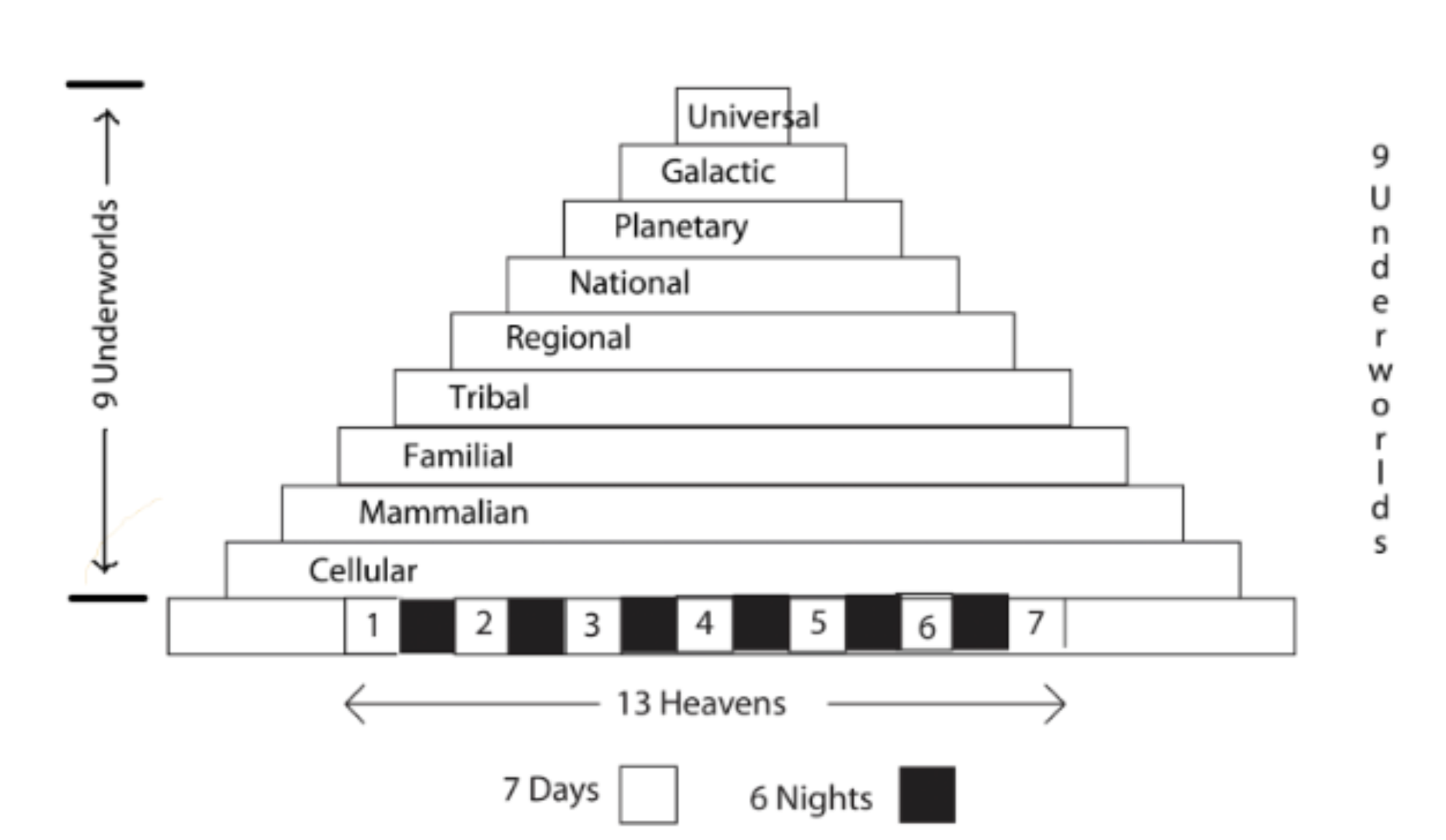
Mayan Temple structure reflecting 9 waves/levels of Creation and 13 Heavens (7 Days/6 Nights) that mark all in a holistic Genesis Pattern
Days 1-7 are named for developmental stages in a Mayan agricultural cycle: Seeding, Germinating, Sprouting, Leafing, Budding, Flowering, Fruition. Nights go unnamed in this Seed-Fruit progression, echoing a 7 Days/6 Nights Genesis Pattern as in the Biblical Creation Story. A major breakthrough came when a start date was found for the 5th Creation wave. As this was known to last 13x18x20⁴ solar days, it was possible to count forward to an exact end date of October 28, 2011. This proved to be a 13 Ahau day, on which all 9 Creation waves are scheduled to end according to the Stone. Calleman thus accepted it as a more exact indication than the generic ‘2012’ of popular Calendar lore. The implications of this are enormous because it means that all of us living after 2012 are metaphorically walking over residual traces of 9 ‘Underworlds’ that are now past but by which we continue to be affected, unlike archaeological layers that have had their day . This is so because the waves are still ongoing. The fact that all 9, each of which supported an Underworld, have now been delivered suggests that this ‘end time’ can be one of great empowerment if we can integrate the gifts of a system that is now fully charged and grant them appropriate expression, having clarified collective effects of trauma and karmic derailment. Again, ‘2012’ convergence is unlikely to be accidental here, given the power of Kaleshwar’s teachings to address these issues.
In any case, Calleman was able to establish significant correlations between critical threshold points identified by his 9 levels, 7 Days/6 Nights model and the evolutionary-historical record posited by modern science. This shows that his intuition of the Coba Stone’s significance was fundamentally correct, not just regarding the 5th wave but all that came before and after it. I endorse this fully but also view the Stone and its entire calendrical display as a symbolic structure, raising questions beyond those which Calleman was prepared to ask. What for example is the status of pre-cosmic waves that the stone also identifies in panels 13x18x20⁹ and above? Why do these stop at 20²²? 20⁶⁷seems no less arbitrary, or 20⁵⁶⁷. Why stop there if not for merely pragmatic-logistical reasons? As the stone points indefinitely to ever increasing powers of 20, I followed my own intuition and imagined 13x18x20∞ as the theoretical maximum of an indefinitely extended array. Adopting this value triggered amazing insights, not least that a wave that takes 13x18x20∞ days to complete its cycle is infinitely slow and thus effectively still. I then intuited this as the vibration of what Kaleshwar calls the Silence: a stillness that remains eternally present before and beyond time.
The thought was especially intriguing because the 13 of our generic formula 13x18x20ⁿ indicates a tendency to movement within the whole while the 18 (9x2, up and down per temple structure) suggests that any unfolding this might entail is also intrinsically ‘intelligent,’ i.e. organised in the sense of non-random. Calleman avoids such metaphysical issues because they aren’t amenable to standard forms of empirical verification. I embrace them because I perceive a crying need to integrate our mysticisms of Cosmos and Source in order to remember Spirit in our Age of Loss. It is also relevant that Calleman associates his 13 Heaven Creation wave forms with the vocabulary of yin and yang. We see this below, where the broken vertical line indicates how, in its final ‘Fruition’ stage (7th Heaven or 13th Day) a precursor wave metaphorically drops the seed from which its successor is then generated. We also see 7 Light Days of the new wave form above the horizontal line (x axis) and 6 Dark Nights below it. There is a problem here in that the display implies an abrupt switch from yang-Days to yin-Nights. Yet it is a hallmark of yin-yang symbolism (and empirical day/nights) that the motions implied are reciprocal continuous functions such that as yang waxes, yin wanes and vice versa.

The 7th Day of a precursor wave drops the metaphorical ‘seed’ from which its successor will develop across another 7 Days/6 Nights cycle
The following figure illustrates this: as yang values wane from +9 to -9, so yin waxes, reaching its strongest value at -9 and vice versa up the other side. This scale establishes a functional range where maximum yang secretes and releases minimum yin and vice versa at the turning points without either ever being negated, implying that both express and are governed by an overarching Unity.
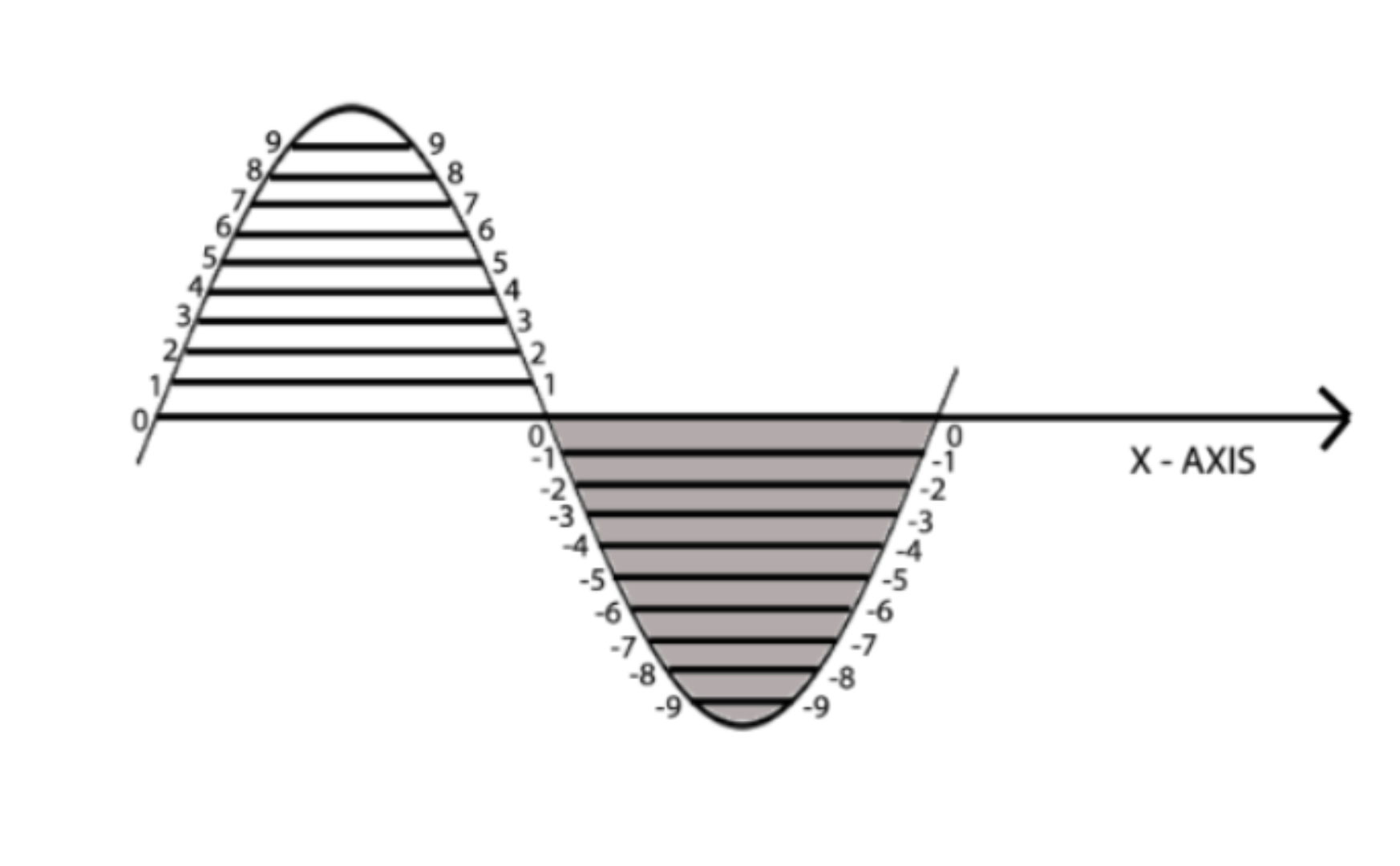
Mutually waxing and waning sequential yin-yang motions indicate an overarching Unity
When yang does threaten expansion to a point of leaving yin behind, yin reacts by contracting past the limits of their previous functional range, thus precipitating a reactive yang explosion. This is how transformative ‘quantum leaps’ to new frequency levels are achieved, as in wave successions that lead eventually to our Big Bang. Note also that while ‘Light’ as such only comes into play after this has occurred, our standard yin-yang symbol offers an ideal image of ‘waves’ that are perfectly balanced in terms of light and dark, where each constantly rotates through the other’s ‘eye’ as in the standard tai chi diagram. Such balance applies only in existence/Creation. Prior to this, pre-cosmically, before God says Let there be light, light is not yet made. Thus it is more appropriate to present the primal yin-yang relation in terms of its emergence from a Dark Ground of Be-ing as below:
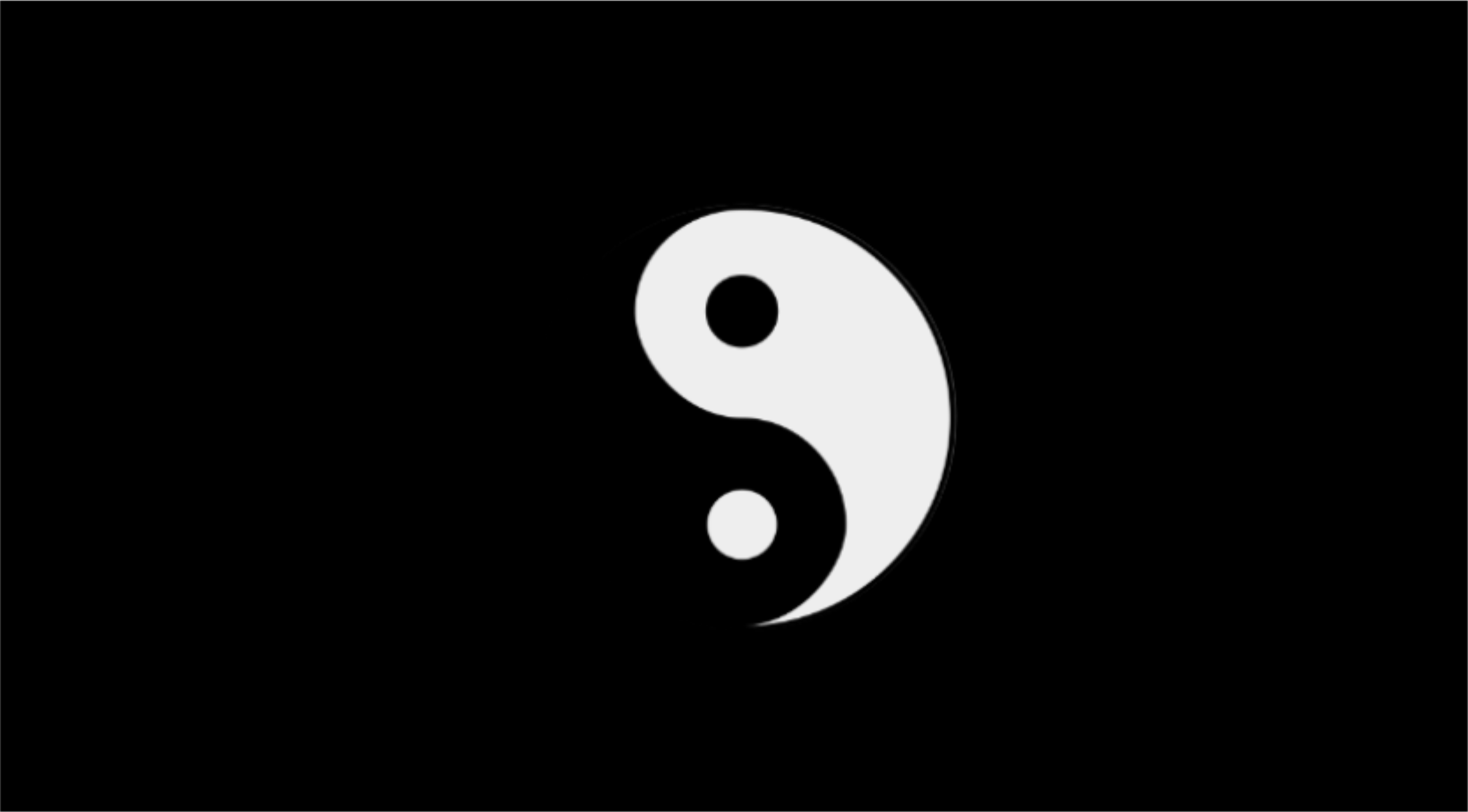
Ideal image of yin-yang balance set against a Dark Ground of Be-ing from which the Light (reflections) of existence arise
This makes a huge difference that registers on a Feeling level of unformulated Awareness, engendering profound internal resonances. Spontaneously, we begin to note imaginative elaborations: seeing existence as an embryo, for example, looking back at the Divine Ground from which it has arisen. The entire sequence of our Coba Stone pre-cosmic waves also point back towards such emergence. Moreover, the formula 13x18x20∞ implies a condition of perfect stillness that also secretes an ineluctable movement tendency (signified by the 13) within a darkness that mystics experience as radiant with super-saturated light, so densely concentrated that world-adjusted eyes can’t see it. This ‘darkness’ also metaphorically evokes the darkness/unknowingness of God – all that is unknown of Her/Him, perhaps even to themselves. This is very different than patriarchy’s all-knowing, all powerful Father, the fantasised ideal that AI theologians currently aspire to ‘build’ by excluding all that is untamed, inscrutable and darkly, wildly, unreliably ‘feminine,’ much like our unsustainably repressed/murdered Mother.
5. Be-ing, Consciousness, Bliss
13x18x20∞ implies an eternal state that is dark, still and unknowing while also secreting a movement tendency and the potentiality of light. Moreover, mystics affirm, this primal condition entails an undifferentiated Consciousness that I have described as pure Feeling Awareness. It has no divisions, parts or reflections. It is thus wholly implicate: in but not for itself, as philosophers say. That said, Be-ing entails pure activity. It is pure activity, formless and without content. It entails energy, named as an energy of Bliss when Vedic masters access it by yogic means. We can qualify this bliss state of primal Reality in terms of yin-yang relations, understood as enfolded Love that is intrinsically disposed to reach out (yang) and gather in (yin). An early prevalence of the latter holding tendency accounts for primal Reality’s initially implicate state, even as a latent yang expansive tendency is also forever building momentum (as in Calendar powers of 20 impelled by the 13 of its Seed-Fruit progression). This suggests that something is always enigmatically growing within Eternal Be-ing.
Primal Reality may be considered Womb-like for this reason (the Orthodox St. Ephrem speaks of a Divine Womb, for example), eternally pregnant with the seed of its own potential which, being infinite, may never be finally delivered. The progression itself is not contentious: we have only to run our Calendar powers of 20 sequence forward again to reach a 21st century state of manifestation where we - ourselves expressions of this generative, underlying primal Reality - still strain to fathom it according to our needs and resources. However, given that we are now as far as it’s possible to be from a Sat Yuga condition of undiluted Truth, we need help. Thus it is to a Vedic culture whose memory encompasses Source that we must turn. I supplement its vocabulary with that of yin-yang philosophy knowing that Lao Tse, the legendary founder of Taoism and one of the first rishis, was responsible for carrying Vedic lore into neighbouring China. I see this as a classic case where straying maps the path, as Taoism has certainly done for me. In any case, running the Calendar sequence forward from 13x18x20∞ through 20∞⁻¹, ⁻², ⁻³, ⁴, ⁵... we eventually reach a point (20ˣ) where the expansive power of yang equals the formerly containing power of pre-set yin. The next step, 20ˣ⁺¹must then exceed this so that a stirring that wasn’t previously discernible in the Silence becomes apparent. Again yin reacts by contracting, compressing yang to an unsustainably infinitesimal point so that it erupts with renewed force.
This engenders an Invisible Point of Creation from which yin and yang motions, rather than happening simultaneously and stifling each other, are instead staggered, with yin and yang phases waxing sequentially, accompanied by superficially eclipsed, correlatively waning yang/yin complements throughout. Together, these staggered waxing-waning/waning-waxing yin-yang motions assume the form of a self-propagating wave. This underlying Unity of yin-yang waves underwrites the indivisible Unity of Be-ing Consciousness Bliss as mysteriously propelled from within towards existence/Creation. This process later culminates in the engendering of a second Visible Point of Creation via our ‘Big Bang.’ This exhausts the relevance of our Calendar model until later sections, where the power of its applicbility will again become apparent.
6. Shiva, Shakti, Ardhanarishwara
Ardhanarishwara is the Vedas’ symbolic equivalent of our dark field of pure undifferentiated Be-ing. It presents a beautiful image of one conjoint figure, half Shiva on one side and half Shakti on the other, apparently split down the middle. Despite this surface image of inner twoness, it more deeply signifies that this ‘two’ is eternally and indivisibly One. Although more attractive than our Blackness, the image may also appear clunky and static. How did this split Unity come about? And how could we ever get from it to the explicit evocation of apparent duality as differentiated Shiva and Shakti, male and female, as in our panel below, with conjoint Unity on our left and seemingly discrete entities to the right?
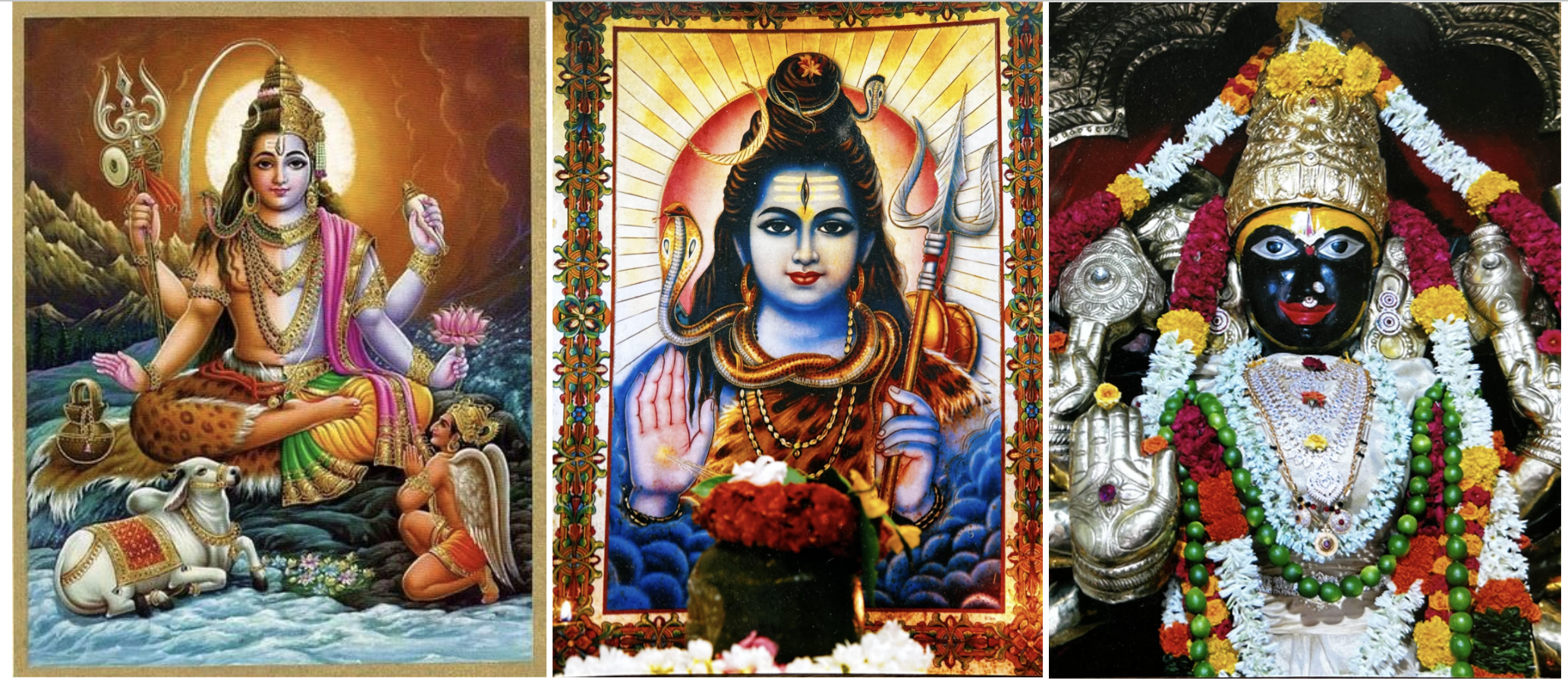
The answer is that everything previously said about yin/yang-orchestrated emergence can also be applied to the tacitly dynamic relationship of Shiva-Shakti as conjoint Ardhanarishwara, behind the surface as it were. The Dark Field/Ground of pure undifferentiated Be-ing entails pure Consciousness/Awareness and pure Energy/Activity, also undifferentiated. It follows that something is forever stirring in the Stillness-Silence, namely a movement potential that will eventually become known as Shakti. This goes from strength to strength just as powers of 20 do in our yin-yang Calendar scenario, akin to images of Mother Durga sitting on a quiescent Tiger (power) that later walks, runs, bounds and sometimes pounces.
Vedic symbolism entails that the Divine Ground of Unitary Be-ing, where Awareness and Energy are One, contains this movement potential in itself and may be considered Womb-like for this reason. Note that this applies to the Undivided State but not yet to Mother/Shakti Herself, as there can be no actual Mother without a Birth. What happens is that an intrinsically latent yang power known Vedically as Shakti gradually builds momentum until a formerly checking yin force can no longer contain it. Eventually exceeded, this precipitates a reactive contraction that transforms the previous arrangement but, while our Calendar account glosses this in purely mechanistic terms, Vedic mytho-poetry presents it as a birthing that happens out from the undifferentiated, indivisible Unity evoked by Ardhanarishwara. Thus Shakti, acknowledged as the emerging movement principle, triggers a reactive yin compression of yang power as before, such that a light potential that was always implicit in the radiant darkness of pure Be-ing is squeezed out, resulting in what we may call the spreading light of Shiva’s soul, as below. This too is a great OM moment from which all later appearances also apparently follow.

The Light of Shiva’s Soul is squeezed out from the radiant darkness of pure undifferentiated Be-ing
In this act of birthing Shiva’s soul as such, Ardhanarishwara as the undifferentiated Unity of God also births Mother Shakti as such, just as a reactive yin compression differentiates Her Holy Womb within the formerly undifferentiated space of Her pure Heart, which is also the Heart of Silence. [An ancient mystical trope presents God as an intelligible sphere with centre everywhere and circumference nowhere. Substituting Heart for ‘centre’ carries us to the Heart of Mystery, ineffable as the pure Feeling Awareness of Sat Chit Ananda/Be-ing Consciousness Bliss. Kaleshwar teaches that Mother’s Womb is part of Her Heart and that its centre (Nadu Bindu) is everywhere. Ammachi, a current Mother avatar, says God is neither male nor female but that, if pressed, we would have say more of the second than the first. Vedic symbolism skates masterfully over this thin ice of ineffability. Here we must recall that, just as there can’t be a Source without Cosmos, nor a Mother without Birth, prior to this moment of Impossible Beginning the primal Reality of Zero Silence is Womb-like in that it harbours a tendency to carry the seed of its own potential to fruition. In doing so it releases the latency of Mother-in-Waiting to become our actual Mother Divine. There is great philosophical subtlety behind the poetry of this, to be unpacked later.
Once Shiva is birthed as an apparently separate soul, Mother’s continuing Shakti motions continue to impact Him. This is inevitable as He has now become part of the environment into and within which She expresses. Kaleshwar describes Shiva as an ‘abbreviation’ of the Silence. Thus His light-infused soul carries every latency that was always enigmatically vested in the super-saturated Dark of Zero Silence. This arrangement frees Mother’s Shakti power to grow in strength and birthing scope as it engages new potentials of abbreviated Silence every time it passes through Shiva’s now quiescent, only apparently separate being as the perfect medium for Her newly unleashed expressive tendencies. Thus Mother births the Infinite Awareness of Father God as Her ‘son’ and continues to coax new frequencies from Him*. These propagate as sound waves and carry divine vibrations (seed letters, sacred syllables) that emanate from/express through an In/Visible Point of Creation at the centre of Her Trans/Cosmic Womb, depending whether we view the Nadu Bindu from a perspective of Eternity or time. This will be pursued later regarding the Sri Chakra yantra, an energy diagram of Mother’s Holy Womb revised by Kaleshwar from ancient sources to meet our modern needs.
[*It is said that Shiva ‘gives’ the seed of Silence from which Shakti then creates. This is unavoidably correct but also easily misconstrued in terms of unconsciously applied sexual imagery that is both conditioned by patriarchal history and fundamentally irrelevant. Shiva and Shakti are wholly subtle beings at this pre-cosmic point, virtually formless and forever One regarding an overarching Unity that yin-yang symbolism forever presupposes. Their relationship at this level is beyond touch and all related physical imagery. Moreover, Shakti is the yang-active principle here and Shiva the yin-receptive one. His purpose is to suffer all that She gives rise to, regardless of whatever humanly gauged abominations it might produce (scenes of massacre, desolation etc.). Thus Paramashiva, transcendent even after part-entering the Illusion of our material world, remains wholly unattached. Charged with taking care of Mother’s Creation, he reconciles its every manifestation via the infinitely compassionate awareness vested in his Be-ing. This theological innovation makes him the spiritual Father of his brother gods and of his own partially descended soul.
It is utterly astonishing that Mother re/births Silence in the form of Shiva‘s soul as if this were outside or other than Herself. Kaleshwar’s ‘abbreviation’ notice entails that every latency implicit in it is present in Him also. These are all available to be raised towards and birthed into Creation as Mother's kala/time-driven pulsing releases new Shakti surges that impact on his soul as the medium of Her now rampantly manifesting creativity. (This fits loosely with symbolic equivalences already noted regarding our transposed calendar schedule.) Finally, for now,I take this opportunity to note that a live presentation of this material drew comments that it seemed very ‘logical.’ I appreciate that while this may seem so between periodic quantum leaps, it doesn’t apply to intuitions that upward-pointing stones evoke pre-cosmic Silence; or that primordial ‘Love’ gathers in and reaches out (as prevailing yin force binds a Unitary Field of pure Be-ing/No-thingness in a Way that is weirdly compatible with symbolic properties of our Mayan Calendar schedule applied to metaphysical time). I have come through many such intuitive leaps, all flashes glimpsed during or arising from meditation that always lead to new openings of the Way. I am happy to persist on this trackless track, availing of logic to fill the space between escalating core plateaus.]
7. Introducing Sri Chakra
Despite all the above, Shiva does contribute the Seed(s) of Silence, so enabling Mother’s generation of intermediate beings through whom She also creates, from Brahma, Vishnu and lesser gods to saptarishi souls and angelic hosts that cluster petal-like around the circumference of Sri Chakra – i.e. Mother’s Cosmic Womb as a bounded locus within the pure Be-ing of Her all-encompassing Heart. The angelic vibrations noted correspond to seed sounds (bijas) and constitute the fundamental building blocks of mantra, or the language of birds, so called due to ancient metaphoric resonances that continue to apply. Birds sing and, like angels, have wings that evoke flight, which evokes transcendence and engages our attention. However, there is more than metaphor involved. The conscious harnessing and use of mantra in specific formulaic combinations empowers us to change constructively the Reality in which we participate: altering it in ways that please Mother rather than compounding a maya in which we otherwise get ceaselessly embroiled. The latter scenario unfolds as we improvise ever more desperate measures to promote what we believe to be self-interest amid fogs of alienation and confusion.
The fact that we have an option to do better is critically important for it entails right alignment with a Way of the Mother that we master via karmic feedback, direct inspiration and/or a Master’s help. The significance of this can’t be overstated in our culture of obsessive reflexivity, where philosophers glibly proclaim and rulers gladly enact the giddying chaos of a ‘post-Truth’ world. There is much to clarify here, not least regarding provisions for an empowered spiritual education. Before elaborating this, we must return to the formative influence of mantra relative to Kaleshwar’s Sri Chakra yantra:
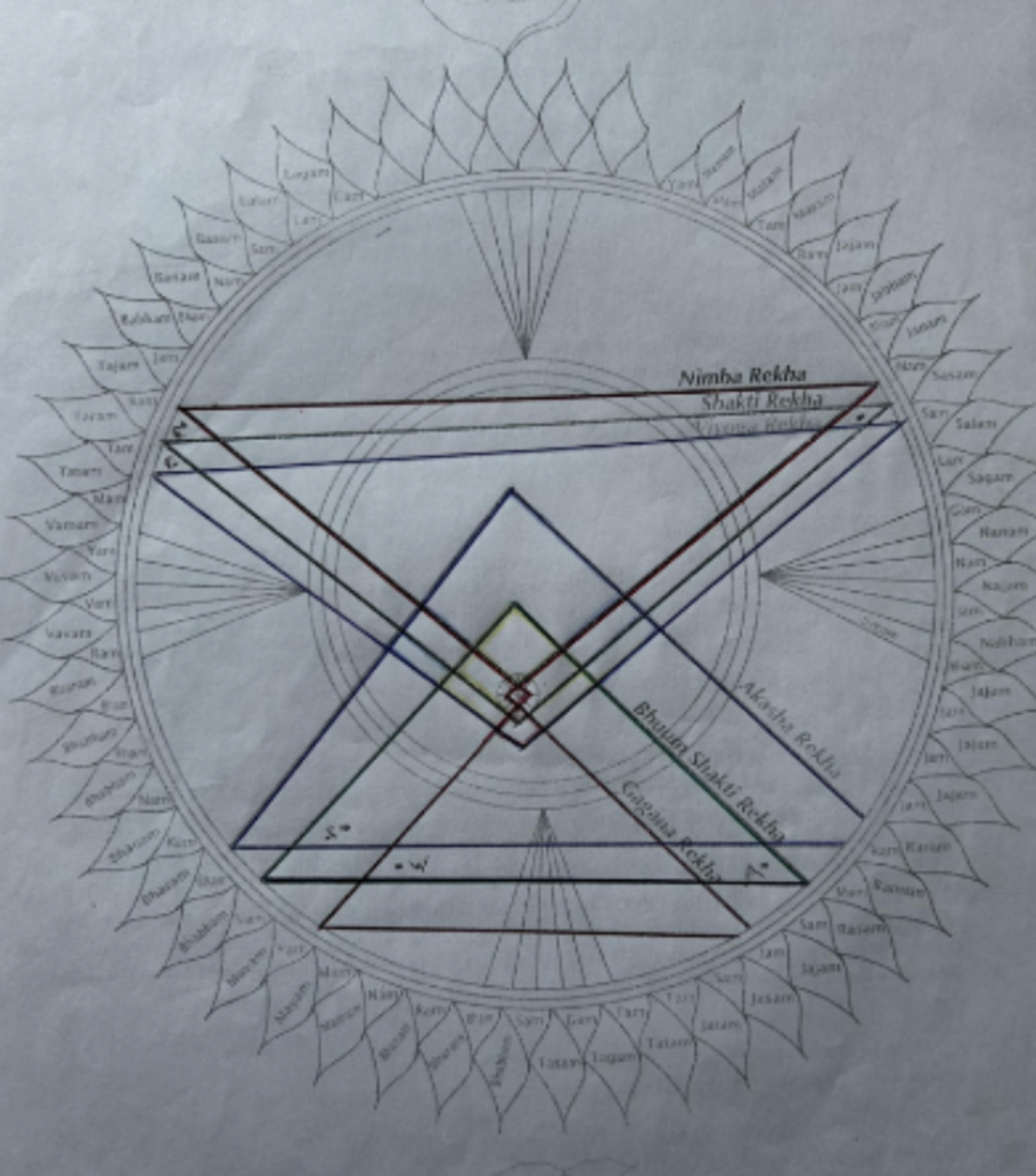
Starting from the top right, just after the gap, the first petal contains the bija ya, the next ma, then ta and so on. These are all the seed vibrations of Shiva angels, fifty-four in total that are usually presented across five rows but here stretch in a downward arc to the bottom of the yantra. The same sequence then repeats in an ascending arc back to its top, where six empty petals are found and, above them, a higher order six from which an upward thrusting lotus protrudes on which Brahma Consciousness will finally come to rest. The six empty petals evoke the Vedas’ double god/ess trinity. Returning to our gap, we also note a second tier of bijas/petals that derive formulaically from the first. In principle, this orderly proliferation might go on to higher levels, always conserving an ever-widening gap through which Mother’s Illusion energy continues to pour in, despite patterning influences of all the bijas/angelic powers that help to sing Cosmos into Be-ing. We thus have a provision for right order and another for Chaos that perpetually enables growth, such that both working together make new Beauty. This arrangement recaps the Divine’s sponteneously arising motive for Creation: namely, to Know, Love and Be better/more.
Kaleshwar stresses that the real power of Sri Chakra is located in the petals around its circumference. This might seem surprising granted the formidable power of Mother’s Shakti. Despite this, we must recall how the vital structuring influence through which Beauty and Complexity are built comes from a Seed that Shiva provides as an abbreviation of Zero Silence. We also recall that Mother’s power and Father’s order are both pre-contained in a Divine Ardhanarishwara Unity that precedes and transcends their apparent separation; and again that Kaleshwar says of the ‘phallic’ Shiva lingam as a supernatural complement to Mother’s Womb that its power derives from the yoni base on which it archetypally rests. Only when a dissociation occurs between these powers do rapacity and other forms of alienated expression arise. There is a deliberate balancing across these remarks which we mustn’t lose sight of. Moreover, returning to the generic role of mantras as showcased by Sri Chakra, many are given whose intentional use serves to elevate the whole structure, causing soul to rise up and finally lifting the experiential centre of Sri Chakra back into Mother’s Heart. Quantitatively a matter of inches, qualitatively this entails a journey of ten thousand miles. A detailed account of Sri Chakra explorations will be offered in later Parts.
8. How Kaleshwar Found His Dharma
Sri Sai Kaleshwar (1973-2012) was born in the South Indian state of Andra Pradesh. A brilliant student from his earliest years, he became very interested in science. One day, aged 14, he went to study in a small temple situated in the middle of a rice field near his home. Preoccupied, he noticed nothing odd until, looking up from his books, he saw an old man sitting before him dressed in beggar’s rags (slides 19-20). Reaching into his garment, the man produced a tin cup filled with rancid food. ‘Eat,’ he urged, offering the battered cup. ‘You don’t need to eat that,’ Kaleshwar countered. ‘My mother is an excellent cook. I’ll get you something from her kitchen.’ Tears appeared on the old man’s cheeks but he remained adamant. He took a stick and stirred the cup. A wonderful fragrance arose and Kaleshwar knew that the food was somehow cooking. Reluctantly, he took some and was amazed to find it was the most delicious he had ever tasted. Moments later he rose to wash his hands at a tap just yards away. Turning back, he found that the old man had vanished. He climbed up on the temple roof but there was no-one to be seen in any direction.
The old man returned in a dream the following night and identified himself as Shirdi Baba, a venerable saint who is now very famous and had spent his entire adult life in a then tiny hamlet called Shirdi. Born in 1838, Baba died in 1918 having prepared the ground for an epochal spiritual transformation in which Kaleshwar was also destined to play a leading role. Already his life was starting to change as a result of their temple encounter. Although he didn’t know it then, avatars awaken at age 14. This usually involves meeting a master to oversee the process. As a result of meeting his, Kaleshwar lost interest in his studies and turned his attention to spiritual texts that began finding their way to him. Over the following years he would accumulate a whole library of palm leaf manuscripts. All featured spiritual knowledge etched by ancient rishis onto palm leaves as far back as 10,000 years before. This happened as fears arose for the survival of teachings that had been orally transmitted by masters to trusted students over many generations. Written in Sanskrit and Telegu (Kaleshwar’s mother tongue), the texts are coded so that only eligible eyes can decode them. His task would be to reintroduce them to the modern world after millennia of neglect. This and his special affinity for the Mother had been foretold centuries before.
He turned his attention passionately to this task. His schoolwork suffered, prompting his father to an angry and sometimes violent response but nothing could dissuade him. Eventually he was expelled from the family home. Baba reassured him inwardly. Kaleshwar went travelling, staying in ashrams, asking questions and learning from every possible source. More palm leaf texts were presented, drawn by his increasingly apparent light. Once while he was meditating in a temple, a burly sadhu entered and, manifesting ash from his hands, began covering a Shiva lingam with it. Afterwards the man approached Kaleshwar and struck him forcibly. Startled, Kaleshwar asked why he did that. ‘I saw you trying to steal my power.’ ‘I wasn’t. I don’t need your power. I have my own master.’ The yogi’s angry front dissolved. ‘Your master told me to hit you.’ From that moment Kaleshwar began to recollect past lives and realise what his current life mission would be (2). By age 24, he was ready to come to the West.
9. California Dreaming
An earlier Indian saint, Yogananda, had already made a big impact in America. His Foundation was headquartered in LA, where many other Eastern teachers had also taught. Hence there was already a receptive community in place. An audience of people with a special interest in healing was arranged to greet a new young saint who spoke very little English. Kaleshwar began by manifesting a rose in his palm. Next he caused it to burst into flames that burned without consuming its source. Eventually he let it burn to ash. He then passed through the hall, anointing all present with this residue. Amongst these was one man who would become a senior student and another, his friend, who had received a terminal cancer diagnosis. Everyone who received Kaleshwar’s blessing reported healing benefits, including the friend, who recovered. Word spread rapidly, even reaching Oprah Winfrey, who wanted the young saint for her next show. He declined, saying that he wanted to attract a small number of dedicated students who would follow him to India, not thousands of casual seekers. More meetings were arranged, a group was assembled and from 1997 the first Western students began arriving in Penukonda, where Kaleshwar’s ashram was in the early stages of construction.
Evidently he didn’t expect to live very long as he told them repeatedly that he would be a million times more effective working outside a body. First he needed to train a pioneering generation of Westerners who would be equipped to transmit his teachings without distortion. This was important because of chaos levels he discerned in the modern world and a disturbing inertia that he found in traditional Indian spiritual practice. What were yogis really accomplishing, he asked, if they spent all their time sitting in bliss? This was a necessary but not sufficient Enlightenment practice. A healing engagement with the world was also required, including the qualitative West. Western students were best suited for this, both for their dynamic attitude and because they carried the disease in question. He would train them hard to ‘wash their blocks’ and establish a shared culture of Dharma and Truth. This took longer than he first imagined. He began formally by teaching the Five Elements, a foundational programme that purifies our relationship with Earth, Fire, Sky, Water and Air as the basic pillars of Creation. This was followed by the Sri Chakra, which he didn’t associate with Mother’s Holy Womb until years later. The reason for such a circumspect approach was that he didn’t want the mission or his students exposed to potentially debilitating levels of Illusion before they were adequately prepared.
There is a vast backstory here that needs to be unfolded carefully, in stages (see Part III). A key factor is that Consciousness in existence tends to develop attachments to given forms and so resists transformation. In humans a major aspect of this tendency is the elaboration of ego stories that reinforce the hold of illusion by consolidating a sense of our own separateness, from each other and All That Is. This compounds our estrangement from Truth even as we aim to overcome it. Mother lets this tendency run by way of testing insight, resilience and sincerity before granting further inspiration. Kaleshwar thus had to be careful during these crucial early years. His use of miracles, he explained, was initially to draw attention and, beyond that, to smash conditioned belief systems so that hungry souls might awaken past reductive inclinations to the radical spirituality he had come to promote. Even now, it takes considerable manoeuvring to establish the significance of this in regard to a ‘post-Truth’ intellectual culture where the Consciousness of Sat Yuga has been all but erased from the consciousness levels that our defensive ego selves are now capable of hosting.
On the face of it, Kaleshwar had little to say about such matters. He did however arrange darshans – fully physical, open-eyed manifestations – for his students with both Jesus and Mother Divine. He also spoke a colloquial English to which they adapted gratefully as it always occurred in contexts of direct transmission where its impact was supported by the depth and energy of his teaching. For people without access to such mesmerizing transmissions, his written words may seem obscure or void of intellectual substance. Nothing could be further from (the) Truth. Indeed, it was an intuition of poetic depth that motivated me to look deeper and find in his work a key to resolve issues that had perplexed me across years of writing and research. A trip to Penukonda confirmed that my role was to explore the teachings further. The consequences of this are still unfolding. During his lifetime, Kaleshwar’s primary focus was to train healers, drawn initially from America, Germany and Japan. Students from other countries followed. I can’t count myself among them but am resolved to support their necessary and invaluable work while also remaining open to whatever the future may one day require.
(1) As this Mayan Calendar account will feature in volume 7, it is relatively dense and compressed. Readers without prior knowledge are referred to volume 1, Part I for a clearer and more explicit account. See Tantra of the New Grail, volume 1 of The Calendar and the Grail series under ‘Books.’
(2) In addition to written accounts I heard variations of these ‘classic’ Kaleshwar stories at nth hand from different sources, so whispering telephone effects may have crept in. I remain satisfied, despite this, regarding their essential accuracy and Truth value.
Remembering Spirit in an Age of Loss (Part II)
1. Introduction
It’s hard to picture a Beginning in the context of Eternal Be-ing. This difficulty is compounded by an opposition drawn in Western philosophy between Being and Becoming, which presents Being as the Constant, Becoming as Change and both as binary alternatives. Vedic philosophy improves on this via its discovery that our changing world of appearances arises from an Eternal Constant of Sat Chit Ananda (Be-ing Consciousness Bliss) and discloses it in some way. The challenge remains of clarifying this relationship and how it is that our world arises at a particular point, having not existed before. Having offered a response in Part I, I will focus here on stories from Vedic mythos before responding further. Kaleshwar associates these with real events that actually happened, even in a context of recurring time cycles. There are many overlapping views on this issue, all beyond the scope of rational adjudication. Mine holds that Eternal Be-ing contains the seed of its own disclosure. This happens via a process that unfolds and then manifests Creation, affording the Divine a previously lacking capacity for self-reflection and then self-steering that Mother implements through awakened Consciousness forms in existence: us.
This suggests that a seed of time must always have been present in Eternal Be-ing, as time provides the medium for Becoming to happen in. Lots of it is evidently needed. As pure unmediated, un-reflected Be-ing is eternal, banks of infinite time are potentially available, this isn’t a problem: endlessly recurring cycles can in principle fill up infinite time. These recurring cycles repeat in the manner of trans-cosmic seasons, manifesting the same macro-patterns over and over, including series of Big Bangs that lead to Big Crunches. Existence here arises out of Eternal Be-ing to be resorbed by it over and over, perhaps until Consciousness in form remembers Truth beyond illusions of separateness to which it has adjusted. Indian tradition offers a bewildering variety of perspectives on such matters. I am not concerned with any apart from what Kaleshwar as a ‘shortcut master’ has highlighted to ease our way through end times of our own Kali Yuga. I am also not moved to pursue the issue of recurring time cycles in detail because it makes little practical difference. Jesus says My Father’s House has many mansions (contexts, worlds, dimensions). There is no reason this can’t be true across infinite time as well as space, illuminating how the Divine can occupy itself forever with ecstatic awakenings amidst a World Illusion that presents as glorious or dismal according to our making.
This idea shouldn’t be dismissed. Reflections can be more or less Good, True and/or Beautiful despite objections based on accounts of maya as mere appearances that don’t matter because they’re not Eternal. Baba, Jesus and Kaleshwar disagree. Bur for this they would have no reason to guide us Home to Mother nor She, through us, to Herself. And insofar as Consciousness can reflect that Creation is good, there is no reason why the process can’t go on forever, even as our G-O-D is sometimes moved to recalibrate at the behest of Mother’s relentless love for birthing.* That said, our focus must also be on pragmatic issues that currently threaten to degrade organised human life to such an extent that our children may have to start over under severely traumatic conditions, not just regarding spiritual awareness but also physical survival. Kaleshwar incarnated to avoid this by consolidating and renewing the impact of Jesus’ only life. Unique across time, it planted a seed of radical renewal. Both men acted out of Love, building on a memory of Sat Yuga, when Truth was fully known and can be again by following palm leaf teachings back to Awareness. Our challenge in entering the great stories below is whether we can imagine and sustain a divine human culture capable of saving us from our alienated, world-adapted egos.
[Note: The principal male deities of Vedic tradition are Brahma, Vishnu and Shiva. Brahma is known as the Generator, through whom Mother acts to bring Creation into Be-ing; Vishnu is the Operator, charged to preserve balance and coherence once Creation has been set in motion. Shiva is the transcendent Father deity but, in his descended role within the male trinity, he is known as the Destroyer: one who brings lives, cycles and processes to an end whenever renewal is needed. The three together make up G-O-D although it is important to note that their roles are separate so that no one of them can know or do what the others can. Shiva’s consort is Durga-Parvati, named for as a generic form of the fierce Mother Goddess and Her human maniestation as his earthly wife. Lakshmi is Vishnu’s wife and associated with spiritual-material abundance. Brahma, being Otherworldly, is initially found at the Nadu Bindu but ideally also rises to the thousand-petal Lotus of an open Crown. His consort, Saraswati, balances his aloofness and is known as the goddess of arts, wisdom, music, healing, creativity and expression. We will learn more about these characters later in this work.]
2. The Great Churning
Little can be said about the ‘Archaic’ structure of Sat Yuga precisely because it steeped in Truth. It thus eases us into pain-free spiritual access where all creatures live their divine nature un-self-consciously, without need for rationalisation or account-giving. That comes only with the onset of Treta Yuga. We do well to mark transitional patterns here because they have an archetypal status, indicating tendencies that seem fated to recur over and over. These affect even devas (gods) whose spiritual existence had seemed effortless until then. In the Treta Yuga Truth rests on only three legs, bringing 25% negativity that spreads doubt and uncertainty where before there had been none. It seems the gods are so disturbed by this that they doubt their immortality and are thus motivated to churn the Ocean of Milk (which is unspecified but assumed to evoke Mother’s bounty). The purpose is to raise Her amrutha, a golden liquid known to bestow immortality on all who consume it. There is a problem in that they lack necessary muscle power. For this they need assistance from the Asuras or Rakshasas, demonic characters whom Kaleshwar presents as a distinct race marked by pronounced selfishness. The parties negotiate and a bargain is struck. The work and its spoils are to be shared equally. The rakshasas are suspicious from the outset however, and contest every detail for fear of being cheated.
The Sacred Mountain of the World will be used as a central axis and the body of the Primal Serpent as a rope with which to initiate the churning (slide 27). The rakshasas insist on working with the serpent’s head, lest this confer advantage. Vishnu oversees the event and also manifests as a giant turtle to provide a solid base for the axis. Although Shiva has already entered Creation, he hangs contemplatively back. Brahma declines active involvement. The churning begins and many wonders are thrown up without any sign of Mother’s amrutha. Then a toxic substance (alahala) spews forth, threatening to burn up the world. No one is able to contain it until Shiva, pledged to take care, swoops in and drinks the poison, holding it in his throat so that it is neither digested nor released. Then, danger past, Lakshmi rises from the depths, bringing the amrutha. The rakshasas immediately suspect that the devas will renege on their promise to share the boon of immortality. The devas likewise suspect the rakshasas of plotting to commandeer the amrutha and question the wisdom of conferring such a gift on these unscrupulous adversaries.
Vishnu is alerted. As the Preserver of Cosmic Balance, he inclines to agree. Thus, as the amrutha is about to be shared, he morphs into Mohini, a beautiful dancing girl who launches a seductive routine. The rakshasas are smitten. So engrossed are they that they fail to notice when Vishnu-Mohini substitutes mere soma for the precious elixir. The rakshasa, temporarily sated, don’t realise that they’ve been deceived until later, which consolidates their animosity towards the gods. Already we can draw three key lessons for our time: i) poison must always surface before true Gold comes into view, ii) we need supernatural help to process this, and iii) even gods, engaging with rakshasas, become like them. It is also noteworthy that Vishnu’s ethical standards are remarkably fluid compared to conventional standards. It may even be that a karmic sting was initiated by his conduct for it transpire that Shiva himself becomes enthralled by Mohini’s voluptuous dance and approaches her so ardently that the two make love, Vishnu apparently so consumed by his role that he lacks the awareness to question Shiva’s advance. A child is promptly born of this godly union. Ayappa is an embodiment of Brahma, who had previously disdained incarnation.
What kind of lila (sacred play) is this? It is clearly Mother’s, and intentional because when She asked Shiva to enter Creation his main concern had been that he didn’t want to fall prey to Her Illusion as everyone else did. To allay his concern Mother gave him Her Third Eye and with it an ability to burn through illusion: Her Illusion per their agreement but evidently not Vishnu’s. It thus seems that She availed of Mohini’s rakshasa performance to awaken kama (desire) in otherwise dispassionate Shiva. The reasons for this will be clarified later. For now, we must note that both gods are dismayed on awakening from their enchantment, especially when presented with the fruit of their union. Vishnu rebukes Shiva for taking advantage of his role while Shiva is aghast at having succumbed to its allure. What was to be done with the child? Both agree that their wives would not take kindly to either of them bringing Ayappa home. Thus they entrust the infant to pious forest sages for early upbringing, perhaps anticipating that he will later be given into the care of a virtuous king.
3. Shiva as Unworldly
It is said of Ayappa that he never matures beyond age 14, although Brahma is generally depicted as a four-faced greybeard. The suggestion, I daresay, is that he never succumbs to sexual kama or inclines to worldly desire. This makes it possible for him to maintain an uncomplicated relationship with Mother’s Shakti, being neither fearful of nor amenable to fascination by it. It is also worth pondering the implications of what it means that Shiva the Destroyer and Vishnu the Preserver should together produce Brahma the Generator as simultaneously a perennial child and eternal sage. I will return to this, regarding Jesus as Logos or ‘the Word made flesh’. In any case, despite their supposed misadventure, Shiva and Vishnu continue to interact regularly for Shiva, despite his loftiness and illusion-burning brow, never becomes street-smart. Rakshasas quickly learn to take advantage of his detachment. Thus, finding that he is satisfied by a technically perfect execution of meditative practices that warrant the bestowal of certain boons, they turn increasingly to him for selfish purposes that he never thinks to question, thereby causing disturbances that Vishnu is called on to put right.
One example arises when a characteristically power-hungry rakshasa completes his austerities and duly approaches to claim Shiva’s favour. The request seems bizarre, even for a rakshasa, as he claims the power to dissolve people by placing his hand on their heads. Distracted from his meditation Shiva obliges, then looks askance as the rakshasa draws nearer, his hand raised. ‘What are you doing?’ ‘Testing my new power.’ Shiva rises quickly and starts running. As always under such circumstances he makes his way to Vishnu, the rakshasa in hot pursuit. ‘What is it today?’ asks Vishnu. Shiva explains breathlessly. ‘Just hide behind that tree and I’ll deal with it.’ Shiva obeys as Vishnu turns into Mohini, just before the rakshasa arrives. ‘Wow, I like you!’ ‘You want me?’ ‘Yeah!’ ‘Can we dance first?’ ‘Okay.’ Mohini’s hip wiggling is crudely imitated, then her waving hands and finally a palm laid flat upon her own head. The rakshasa duly dissolves, the first victim of his new power. ‘God that was great,’ Shiva says, stepping out from behind the tree. ‘You’re welcome God. I’ll see you next time,’ comes Vishnu’s reply. ‘There won’t be a next time.’ ‘Fair enough. I’ll see you anyway.’
4. Maha Kali Meets Mahishasura
It transpires that there are many next times, none graver than the occasion when Shiva is approached by Mahishasura, a buffalo demon who – having performed the necessary austerities – arrives to claim his boon, namely that he can’t be defeated by any man. Boon secured, he breaks out from Underworld confinement to wreak havoc on Earth and throughout the Celestial Realm. Not even gods can stand against him and his demon hordes. As usual under crisis Vishnu is petitioned. ‘What has He done now?’ They explain and Vishnu summons an assembly of all the gods and rishis on Penukonda plain, the area where Kaleshwar’s ashram now stands. There, pooling their meditation powers, they call forth Maha Kali as a fierce embodiment of Shakti power whose first nature is Fire. She comes with many arms, all weapon-bearing, but on the surface manifests as a beautiful maid of 16-17 years. On Her first encounter with one of Mahishasura’s armies, his generals think She would make a pleasing gift for the Boss. They advance confidently. Assuming Her fierce nature, She destroys them with indefatigable power. Escapees carry back reports of a stunning female warrior who can’t be defeated. The pattern repeats. Eventually Mahishasura is persuaded that direct attention is required.
He arrives at the head of a formidable army and is captivated by the fierce beauty of his quarry. He makes his case with presumptuous eloquence. ‘We should hook up. With your strength and mine we could do great things…’ Advances scorned, he sends in troops. Seeing them obliterated, he takes the field himself, still bragging and cajoling as they fight. Finally, losing patience, Kali looses a whirling discus (sudarshana) that flies through the air and cuts off his head. On some accounts, his headless soul is grateful for this removal of dead weight. Kali scoops up the severed head and, brandishing weapons, looks ominously towards cowering remnants of the demon army, still in a surge of battle frenzy (29). Fearing that She may cause untold damage, the gods ask Shiva to intervene. He comes before Her and She knocks him on his back, unable to identify him in Her mist of unspent rage. Then, placing Her foot triumphantly on his chest, She registers the vibration of his Heart chakra and is calmed (30). Perceiving that the greatest negativity is now vanquished, a smile begins to form. She assumes the softer guise of Kaneka Durgamba (which Kalshwar chose for a 9 feet tall living statue positioned beside his Samadhi (resting place) in the Penukonda ashram, where it is also ringed by Baba images of Shiva power to help balance and contain Her Shakti).
[This may relate to an aspect of Jesus’ negotiation with Mother (below), whereby She would go gently on humanity until our year 2,000, not letting us destroy ourselves before a ‘second coming’ of Christ consciousness could be orchestrated within Sai tradition, spearheaded in our time by incarnate Kaleshwar acting under discarnate Baba’s orders. Here Baba is both the spiritual regent of a coming Sai Yuga and the primary vehicle (Parampara) for cumulative Shiva energy in our time. That is to say, he represents the still growing accomplishment of human-divine yoga culture, whereby Consciousness in form slowly realises how better and more fully to remember the Truth of Oneness in the multi-form midst of Mother’s great illusion (mahamaya). The very name Sai Shakti is indicative of the dynamic marrying that this constantly entails. At the same time, Kaleshwar was evidently apprehensive as the year 2,000 approached and the agreement brokered by Jesus came to an end, it being his responsibility to make good any possible shortfall.]
5. The Story of Ganesh
After the Mahishasura crisis is averted, Maha Kali’s rampaging power is no longer needed as a constant presence. Things go smoothly between Shiva and Parvati-Durga for a while until, with Shiva again absent and preoccupied by his meditations, Parvati decides to bring forth a child by Herself, one whose primary loyalty will be foresworn to Her. Thus She takes some sandalwood paste and, having moulded it into the figure of a boy, breathes life into it. Ganesh is then born as a devoted son, wrapped in the physical form of an 8-9 year old. Parvati arms him with a dagger and instructs him to stand guard at the door, denying entry to all until She has finished taking Her bath. Shiva returns while She is so engaged and is denied entry by this strange boy at the door. ‘Who are you?’ he asks. ‘I am my Mother’s son,’ comes the reply, ‘charged to safeguard her privacy.’ ‘Then you must be my son also. Step aside and let your Father enter his home.’ ‘Permission denied.’ This goes on until tempers flare. Then, across various accounts of how intense the conflict becomes, the scene closes with Shiva severing the defiant boy’s head. Ganesh’s falling dagger makes a clanging noise on the ground and Parvati, alerted, instantly fears the worst. Rising from her bath She rushes out to behold the calamity.
‘What have you done to my beautiful son?’ She is furious with Shiva, who promises swift recompense. He summons his retainers and bids them spread out and return with the head of the first creature they find asleep with its head towards the North. They come first upon a baby elephant sleeping in this way. They ask the mother’s permission to take its head, promising that great honour will be done to mark her sacrifice. She consents and they return with the yielded elephant head. As the head is fitted on Ganesh’s vacant shoulders, an assembled company of rishis and gods once more pool their meditation power to vest him with all the knowledge and spiritual wisdom at their command. It also transpires that this baby elephant is perfectly connected to the angelic realms. The scene further evokes an integration of animal and spiritual powers, enlightened beyond narrow ego-self preoccupations. Parvati nonetheless acts enraged on finding that Her son now has an elephant head, even if it does lift him into enlightened consciousness. Shiva assures Her that Ganesh (32) will always be given pride of place in sacred rituals and honoured especially as an opener of new ways. Henceforth Ganesh, originally an obstacle, will become a remover of obstacles, universally revered for his clearing and empowering energies.
Parvati is appeased and Ganesh integrated as the first named member of Shiva-Shakti’s budding Holy Family. His tale of sacrifice, like that of Biblical Isaac, divides Western opinion. Some foreground an element of tragedy, un/consciously construing it in terms of absent or even abusive father themes. It may be necessary for such people to register the story in this way but there are also other options to which Kaleshwar draws attention. It highlights Mother’s power of independent generation, which also presupposes a role for Paramashiva as the spiritual Father who contributes the seed(s) of Silence to Her Creation of a material world that makes even sandalwood available as a vessel for her birthing intent. Moreover, the story illustrates a generic role of spiritual-cultural fathering that descended Shiva is now called upon to play, precisely because amnesiac humans identify prematurely with head-centred ego-mind identities that are pre-emptively small and yet defensively inclined, impeding our access to greater life. Metaphoric decapitation is a necessary response to such tenacity, as literal enactment was in bringing even arch demon Mahishasura to some inkling of potentials available beyond the burden of his cloying selfishness.
Ganesh may be wholly innocent in this regard but he still needs opening to the world of angels and cosmic energies. Some versions also emphasise Shiva’s foresight in directing the search for a new head, identifying the baby elephant as the embodiment of a divine soul. Physically fatherless Ganesh is also capable of realising this high potential once attachment to his ego-mind (head-centred) identity has been overcome. Again he stands as a representative of all of our potentials as human beings in this regard. (The Vedic gods’ assumption of human form is not mere accident or a result of anthropomorphic projection; rather it is seen to indicate the high spiritual calling of our Vilakshana type, as I understand it.) Hence Shiva’s role in orchestrating the company of gods and saints to oversee the investiture of Ganesh’s new ‘head’ can’t be overlooked. Viewed generically, it offers a condensed prototype example of how Father-sponsored yogic tradition works to support our development from spiritual infancy towards remembrance of our intrinsically divine fully human nature. Yes, Shakti births diverse forms prolifically but She also calls in Shiva as Destroyer to shift us beyond preclusive fixations, knowing well that he must attend to his austerities in order to take care of Her Creation.
6. Love amidst the Ashes
Shiva’s summoning of gods and saints above evokes a focused application of yogic accomplishments to date with the intention of maximising Ganesh’s raw potential as a product of Mother’s burgeoning Shakti power, again marrying Energy and Awareness in existence. Despite this, and the relative harmony achieved after Ganesh’s elevation has been achieved, Shiva continues to be preoccupied by the question of how it was that Parvati was able to bring forth an embodied soul of Her own accord. He contemplates and meditates on this incessantly. Eventually, still stymied, he dances his frustration out so violently that his movements threaten to disintegrate the universe. Alarmed, the gods petition his wife to go and calm him down, balancing him as he did Her after the defeat of Mahishasura.
She comes upon him in a cemetery, with which he is associated as the one who receives souls newly liberated after death. He is not best pleased on being disturbed, especially by this Source of his frustration. ‘What are you doing here?’ ‘I need to talk to you. Can I approach?’ ‘Why? What do you really want?’ ‘I want to make love.’ ‘Here!?’ He points to burning bodies and ash clouds swirling around the cremation fires. ‘Why not? You know it’s all Illusion.’ This disarms him and he bids Her draw near. They embrace then and make physical love for the first time in Creation, satisfying his curiosity regarding the nature of Her generative power. This is a matter of experiential discovery, not inference or declaration. Crucially it is said that Shiva must grow male genitals in order that their union can be realised. This reminds us of his essentially feminine nature as a manifest form in Mother’s Creation, countering our tendency to assume his male agency as proactive in the matter of ‘giving’ his seed to enable Mother’s birthing prowess. Even reviewing Kaleshwar’s ‘which came first’ enquiries with senior students, I am struck by how our sensibility in this regard is tacitly conditioned by unconscious images of penetrative sex, including how it has been construed within the frames of patriarchal sexual history.
Beginning with Paramashiva before Cosmos ever came into Be-ing, we have seen how it may be truer to say that She coaxes the seed of Silence from him rather than him ‘giving it to Her’ in any coarser sense. Likewise in the graveyard his phallus must be called into existence and then, we may imagine, further induced towards physical release. This is more consistent with pre-Cosmic precedent than any kind of forceful engendering being visited on the body of the Goddess. The ‘flowery combat’ of Taoist love-making is a recognisable evolution of this first option, not a smoothed out rehabilitation of the second. In any case, experiencing his own orgasmic yielding in this way awakens his awareness and reconciles him to continued involvement in the spiritual fathering of en-souled human beings. He now sees that we finally come, like Him, from Silence, but necessarily through Her. That said, Mother also comes to recognise an avoidable limitation in having Brahma, Vishnu and Shiva so specialised that none of them can truly fathom Her totality. For this reason, it would appear, She contrives yet another superbly orchestrated Sacred Play.
7. Dattatreya
There was once a famous yogini named Anasuya whose accomplishment was so great, it is said, that she aroused jealousy in Parvati, Lakshmi and Saraswati. Accordingly, it is also said, they prevailed on their god consorts to visit Anasuya while her husband was away with the aim of mortifying her. Despite this being wildly out of character for all three goddesses, the gods agree to do their bidding. Thus they arrive at a time when Anasuya is known to be alone, understanding that she will be bound to receive them deferentially, given their status and her obligation of hospitality towards them. They are gruff and over-bearing from the moment they enter, finally demanding that she feed them and go bare-breasted as she does. This would count as a crushing humiliation in traditional Indian culture. Ever the gracious hostess, Anasuya agrees and proceeds to breastfeed all three but not without first changing them into babies. Later she sets them crawling and mewling on the floor. Eventually, the goddesses arrive to reclaim their gods. ‘Have you seen our husbands?’ ‘Sure. There they are. You’re welcome to them if you can tell which is which.’ The goddesses exchange what may be knowing looks.
‘Would you mind restoring them for us, please?’ ‘Certainly, on one condition.’ ‘Name it.’ ‘I’m going to have a child soon and will restore your husbands if each of them agrees to contribute their essence at his conception.’ ‘Leave it with us.’ And so it came to pass that Dattatreya was born of human parents as a human being, vested with the divine attributes of Brahma, Vishnu and Shiva combined, embodying their respective attributes in his uniqueness as the highest representative of our ideal (Vilakshana) type. He is depicted as having three heads due to this triple aspect but that is just visual metaphor (33). The primary expression of his power comes in an ability to handle the vagaries of Mother while drawing on Shiva’s ability to see past Her Illusion, Vishnu’s to balance it while also charming Her and Brahma’s knowledge/generative power. She is not dismayed by this but overjoyed as his appearance heralds a promise of Truth-full interaction between the deeply latent intentionality of Her Shakti and awakened human agents who are inwardly moved to facilitate its glorious realisation on Earth and Beyond.
I experienced intimations of this when I first heard the basic Dattatreya mantra (Om visha kara…) in its evocation of Shiva’s utter frustration around the creating of a soul (…dham dham dham) and then the wonderful flip that announces the Dattatreya ideal of universal beauty (Vishva sundara…). I also experienced its closing lines (Datta swarupa) as a compelling invitation for me to realise whatever integration of latent Dattatreya potential that I might be capable of according to my light. For months, the pursuit and attempted comprehension of this ideal became the focus of my meditations, eclipsing all other channels that I had been working to develop. Finally I came to see that as the current ‘bosses’ of Sai tradition (Jesus, Baba and Kaleshwar) were all Dattatreya masters, my expression of this ideal is best supported by participating in an ever-growing lineage that traces its origin back to this highest realisation of humanity’s Vilakshana ideal, especially now with Baba as Parampara. That said, few attain such high realisation. Thus, despite Dattatreya’s achievements and those of his exalted avatars, the majority of humans have always remained stuck in degenerative cycles of increasing negativity. This suggests that intervention by a different kind of avatar was also needed: whence Jesus’ supreme modelling of universal loving compassion as well as arcane yogic powers.
8. Jesus’ Once and Only Life
Jesus’ one life would never have been possible without the many that Mother Mary lived in preparation for it, building gradually towards levels of purification and empowerment required to bear his fully divine human soul into our world and guide it through snares of illusion that come with this. The essence of Jesus’ incarnation was its embodiment of pure Love, so deeply ingrained that it could withstand every challenge that earthly immersion would put in its way. We hear repeatedly how illusion strikes the moment a soul enters Creation. How could Jesus have avoided this? One answer involves resilience endowed by his soul calibre. Equally important and instructive is the great care taken in preparation for its coming. This includes the purity of his conception (in a spiritual rather than conventionally moral sense) and the absolute integrity with which Mother Mary safeguarded this process throughout her pregnancy and rearing of him from infancy to youth. She was, according to Kaleshwar, his first guru and primary soulmate, again in a non-conventional sense. There is a rich backstory to this that we must review in order to understand the unique profundity of Jesus’ mission, the depth of his relationship with Mother Mary and through Her with Mother Divine.
Our tale begins when Mary is 14 years old during the lifetime for which all her previous incarnations had been a preparation. The Annunciation that Christianity’s New Testament associates with the angel Gabriel being sent by God to declare her imminent pregnancy is inflected differently by Kaleshwar. On his telling she is actually visited by Mother Divine in a full physical darshan. Mary, well used to such intimate association, proclaims her grief at the suffering of the world and asks that she might be allowed to sweep it all away. Mother responds that this option isn’t available to her because, as a woman, she is so deeply embedded in nature and feels everything about it so deeply that she would be unable to act on it in ways that would be required. Men, by contrast, have a measure of detachment (that presumably harks back to Shiva’s prototypically masculine soul disposition). This allows us to stand back from nature and operate on it in a way that women’s depth immersion precludes. It is known that many men ‘operate’ in a controlling mode that aggravates rather than relieves distress. Mother therefore tells Mary that she will bear a son, a uniquely gifted man who will balance operational power with loving compassion in order to bring about the reorientation of human conduct and experience that Mary longs for. Her role will be to prepare him for this mission.
And so Jesus comes to be born, conceived according to Mother’s highest intent in the mode of Ganesh except that an even more enabling yogic culture is also now in place. Well versed in this, Mary recites empowering mantras throughout her pregnancy and during his birth. So clear is she that nothing of Earth’s woes disturbs her infant as she nurses and swaddles him. He is also fortified by gifts received from three Eastern (yogic) kings who come to welcome and anoint him. Kaleshwar notes that Mary had the strongest Womb Chakra and biggest Heart ever, excepting only this son who flourished under her tuition. Other yogis return for him at age 14, much as Baba came to Kaleshwar and Mother to Mary. They escort him to India, where he spends his ‘missing years’ until he returns to the Middle East around 30 years of age. While Christian gospels offer no account of this period, Kaleshwar notes that Jesus travelled extensively through India and Tibet, learning from the greatest teachers and mastering their highest yogas. Baba in his incarnation of that time was one of Jesus’ gurus and Kaleshwar a friend, later to become Mother Mary’s teacher. By this time, according to Kaleshwar, Jesus had become the greatest healer who ever lived.
Beyond specific miracles attributed by Christian sources, Jesus set himself a two-fold mission: to clear the karma of the world and make healing channels he had learned in India available to all. He had long since learned to commune directly with Mother and did so daily. Taking on so much karma, She explained, would require him to pay a terrible price, greater than he could bear. No matter, he replied, She could do with his body whatever was necessary. The likely outcome of this resolution was known to him in advance. Still there is uncertainty regarding details of his fate. It is said, for example, that he over-ruled his yogic mentors by returning to Jerusalem without major power objects he had collected in the course of his Eastern sojourn. (A power object carries the high spiritual energy of its source, serving to strengthen and protect those into whose possession it is entrusted.) It seems to me that he was resolved to uphold his bargain with Mother whatever the cost. As Kaleshwar states, Jesus could never have been crucified unless he allowed it. As a master of the elements – a walker on water, stiller of winds, multiplier of loaves etc. – he could have changed the Romans’ nails to flowers and their whips to garlands. Was the crucifixion therefore necessary? Could it have been avoided? Evidently not and by his choice, given lofty goals that had been set.
My sense is that Jesus was resolved to deliver the highest result that his incarnation could possibly achieve, far beyond the political resonances of his execution as an alleged insurrectionist. It is also relevant that, even before entering Jerusalem on Palm Sunday, he had used a high yogic technique to deposit (let us say) 90% of his soul power in a time pocket from which it could later be retrieved. A psychological explanation for this might be that it would prevent that portion of his soul from being disfigured by torture. A complementary option is that it makes Jesus’ sacrificial gesture in going freely to the cross more authentically representative of the human potential that he was attempting to rescue from aeons of karma, trauma and related soul-destroying practices. (The Romans crucified millions of people over the duration of their empire; few have been remembered and none possessed anything like Jesus’ Shakti power.) It is also debated whether he suffered on the cross. Some say no owing to his divine nature and others yes as his sacrifice would otherwise have been merely cosmetic. Kaleshwar says that he suffered terribly and that Divine Father-Mother bore his pain.
I would have no idea what this means were it not for a pre-surgical process where I experienced bursts of excruciating pain that were inwardly linked in the moment to stages of Jesus’ crucifixion such that I found myself experiencing on two levels: mundane ego agony as described and at the same a spiritual ecstasy induced by my soul’s mystical participation in his Passion, which almost totally eclipsed my earthly pain. Thus I came to understand that Jesus both did and didn’t suffer, the latter due to his living Awareness of the great trans-cosmic Shiva-Shakti drama that he was serving to unlock. This experience also allowed me to grasp that Jesus’ challenge was forever to maintain an attitude of unconditional Love (as in Prema, the key to realising Truth: below) throughout his ordeal and during days and nights before when he might have faltered. Kaleshwar tells how Jesus’ wrists were nailed down by a soldier who had been blinded in one eye, to which sight was restored by spurting blood. Astounded, the soldier hesitated, reluctant to proceed. Jesus then advised him to do his duty, knowing that the bargain with Mother must be honoured.
Kaleshwar, who attended the crucifixion alongside Mother Mary, mentions yet another detail that I would suspect as superfluous embellishment if it came from any other source. This concerns a claim that Jesus was finally stabbed with elephant tusks. Although these were hardly standard issue to Roman centurions, there is no obstacle here that bribery couldn’t overcome as long as the victim’s ‘death’ was reliably confirmed. Jesus was certainly removing obstacles in the manner of Ganesh, albeit on a more refined level to which the symbolism presumably points. I also allow totally that Jesus recited the Maheshwari prayer as he died, emulating his Father’s wish to be one again with Mother, returning through Her Womb to find completion in Her Heart. Kaleshwar confirms that this re-union was duly achieved, with history’s most fully realised god-man passing graciously out through Mother’s Womb and back to Heart as his Dharma had ordained. On earth, meanwhile, an impending Sabbath required that the lifeless corpse be promptly taken down. Once this happened there was no time to be lost. Another bribe no doubt facilitated immediate release, whereon the body was carried swiftly to a waiting sepulchre. Here Kaleshwar exhorted a stricken Mother Mary to heal her son’s broken body.
Finding her deeply traumatised he had to push through layers of Heartbreak and grief. ‘Fix him! Fix him!’ he repeated, knowing that only Mother Love could repair the brutal damage that had been inflicted. Jolted out of despair, Mary took Jesus’ body into Her lap and, clasping it to Her Holy Womb, blasted him with divine Shakti, reciting mantras and calling back the portions of his soul that had been banked in the time pocket. Kaleshwar compares this episode to Michelangelo’s Pieta (slide 35), which he says offers an energetically exact image of the scene, especially in its depiction of Mary as a Great Mother who would be 9 feet tall were She to stand, the same height as the Kaneka Durga statue that he had installed beside his Samadhi in Penukonda. Indeed, throughout this healing episode, he notes that Mother Mary was equal in power to Maha Kali and an almost total embodiment of Mother Divine Herself. We may sense many profoundly complex threads weaving together in these lines.
That said, despite overwhelming love and admiration for Jesus, Kaleshwar refers to the outcome of his mission as successful failure: successful in that the patterns as evoked above were established, principally a model for clearing karmas of the world through voluntary self-sacrifice and concomitant dedication to miracle healing practices that utilise the same powers as Jesus won from Mother, unequivocally for the sake of all; a failure in that he was unable to prepare his students to the same sublime level as himself, although he predicted a future of greater attainment for them, perhaps to be realised in our present. The problem finally was, according to Kaleshwar, that he loved too much and was thus reluctant to press the students to depths of self-clarification that might have allowed them to overcome fears, jealousy and divisions that arose at the time of his arrest and after his crucifixion. As a result, they lacked unity and cohesion, something that is reflected in Christianity’s early history. For this reason, Kaleshwar was fiercely strict with his students, drilling them to levels of personal and group cohesion so that they could implement and relay his teachings without distorting them or disintegrating into factions.
In any case, once Mother Mary’s healing reanimated Jesus’ body, it was necessary to smuggle him out of Jerusalem as quickly as possible. Eventually, he was brought back to Penukonda, where he lived for more than another fifty years, making major contributions to the tradition. During this time, with a better understanding of difficulties involved in implementing the teachings, he asked Kaleshwar to return in due time and bring the mission to fulfilment. Kaleshwar agreed: whence his most recent (1973-2012) incarnation. Jesus’ physical remains are still in Penukonda, as are Kaleshwar’s. Both continue to work in Spirit, alongside Baba, to promote the inauguration of a Sai Yuga, working through established senior students and others who are even now incarnating for that purpose. Knowing of the hostility shown by Peter and other male disciples towards Mary Magdalene after Jesus’ departure, Kaleshwar was particularly emphatic in stressing the power of the Divine Feminine and the need for actual women to realise it in our time. Thus he specifically trained female masters, even appointing one to succeed him as leader of the lineage on Earth.
Like Jesus, he had to encounter unanticipated problems. Thus he had originally intended to leave a few years after connecting with his Western students. One reason for this was his sense that he could work a million times more effectively out of a body than he could while constrained by physical limitations. However, it took more than an extra decade for him to bring senior students to a level where he felt confident that they would be able to manage without his actual presence (as in full-body darshans with Mother and Jesus that he oversaw, for example). The crux was always that She must be able to recognise and respond to their/our efforts favourably so that Her reflections might actively help humanity move towards a platform of renewed co-creativity after centuries and millennia of spiritual amnesia had led to Her repression and neglect. It now seems that real progress is being made in this regard. Whereas before Mother was unable to see us clearly as Her children (because our soul vibrations had become so distorted by karma and hurt), there are now clear signs that She has begun again to acknowledge and empower those who turn consciously to Her. This transformed arrangement was declared by Mataji, the living head of Sai tradition on Earth, at the end of 2023 and I have been privy to it since.
9. Four Flames of Burning Truth
It is time to look again at Sri Chakra, with particular reference to the diamond structure left of its centre, which encompasses the Nadu Bindu (slide 34). This is said to be the centre, yet inspection reveals a clear asymmetry regarding both the structure’s vertical and horizontal axes, with the Nadu Bindu skewed slightly to its left (Shiva) side from our frontal perspective and well below what should be its geometric centre. Bear in mind that we are dealing with Kaleshwar’s ‘shortcut’ version of this energy diagram of Mother’s Womb, adapted for modern times. The implications of this will become pivotal later but for now I stress that we are viewing it from the outside, so to speak, from our vantage point in manifest, apparently material Creation, although this is in Truth a projection of Consciousness with the Nada Bindu at its centre. Viewing the yantra like this, we sense that there is also an interior dimension, a backdrop of un-manifest Be-ing on its far side, ‘behind’ how it appears to us. Mother Parashakti dwells here as the undisclosed generative Source of All Things. What Kaleshwar calls the Diamond Yantra (slide 35) offers a glimpse of this ‘other side.’ There are also mantras that carry us through to this ‘interior,’ even to the point of our souls’ origin within it. More work is required to make this accessible but it is important for present purposes that certain preliminary details be shared now.
Firstly, imagine stepping through the visible, out-facing Nada Bindu into a Diamond Yantra whose interior is composed entirely of straight lines, despite the impression it creates of being everywhere curved, like a church dome seen from above. All these straight lines come in pairs, signifying the underlying indivisibility of Shiva-Shakti, even as they tend towards differentiation. We see this in a six-pointed star at the structure’s centre. Perhaps anticipating the double trinity of the main god/desses, this is also made up of the union of an ascending (male, Shiva) and descending (female, Shakti) triangle. An inner Nada Bindu (Invisible Point of Creation) lies at the Heart of their intersection, focusing a creative tension that will manifest (apparently, given that all manifestation is finally Illusion) through the Nada Bindu’s ‘outer’ visible aspect, notwithstanding evident asymmetries and that corresponding ‘outer’ fe/male triangles don’t overlap fully, and in one crucial case not at all. Suspending such concerns for now, let us focus on the Diamond Yantra per se.
Evidently, it evokes a latent structure that was always implicit in the pure potentiality of Zero Silence or Be-ing as such. Note that it is emphatically compartmentalised, like a variable honeycomb structure. Within each compartment a Telegu inscription is found, a mantra that corresponds to a particular soul type/configuration. By using a particular mantra from Kaleshwar’s Kala Chakra system, it is possible to find our way back into this structure and so discover where we as souls come from. We can then come forward again with a renewed and reinforced sense of who we truly are and what for, beyond the specifics of our current incarnation while also bringing them into clarified focus. There is a message here for us that Baba underscored via certain details he incorporated into his Samadhi (resting place). Beneath this, invisible and underground, is a sealed chamber where he set four flames perpetually burning, despite the lack of an oxygen source. My intuition has always been that the flames correspond to four ‘corners’ marked in blue on the diamond yantra. These respectively evoke, from top right to bottom left, the ‘four knowledges’ of Satya, Dharma, Shanti and Prema: respectively Truth, (spiritual) Duty, Peace and (unconditional) Love.
The relations between these in our naïve experience can be visualised in terms of an energy wheel, spinning so fast that they seem to pass us by in a constant blur of maya, leaving us disorientated, without any sense of purpose or purchase in the world. To overcome this, we must find a way of stepping aboard that neutralises this surface whirl of constant motion. Our point of access from within existence (Creation) is always Dharma. This involves establishing a sense of what we were born to do and then doing it. How are we ever to learn what our spiritual duty is? What specifically we are meant to be doing in a postmodern world that constantly assails us with noisy claims about infinite possibilities? The answer is gradually, incrementally and usually by default. We must first slow down, attending only to the next right step and ignoring outer blandishments. We may not have any idea of what this step is but we do have a residual spiritual-emotional radar that tells us what it’s not: whence our default sense of being stuck with a wrong person, place, task etc. Moving gradually away from such mistaken options, we also gradually move closer to more fitting ones, without pushing.
Applying this principle consistently we come into a sense of being on a way, our way, steadily course-correcting as required. By observing this fundamental discipline we fall into a growing sense of becoming clearer, more deeply aligned and empowered, especially if blessed with spiritual guidance that our constancy may attract. We may even develop a sense of what Saint Teresa meant by saying that ‘The Way to Heaven is already Heaven,’ or the Way of Heaven as Lao Tse advised. Realising this, we also come to realise the experience of Shanti, a mystical Peace that surpasses cognitive understanding and doesn’t depend on contingencies like the satisfaction of desire x or the success of project y. Indeed, under this condition, Shakti flows easily through us, without forcing or resistance, always summoning the next right latency (step) into awareness towards a commissioning of right action in the world. This recaps on a micro scale the macro process whereby primordial Shakti stirs the infinite latencies of Shiva as abbreviated Silence towards existence. And without resistance, the power of Shakti becomes known again in its essence as Love, unconditional now as it was Unconditioned before (our Impossible Beginning). The absence of a hyphen (as in un-conditioned) evokes the latent presence of a primal, unbroken integrity; not the negation of some apparent deviation from it.
This brings a realisation of Love as such, in itself, known in conscious awareness without attachment to self, so that we experience It spontaneously reaching out and gathering in, just like primordial yin-yang, with no need for a doer. This Love is not kama/desire, not a yearning for this or that or something we do but rather a direct apprehension and expression of all that we are, which is finally All That Is. Beyond Illusion and the terms of our embroilment in it, this state is at once radiant, effortless, magnetic and unconditionally freeing in every sense. Such words only begin to evoke the ineffable experience of Prema, or Love brought to Awareness in and of itself. The realisation of this, its (self-) re-cognition is experienced as Satya, or Truth, again spontaneously. This experience is beyond facts, logic, analysis or propositions. It simply is, just so, known immediately in and for itself as Love brought to Awareness or, regarding the mythology of our Illusion, Shiva and Shakti made One again, despite never having been otherwise in Truth. Our undeclared ‘I Am’ thus comes Home knowingly to itself as the I AM THAT I AM eternally is (was and ever will Be).
10. A Fifth Knowledge
Satya, Dharma, Shanti and Prema are known as the Four Knowledges but, Kaleshwar insists, there is also a fifth. What could this be? His answer is the Nadu Bindu, the life and death point of entry/exit between inner and outer, Silence and Creation, Life and Death, Be-ing and Existence etc. This focal threshold is also a point of infinite contraction and expansion where the energy of Shakti (yin Love drawing in) precipitates Mat(t)er, Mother-stuff as a precondition of apparently material existence, which then explodes volumetrically (yang Love reaching out) to bestow apparent substance on Creation as an intrinsically urged Dream of the Divine. By means of this yin contraction and yang expansive complement, implicate Love – first stirred as kama/desire – reaches out in hope of becoming better known. Again, Kaleshwar’s Nadu Bindu is off centre, reflecting a late stage Kali Yuga where Truth rests only on one leg. This makes sense granted Sai’s revolutionary motivation.* Recall also that Sri Chakra can be raised to a level of pure Feeling (Heart) Awareness. This restores a primal sense of felt integrity but is not yet I AM THAT I AM as there is more to be revealed (Part III). We can say that raising Sri Chakra to the level of Heart Awareness allows us to change Nature via applications of miracle power (Shakti) won through yogic discipline and clarified imbalances in formerly unconscious, kama-driven, karma-ridden and trauma-afflicted Womb-based creativity. Perhaps from this we can build a spiritually responsive culture based on conscious co-creativity with Mother, aligned according to Sai’s Five Knowledges.
*Focused application of the first four on the Nada Bindu as a quintessential fifth has startling implications: it suggests that Satya, Dharma, Shanti and Prema are emergent qualities with respect to Creation. Despite being eternally latent in the Silence, they become known to Awareness by virtue of Illusion and our part in it. Looking forward, this also implies that the restoration of such Awareness to a broad human culture – to everybody per Jesus’ most cherished ambition – signals an interventionist programme. Its aim is not just to help us survive the perilous end of our Kali Yuga and stumble into Dwapara on an ascending arc towards eternal recurrence; rather it aims to wake us up, transforming our conduct as well as consciousness to establish a Golden Age out of its prescribed sequence. In this regard, Baba’s Knowledges offer dynamic new legs for Truth. Also, their convergence on the Nadu Bindu suggests a more complex relationship between Truth and Illusion than has customarily been allowed. It is important to acknowledge this at a time when the post-Truth machinations of a deranged genocidal state and flailing Western Empire heap shame on humanity as well as one of its great spiritual traditions. A lazy conclusion here, embraced by the self-serving, is that Illusion is paramount, reducing Truth to the loudest mouth’s most forceful bite. Knowing that even the most ungracious dramas so contrived are not Truth prepares us to endure and then transcend. I will write more about this elsewhere.
The difference between these perspectives becomes evident on contrasting the Greek Ages and Vedic Yugas. One posits an inexplicably dismal trajectory of decline that consigns us to more of the ignorant same, regardless of ‘improved’ weapons that dissociated rakshasa mentality produces. This scenario leads only to what has been called an ‘end times fascism’ that is currently playing out. A Sai Yuga can defeat the shame-ridden infamy of this charade because it knows that a Golden Age can’t be rhetorically proclaimed. Poison must be processed before Gold can be raised and this, crucially, requires Shiva’s help – i.e. the support of a transcendent awareness that is also moved to take care. This is where Kaleshwar’s palm leaf teachings come in, with four knowledges that converge upon a fifth, suggesting new possibilities of Truth that can be explored through remembered Shakti Love and Shiva Awareness. Sai tradition can support this trajectory because it retains continuous memory of all the consciousness structures through which we have passed in the course of our evolution and of methods we can employ to re-integrate their gifts in a sane harmonious manner consistent with Mother’s continuing adventure.
We have always sought greater clarity in the midst of this as the conditions of our lives allowed but mostly been frustrated due to ignorance and lack of opportunity. We now have an opportunity to plot our course more consciously, blending the power of Shakti Love with Shiva Awareness towards that end, knowing that these are forever actually One: complementary poles that were never really opposite or truly sundered. Allowing this, we see also that Mother’s adventure is a song with an end but no ending. Confirmation comes when we look again at slide 39, which images the tai chi diagram against a black ground, remembering Zero Silence before Light was made (apparent). As before, we can now sense a movement of dark energy from the limitless Ground of pure Be-ing (also No-thingness) pressing constantly onto the light of existence, pushing our universe to endless quantitative expansion. Qualitatively, we can also say, a parallel process unfolds as every emergent sub-unit of pure Dark potential (super-saturated light contained in the unknowingness of God) that gets born into Creation (40) and remembers its Source, contributes its own lightning flash (41) in an ongoing process of divine self-recollection that never ends but rather constantly renews by means of Creation the ecstatic self-awareness of pure Be-ing, now known in and for itself and still tending eternally to celebrate, illuminate and embellish its manifesting nature.
We find this urge beautifully expressed in a Vedic text called the Tripura Rahasya. Much of this concerns Dattatreya’s advice to a senior student regarding how best to access the highest forms of Mother, including Her formlessness. I end with a paraphrased summary of the text’s most eloquent declaration, speaking as if from Her point of view words I have waited all my life to utter: I incarnate and I incarnate and I incarnate, again and again and again, always looking for my Guru (a Master to awaken Her in given lives) the better to realise, again and again, who I AM (where from and what for). I leave this assertion undefended for now, qualified only by a renewal of promise regarding a lifelong quest that was long hidden from me: namely to evoke a Vedic Grail in ways that will not reduce it to common denominators of a universal mythos but rather lift wounded them towards appreciation of the depth, precision and actionable efficacy that Kaleshwar’s teachings have restored for the sake of all.
(1) Material Creation is a projection of Consciousness with the Nadu Bindu at its centre. This Nadu Bindu constitutes a Visible Point of Creation (in terms of scientifically observable Big Bang traces etc.). It is engendered along with Mother’s Holy Womb by a primary yin contraction that occurs when a formerly laten yang Shakti pulse first exceeds a pre-set yin (Shiva) containing power. This Invisible Point of Creation first registers in Mother’s all-encompassing Heart but is drawn down and slightly leftwards by the contraction, per my visualising, in a way that corresponds uncannily to the Nadu Bindu’s displacement from geometric centre in Kaleshwar’s revised Sri Chakra. It is suggested that this reflects the distorting influence of Sai Yuga relative to a classic ideal whose intrinsic harmony was evidently deemed sufficient to elevate souls towards right order. An asymmetrical Sri chakra can’t serve this purpose and so must be directed towards what we need to accomplish by means of it in order to rise above and re-centre beyond multiply compounded layers of reactive chaos by which our materialistic global culture is now affected. I hope to show how this works in a later Part.