Remembering Spirit in an Age of Loss (Part I)
1. Introduction
2. Yugas, Ages, Structures
3. Big News from Ancient East
4. Mayan Calendars Point to Eternal Be-ing
5. Be-ing, Consciousness, Bliss
6. Shiva, Shakti, Ardhanarishwara
7. Introducing Sri Chakra
8. How Kaleshwar Found His Dharma
9. California Dreaming
[Note: This text is a compressed version of material that will eventually appear in elaborated form in volume 7 of The Calendar and the Grail. Beginning readers are referred to Parts I of volume 1 under ‘Books’ for a more complete account of the Mayan Calendar.]
1. Introduction
As a child I was fascinated by stories about the Holy Grail and read many different versions of core tales. A detail that stayed with me most vividly involves a representative of the Faery realm pleading with a group of humans never to forget her type because, she says, they can’t continue to exist without our remembering. On the whole, it seems that we as modern people have let her down and that as a result, our world is now bereft of spirits. Many commentators have recently associated such forgetting with a ‘disenchantment’ of experience and call for a re-enchanting of our world. This may inspire a renewed acknowledgment of ‘spirits’ – those of people, places, animals and ‘things’ like plants or stones. At a stretch, such inspiration might be extended to include the restoring of an anthropomorphic ‘God’ who has lost ground steadily over the last three centuries of scientific materialism.
There is a huge difference between remembering ‘spirits’ and ‘Spirit’ with a capital S, although we may argue that to acknowledge spirits is implicitly to acknowledge a spiritual Source from which they derive. The difference here is between a mysticism of Cosmos and a mysticism of Source. In the first of these our world is given and, within it, a recognition of the spirits of ancestors, animals, rivers, mountains, trees etc. These are all mundane categories, somehow imbued with an immaterial quality that heightens our sense of reverence and participation. Attending to them can also serve to eclipse awareness of a Source beyond even subtly manifest realms, from which all arises. Forgetting our capacity for a mysticism of Source entails the loss of a ‘transcendent’ Reality that precedes, energises and in-forms Cosmos such that, by remembering, we can draw on it to address crises that arise here, including those of the Wasteland that humanity is currently making of Earth.
This is vital for we know that even the bravest and most skilled of traditional shamans have been unable to thwart devastating machines and armed invaders who come to plunder their ancestral lands, nor can we pray for assistance to a God by whose image such rapacity has historically been accompanied. Vedic India is virtually unique in that it remembers Source, not in a vague mythopoetic or anthropomorphic sense but exactly, including methods whereby we can engage the eternal nature of transcendent Reality and transform patterns of our worldly experience in relation to it. It does so by drawing on a yogic science which knows that Source, in order to be Source, must give rise to something (seemingly) other than itself by virtue of which it then becomes a Source. To realise this we must clarify, master and enact principles of right relationship between Source and Cosmos or, mythically, Creator and Creation. This warrants a broad cultural restoration of the Sacred Feminine principle of Be-ing and its rebalancing with respect to a correspondingly revisioned Divine Masculine.
2. Yugas, Ages, Structures
The Source-Cosmos issue can be pursued in terms of the following table. which presents Vedic Yugas in relation to Ages of Greek mythology and a modern scholarly account of ‘consciousness structures’ through which humanity is said to have passed in the course of our evolution to date:
Yugas Ages Structures
Satya Golden Archaic
Treta Silver Magical
Dwapara Bronze Mythic
Kali Iron Mental
The ancient Greeks echo Vedic rishis in positing a Golden Age that came first, closest to ‘the Beginning.’ This was followed, according to the Greeks, by a succession of Silver, Bronze and Iron Ages which together signify a steady decline as we move ever farther from the from the pristine order of that Beginning. Decline is here indicated by the increasingly degraded quality of the metal with which each successive Age is associated. Also, this decline seems to be irreversible as all we have known since the dawn of the Iron Age is more refined technological elaborations of that base metal, which primarily contribute to the increasing lethality of our devastating wars. Another remarkable feature of the Greek sequence is that it is far from clear what exactly made the Golden Age golden. We are told only that it obtained for early generations who lived long lives of peace, stability and abundance, the latter evidently associated with Earth’s spontaneously arising bounty. It is also said that misfortune began when women were introduced into existence as separate beings.
Vedic Yugas are relatively well explicated. The first Sat(ya) Yuga evokes an age during which Truth is said to stand on four legs and a state of natural abundance obtains. There is no need for philosophy or theological reflection as gods and creatures unthinkingly live virtuous lives that effortlessly express a divine nature that is fully realised in accordance with principles relayed directly by Mother Divine to the rishis. In the second (Treta) Yuga, Truth stands on only three legs, inducing doubt, uncertainty and reflection. This makes us become more self-focused as we seek to comprehend the 25% negativity by which our experience is now affected. The problem increases to 50% during the next (Dwapara) Yuga, when Truth stands on only two legs and is even more precarious. The situation becomes ever worse in our still current Kali Yuga. Here Truth must manage on only one leg and 75% negativity applies. We will learn a lot more about this as we go. For now we must stress that, whereas the Greek symbolism as it has come down evokes a pattern of irreversible decline, Vedic Yugas come in recurring time cycles and are distinguished by an ascending stream that balances the descending one already noted.
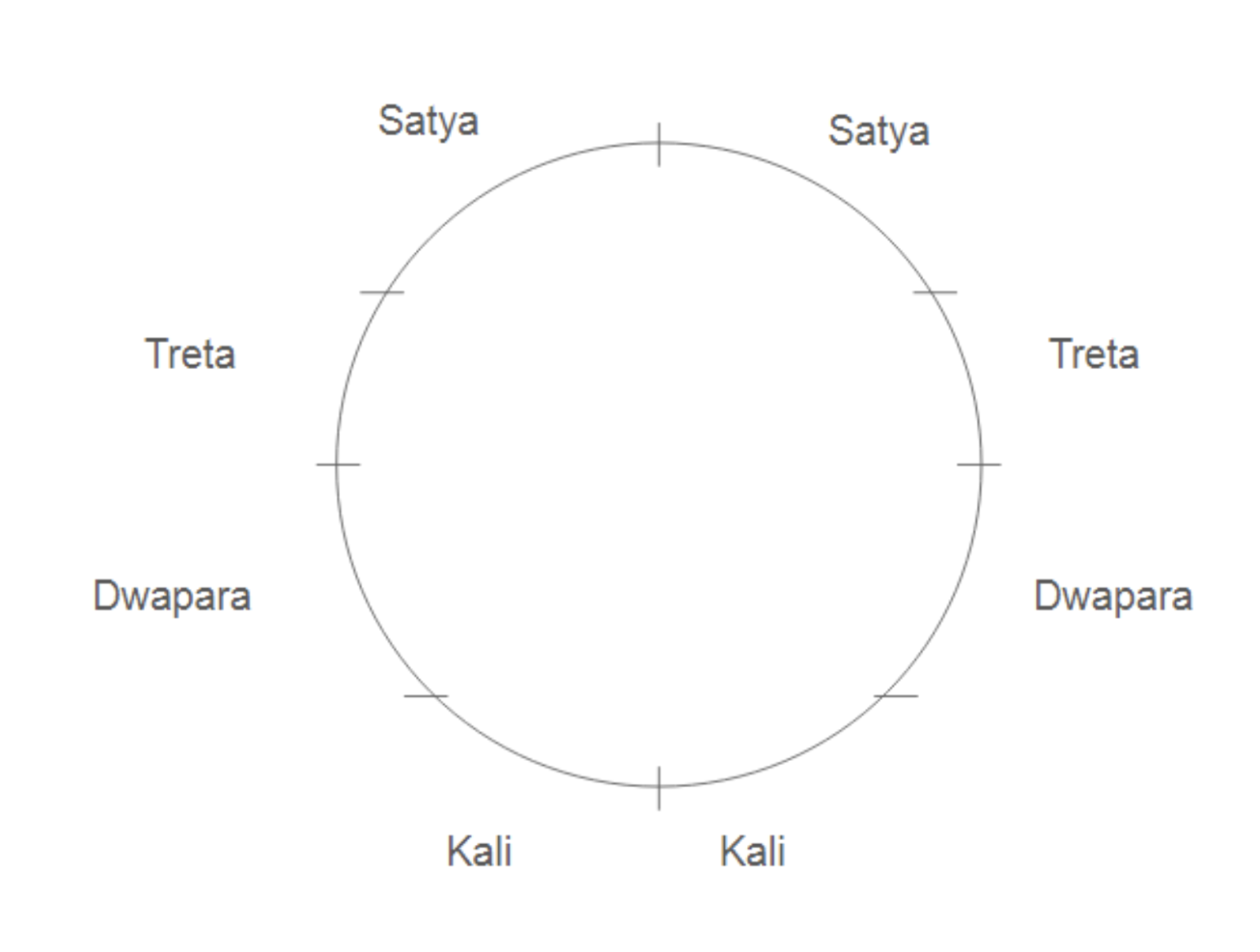
At the top of this cycle we experience two continuous stretches of Sat Yuga and at its bottom, two of Kali. We are now approaching the end stages of the second of these, which should lead into the start of a balancing upward arc through ascending Dwapara. Jesus is said to have incarnated at a critical point in our double Kali period when human consciousness was at its lowest, most vehemently materialistic ebb up to that point, as represented by the Iron Age cruelty of a sprawling Roman Empire. The aim was that his teaching and the Truth of Consciousness he modelled would serve to transform our experience and conduct, leading to a radically revised mode of human existence. This mission turned out to be what Kaleshwar calls a ‘successful failure.’ We will consider reasons for this later, to do with what is now known as a ‘second coming’ of Christ Consciousness. Here we must note that the persistence of Kali Yuga over the last two millennia has continued to generate accumulating negative karma so that we now have enhanced Iron Age power to destroy or degrade whatever civilizational accomplishments we have managed to achieve in our short official histories and inscrutably deeper past. The intervention of Sri Kaleshwar, a recent Indian saint and spiritual master, is thus extremely urgent at this time.
[There are many competing visions regarding the length and appropriate dating of Vedic Yugas, just as there are intractably many different schools and perspectives within the Indian tradition. I have no interest in these except insofar as they figure in Kaleshwar’s teachings and his specific aim in drawing on them to help us thrive beyond our present crisis. Towards this end, he worked from a body of palm leaf manuscripts which ancient rishis began to produce at least 10,000 years ago when they feared for the accurate relaying of vital spiritual information via master-pupil oral transmissions that had sufficed until then. This new provision relates to the declining fortunes of Truth across successive Yugas and is of particular relevance now because the manuscripts contain information that harks back to the Sat Yuga of unalloyed Truth and, combined with other Vedic lore regarding the stages through which we have since passed, offers an invaluable resource for current efforts to renew our flailing spiritual civilisation. Such is the urgency of this focus within our current time cycle.]
We recognise a need for this when we turn attention to our third column. Based on Western scholarly work (after Jean Gebser), this details a series of ‘structures’ through which human consciousness is said to have passed, given what is known of our evolution and pre/history. The first ‘Archaic’ structure corresponds loosely to the Greek Golden Age and the Vedic Yuga of Truth. Significantly, Gebser can say little about it, precisely because it was characterised by a form of direct experiential knowing that warranted no ‘ologies’ but did presuppose a mode of direct Awareness that is no longer available to us. Vedic tradition confirms that this entailed experience of a transcendent Reality that was also known as the Source of our world. India is unique in having preserved such awareness, together with knowledge of the means required for even post/modern people to access it. We have lost this over the course of successive adjustments to Earth life, including contingencies of evolutionary adaptation and, crucially, the traumatising impact of difficult experiences.
The effect of both is implicitly acknowledged by Gebser’s ‘Magical’ structure. This notes a persistence of super-natural awareness as we adjust to a material world, whose pragmatic features increasingly need to be taken into account. Shamanism is a characteristic spiritual form of this structure. It is said to engage with spirits (of ancestors, places, functions…) rather than Spirit as such. Even when a Creator is invoked, the focus tends to be anthropomorphic rather than trans-cosmic (as in a First Father/Mother). Scholars speculate that such quasi-transcendent forms of Deity/Spirit fall away as they become too remote from patterns of everyday life to be of use. This begs a crucial question tacitly raised by Jewish evocations of a Paradise Garden and the Greeks’ Golden Age: namely, how could this transcendent awareness ever have been engendered and then lost via the mysterious decline process that we remember as a Fall. As we shall see, Vedic evocations of such matters preserve a more refined awareness. Elsewhere only traces of such concerns persist if they haven’t been completely forgotten and as particular states of culture provide encouragement to revive them.
Both of these apply in Gebser’s Mythic consciousness structure. Here our story-making capacity takes pride of place as patterns of experience begin to be ordered by primarily narrative means. There is still magical content but belief eventually replaces experience for all but a priestly elite in its regard. Polytheism is the characteristic spiritual form. A drift towards organised religion with named deities in regional pantheons is evident, especially as people become less nomadic and more settled. No world-transcending God is recognised due to a contraction of awareness associated with local survival. I focus on the ancient Near-Middle East due to the critical role this area has played in determining religious, social and political formations of our modern West. Here, prior to the 4th millennium BCE, a favourable climate obtained before patriarchy emerged as an historical phenomenon. There was universal acknowledgment of a Great and Terrible Mother who was simultaneously revered for the life-giving bounty that Nature afforded and feared for the horrific calamities (storms, earthquakes, droughts) that She also sometimes allowed.
3. Big News from Ancient East
A crucial transition occurred in these regions during the late 4th millennium BCE. This gave rise to the earliest city states and from them the first imperial civilisations. The period was marked by an increase in the number of settled communities, associated with a spread of agriculture that served to sustain fixed and growing populations. As cities developed, agricultural production was required on a larger scale, based on specifically constructed irrigation systems that worked well insofar as extreme weather didn’t wreak havoc on them. When that happened, the result was famine and drought. Conflict followed as people displaced from one disaster area ran up against others who were then forced to defend their land against invaders. This would have crucial repercussions on the social, cultural and political life of early settled communities.
Specifically, men became more valued for their greater muscle and fighting power as these societies became increasingly militarised. As this happened, male gods first became equal to and then ruled over goddess consorts to whom they had previously been subordinate. Male hierarchies of kings, priests and warriors emerged, leading to new concentrations of power. At the same time, granted the prevalence of agricultural production, animal breeding practices led to a widespread realisation of the male role in procreation (which hadn’t been well known before, at least by men). This development had a radical impact as women had previously occupied a culturally central position due to their obvious role in childbirth, which was associated with the generativity of the Goddess/Mother Nature in bringing forth the bounty of Earth. Now it was becoming apparent that the cultural marginalisation of men associated with this mystifying conflation had been unwarranted. Not only was the role of men in technology-driven agricultural production pivotal in bringing forth fruits of earth clearly established but recognition of the role of fathering also undermined a former female-feminine mystique.
This realisation contributed to a fierce backlash that accompanied the rise of patriarchy, or the rule of fathers. It was exacerbated by other cultural-ecological concerns. In particular, while mobile hunter-gatherers might see signs of impending natural disaster and take evasive action, settled communities were more vulnerable. Planted seeds couldn’t be moved and the destruction of crops meant famine, ruin and/or encroachment by rival groups who had also been affected. As this happened more and more the Goddess/Mother, instead of being revered for Her bounty, became reviled for Her seeming caprice and unreliability. The latter had always been part of the awe in which She was held but population growth and new patriarchal inflections now tipped the balance violently. The Goddess was demoted in favour of new generations of Sky gods. Initially associated with control over storms, their role was generalised to include war. Figuratively above Earth, they were vested with a power to rule over natural phenomena and so eclipsed the Mother’s former primacy. Thus they came in time to rule over Her.
This process is codified in Babylonian mythos when the god Marduk, a grandson of the Great Goddess Tiamat (also known as the Dragon of Heaven), commits a symbolic Mother murder. Then, having slain Her, he dissects Her body and uses it to construct a new (order of the) world. Later associations of the Goddess with Snakes and Dragons are overwhelmingly negative: Christian knights still slay dragons in medieval iterations of Arthurian legend while the Biblical Snake couldn’t be more reviled in later historical imagining. In any case, this confluence of three main factors – discovery of paternity, militarisation of society and relegation of the Goddess/Mother – led to a repression of the Sacred Feminine in Western culture and, with it, of actual women. This was compounded by a virtual institutionalisation of warfare and, as a seemingly inevitable adjunct, rape. It is also important to note in this regard that the ancient Middle Eastern animus against Goddess/Dragons is mediated via the Old Testament into Christian and thus later European culture. Monstrous Leviathan is consigned in Genesis to dark female waters, after which the Mother as such can no longer be imaged or named (except in minority mystical streams). Along with other unresolved tensions, this legacy became part of early Christian orthodoxy.
Gebser’s next ‘Mental’ structure begins around 800 BCE. According to him, this is the first time it becomes feasible to link a consciousness structure with an approximate starting date (as there was no time consciousness before). This structure divides into two phases. We may call these Mythic-Mental and Rational-Mental for convenience. The first runs from 800 BCE to the mid-18th century CE, when the second emerges. Philosophy and Theology are principal cultural expressions of the Mythic-Mental form. Both are associated with a type of organised religion that tends towards monotheism, especially in the West. We have already noted how polytheistic religions already gravitated towards patriarchy, which is historically associated with concentrations of power and wealth. We have also noted how early gods of storm and war become ‘high’ gods, granted the cultural centrality of their roles. This too is a step towards monotheism and consolidates a power of ruling over female deities with which early Sky gods were wishfully vested. Beyond this, the God of institutional Christianity would be acclaimed as all-powerful, all-knowing, all-male and already complete in Himself.
This raises a fundamental problem in that, if we regard an already all-knowing, all-powerful God (now capitalised since no peers or rivals are admitted) as our Source/Creator, we must wonder why ‘He’ would even bother to create as no plausible motive for doing so remains. If we try to illuminate this by claiming that the God is also all-loving, we add another problem to do with why this God who is now all-knowing, all-powerful and all-loving would create a world marked by so much cruelty and suffering. Much ink has been brilliantly spilt compounding speculation on this theme to no avail. This is unsurprising since the problems raised are insoluble as formulated. That said, Kaleshwar’s Vedic teachings offer a foundation from which they can be illuminated, not least because his vision of God includes a remembering of the Mother. (Note in this regard that 21st century AI moguls who talk about ‘building’ God have patriarchy’s all-knowing male version in mind. They are less forthcoming about power relations and even less still concerning love. The significance of this will become clearer later regarding their currently manic desire for wealth and power.)
The Rational-Mental consciousness structure came to the fore in the middle of our 18th century and sought to dissociate itself from earlier, supposedly regressive forms. Its characteristic expressions are materialist science and atheism. Materialism historically tends towards a relegation of Spirit while the ‘God’ that modern atheism debunks is the all-knowing One of Mythic-Mental religiosity. Its critiques thus tend to obscure our core concern with the relationship between Cosmos, Source and whatever might be meant by the word ‘God.’ Gebser already notes a basic discontinuity across the sequence of consciousness structures that he describes. This entails not just a series of qualitative leaps to be explained via a chain of mysteriously transformative quantum leaps but also considerations of power that impede harmonious transitions across structures. These come to light in modern notices of a Shadow history that begins with Freud and serves to undermine an earlier naïve faith in rational progress (as in the scandal of two World Wars and genocides perpetrated under cover of both). The result has been a loss of human self-confidence and of our faith in memory as well as of memory itself.
By contrast, Vedic spirituality conserves a living memory of its deep past, its relationship to Source and methods that help us reconcile all stages, cataclysmic and not, through which humanity as an unfolding collective must pass. This is utterly unsentimental and vitally important as we come to understand again effects that collective trauma and cumulative karma have on our potential for harmonious Be-ing.
4. Mayan Calendars Point to Eternal Be-ing
I have written elsewhere about the Mayan Calendar in relation to this work. My focus here is on a particular theme that surfaces regarding a single artefact known as the Coba Stone. This monumental structure literally points to the sky and is divided into panels, all of which are covered by hieroglyphics. These glyphs incorporate mathematical expressions that refer from the top down to steadily contracting time periods, all of which conform to a general formula 13x18x20ⁿ where the value of n ranges from 22 to 0 per diagram below. On its bottom line, kin refers to an ordinary 24 hour solar day while 13 Ahau refers to the final, most energetically powerful day in a basic 260 day cycle that pervades many sometimes unimaginably longer ones (1). The key to interpreting the whole array is to see it as a series of calendars, measured in kins, where each is shorter by a power of 20 as we move from top to bottom. The significance of this formulaic pattern was first deciphered by Carl Calleman, a Swedish biologist. As a scientist, he was especially interested in the range 13x18x20⁸ to 13x18x20⁰ kins because the 20⁸ range corresponds to 16.4 billion years. This encompasses the date of our Big Bang, which is generally thought to have happened between 13.7 and 14 billion years ago.

Calleman noted that many of the ancient Mayans’ most prominent temples are built on nine levels. He intuited that these correspond to 9 Creation waves, each of which divides into 13 ‘Heavens.’ This begins to account for the 13x18 (i.e. 9x2) of our general formula. Calleman’s focus on the 20⁸⁻⁰ range allowed him to test his Calendar model against the evolutionary and pre/historic records of modern science. To begin, he asserts that each of the 9 levels of a Mayan temple corresponds to a particular wave/level of Creation, building from the bottom up as below, from 13x18x20⁸ to 20⁰. Every wave is named for a major evolutionary or historical innovation that it introduces. Thus the first ‘cellular’ wave lasts 16.4 billion years and produces a first living cell during its final phase. The second wave last 820 million years and produces the first mammals, the third lasts 41 million years and produces the first primates and so on. Every wave produces the same amount of evolution but does so at a rate that is 20 times faster than its predecessor and 20 times slower than its successor. All divide into 13 Heavens, or 7 Days and 6 Nights, where capital ‘D’ Days correspond to yang periods of growth and expansion and Nights to yin periods of integration and consolidation. (See Tantra of the New Grail, I.1 under ‘Books’ for a fuller account.)
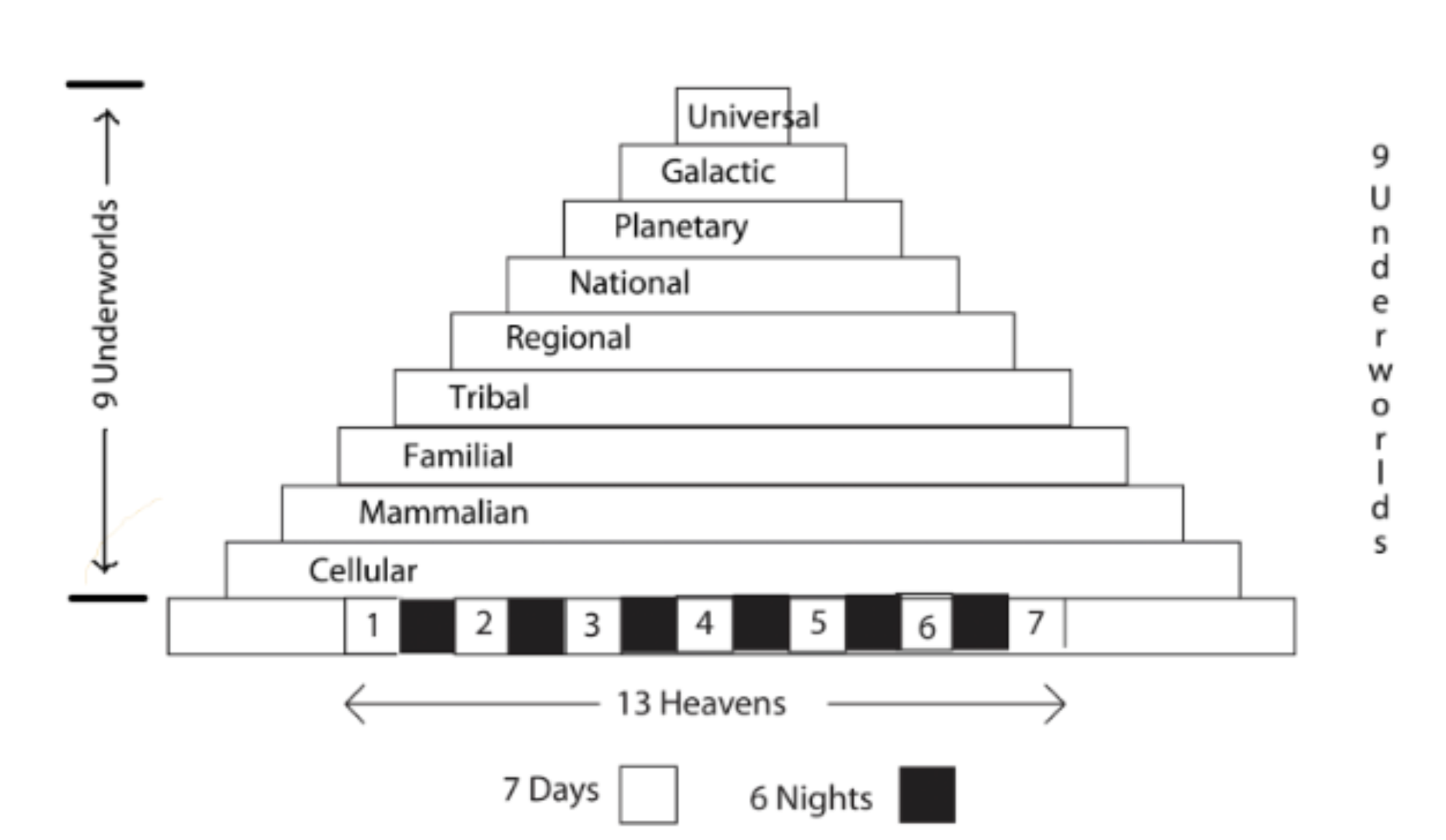
Mayan Temple structure reflecting 9 waves/levels of Creation and 13 Heavens (7 Days/6 Nights) that mark all in a holistic Genesis Pattern
Days 1-7 are named for developmental stages in a Mayan agricultural cycle: Seeding, Germinating, Sprouting, Leafing, Budding, Flowering, Fruition. Nights go unnamed in this Seed-Fruit progression, echoing a 7 Days/6 Nights Genesis Pattern as in the Biblical Creation Story. A major breakthrough came when a start date was found for the 5th Creation wave. As this was known to last 13x18x20⁴ solar days, it was possible to count forward to an exact end date of October 28, 2011. This proved to be a 13 Ahau day, on which all 9 Creation waves are scheduled to end according to the Stone. Calleman thus accepted it as a more exact indication than the generic ‘2012’ of popular Calendar lore. The implications of this are enormous because it means that all of us living after 2012 are metaphorically walking over residual traces of 9 ‘Underworlds’ that are now past but by which we continue to be affected, unlike archaeological layers that have had their day . This is so because the waves are still ongoing. The fact that all 9, each of which supported an Underworld, have now been delivered suggests that this ‘end time’ can be one of great empowerment if we can integrate the gifts of a system that is now fully charged and grant them appropriate expression, having clarified collective effects of trauma and karmic derailment. Again, ‘2012’ convergence is unlikely to be accidental here, given the power of Kaleshwar’s teachings to address these issues.
In any case, Calleman was able to establish significant correlations between critical threshold points identified by his 9 levels, 7 Days/6 Nights model and the evolutionary-historical record posited by modern science. This shows that his intuition of the Coba Stone’s significance was fundamentally correct, not just regarding the 5th wave but all that came before and after it. I endorse this fully but also view the Stone and its entire calendrical display as a symbolic structure, raising questions beyond those which Calleman was prepared to ask. What for example is the status of pre-cosmic waves that the stone also identifies in panels 13x18x20⁹ and above? Why do these stop at 20²²? 20⁶⁷seems no less arbitrary, or 20⁵⁶⁷. Why stop there if not for merely pragmatic-logistical reasons? As the stone points indefinitely to ever increasing powers of 20, I followed my own intuition and imagined 13x18x20∞ as the theoretical maximum of an indefinitely extended array. Adopting this value triggered amazing insights, not least that a wave that takes 13x18x20∞ days to complete its cycle is infinitely slow and thus effectively still. I then intuited this as the vibration of what Kaleshwar calls the Silence: a stillness that remains eternally present before and beyond time.
The thought was especially intriguing because the 13 of our generic formula 13x18x20ⁿ indicates a tendency to movement within the whole while the 18 (9x2, up and down per temple structure) suggests that any unfolding this might entail is also intrinsically ‘intelligent,’ i.e. organised in the sense of non-random. Calleman avoids such metaphysical issues because they aren’t amenable to standard forms of empirical verification. I embrace them because I perceive a crying need to integrate our mysticisms of Cosmos and Source in order to remember Spirit in our Age of Loss. It is also relevant that Calleman associates his 13 Heaven Creation wave forms with the vocabulary of yin and yang. We see this below, where the broken vertical line indicates how, in its final ‘Fruition’ stage (7th Heaven or 13th Day) a precursor wave metaphorically drops the seed from which its successor is then generated. We also see 7 Light Days of the new wave form above the horizontal line (x axis) and 6 Dark Nights below it. There is a problem here in that the display implies an abrupt switch from yang-Days to yin-Nights. Yet it is a hallmark of yin-yang symbolism (and empirical day/nights) that the motions implied are reciprocal continuous functions such that as yang waxes, yin wanes and vice versa.

The 7th Day of a precursor wave drops the metaphorical ‘seed’ from which its successor will develop across another 7 Days/6 Nights cycle
The following figure illustrates this: as yang values wane from +9 to -9, so yin waxes, reaching its strongest value at -9 and vice versa up the other side. This scale establishes a functional range where maximum yang secretes and releases minimum yin and vice versa at the turning points without either ever being negated, implying that both express and are governed by an overarching Unity.
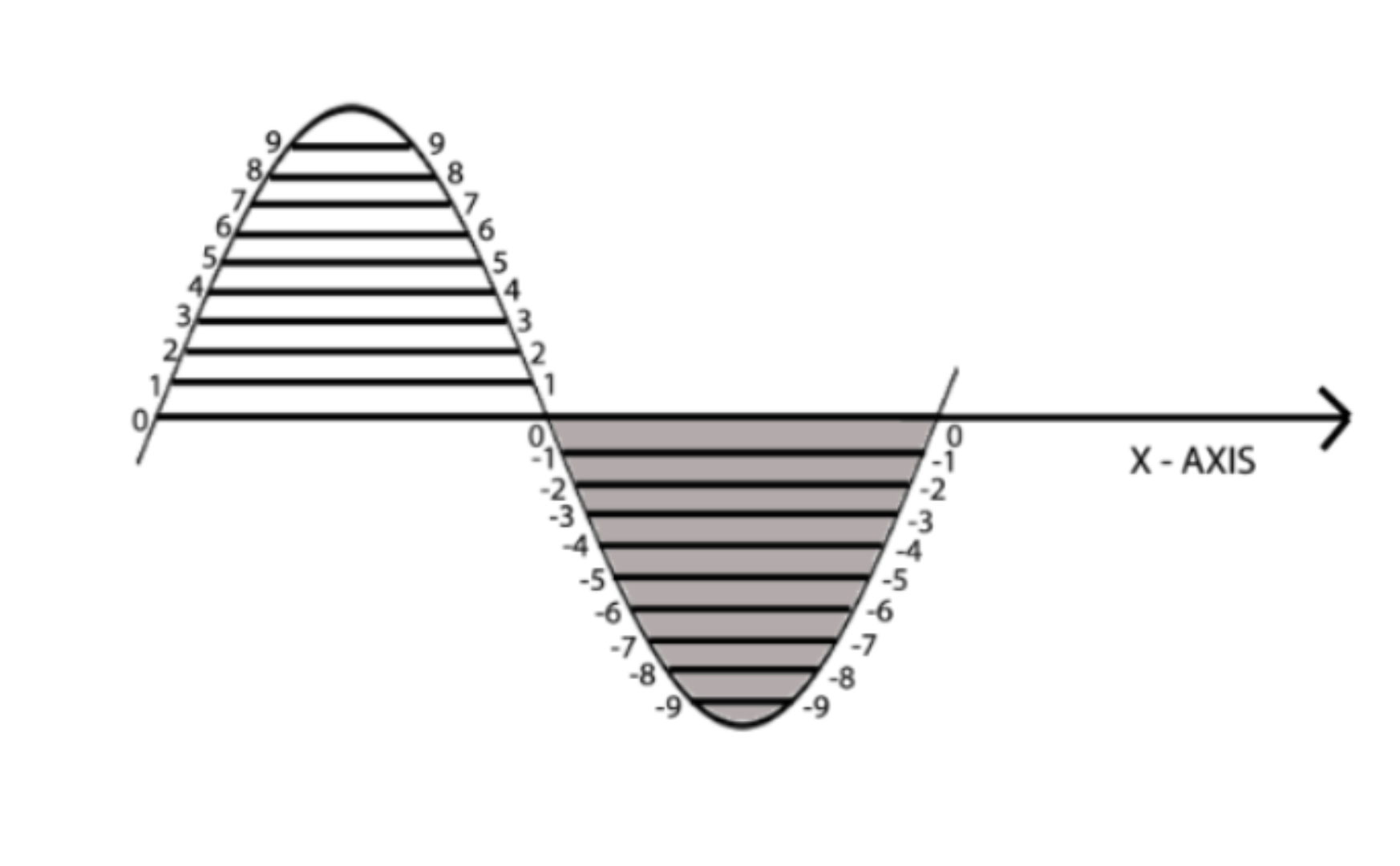
Mutually waxing and waning sequential yin-yang motions indicate an overarching Unity
When yang does threaten expansion to a point of leaving yin behind, yin reacts by contracting past the limits of their previous functional range, thus precipitating a reactive yang explosion. This is how transformative ‘quantum leaps’ to new frequency levels are achieved, as in wave successions that lead eventually to our Big Bang. Note also that while ‘Light’ as such only comes into play after this has occurred, our standard yin-yang symbol offers an ideal image of ‘waves’ that are perfectly balanced in terms of light and dark, where each constantly rotates through the other’s ‘eye’ as in the standard tai chi diagram. Such balance applies only in existence/Creation. Prior to this, pre-cosmically, before God says Let there be light, light is not yet made. Thus it is more appropriate to present the primal yin-yang relation in terms of its emergence from a Dark Ground of Be-ing as below:
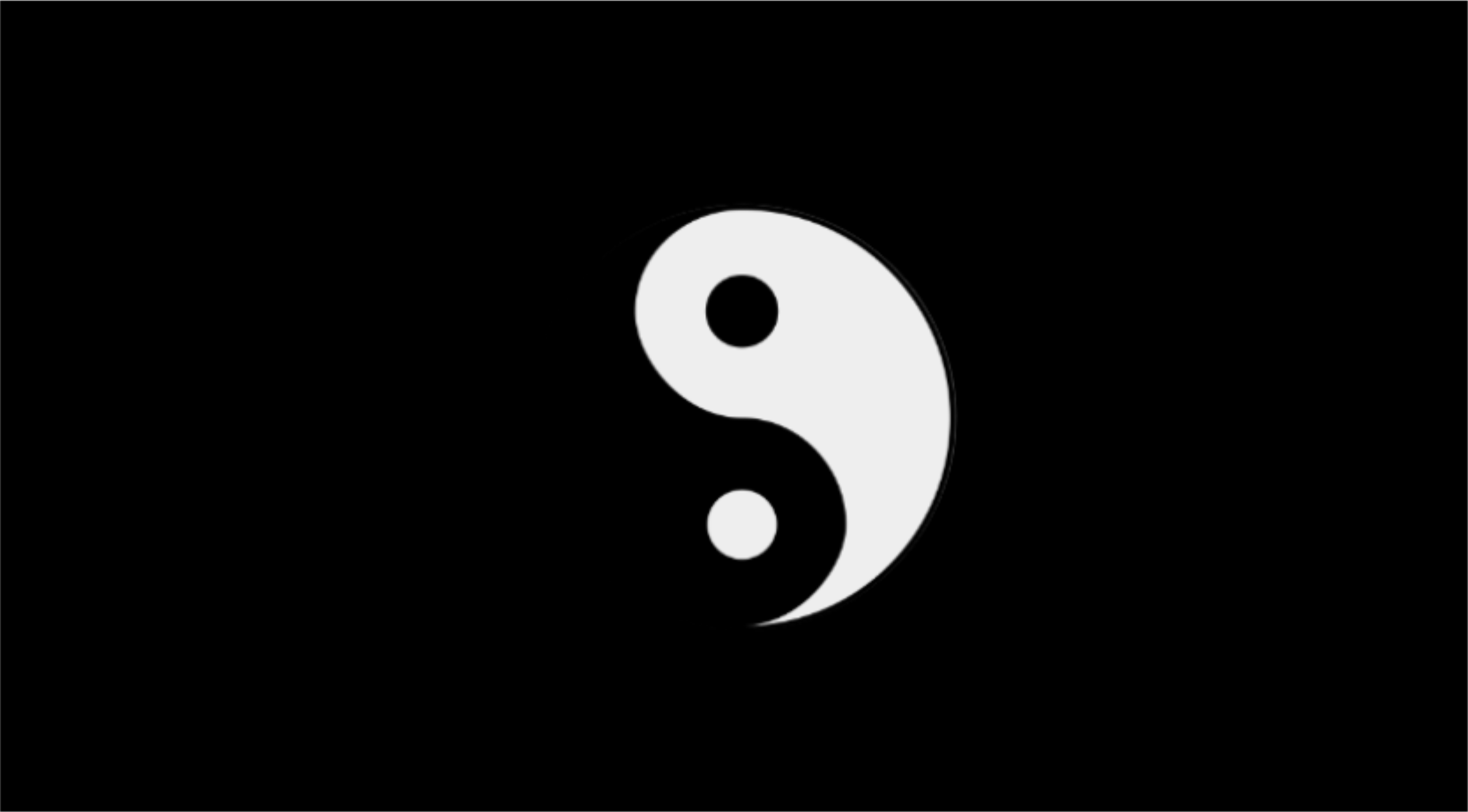
Ideal image of yin-yang balance set against a Dark Ground of Be-ing from which the Light (reflections) of existence arise
This makes a huge difference that registers on a Feeling level of unformulated Awareness, engendering profound internal resonances. Spontaneously, we begin to note imaginative elaborations: seeing existence as an embryo, for example, looking back at the Divine Ground from which it has arisen. The entire sequence of our Coba Stone pre-cosmic waves also point back towards such emergence. Moreover, the formula 13x18x20∞ implies a condition of perfect stillness that also secretes an ineluctable movement tendency (signified by the 13) within a darkness that mystics experience as radiant with super-saturated light, so densely concentrated that world-adjusted eyes can’t see it. This ‘darkness’ also metaphorically evokes the darkness/unknowingness of God – all that is unknown of Her/Him, perhaps even to themselves. This is very different than patriarchy’s all-knowing, all powerful Father, the fantasised ideal that AI theologians currently aspire to ‘build’ by excluding all that is untamed, inscrutable and darkly, wildly, unreliably ‘feminine,’ much like our unsustainably repressed/murdered Mother.
5. Be-ing, Consciousness, Bliss
13x18x20∞ implies an eternal state that is dark, still and unknowing while also secreting a movement tendency and the potentiality of light. Moreover, mystics affirm, this primal condition entails an undifferentiated Consciousness that I have described as pure Feeling Awareness. It has no divisions, parts or reflections. It is thus wholly implicate: in but not for itself, as philosophers say. That said, Be-ing entails pure activity. It is pure activity, formless and without content. It entails energy, named as an energy of Bliss when Vedic masters access it by yogic means. We can qualify this bliss state of primal Reality in terms of yin-yang relations, understood as enfolded Love that is intrinsically disposed to reach out (yang) and gather in (yin). An early prevalence of the latter holding tendency accounts for primal Reality’s initially implicate state, even as a latent yang expansive tendency is also forever building momentum (as in Calendar powers of 20 impelled by the 13 of its Seed-Fruit progression). This suggests that something is always enigmatically growing within Eternal Be-ing.
Primal Reality may be considered Womb-like for this reason (the Orthodox St. Ephrem speaks of a Divine Womb, for example), eternally pregnant with the seed of its own potential which, being infinite, may never be finally delivered. The progression itself is not contentious: we have only to run our Calendar powers of 20 sequence forward again to reach a 21st century state of manifestation where we - ourselves expressions of this generative, underlying primal Reality - still strain to fathom it according to our needs and resources. However, given that we are now as far as it’s possible to be from a Sat Yuga condition of undiluted Truth, we need help. Thus it is to a Vedic culture whose memory encompasses Source that we must turn. I supplement its vocabulary with that of yin-yang philosophy knowing that Lao Tse, the legendary founder of Taoism and one of the first rishis, was responsible for carrying Vedic lore into neighbouring China. I see this as a classic case where straying maps the path, as Taoism has certainly done for me. In any case, running the Calendar sequence forward from 13x18x20∞ through 20∞⁻¹, ⁻², ⁻³, ⁴, ⁵... we eventually reach a point (20ˣ) where the expansive power of yang equals the formerly containing power of pre-set yin. The next step, 20ˣ⁺¹must then exceed this so that a stirring that wasn’t previously discernible in the Silence becomes apparent. Again yin reacts by contracting, compressing yang to an unsustainably infinitesimal point so that it erupts with renewed force.
This engenders an Invisible Point of Creation from which yin and yang motions, rather than happening simultaneously and stifling each other, are instead staggered, with yin and yang phases waxing sequentially, accompanied by superficially eclipsed, correlatively waning yang/yin complements throughout. Together, these staggered waxing-waning/waning-waxing yin-yang motions assume the form of a self-propagating wave. This underlying Unity of yin-yang waves underwrites the indivisible Unity of Be-ing Consciousness Bliss as mysteriously propelled from within towards existence/Creation. This process later culminates in the engendering of a second Visible Point of Creation via our ‘Big Bang.’ This exhausts the relevance of our Calendar model until later sections, where the power of its applicbility will again become apparent.
6. Shiva, Shakti, Ardhanarishwara
Ardhanarishwara is the Vedas’ symbolic equivalent of our dark field of pure undifferentiated Be-ing. It presents a beautiful image of one conjoint figure, half Shiva on one side and half Shakti on the other, apparently split down the middle. Despite this surface image of inner twoness, it more deeply signifies that this ‘two’ is eternally and indivisibly One. Although more attractive than our Blackness, the image may also appear clunky and static. How did this split Unity come about? And how could we ever get from it to the explicit evocation of apparent duality as differentiated Shiva and Shakti, male and female, as in our panel below, with conjoint Unity on our left and seemingly discrete entities to the right?
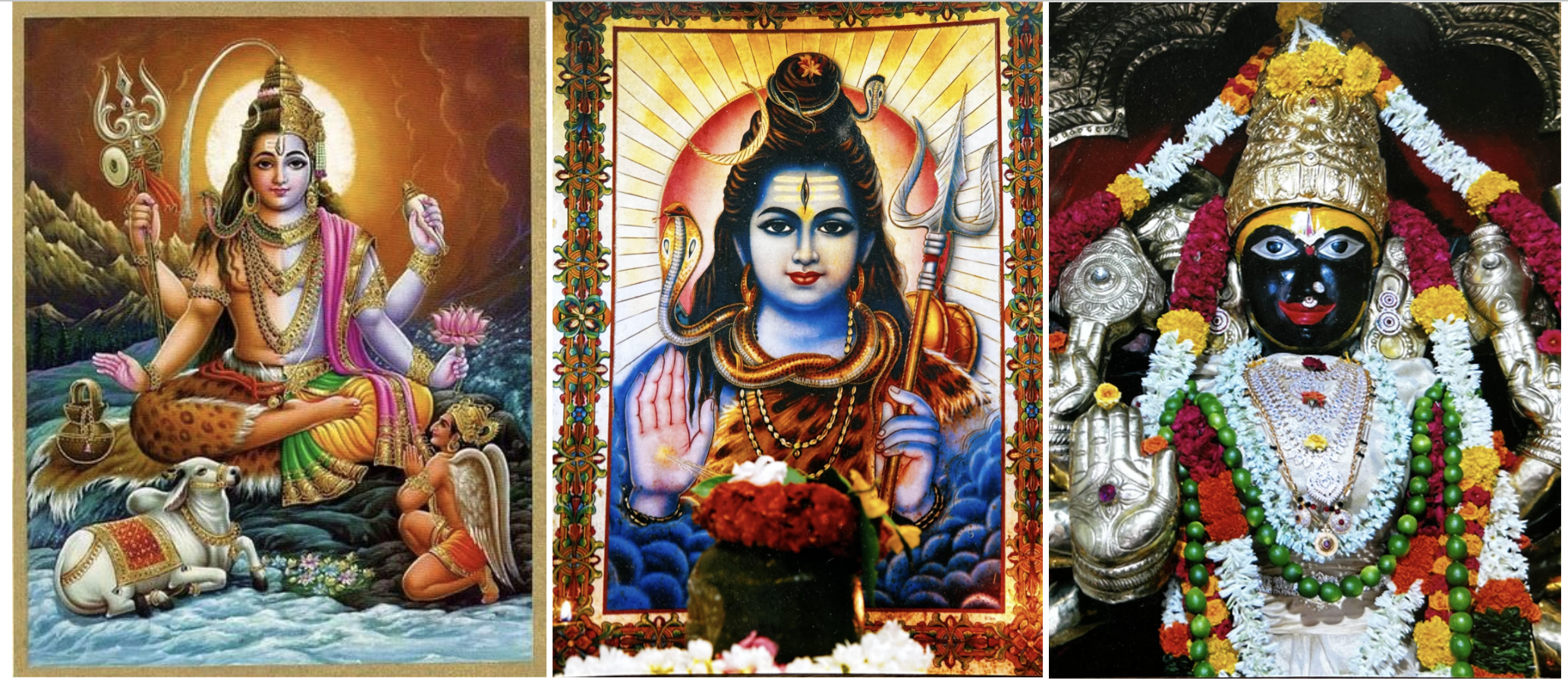
The answer is that everything previously said about yin/yang-orchestrated emergence can also be applied to the tacitly dynamic relationship of Shiva-Shakti as conjoint Ardhanarishwara, behind the surface as it were. The Dark Field/Ground of pure undifferentiated Be-ing entails pure Consciousness/Awareness and pure Energy/Activity, also undifferentiated. It follows that something is forever stirring in the Stillness-Silence, namely a movement potential that will eventually become known as Shakti. This goes from strength to strength just as powers of 20 do in our yin-yang Calendar scenario, akin to images of Mother Durga sitting on a quiescent Tiger (power) that later walks, runs, bounds and sometimes pounces.
Vedic symbolism entails that the Divine Ground of Unitary Be-ing, where Awareness and Energy are One, contains this movement potential in itself and may be considered Womb-like for this reason. Note that this applies to the Undivided State but not yet to Mother/Shakti Herself, as there can be no actual Mother without a Birth. What happens is that an intrinsically latent yang power known Vedically as Shakti gradually builds momentum until a formerly checking yin force can no longer contain it. Eventually exceeded, this precipitates a reactive contraction that transforms the previous arrangement but, while our Calendar account glosses this in purely mechanistic terms, Vedic mytho-poetry presents it as a birthing that happens out from the undifferentiated, indivisible Unity evoked by Ardhanarishwara. Thus Shakti, acknowledged as the emerging movement principle, triggers a reactive yin compression of yang power as before, such that a light potential that was always implicit in the radiant darkness of pure Be-ing is squeezed out, resulting in what we may call the spreading light of Shiva’s soul, as below. This too is a great OM moment from which all later appearances also apparently follow.

The Light of Shiva’s Soul is squeezed out from the radiant darkness of pure undifferentiated Be-ing
In this act of birthing Shiva’s soul as such, Ardhanarishwara as the undifferentiated Unity of God also births Mother Shakti as such, just as a reactive yin compression differentiates Her Holy Womb within the formerly undifferentiated space of Her pure Heart, which is also the Heart of Silence. [An ancient mystical trope presents God as an intelligible sphere with centre everywhere and circumference nowhere. Substituting Heart for ‘centre’ carries us to the Heart of Mystery, ineffable as the pure Feeling Awareness of Sat Chit Ananda/Be-ing Consciousness Bliss. Kaleshwar teaches that Mother’s Womb is part of Her Heart and that its centre (Nadu Bindu) is everywhere. Ammachi, a current Mother avatar, says God is neither male nor female but that, if pressed, we would have say more of the second than the first. Vedic symbolism skates masterfully over this thin ice of ineffability. Here we must recall that, just as there can’t be a Source without Cosmos, nor a Mother without Birth, prior to this moment of Impossible Beginning the primal Reality of Zero Silence is Womb-like in that it harbours a tendency to carry the seed of its own potential to fruition. In doing so it releases the latency of Mother-in-Waiting to become our actual Mother Divine. There is great philosophical subtlety behind the poetry of this, to be unpacked later.
Once Shiva is birthed as an apparently separate soul, Mother’s continuing Shakti motions continue to impact Him. This is inevitable as He has now become part of the environment into and within which She expresses. Kaleshwar describes Shiva as an ‘abbreviation’ of the Silence. Thus His light-infused soul carries every latency that was always enigmatically vested in the super-saturated Dark of Zero Silence. This arrangement frees Mother’s Shakti power to grow in strength and birthing scope as it engages new potentials of abbreviated Silence every time it passes through Shiva’s now quiescent, only apparently separate being as the perfect medium for Her newly unleashed expressive tendencies. Thus Mother births the Infinite Awareness of Father God as Her ‘son’ and continues to coax new frequencies from Him*. These propagate as sound waves and carry divine vibrations (seed letters, sacred syllables) that emanate from/express through an In/Visible Point of Creation at the centre of Her Trans/Cosmic Womb, depending whether we view the Nadu Bindu from a perspective of Eternity or time. This will be pursued later regarding the Sri Chakra yantra, an energy diagram of Mother’s Holy Womb revised by Kaleshwar from ancient sources to meet our modern needs.
[*It is said that Shiva ‘gives’ the seed of Silence from which Shakti then creates. This is unavoidably correct but also easily misconstrued in terms of unconsciously applied sexual imagery that is both conditioned by patriarchal history and fundamentally irrelevant. Shiva and Shakti are wholly subtle beings at this pre-cosmic point, virtually formless and forever One regarding an overarching Unity that yin-yang symbolism forever presupposes. Their relationship at this level is beyond touch and all related physical imagery. Moreover, Shakti is the yang-active principle here and Shiva the yin-receptive one. His purpose is to suffer all that She gives rise to, regardless of whatever humanly gauged abominations it might produce (scenes of massacre, desolation etc.). Thus Paramashiva, transcendent even after part-entering the Illusion of our material world, remains wholly unattached. Charged with taking care of Mother’s Creation, he reconciles its every manifestation via the infinitely compassionate awareness vested in his Be-ing. This theological innovation makes him the spiritual Father of his brother gods and of his own partially descended soul.
It is utterly astonishing that Mother re/births Silence in the form of Shiva‘s soul as if this were outside or other than Herself. Kaleshwar’s ‘abbreviation’ notice entails that every latency implicit in it is present in Him also. These are all available to be raised towards and birthed into Creation as Mother's kala/time-driven pulsing releases new Shakti surges that impact on his soul as the medium of Her now rampantly manifesting creativity. (This fits loosely with symbolic equivalences already noted regarding our transposed calendar schedule.) Finally, for now,I take this opportunity to note that a live presentation of this material drew comments that it seemed very ‘logical.’ I appreciate that while this may seem so between periodic quantum leaps, it doesn’t apply to intuitions that upward-pointing stones evoke pre-cosmic Silence; or that primordial ‘Love’ gathers in and reaches out (as prevailing yin force binds a Unitary Field of pure Be-ing/No-thingness in a Way that is weirdly compatible with symbolic properties of our Mayan Calendar schedule applied to metaphysical time). I have come through many such intuitive leaps, all flashes glimpsed during or arising from meditation that always lead to new openings of the Way. I am happy to persist on this trackless track, availing of logic to fill the space between escalating core plateaus.]
7. Introducing Sri Chakra
Despite all the above, Shiva does contribute the Seed(s) of Silence, so enabling Mother’s generation of intermediate beings through whom She also creates, from Brahma, Vishnu and lesser gods to saptarishi souls and angelic hosts that cluster petal-like around the circumference of Sri Chakra – i.e. Mother’s Cosmic Womb as a bounded locus within the pure Be-ing of Her all-encompassing Heart. The angelic vibrations noted correspond to seed sounds (bijas) and constitute the fundamental building blocks of mantra, or the language of birds, so called due to ancient metaphoric resonances that continue to apply. Birds sing and, like angels, have wings that evoke flight, which evokes transcendence and engages our attention. However, there is more than metaphor involved. The conscious harnessing and use of mantra in specific formulaic combinations empowers us to change constructively the Reality in which we participate: altering it in ways that please Mother rather than compounding a maya in which we otherwise get ceaselessly embroiled. The latter scenario unfolds as we improvise ever more desperate measures to promote what we believe to be self-interest amid fogs of alienation and confusion.
The fact that we have an option to do better is critically important for it entails right alignment with a Way of the Mother that we master via karmic feedback, direct inspiration and/or a Master’s help. The significance of this can’t be overstated in our culture of obsessive reflexivity, where philosophers glibly proclaim and rulers gladly enact the giddying chaos of a ‘post-Truth’ world. There is much to clarify here, not least regarding provisions for an empowered spiritual education. Before elaborating this, we must return to the formative influence of mantra relative to Kaleshwar’s Sri Chakra yantra:
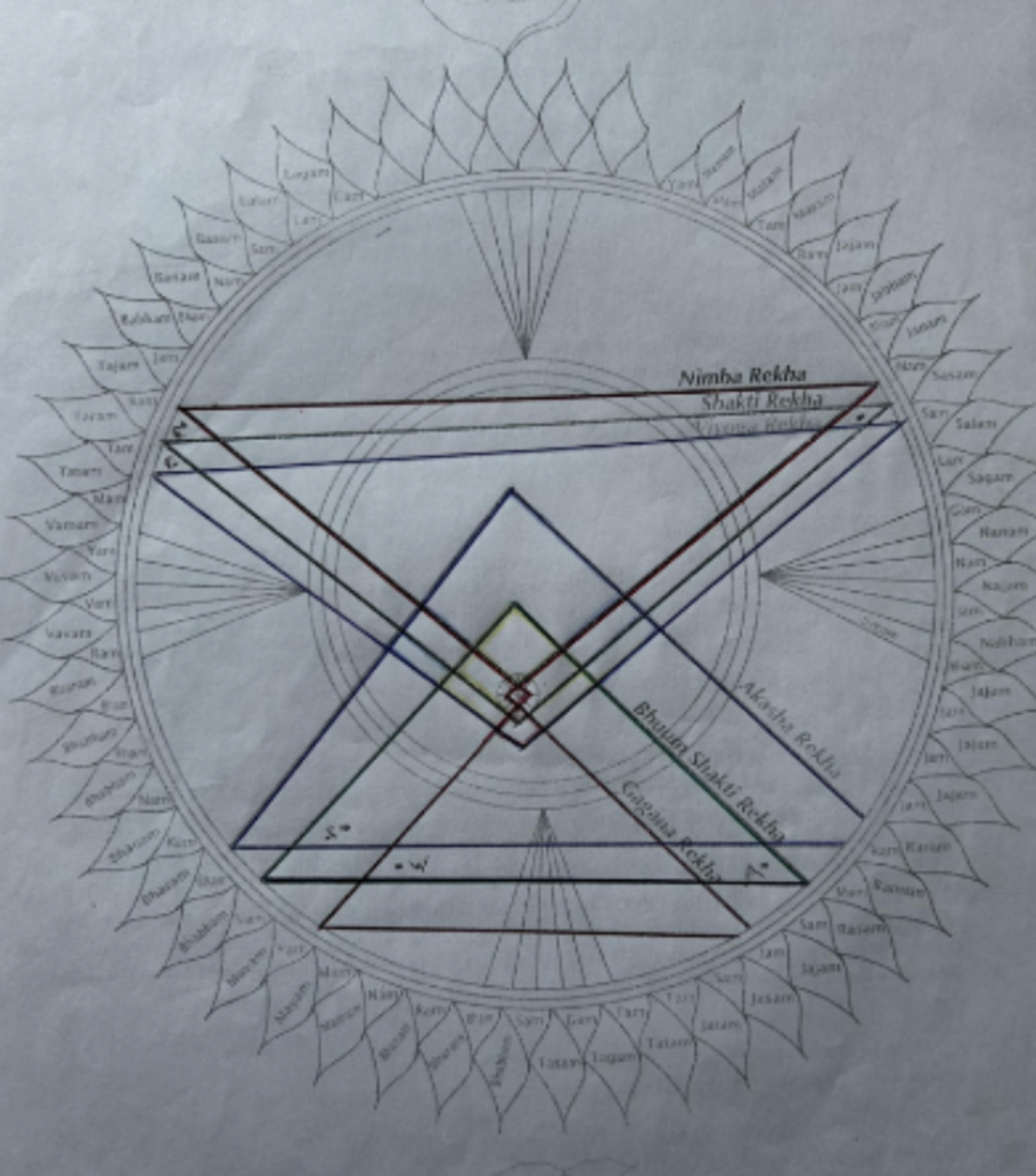
Starting from the top right, just after the gap, the first petal contains the bija ya, the next ma, then ta and so on. These are all the seed vibrations of Shiva angels, fifty-four in total that are usually presented across five rows but here stretch in a downward arc to the bottom of the yantra. The same sequence then repeats in an ascending arc back to its top, where six empty petals are found and, above them, a higher order six from which an upward thrusting lotus protrudes on which Brahma Consciousness will finally come to rest. The six empty petals evoke the Vedas’ double god/ess trinity. Returning to our gap, we also note a second tier of bijas/petals that derive formulaically from the first. In principle, this orderly proliferation might go on to higher levels, always conserving an ever-widening gap through which Mother’s Illusion energy continues to pour in, despite patterning influences of all the bijas/angelic powers that help to sing Cosmos into Be-ing. We thus have a provision for right order and another for Chaos that perpetually enables growth, such that both working together make new Beauty. This arrangement recaps the Divine’s sponteneously arising motive for Creation: namely, to Know, Love and Be better/more.
Kaleshwar stresses that the real power of Sri Chakra is located in the petals around its circumference. This might seem surprising granted the formidable power of Mother’s Shakti. Despite this, we must recall how the vital structuring influence through which Beauty and Complexity are built comes from a Seed that Shiva provides as an abbreviation of Zero Silence. We also recall that Mother’s power and Father’s order are both pre-contained in a Divine Ardhanarishwara Unity that precedes and transcends their apparent separation; and again that Kaleshwar says of the ‘phallic’ Shiva lingam as a supernatural complement to Mother’s Womb that its power derives from the yoni base on which it archetypally rests. Only when a dissociation occurs between these powers do rapacity and other forms of alienated expression arise. There is a deliberate balancing across these remarks which we mustn’t lose sight of. Moreover, returning to the generic role of mantras as showcased by Sri Chakra, many are given whose intentional use serves to elevate the whole structure, causing soul to rise up and finally lifting the experiential centre of Sri Chakra back into Mother’s Heart. Quantitatively a matter of inches, qualitatively this entails a journey of ten thousand miles. A detailed account of Sri Chakra explorations will be offered in later Parts.
8. How Kaleshwar Found His Dharma
Sri Sai Kaleshwar (1973-2012) was born in the South Indian state of Andra Pradesh. A brilliant student from his earliest years, he became very interested in science. One day, aged 14, he went to study in a small temple situated in the middle of a rice field near his home. Preoccupied, he noticed nothing odd until, looking up from his books, he saw an old man sitting before him dressed in beggar’s rags (slides 19-20). Reaching into his garment, the man produced a tin cup filled with rancid food. ‘Eat,’ he urged, offering the battered cup. ‘You don’t need to eat that,’ Kaleshwar countered. ‘My mother is an excellent cook. I’ll get you something from her kitchen.’ Tears appeared on the old man’s cheeks but he remained adamant. He took a stick and stirred the cup. A wonderful fragrance arose and Kaleshwar knew that the food was somehow cooking. Reluctantly, he took some and was amazed to find it was the most delicious he had ever tasted. Moments later he rose to wash his hands at a tap just yards away. Turning back, he found that the old man had vanished. He climbed up on the temple roof but there was no-one to be seen in any direction.
The old man returned in a dream the following night and identified himself as Shirdi Baba, a venerable saint who is now very famous and had spent his entire adult life in a then tiny hamlet called Shirdi. Born in 1838, Baba died in 1918 having prepared the ground for an epochal spiritual transformation in which Kaleshwar was also destined to play a leading role. Already his life was starting to change as a result of their temple encounter. Although he didn’t know it then, avatars awaken at age 14. This usually involves meeting a master to oversee the process. As a result of meeting his, Kaleshwar lost interest in his studies and turned his attention to spiritual texts that began finding their way to him. Over the following years he would accumulate a whole library of palm leaf manuscripts. All featured spiritual knowledge etched by ancient rishis onto palm leaves as far back as 10,000 years before. This happened as fears arose for the survival of teachings that had been orally transmitted by masters to trusted students over many generations. Written in Sanskrit and Telegu (Kaleshwar’s mother tongue), the texts are coded so that only eligible eyes can decode them. His task would be to reintroduce them to the modern world after millennia of neglect. This and his special affinity for the Mother had been foretold centuries before.
He turned his attention passionately to this task. His schoolwork suffered, prompting his father to an angry and sometimes violent response but nothing could dissuade him. Eventually he was expelled from the family home. Baba reassured him inwardly. Kaleshwar went travelling, staying in ashrams, asking questions and learning from every possible source. More palm leaf texts were presented, drawn by his increasingly apparent light. Once while he was meditating in a temple, a burly sadhu entered and, manifesting ash from his hands, began covering a Shiva lingam with it. Afterwards the man approached Kaleshwar and struck him forcibly. Startled, Kaleshwar asked why he did that. ‘I saw you trying to steal my power.’ ‘I wasn’t. I don’t need your power. I have my own master.’ The yogi’s angry front dissolved. ‘Your master told me to hit you.’ From that moment Kaleshwar began to recollect past lives and realise what his current life mission would be (2). By age 24, he was ready to come to the West.
9. California Dreaming
An earlier Indian saint, Yogananda, had already made a big impact in America. His Foundation was headquartered in LA, where many other Eastern teachers had also taught. Hence there was already a receptive community in place. An audience of people with a special interest in healing was arranged to greet a new young saint who spoke very little English. Kaleshwar began by manifesting a rose in his palm. Next he caused it to burst into flames that burned without consuming its source. Eventually he let it burn to ash. He then passed through the hall, anointing all present with this residue. Amongst these was one man who would become a senior student and another, his friend, who had received a terminal cancer diagnosis. Everyone who received Kaleshwar’s blessing reported healing benefits, including the friend, who recovered. Word spread rapidly, even reaching Oprah Winfrey, who wanted the young saint for her next show. He declined, saying that he wanted to attract a small number of dedicated students who would follow him to India, not thousands of casual seekers. More meetings were arranged, a group was assembled and from 1997 the first Western students began arriving in Penukonda, where Kaleshwar’s ashram was in the early stages of construction.
Evidently he didn’t expect to live very long as he told them repeatedly that he would be a million times more effective working outside a body. First he needed to train a pioneering generation of Westerners who would be equipped to transmit his teachings without distortion. This was important because of chaos levels he discerned in the modern world and a disturbing inertia that he found in traditional Indian spiritual practice. What were yogis really accomplishing, he asked, if they spent all their time sitting in bliss? This was a necessary but not sufficient Enlightenment practice. A healing engagement with the world was also required, including the qualitative West. Western students were best suited for this, both for their dynamic attitude and because they carried the disease in question. He would train them hard to ‘wash their blocks’ and establish a shared culture of Dharma and Truth. This took longer than he first imagined. He began formally by teaching the Five Elements, a foundational programme that purifies our relationship with Earth, Fire, Sky, Water and Air as the basic pillars of Creation. This was followed by the Sri Chakra, which he didn’t associate with Mother’s Holy Womb until years later. The reason for such a circumspect approach was that he didn’t want the mission or his students exposed to potentially debilitating levels of Illusion before they were adequately prepared.
There is a vast backstory here that needs to be unfolded carefully, in stages (see Part III). A key factor is that Consciousness in existence tends to develop attachments to given forms and so resists transformation. In humans a major aspect of this tendency is the elaboration of ego stories that reinforce the hold of illusion by consolidating a sense of our own separateness, from each other and All That Is. This compounds our estrangement from Truth even as we aim to overcome it. Mother lets this tendency run by way of testing insight, resilience and sincerity before granting further inspiration. Kaleshwar thus had to be careful during these crucial early years. His use of miracles, he explained, was initially to draw attention and, beyond that, to smash conditioned belief systems so that hungry souls might awaken past reductive inclinations to the radical spirituality he had come to promote. Even now, it takes considerable manoeuvring to establish the significance of this in regard to a ‘post-Truth’ intellectual culture where the Consciousness of Sat Yuga has been all but erased from the consciousness levels that our defensive ego selves are now capable of hosting.
On the face of it, Kaleshwar had little to say about such matters. He did however arrange darshans – fully physical, open-eyed manifestations – for his students with both Jesus and Mother Divine. He also spoke a colloquial English to which they adapted gratefully as it always occurred in contexts of direct transmission where its impact was supported by the depth and energy of his teaching. For people without access to such mesmerizing transmissions, his written words may seem obscure or void of intellectual substance. Nothing could be further from (the) Truth. Indeed, it was an intuition of poetic depth that motivated me to look deeper and find in his work a key to resolve issues that had perplexed me across years of writing and research. A trip to Penukonda confirmed that my role was to explore the teachings further. The consequences of this are still unfolding. During his lifetime, Kaleshwar’s primary focus was to train healers, drawn initially from America, Germany and Japan. Students from other countries followed. I can’t count myself among them but am resolved to support their necessary and invaluable work while also remaining open to whatever the future may one day require.
(1) As this Mayan Calendar account will feature in volume 7, it is relatively dense and compressed. Readers without prior knowledge are referred to volume 1, Part I for a clearer and more explicit account. See Tantra of the New Grail, volume 1 of The Calendar and the Grail series under ‘Books.’
(2) In addition to written accounts I heard variations of these ‘classic’ Kaleshwar stories at nth hand from different sources, so whispering telephone effects may have crept in. I remain satisfied, despite this, regarding their essential accuracy and Truth value.
